Introduction
In history, the driest and hottest periods for growing season in southern Punjab, Pakistan occur from April to June. Optimal temperature for effective cotton growth is reported to be 33 °C while significant reduction in flower as well as boll retention has been recorded at above 36 °C (Luo, Reference Luo2011; Nasim et al., Reference Nasim, Ahmad, Belhouchette, Fahad and Hoogenboom2016). It is very common for air temperatures to exceed the upper temperature threshold during April to August in southern Punjab. The high temperature impaired with drought causes more severe losses to cotton yield productivity in this region. These two abiotic stresses combined with increasing insect infestations specially of pink boll worms and white flies as the growing season prolongs, make the late August and September a challenging period for cotton growers (PWQCP, 2018).
In Punjab (province of Pakistan), the invasion of dusky bug and red cotton bugs were recorded more in early sown than normal and late sown cotton (Shahid et al., Reference Shahid, Mahmood, Farooq, Shahid, Asif, Ramzan, Akram and Iqbal2014). In another aspect, farmers must manage insect pest for long crop duration for early sown cotton as compared to late sown. Cotton growers with irrigation facilities can irrigate to minimize the water deficit, but there is no way that growers can adopt to reduce the damaging effects from high temperature. Unfortunately, all the strategies for combating these abiotic stresses along with heavy insects' pressure further increase the input costs for growing cotton crop successfully. Shrinking the exposure to early season stresses is a desirable approach for cotton growers because it would reduce some input costs to manage the crop.
The shifting of the reproductive growth to later in the growing season with late planting led us to hypothesize that the benefits derived from late planting might be more advantageous to a south Punjab production system because of this avoidance strategy for critical window of drought, heat and insect pressure. As the critical period will reduce which will ultimately leads to minimize the input cost for crop management due to shorter crop duration (Lu et al., Reference Lu, Dai, Li, Tang, Zhang, Eneji and Dong2017). To shorten the critical window, breeders need to develop such genotypes that produced required yield in a short period.
Harvest index (HI) is a complex trait signifying the balance of genetic and environmental factors leading to improved yield and therefore an important breeding objective is to develop the material with higher HI under different sowing dates. The HI is the ratio of crop yield to total above-ground biomass (Luo et al., Reference Luo, Ma, Yue, Hu, Li, Duan, Wu, Tu, Shen, Yi and Fu2015). Improvement in HI translates an increase in economic portion of plant (Li et al., Reference Li, Yan, Agrama, Jia, Jackson, Moldenhauer, Yeater, McClung and Wu2012). Ideotype of cotton plant having compact growth habit and improved HI will lead to increased yield in short duration. The high HI means more photosynthates transported to reproductive tissues, generally leading to higher yields (Liu et al., Reference Liu, Gu, Dong, Zhang, Liu and Zhao2015). Therefore, objectives of the present study were to (i) to screen our elite breeding material for high HI and SCY in late planting and (ii) to study the HI in the context of different sowing times to optimize the critical window of cotton crop management.
Materials and methods
Experimental site and genotype details
Field experiments were conducted in 2017 and 2018 over 2 years on the experimental farm of Department of Plant Breeding and Genetics, The Islamia University of Bahawalpur (29°24′ N latitude, 71°41′E longitude, 214 m above sea level) Pakistan. Cotton genotypes included in the study were an approved cotton cultivar IUB-13 along with two advance lines i.e., IUB-71 and IUB-73 which were developed by the Department of Plant Breeding & Genetics, The Islamia University of Bahawalpur (IUB), Pakistan. The average air temperatures, total rainfall and relative humidity (%) from April to November over 2 years (2017 and 2018) are presented in online Supplementary Table S1.
Experimental design and crop management
An RCBD factorial was employed with four sowing dates (S1 = 25th April, S2 = 10th May, S3 = 25th May and S4 = 10th June) as one factor and three cotton genotypes (IUB-13, IUB-71 and IUB-73) as another factor with three replications during both years (2017 and 2018). There were five plants maintained within each replication. The observations were taken from three central plants to minimize border effect. Plant to plant and row to row spacings were maintained at 30 and 75 cm respectively.
Cotton seeds of three cotton genotypes were planted under field conditions according to the corresponding dates. The seedlings were thinned at 20 d after emergence. Nitrogen (180 N kg/ha), phosphorus (54 P2O5 kg/ha), potassium (180 K2O/kgha) and boron (1.5 kg/ha) were applied on first flowering during both years. Standard agronomic practices (e.g., hoeing weeding, pesticides application and irrigation) were carried out according to the crop requirement.
Sampling and processing
Data were collected for cotton phenology, yield and biomass accumulation related traits during 2017 and 2018. The data regarding monthly air temperatures, relative humidity and total rainfall were also recorded during both years from April to November.
Plant height (PH)
At the time of maturity, PH was recorded with the help of measuring tape in centimetres of each marked plants. PH was taken from 1st cotyledonary node to apical bud.
Total number of nodes (NN)
At maturity, before picking, total number of nodes on the main stem was recorded from selected plants.
Number of bolls per plant (BP)
The number of effective matured BP for both picks was recorded.
Seed cotton yield (SCY)
The matured bolls were obtained at two various picking times and separately seed cotton was obtained for individual plant in Kraft paper bags and weighed average SCY/plant in grams.
Above ground fresh biomass (AGFB)
At crop maturity the individual plant was removed from soil and fresh plant weight was measured in grams after separation of roots.
Harvest index (HI)
The HI is the ratio of harvested product (lint and seed) to the above ground plant biomass calculated by following formula.
 $${\rm Harvest}\;{\rm index}\;\lpar {HI} \rpar = \displaystyle{{{\rm Seed}\;{\rm cotton}\;{\rm yield}} \over {{\rm Above}\;{\rm ground}\;{\rm fresh}\;{\rm biomass}}} \times 100$$
Statistical analysis
Data recorded from three cotton genotypes under four sowing dates were analysed as a 3 × 4 factorial experiment with RCBD layout, with three replications. Data were subjected to analysis of variance (ANOVA) using the Statistix 8.1 software. Significance is reported at 1 and 5% probability levels. As there were non-significant differences for the genotypes × years and genotypes × years × sowing dates, data were averaged for 2 years and used for further statistical analysis.
Mean graphs were made through Microsoft Excel Program and standard Errors of means were displayed in graphical way. Furthermore, mean comparisons were also made through Tukey's test again using Statistix 8.1.
Results
Meteorological data for the cotton growing seasons (2017 and 2018)
Meteorological data recorded during crop growing period for both years (online Supplementary Table S1) presents mean monthly values of the temperature relative humidity and rainfall. Mean values of maximum and minimum temperature during 2017 growing season were recorded as 41.20 and 12.80 °C in the months of May and November, respectively. Whereas in 2018 mean values of maximum and minimum temperature were found in the months of June and November as 39.80 and 14.0 °C, respectively. Maximum relative humidity in 2017 and 2018 was recorded in November (72.8%) and August (64.9%), respectively. Total rainfall during growing period was 811.28 mm during 2017 and 97.81 mm during 2018. Maximum rainfall (291.09 and 56.90 mm) was recorded in June (2017) and July (2018) respectively.
Assessment of genetic variation under varying sowing dates in cotton genotypes
ANOVA results described in online Supplementary Table S2 showed that there existed highly significant differences under both levels of significance (P < 0.01 and P < 0.05) among genotypes and different sowing dates indicating that genotypes performed inconsistently under different sowing dates. The year × genotypes and year × genotypes × sowing dates, were non-significant for all traits, which imply that the genotypes performed quite consistently between the 2 years and therefore average values for 2 years were taken and discussed.
Changes in morphological indices and biomass partitioning in cotton genotypes
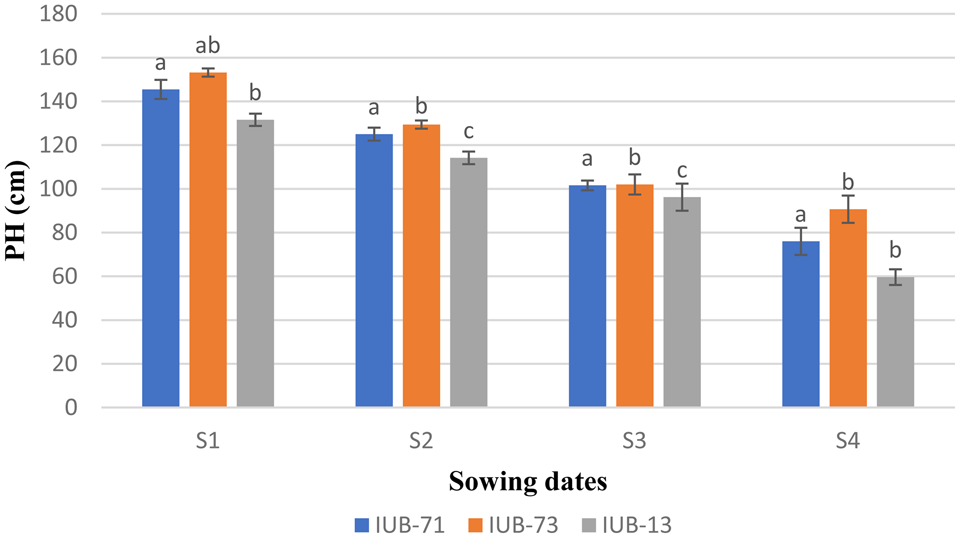
A general decreasing trend in all the studied parameters was observed with the increase of sowing dates except HI that relatively increased in all the three genotypes. Regarding PH, for S1, IUB-73 showed highest PH (153.17 cm), followed by IUB-71 (145.46 cm) and IUB-13 (131.58 cm). Similarly, for S2 the IUB-73 showed highest PH (129.4 cm), followed by IUB-71 (125 cm) and the lowest was observed in IUB-13 (114.2 cm). For S3, IUB-73 again showed highest PH (102 cm), followed by IUB-71 that showed moderate PH (101.6 cm) and the lowest was shown by IUB-13 (96.2 cm). Likewise, for S4 the IUB-73 also showed highest PH (90.6 cm), followed by IUB-71 (76 cm) and IUB-13 (59.6 cm) (Fig. 1).
Mean graph for PH of three cotton genotypes under four different sowing dates. Bars indicate standard error bars. Different letters indicate significant differences at P < 0.05 by Tukey's multiple comparison test.

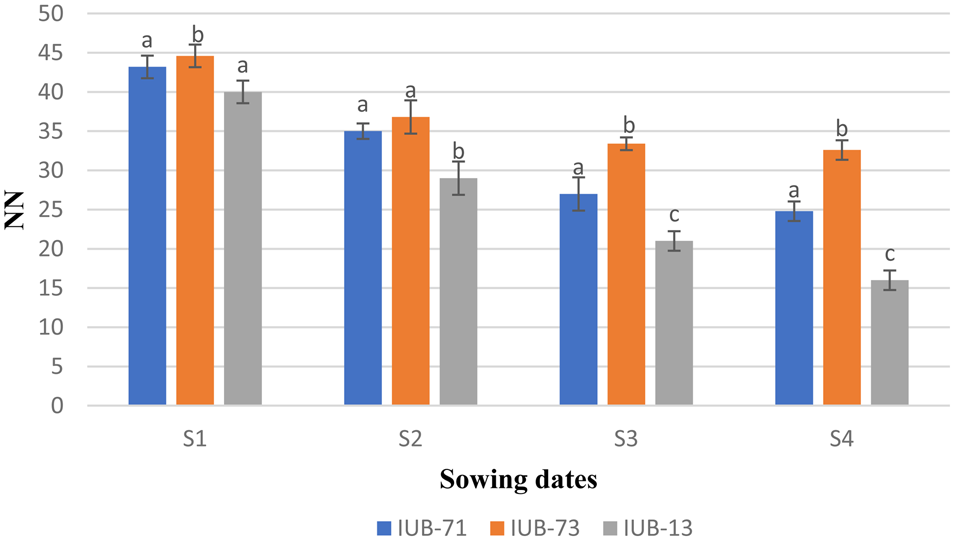
Regarding NN, for S1, IUB-73 showed the maximum number of nodes (44.6), followed by IUB-71 (43.2) and the minimum was recorded by IUB-13 (40). For S2 IUB-73 showed he highest number of nodes (36.8), moderate was shown by IUB-71 (35) and the lowest was observed in IUB-13 (29). For S3 the IUB-73 showed the highest number of nodes (33.4), followed by IUB-71 (27) and IUB-13 (21). Likewise, for S4, IUB-73 showed the maximum number of nodes (32.6), moderate was shown by IUB-71 (24.8) and minimum was recorded in IUB-13 (16) (Fig. 2).
Mean graph for total number of nodes (NN) on main stem of three cotton genotypes under four different sowing dates. Bars indicate standard error bars. Different letters indicate significant differences at P<0.05 by Tukey's multiple comparison test.

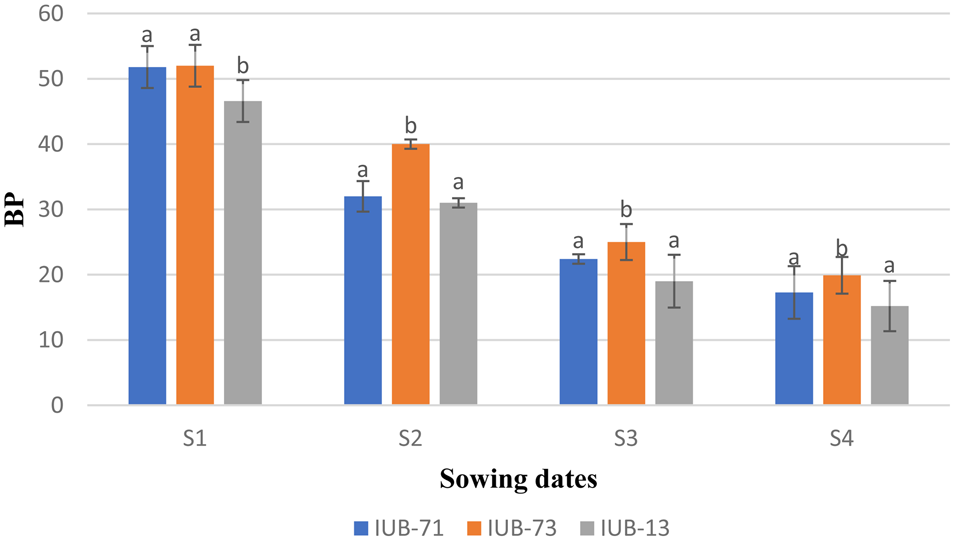
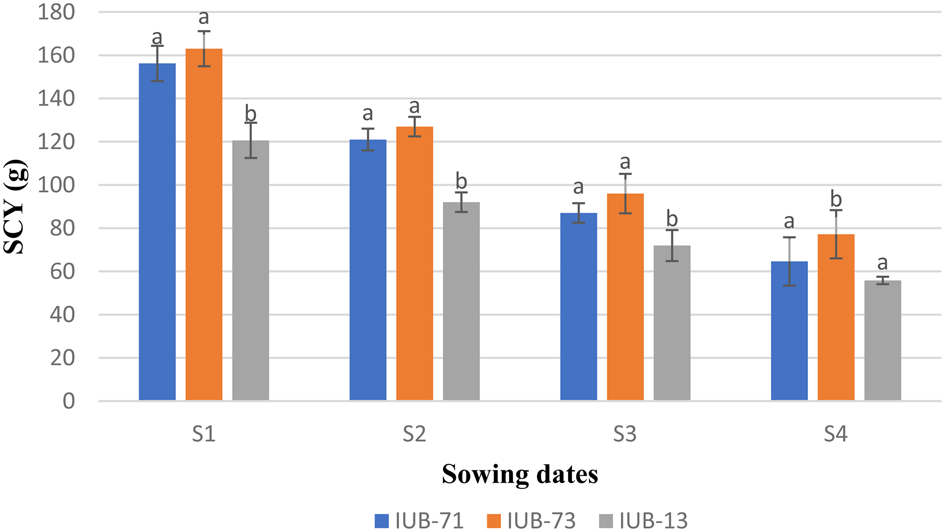
Regarding BP from S1 to S4, IUB-73 showed highest BP (52–19.9) surpassing the other two genotypes. IUB-71 genotype showed moderate BP ranging from 51.8 (S1) to 17.3 (S4). However, minimum (46.6–15.2) were recorded in IUB-13 from S1 to S4 respectively (Fig. 3). IUB-73 showed highest SCY from S1 to S4 (163–77.2 g), followed by IUB-71 (156.2–64.6 g) and minimum was recorded in IUB-13 (120.6–55.8 g) (Fig. 4).
Mean graph for number of BP of three cotton genotypes under four different sowing dates. Bars indicate standard error bars. Different letters indicate significant differences at P < 0.05 by Tukey's multiple comparison test.

Mean graph for SCY of three cotton genotypes under four different sowing dates. Bars indicate standard error bars. Different letters indicate significant differences at P < 0.05 by Tukey's multiple comparison test.

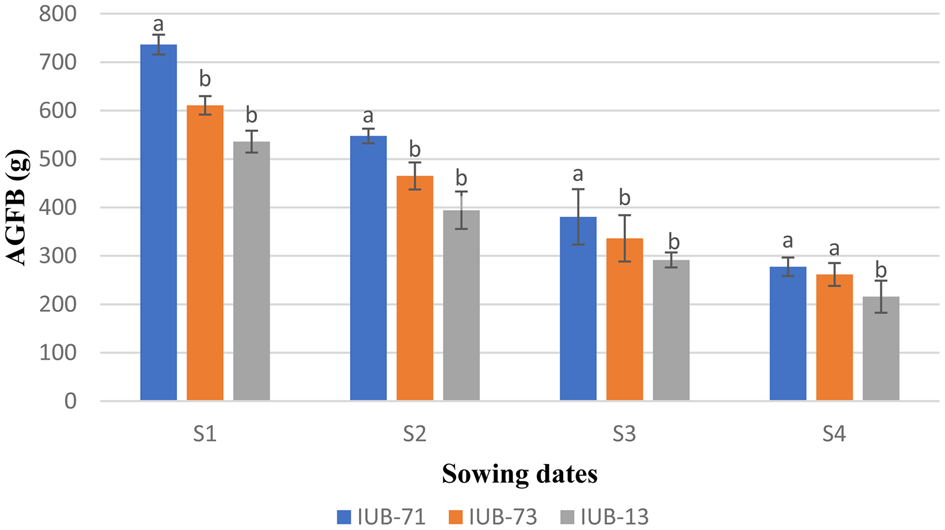
For AGFB, not much difference was observed among the three genotypes within the sowing date. However, a decrease in AGFB was observed with an increase in sowing dates. For example, in S1, IUB-71 showed highest AGFB (736.36 g) followed by IUB-73 (610.71 g) and IUB-13 (535.87 g). Likewise, in S2, IUB-71 showed highest AGFB (547.51 g), moderate was recorded in IUB-73 (464.98 g) and the lowest was observed in IUB-13 (394.20 g). Similarly, for S3 and S4, IUB-71 showed highest AGFB (380.58 and 277.50 g respectively), followed by IUB-73 (336.2 and 261.61 g respectively) and the lowest was recorded in IUB-13 (291.50 and 215.70 g respectively) (Fig. 5).
Mean graph for AGFB of three cotton genotypes under four different sowing dates. Bars indicate standard error bars. Different letters indicate significant differences at P < 0.05 by Tukey's multiple comparison test.

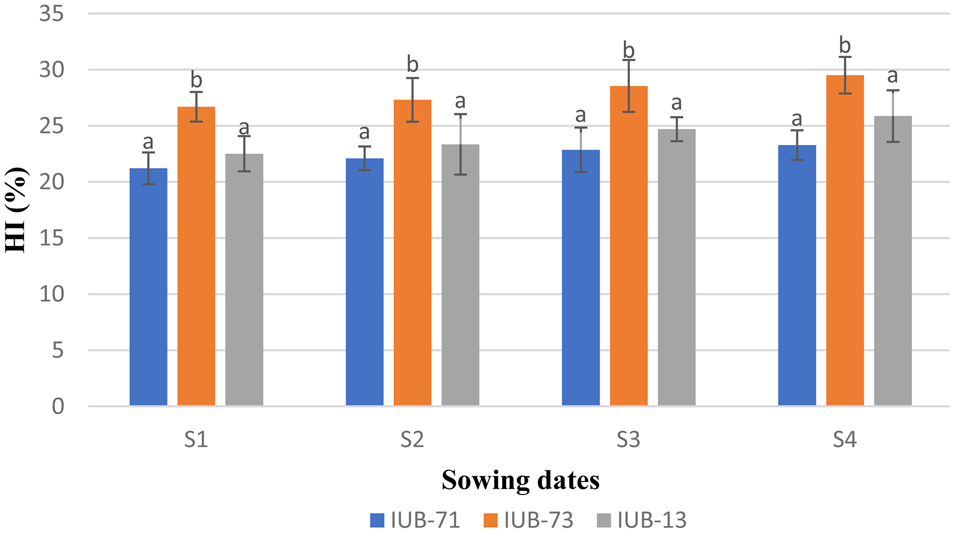
In contrast to other studied parameters, HI showed an increasing trend with a decrease in sowing dates. This increasing trend is desirable as due to this optimum yield can only be achieved in late planting reducing the critical window. IUB-73 showed highest HI (26.69%) under S1, gradually increased with an increase in sowing dates with 29.51% in S4. Likewise, HI in IUB-13 ranged from 22.51 to 25.87% in S1 to S4 respectively. IUB-71 also showed similar increasing trend however falling short from other two genotypes with range from 21.21% corresponding to S1 and 23.28% (S4) (Fig. 6). Thus IUB-73 with an increase in HI in late planting and possessing other favourable yield traits seems to be the promising genotype for short cotton growing seasons.
Mean graph for HI of three cotton genotypes under four different sowing dates. Bars indicate standard error bars. Different letters indicate significant differences at P < 0.05 by Tukey's multiple comparison test.

Discussion
The cotton crop in Southern parts of Punjab (Pakistan) observes critical growth window against selected abiotic (drought and heat stress) and biotic stresses in its life cycle. Farmers normally need to manage multiple irrigations in early cotton growth period to tackle the problem arising due to water deficit condition. In the present study, a less rainfall was also noted in earlier month i.e., April and May along with less relative humidity. Meanwhile, a high rate of infestation of whitefly and bollworms has also been a menace in cotton crop. To shorten the critical widow of drought, heat and insect pests will likely to help cotton growers to manage them for short period of time.
The present study was therefore aimed to identify genotypes with reasonably good yield in short crop durations (with reduced critical window). In the present study, we explored the variability in growth among three cotton genotypes of diverse growth habit under four different sowing dates and how these might affect the maturity of the crop. As cotton is an indeterminate crop, the timing of maturity is mainly depending upon the ability of plant to produce new vegetative organs along with associated fruiting sites. The production of dry matter and reproductive demand might also have impact on plant yield (Wells and Meredith, Reference Wells and Meredith1984) and there is some evidence to suggest that there is a trade-off between early maturation and yield potential in cotton (Quisenberry and Roark, Reference Quisenberry and Roark1976; Stiller, Reference Stiller2000). Therefore, the HI or the ability of plant to transfer resources toward fruit might have impact on yield and the cut out stage and crop maturity.
Cotton plant growth mostly depends on environmental factors, changes in weather conditions, management, varietal characteristics and planting patterns. PH indirectly affects the yield, as PH increases, fruiting branches and fruiting points also increases, consequently increase in yield (Baloch et al., Reference Baloch, Khan, Jatoi, Hassan, Khakhwani, Soomro and Veesar2011). All the genotypes had shown decline in PH with sowing dates. But if we compare genotypes highest PH was attained by IUB-73 in all sowing dates. The differences in PH might be due to genetic makeup of plant, soil type and ecological factors (Hussain et al., Reference Hussain, Ahmad and Zamir2007; Batool et al., Reference Batool, Khan, Makhdoom, Bibi, Hassan, Marwat, Farhatullah, Raziuddin and Khan2010).
The NN has a direct influence on flowering point which determines the seed cotton productivity. Cotton plant with more nodes on main stem will carry more sympodial (fruit bearing) branches. For NN on the main stem, IUB-73 again showed the highest values under all sowing dates. The PH is normally governed by the total number of main stem nodes and internode lengths (Reddy et al., Reference Reddy, Hodges and Reddy1992). A decline in NN consequently with PH is also happened with late sowing dates. Number of bolls in cotton has been reported to be a major yield contributing feature, affecting the hybrid yield (Zeng and Wu, Reference Zeng and Wu2012). The higher number of bolls in the cotton hybrids resulted from the collective effect of both the boll retention and fruiting node (Munir et al., Reference Munir, Hussain, Manzoor, Quereshi, Zubair, Nouman and Manzoor2016). Mean values for sowing dates revealed that S1 produced maximum bolls while S4 sowing minimum BP. The results indicated that IUB-73 produced more bolls under all sowing dates. In cotton crop late sowing normally associated with the lower number of bolls for all genotypes that probably due to the abortion of flowers and immature bolls and thus resulted in fewer bolls retention (Reddy et al., Reference Reddy, Hodges and Reddy1992; Hodges et al., Reference Hodges, Reddy, McKinion and Reddy1993).
SCY is mainly determined by two components, i.e. boll numbers and boll weight (Rahman et al., Reference Rahman, Ullah, Ahsraf, Stewart and Zafar2008). When high temperature occurs at flowering stage, the reduction in SCY is due to square and boll shedding (Cook and El-Zik, Reference Cook and El-Zik1993). Meanwhile in early sowing reduction in SCY occurs due to flower and bolls shedding but under late sowing it is attributed to less flower production. In our study all the genotypes showed reduction in yield with sowing dates. However, comparing the three genotypes, the IUB-73 showed better SCY in all sowing dates.
In the present study biomass production also reduced with sowing dates in cotton. While the inter-genotype comparison depicted that IUB-71 produced better final plant biomass in almost all sowing dates followed by IUB-73. Yang et al. (Reference Yang, Tang, Nie and Zhang2011) showed negative correlation of SCY with fresh plant biomass especially of the vegetative organs before peak bloom. According to Austin et al. (Reference Austin, Bingham, Blackwell, Evans, Ford, Morgan and Taylor1980), most of the historical genetic progress in yield was due to de facto increase in HI rather than biomass. Therefore, HI is an important indicator to assess the SCY. Interestingly in our study HI was increased slightly with increasing sowing dates while IUB-73 clearly outclassing other two genotypes.
Conclusions
Our study identified that IUB-73 is a unique breeding line with high HI and consequently superior SCY under late sowing. This highlights that it is possible to achieve high SCY through increasing HI under reduced critical window due to late planting.
Supplementary material
The supplementary material for this article can be found at https://doi.org/10.1017/S1479262120000106.
Conflict of interest
The authors have declared that no competing or conflicts of interest exist.