Tallgrass prairies are historically important, biodiverse ecosystems (Samson et al. Reference Samson, Knopf and Ostlie2004; Steiger Reference Steiger1930). They provide a range of ecosystem services (Gascoigne et al. Reference Gascoigne, Hoag, Koontz, Tangen, Shaffer and Gleason2011), are a refuge for many threatened and endangered species (Gerla et al. Reference Gerla, Cornett, Ekstein and Ahlering2012), and reduce establishment of invasive plants (Tilman Reference Tilman1997). This system is threatened, as greater than 99% of the presettlement tallgrass prairie has been destroyed or severely altered in the midwestern United States, making this a globally endangered ecosystem (Samson and Knopf Reference Samson and Knopf1994). Replanting of prairies has become a priority over the last 30 yr, powered by conservation programs, funding by the Conservation Reserve Program (Skold Reference Skold1989), and interested conservation organizations and private citizens (Anderson Reference Anderson2009). While many hectares have been planted, prairie restorations are challenged by invasive plants (Blumenthal et al. Reference Blumenthal, Jordan and Svenson2005; Larson et al. Reference Larson, Bright, Drobney, Larson, Palaia, Rabie, Vacek and Wells2013), and establishment has been documented to be severely impaired by invasive species (Larson Reference Larson2009; Norton Reference Norton2009). Weed invasions of newly planted prairies may be enhanced due to their limited size, as most prairie remnants average 16 ha (40 acres), with many less than 4 ha (10 acres). This results in a high ratio of patch edges, lending to encroachment by invasive species (Solecki 1997).
Canada thistle [Cirsium arvense (L.) Scop.] is a common, invasive, creeping perennial, able to thrive in tallgrass prairies (Hodgson Reference Hodgson1968). It is considered the third most harmful weed in agricultural production (Schröeder et al. Reference Schroeder, Schaerer and Stinson1993), as well as prairies (Guggisberg et al. Reference Guggisberg, Welk, Sforza, Horvath, Anderson, Foley and Rieseberg2012). Once established, it is costly and difficult to manage (DiTomaso Reference DiTomaso2009). Best management practices in prairie restorations recommend herbicide applications prior to seeding to suppress Canada thistle and other invasive plants. While herbicides can be effective and economical, use of herbicides has been limited to glyphosate in prairie seedings (Wilson and Gerry Reference Wilson and Gerry1995). This is likely due to limited information about selectivity of herbicides to the wide range of species seeded in prairie establishments. In addition, clopyralid and aminopyralid, two active ingredients that have been shown to provide excellent control of Canada thistle, persist in the soil following application (Renz Reference Renz2010; Senseman et al. Reference Senseman, Hancock, Wauchope, Armburst, Peters, Massey, Johnson, Reynolds, Lichtner, MacDonald, Rushing, Kitner, McLean and Vencill2007). To use these herbicides for Canada thistle control, land managers may need to delay planting for multiple years until the herbicides degrade from the soil to ensure no injury occurs to native species.
Clopyralid and aminopyralid are effective at controlling Canada thistle (Bukun et al. 2009; Enloe et al. Reference Enloe, Lym, Wilson, Westra, Nissen, Beck, Moechnig, Peterson, Masters and Halstvedt2007; Wilson et al. Reference Wilson, Burch, Carrithers, Duncan, Masters and Whitson2005), with minimal to no impact to established grasses (Douglass et al. 2012; Smith et al. Reference Smith, Askew, Hagood and Barney2015) that are registered for use in natural areas (Carrithers et al. Reference Carrithers, Burch, Kline, Masters, Nelson, Halstvedt, Troth and Breuninger2005), and provide better control than glyphosate (Panke and Renz Reference Panke and Renz2012). Timing and application rates of herbicides are important to not only maximize efficacy against Canada thistle but to minimize the injury to desirable forbs that are sensitive to these herbicides. Research has determined that applications of these herbicides to established prairie forbs can cause injury, but injury was specific to the species, time of application, and stage of plant development (Almquist and Lym Reference Almquist and Lym2010; Becker and Haar Reference Becker and Haar2008; Mikkelson and Lym Reference Mikkelson and Lym2013), and in some cases the plants recovered from injury (Halstvedt et al. Reference Halstvedt, Peterson, Beck, Moechnig and Rice2011). However, little is known about the tolerance of prairie forb species to aminopyralid, clopyralid, or aminopyralid+clopyralid when applied prior to a seeding.
The goal of this project was to determine whether applications of aminopyralid, clopyralid, or aminopyralid+clopyralid could be used in a tallgrass prairie restoration with common forb species when applied prior to seeding to manage pervasive species such as Canada thistle. Experiments were established in Arlington, WI, and Beresford, SD, in 2009 to determine whether applications the summer before seeding affect common prairie forb species’ establishment after a fall dormant or spring seeding. We hypothesized that while the response of herbicide treatments would be specific to the forb species, applications the summer prior to seeding would not reduce prairie forb populations.
Materials and Methods
Sites
Field experiments were conducted from the summer of 2009 through the summer of 2011 at the Arlington Agricultural Research Station in Arlington, WI (43°18′4.67″N, 89°20′50.72″W; elevation: 315.2m), and the South Dakota State University Southeast Experiment Station in Beresford, SD (43°2′37.50″N, 96°54′15.59″W; elevation: 387.1m). The soil type at Arlington was a Plano silt loam (Fine-silty, mixed, superactive, mesic Typic Argiudolls) located in the south-central portion of the state in the tallgrass prairies–northern forest transition ecoregion. The soil type at Beresford was an Egan silty clay loam (Fine-silty, mixed, superactive, mesic Udic Haplustolls) located in the southeastern portion of the state in the tallgrass prairie ecoregion. Prior to this study, both sites were planted with either perennial (alfalfa [Medicago sativa L.]) or annual crops (corn [Zea mays L.]).
Research Design and Establishment
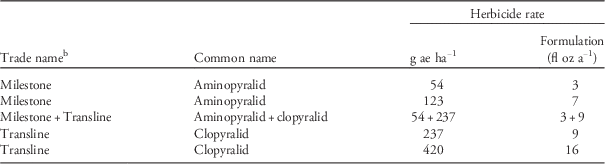
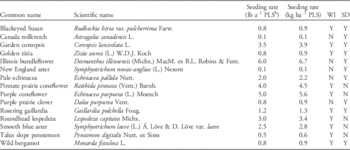
A randomized complete split-plot block design was established at both locations. The experiment was replicated four times with seeding date as the main plot and herbicides the subplot. Both sites were initially chisel plowed to prepare the soil. In Wisconsin, fields were then disked prior to herbicide application, while a no-till drill system was used in fields in South Dakota to prepare the soil prior to herbicide applications. Five herbicide treatments and one untreated control (UTC) (Table 1) were applied on July 22, 2009, in Arlington and on July 7, 2009, in Beresford using a CO2-powered backpack sprayer calibrated to deliver solutions at 178 L ha−1 (20 gal acre−1). Following applications, 10 native forb species (Table 2) were individually no-till drilled (Truax, New Hope, MN) to a depth of 2.5 cm into two parallel rows spaced 19-cm apart and 3.05-m long perpendicular to the herbicide treatments by either the fall dormant seeding (November 17, 2009, and November 16, 2009, in Arlington and Beresford, respectively) or spring seeding (April 16, 2010, and April 28, 2010, in Arlington and Beresford, respectively). In Wisconsin, fields were mowed in mid-July 2010 to suppress broadleaf (common ragweed [Ambrosia artemisiifolia L.], red clover [Trifolium pratense L.], and white clover [Trifolium repens L.]) and grass weeds (large crabgrass [Digitaria sanguinalis (L.) Scop.]) to a height of 15 cm. Fields in South Dakota contained common dandelion (Taraxacum officinale G.H. Weber ex Wiggers) and were not managed for broadleaf weed pressure.
Herbicides applied in July prior to either a fall dormant (November 2009) or spring (April 2010) seeding at two locations in Arlington, WI, and Beresford, SD.Footnote a

a Ten different forb populations were planted at each site and plant counts were evaluated 1 and 2 YAT.
b All herbicides are registered trademarks of the Dow Chemical Company (“Dow”) or an affiliated company of Dow; Indianapolis, IN; http://www.dowagro.com.
Native prairie forb species evaluated for tolerance to soil residue of aminopyralid or clopyralid alone or in combination at Arlington, WI, and Beresford, SD.Footnote a

a Fields were treated with herbicides in July 2009 prior to either a fall dormant (November 2009) or spring (April 2010) seeding of 10 commonly planted forb species in each location.
b PLS, pure live seed.
Measurements and Statistical Analysis
Plant counts (plants m−1 row) were recorded 12 (June 2010) and 24 (July 2011) mo after treatment (MAT) for each forb species. Species were recorded by randomly placing a meter stick within each of the two parallel rows once, counting the number of plants per row, and averaging the values. ANOVA was used to determine the effect of seeding date and/or herbicide treatment on each native forb using R (v. 3.1.3; R Project for Statistical Computing 2015). As species selection varied between locations, each location was analyzed separately. The assumptions of ANOVA were checked prior to analysis and met, which required no transformation of the data. Fisher’s least significant difference (LSD) test at P≤0.05 was utilized to separate least square means where appropriate. Each time period was evaluated independent of the others, and individual species were analyzed separately using the procedure described above due to the lack of complete overlap in studied species across the two sites and varying local climatic conditions.
Results and Discussion
Weather
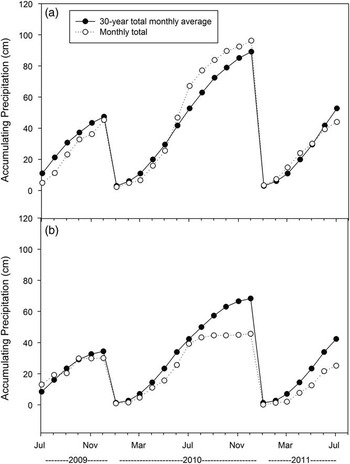
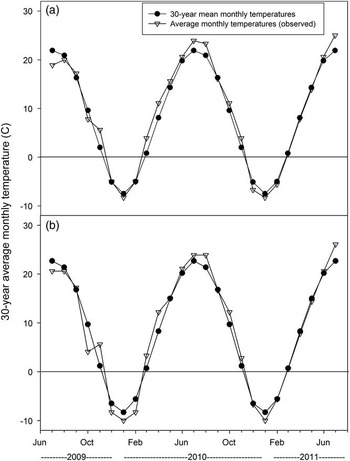
Precipitation (Figure 1) and temperature (Figure 2) at both sites at times deviated from 30-yr normal climate data over the duration of the study. In Wisconsin in 2009, conditions were relatively normal, with dry conditions immediately following herbicide treatments. In South Dakota, conditions were cooler and drier, with sometimes considerable deviations from the 30-yr averages, depending on the month (e.g., September 2009 and 2010 precipitation >80% lower than average). Temperatures were roughly 10% above average at both locations in summer of 2010. In Wisconsin, 2010 was a wet year, particularly during the summer months, compared with averages, while South Dakota experienced a considerably drier year (33% less precipitation), mainly at the end of the growing season and into the winter months. In 2011, both Wisconsin and South Dakota had slightly warmer (5%) and much drier conditions (>30% less precipitation) from the beginning of the growing season into July compared with 30-yr averages. Atypical weather patterns during the course of the study could have resulted in reduced persistence compared with historical weather. Aminopyralid and clopyralid are both broken down by soil microbes (Senseman et al. Reference Senseman, Hancock, Wauchope, Armburst, Peters, Massey, Johnson, Reynolds, Lichtner, MacDonald, Rushing, Kitner, McLean and Vencill2007). Higher soil moisture and temperature could have reduced persistence at both locations.
Total accumulated precipitation (cm) from 30-yr monthly precipitation (1981–2010) compared with total accumulated monthly precipitation during the growing seasons of 2009, 2010, and 2011 at (a) Arlington, WI, and (b) Beresford, SD.

Average observed monthly temperature compared with 30-yr mean monthly average temperatures (1981–2010) at (a) Arlington, WI, and (b) Beresford, SD, during the growing seasons of 2009, 2010, and 2011.

Seeding Date
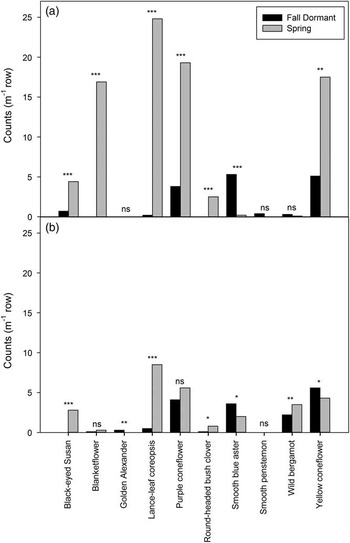
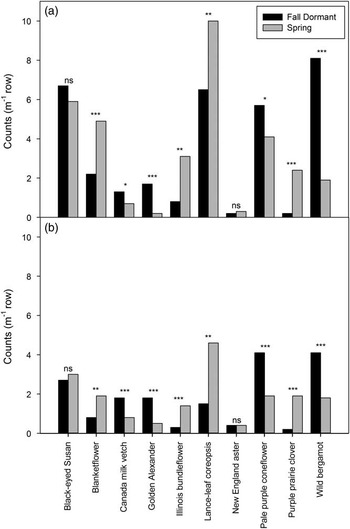
Prairie forb establishment in this study was site and species specific. Seeding date at both locations was often a significant factor driving plant species’ counts (Figures 3 and 4). At 12 MAT, six of the 10 studied forbs established better when planted in the spring compared with the fall seeding date in Wisconsin (Figure 3a), while in South Dakota four of 10 studied species had higher counts in a fall than a spring seeding (Figure 4a). Species that established better in Wisconsin when planted in spring were pinnate prairie coneflower coneflower [Ratibida pinnata (Vent.) Barnh.], garden coreopsis (Coreopsis lanceolata L.), rosering gaillardia (Gaillardia pulchella Foug.), and roundhead lespedeza (Lespedeza capitata Michx.); and in South Dakota rosering gaillardia, Illinois bundleflower [Desmanthus illinoensis (Michx.) MacM. ex B.L. Robins & Fern.], garden coreopsis, and purple prairie clover (Dalea purpurea Vent.). In contrast, just one forb species established better with a fall seeding in Wisconsin (Figure 3a) compared with a spring seeding, while in South Dakota that number was three forb species (Figure 4a). In Wisconsin, smooth blue aster [Symphyotrichum laeve (L.) Á. Love & D. Love var. laeve] established better in a fall seeding than in spring, while in South Dakota, three species (golden zizia [Zizia aurea (L.) W.D.J. Koch], pale echinacea [Echinacea pallida Nutt.], and wild bergamot [Monarda fistulosa L.]) established better with a fall, compared with spring, seeding. Golden zizia, wild bergamot, and talus slope penstemon (Penstemon digitalis Nutt. ex Sims) in Wisconsin and blackeyed Susan (Rudbeckia hirta var. pulcherrima Farw.) and New England aster [Symphyotrichum novae-angliae (L.) Nesom] in South Dakota did not differ in establishment by seeding date at 12 MAT.
Comparison of a fall dormant and spring seeding of 10 native forb species plant counts (plants m−1 row) as observed 12 (June 2010; a) and 24 mo (July 2011; b) after herbicide treatment (MAT) in Arlington, WI. Each time period was evaluated independent of the other. Values are the average of 24 replicates (N=24). P-values presented are significant at a level of α=0.05. “ns” indicates a nonsignificant difference; significance designations: *P<0.05; **P<0.01; ***P<0.001.

Comparison of a fall dormant and spring seeding of 10 native forb species plant counts (plants m−1 row) as observed 12 (June 2010; a) and 24 mo (July 2011; b) after herbicide treatment (MAT) in Beresford, SD. Each time period was evaluated independent of the other. Values are the average of 24 replicates (N=24). P-values presented are significant at a level of α=0.05. “ns” indicates a nonsignificant difference; significance designations: *P<0.05; **P<0.01; ***P<0.001.

In Wisconsin, blackeyed Susan, garden coreopsis, and roundhead lespedeza still had higher counts in the spring seeding by 24 MAT, while smooth blue aster populations remained highest in the fall seeding (Figure 3b). Significant differences from the previous year were opposite for populations of pinnate prairie coneflower at 24 MAT, while two species, rosering gaillardia and purple coneflower [Echinacea purpurea (L.) Moench], no longer differed between seeding dates. One species, golden zizia, had higher counts at 24 MAT in the fall seeding compared with the spring seeding. Some of the golden zizia seeds may have remained dormant in the seedbank until the second growing season when seeded in the fall or were detected by our sampling method at that time. For pinnate prairie coneflower, differences in counts between the two years may be due to intraspecific competition in the spring seeding that resulted in higher levels of seedling mortality over the winter that was not observed in the fall seeding. Those fall-seeded plants, less constrained by intraspecific competition, may have experienced better development to persist overwinter. In contrast to Wisconsin, patterns in plant counts between the two seeding dates at 12 to 24 MAT remained consistent in South Dakota (Figure 4b). Results reflect seed traits and germination differences across forb species (Schramm Reference Schramm1990).
Herbicide Treatments
Herbicide treatments did not negatively impact the establishment or survival of any of the species studied in Wisconsin or South Dakota compared with the untreated controls. In Wisconsin, no species were impacted by any of the herbicides when compared with one another or the untreated controls (P≥0.115); therefore, data were combined. In South Dakota, while results indicated a difference between herbicide treatments for golden zizia (P=0.003), wild bergamot (P=0.02), and pale echinacea (P=0.04), Fisher’s LSD test (P≤0.05) did not identify differences among the herbicide treatment means. Results suggest that forb stands may not be reduced when aminopyralid and/or clopyralid are applied the summer prior to subsequent forb seeding times in the fall or following spring in the upper midwestern United States.
Forb tolerance to aminopyralid and clopyralid is likely due to tolerance to herbicide(s) in combination with degradation of these herbicides to tolerable levels by the time of forb germination. While the half-life of aminopyralid ranges from 25 to 35 d, and clopyralid from 12 to 70 d (Senseman et al. Reference Senseman, Hancock, Wauchope, Armburst, Peters, Massey, Johnson, Reynolds, Lichtner, MacDonald, Rushing, Kitner, McLean and Vencill2007), applications at the rates used in this study have persisted and caused injury in susceptible broadleaf plants the following season in other studies. For example, Seefeldt and colleagues, in two different studies, determined that aminopyralid (Seefeldt et al. Reference Seefeldt, Boydston, Kaspari, Zhang, Carr, Smeenk and Barnes2013) and clopyralid (Seefeldt et al. Reference Seefeldt, Boydston and Kaspari2014) caused injury to potato (Solanum tuberosum L.) mother plants within the growing season and subsequent daughter tubers at rates as low as 8 g ae ha−1 and 25 g ae ha−1 for aminopyralid and clopyralid, respectively. Renz (Reference Renz2010) determined that aminopyralid applied at 0.122 kg ha−1 in the fall resulted in reduced legume establishment the following spring. Others have shown soybeans [Glycine max (L.) Merr.] were injured by aminopyralid applications at 120 or 240 g ae ha−1 when seeded up to 23 MAT (Mikkelson and Lym Reference Mikkelson and Lym2011). These studies confirm that aminopyralid and clopyralid can persist in the soil at concentrations high enough to impact sensitive plant species over the time frame that existed between application and seeding dates in this study. Due to the fact that other studies (e.g., Renz Reference Renz2010) in the Midwest have shown that these products can persist over the time frame of our study, this suggests species studied may possess some level of tolerance to their presence in the soil when germinating.
While to our knowledge no information has been published on effects of aminopyralid or clopyralid applications prior to seeding on native forb establishment, others have evaluated forb tolerance to foliar applications on established forbs for some of the species in this study. Becker and Haar (Reference Becker and Haar2008) determined that while injury was initially found in these species, by 2 yr after treatment (YAT) established populations of wild bergamot, purple prairie clover, golden zizia, and rosering gaillardia recovered and displayed ≤15% stand reduction to applications of aminopyralid or clopyralid; the results of this study do not indicate any effects from these herbicides. Other species, such as pinnate prairie coneflower and blackeyed Susan, were injured (>75%) in established settings with both herbicides. Although established populations of these species are sensitive to aminopyralid and clopyralid, our data do not show effects from these herbicides when applied at least 4 mo prior to seeding. Almquist and Lym (Reference Almquist and Lym2010) concluded that applications of aminopyralid at 120 g ae ha−1 decreased established populations of purple prairie clover 22 MAT compared with untreated plots, while other species like wild bergamot were decreased initially by herbicide application but recovered by 22 MAT. Furthermore, species such as golden zizia were not affected by aminopyralid throughout the course of their study. With these herbicides, a wide range of tolerances have been documented in established settings. Waiting at least 4 mo to seed the species investigated in Wisconsin and South Dakota after a summer application, however, was adequate for the herbicides to break down in the soil enough to avoid harm in our studies. Seeding too soon after applications may compromise native seedling establishment (Wagner and Nelson Reference Wagner and Nelson2014). Environmental (Jachetta et al. Reference Jachetta, Havens, Dybowski, Kranzfelder and Tiu2005; Senseman et al. Reference Senseman, Hancock, Wauchope, Armburst, Peters, Massey, Johnson, Reynolds, Lichtner, MacDonald, Rushing, Kitner, McLean and Vencill2007) and physical (e.g., soil) factors (Bukun et al. Reference Bukun, Shaner, Nissen, Westra and Brunk2010; Fast et al. Reference Fast, Ferrell, MacDonald, Krutz and Kline2010) in other environments may also affect herbicide persistence. Given that below-average rainfall and above-average temperatures occurred after herbicide application at both Arlington, WI, and Beresford, SD, our results may differ if repeated in different locations that have dissimilar environmental and physical characteristics compared with these two locations.
Interaction between Variables
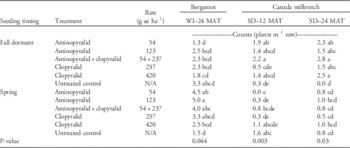
An interaction between seeding date and herbicides was found for wild bergamot in Wisconsin and Canada milkvetch (Astragalus canadensis L.) in South Dakota (Table 3). In Wisconsin, wild bergamot seeded in the spring was found to have more plants per 1-m row when treated with either the low or high rates of aminopyralid and the combination of aminopyralid+clopyralid when compared with the spring untreated control plots at 24 MAT. While established bergamot is considered tolerant to aminopyralid and clopyralid (Becker and Haar Reference Becker and Haar2008), the fall dormant seeding may result in earlier germination of cohorts of seeds the following spring prior to the spring seeding. These early-germinating cohorts could have been exposed to greater concentrations of herbicides. Alternatively, the soil disturbance in the fall may have enhanced herbicide breakdown compared with the spring planting, thus providing more weed suppression during establishment. Plots treated with aminopyralid or clopyralid displayed considerably lower broadleaf weed population densities the following spring (NJ, personal observation).
Effect of seeding timing (November 2009 or April 2010) and herbicide treatment (July 2009) on native prairie forb species counts (plants m−1 row) in Arlington, WI, and Beresford, SD, in June 2010 and July 2011, 12 and 24 MAT, respectively.Footnote a

a Values are the average of four replicates (N=4). Means within a column followed by the same letter are not different according to Fisher’s LSD at P<0.05.
In South Dakota, Canada milkvetch was the only species with an interaction between planting time and herbicide treatment at both the 12 and 24 MAT evaluations (Table 3). At 12 MAT, Canada milkvetch seeded in the fall had higher counts in plots treated with aminopyralid at the low rate or with aminopyralid+clopyralid when compared with the fall untreated control. By 24 MAT, these two treatments and the high rate of clopyralid had higher counts than either UTC. The process of seeding forbs may have disturbed the soil and therefore encouraged more rapid breakdown of herbicides in fall before germination the following spring. In spring-seeded forbs, seeds were placed in the disturbed soil close to when they would germinate, thus less time was available for herbicide breakdown or movement. This may help explain the overall higher counts of Canada milkvetch in fall plots compared with spring plots. In addition, cold stratification of Canada milkvetch is a requirement for germination (Prairie Moon Nursery 2015); therefore, fall seeding may provide better conditions for germination of this species, as it can fulfill this requirement when a spring seeding may not. The differences between the seeding dates and herbicide applications relative to the UTC may also not have been fully realized until 24 MAT. Competition from dandelions in the forb rows could have been an additional driver of low Canada milkvetch counts in South Dakota.
Results of this study suggest that prairie forbs planted in either a fall dormant or spring seeding can tolerate a onetime application of aminopyralid, clopyralid, or aminopyralid+clopyralid at the studied rates the summer prior to seeding. Additional studies exploring how these known factors affect establishment would be warranted to ensure results are consistent in different physical and/or environmental conditions. Risks with establishment issues need to be contrasted with the level of competition of invasive species targeted for control with these herbicides. We suggest conducting a risk assessment prior to applications to determine whether applications are warranted. Further research should continue to explore the timings and factors associated with tolerance of common prairie forbs to these herbicides to enhance the success of prairie restorations.
Acknowledgments
We would like to acknowledge the Arlington Agricultural Research Station and Beresford Agricultural Research Station for the excellent technical support staff through the duration of this project and all of the undergraduate student assistance in completing plant counts and cover when necessary. In Wisconsin, we would specifically like to thank John Albright for his expertise in managing the day-to-day activities over the course of this 2-yr study.