Introduction
Elderly individuals (>65 years of age) account for 11% of the US population, yet they consume 34% of health care expenditure, between 42% and 52% of intensive care unit (ICU) admissions, and approximately 60% of all ICU days (Marik, Reference Marik2015). Because of the high fatality rate (20%) during or shortly after a stay in the ICU, critical care is scrutinized for the provision of potentially futile resource-intensive treatment (Huynh et al., Reference Huynh, Kleerup and Wiley2013). Researchers at one health system encompassing 5 ICUs revealed the cost of treatment perceived to be futile in critical care was estimated at $2.6 million per year (Huynh et al., Reference Huynh, Kleerup and Wiley2013). In the United States, treatment of sepsis is listed as the most expensive condition in hospitals, costing more than $20 billion annually (Arefian et al., Reference Arefian, Heublein and Scherag2017; Pirozzi et al., Reference Pirozzi, Rejali and Brennan2016). If patients are given a mechanism to specify and document their preferences for or against explicit medical procedures, then unwanted treatments could be averted (Khandelwal et al., Reference Khandelwal, Benkeser and Coe2016). Theoretically, early identification and prevention of treatments that patients deem undesirable would be fiscally reasonable. Similarly, a reduction in unwanted treatments in the ICU can have an effect on ICU length of stay (LOS).
Advance care planning (ACP) occurs when a patient makes stipulations for future medical care in the event that the patient loses decision-making capacity (Bomba & Orem, Reference Bomba and Orem2015). ACP can clarify whether ICU care is consistent with a patient's wishes and may reduce the intensity and resource usage for end-of-life care (Mun et al., Reference Mun, Ceria-Ulep and Umbarger2016). It is unclear if ACP may reduce healthcare expenditures (Klingler et al., Reference Klingler, der Schmitten and Marckmann2016). One model used for ACP in the State of New York is Medical Orders for Life-Sustaining Treatment (MOLST) (Bomba & Orem, Reference Bomba and Orem2015). MOLST is New York's nationally endorsed Physician Orders for Life-Sustaining Treatment (POLST) paradigm program (Bomba & Orem, Reference Bomba and Orem2015; Hickman & Critser, Reference Hickman and Critser2018). POLST is a communication process that emphasizes shared decision-making based on the patient's current health status, not on future care preferences (MacKenzie et al., Reference MacKenzie, Smith-Howell and Bomba2018). There is a clear distinction between medical orders and advance directives. MOLST is not an advanced directive. MOLST contains a set of medical orders, which not only reflect the individual's preference or rejection of life-sustaining treatment, but also include decisions about a range of situations and options relevant to end-of-life care (Bomba & Orem, Reference Bomba and Orem2015). MOLST is the only medical order form approved under New York State Public Health Law whereby emergency medical services must follow both do not resuscitate (DNR) and do not intubate orders (Bomba & Orem, Reference Bomba and Orem2015; MacKenzie et al., Reference MacKenzie, Smith-Howell and Bomba2018). Since January 2006, the MOLST program has been implemented in healthcare facilities, including hospitals and nursing homes, in addition to assisted living facilities, enriched housing, and the community (Bomba & Orem, Reference Bomba and Orem2015).
Medical decision-making in the ICU is unique. It can be challenging for patients because this setting can be frightening, especially if decisions need to be made quickly (Rincon & Lee, Reference Rincon and Lee2015). In 2010, the New York State Legislature enacted the Family Health Care Decisions Act and covers treatment decisions, including decisions to forgo life-sustaining therapies, for those patients who lack decision-making capacity and have not signed an advance directive. The Family Health Care Decisions Act authorizes family members and others close to the patient to withdraw or withhold life-sustaining measures in the absence of a healthcare proxy or living wills (Rincon & Lee, Reference Rincon and Lee2015).
eMOLST is an electronic documentation system for the New York State Department of Health 5003 MOLST form that also serves as New York's eMOLST registry and is the most electronically advanced of any state (Bomba & Orem, Reference Bomba and Orem2015; Schiefelbein et al., Reference Schiefelbein, Markovich and Feingold2014). eMOLST is an ACP tool for seriously ill patients who might die in the next year (Bomba & Orem, Reference Bomba and Orem2018). New York's eMOLST system incorporates MOLST form completion and process documentation of a standardized communication process, including patient health status, prognosis, and goals for care (Bomba & Orem, Reference Bomba and Orem2018). It is a web-based application that provides an ethical framework and legal requirements for making decisions regarding cardiopulmonary resuscitation and life-sustaining treatment (Bomba & Orem, Reference Bomba and Orem2015, Reference Bomba and Orem2017). It has been found to eliminate errors and guide conversations between clinicians and the medical decision-maker and family. eMOLST also provides areas for descriptive documentation of those conversations among the healthcare team, patient, and family. It is available for any New York State and border state provider at no charge (Bomba & Orem, Reference Bomba and Orem2015, Reference Bomba and Orem2017). eMOLST can be integrated into an electronic medical record and allows electronic signature from providers and decision-makers (Bomba & Orem, Reference Bomba and Orem2015). Several studies have demonstrated poor quality and missing data on POLST/MOLST forms that were completed before the current electronic system (Clemency et al., Reference Clemency, Cordes and Lindstrom2017; Rahman et al., Reference Rahman, Bressette and Enguidanos2017). The shortcomings of the paper MOLST form can be overcome by eMOLST because it generates automatic error messages when data are missing or have contradictory medical instructions. This cloud-based system prevents the clinician from missing important fields and allows for modification of the document if patient preferences change. The eMOLST must be completed by a physician and, as of May 28, 2018, New York State public health laws were amended to expand the authority of the “attending nurse practitioner” to participate fully in the process and sign the eMOLST (Bomba & Orem, Reference Bomba and Orem2018).
Key components of the MOLST form are to convey a patient's wishes regarding cardiopulmonary resuscitation and other life-sustaining treatments such as instructions for intubation and mechanical ventilation, receipt of artificially administered fluids and nutrition, and antibiotic use. Resuscitation instructions are clearly provided. The DNR order instructs the healthcare team to not attempt to revive the patient if his or her heartbeat and breathing have stopped. The opposite of a DNR order is considered to be a “full code” whereby when a person's heartbeat is on the verge of stopping or has completely stopped, the healthcare team will provide emergent measures in attempt to resuscitate the patient. This may involve chest compressions, electric shocks, and emergency medications that promote blood flow to essential organs, such as the brain.
Palliative care (PC) is a medical subspecialty that aims to improve the quality of life for patients living with serious advanced illness by ensuring the patient and family understand the health status and patient prognosis, manage symptoms, and alleviate suffering in the context of the patient's goals of care. ACP that includes eliciting patient values, beliefs, and goals for care is a critical pillar of PC. Having these important conversations could potentially decrease the intensity of unwanted care at the end of life (Mun et al., Reference Mun, Ceria-Ulep and Umbarger2016). There is evidence that early identification of patient goals and values reduce ICU LOS and potential ICU admissions (Mun et al., Reference Mun, Ceria-Ulep and Umbarger2016). A PC consultation is often requested for patients with life-limiting illnesses under medically or socially challenging circumstances that require an additional layer of expertise. Social hardships such as strained family communication, grief, and guilt are some areas of focus. Furthermore, a PC department coordinates the transition of a severely ill patient from the hospital to the comfort of the patient's home with or without hospice care. PC might influence earlier hospice referral and lead to a lessening of public healthcare cost burdens (Wonnaparhown et al., Reference Wonnaparhown, Shafi and Liu2017); however, the data are mixed (Smith & Cassel, Reference Smith and Cassel2009). Overall, evidence on the economic implications of ACP is limited and imprecise (Dixon et al., Reference Dixon, Matosevic and Knapp2015).
The main purpose of our study was to determine if completing or not completing an eMOLST form was associated with reduced LOS, ICU, and direct costs. In this study, direct costs are all costs associated with direct patient care. Nursing labor and medical supply costs are good examples. Indirect costs cannot be directly traced to patient care. These costs are allocated based on some level of activity; for example, overhead such as human resource and finance departments are considered indirect costs. Indirect costs are associated with departments and staff that support patient care, such as a human resource department or nursing directors. ICU costs encompass both direct and indirect costs and are associated with a respective ICU charge code.
Methods
Study design
This retrospective chart review was conducted using data abstracted from the patient's hospital electronic medical record linked with his or her New York State eMOLST. eMOLST allows for electronic completion of the current New York State Department of Health-5003 MOLST paper form. A comprehensive review of 331 medical records was conducted on patients meeting the eligibility criteria. The cohort was divided into two groups: those who signed the eMOLST form and those who did not. The Case Mix Index (CMI) was used to numerically reflect the diversity, clinical complexity, and consumption of resources of the study patients. The Greater Hudson Valley Health System used a business intelligence system called Strata Decision Technology (Strata Decision) to derive cost at the patient level. Three measures were used to calculate costs: (1) ratio of cost to charges; (2) actual invoice cost; and (3) activity-based costing. Additionally, we investigated which individuals were the decision-makers for resuscitation instructions. The protocol was approved by the institutional review board of Orange Regional Medical Center.
Participants
Eligibility criteria included patients aged ≥65 years of age, who were admitted into the intensive care unit between July 2016 through July 2017, and who presented with a diagnosis of sepsis, regardless of severity of sepsis (i.e., sepsis, severe sepsis, septic shock, or septicemia). Seventy-five percent of the patients received primary International Classification of Diseases 10 code, A41.9, sepsis unspecified organism. Eighty-three percent of the patients were admitted through general medicine and the rest through general surgery.
Demographics
Descriptive statistics were used to present the demographic characteristics (gender, age, race, ethnic group, payer, and marital status) of those who did and did not complete the eMOLST form.
Outcome measures
The following outcome measures were queried for total direct cost, ICU cost, total number of days in hospital, and hours spent in the ICU. These variables were compared across both groups (those who did and did not sign the eMOLST form).
Statistical analyses
Chi-square tests were used to test for differences between categorical dependent variables. Independent samples t tests were used to test for significant differences between continuous dependent variables. Data were analyzed using STATA, version 14.2. A p value <0.05 was considered statistically significant.
Results
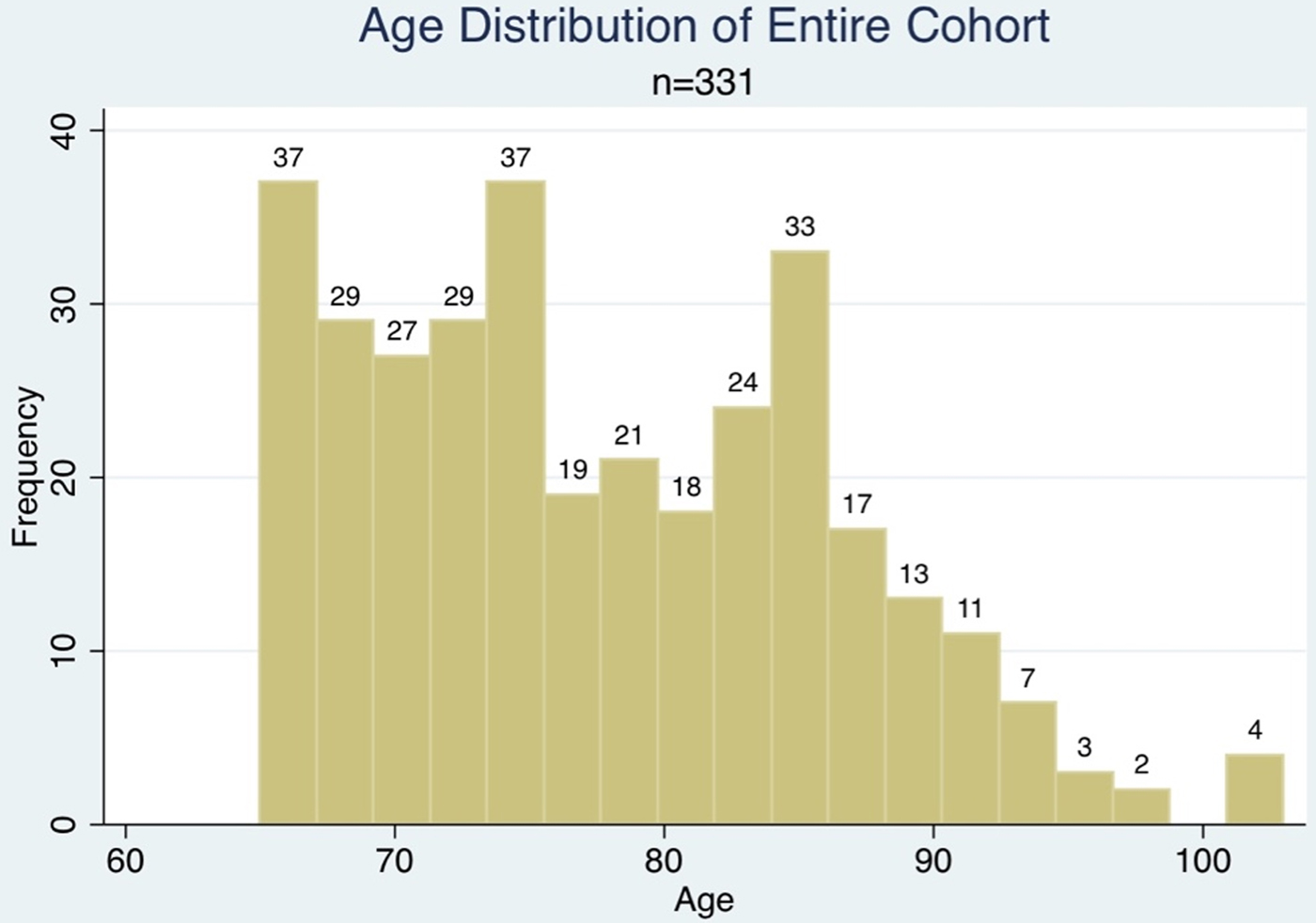
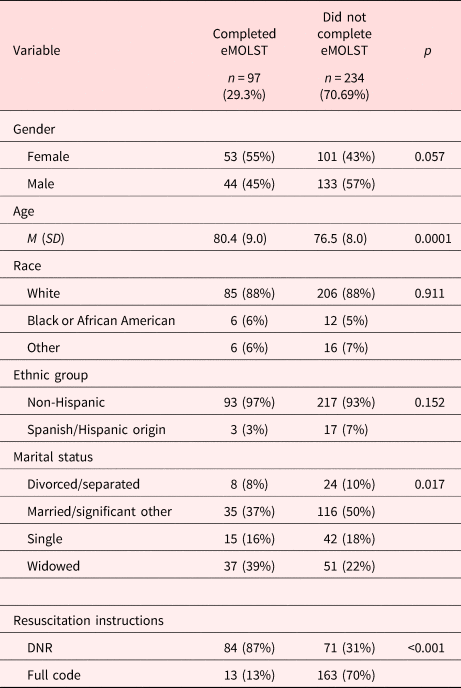
The demographic characteristics and resuscitation instructions of both groups (patients who completed eMOLST form and the noncompletion group) are presented in Table 1. The mean age of patients who did not complete the eMOLST was 76.5 years; the mean age for patients who completed the eMOLST form was 80.4 years (p = 0.0001; Figure 1). Figure 2 represents the age distribution of the entire cohort. There were no statistical differences found between groups with respect to gender (p = 0.057), race (p = 0.902), or ethnicity (p = 0.395). In the married/significant other category, 50% did not sign an eMOLST form compared with 37% percent who did (p = 0.017). In the eMOLST completion group, 87% of patients had resuscitation instructions of DNR compared with 30% in the noncompletion group (p < 0.001). In the eMOLST completion group, 13% of patients had a full code status compared with 70% in the noncompletion group (p < 0.001).
Age and eMOLST. In this box-and-whiskers plot, the mean age of patients who did not complete the eMOLST was 76.5 years; the mean age for patients who completed the eMOLST form was 80.4 years (p = 0.0001). eMOLST, Electronic Medical Orders for Life-Sustaining Treatment.

Age distribution of entire cohort.

Comparison of demographic characteristics and resuscitation instructions among patients who completed and did not complete the eMOLST form

DNR, do not resuscitate; eMOLST, Electronic Medical Orders for Life-Sustaining Treatment; M, mean.
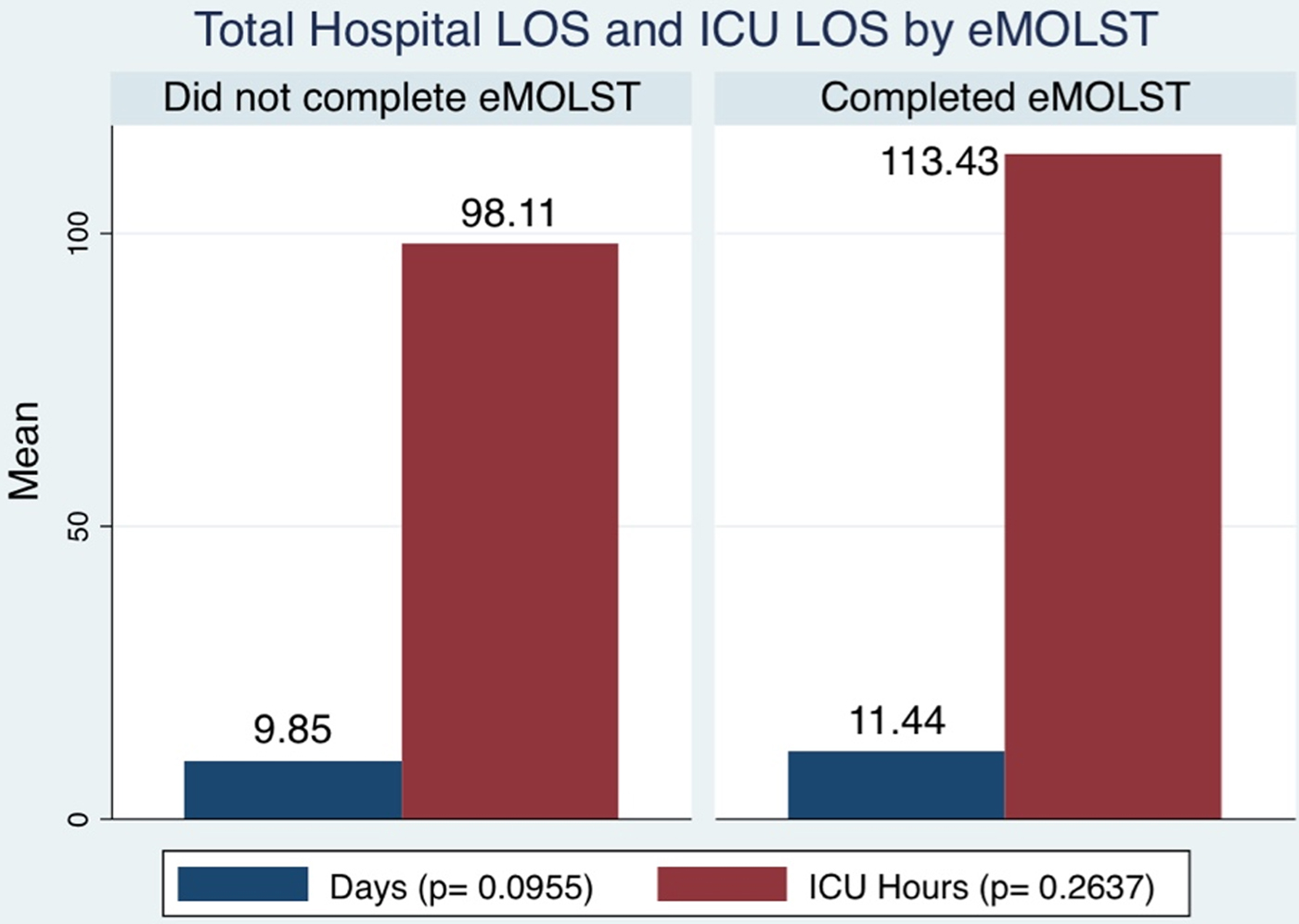
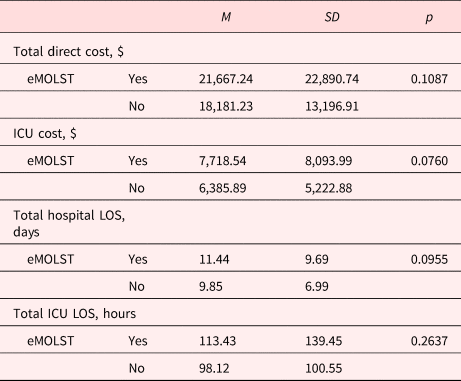
The comparison of total direct cost, ICU cost, number of days in the hospital, and hours spent in the ICU between the eMOLST completion group and noncompletion group are presented in Table 2. There were no statistical differences found between groups with respect to total direct cost, ICU cost, CMI, total length of hospital stay, and hours spent in the ICU (Figure 3). Total direct cost and ICU cost by eMOLST are shown in Figure 4.
Total hospital LOS and ICU LOS (hours) by eMOLST: Patients who did and did not complete the eMOLST form. eMOLST, Electronic Medical Orders for Life-Sustaining Treatment; ICU, intensive care unit; LOS, length of stay.

Total direct cost and ICU cost ($) by eMOLST: Patients who did and did not complete the eMOLST form. eMOLST, Electronic Medical Orders for Life-Sustaining Treatment; ICU, intensive care unit; LOS, length of stay.

Comparison of outcome measures between patients who completed (yes [n = 97, 29%] and did not complete (no [n = 234, 71%]) the eMOLST form

PC physicians are uniquely trained to assist patients with ACP. For the entire cohort, 39% received a PC consult and 61% did not. Of the 97 eMOLST documents signed by the patient or designee, 9 were signed by a physician after the patient was discharged. Although the form was signed by the patient/designee and not the physician during that admission, a conversation was initiated by the physician that allowed a decision to be made.
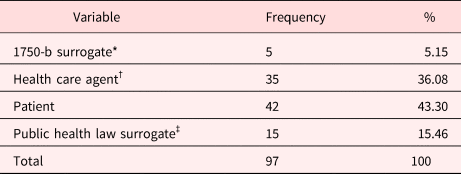
The plurality of those who provided consent for resuscitation instructions on the eMOLST form were patients, 43% (n = 42), followed by healthcare agents, 36% (n = 33); public health law surrogates, 15% (n = 51); and 1750-b surrogates, 5% (n = 5). These data are presented in Table 3 and Figure 5.
Decision-makers who provided consent for resuscitation instructions per New York's Family Health Care Decisions Act.

Decision-makers who provided consent for resuscitation instructions (n = 97)

*When a person who is intellectually disabled, not having the capacity to make healthcare decisions, the guardian of such person appointed pursuant to the law, will serve a surrogate decision-maker. The appointed guardian is the first on the surrogate list. For those without a guardian, there is a list of others who can make do not resuscitate and life-sustaining treatment decisions.
†A person the patient chooses in advance to make healthcare decisions for the patient in the event that the patient becomes unable to do so.
‡ When patients lack medical decision-making capacity and do not have the capacity to designate a healthcare agent or make medical decisions for themselves, the attending physician will identify a person from the class highest in priority who is reasonably available, willing, and competent to serve as a surrogate decision-maker.
Discussion
At the time of this study, the Orange Regional Medical Center (ORMC) palliative medicine team consisted of a Board-certified palliative medicine physician, a nurse practitioner, and a licensed clinical social worker certified in PC. Thirty-nine percent of patients received a PC consult and 61% did not. Because PC physicians are uniquely trained to assist with ACP, this could explain why only 29% of the study patients completed the eMOLST form. These figures strongly point to the necessity of increasing referrals to the PC team sooner than later (Fitzpatrick et al., Reference Fitzpatrick, Mavissakalian and Luciani2018).
Discussions between the healthcare provider and patient/family members often require an immense time commitment over the span of several days. One barrier for eMOLST completion may be inadequate reimbursement for time spent. A recent policy change for reimbursement to physicians and qualified healthcare professionals for providing ACP services to Medicare and Medicaid patients may improve these numbers (Bomba & Orem, Reference Bomba and Orem2015).
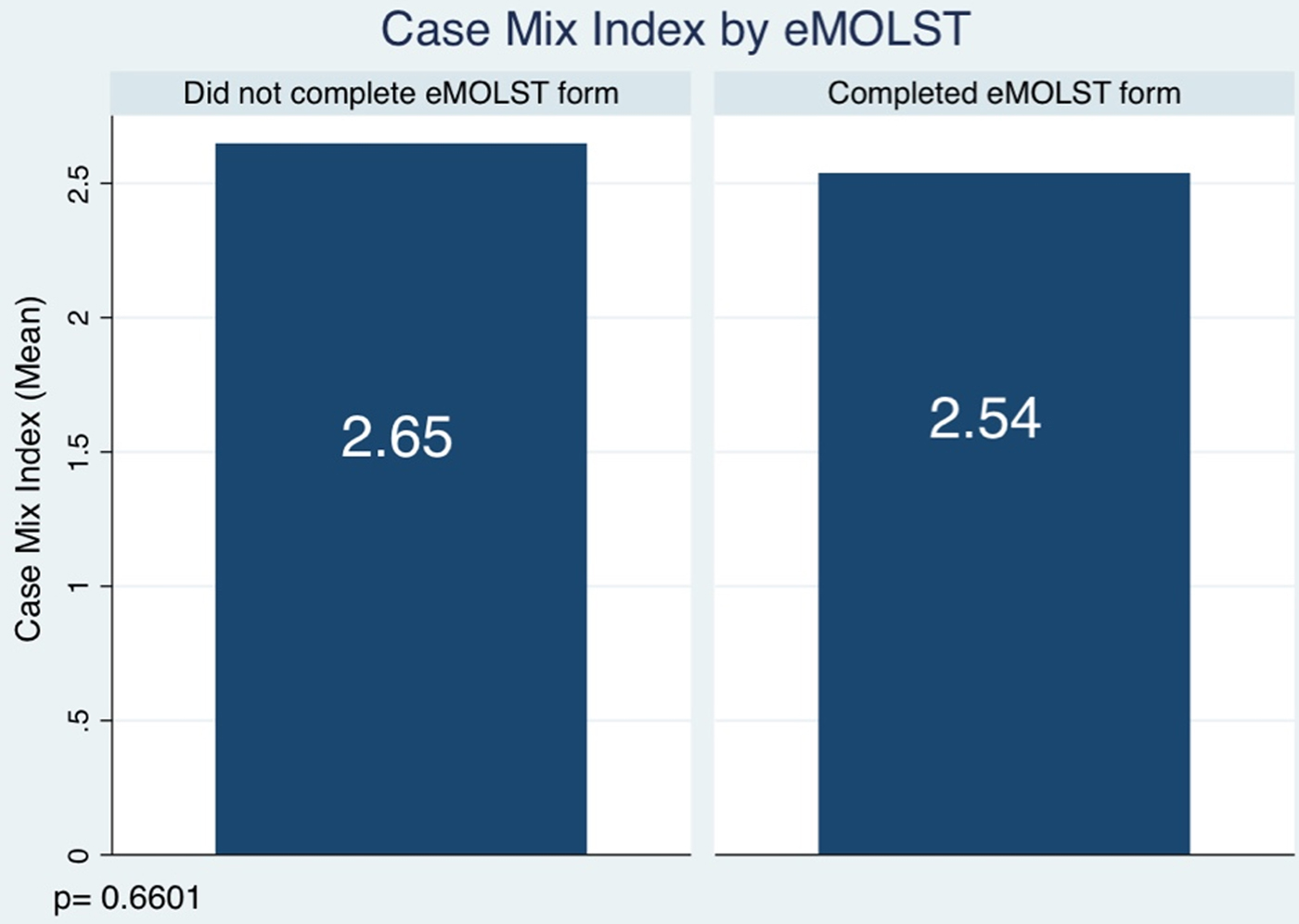
We recognize an age and population (i.e., sepsis diagnosis) selection bias within our study. This may be an indicator of selection bias in our study design, despite our attempt to match groups based on the CMI (Figure 6). It is interesting to note, however, that those who completed the eMOLST form were significantly older than those who did not sign the form and the majority of them signed a DNR order. It is unclear if these patients potentially avoided futile care towards the end of their life, which could potentiate cost savings.
Case mix index by eMOLST: Patients who did and did not complete the eMOLST form.

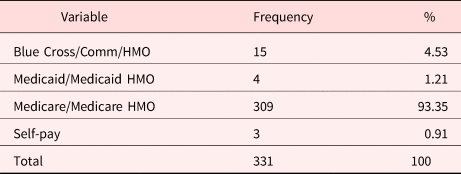
The results of this study indicate eMOLST completion is not associated with a lower cost of care in the management of sepsis for patients in the ICU. Forty percent of the patients who signed the eMOLST form had an estimated prognosis of >1 year. MOLST is appropriate for patients who might die in the next year. Despite the fact that 30% of patients were discharged into a skilled nursing facility, upon admission, <1% had completed an eMOLST form. It is unclear if completing the eMOLST forms before admission would have changed the trajectory of the patient experience in this institution (i.e., less costly care). The majority of patients in this ≥65-year-old age group were Medicare recipients (Table 4) and even small savings could be significant for the US healthcare system.
Payer status for all patients

Comm, commercial; HMO, health maintenance organization.
Clinician training in ACP and communication skills that support the eMOLST process using a team-based interdisciplinary approach within scope of practice is imperative (Reinhardt et al., Reference Reinhardt, Downes and Cimarolli2017). The PC Service at ORMC has conducted training for the clinical staff and continual training sessions are warranted for the eMOLST Registry user numbers to increase. Of note, ORMC has several newly developing residency programs, for which competency in the eMOLST process is integral to training. Theoretically, this will increase the prevalence of eMOLST completion within the hospital system overall.
CMI was originally designed to calculate hospital payments, not to track disease severity. It is highly dependent on documentation and coding accuracy; however, CMI has become a commonly used disease severity index (Mendez et al., Reference Mendez, Harrington and Christenson2014). Within this institution, a high CMI reflects that the hospital performs more expensive services and therefore receives more reimbursement per patient. We did not find a significant difference in CMI among patients who did complete the eMOLST form versus patients who did not.
Calculating exact cost is complex and the definition of cost varies by perspective taken across institutions as well as within healthcare systems. In this study, direct costs are all costs associated with direct patient care. We did not investigate indirect costs, which are costs associated with departments and staff that support patient care such as nursing directors. The ratio of cost to charges examines individual cost centers and their associated revenue. ICU accommodations, computed tomography scans, and radiology are examples of cost centers. Actual invoice cost includes items such as medical supplies (e.g., nasogastric medical tube, gauze). Activity-based costing includes costs associated with time measures. Patients who presented with a diagnosis of sepsis, regardless of severity of sepsis (i.e., sepsis, severe sepsis, septic shock, or septicemia) were included. It is difficult to obtain precise costs for treatment of sepsis because of controversy regarding the definition and nature of sepsis, which is typically accompanied by comorbidities such as diabetes, pneumonia, or cancer (Arefian et al., Reference Arefian, Heublein and Scherag2017). Our dataset included all categories of sepsis; therefore, calculating precise costs was challenging.
Implementation of the eMOLST system has been a meaningful development at this hospital since 2014; it is automated to prevent incompatible medical orders and to address incomplete or incorrectly completed MOLST documents. It is designed to ensure that the clinical, ethical, and legal process for making end-of-life decisions is always followed (Bomba & Orem, Reference Bomba and Orem2017). The upgraded electronic medical record in this hospital offers a single sign on gateway for the clinician to enter the eMOLST Registry, a development that was implemented in 2016. This encourages the clinician to use the eMOLST form and allows for rapid identification and updating of patient preferences.
Before being transferred to the ICU, most patients are admitted to the emergency department. We found that resistance exists by newly graduated healthcare providers who are uncomfortable with having end-of-life discussions with patients, thereby delaying the initial ACP conversation. Early identification of patient preferences in regard to end-of-life goals of care can potentially reduce unwanted and possibly futile expensive treatment given to the patient, and thereby reduce overall costs.
Future studies could explore patient outcomes by analyzing outcomes before and after the eMOLST system was incorporated into the hospital's workflow. Difficulty with such a study includes accounting for inflation, changes in insurance reimbursement, and changing costs within hospital systems.
This single-institution study based in a community hospital focused mainly on three parameters: completing an eMOLST form, LOS, and cost. We propose that the value of ACP such as eMOLST is not only in cost reduction; instead, it is in the quality of care that patients receive (Bond et al., Reference Bond, Kim and Franciskovich2018). New York State MOLST and eMOLST focus on shared decision-making that is well informed based on the patient's current health status, prognosis, and goals for care. It was positive to note that the plurality who signed the eMOLST form were the patients themselves (43.30%) followed by the healthcare agent (36.08%) (Figure 5). Educational programs are greatly needed for clinicians, patients and family members, caregivers, surrounding nursing homes, and physician practices to streamline the eMOLST process to ensure the patient's last wishes are being met.
Acknowledgments
The authors thank the following individuals for their contributions in this study: Pete Ondish; David DeLong; Katie Orem; Adrian Paraschiv, MD; Cleveland Lewis, MD; Regina Toomey-Bueno; Ashok Kumar, MD; and Thomas R. Eanelli, MD. We also thank the administration of Orange Regional Medical Center for its support in this endeavor.