The field of gender archaeology has existed within the broader discipline of archaeology for several decades in the Anglo-Saxon academic setting. It began with the exposure and analysis of a marked androcentric bias in both professional practice and interpretations of past societies (Conkey & Spector Reference Conkey and Spector1984; Gero & Conkey Reference Gero and Conkey1991; Wylie Reference Wylie, Gero and Conkey1991) and by situating and raising awareness of women in societies of the past (e.g. Claassen & Joyce Reference Claassen and Joyce1997; Crown Reference Crown2000). The Spanish school of gender archaeology has mainly adopted the perspective of material feminism to increase the visibility of activities that are generally associated with women and therefore have often been ignored, especially those associated with social reproduction and maintenance (e.g. Piqué et al. Reference Piqué, Vila, Berihuete, Escoriza, López and Navarro2008; Sanahuja Reference Sanahuja2002).
One of the greatest difficulties in gender-based approaches in archaeology, however, has been to associate material culture and practices with a given gender, i.e. to relate certain activities, uses and distributions of material culture with a given sex/gender, without projecting and imposing our own categories onto past societies. This challenge emerges even in bioarchaeological studies focused on musculoskeletal stress markers, where the same marks found on males and females are attributed to different activities, based on expectations of the sexual division of labour grounded in current Western criteria (e.g. Esched et al. Reference Esched, Gopher, Galili and Hershkovitz2004).
Over the past decade, gender studies in archaeology, echoing and aligning with theoretical developments in gender anthropology, have begun to question not only these kinds of projections, but the very assumption that a dichotomized, binary gender system existed at all in past societies, whether hierarchical or not, and whether present at all times in their development (Ghisleni et al. Reference Ghisleni, Jordan and Fioccoprile2016; Joyce Reference Joyce2009; Robb & Harris Reference Robb and Harris2018).
These questions are linked to foundational issues addressed by Anglo-Saxon gender anthropology in the 1970s–80s, when discussion centred strongly on the universality and causes of hierarchical gender systems in which women invariably occupied an inferior social position (Ortner Reference Ortner, Rosaldo and Lamphere1974; Reference Ortner1989–1990; Rosaldo Reference Rosaldo, Rosaldo and Lamphere1974), and the possibility that truly egalitarian societies have existed in the past (Leacock Reference Leacock1978). In this regard, it seems that even the most egalitarian societies display differences that invariably favour men in the symbolic realm and in terms of prestige (Hernando Reference Hernando, Dommasnes, Hjørungdal, Montón-Subías, Sánchez Romero and Wicker2010; Ortner Reference Ortner1989–1990).
The development of gender archaeology in Latin America has been slow. In Central America, as Navarrete (Reference Navarrete2010) indicates, interest in this subject has developed principally in the work of Anglo-Saxon women archaeologists (e.g. Brumfiel Reference Brumfiel, Gero and Conkey1991; Claassen & Joyce Reference Claassen and Joyce1997) who concentrated on visibilizing women's economic and social activities, their agency and associated symbolic aspects. In South America, gender studies have not developed so strongly (Williams & Alberti Reference Williams and Alberti2005). They have been carried out by North American archaeologists, especially in the work of Gero (e.g. Gero & Scattolin Reference Gero, Scattolin, Nelson and Rosen-Ayalon2002); South American archaeologists have produced occasional works, mainly focused on visibilizing the androcentric bias in archaeological practice and production (e.g. Bellelli et al. Reference Bellelli, Berón and Scheinsohn1993).
In the archaeology of central Chile, and indeed Chilean archaeology as a whole, virtually no studies with a gender perspective have been conducted to date, with a few exceptions (e.g. Planella & Falabella Reference Planella, Falabella and Montecinos2008; Sánchez Reference Sánchez1993; Torres-Rouff Reference Torres-Rouff, Baadsgaard, Boutin and Buikstra2011). It is in this nascent context that we ask the central question of this study: Were gender divisions, understood as the social construction of sexual differentiation, operative during the Ceramic Periods of central Chile? At a time when major changes were occurring in mobility and subsistence systems as a result of the introduction of cultigens, we explore whether gender categories existed, how they emerged and whether they changed over time.
Gender studies in funerary contexts
Funerary practices offer a unique opportunity for studying past gender systems. They allow the remains of a potentially sexable person to be concretely associated with a set of mourning practices and material cultural elements in a specific socio-cultural matrix.
The study of funerary contexts, however, is not free from complexities, primarily because mortuary practices cannot be understood merely as a reflection of a broader society; rather, they constitute a space for agency, ideological manipulation and the active social construction of reality (Shanks & Tilley Reference Shanks, Tilley and Hodder1982). The specific socio-historical context in which these rituals took place is fundamental insofar as social acts occur within a framework of meanings which is relative and historically constructed (Costin Reference Costin and Wright1996; Hodder Reference Hodder, Miller and Tilley1984). In keeping with this, and noting that the dead do not bury themselves, it is equally important to consider the social group left behind by the deceased person (Parker Pearson Reference Parker Pearson2000). This requires us to emphasize that the patterns observed are the product of actions undertaken by mourners within a culturally and historically framed ideological representation.
The socio-political dimension of funerary practices must also be considered (cf. Hayden Reference Hayden2009). As a social event, they potentially congregate a number of people from outside the deceased person's domestic unit. In the political dimension, they offer a scenario where social relations and alliances are displayed, declared and managed. As a type of ritual activity, understood as a repetitive behavioural pattern that expresses fundamental societal values (Parker Pearson Reference Parker Pearson and Hodder1982), funerary practices are an especially effective instance in non-state societies, offering a privileged space for the ideological deployment of social actions that involve the infinite recreation of the same ritual elements (Shanks & Tilley Reference Shanks, Tilley and Hodder1982).
With this in mind, when differences between males and females existed in the funerary practices of a given context, we can assume that the living took an interest in these differences and in how they were renegotiated in the mortuary sphere. However, this does not imply that this differentiation can automatically be applied to everyday life (Stratton Reference Stratton2016). At the same time, there is no assurance that gender as a social identity is necessarily expressed through funerary practices (Jordan Reference Jordan2016; Joyce Reference Joyce2009; Stratton Reference Stratton2016). Material culture and objects, or certain aspects of these, effectively serve as repositories of gender symbolism and therefore act as contextually determined gender markers (Sofaer Reference Sofaer, Moore and Scott1998). However, material culture is also multi-dimensional, and does not always necessarily refer to a single aspect of a person's identity in all contexts (Jordan Reference Jordan2016; Joyce Reference Joyce2009; Stratton Reference Stratton2016).
Gender, on the other hand, is not a static category. Rather, it is intersected by age categories and therefore should be understood as a process (Sofaer Reference Sofaer1997a,Reference Sofaerb; Reference Sofaer, Moore and Scott1998). As social constructions, gender categories are learned, and gender roles change throughout the human life cycle. The material culture associated with a given gender may also change with age, to the extent that socio-economic roles and perceptions of what is acceptable for a given gender/age category are modified (Sofaer Reference Sofaer1997b).
In the light of the above, analysis of funerary contexts must consider that: a) the category of gender may not necessarily be operative; b) if it is operative, it is not necessarily binary; and c) if it is operative, it will not necessarily be reflected in funerary practices. The methodological strategy, then, must start with recurring contextual associations of funerary objects. Only then can sex be considered as one of the possible identities at play, and those aspects/objects be examined that may seem exceptional to us, as well as those that are less significant. Such a methodological strategy must consider all possible ambiguities in the data, enabling us to identify aspects that are potentially significant (Jordan Reference Jordan2016; Stratton Reference Stratton2016).
The Ceramic Periods in central Chile
The Ceramic sequence in central Chile began around 300 bc when pottery appeared. The introduction of cultigens gradually changed the diet of these populations and was accompanied by a shift to a sedentary lifestyle in the first millennium ad (Early Ceramic Period). The process was heterogeneous as not all groups farmed the same range of crops (Planella et al. Reference Planella, Falabella, Belmar and Quiroz2014), nor did they farm their chosen crops to the same extent (Falabella et al. Reference Falabella, Planella, Aspillaga, Sanhueza and Tykot2007; Reference Falabella, Planella and Tykot2008). By ad 1000, with the changes that gave rise to the Late Intermediate Period, a diet based on cultigens, especially corn (Zea mays), and a sedentary lifestyle were well established in this region.
Two partially contemporary cultural complexes have been identified for central Chile during the Early Ceramic Period. Bato (ad 200–1000) developed slightly earlier and Llolleo (c. ad 450–1200) extended slightly later, but they coincided during a large part of the sequence (at least 500 years) and occupied the same area (Aconcagua, Maipo/Mapocho and Cachapoal watersheds, from the coast toward inland areas and the mountains of central Chile). These two complexes shared certain characteristics such as an emphasis on monochrome designs and plastic decorations on ceramics, and the preferred position of the bodies in their burials (flexed); in both cases the burial sites were directly associated with dwelling areas.
The main differences between these two complexes lie in the characteristics of their ceramic production (specific forms and decorations), in their funerary practices (primarily the inclusion or not of ceramic vessels as part of the offering and certain variations in body position), in the use of certain body adornments (a ceramic or stone labret for Bato and beaded necklaces for Llolleo) and in their livelihood and mobility (Falabella et al. Reference Falabella, Pavlovic, Planella, Sanhueza, Falabella, Uribe, Sanhueza, Aldunate and Hidalgo2016). The Llolleo farmed several cultigens: quinoa, beans, squash and, most importantly, corn, and appear to have had a more sedentary lifestyle. The Bato also farmed cultigens, but not such a wide variety as Llolleo, and these cultigens are found less frequently in the contexts they inhabited. Corn does not appear to have had the same importance as it did for Llolleo groups (Falabella et al. Reference Falabella, Planella, Aspillaga, Sanhueza and Tykot2007; Reference Falabella, Planella and Tykot2008; Planella et al. Reference Planella, Falabella, Belmar and Quiroz2014). It is therefore assumed that their lifestyle was less sedentary and that hunting and gathering played a greater role in their sustenance.
Both groups exhibited a dispersed settlement pattern, indicating that each had a relatively simple social organization with no institutionalized hierarchy. The main difference can be seen in the degree of integration between autonomous co-residential units and the spatial scales on which this occurred, with the Llolleo appearing to be integrated on a more limited spatial scale than the Bato (Sanhueza Reference Sanhueza2016).
Only one cultural complex has been defined for the Late Intermediate Period: the Aconcagua group (c. ad 1000–1450), which extended from the Pacific coast to the inland valleys and the Andes Mountains of central Chile. Changes from the previous period are recorded in all areas of society: ceramic production changed in terms of the raw materials used, the vessel categories produced (greater importance placed on open-mouthed vessels such as bowls) and the type of decorations used (painted and geometric). In terms of livelihood, these groups farmed a wider variety of cultigens, corn being the main crop; small-scale camelid raising has also been put forward as a possibility (Soto Reference Soto2018). In terms of funerary practices, cemetery spaces of up to 100 burial mounds, most of them with multiple burials, were common inland. Other areas, such as that lying south in the Santiago basin, the coastal mountain valleys and the coast itself, do not present this type of above-ground structure, and, at least on the coast, burials are associated with dwelling sites. Despite their differences from the Early Ceramic Period, these groups have also been described as non-hierarchical, medium-scale societies.
To date, studies that analyse gender in the prehistory of central Chile have been scarce. Sánchez (Reference Sánchez1993), in his analysis of the Chicauma burial mound cemetery site, proposes that the Aconcagua group observed a hierarchical difference between males and females and between children and the elderly, based on the distribution of their burials in the cemetery, the size of the burial mounds and the number of offerings. Considering this proposal, it has been proposed that a difference in gender relations emerged with a tendency towards hierarchical gender relations occurring in the Late Intermediate Period (Falabella Reference Falabella and Montecinos2003; Planella & Falabella Reference Planella, Falabella and Montecinos2008). Analysis of stable isotopes has shown another interesting divergence between the two periods: the consumption of corn differed between men and women in the Late Intermediate Period, something that has not been detected in the Early Ceramic Period (Falabella et al. Reference Falabella, Planella, Aspillaga, Sanhueza and Tykot2007).
Recently, we have proposed a substantial difference between Bato and Llolleo in terms of societal representation in Early Ceramic Period funerary contexts in central Chile. The evidence shows that the Llolleo segregated the male realm from the female/child realm, the former being associated mainly with jars and so, it is suggested, with the socio-political dimension of drinking. Females and children, on the other hand, were associated with jars but also with elements related to farming and processing, such as cooking and storage pots, and grinding-stones. This contrast suggests an analogy between biological and social reproduction. In Bato funerary contexts, no gender or age differences were observed in the offerings, and any possible differentiations appear to have been organized around other axes (Sanhueza Reference Sanhueza2016).
While previous research considered only Early Ceramic sites, for this study we have included new evidence for the Early Ceramic Period funerary contexts and added sites from the Late Intermediate Period. They will provide us with a more comprehensive picture of similarities and differences related to the variables of sex and age and eventually gender constructs in those periods, based on funerary contexts in central Chile.
Sample and methodology
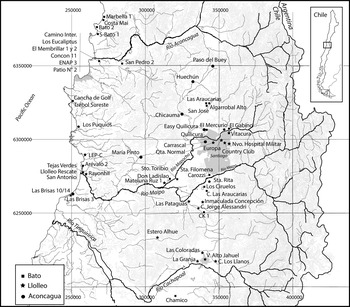
The sample is composed of a total of 489 funerary contexts from 56 sites in central Chile (Fig. 1; Supplementary material). We obtained funerary context data from publications, manuscripts and/or field reports of excavations conducted as part of Cultural Resources Management or salvage archaeology. Funerary contexts were only included if they provided reliable information on the individual and his/her contextual associations, and if there was certainty regarding cultural affiliations. Bioarchaeological information was obtained mainly from reports where the archaeologist or bioarchaeologist based an estimate of sex and age on direct observation of the skeletal remains. Conservation conditions are poor, especially in inland areas of central Chile, and the remains of individuals often do not allow for detailed observation; in many cases, sex/age cannot be inferred. At other times the estimate was only recorded in situ because the fragility of the remains made laboratory observation impossible. The reliability of the sex/age data is variable, increasing in the more recent reports. In some collections (18 sites, 88 individuals) sex/age information was complemented by direct laboratory observations made by a collaborating bioarchaeology team; in most cases, the sex/age information of the individual coincides, but in cases where it did not (11 cases), preference was given to the most recent information with the greatest number of updated protocols and observations for this determination.
Map showing the sites with funerary contexts used in this study.

Regarding age, an attempt was made to use the greatest number of age-range categories. However, this was hindered by the information available in reports, publications and manuscripts, which often provide only generic age categories (child/adult). Even so, we were able to generate the following subcategories for 302 of the 489 cases included in the sample: child ‘a’ (under 1 year old); child ‘b’ (between 1 and 5 years old); child ‘c’ (between 6 and 10 years old); juvenile (11–17 years); young adult (18–24 years); adult (25–40 years); mature adult (over 40 years).
For funerary contexts, information on the position of the body and associated features (e.g. evidence of burning, rock piles) and offerings were taken into account. Due to the poor conservation conditions mentioned above, no organic remains were conserved, with the exception of charred botanical remains, animal bones and shells. The few cases where skin or hair remains were reported (n = 4) were not considered due to the lack of comparable information between contexts. However, these reports drew attention to the fact that we are working with only part of the context, which undoubtedly can generate a significant bias.
Another related issue is the difficulty of discerning whether an object (ceramic fragments, lithic flakes, shells) was intentionally included in funerary contexts in cases where burial grounds were located in dwelling sites. This is especially challenging for the Bato contexts, because they were frequently located in waste disposal areas and in shallower graves than the Llolleo. To the extent that the information was available in reports and publications, intentional inclusion in the funerary context was assessed case by case, based on the description in the field report of the excavation process and the funerary context, the degree of association and completeness of the objects and their distribution in relation to the body (88 cases).
There is a finite repertoire of objects that were included in funerary contexts in central Chile. They can be grouped into four categories: those related to production (artefacts used in producing or processing food or other artefacts, such as projectile points, grinding tools, cooking pots, scrapers, etc.); those associated with consumption activities (ceramic jars and bowls; zooarchaeological and botanical remains); those referring to more ritualistic practices (e.g. objects that have no utilitarian or known function, like bezoar stones, quartz crystals, bone spatulas, etc.); and those that can be considered as personal adornments (e.g. earrings, beads, necklaces, labrets) (Tables 1, 2 & 3). These categories should not be understood to be exclusive; in other words, objects may have adopted different meanings in different contexts (e.g. camelid phalanges were categorized as related to consumption, but they may well also be elements of a ritualistic/symbolic order).
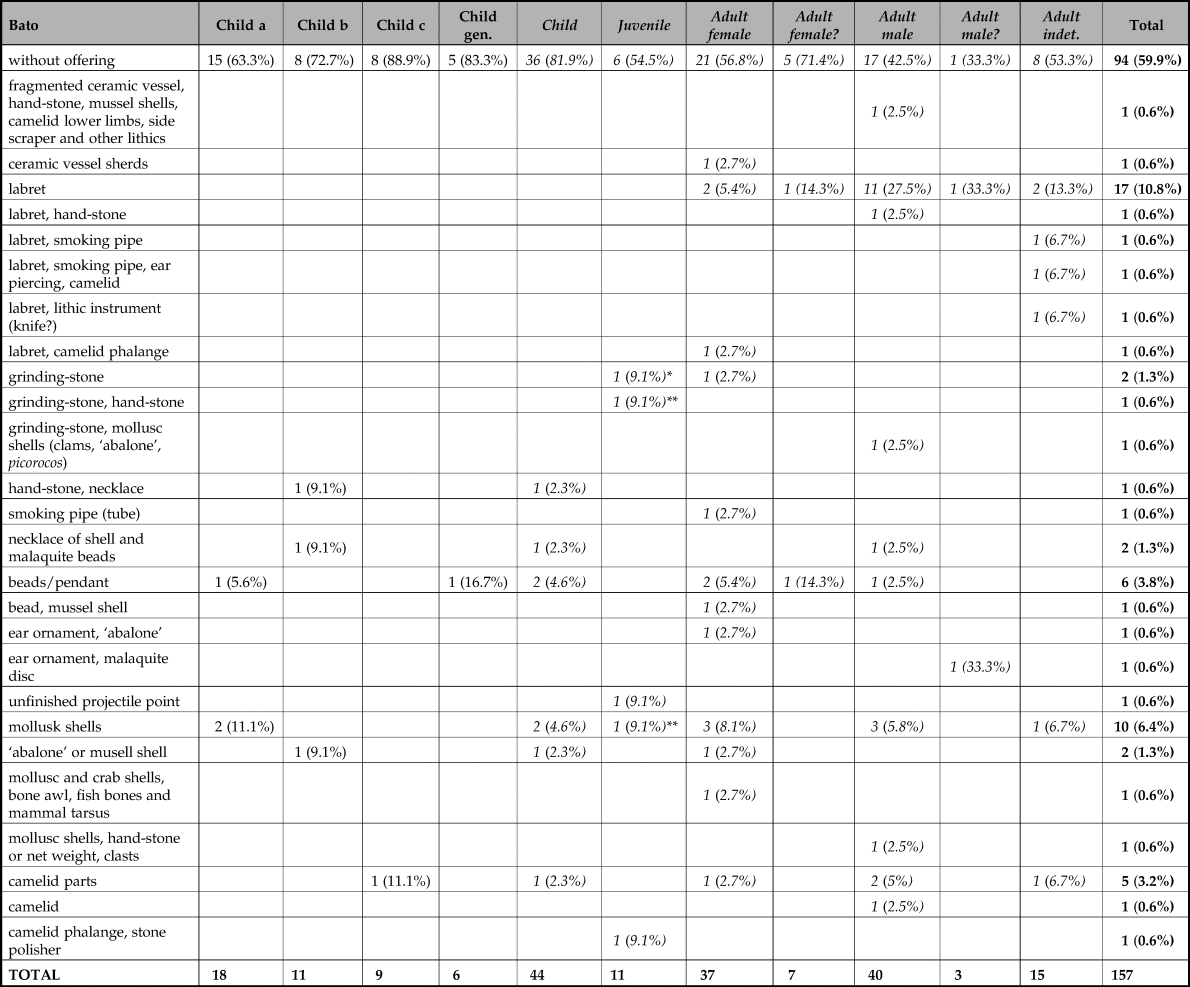
Offering associations in Bato contexts (Note: in juvenile column *probable female; **probable male.)

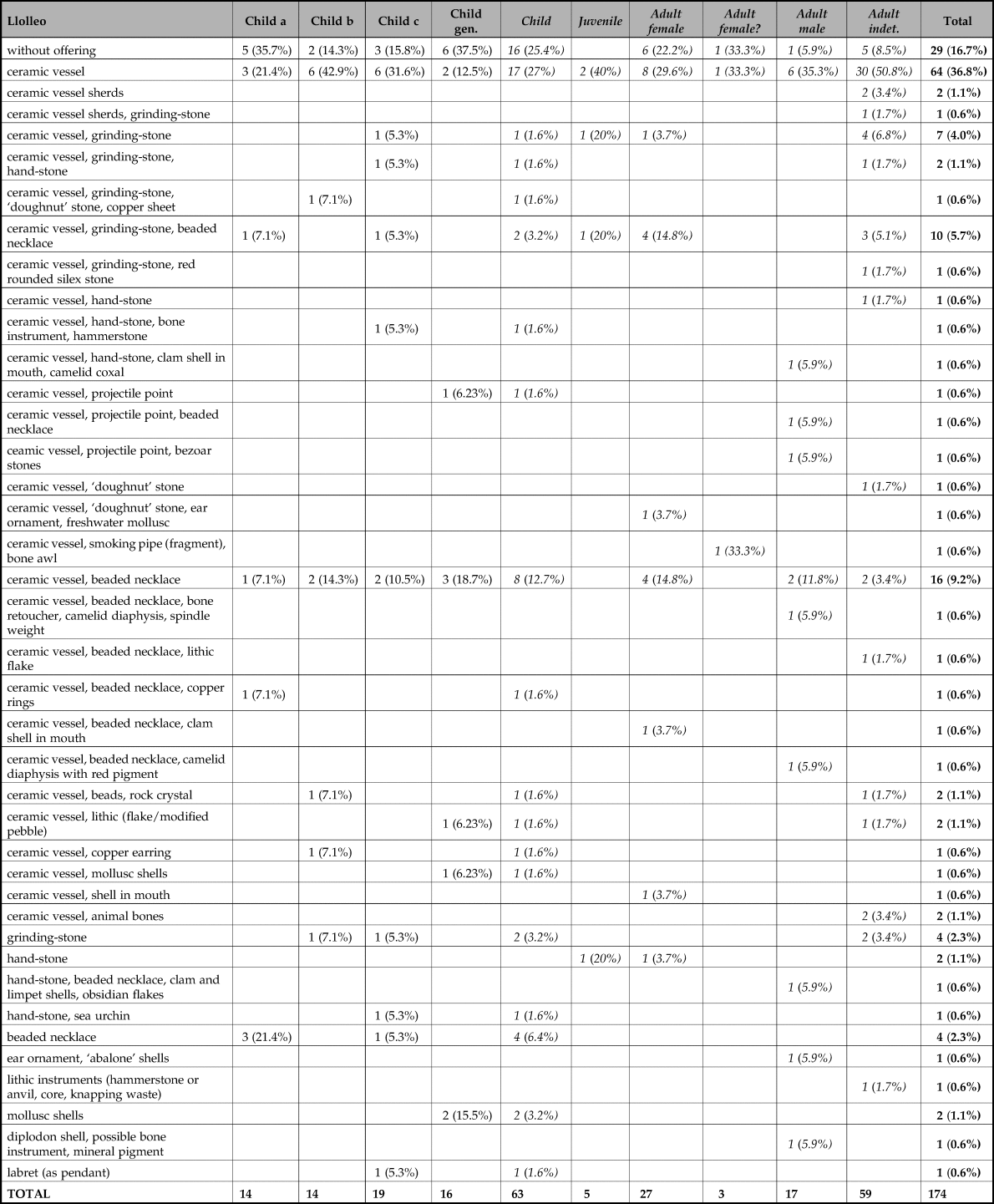
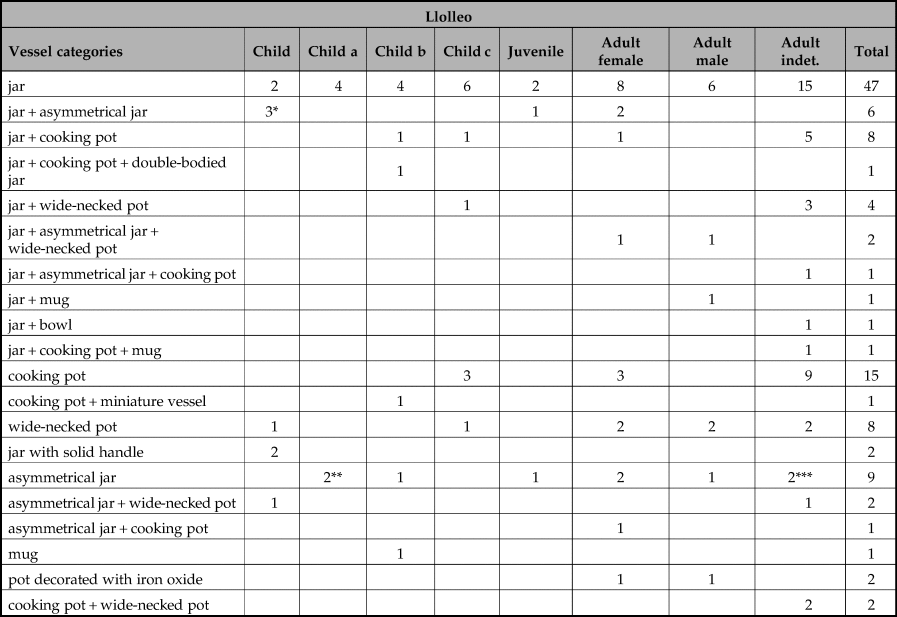
Offering associations in Llolleo contexts.

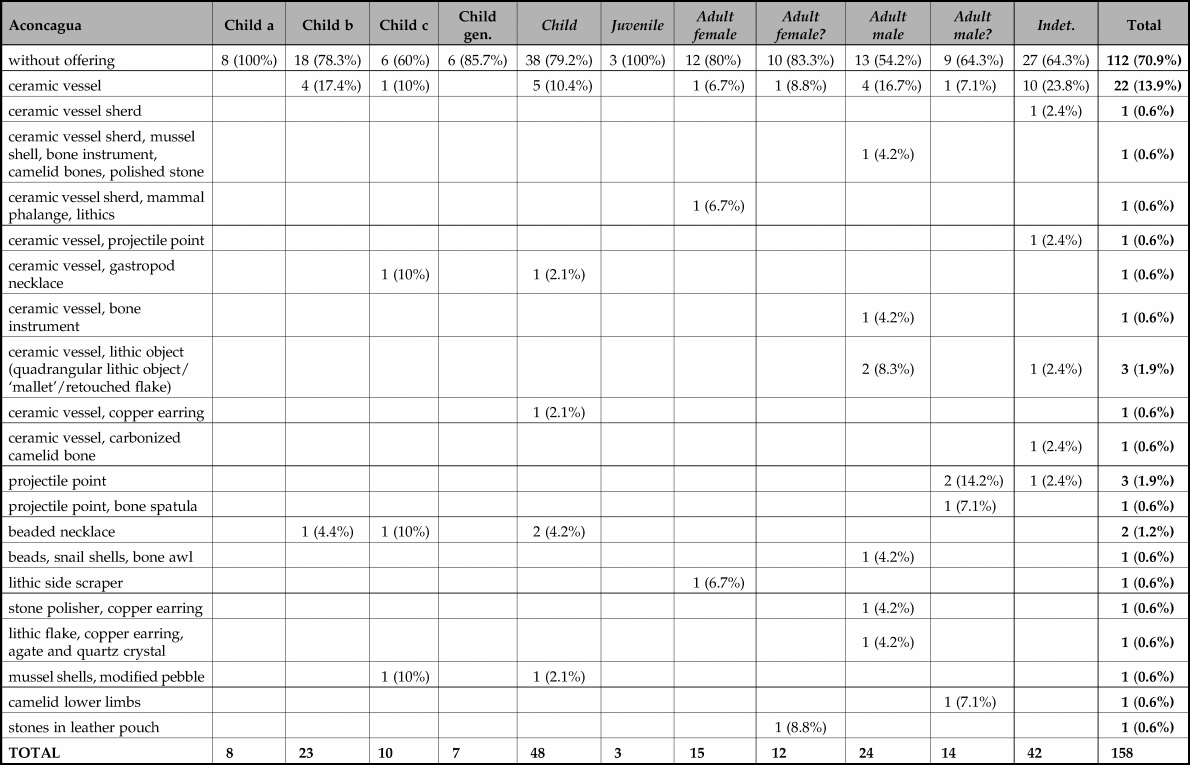
Offering associations in Aconcagua contexts.

Bato funerary practices
The Bato sample is made up of 157 individuals, 44 of whom were identified as female or probably female, 43 as male or probably male, 15 as adults of indeterminate sex, 11 sub-adults (3 with probable sex assignation) and 44 children (Table 1).
Bato burials were generally located in dwelling areas, usually directly within waste disposal areas and sometimes at very shallow depths (30 cm). This can make it difficult to distinguish what was intentionally placed as a funerary offering/object and what was used to fill the burial pit (see above).
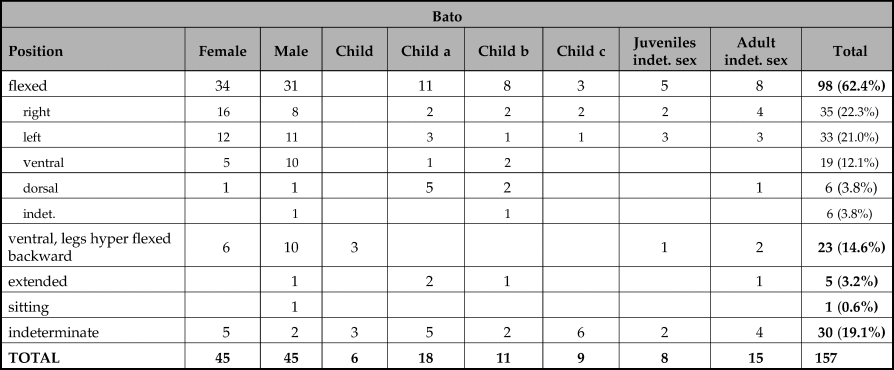
The preferred body position was lateral flexed or hyper-flexed (right or left and less frequently ventral) (63.1 per cent); the ventral position with legs hyper-flexed towards the back and feet in the gluteal area (14 per cent) is a position that only occurs in Bato contexts. Males, females and children were positioned in both ways, although there seems to have been a preference for the ventral position in burials of male individuals. The extended position was also recorded in exceptional cases (five cases, three of them questionable) and there was one case of the seated position. In many cases, mainly those of children, the position could not be identified (16 cases) (Table 4).
Body positions in Bato context. (Note: 3 juveniles have sex determined: 2 male, 1 female.)

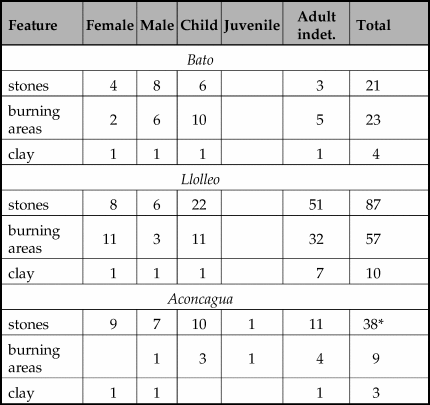
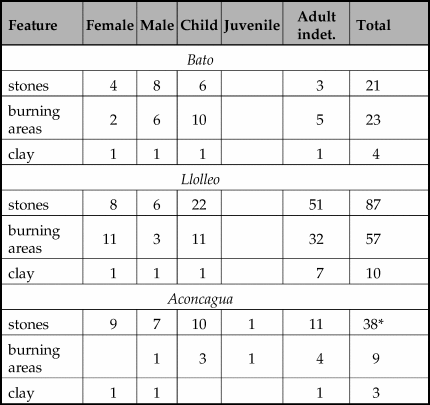
In the lower Aconcagua watercourse, the mortuary ritual sometimes involved burning events, which have generally been identified as associated with the burial and described as small burned areas or fires. The inclusion of stones or clasts in burials, sometimes described as pircas [dry stone walls] (Trebol SE case) or emplantillados [dry stone floors] (ENAP3 case), appears to have been common on the coast (only one case inland), where this practice has been recorded at coastal sites in both the Maipo and the Aconcagua watercourses. Males, females and children were subject to these practices, so it seems to have more to do with regional variations in mortuary practices than with sex/age (Table 5).
Stones, burning areas and clay in Bato, Llolleo and Aconcagua contexts. (Note: * = 4 explicit cases of dry stone floors.)
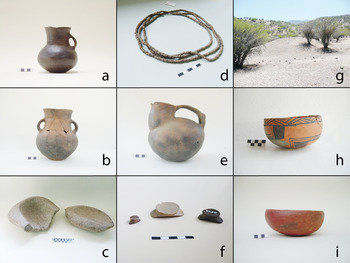
Thirteen types of funerary objects were found. Those used for adornment and personal use predominate, particularly ceramic or stone labrets (22 cases: Fig. 2f) and beads/necklaces (10 cases), in addition to ear ornaments (three cases) and a malachite disc (one case). Objects from the productive sphere were scarce, while ceramic vessels, projectile points and perforated or ‘doughnut’ stones were also conspicuous by their absence.
Objects from funerary context and tumuli: (a) jar (Llolleo); (b) cooking pot (Llolleo); (c) grinding-stone (Llolleo); (d) beaded necklace (Llolleo); (e) asymmetrical jar (Llolleo); (f) ceramic and stone labrets (Bato); (g) tumuli (Aconcagua); (h) Aconcagua Salmón type bowl (Aconcagua); (i) Aconcagua Rojo Engobado type bowl (Aconcagua). (All objects from Departamento de Antropología, Universidad de Chile collections. Photographs: L. Sanhueza.)

The distribution and grouping patterns of offerings generate 25 different possibilities (Table 1), which present the following overall panorama:
a) Burials without objects. This was the predominant form of burial in the Bato, both among adult females (57.7 per cent) and males (40 per cent), but predominantly among children, reaching 81.8 per cent (in subcategories ‘a’, ‘b’ and ‘c’). It is interesting to note that the burials of juveniles, while few in number (54.5 per cent), are more similar to adults than to children.
b) Individuals with labrets, only present in adults (with no distinction for age subcategory), primarily male (n = 13, 28.9 per cent; female n = 4, 8.9 per cent). Present in both coastal and inland areas, in only some individuals per site (Fig. 2f).
c) Individuals with necklaces/beads, present in female (n = 4) and male (n = 2) burials, and children (n = 4), all without labrets. Present only in coastal sites.
d) Burials with objects from the productive sphere, some of them with labrets or beads/necklaces; mostly adults and juveniles. Grinding-stones are associated with both male and female individuals; hand-stones with males and in one case an infant. Scarcer elements such as a fragmented vessel, a possible fishing-net weight and a side scraper appear next to male individuals, while a bone awl is associated with a female individual. A polisher and an unfinished projectile point appear next to juvenile individuals, and a knife is associated with an adult individual of undetermined sex.
e) Elements from the consumption sphere, such as mollusc shells and animal remains (usually camelid remains, e.g. phalanges, ribs or jaws) are found in burials of females, males and children, and are especially frequent in burials in the coastal sector (21 cases versus 2 inland and 3 in the mid-to-lower Aconcagua watercourse).
The inclusion of animals in the funerary contexts of the Bato 2 and ENAP3 sites on the coast and the Chamico site in the Rancagua basin is worthy of mention. In the first two, an association with camelids (Berdichevsky Reference Berdichewsky1964; Silva Reference Silva1964;) is reported, but due to the nature and antiquity of the report it does not provide a clear idea of the completeness and/or distribution of the animal with respect to the individual; only the Bato 2 individual was associated with a labret, a pipe and an ear ornament. The burial in the Chamico site is quite different (Cartajena et al. Reference Cartajena, Trejo, Sanhueza, Gutiérrez, De Nigris and Fernández2010): the head and the lower sections of the legs were removed from the animal's carcass and the thoracic cavity was separated and stretched to make room for the individual (adult male) whose remains were placed partially inside this cavity. The individual's body was placed in a ventral position hyper-flexed towards the back, with the feet in the pelvic area. No other offering elements were present. These constitute exceptional cases in the context of the Early Ceramic Period in central Chile.
As proposed earlier (Sanhueza Reference Sanhueza2016), the deceased in the Bato funerary tradition were situated in domestic and social spaces, and the main elements that differentiate individuals are those for personal use. These items allow the identification of two types of contrasting categories: with/without offerings and with/without labret. Others include with beads or necklaces/without ornamental elements, and with beads or necklaces/with labret.
These categories do not appear to relate to the sex of individuals, but rather to the age. The inflection point is the juvenile age category, which is more similar to adults than to children. In this regard, the clearest element is the labret, which is only present in adult individuals (both female and male), suggesting positions or attributes that are acquired in the course of life, regardless of the sex of the individual. However, they definitely appear to be more frequent in male individuals. On the other hand, elements related to production also appear mainly in the burials of adults and juveniles (there was only one case of a hand-stone included in a child's burial). These objects do not appear to be differentiated by sex and there is no pattern-forming recurrence.
The inclusion of beads or necklaces is related to geographical area rather than other variables, appearing mainly in coastal sites or in the mid-to-lower Aconcagua basin (San Pedro 2). Their appearance among individuals without labrets is not associated with sex or age categories (they are present in both female and male adults and children) or spatial categories (there are labrets and beads in the same sites). Therefore, these probably allude to other qualities or identities, currently undefined.
All the above findings suggest that the funerary space was not a place for the active construction of gender, but that the important aspects were certain qualities in adults as a group, through the presence of a labret, or the qualities of an individual, as indicated by the inclusion of different elements from the productive sphere. The maximum expression of this can be seen in cases where adult individuals were accompanied by practically whole camelids. This intersects with practices on a more ‘local’ scale, such as the inclusion of molluscs, animal parts, beads/necklaces, or burnings, and the inclusion of clasts in the coastal sector.
Llolleo funerary practices
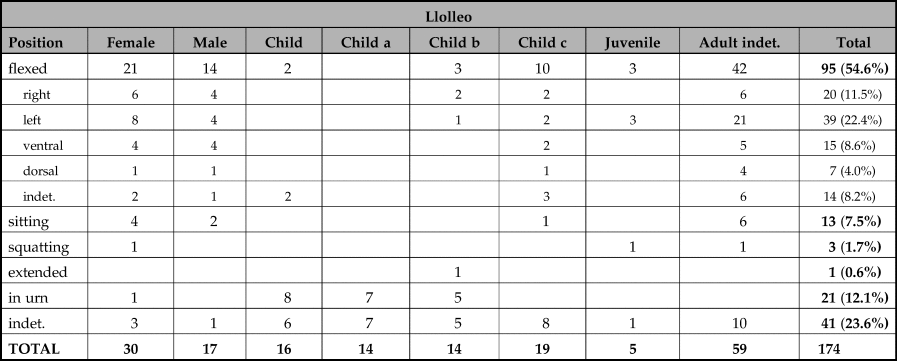
The Llolleo sample is made up of 174 individuals, 30 of whom were identified as female or probably female, 17 as male or probably male, 59 as adults of indeterminate sex, 5 sub-adults and 63 children (Table 2).
Llolleo burials are also directly associated with dwelling areas, generally in or slightly to one side of waste accumulation areas. As with the Bato, these are domestic and social spaces.
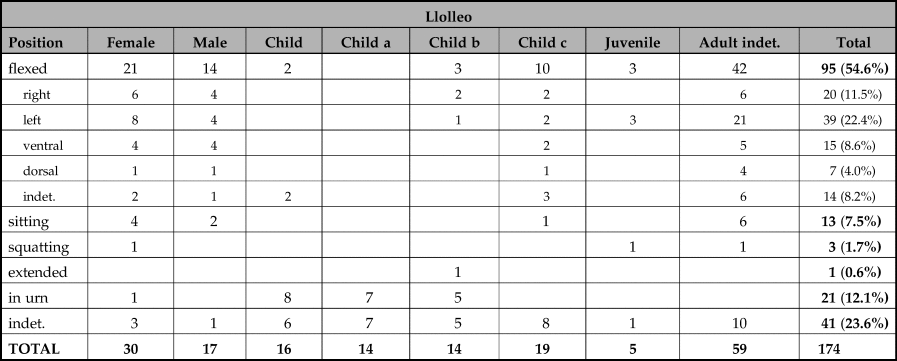
The preferred body position remains flexed or hyper-flexed, either horizontal (especially right or left lateral decubitus) or vertical (sitting and squatting). As research has shown (Falabella et al. Reference Falabella, Pavlovic, Planella, Sanhueza, Falabella, Uribe, Sanhueza, Aldunate and Hidalgo2016), children were treated in a unique fashion in Llolleo burials: 31.7 per cent (n = 20 of 63) in our sample were placed in large ceramic containers, re-used as urns. This practice was reserved particularly for the youngest children (subcategories ‘a’ and ‘b’, or up to 5 years), although many of them were buried directly in the ground, alongside older children (subcategory ‘c’). In only one instance, an adult female was found buried in an urn in Tejas Verdes 4 (Table 6).
Body positions in Llolleo contexts.
A number of relatively common practices were involved in the funerary rite, including small burnings (57 cases, in coastal and inland sites), the incorporation of clasts or boulders (86 cases) and the deposit of layers of clay (10 cases). Specifically, at the El Mercurio and Europa sites, both located in the middle watercourse of the Mapocho River, large boulders from the river, built up into piles alongside or on top of the body (from 2 to 25 boulders), were found in burials of children (placed in urns or not), both male and female. Turning to clay deposits, bodies found in coastal burials in Tejas Verdes 1 and Rayonhil were covered with a layer of clay; different variations were found at the Europa site, with clay located under the body, associated with the offering or in some cases in a layer on top of the body (Table 5).
Seventeen types of objects were included as offerings in Llolleo burials, with each of the four categories represented (production, consumption, adornments and symbolic). As we know (Falabella et al. Reference Falabella, Pavlovic, Planella, Sanhueza, Falabella, Uribe, Sanhueza, Aldunate and Hidalgo2016), the most frequent offering was the ceramic vessel, present in more than 70 per cent of adult burials (females, males and indeterminate) and in 60 per cent of child burials. In some instances, only vessels were included, but in almost half of the cases they were accompanied by other objects, mainly grinding-stones (n = 26) and necklaces (n = 39), but also instruments from the productive sphere (such as hand-stones, projectile points, bone instruments) and ornaments (ear piercings, copper objects) (Table 2).
The presence of offerings and associations between them generate a large number of possibilities (n = 38) (Table 2), leading to the following relationships (not mutually exclusive):
a) Burials with no objects—not the most common option, but more recurrent among children (25.4 per cent) than adults (12.7 per cent). Among adults, only one male individual had no offering. Among children who could be sub-classified into age categories, this seems to be more recurrent in children under 1 year old, although the sample size is small.
b) Burials with vessels—the most frequent offering found for all age categories and for male and female individuals. As mentioned, vessels were the only object found in some burials, while in others they were accompanied by ornamental or productive elements. In terms of the types of vessels included, jars and wide-necked pots appear across the board in burials of children and adults of both sexes. Cooking pots and asymmetric jars, however, appear to be almost exclusively associated with adult females and children (Table 7; Fig. 2a, b, e).
c) Burials with no vessels, but with some other element from the productive sphere or personal adornments; these occur more frequently among children.
d) Burials with grinding-stones—elements linked to the processing of plant remains, specifically flour, associated with children (n = 9), juveniles (n = 2) and females (n = 5) (Fig. 2c). A similar scenario was found with perforated or ‘doughnut’ stones.
e) Individuals with necklaces—mainly children (n = 17), but also adults (young, middle-aged and mature), both female (n = 9) and male (n = 6). This common association of ornamental objects with children also extends to copper (n = 3), which so far has only been associated with this age group (Fig. 2d).
f) Burials with more than four objects in the offering—found among children and adults, female and male.
g) Burials with projectile points—these appeared infrequently (n = 3): twice with adult males and once with a child.
h) Burials with elements from the animal realm (n = 5)—primarily camelid diaphysis and in one instance a hip-bone, associated with males in inland sites.
i) Burials with mollusc shells—present in both coastal areas and inland, with children and female and male adults. There are some cases on the coast where the occurrence of mollusc shells as an offering is unclear, but others where the presence of discrete assemblages is reported. There is even one case with freshwater mollusc shells. Inland, shells identified as razor clams, and in one case a limpet, were placed in the mouth of the individual (3 of 5 cases).
Vessel categories associations in Llolleo funerary contexts. (Note: * in two cases the assymetrical jar is a miniature; ** in one case the asymmetrical jar is a miniature; *** one of the asymmetrical jars has two mouths.)
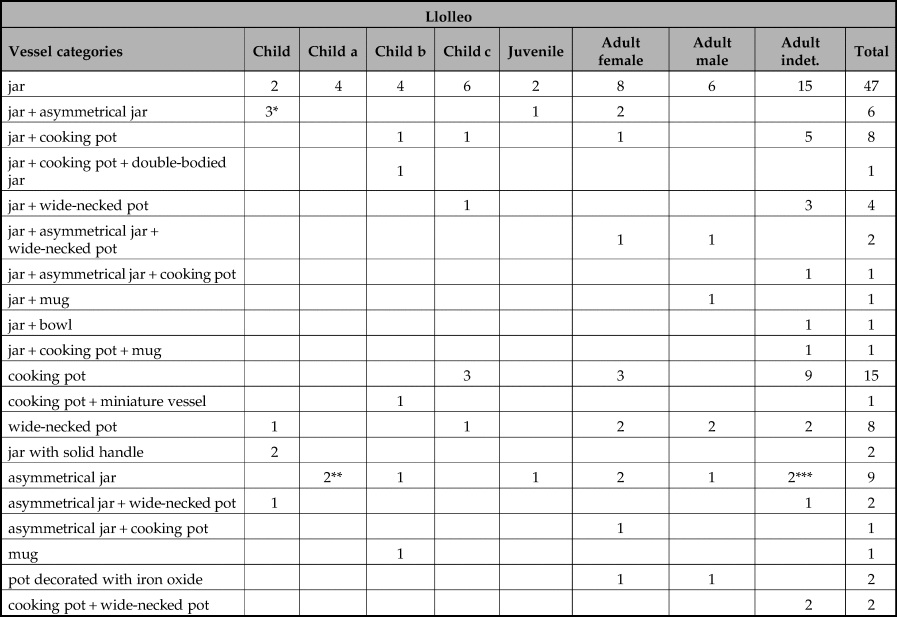
Llolleo funerary practices present a different scenario from those of Bato groups, not only because the array of offerings includes a wider spectrum of objects, but because of the recurrence of a set of oppositions that seem to relate to both the age and sex of the individuals, and potentially to other factors: with/without vessels; with productive elements associated with the plant environment/with productive or consumption elements associated with the animal world; with/without ornamental elements.
In terms of age, children most commonly appear without offerings, especially the younger ones. Differential treatment was given to a particular group of children who were placed in urns, and whose remains may or may not be accompanied by other offerings. Ornamental elements such as necklaces and copper objects were most commonly found with children. Also notable is the association of women and children with elements related to the production and processing of plant resources—grinding-stones, perforated stones, cooking pots, asymmetric jars and urns in the case of children, recycled from their primary function as storage vessels—a sphere from which adult males were excluded. However, not all females or children are accompanied by such objects (46.7 per cent and 57.2 per cent, respectively).
Males are exclusively associated with projectile points and animal bones in inland areas, although this does not appear to be a recurrent practice (four cases).
There is a series of elements that allude to local practices, such as the inclusion of large stone boulders in the two sites located on the banks of the Mapocho river, or the practice of covering some bodies with clay in the sites along the mouth of the Maipo river.
The above analysis allows us to propose that age- and sex-related discourses are actively deployed in the funerary space, but not all females and children were included in this distinction. Other elements, such as ceramic jars and wide-necked pots, tend to unify females, males and children, and seem to allude to the group as a whole; necklaces follow the same logic, but are less frequent and may allude to other distinctions that are currently unknown.
Aconcagua funerary practices
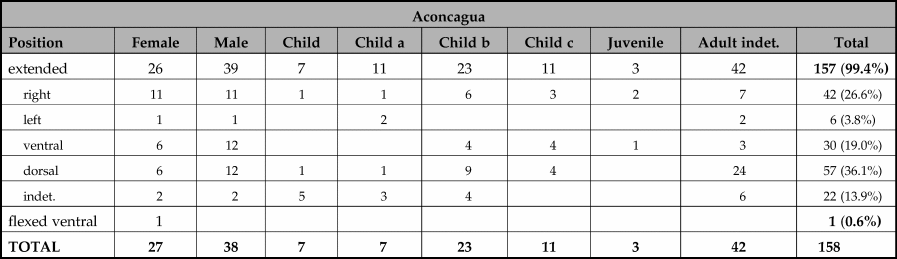
The Aconcagua sample is made up of 158 individuals: 27 of these were identified as female or probably female, 38 as male or probably male, 42 as adults of indeterminate sex, 3 sub-adults and 48 children (Table 3).
One of the primary differences between funerary practices in the Late Intermediate Period and the Early Ceramic Period is the use of separate areas for burials away from dwelling sites, involving the formation of true cemeteries with tumuliform structures (above-ground, human-made mounds between 5 and 16 m in diameter and from 20 to 120 cm in height: Fig. 2g) holding up to six individuals (Durán & Planella Reference Durán, Planella, Hidalgo, Schiappacasse, Niemeyer, Aldunate and Solimano1989). In the northern sector of the Santiago basin, cemeteries can have up to 100 tumuli (e.g. Chicauma), although others exist that are smaller in size (e.g. Huechún and Paso del Buey).
In other areas the presence of tumuli is not so evident. There are also burial areas in the northern area of the basin with no associated dwelling areas and no tumuli recorded (Easy Quilicura/Marcoleta). The non-existence of mounds may be related to past cultural practices that did not include above-ground tumuli, or to post-disposal processes associated with farming, which flattened the land (as was the case with the Chicauma cemetery after its excavation). The same uncertainty exists for other sites in the inner Maipo basin.
There are no records of tumuli on the coast, where individuals were buried inside domestic spaces or adjacent to them, marking a difference from inland sites.
The remains of all the individuals in Late Intermediate contexts are placed in an extended position, most often dorsal, right lateral or ventral. Only six cases presented a left lateral position: these were found at different inland sites and fell into different age and sex categories. The only exception to this pattern is a female individual from the Las Brisas 10-14 site, found in a ventral position with her legs bent backwards. This is characteristic of the Bato, but she was found with an offering that clearly places her in the Late Intermediate Period (Aconcagua Salmon-type ceramic bowl fragment near the skull) (Table 8).
Body position in Aconcagua contexts.

The inclusion of stones was a relatively common practice in Late Intermediate burials (38 cases), but different characteristics were adopted in accordance with the site. Whereas only stones or clasts were included in the tombs at the Carrascal site, the sites with tumuli in Huechún and Chicauma are described as having (in addition to isolated or haphazard clasts) alignments, ‘structures’ and ‘dry stone floors’, generally associated with adults (10 cases) (Table 5).
Burnings seem to have been less frequent as they were seen in only five individuals in the burial grounds, all in Chicauma, with no recurrence for age or sex. Two bodies were found covered with a mix of compact earth and plant matter, and others with several colours of rust sediment on the body in Huechún, which correspond to local practices (Table 5).
In terms of offerings, although they encompass all object categories (production, consumption, adornments and symbolic), there is a smaller repertoire of objects included, while grinding-stones, hand-stones and perforated or ‘doughnut’ stones are notably absent. The presence and associations between the offerings have generated 21 possible combinations (Table 3); overall, the following can be observed:
a) Individuals with no objects—the predominant mode in Aconcagua. However, the proportion of burials without offerings is notably higher among female individuals (c. 80 per cent) and children/juveniles (79.2/100 per cent) than among male individuals, where it is only 54.2 per cent. There is no connection between this and the presence or absence of tumuli, since in both cases the frequency of individuals without offerings is high (69 per cent and 55 per cent, respectively).
b) Individuals with vessels as part of their offerings (Fig. 2h, i). This occurs in only 20.9 per cent of cases, and only in cemeteries located inland. In this relatively scarce practice, it is more frequent to see male individuals with vessels included in their burials (33.3 per cent) than female individuals (11.1 per cent) or children (14.6 per cent), especially the youngest. On the other hand, female individuals only have a single vessel as an offering, whereas males and children may have up to three and even four. There is no relation with the presence of tumuli; vessels were found more frequently in burials without tumuli (23.5 per cent) than in those with tumuli (13.1 per cent).
c) Individuals with artefacts from the productive sphere, such as projectile points, bone instruments or lithic instruments; these were mainly male individuals, although the offerings of at least two female individuals include lithic instruments (side scraper and only described as ‘lithic tool’ in the other case).
d) Individuals with bodily adornments (necklaces and copper earrings); this is recorded infrequently, only inland and only with males and children.
e) Individuals with ‘symbolic’ objects—male individuals were found in Chicauma, one with a bone spatula and another with ‘agate and quartz crystal ornament’, as well as one with a ‘polished stone button’ in Las Brisas 10-14. A female individual appears with an accumulation of stones inside a ‘bag’, also in Chicauma.
Although Late Intermediate funerary practices display some similarities to those analysed previously, they remain distinct. They are more similar to Bato in that fewer objects in general were included and productive elements associated with plant processing were absent. At the same time, the inclusion of ceramic vessels is similar to Llolleo. However, Aconcagua funerary practices seem to have their own logic. We can observe burials with/without offerings, with/without vessels, with/without productive and ritual elements, and with/without ornamental elements (see also Sánchez Reference Sánchez1995).
Some of these relate to age: most children and juveniles do not have offerings, and when they do, productive or ‘ritual’ elements are not represented (only one exception: Las Brisas site 10-14).
However, none of these offerings is clearly related to the sex of the individuals. There is a qualitative and non-exclusive difference in the inclusion of vessels in burials (more frequent and in greater abundance for males and children, but also present in female burials). Both productive and ritual elements, on the other hand, seem to be associated with the characteristics of the buried adult individual, apart from his or her sex, and can therefore be related to characteristics/abilities acquired during their lives. This same logic can be applied to copper earrings, scarce objects that are associated with male individuals (in two burials) and a child. There appears to be a different logic behind the necklaces, also scarce objects and associated only with children (of all male adults, only one was found with a single bead from a necklace). Given the individuals’ age, therefore, it is unlikely that necklaces relate to acquired qualities.
In addition, there are certain practices that are observed to have only local expression, and in some cases they are associated with tumuli, such as alignments of stones/’dry stone floors’ or burning events.
Discussion
The Ceramic Periods in central Chile involved not only the manufacture and use of ceramic vessels, but also, through a long, gradual and varied process, the incorporation of subsistence crops that altered the mobility patterns of a hunter-gatherer way of life. This was especially so as the variety of cultigens increased, along with the importance of certain species such as corn, which required greater maintenance and water than other crops like quinoa (Planella et al. Reference Planella, Falabella, Belmar and Quiroz2014).
A scenario of this nature is theoretically associated with changes in territoriality and in the mechanisms and rights of access to plots of land which contain the domestic unit's work output. The livelihood and continuity of this unit were dependent on this land in both the short and the long term. It likewise implies changes in the roles of the people who made up the domestic or co-residential unit and in the way in which work was organized. The role of women as reproducers of the workforce, under principles of filiation established by the rules governing kinship, has been highlighted in this context (Godelier Reference Godelier1979; Hernando Reference Hernando2002; Meillasoux Reference Meillassoux1977; Wolf Reference Wolf1987).
Contrary to what might be expected from the above, the funerary practices of the Ceramic Periods in central Chile confront us with a heterogeneous situation, where not all groups decided to expose gender differences at such significant times as death; this situation is not related either to chronology or to a greater or lesser dependence on crops.
The funerary practices of the Bato, mostly contemporary with the Llolleo and less dependent upon crops such as corn, show that the elements that differentiate people are not based on the sex of the individuals, but on their age. Highly visible elements, such as the labret, differentiate a group of adults of both sexes from other individuals—children and other adults of both sexes. This seems especially significant given that the labret is an element of personal adornment whose effective use in life (documented from traces left in jaw bones and incisors) involves a process that begins with the perforation of the lower lip and continues over time as it is expanded to allow for the insertion of labrets whose ‘button’ can be up to 4 cm wide. As such, this ornament signifies certain qualities held or acquired by a specific group, and lasts throughout the lifetime of the individuals, without any apparent link to their sex. On the other hand, the inclusion of productive elements, which is infrequent, does not appear to follow a clear pattern in terms of the sex of the individuals; however, children are excluded from this practice. In this case, once again, the burial elements appear to relate to non-sex-related qualities or characteristics of the deceased or of their group.
The case of the Llolleo presents a different situation. Not only are productive elements frequently included, but their inclusion links some children and women to production and the processing of plants (grinding-stones, perforated stones, cooking pots, asymmetric jars and urns). Based on this evidence, we have previously hypothesized a link between plant reproduction represented by the objects related to processing, and social reproduction, represented by women and children, in a scenario where crops take on greater importance for the livelihood of these populations (Sanhueza Reference Sanhueza2016).
However, the fact that only half of the women and children are associated with this type of offering leads us to question whether this apparent relation really is a gender construct or whether it could refer to other factors. In this respect, the involvement of children makes it difficult to associate personal qualities with this finding, as they have not yet acquired these qualities in their short lives. It seems more likely, then, that what is emphasized here is production/processing in itself, which may well be connected to qualities that are collective rather than individual, but have been signified through women and children. To delve deeper into this area, we would need to know the sex of the children who were placed in urns and associated with productive elements, and to clarify the Early Ceramic intra-period chronology, which also may play a role in this pattern.
Given the above analysis, it still seems plausible to propose that in Llolleo gender construction effectively enters into play in the realm of funerary rites.
On the other hand, the jar is clearly the most frequent and transversal offering throughout Llolleo funerary practices. Due to its context and connotation, associated as it is with beverages and by extension with hospitality and the generation of ties outside the domestic/co-residential unit, this appears to be a noteworthy theme in the funereal sphere and involves all members of the community: adult females and males, and children.
Among the Aconcagua groups of the Late Intermediate Period, there does not appear to be any clear division along sex/gender lines, but rather there is an emphasis on elements that highlight certain individuals within their age and sex groups (vessels, necklaces, copper objects) (cf. Sánchez Reference Sánchez1995), although this appears to be more frequent in male individuals. In contrast with the Llolleo, and in spite of the greater dependence on crops, objects related to the production or processing of plants are absent. Other productive objects (such as projectile points, bone instruments) are scarce and principally associated with males.
The study of analogous systems of subsistence and socio-political organization found on the one hand in ethnographical references (e.g. for Amazon Basin groups) (Århem Reference Århem1981; Descola Reference Descola, Carrera Colin and Catta Quelen1996; Rosengren Reference Rosengren1987) and on the other in the ethnohistory of the zone immediately to the south of the study area (and therefore not directly affected by the Inca and Spanish conquests) (Boccara Reference Boccara and Milos2007; Nuñez de Pineda Reference Nuñez de Pineda y Bascuñan, Fereccio P and Kordic2001; Planella Reference Planella1988) show that clear existence of gender categories is common, associated with a strongly complementary division of labour between men and women. Although men play public roles associated with positions of greater prestige in practically all these societies, it is also true that the whole domestic or co-residential unit not only shares this prestige, but also actively contributes to its procurement and maintenance (Bowser Reference Bowser2000; Sanhueza Reference Sanhueza2016).
Thus although it is highly probable, judging by ethnohistorical sources, that a marked gender construction and differentiation along gender/sex lines existed in Late Intermediate groups, this does not appear to have been significantly marked in the funerary context, at least not among the materials that have been conserved. The slight distinction seen in the burials of some male individuals suggests a difference that must have been largely expressed in other scenarios.
For tumuli cemeteries, the available information points to other categories that are revealed and highlighted in funerary rites. Tumuli required the presence of a workforce made up of several co-residential units, or at least, that clearly extended beyond the co-residential unit of the deceased. These constructions also required the transfer of earth and/or waste from other areas—the records of tumuli excavations show that they contained ceramic, lithic and bone fragments originating from waste from dwelling areas not adjacent to the cemeteries (Durán et al. Reference Durán, Rodríguez and González1999; Sánchez Reference Sánchez1993). Burning events have also been documented, which suggest certain rituals during their construction. These structures could accommodate up to six individuals. Based on our analysis, we propose that the emphasis in these funerary practices is on the community, which emerges materially and visually not just in a given space (the cemetery), but also through the construction of the space (tumuli).
It is particularly interesting to note that objects usually associated with practices related to the construction and maintenance of ties outside the domestic unit (e.g. jars) are excluded. This is an important change with respect to the previous period. Although it appears that community bonds and alliances remained important, their significance seems to have shifted from everyday practices to a practice that occurs in the funerary act—the construction of the tumulus, a specific moment with a visible material outcome that lasts over time.
This interpretation cannot be applied to Aconcagua burial sites without tumuli, although unfortunately we do not know whether the absence of tumuli is due to post-burial processes or not. On the coast, the absence of tumuli and the inclusion of part of the burials within domestic waste areas may be related to the form and periodicity of the occupation of this portion of the territory by Aconcagua groups, which appears to be less permanent than inland, or to be subject to local dynamics (Falabella et al. Reference Falabella, Pavlovic, Planella, Sanhueza, Falabella, Uribe, Sanhueza, Aldunate and Hidalgo2016).
Conclusion
Our analysis of funerary practices in the Ceramic Periods of central Chile from a gender perspective led to unexpected findings, as the information available for the area, though limited, suggested that gender-based differences did exist, at least in the Late Intermediate Period, and were both constructed and reaffirmed.
If we adopt the perspective that the funeral rite is a space where reality is actively constructed, that the acts carried out here allude to the practices of mourners and that gender construction may or may not be reflected in these spaces and practices, analysis of these funerary contexts suggests the presence of other categories and meanings. In the Bato culture, the main axis of differentiation is age. In the Llolleo, there is a certain association of practices concerning productive aspects with women and children; this suggests that although not all these practices are signified in this way, the productive realm is effectively signified through women and children. Other elements, such as jars and wide-necked pots, refer more to the collective, and even connote the community in the funerary rite. This is different for the Aconcagua groups, for whom the important act is the construction of the tumulus, a very different way of denoting and constructing community.
Clearly, we do not mean to suggest that gender categories did not exist in these groups. In fact, there are several burial elements that suggest their existence (especially in the Llolleo groups and more subtly in the Aconcagua). However, our purpose is to draw attention to the fact that a highly significant aspect such as a funerary rite does not seem to be the main stage where this category comes into play, especially in the Aconcagua. In a context where there is a high dependence on crops and where, judging from ethnohistorical sources, a marked gender differentiation in daily life and the productive sphere is expected, the emphasis in funerary rites is on other elements that draw attention to certain individuals and, in the case of tumuli cemeteries, unite them in both a collective display (the construction of the tumuli) and a collective space (the cemetery).
We are aware that our contexts are influenced by conservation issues. Even so, the materials that are conserved and their associations problematize our theoretical expectations, showing us that there are many more possibilities in the past than we are able or perhaps willing to imagine.
Supplementary material
The supplementary material for this article can be found at https://doi.org/10.1017/S0959774320000013.
Acknowledgements
This study was funded by FONDECYT, project 1160511. Thanks to Constanza Urrutia for her assistance in gathering the reports and manuscripts, and to the project's bioarchaeological team, Violeta Abarca and María José Herrera for their commitment. The Gender and Archaeology study group was a great contribution.