

Although electoral accountability is critical to democracy, politicians have several tools at their disposal to shield themselves from blame. We examine one such method in the context of political dishonesty: making a subordinate the face of a lie. While this kind of shielding may occur intentionally or unintentionally, we focus on how citizens assign blame to the political actors involved.Footnote 1 Shielding may occur in any level of government, but it should be particularly important for executives (i.e., mayors, governors, presidents) who oversee large bureaucracies and therefore have more subordinates they can push in front of a camera.
Recent events highlight the relevance of this investigation. In June 2018, the Trump Administration was criticized for separating undocumented immigrant children from their parents. Officials initially maintained they could not end this practice without congressional action,Footnote 2 yet reversed course as pressure mounted, with Trump signing an executive order shortly after claiming he lacked the authority to do so. Throughout the controversy, Trump relied on Homeland Security Secretary Kirstjen Nielsen to justify his policies, thereby ensnaring her in the falsehood.Footnote 3 In the subsequent months, criticism was often directed at Nielsen rather than Trump. When Senator Richard Durbin said, “someone in this administration has to accept responsibility” for the family separation practice, he called for the resignation of Nielsen.Footnote 4
This strategy, however, is not unique to Trump, or even to presidents. City managers become embroiled in scandals involving mayors and city councils,Footnote 5 and state bureaucracies can serve as the focal points for failures in state government. Any politician caught in a political controversy may face an opportunity to blame a subordinate, so examining how citizens react to such episodes has critical implications for electoral accountability.
Here, we address two questions. First, what price do political actors pay for dishonesty? Fact-checkers have noted a recent jump in dishonest political rhetoric.Footnote 6 However, the rise of polarization and the hardening of attitudes toward well-known politicians may make it difficult for singular events, no matter how negative, to substantially alter public opinion. Second, do evaluations change when a subordinate is the face of a lie? If politicians can escape the negative fallout of dishonesty, how might this limit accountability?
Employing two survey experiments, we find that when a subordinate is the face of a crisis, citizens are less likely to punish the executive and more apt to punish the subordinate. Recreating the Trump-Nielsen scenario discussed above, we find that Nielsen shields Trump from fallout, but in doing so, takes on costs of lying which Trump himself does not face.Footnote 7 In the second experiment, we examine another scenario involving a fictional mayor and city manager. We find larger costs for dishonesty among these unknown actors, but replicate the finding that subordinates can effectively shield executives.
Theoretical expectations
When it comes to the cost a politician should pay for dishonesty, we expect any well-known figure will face a relatively small penalty. This expectation is informed by several features of the American electorate. First, Americans often lack the information necessary to assign blame and give credit where it is due (Achen and Bartels Reference Achen and Bartels2016; Healy and Malhotra Reference Healy and Malhotra2009). Moreover, blame attribution is biased by motivated processes, such that many citizens will attribute blame to further their own partisan goals (Alicke Reference Alicke2000; Rudolph Reference Rudolph2006).Footnote 8 Given this, we expect the cost of lying may be limited in cases involving a sitting president. Indeed, research finds that negative events rarely affect overall evaluations of well-known politicians, even if they affect evaluations of how the politician handled a specific situation (Croco, Hanmer, McDonald Reference Croco, Hanmer and McDonald2020; McDonald, Croco, Turitto Reference McDonald, Croco and Turitto2019; McDonald Reference McDonald2020).
Yet crises can harm leader reputations (Busuioc and Lodge Reference Busuioc and Lodge2016, Coombs Reference Coombs1995). Weaver (Reference Weaver1986) notes that politicians are motivated to avoid blame, since a negativity bias exists whereby voters’ perceptions of politicians are affected more by what goes wrong than what goes right. Weaver and others (see, e.g., Arnold Reference Arnold1990; Hood Reference Hood2007; McGraw Reference McGraw1991) note that leaders have tools at their disposal to avoid blame, one of which is shielding. For example, Maestas et al. (Reference Maestas, Atkeson, Croom and Bryant2008) find that national political actors successfully shifted blame to state governments during the poor response to Hurricane Katrina. Yet the lines between federal, state, and local governments are more defined than those that separate executives from their subordinates. Ellis (Reference Ellis1994) outlines the use of presidential “lightning rods,” namely cabinet secretaries, who shield presidents from criticism by taking blame, but similar dynamics are found regardless of the country or level of government (e.g., Bovens et al. Reference Bovens, Hart, Dekker, Verheuvel and Anheier1999; Cohen and Hult Reference Cohen and Hult2020; Hinterleitner Reference Hinterleitner2020; Hood and Lodge Reference Hood and Lodge2006).
Malle (Reference Malle and Chadee2011) posits that the degree of blame assigned to an individual is based both on how negative an outcome is and how much intent someone feels they can assign to those involved. Drawing on this framework, scholars find that the contracting of government services shields government actors from blame, since government officials are more distanced from any service delivery failure (James et al. Reference James, Jilke, Petersen and Van de Walle2016; Marvel and Girth Reference Marvel and Girth2016; Piatak, Mohr, and Leland Reference Piatak, Mohr and Leland2017). Since the cases we examine suggest the politician is knowingly lying, intent of dishonesty can be inferred by citizens, who should consequently disapprove of the dishonest actor.Footnote 9
Most research examines shielding qualitatively and in organizational settings. We apply this framework to a new context (political dishonesty) and test the following: 1) When a lie is apparent, public approval of the executive who lied will drop, 2) When a subordinate is the mouthpiece for a lie, any negative appraisal of an executive will be smaller, and 3) For well-known executives, the cost of lying will be limited to narrower measures of how they handled the situation, but may not alter overall evaluations (job performance). For lesser-known executives, negative situational approval will translate into lower levels of general approval since citizens have little additional information to counter the situation’s effect.
Research design
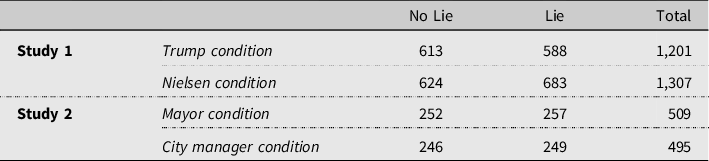
We rely on two survey experiments fielded using Amazon’s Mechanical Turk (MTurk). Study 1 ran from June 23 to 25, 2018 and Study 2 ran from May 28 to 29, 2020. While MTurk’s panel is younger and more liberal than the general population, the literature on experimental research using MTurk finds that researchers can make credible inferences (e.g., Berinsky et al. Reference Berinsky, Huber and Lenz2012). There were 2,508 American adult citizens in Study 1 and 1,004 in Study 2, resulting in the distribution of groups as shown in Table 1.Footnote 10
Sample sizes for treatment and control conditions

The studies employ parallel experiments.Footnote 11 We first subset our samples, randomly assigning half to a condition in which an executive (either President Trump or fictional Mayor James Riken) is the main actor, and half to a condition in which a subordinate (either Secretary Nielsen or fictional City Manager Linda Hendricks) is the main actor. Respondents were further assigned to be in one of two additional experimental groups: the “No Lie” or “Lie” condition.Footnote 12
The actor manipulation is subtle. The only change is the speaker: either the executive himself or the subordinate speaking as his representative. Still, we expect the treatment to have substantial effects because the speaker’s identity is a critical element. When journalists cover the story, they will be quoting the speaker, even if they are not responsible for the policy. In the family separation case, Nielsen received media attention for her remarks at two White House press briefings on April 4, 2018 and June 18, 2018. At both briefings, she spoke for the majority of the time and took press questions. In the days that followed, her name was linked to the policies, even though she was representing the Trump Administration.Footnote 13
In Study 1, respondents in the No Lie condition read a statement that described the practice of separating families during border crossings in May 2018, as well as the Trump Administration’s decision to end the practice the following month. In the Lie condition, respondents read the same descriptions with an additional statement from either Trump or Nielsen. In this statement, Trump/Nielsen declared that the President lacked the power to end the family separation policy. Instead, they insisted that only Congress could do so. The same respondents then read a statement indicating that a few days later, the President signed an executive order ending family separation without congressional authorization. With this additional information, the dishonesty of the initial claim is made clear. Across both conditions, the substantive outcome remains the same and comparable groups only differ by the lie.
In Study 2, respondents read about a scenario involving a city budget crisis in Newtown, Pennsylvania. In the No Lie condition, respondents read that budget cuts would result in the end of a school lunch program, but that Mayor Riken’s office had saved the program via executive order, drawing on discretionary funds. In the Lie Condition, respondents read that Mayor Riken/City Manager Hendricks initially claimed that only an act by the City Council could save the popular school lunch program, but that the administration later reversed course and signed the order providing the funds. Similar to Study 1, this reversal makes the lie clear to respondents.
After viewing the treatment, each respondent completed a short survey. We focus on two items to gauge the cost an executive might pay for dishonesty and their ability to avoid blame: situational approval and job approval. For situational approval, we asked respondents to rate the degree to which they approved or disapproved of how Trump, Nielsen, and Mayor Riken were handling the situation described in the vignette.Footnote 14 For general approval, we asked respondents to rate Trump, Nielsen, and Riken on their overall job performance.Footnote 15 We do not anticipate large differences between situational and job approval for a fictional politician like Mayor Riken, since there is little else respondents can use to evaluate him beyond his actions in this situation. Yet the Riken example helps support our assertion that a known entity’s job approval is harder to move on account of people knowing more about them.
Asking both questions allows respondents to use new information to update both short- and long-term impressions of well-known and unknown politicians. We can also test whether an executive is able to stunt the effect of dishonesty on approval when a subordinate is the face of a controversy. For ease of interpretation, we recode the 1–5 approval scales from 0 to 1, such that treatment effects may be interpreted as the percentage point shift across the response scale. Results in the next section present a simple difference in means across experimental conditions, though ordinary least squares regressions including demographic covariates do not yield substantially different results (found in Table A6a–c of the Appendix). Additional analyses accounting for the potential interaction of the Lie Condition and the partisanship of the respondent can be found in Table A2.
Results
Study 1
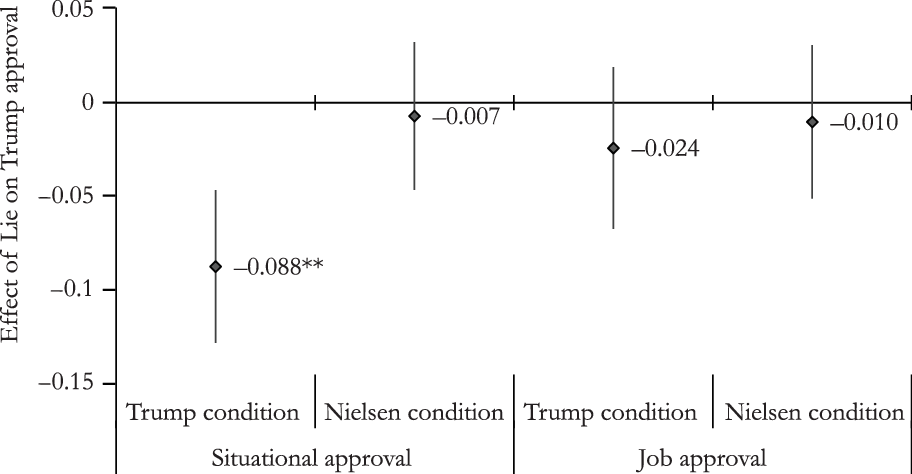
To assess whether Trump pays a price in public support for dishonesty, we first examine the difference in approval between those in the No Lie condition and those in the Lie condition. Figure 1 shows that Trump pays a significant cost in situational approval – nearly 9 points – when the lie is made apparent and he is the primary official in the story. When Nielsen is the primary official mentioned, the negative effect on Trump’s approval disappears almost entirely.
Effect of Lie on Trump approval by condition.
NOTE: Bars represent 95% confidence intervals. **p < 0.01, two-tailed test. Interaction between Lie and Nielsen treatments is significant for situational approval but not for job approval.

It is important to note that this survey took place less than a week after the story on family separations played out in the news media, meaning pretreatment likely decreased the observed effect. Indeed, 84 percent of our sample said they were following the news on family separations somewhat or very closely. Even so, by making the dishonesty explicit, we still measure a 9-point drop in situational approval. That this effect disappears if it is Nielsen who publicly reverses is noteworthy – consider that citizens who only occasionally pay attention to the news may get the false impression that she is responsible for the falsehood and, therefore, fail to consider Trump as blameworthy for his own administration’s actions. The 0.081 difference between the Trump and Nielsen conditions on situational approval is statistically significant at conventional levels (p < 0.01). These results demonstrate that making a case of dishonesty explicit can affect public opinion, even toward a well-known and polarizing actor like Trump.
Yet does a drop in situational approval translate to general evaluations? The findings here suggest not. In terms of substantive effects, the cost Trump pays on job approval is 2.4 percentage points, barely a quarter of the cost paid on situational approval. This effect is neither statistically significant, nor significantly greater than the 1.0-point effect in the Nielsen condition. Because Trump does not suffer a loss in job approval, a shield is not necessary to protect him from a negative appraisal; his ratings remain relatively static across conditions.
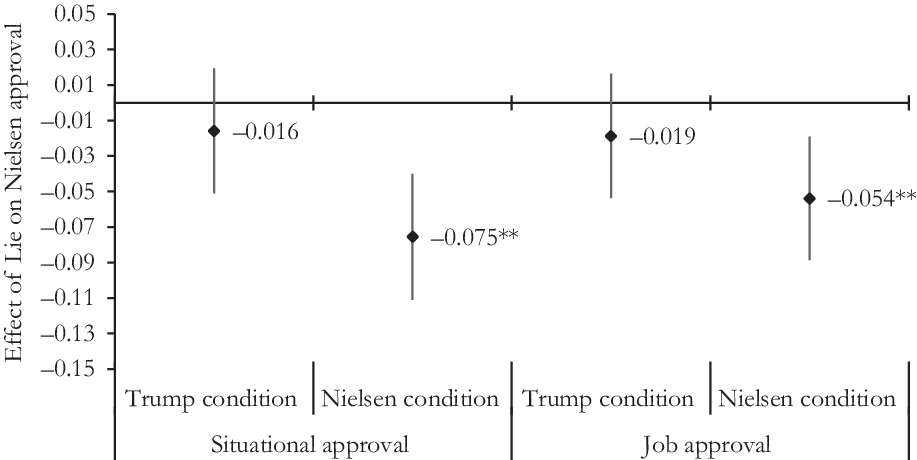
We also find it worthwhile to consider what effect being used as a shield might have on Nielsen (Figure 2). After all, negative news coverage can undercut the ability of administration officials to advocate for the administration. Here we find that she pays a similar cost in terms of situational approval when she is the actor described in the vignette, a drop of roughly 7.5 points, an effect that is significantly greater than the 1.6-point drop in the Trump condition (p < 0.05). Yet, unlike Trump, we find that she also pays a cost in terms of job approval when she is caught lying. The 5.4-point drop in job approval is significant, though not significantly different from the 1.9-point drop in the Trump condition, and more than double the job approval cost Trump faced. Although Nielsen can shield Trump by taking ownership of the lie, she does so at a notable cost to her own political standing. Because she is less well known, general evaluations of her job performance will be determined by her actions in this highly visible, singular instance.
Effect of Lie on Nielsen approval by condition.
NOTE: Bars represent 95% confidence intervals. **p < 0.01, two-tailed test. The interaction between Lie and Nielsen treatments is significant for situational but not job approval.

Study 2
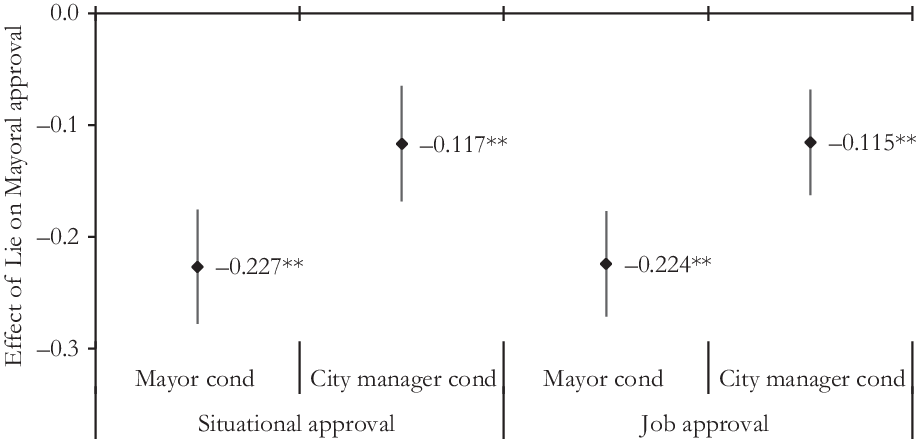
Study 2 examines shielding in the context of a lesser-known official (Figure 3). What is clear is that the unknown mayor pays much larger costs than the known actors. In terms of both situational approval and job approval, the mayor pays a massive 22-point cost in public support when he is named as the main actor of the story. Since he is unknown, the effect on both approval measures mirror each other, as we would expect, and is consistent with research on the importance of attitude crystallization for well-known politicians (e.g., Croco et al. Reference Croco, Hanmer and McDonald2020).
Effect of Lie on Mayor Riken approval by condition.
NOTE: Bars represent 95% confidence intervals. **p < 0.01, two-tailed test. Interaction between Lie and Mayor treatments is significant for both situational and job approval.

Is shielding effective for the mayor? Unlike Trump, Riken cannot erase the backlash entirely. Yet for both situational and job approval, the city manager still appears to shield him, cutting the punishment by roughly half (differences that are statistically significant, p < 0.01). Given these findings, it appears executives may have an incentive to force their subordinates into damaging situations, making the latter carry the water for the former’s dishonesty.
Discussion
These findings have implications for both the incentives executives face when they are caught in a lie and the cost that subordinates pay when they cover for dishonest politicians. Executives pay a cost in situational approval for dishonesty, but when the president uses a member of the administration to shield him from disapproval, the subordinate pays a heavy cost.
The findings of these studies should inform our expectations about turnover in presidential cabinets. From Trump’s blaming of former Attorney General Jeff Sessions for the Russia inquiry to former Press Secretary Sean Spicer’s defense of Trump’s claims about his inaugural crowd size, President Trump used prominent public officials to explain away controversies and deflect blame. Our research suggests that the more the public focuses on surrogates, the easier it is for the executive to avoid blame. And although our studies focused on cases of dishonesty, they have implications for politicians going through any negative news cycle. Whether it is an unpopular policy, a scandal, or a reversal from a previously stated position, politicians are incentivized to pretend that the buck stops with anyone but them.
Data Availability
This research was made possible through the support of the Dean’s Research Initiative in the Department of Behavioral and Social Sciences at the University of Maryland, as well as the POLS Lab and the Department of Political Science and Public Administration at the University of North Carolina at Charlotte. The data, code, and any additional materials required to replicate all analyses in this article are available at the Journal of Experimental Political Science within the Harvard Dataverse Network, at doi: https://doi.org/10.7910/DVN/QJ9RLJ.
Conflicts of Interest
The authors declare no conflicts of interest.
Supplementary Material
To view supplementary material for this article, please visit https://doi.org/10.1017/XPS.2021.16