In the second half of the eighteenth century, new tools and new commercial practices appeared or were disseminated widely in European long-distance trade. For instance, the publication of mercantile almanacs and a trade press, which had until then been limited to a few large capitals (chiefly Paris, London, Amsterdam, and Madrid), developed across all trading places in Europe and America, bringing widening access to information on agents (almanacs) and market rates, incoming vessels, and their cargo (mercantile press).Footnote 1 At the same time, commercial travelers appeared on European roads from the 1750s, promoting certain products (initially fine textiles and wines) and winning over new clients for their employers.Footnote 2 Like other tradesmen, they began to produce and hand out trading cards to make themselves known and as a reminder of their visit.Footnote 3 In addition, it became common practice during this period for newly established traders to “advise any correspondents they might know [and] with whom they [were] hoping to enter into commerce” through the use of printed circular letters advertising their trade name, signature, and the “type of commerce” they offered.Footnote 4 This article focuses on the use of circular letters.
While the various commercial innovations that emerged in the second half of the eighteenth century—almanacs, trade press, commercial travelers, trading cards, printed circular letters—are now well known and extensively described, the academic literature still lacks synthetic studies that explain the conditions in which they appeared, the manner in which they were adopted by merchants, and ultimately their meaning.
Indeed, the historians who have focused their attention on these commercial innovations have understated the scope of the changes that occurred during this period. Stanley Chapman, Alfred Chandler, and Patrick Verley, for example, link the decisive breaks in the practice of commerce to the organizational (birth of the big company) and technological (telegraph, steam navigation) innovations of the second half of the nineteenth century.Footnote 5 They insist on the continuity of market practices during the first half of the nineteenth century, thus concurring with the dominant point of view of historians who have studied the evolution of the institutional context of the time and who tend to underestimate the magnitude of the transformations of that period.Footnote 6 However, historiography also shows that even minimal, slow, or unnoticeable changes can have a great significance. Amalia Kessler describes the emergence of a modern conception of commerce (as functional and no longer statutory) in eighteenth-century France and presents it as one of the symptoms of the progressive decline of the “corporate social order” that had formerly organized society.Footnote 7 Similarly, Jean-Pierre Hirsch, while describing the limits of the conversion of the northern French economic elite to the premises of liberalism, also mentions that they embraced some aspects of the legal modernity of the time to reinforce their situation or their power (law complementing the family, rather than law replacing the family).Footnote 8 By insisting on the complementarity and hybridization of the old and the new, Hirsch recognizes the importance of the current changes but refuses to characterize them as “revolutionary.”
This article seeks to contribute to these questions on processes of change and innovation in the business world during the period from 1750 to 1850, working from the example of the emergence, diffusion, and use of printed circular letters. For this purpose, this study draws from a wide corpus comprising some 1,700 printed circulars that were selected from the letters received by five major French trading houses.Footnote 9 These companies were commercial leaders in their respective fields, and all five maintained a substantial correspondence with companies based in France, Europe, and around the world. They regularly received printed circular letters from trading companies of all sizes, sectors, and origins that wanted to enter into business with them or make themselves known to them. This correspondence provides valuable information on the trading practices of the time. The corpus is complemented by registers logging the outgoing correspondence of the Cognac brandy trade house Jas. Hennessy & Co., which provide insight into the perspective of the companies that sent out these circular letters, and by registers logging the incoming correspondence of the firm González de la Sierra in Cadiz, covering a longer period of time.Footnote 10 The corpus also includes mercantile guidebooks containing mentions of circular letters.Footnote 11
Working from a quantitative and qualitative treatment of the corpus to analyze the origin of printed circular letters and their three principal functions (disseminating information on firms, prospecting for new partners, and displaying one's socioprofessional identity), we show that this period saw major innovations in trade practices. We can, however, affirm that these changes were not truly revolutionary and cannot be interpreted as forming part of a linear and univocal process of progress toward an increasingly modern world; rather, to perpetuate the old business world in the upheavals of the time, they sought to use their knowledge of business acquired over time.Footnote 12
The Origins of Printed Circular Letters
Our documents provide information on the origins of circular letters and on the chronology of their emergence. The term “circular letter” (lettre circulaire) appeared in French-language dictionaries from the early eighteenth century, with a definition such as the following: “A circular letter is the name given to a single letter addressed to various recipients, delivering information regarding an order [mandement].”Footnote 13 Although this definition was established relatively late, the term was frequently used in France from the mid-seventeenth century and the practices it refers to were, of course, present at an even earlier date.Footnote 14 Most occurrences of the term “lettre circulaire” appearing in the Gallica database for the pre-1789 period refer to ecclesiastical, administrative, or political uses of this type of correspondence; these were used to summon bishops to a synod, invite the members of a provincial assembly, or dispatch instructions within an administration (such as consular administrations). The only pre-1789 occurrence in Gallica that refers to a commercial use of circular letters is from 1781. This occurrence can be found in Brillon's dictionary, in the entry for the word “adresse,” and refers to a judgment of 1782 regarding a tailor, Tissot, who distributed “to the public printed addresses bearing mentions of his name, profession, domicile, and the cost of his works,” thus contravening the corporation's customs to win the public's preference: “This judgment does not prohibit the distribution of such addresses: these are seen every day and inserted into public papers. Therefore, these addresses appear to be to tradesmen as are signs on their shops, and as circular letters are to merchants throughout European trade.” The first specific descriptions of “commercial circular letters” only appeared in guidebooks a few years later, in the Lettres d'un négociant à son fils sur les sujets les plus importants du commerce: “Thus when a merchant becomes established, that is, begins a commerce with his own funds and under his own name, it is customary for him to advise any external correspondents he might know with whom he might hope to enter into business . . . . Since these letters only repeat one another, or are copies of one minute, it became customary, in order to abbreviate the task of writing, to have them printed, and because they are sent all around they were given the name of circulars.”Footnote 15
After this date, commercial circular letters became a perfectly identified a very common object in the business world: trading companies used these documents, most of which were printed, to inform their correspondents of diverse events (creation, dissolution, recruitment of a new partner, opening of a new trading post). These letters were usually accompanied by sample signatures of the partners who had signing powers, letters or bills of exchange, and a commercial offer. However, there is again a considerable time gap between the relatively late theorization of these practices in the scholarly literature and their much earlier effective use in commercial practices. Archival sources establish with certainty that Hennessy sent circular letters from its creation in 1765 and that Roux received them from its creation in 1728.Footnote 16 The letters were initially copied by hand and were increasingly printed in later years.Footnote 17 According to the 1786 guidebook mentioned above, the move from handwritten to printed circulars was simply a practical measure aimed at rationalizing the epistolary process: merchants increasingly resorted to printers to spare themselves the labor of copying the letters by hand.Footnote 18 In their handwritten form, the preparation of circular letters was a long and tedious process, often delegated to clerks and junior traders. For instance, the merchant Vincent Nolte reports that his friend and peer Paul Delessert had learned his trade in the 1820s with Matthiesen and Sillem, a powerful Hamburg company. Tired of being made to copy commercial circulars, young Delessert made a mockery of the remarks on the prices of the goods, which traditionally closed the circulars, and added the following comment to his lists: “Omelets are rising, owing to the extreme scarcity of eggs.” This prank was not to the taste of his employer, and the impertinent young man was immediately fired.Footnote 19 Print made it possible to save time while producing large numbers of standard letters that could then be customized by hand with the addition of personalized elements: the addressee's name and term of address in the header (which were present in two-thirds of our corpus), almost always the precise date of posting (present in 97 percent of letters), and the senders’ signatures (present in 98 percent of letters). Personalized notes and information on rates were sometimes added in a final apostil, an element found in a quarter of the letters. In the late eighteenth century, circulars were almost always composite documents, most of them printed with manuscript additions (see Figures 3 and 4).
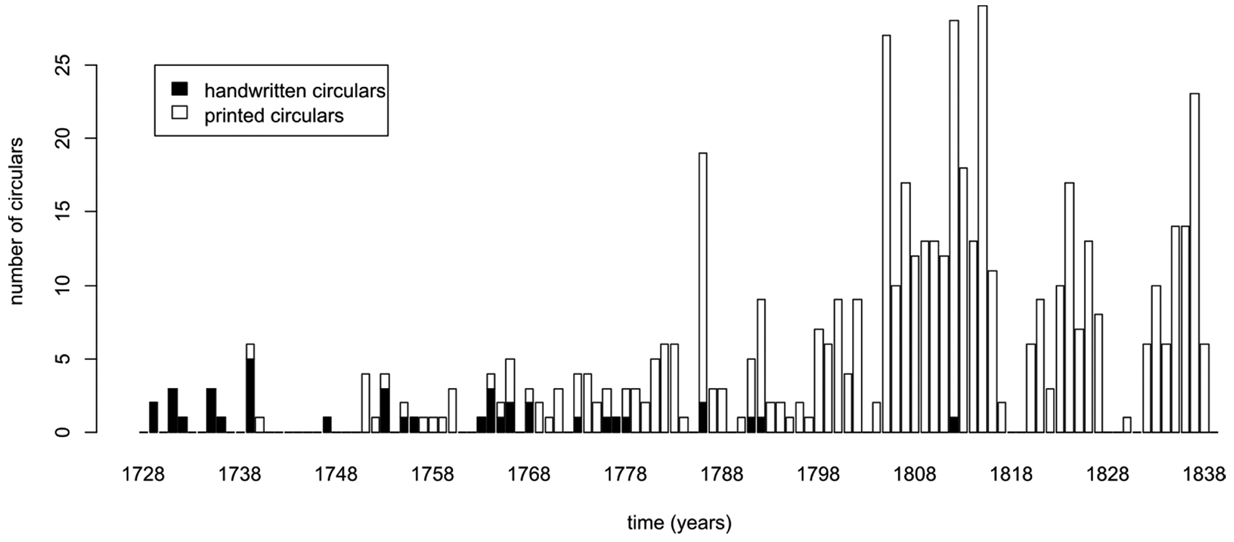
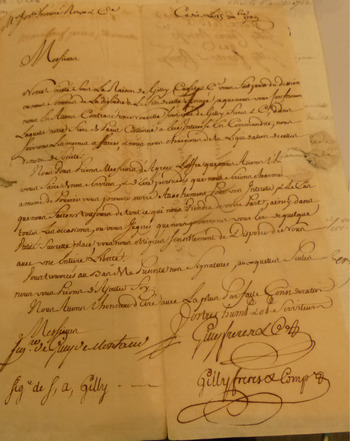
The moment when print was adopted can be dated more precisely thanks to the Roux archive, which covers most of the eighteenth century and the first half of the nineteenth. In this archive, we identified all of the manuscripts and printed circulars received from a sample of correspondents from about thirty different locations. Figure 1 shows three distinct moments in the use of commercial circular letters. During the first period (1730–1740), their use is rare and the letters are almost exclusively handwritten. These often comprise a simple apostil added to a traditional commercial letter, mentioning the changes that had occurred in the firm's organization and presenting the signatures of the new partners. However, during this period, some circulars are already presented as targeted letters, following the same standards as those prescribed in guidebooks at the end of the century (see Figure 2).
Chronological distribution of the circular letters in the Roux archive

A handwritten circular. (Source: Gilly frères from Cadiz, letter, 15 Dec. 1739, Roux archive, LIX855, ACCIMP.)

This example shows how, a century before the formal codes of the circular letter are precisely defined in mercantile textbooks, they are already being used in practice. In the first paragraph the authors describe the changes in the organization of their company, before offering their services in the second one (“We are honored to present you, Sirs, with this offer of services”) and reassuring the recipients that their interests will continue to be the object of their attention. The two managers of the company finish by providing samples of the signature of the new company name that will allow recipients to notarize the bills of exchange and correspondence they will receive. From 1740 to the late 1770s, the use of circular letters remained sporadic, despite the emergence and diffusion of the first printed examples. It is difficult to establish which region of the world first pioneered this new printed tool. In our corpus, the earliest cases come from trading places in Spain (Cadiz and Madrid) and the Netherlands (Amsterdam and Rotterdam). Finally, after 1780, merchants started to make much more systematic use of circular letters, almost exclusively in their printed form.
A similar chronology appears in the Hennessy archive, which includes registers of outgoing correspondence. Before 1772, the company never sent more than 25 copies of a single letter, which may indicate that these were handwritten circulars. After this date and until 1789, Hennessy sent out circular letters in small numbers but also increasingly sent circular letters addressed to several dozen correspondents. On August 15, 1789, the company sent 177 copies of a circular letter, and on more than twenty occasions over the following three decades it sent batches of 50 circulars. As for the firm Greffulhe Montz, it mailed out 5,000 to 6,000 circulars to announce its creation and “secure its international reputation” in 1789.Footnote 20 There is no doubt that such large dispatches were only possible through the use of print.
The other four archives confirm the general chronology established using the Roux archive, with some variations in the timescales. Foache received 36 circulars during the first ten years of its existence (1783–1792) and 105 during the next ten years. Similarly, the number of circulars received by Veuve Guérin increases from 8 in the first ten years of preserved archives (1773–1782) to 34 in the following decade (1783–1792) and 54 in the next (1793–1802). In all of the archives investigated, a boom begins at the time of the Revolution and continues to grow in the first half of the nineteenth century.Footnote 21 Unfortunately, this corpus does not allow us to assess the evolution of the use of circulars in the second half of the nineteenth century. However, the González de la Sierra archive in Cadiz, which still has to be examined in a more systematic manner, does suggest that European merchants resorted to these letters very frequently in the 1900s.Footnote 22
So, while printed circular letters remained relatively rare before 1789, their use became much more widespread across all five firms after the Revolution and persisted in the nineteenth century. A reason can perhaps be found in the global growth of trade in the second half of the eighteenth century, which historians have described profusely.Footnote 23 In the context of growing colonial and domestic trade, the number of traders increased in all European trading centers, for example, from 238 to 900 in Marseille between the beginning and the end of the eighteenth century.Footnote 24 The result is a continuous increase in the number of partners with which each merchant must maintain epistolary relations: between 1728 and 1790, Roux initiated new commercial relations with thirty new partners each year, and during the four years in which it was active in Paris, the Greffulhe Montz bank opened several thousand accounts for its customers, for a turnover of around 50 million pounds a year.Footnote 25
Driven by the growth in the number of their partners, European firms adapted epistolary practices to respond to the increasing workload brought about by this task. In contrast, Gérard Gayot associates circular letters with the new commercial climate of the late eighteenth century. He mentions these letters when describing the aggressive commercial strategies that the Protestant merchants of Sedan implemented in the last quarter of the century.Footnote 26 Circulars could in this case be indicators of a move toward mass prospection, with more modern and disembedded practices for processing a merchant's relations: precursors of today's mass mailings and spam. However, a statistical analysis of the corpus indicates that this hypothesis should be more nuanced in two respects: while this prospective function of circulars did effectively exist, it remained secondary in comparison with the informative function described in guidebooks. Moreover, while circulars enabled a firm to expand the circle of its usual correspondents, they were not addressed indistinctly to all players in a vast anonymous European market; instead, they targeted a specific, hierarchized audience.
An Information Tool, between Interpersonal Networks and the Anonymous Market
Mercantile guidebooks published in the eighteenth and nineteenth centuries usually presented circulars as an information tool aimed at delivering specific intelligence on a business to its various partners. For instance, a 1786 guidebook describes the information communicated in a circular letter as follows:
The contents of these circulars are almost always prescribed. They must announce how long one has spent learning the trade, in the quality of apprentice or clerk or companion, although the latter term is only used by craftsmen, or in mills and manufactures. There must then be a mention of the stock available for trading companies, of the type of goods that will be manufactured, and of whether one will trade solely through brokers or through one's own stores; finally, it is essential to specify precisely the signature that one will use, and under which he will be known for both subscribing letters and other writings, and sending bales and other items.Footnote 27
A century later, a guidebook published by Marie Clément noted very similar elements:
A circular is a letter aimed at informing several people of a number of facts or instructions. It is used in particular to announce the establishment of a trading house, any changes that may occur within an existing house, the creation or the dissolution of a company, and the retirement or death of an associate. It sometimes includes current rates as well as an offer to ship any objects that may be ordered.
What must be the contents of a circular letter. The type of trade one proposes to practice. The advantages one is able to offer, such as one's special knowledge, considerable capital, guarantees of zeal and industriousness, and if writing on behalf of a company, the house's trading name, the signatures of its associates, and some affectionate offers expressed in an agreeable yet not affectionate manner.Footnote 28
A review of the circulars in the corpus shows that these instructions must be put into perspective. The letters actually contain little specific information on the firms’ capital, on the nature of their business, or on the goods they sell. In 88 percent of cases, the company's resources are either mentioned in very vague terms (“endowed with sufficient funds”) or not mentioned at all.Footnote 29 Moreover, only a small minority of circulars (one-tenth of the documents) indicate the names of the sender's silent partners. Only a third of the corpus provides information on the firm's activities—and sometimes in very general and allusive terms, by mentioning, for instance, the trading house's “business” (affaires) with no additional specifications. Similarly, there is rarely any mention of current rates.
Circular letters do, however, almost always convey information on the company's life and on the identity of the associates who have signing rights. The scholarly literature often insists on the crucial importance of such elements, as shown in Lettres d'un négociant à son fils:
Anything that regards commerce, that is any piece of writing or term of address implying a commitment, an obligation or a commission, in other words anything that makes a merchant accountable for something, or any negotiable instrument, any of the above can be legally binding and must be made, written or addressed under the true and exact trading name that has been announced by said merchant and publicized as that of his house or company. Although it is customary in printed circular letters to have the names printed at the bottom in the usual place, one must therefore never fail to place one's manuscript signature alongside it.Footnote 30
Empirical observation confirms the importance of these elements. Regardless of where they were sent from, almost all circulars bear at least one signature. In addition, two-thirds of the letters in the corpus contain samples of signatures where each signatory's first name and surname is matched with their personal signature. Finally, over 95 percent of circulars carry information on an event in the social life of the company that led to the dispatch of the letter: in most cases, the dissolution of a company and its replacement by a new entity.
Examination of the five selected archival fonds shows that this informational function of circulars did not change significantly between the eighteenth century and nineteenth. Over this period, documents remained just as evasive about the firms’ funds, business, and professional specialities. The widespread use of signature samples remains constant: variations between the proportions noted before, during, and after the period from 1789 to 1815 were only minimal (the percentages oscillate between 60 and 68 percent, without any discernable trend). These practices appear to have endured over the long term. The González de la Sierra archive shows that this was one of the main functions of the commercial circulars that circulated across the Spanish business world in the second half of the nineteenth century and the first decades of the twentieth.Footnote 31 However, these circulars do present a singularity in comparison with those in the other corpus: they often bear the firm's logo, which does not change the circular letter's function of identification but suggests that signatures gradually stopped being the only identification device used by trading companies.Footnote 32
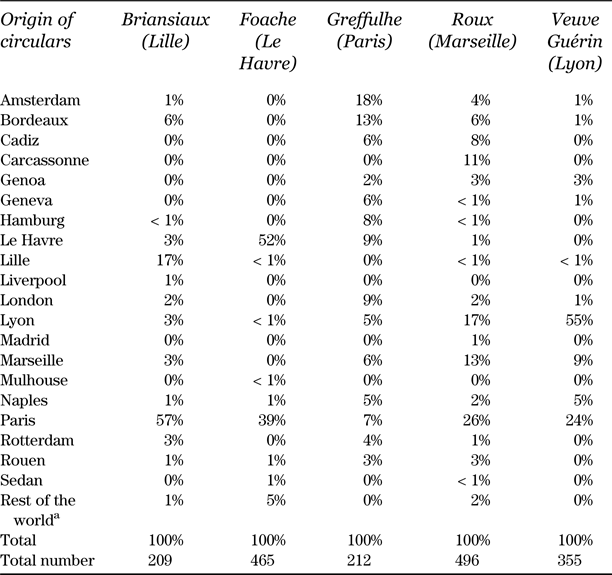
Who was this information on companies addressed to? The nature of the archival fonds—incoming correspondence—makes it difficult to provide a straightforward answer to this question. It is, however, possible to make a few preliminary observations. The first is that circulars are not only addressed to known correspondents with an established connection to the sender. From 1730 to 1760, the manuscript circulars addressed to Roux were often simple apostils added to traditional commercial letters, to convey information on a change in the firm's structure. In stark contrast, the printed circulars in the corpus are often found at the beginning of bundles of correspondence (in 63 percent of cases) rather than in the middle or at the end. This shows that circulars were frequently sent to addressees with whom the sender had never previously had any correspondence. Nevertheless, analysis of the geographic origin of the circulars shows that these documents were not sent indiscriminately, either—for instance, to all the traders listed in mercantile almanacs. On the contrary, they were sent to a targeted audience (Table 1).
Main Places of Origin of the Circulars

a The category “Rest of the world” covers all circulars originating from locations outside of western Europe and the Ottoman Empire, namely, Cayes, Ile-de-France, Havana, Cape Town, New York, Pernambuco, Pointe-à-Pitre, Port-aux-Princes, Riga, Saint-Petersburg, and Saint-Pierre.
Our sources highlight the importance of “intra-place” circulars, that is, letters coming from the addressee's own city. About half of the circulars kept in the Roux, Foache, and Guérin archives originated in Marseille, Le Havre, and Lyon, respectively. In the other two fonds, the proportion is lower but remains significant (over 10 percent). It can therefore be presumed that it was common practice for a merchant to send a circular to the leading firms in their local market, such as the five firms studied here.
Furthermore, each of the firms received circulars sent from a geographic area that more or less coincided with the geography of its operations. For instance, Greffulhe (Paris), which specialized in banking, received more circulars from large banking centers such as Amsterdam and London (over a quarter of the total), while these two cities accounted for only 3 percent and 1 percent, respectively, of circulars received by Briansiaux and Foache, which were established in provincial towns (Lille and Le Havre). Guérin received a relatively high proportion of Italian circulars, from locations where suppliers of raw silk were based (Naples, Genoa). The Briansiaux and Foache archives contain a large proportion of circulars from Paris, as well as documents from coastal or northern locations. Roux is the only firm with connections in Carcassonne, where the woolen cloth it exported to the Levant was produced. As for America (which accounts for most of the “rest of the world” category), it appears in the correspondence of companies involved in transatlantic trading (Roux and Foache) but is absent in others. In the Foache and Briansiaux archives, we also collected all the circulars sent from locations not listed in the table. This provides information on another type of target: the community of regional and local merchants. By examining their respective locations, it is possible to draw a more specific outline of these two firms’ geographical reach.Footnote 33
In spite of their presumably low production cost, circulars do not appear to have been used to blanket-mail the totality of European traders, which differentiates this medium from contemporary practices such as mass mailings and spam. On the contrary, they appear to have been targeted at two specific groups: on the one hand, professionals from the trading sector in which the sender firm specialized; and on the other hand, professionals from all local and regional companies. The other two corpuses confirm these findings, in that the vast majority of the circulars from the Hennessy fund are addressed to companies that traded brandies (mostly British importers) and the González de la Sierra archives indicate the same importance of intra-place circulars, with a total of forty-eight circulars sent from Cadiz.
It seems that the circulars’ main function was to widely disseminate information that could be used to identify the sender (its trade name, the names and signatures of its associates). Merchants appear to have attached the utmost importance to these elements of identification. An extreme example is provided by the firm Autran-Bellier and Son, which sent a circular to its correspondents in 1808 to inform them that it would henceforth be trading under the name “Autran-Bellier et fils et Paul Autran” as a new partner (Paul Autran) had joined father Autran-Bellier and his son Melchior; this was followed by a new circular in 1809 when the firm became “Autran-Bellier fils, et Paul Autran” (with a comma, which is scrupulously reproduced in the signature) owing to the retirement of father Autran-Bellier.Footnote 34 This type of information was far from anecdotal, as it informed all of the firm's potential partners regarding the identity of the persons who held signing rights and the distribution of its capital. However, it should be stressed that this information was not aimed at the “market” as a whole, but rather at targeted segments, which connects these documents to ancien régime practices. Similarly, in the fulfillment of their prospective function, the circulars also combined modern elements with older practices.
A Prospecting Tool?
The objective at this point is to appraise whether the wide-scale dissemination of information aimed at authenticating companies formed part of a broader commercial prospecting strategy to expand the sender's client base. At a first glance, the corpus appears to confirm this hypothesis: about 81 percent of selected documents include, whether implicitly or explicitly, a commercial offer. It must also be stressed that among the 19 percent of circulars in which no offer is identified, a large majority of documents are dedicated to the dissolution of a company (19 percent, compared with only 4 percent of other circulars). In this regard, it appears that almost all the documents in the corpus have a prospective dimension. Nevertheless, we could question the true meaning of these offers: two-thirds of them are formulated in very elusive terms (an expression of the desire to win the addressee's trust), and only a third adopt the more explicit vocabulary of an “offer of service” (as shown in the very typical phrase in Figure 2: “We are honored to present you, Sir, with this offer of services”). Besides, even in the latter cases, circulars rarely present—at least in their printed section—any specific information that could make these offers actually operational. There is often no mention of the actual products or services offered and of their prices. Even the distinction between commission trade and trade on one's own account, although deemed essential by mercantile guidebooks, rarely appears in the circulars.Footnote 35
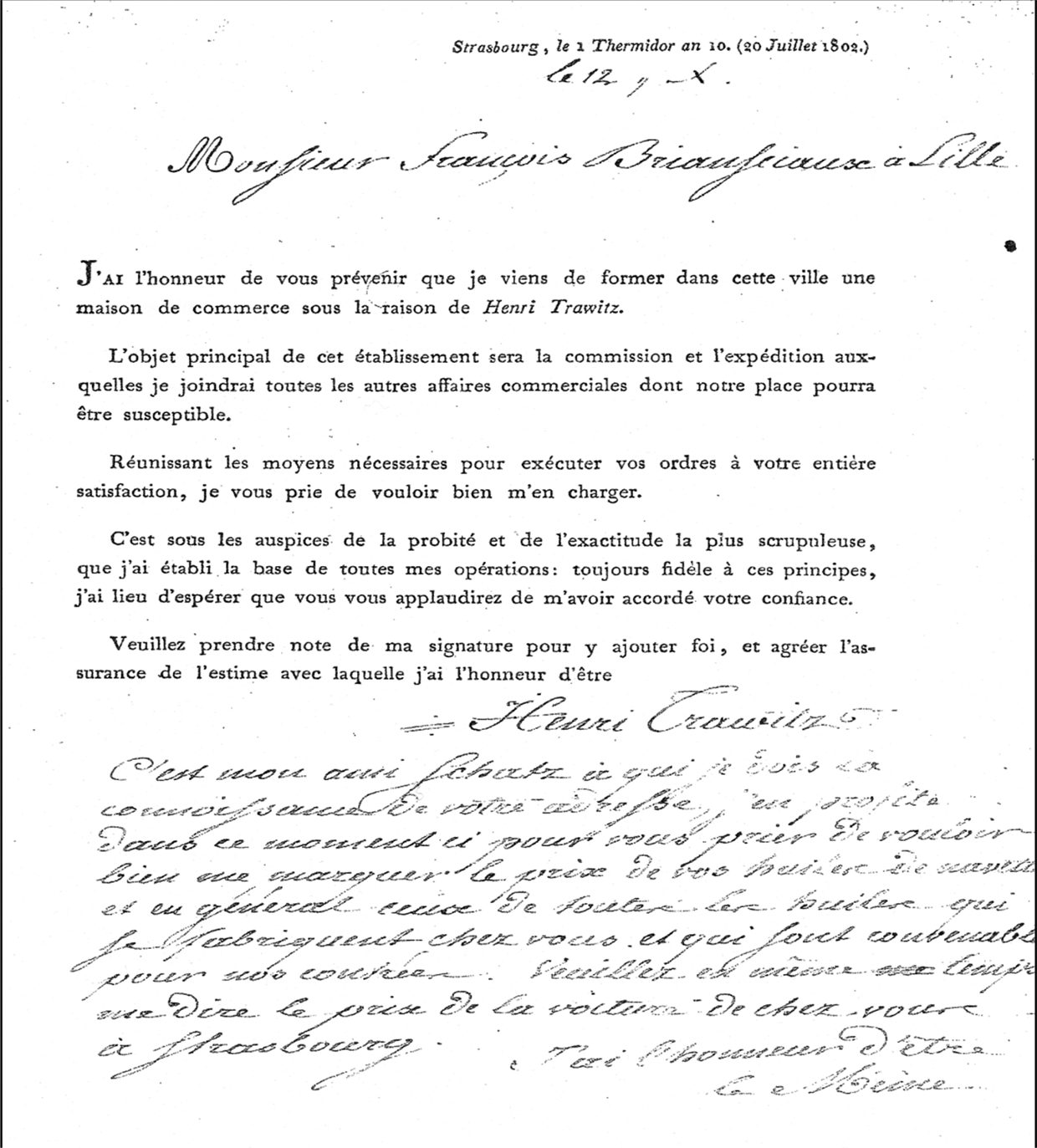
These items of information can, however, be found much more frequently in the manuscript apostils, including detailed and insistent offers of services, sent along with a quarter of the printed circulars in the corpus. These apostils vary greatly in length.Footnote 36 Some are only a short sentence added to the end of a letter to reiterate an offer of service for the attention of the addressee.Footnote 37 In other cases, but only for the circulars that are found in the middle of a bundle and not at the beginning of the correspondence, the apostil describes the sender's current business or includes a statement of account.Footnote 38 However, the main objective of these apostils remains to characterize the offer of service stated in vague terms in the printed part. Quite logically, the circulars that include an apostil are also the most likely to contain a list of “current rates”: a quarter of these contain such a list, against only 3 percent of the circulars with no apostil. These circulars can also include additional information on current events in their city of origin, a detailed analysis of current or forecasted evolutions of the local markets (situation of stock or harvests, incoming ships), or formal recommendations, as shown in Figure 3.
A highly personalized and prospective circular with handwritten additions. (Source: Henri Trawits, Strasbourg, letter, 20 July 1802, Briansiaux archive, 3 AQ 339, ANMT.)

In this case, Henri Trawitz from Strasbourg uses a traditional printed circular letter to which he adds a handwritten note presenting a very specific service offer—that he would be interested in purchasing “the oils that are made in your region”—and inquiring about their prices. To avoid coming across as too aggressive, he mentions a recommendation from a mutual friend, “Schatz,” who had given him Briansiaux's address. Ultimately, this type of letter, both prospective and personalized, is comparable to letters of introduction: this other category of commercial correspondence, whose object was precisely to establish new commercial relations, is also described in the educational literature of the time.Footnote 39 This observation suggests that the sections of a circular that did perform a prospective function were those that were added by hand; the personalization of a document was closely linked to its prospective function.
It should be stressed, however, that personalized and prospective circulars tend to decline over the period. While over half of the first hundred circulars in our sample include an apostil (54 percent), this share drops to 2 percent in the last hundred. It is precisely in the years between 1760 and 1790 that traders appear to have mainly used circulars to solicit new customers and disseminate their commercial offerings more widely. After 1800, the use of the circular declined. The corpus also contains circulars that are comparable to “prospectuses”: strictly standardized solicitation documents that describe the intrinsic qualities of a commercial offer in very specific terms. Such documents are a small minority (they account for only eighty-one pieces in the corpus) and it is also during the last decades of the ancien régime that they are most numerous. These “prospectuses” are interesting because they are sent by particular types of companies, often from the banking or freight transport (haulage) sectors, or addressed to specialist companies (Cognac brandy wholesalers), for the purpose of one-off operations (auction sale, financial products).Footnote 40 The circulars received by Briansiaux from Dunkirk during the Napoleonic period provide very significant examples of these practices: of twenty documents collected in this city, three are subscriptions for privateer weapons and two advertise auction sales of ship cargoes taken by local privateers.Footnote 41
Overall, the corpus reflects significant changes in the use of circular letters. However, these changes differ from those described by some historians who present the evolution of Western economies as a linear progression toward ever more powerful, larger, and more impersonal markets.Footnote 42 While in the 1780s and over the following two decades the circular letters were often used as commercial prospecting tools, this practice was frequently based on very personalized relational mechanisms (such as the use of apostils or recommendations). In contrast, the boom of strictly printed circulars in the first decades of the nineteenth century is more closely connected to their informative function. This evolution went along with formal transformations: the circulars became more concise and less personalized, until they were reduced in some extreme cases to a laconic announcement—as illustrated in an 1816 circular addressed to Roux that simply states, “I have the honor of informing you that I'm retiring from business and will in the future only take care of my liquidation.”Footnote 43 Even when these were sent to peers the merchants knew in person and regularly met at their local exchange, merchants supplemented the information provided in their circulars with notes on their activities and their values, thus revealing the foundations of a characteristic language of the business world.
A Shared Language for Mutual Identification and Recognition
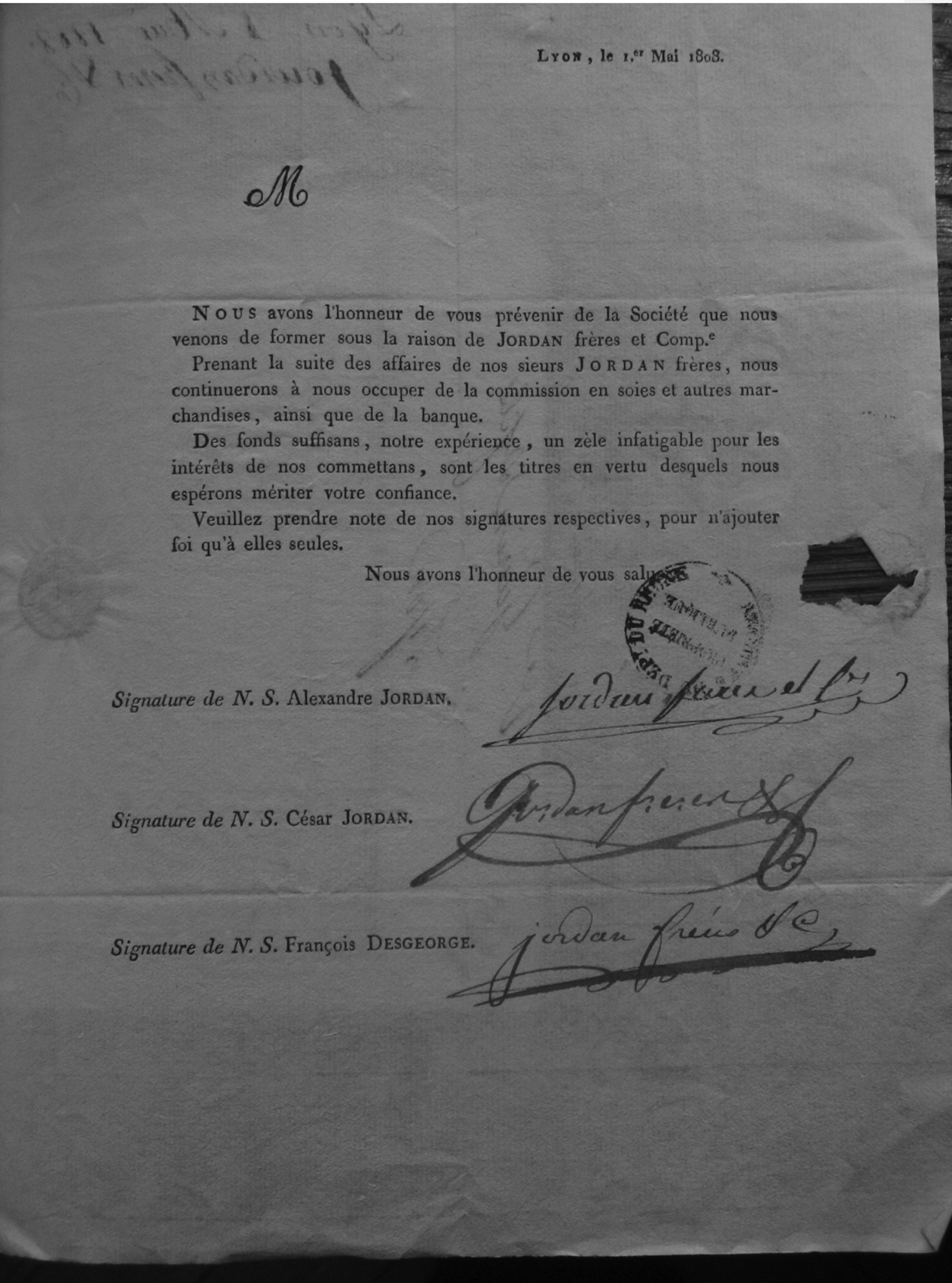
As well as carrying information on the identity of trading houses and a more or less explicit offer of service, a vast majority of circulars also include a brief description of their authors’ status and activities, along with the moral and professional qualities they claim to offer to their correspondents. Figure 4 provides an interesting illustration of the characteristics of this “self-narrative” delivered by traders in their circulars. This circular contains all the typical elements of this type of letter, as described above: a mention of the event that prompted the sending of the circular in paragraphs 1 and 2 (the firm Jordan frères et Cie succeeds Jordan frères); a very implicit offer of services, as the partners hope that they will continue to be “worthy of the trust” of their correspondents (end of paragraph 3); and sample signatures for the company's three new managers. But the circular also includes other elements: first of all, a rather allusive description of the firm's commercial activity (the partners state that they “handle the commission of silk and other goods, along with banking” at the end of paragraph 2); and second, an equally allusive and highly standardized presentation of the qualities they claim to offer to their clients (“sufficient funds,” their “experience,” an “unflagging for the interests of [their] constituents”) to deserve their “trust.” We will now analyze these discursive and rhetorical elements of the circular letter, as these are very typical of the rest of our sample and reveal one of the key functions of these letters: asserting their authors’ belonging to the socioprofessional trading environment.
An informative circular with very typical language
(Source: Jordan frères et Cie from Lyon, letter, 1 May 1808, Veuve Guérin archive, 4J328, ADR.)

Circulars containing no specifications on the qualities of their senders are very rare, accounting for fewer than 2 percent of the corpus. For European merchants at the time, it seems circulars were systematically used as a means of self-designation and social representation as much as a way of advertising their signature. Nevertheless, in spite of the guidebooks’ prescriptions recommending that circulars provide information on the merchant's specialization, the terms used tend to be very evasive and standardized. All traders claim to be involved in “commerce” (faire du commerce), to be “zealous” (zélé), and to be worthy of their correspondents’ “trust” (confiance). The repetition of these terms is such that these discursive devices’ actual value and meaning need to be questioned.
Most of the self-designation formulas used by traders may be characterized as imprecise; they simply evoke a mere connection with the business world or only mention the name of a firm without providing any specific information on its activities. Overall, these inaccurate designations are present in two-thirds of the cases in our sample. Some merchants simply name their predecessors without taking the time to recall what their business is. For instance, a letter from the company Henry Scherer states, “Our trade, Sirs, will continue with the same establishments as in the past, in Lyon and Saint-Gall, and will be conducted according to the same principles: we are pleased that our connections will remain unchanged.” Many others only describe their activity as “trade” (commerce). This is the case with very influential companies such as the large Parisian banking firms Delessert et Cie and Perregaux, Laffitte et Cie. But small firms also function in this manner, for instance, Cornud, a small company from the Rhône valley, based in Montélimar, in the 1820s. In 1824, the company changed its name following the departure of one of its partners. On this occasion, Cornud printed some circulars that refer to its diverse activities only in very allusive terms. The circulars merely indicate that the “trading name Cornud et Lacoste will no longer continue in the future, with the company now trading under the name Cornud et Compagnie.” There is no mention of the firm's activity (the manufacturing and trading of bristles). In addition, even when a given circular does contain more specific descriptions of a firm's main activities (banking, manufacturing, transport, trade of a specific good), these terms usually form part of a broader list of activities; their main concern appears to be with showing the trading house's versatility. This case is well illustrated by the example of Jordan frères et Cie, described above (see Figure 4). While the firm's directors state that they specialize in silk commission, they add that they trade in “other goods, as well as banking.” They use specific terms to define the activities of a generalist house. The priority appears to be that of marking the author's belonging to the world of trade in the broadest sense of the term, rather than providing specific information on the nature of the services the firm offers.
However, toward the end of the period this trend appears a little less marked. Some documents express each individual's or each firm's characteristic functions, thus suggesting a stronger differentiation of the entrepreneurs’ activities. A few companies refer directly to their area of specialism, such as “printers,” “bank,” “manufacturer of food preserves” (imprimerie, maison de banque, société pour la fabrication de conserves alimentaires). Others choose to specify the operations or goods they specialize in: “sugar refinery,” “banking operations,” “soap manufacturing,” “rowing boat rental,” (raffinerie de sucre, opérations de banque, fabrication de savons, location de chaloupes), and so on. It is not possible at present to determine whether the frequency of such cases in our sample objectively reflects a growing specialization of traders in the business world, as is often described in the literature.Footnote 44 This phenomenon could also be the consequence of the professionals’ desire to differentiate themselves from the traders who had so far occupied a subordinate and peripheral position in the business world. Our data does not allow us to establish this point with certainty.
While they often failed to define their activities in specific terms, at least until the late nineteenth century, merchants were more eloquent in describing their moral and professional qualities. In doing so, they resorted almost unanimously to a common language, which can be found in very similar forms throughout the circulars of the five archival fonds without any major differentiation. There is a prevalence of very standardized terms expressing friendship and trust (and the pursuit of trust), as well as formal salutations. A simple count shows the omnipresence of certain keywords: “trust” (confiance, present in 75 percent of circulars), “zeal” (zèle, in 59 percent of the corpus), “interest” (intérêt, in 47 percent of the corpus), “friendship” (amitié, in 40 percent of the corpus), and “punctuality” (ponctualité, in 30 percent of the corpus). Only 20 percent of circulars do not include any of these terms.
This language used by the merchants tends to evolve throughout the period but remains very broadly common to all authors of circulars. In eighteenth-century documents, the words listed above abound. In 1762, the firm Pierre de Laralde et Cie indicates, at the end of a circular addressed to Roux, “The real and rather considerable funds I have at hand . . . put me in a position to fulfil any orders with which you will honor me, to your greatest advantage: you can expect from me the greatest zeal and exactitude in their execution; it is in this trust [confiance] that I take the liberty of addressing you this letter.”Footnote 45 In contrast, later circulars are much more plain and concise. They use fewer of the keywords that were popular in the eighteenth century, except for the word “trust.” The number of occurrences of the most frequently used terms pre-1815 drops: while these appeared in approximately 53 percent of the corpus before 1815 (N = 207), their proportion decreases to 36 percent after this date (N = 105). The word “trust,” however, remains pervasive and becomes an essential keyword in circular letters. Even the plainest of circulars continue to refer to trust, as shown by a document addressed to Foache in 1845, asking the recipients to place their “trust” in the Paris firm Duméril aîné.Footnote 46
Overall, the language used in circulars undergoes certain mutations but continues to borrow its keywords—and, in particular, the central notion of “trust”—from pre-Revolution vocabulary. This relative stability is all the more remarkable in that, around the same period, the qualifiers used to describe firms began to evolve, as the global definition of trade itself was changing. Moreover, this process is also illustrated by the growing use of specialized self-designations.Footnote 47 The corpus shows that more and more agents chose to introduce themselves to their correspondents by describing the exact nature of their main economic activities, rather than by emphasizing the social status associated with trade in general. However, these traders were also keen to show that they still shared the traditional values of generalist merchants, by continuing to refer to the same linguistic standards. Their purpose was to assert their individual identity while displaying their belonging to the trading world in general.
Conclusion
The use of printed circulars was undoubtedly a new practice for the merchant world in the eighteenth century; while these letters were hardly used at all in the 1750s, they had become almost universal a few decades later. However, our study shows that this “innovation” should not be interpreted as a univocal sign of commercial modernity, indicating the triumph of increasingly impersonal and prospective commercial relations. There was certainly a perceptible growth in the number of recipients of circular letters, which might have been counted in the “few dozens” before midcentury when only handwritten circulars were used. However, even when printed, circulars were not indistinctly addressed to just anyone; on the contrary, they were targeted at specific audiences and market segments. In this respect, the analysis of our corpus does not reveal any sudden break in the practices of the business community.
Furthermore, although circulars had a prospective dimension, this function was only performed through a marked personalization of the documents. While circulars did tend to become more impersonal, this was mostly because they were used less for commercial prospection purposes in the first half of the nineteenth century. Strictly impersonal and prospective circulars, or prospectuses, remain a very minor occurrence in our corpus throughout the period and appear limited to marginal sectors of the trading world (for example, haulage, agents, auction sales). Nevertheless, our data provides useful insight into the process that led to the emergence of the circulars, the modalities of their dissemination, and finally their meaning.
First of all, it should be stressed that the use of circulars reflected the merchants’ strong attachment to some of the practices and codes they had inherited and appeared keen to preserve, in spite of the changes occurring in their environment. Merchants drew from a range of mental and cultural tools inherited from the ancien régime—language, social conventions, interpersonal networks—to tackle the macroeconomic and political changes they faced after the second half of the eighteenth century (commercial growth, major transformations brought about by the French Revolution, and finally a new, more liberal ideological environment). Merchants did partake in the global economic boom that characterized the period by developing more prospective commercial practices and by strongly increasing numbers of partners. To this effect, they modernized their commercial tools. However, these changes took place within a framework set by tradition rather than forming a departure from past practices. Second, circulars bring an original insight into the processes of geographic and sectorial specialization that affected the profession of the merchant. Alongside the figure of the large generalist merchant, who continued to define himself in very vague terms in his circulars, the period saw the emergence or dissemination of qualifiers that described the professionals’ commercial or professional specialization in a more specific manner. However, once again, circulars also attest to the trading world's reluctance to embrace this evolution: far from becoming fragmented, the social identity of the trading world appears to have remained very strong. This is reflected by a persisting attachment to linguistic and interpersonal conventions that draw from the ancien régime and are reproduced as markers of distinction and affiliation to the merchant world. The study of circulars reveals that commercial innovation was not a radical departure from past practices, but rather the reformulation of a response that combined the old with the new, in reaction to the unprecedented challenges met in this period of profound economic and institutional change.