1 Introduction
Investigation of the genitive alternation (-s and of) has received considerable attention in historical and contemporary standard varieties of English, for the most part using written data (see e.g. Altenberg Reference Altenberg1982; Hinrichs & Szmrecsanyi Reference Hinrichs and Szmrecsanyi2007; Hundt & Szmrecsanyi Reference Hundt and Szmrecsanyi2012; Jankowski Reference Jankowski2013; Jucker Reference Jucker and Jucker1993; Leech et al. Reference Leech, Hundt, Mair and Smith2009; Ljung Reference Ljung, Fries, Müller and Schneider1997; O’Connor et al. Reference O’Connor, Maling, Skarabela, Börjars, Denison and Scott2013; Rosenbach Reference Rosenbach2002, Reference Rohdenburg, Rohdenburg and Mondorf2003, Reference Rosenbach2005, Reference Rosenbach2007, Reference Rosenbach2008; Szmrecsanyi Reference Szmrecsanyi2006, Reference Szmrecsanyi, Börjars, Denison and Scott2013; Szmrecsanyi & Hinrichs Reference Szmrecsanyi, Hinrichs, Nevalainen, Taavitsainen, Pahta and Korhonen2008; Wolk et al. Reference Wolk, Bresnan, Rosenbach and Szmrecsanyi2013; the articles in this volume). The genitive in vernacular speech has received less attention except where the focus is on a comparison to standardized written data.Footnote 2 The aim of this article is to explore the genitive alternation in vernacular Canadian English, which has not yet received attention for this variable, and to identify whether there are social correlates that play a role in the alternation between the two forms. The variation is illustrated in (1)–(3).Footnote 3 Examples are from the Toronto English Archive (Tagliamonte Reference Tagliamonte2003–6, Reference Tagliamonte2006, Reference Tagliamonte2008) and the Southeastern Ontario Archive (Tagliamonte Reference Tagliamonte2007–10).Footnote 4
- (1)
(a) I think she was washing the country’sclothes. . . (N/S/49/M)
(b) I know it's still like the honeymoon capital of the world. (N/∫/32/F)
(2) He was the manager of the Toyland of the T-Eaton company, the T-Eaton company’sToyland, and so they were fairly well off. . . (N/Q/72/F)Footnote 5
2 Background
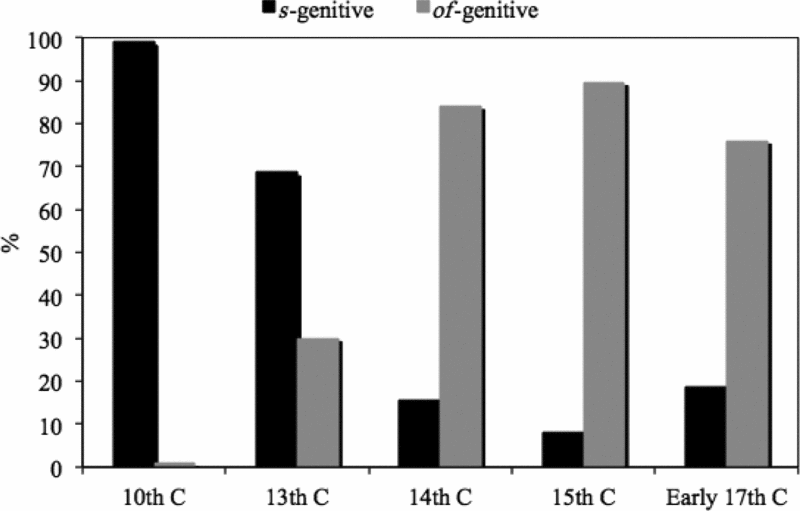
In order to contextualize the genitive alternation in contemporary English, we first summarize its historical trajectory. The older form is the synthetic Germanic s-inflection, which came into competition with the analytic Latinate of-genitive construction in Middle English. The s-genitive lost ground dramatically to the of-genitive as observed in written materials from that time, as illustrated in figure 1.
Trajectory of the genitive variants in Early and Middle English (adapted by Rosenbach Reference Rosenbach2002: 179, 186 from Thomas Reference Thomas1931 and Rosenbach & Vezzosi Reference Rosenbach, Vezzosi, Sornicola, Poppe and Shisha-Halevy2000)

The s-genitive began to increase again by the sixteenth century and has been in competition with the of-genitive ever since. During the Middle English period the s-form came to be associated with human and other animate possessors, as in (3), and the of-form with inanimate possessors, as in (4) (Rosenbach Reference Rosenbach2002: 180, 190–2; Altenberg Reference Altenberg1982: 146–7). This correlation continues in contemporary English (e.g. Ljung Reference Ljung, Fries, Müller and Schneider1997: 25; Biber et al. Reference Biber, Johansson, Leech, Conrad and Finegan1999: 302–3; Rosenbach Reference Rosenbach2005: 614, Reference Rosenbach2008: 152).
- (3)
(a) Because the turtle’sface sort of turns up like a smile. Cute. (b/P/77/F)
(b) Like our parents knew who the bigger kid’sparent was. (N/M/82/F)
- (4)
(a) They just started putting sticks through the spokes of the bike – (I/a/29/F)
(b) It's still like the honeymoon capital of the world. (8/N/32/F)
Researchers report that the s-genitive has continued to rise in frequency throughout the twentieth century in both American and British English, an increase that is most notable in press registers (e.g. Hinrichs & Szmrecsanyi Reference Hinrichs and Szmrecsanyi2007; Jucker Reference Jucker and Jucker1993; Leech et al. Reference Leech, Hundt, Mair and Smith2009: 222–5; Mair Reference Mair2006b: 144–8; Rosenbach Reference Rosenbach2002, Szmrecsanyi & Hinrichs Reference Szmrecsanyi, Hinrichs, Nevalainen, Taavitsainen, Pahta and Korhonen2008).
One explanation given for this is that the press registers are highly ‘innovative’ (Hundt & Mair Reference Hundt and Mair1999), and further that they are responsive to the pressures of economy – the need to fit as much information as possible into a finite amount of text space. Economy is considered to be active in modern journalistic prose (see e.g. Biber Reference Biber, Aitchison and Lewis2003: 180) and has been shown to be active for the genitive alternation in particular (Hinrichs & Szmrecsanyi Reference Hinrichs and Szmrecsanyi2007: 441, 457–8, 469; Szmrecsanyi & Hinrichs Reference Szmrecsanyi, Hinrichs, Nevalainen, Taavitsainen, Pahta and Korhonen2008: 300–1, 307).
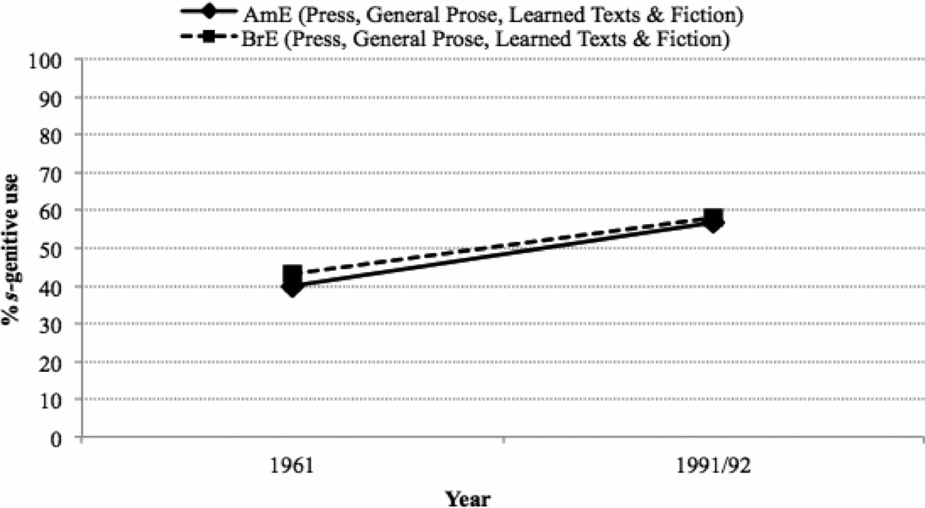
Figure 2 shows the proportion of the s-genitive from 1961 to 1991 in four written genres in the Brown family of corpora. This long-term increase in the s-genitive has been attributed to its spread into certain subtypes of possessors, particularly those that fall along a point below human on an animacy hierarchy such as that in (5), adapted from Zaenen et al. (Reference Zaenen, Carletta, Garretson, Bresnan, Koontz-Garboden, O’Connor, Wasow, Webber and Byron2004: 11):
(5) Human >> other animates (includes organizations, animals, intelligent machines and vehicles) >> inanimates (includes concrete inanimate, non-concrete inanimate, places, time.)
Proportion of s-genitive in four American and British English written registers in the late twentieth century (adapted from Leech et al. Reference Leech, Hundt, Mair and Smith2009: 225)
It has been argued that the ‘the animacy constraint is currently being loosened for collective nouns, not inanimates. . .’ (Hinrichs & Szmrecsanyi Reference Hinrichs and Szmrecsanyi2007: 440, citing Mair Reference Mair, Mair and Heuberger2006a, Reference Mair2006b). Rosenbach (Reference Rosenbach2005: 615, Reference Rosenbach, Rohdenburg and Mondorf2003: 386) finds that the s-genitive is common with certain subsets of inanimate nouns, such as places (geographic locations) and units of time. This highlights the importance of distinguishing subtypes of animates and inanimates, a point to which we will return below.
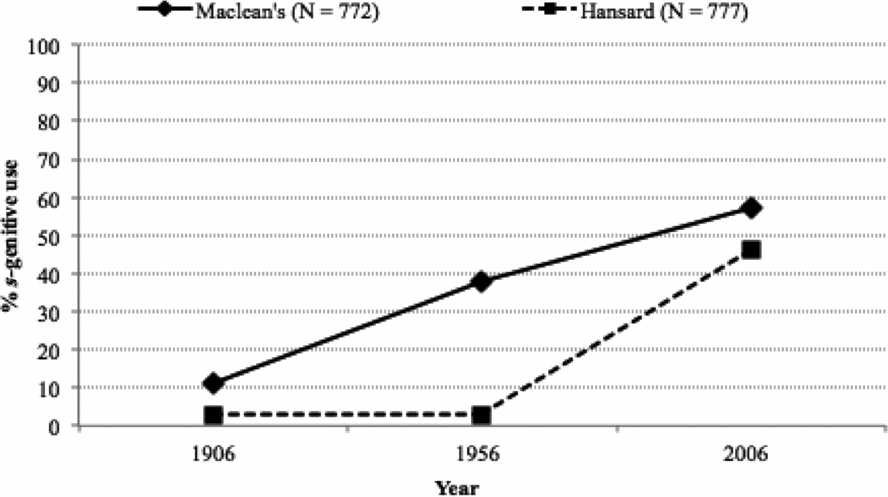
Jankowski (Reference Jankowski2013: 73, 101–5) found the overall proportion of s-genitives to be increasing across the twentieth century in data from standardized, written contemporary Ontario English, supporting previous findings of continued increase of the form. Figure 3 shows a rise in s-genitives in real time over the twentieth century with non-human possessors in written Ontario English text registers, Maclean’s magazine, and the Federal Hansard, transcripts of the Canadian House of Commons parliamentary debates. This demonstrates that expansion of the s-genitive into inanimates is not unique to written language. Although Hansard transcripts are edited so as to make them ‘more readable’ (Hansard n.d.: 48) and so are not considered to be verbatim, they have their origins in formal spoken language. This result provides further impetus for testing the claims for expansion of the s-genitive in vernacular speech.
Proportion of s-genitive over time with non-human possessors in journalistic prose (Maclean’s magazine) and parliamentary transcripts (Hansard) in Ontario English (adapted from Jankowski Reference Jankowski2013: 102)
The of-genitive is said to have had formal connotations since at least the seventeenth century. Altenberg (Reference Altenberg1982: 268–9) describes the of-genitive as being ‘generally restricted to situations demanding some degree of formality and politeness or when the language is raised to the level of rhetoric’. This suggests that standard sociolinguistic indicators – age, gender, socioeconomic status (as indicated by occupation and education) (e.g. Labov Reference Labov2002) – may also offer useful insight into the distribution of the forms. For example, linguistic features that are socially evaluated to have higher prestige tend to be reinforced by the educational system (Wolfram Reference Wolfram and Coulmas1996: 120–2), leading individuals with more formal education to use the of-genitive more than those with less formal education. Those with occupations that require managerial and customer service skills might be expected to use the more formal of-genitive at higher rates than those with manual labour jobs, and women might use it more than men (see e.g. Labov Reference Labov1990, Reference Labov2001). The s-genitive, as the alternative variant, would then be expected to correlate with lower education levels, workers with manual-labour jobs, and men. In the next section, we detail the methodology of our data collection, extraction and coding.
3 Methodology
3.1 Data
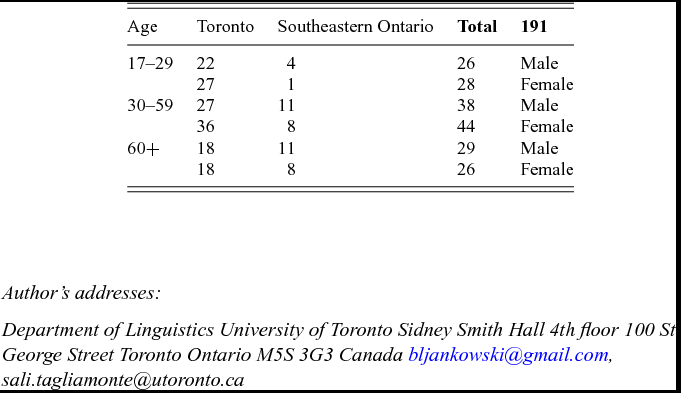
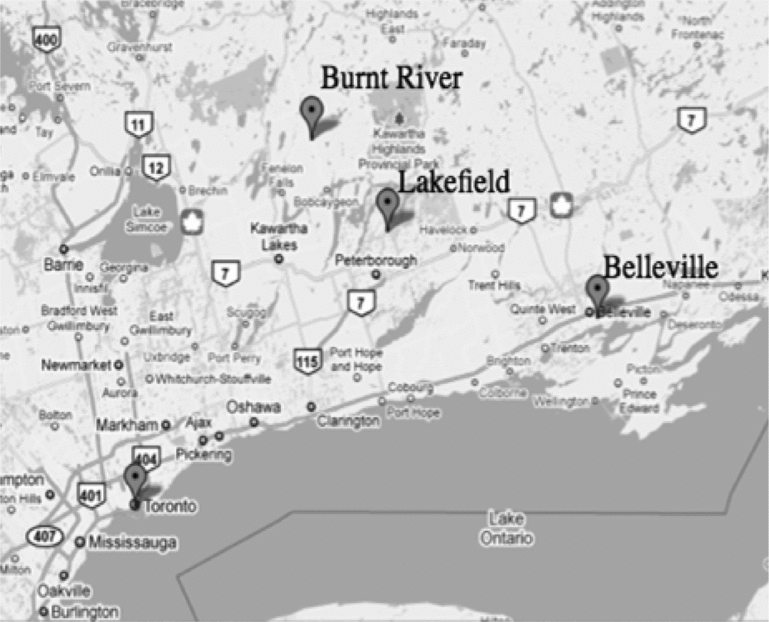
Our data are drawn from the Toronto English Archive (TEA) (Tagliamonte Reference Tagliamonte2003–6, Reference Tagliamonte2006, Reference Tagliamonte2008) and the Southeastern Ontario Archive (Tagliamonte Reference Tagliamonte2007–10). These data comprise over 300 individuals and more than 3.3 million words of vernacular speech stratified by age, sex, education, profession and other social factors.Footnote 6 The materials were collected using sociolinguistic interviewing techniques designed to elicit casual speech. As the many examples in this article show, the discussions are highly informal, often jocular, with many stories and reminiscences. Individuals range in age from 9 to 92.Footnote 7 The sample used for the present study, shown in table 1, is comprised of 191 individuals across this age span and divided between male and female. The location of all the communities on the north shore of Lake Ontario, Ontario, Canada is shown on the map in figure 4. These materials represent Canadian English as spoken in Ontario at the turn of the twenty-first century. We will refer to this variety as Ontario English.
Sample design by age, corpus and gender
Map of Ontario showing location of the four communities
3.2 Circumscribing the variable context
Mindful of Rosenbach's (Reference Rosenbach2002: 71–2) observations regarding the lack of methodological comparability across previous studies of this variable, considerable effort was made to ensure that the analysis is as comparable as possible to more recent studies in terms of the nature of data extraction and circumscription of the variable context. To do so, we followed the procedures used by Hinrichs & Szmrecsanyi (Reference Hinrichs and Szmrecsanyi2007), Szmrecsanyi & Hinrichs (Reference Szmrecsanyi, Hinrichs, Nevalainen, Taavitsainen, Pahta and Korhonen2008), Wolk et al. (Reference Wolk, Bresnan, Rosenbach and Szmrecsanyi2013) and Ljung (Reference Ljung, Fries, Müller and Schneider1997). Our analysis includes only those tokens of the s- and of-genitive that could be expressed by either variant without changing, adding or removing any material from the possessor or possessum, beyond the addition of a determiner to the possessum for the of-genitive (see Hinrichs & Szmrecsanyi Reference Hinrichs and Szmrecsanyi2007: 445). This meant excluding indefinite possessums (6a), where there is a change of meaning between the two expressions. Also excluded were set or ‘idiomatic’ phrases (6b), ‘descriptive’ genitives (6c) and partitives (6d), as these have previously been reported to have no interchangeability (Rosenbach Reference Rosenbach2002: 29), and cases where the genitive phrase has a postmodifier (6e) (see Hinrichs & Szmrecsanyi Reference Hinrichs and Szmrecsanyi2007: 447 and Ljung Reference Ljung, Fries, Müller and Schneider1997: 30).
- (6)
(a) Indefinite possessum (change of meaning): a designate of the mayor ≠ the mayor's (only) designate
(b) Set phrases (including in proper place names): the Village of
Bedford Park, Murphy's Law, Peggy's Cove, ‘for God's sake’
(c) Descriptive and measure genitives: a men's change-room, children's magazines, an hour's wait, a month's delay
(d) Partitives: some of the people, one of the problems
(e) Genitive phrases with post-modifier: ‘sports is the attempt to master
the combination of your mind and body and the pursuit of something’
In addition, we discovered a tremendous number of additional cases of categorical behaviour in these materials. Standard practice in variation analysis is to exclude contexts that are found with ≤ 5 per cent or ≥ 95 per cent of one variant or the other (see Guy Reference Guy, Ferrara, Brown, Walters and Baugh1988: 131). For example, human proper name possessors, such as (7), were realized 99 per cent of the time (N = 475/481) with the s-genitive.Footnote 8
- (7)
(a) That's Marissa’sdog. (N/D/26/M)
(b) She had said, ‘Well I’m gonna give you the number of Lindsay,’ ’cause I had met Lindsay a few times during high school. And she said, ‘I’m gonna give you Lindsay’snumber because she's taking E-C-E too, and you guys. . .’ (b/C/30/F)
Units of temporal measure, as in (8a–e), were realized 95 per cent of the time with the of-genitive (N = 171/181) and were also excluded.Footnote 9
- (8)
(a) I could see how the youth of today could be overcome with ennui. (N/5/50/F)
(b) Well, that's today’sworld, right? (N/7/38/F)
(c) What's gonna be the crisis of the day? (b/L/55/F)
(d) . . .in all the years of my life, never- never raised any stink- (l/L/21/M)
(e) Save power, do it at the height of like the summer . . . (N/I/24/M)
Non-human animate (animal) possessors (i.e. the turtle's face, the name of the pig, a polar bear's fur), while variable, were very sparse (N = 26) and so have been excluded. Even accounting for all these exceptional distributions, further scrutiny of the data exposed additional near-categorical contexts as will be detailed in section 4.1.
The principal finding of earlier research on the genitive is that the s-variant is extending from marking humans and other animate beings, to collective/organization nouns, and also possibly to geographic locations. Concrete or abstract inanimate possessors, meanwhile, largely retain the of-form. This makes different types of possessors particularly relevant to the prevailing issues on genitive variation and thus key to our investigation. Because one of the goals is methodological compatibility with previous studies and future replicability, in section 3.3 we detail our procedure for coding animacy.
3.3 The categorization of non-human nouns
A critical decision is how to categorize collectives and organizations. Previous studies have applied different labels, undoubtedly due to the nature of this semantic class:
Especially prevalent cases of metonomy are the use of names to refer both to organizations (e.g. IBM) and to characteristic members of them, and the use of place names (e.g. Russia) to refer both to organizational entities and geographical places or inhabitants of them. Terms belonging to these semantic classes are systematically ambiguous . . . organizations are often presented as groups of humans engaging in actions that are typically associated with humans. (Zaenen et al. Reference Zaenen, Carletta, Garretson, Bresnan, Koontz-Garboden, O’Connor, Wasow, Webber and Byron2004: 10–11, emphasis ours)
Mair (Reference Mair2006b: 147, data from Raab-Fischer Reference Raab-Fischer1995) and Rosenbach (Reference Rosenbach2006: 105) make a distinction between humans and collective nouns. Similarly, Hinrichs & Szmrecsanyi (Reference Hinrichs and Szmrecsanyi2007: 449) use the term collective to refer to the category that Zaenen et al. call organizations (or [ORG]), which they define as ‘collectivities of humans when displaying some degree of group identity’ with ‘a collective voice/purpose’ (2004: 11).Footnote 10 Under this classification scheme, ‘a group with collective action, such as a mob’ would be coded as human rather than organization, because it does not display a collective voice or purpose.
In the interest of comparability, we use the Zaenen et al. classification for this study, and label the category ‘collective/organizations’.Footnote 11 This includes examples such as the public in (9) and the head table and education in (10).
- (9)
(a) That was the public’sperception of the east-end. (N/J/41/F)
(b) the reaction of - of the public was you-know . . . (N/n/53/F)
- (10)
(a) You’re not supposed to take the head table’sfood you-know. (5/k/18/M)
(b) . . . and I would say it's education’sfault. (N/g/55/F)
Collective/organizations are by definition animate, as they are comprised of humans; however, in context of the animacy hierarchy given in (5), they fall somewhere below humans but above concrete and abstract inanimates (see e.g. O’Connor et al. Reference O’Connor, Maling, Skarabela, Börjars, Denison and Scott2013: 97). Even a lexical item as canonically inanimate as a table, as in (10a) the head table, can serve as a metonym for the collection of people who are sitting at it – the food in question belongs to the people at the table, not to the physical object itself – making the head table, in this case, a collective/organization.
Another important category to code consistently is place-possessors. As Zaenen et al. (Reference Zaenen, Carletta, Garretson, Bresnan, Koontz-Garboden, O’Connor, Wasow, Webber and Byron2004: 11) describe: ‘There are two different problems with the delimitation of place. On the one hand, any location can be a place, e.g. a table, a drawer, a pinhead, . . . On the other hand some places can be thought of as ORGs.’ We again follow their coding scheme here, in which ‘only potential locations for humans’ can qualify as places, such as the world in example (1b), and the examples in (11):
- (11)
(a) . . .like Canada’sSilicon Valley right? (I/q/22/M)
(b) I went to it and it was all on, um, China’sboom right now (N/$/44/M)
(c) You’ll see pictures of other cities’ghettos (I/d/19/M)
Rosenbach (Reference Rosenbach2002: 248–50) uses the term personification to describe this effect, a process of metaphorical extension. In order to test whether the s-genitive is spreading to these types of situations we paid particular attention to the context of place names, which could refer to either a location or to the people who make up a collective/organization. For example, China in (11b) was coded as a place, as it arguably refers to the country as a political and geographical entity. In contrast, Toronto, in (12a), does not refer to the city of Toronto, but rather to a sports team. In (12b) the museum is acting as a metonym for the staff of the museum (who might have an idea). The examples in (12) were therefore coded as collective/organizations.
- (12)
(a) I want to see Toronto’shome games. (I/1/51/M)
(b) . . .talk about what would be the best pose, what the museum’s idea of the pose is and ah, can the T-Rex naturally run like that? (b/f/22/M)
Two additional categories are relatively straightforward: non-concrete (or ‘abstract’) inanimates, such as democracy in (13) and concrete inanimates, as previously in (4a) (the bike).
- (13)
(a) When that goal went into the net it was then that I knew the true meaning of democracy. (N/n/53/F)
3.4 The final data set
Collecting sufficient non-human possessors proved to be one of the biggest challenges of this study. The data comprise highly informal conversations in which people discuss intimate topics, often dominated by stories about their families and friends – in other words, they talk about humans. Non-human genitives were sparse, particularly collectives, organizations and places, the crucial types implicated in change. Preliminary extraction from 100 individuals yielded only 304 non-human tokens containing only 15 s-genitives. Our strategy to mitigate this imbalance was to extract only non-human genitives for another 90 individuals.
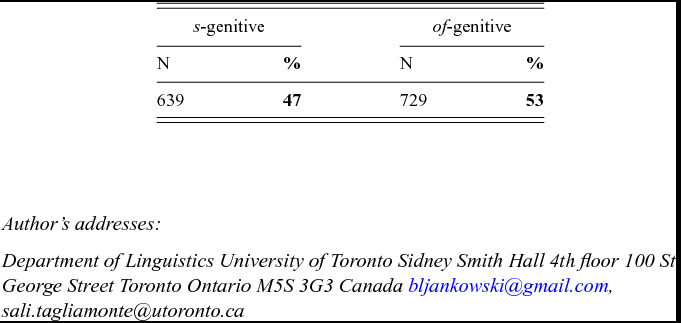
With this procedure and after the exclusions mentioned above, we accumulated 1,368 tokens for analysis. The overall distribution of genitive variants is shown in table 2. The genitive alternation in Ontario English appears to be robust, with 47 per cent s-genitive and 53 per cent of-genitive. What factors determine when one variant will occur rather than the other? We now turn to the linguistic factors other than animacy that have been claimed to influence the alternation.
Overall distribution of genitive variants in Ontario English (N = 1,368)
3.5 Other internal linguistic factors
A number of internal factors are consistently reported as influencing the selection of s- or of-genitive. These include the end weight of the possessor and possessum, the phonological shape of the possessor, the type of possessor relationship (non-prototypical or prototypical) and persistence, i.e. the influence of a previous instance of s- or of-genitive. We introduce each of these predictors in turn.
The principle of end weight dictates that shorter constituents will precede those that are ‘heavier’ (Hinrichs & Szmrecsanyi Reference Hinrichs and Szmrecsanyi2007: 453–5; Szmrecsanyi & Hinrichs Reference Szmrecsanyi, Hinrichs, Nevalainen, Taavitsainen, Pahta and Korhonen2008: 292–3, 299–300). We coded for this following the methodology of Szmrecsanyi & Hinrichs (Reference Szmrecsanyi, Hinrichs, Nevalainen, Taavitsainen, Pahta and Korhonen2008: 299–300), by counting the number of ‘graphemic words’ in each possessor and possessum, and using that as a gauge of their relative ‘weight’ (see also Börjars et al. Reference Börjars, Denison, Krajewski, Scott, Börjars, Denison and Scott2013: 134–5). This predicts that when a possessor is fewer words than the item it possesses, the possessor will take the s-genitive, as in (14a), which has a one-word possessor (Americans) and two-word possessum (grand plan). Conversely, the of-genitive is more likely when the possessum is fewer words than the possessor, as in (14b), where the possessor is two words (certain professors) and the possessum only one (feelings).Footnote 12
- (14)
(a) . . . acquiescing too much to Americans’grand plan to have one defense system for North-America. (N/J/41/F)
(b) . . . on the basis of your work and the, ah, the feelings of certain professors you’re streamed off into different things. (I/f/27/F)
The presence of a sibilant as the final phonological segment of a possessor, such as with the plural nuns in (15a) or with research in (15b), has previously been found to discourage the use of the s-genitive (Altenberg Reference Altenberg1982; Szmrecsanyi & Hinrichs Reference Szmrecsanyi, Hinrichs, Nevalainen, Taavitsainen, Pahta and Korhonen2008: 299).
- (15)
(a) I was taking the original material of the nuns because that's the first material we have of women anywhere in the world. . . (N/i/30/F)
(b) I had the physical aspect of the research. . .. (3/E/18/M)
Hinrichs & Szmrecsanyi refer to this as a ‘phonological horror aequi effect’ in which speakers ‘avoid an immediately adjacent sibilant in the form of an s-genitive’ (Hinrichs & Szmrecsanyi Reference Hinrichs and Szmrecsanyi2007: 452)Footnote 13
A third factor is possessor relation. Recent studies (Wolk et al. Reference Wolk, Bresnan, Rosenbach and Szmrecsanyi2013: 397, see also Grafmiller Reference Grafmiller2010: 18) use a typologically based distinction of ‘prototypical vs non-prototypical’ based on Rosenbach (Reference Rosenbach2002: 58–64, 120–6). Prototypical possessors include body parts (16a), kinship terms (16b) and whole/part relationships of concrete inanimate things (16c). Permanent/legal ownership, as in (16d), is also considered by many to be ‘a central meaning of the English s-genitive’ (Rosenbach Reference Rosenbach2002: 121, citing Taylor Reference Taylor1989, Reference Taylor1995), and so is considered prototypical possession in this classification system.
- (16)
(a) . . . working with the joints of the body. (N/G/26/F)
(b) . . . and I guess his friend’sbrother answered the phone. (2/i/19/F)
(c) They had a plaque on the wall of that building. (N/[/85/M)
(d) We used to go to this lady’shouse to steal zucchinis. (4/J/19/M)
All others are non-prototypical possession. Examples are given in (17):
- (17)
(a) I was president of the organization. (N/d/83/M)
(b) I don't know the man’sname. (b/R/77/M)
(c) She's ah, you know, on Canada’sbest-dressed women's list (N/L/53/F)
(d) . . .near the principal’soffice, with the photos. . . (N/^/40/F)
(e) . . .going up and down the coast of British Columbia. (N/Q/72/F)
(f) . . .might have a book on the history of Burnt River maybe? (r/f/63/M)
The prediction is that prototypical possessors will be more likely to take the s-genitive (Wolk et al. Reference Wolk, Bresnan, Rosenbach and Szmrecsanyi2013: 398), since the ‘possessor and possessum form a very tight, if not inseparable, relation’ that ‘should be encoded by more implicit linguistic means’ (Rosenbach Reference Rosenbach2002: 123).
Finally, it has been demonstrated that genitive choice is affected by which variant was used in the most recent prior genitive token. If an s-genitive has been used within the previous 100 words, then the likelihood increases that the next instance of a variable genitive will be an s-genitive. If an of-genitive is used, then it is less likely that the next variable genitive used will be an s-genitive. This is due to the effect of the processing constraint of persistence (Hinrichs & Szmrecsanyi Reference Hinrichs and Szmrecsanyi2007: 455; Szmrecsanyi Reference Szmrecsanyi2006: 87–101) – a previous instance is believed to prime an upcoming instance, and the speaker reuses the same form.
4 Results
4.1 Human vs non-human possessors
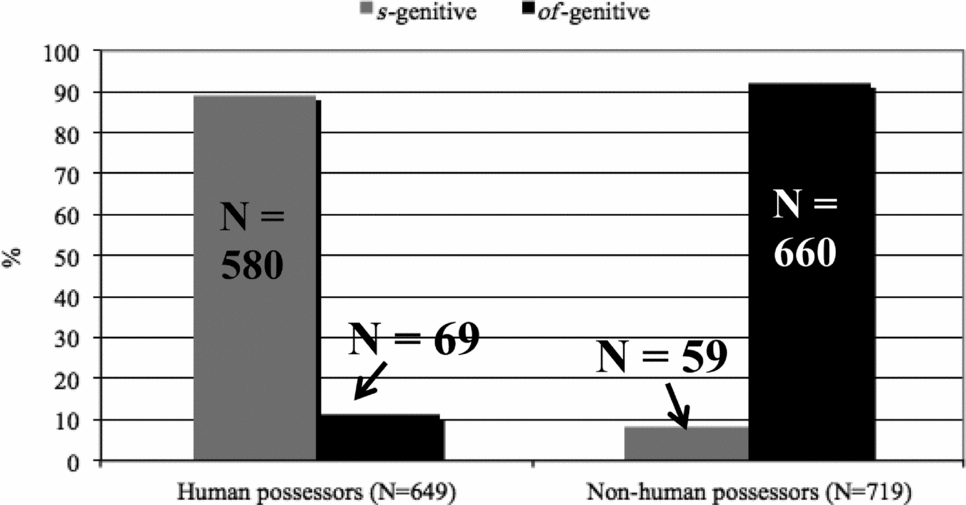
Figure 5 shows that a full 89 per cent of the human possessors take the s–genitive, and 92 per cent of the non-human possessors take the of genitive.Footnote 14 Given the distributional results in figure 5, it is evident that most contexts are invariant once humanness has been factored into the analysis. This is consistent with Szmrecsanyi & Hinrichs’ analysis of the vernacular speech of traditional British dialects (FRED) (see note 2), where ‘human possessors – for all intents and purposes – categorically trigger the s-genitive’ (2008: 303).
Proportion of genitive variants by animacy of possessor in Ontario English
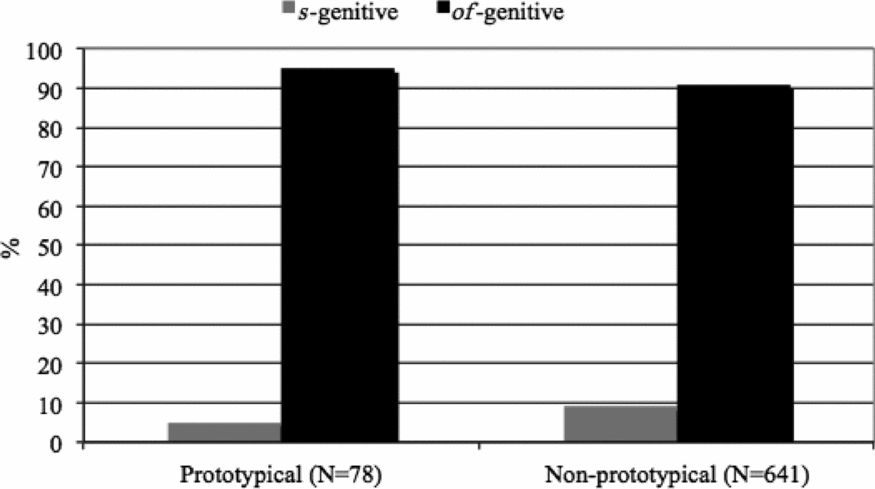
Further examination within the human and non-human contexts revealed additional splits of this type in the data. First, we consider the distributions according to the semantics of the possessor relationship: prototypical possession, examples in (16a–d), or non-prototypical possession, examples (17a–f). Prototypical possessors (body parts, kinship terms, whole/part relationships of concrete inanimates and permanent/legal ownership) are expected to favour the s-genitive (Wolk et al. Reference Wolk, Bresnan, Rosenbach and Szmrecsanyi2013: 398; Rosenbach Reference Rosenbach2002: 121). This is the case in our data: of the 390 prototypical contexts, a full 305 (78 per cent) are with the s-genitive.
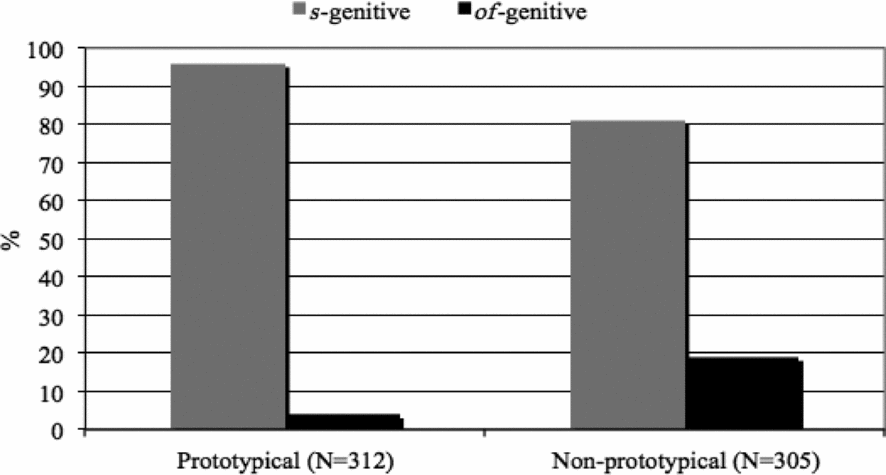
This is not the whole story, however. Prototypical human possessors (figure 6), are realized with the s-genitive 96 per cent of the time, while prototypical non-human possessors (figure 7), are realized with the of-genitive 95 per cent of the time. These distributions fall out from the glaring animacy distinction shown in figure 5. In short, the prototypical possessors in figure 6 may well favour the s-genitive because they are prototypical, but (at least in these data) this cannot be disentangled from the additional fact that they are human. Similarly, the non-human possessors in figure 7 are mostly found with the of-genitive. Here too non-prototypical types overlap nearly entirely with non-humans.
Proportion of s- and of-genitive with human possessors by possessor relation in Ontario English
Proportion of s- and of-genitive with non-human possessors by possessor relation in Ontario English
Variation in a system can, of course, only be modeled when variation is present. If categorical contexts are included in an analysis, they will contaminate the variable system. Therefore, following standard variationist practice, we exclude contexts with ≤ 5 per cent or ≥ 95 per cent of one variant or the other (Guy Reference Guy, Ferrara, Brown, Walters and Baugh1988: 131). Based on the distributions in figure 6 and figure 7, this requires additionally restricting our analysis to only non-prototypical contexts.
Having successfully isolated the context of variation within the genitive system we can proceed to model the alternation between the s- and of-forms. If genitive alternation is changing as predicted in section 2, it will be revealed in the patterns of variation. We now test the claim that the animacy constraint for genitives is extending to certain non-human possessors, such as collective/organizations ((18a–b); see also (9), (10), (12)) and geographic locations ((18c–d); see also (10) with the s-genitive), but not to other inanimate categories, such as concrete and abstract inanimates ((18e–f); see also (12), (4a)) (Hinrichs & Szmrecsanyi Reference Hinrichs and Szmrecsanyi2007: 440; Mair Reference Mair2006b: 147; Rosenbach Reference Rosenbach, Rohdenburg and Mondorf2003: 386, Reference Rosenbach2005: 615).
- (18)
(a) I want the president of the university to shake your hand (I/c/19/F)
(b) He was the conductor of the Toronto Symphony Orchestra (N/?/78/M)
(c) . . .’cause the ethnicity of the area is. . . (N/p/20/M)
(d) I lived a life of running for my life down the streets of Oshawa with my two young kids. (N/h/55/F)
(e) . . . right through the wall of the apartment building. (N/ = /82/M)
(f) Not just you-know sort-of soften the edges of the problems. (N/P/73/M)
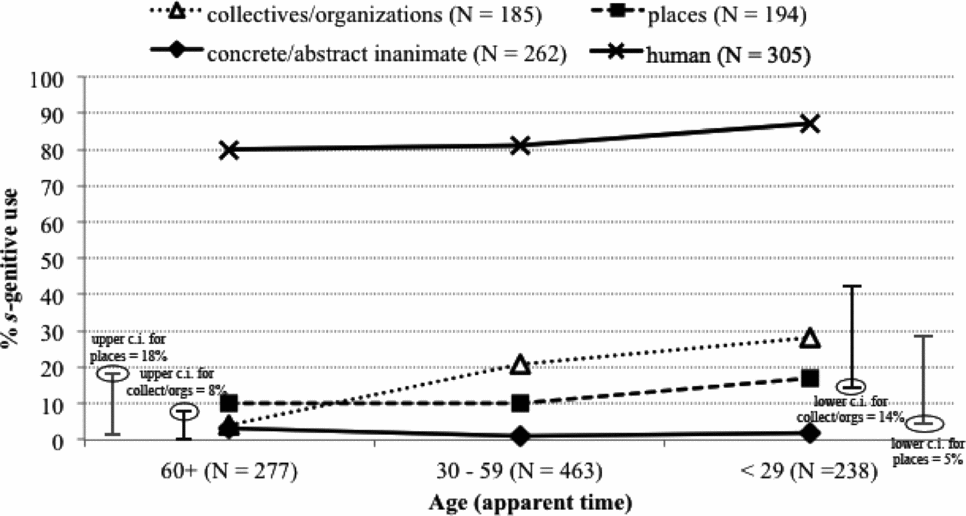
Figure 8 shows the distribution of non-human, non-prototypical possessors alongside human non-prototypical possessors in apparent time. It is evident that human possessors dominate the system and are near categorical in apparent time. We also see that concrete and abstract inanimates are realized with the of-genitive 98 per cent of the time. Both are consistent with figure 5. The precise locus of change is now apparent. The s-genitive is increasing only in the non-prototypical collective/organization possessors. Confidence intervals calculated at p < .05 confirm that the proportion of s-genitives with collectives/organizations (N = 185) by individuals who are 60 or older (4 per cent) is significantly different from that of the < 29 individuals (28 per cent).Footnote 15
Proportion of s-genitive by animacy in Ontario English (non-prototypical possession only)
For the place-possessors (N = 194), there is an increase from 10 per cent s-genitive for the oldest individuals to 17 per cent in the youngest. The boundaries of these confidence intervals do overlap,Footnote 16 demonstrating that this difference is not significant. We therefore have evidence of a change over time for the s-genitive. However, this change is localized to the category of collective/organizations. Hereafter, the visibly categorical concrete and abstract inanimates will be removed from the analysis of non-human possessors. This leaves a relatively small set of 684 tokens where variation between -s and of occurs: 305 human possessors and 379 non-humans, all of which are collective/organizations and places.
In order to determine what mechanisms(s) can explain the choice of variants, we conduct separate fixed-effects logistic regressions of human and non-human possessors using Goldvarb (Sankoff et al. Reference Sankoff, Tagliamonte and Smith2005). The results are presented in terms of the s-genitive. Sum coding shows the relationship between the statistically significant predictors (at the p < .05 level). The factor weights reported are probabilities ranging from 0 to 1 indicating whether a tested factor will favour or disfavour the application value (in these analyses, the s-genitive). Factor weights higher than .5 indicate that the factor favours the s-genitive; factor weights lower than .5 disfavour the s-genitive and favour the of-genitive (see e.g. Guy Reference Guy and Preston1993; Tagliamonte Reference Tagliamonte2012: 126–9).Footnote 17 Internal linguistic factors tested include those detailed in sections 3.3 and 3.5 – final sibilant in the possessor, possessor length, possessum length, persistence and, for non-human possessors only, the animacy type (collective/organization or place). External social factors tested include age, gender and occupation.Footnote 18
4.2 Logistic regression
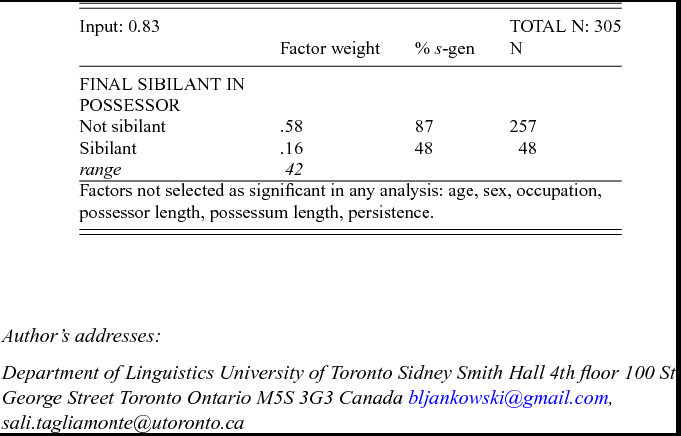
A fixed-effects logistic regression analysis of non-prototypical human possessors is shown in table 3. It reveals that, of the factors tested, there is only one statistically significant effect. Possessors with final sibilants – such as research in (15b) – highly disfavour the s-genitive. The factor weight of .16 for a preceding final sibilant means that even if the possessor is human, if it ends in [s], [z], [ʃ], [ʒ], [ʧ], or [ʤ], it may be realized with the of-genitive.
Logistic regression analysis of non-prototypical human possessors: probability of s-genitive in Ontario English
The non-significant results listed at the bottom of table 3 also provide information to add to our overall picture of this variable. Possessor and possessum length were not selected as significant, nor was persistence. Further, none of the social factors tested – occupation, sex or age – were significant. In sum, the occurrence of rare of-genitives in this context has no social correlates and is not undergoing change. It is the result of articulatory influences on production.Footnote 19
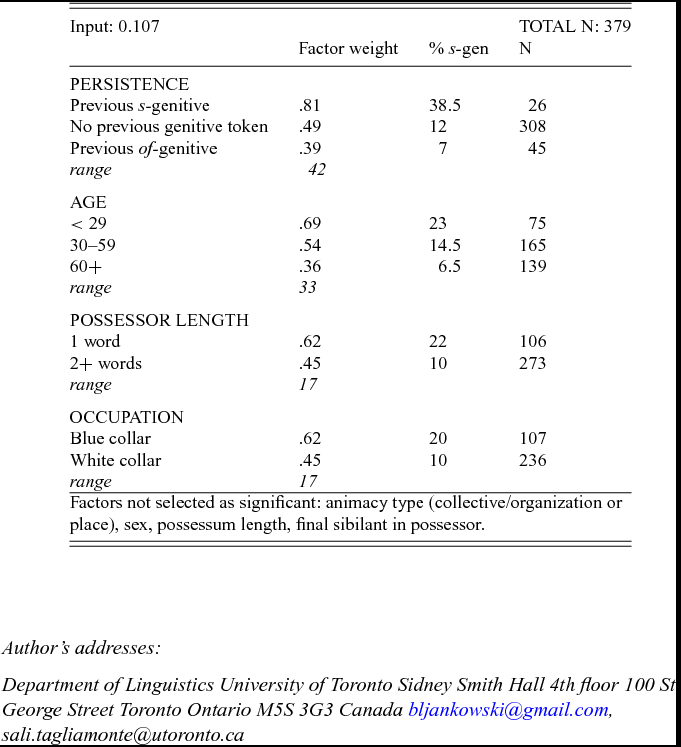
A fixed-effects logistic regression analysis of the variable inanimate contexts, collective/organizations and places, is shown in table 4. The first observation of note is how different these results are from table 3. The most significant factor is persistence. The presence of an s-genitive token within the 100 words preceding another token strongly favours another s-genitive (.81), while a preceding of-genitive disfavours the s-genitive (.39). There is also an effect of possessor length, where one-word possessors favour the s-genitive (factor weight = .62) and longer possessors disfavour it (factor weight = .45).
Logistic regression analysis of non-prototypical collective/organizations and place possessors: probability of s- in Ontario EnglishFootnote 20
Among the social factors, the most important is age. The linear progression towards more s-genitives from old to young is a prime indicator of linguistic change. This provides statistical confirmation of the spread of s-genitive into these non-human possessors, as also observable in figure 8. Further, individuals who work in blue-collar, manual-labour jobs favour the s-variant over white-collar workers, with managerial and customer service jobs, suggesting sociolinguistic value.
The differences in the mechanisms underlying variant choice between human and non-human possessors support the observation that the genitive system is functionally differentiated.Footnote 21 Processing effects and the effect of end weight (here, length of the possessor) favour the spreading form. Ongoing change is currently isolated to non-prototypical collective/organizations (figure 8).
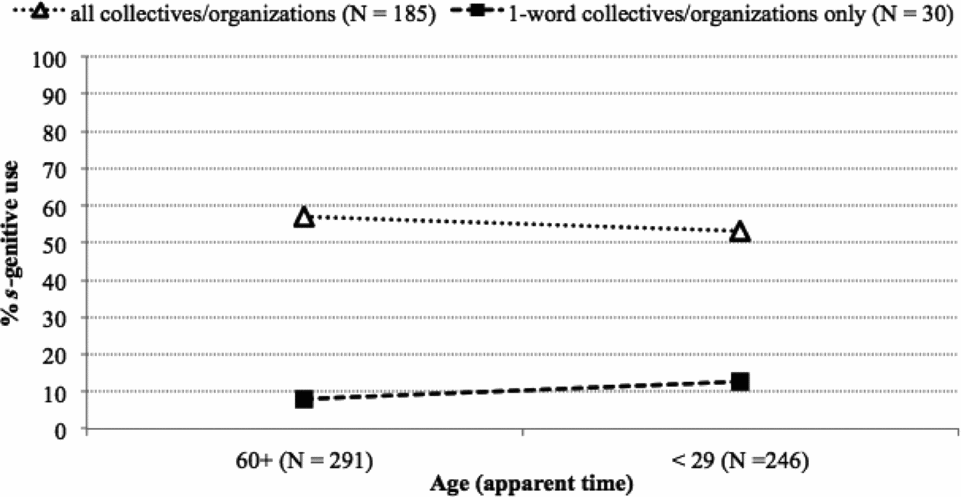
Given that one-word possessors favour the s-genitive, there is a possibility that (i) the increase of the s-genitive in the collective/organizations is because of an overall increase in one-word collective/organization possessors (both s- and of-genitive) over time, or (ii) the result of an overall increase over time in collective/organization possessors (again, both s- and of-genitive) of all lengths. Figure 9 addresses both of these possible interactions, and shows that neither hypothesis is the case. The proportion of one-word collective/organization possessors does not change appreciably between the oldest and youngest speakers, nor does the overall proportion of collective/organization possessors in the corpus. This corroborates the operation of the principle of end weight.
Collective and organization possessors over time, one-word and all lengths (s- and of-genitive combined)
5 Discussion and conclusions
What can we conclude from all this? Most research on the genitive alternation has focused primarily on the question of which factors contribute more or less explanatory value in a model of variation. The distribution of forms in figures 5, 6 and 7 demonstrates that, at least in vernacular speech, nearly all the variation can be explained by the entwined factors of animacy and prototypicality. Once these two factors are taken into account, the arresting divide of genitive variants in contemporary spoken English is exposed: s-genitive for humans and of-genitive for non-human. Variation exists, but human possessors, as shown by the analysis in table 3 and discussed in section 4.2, only vary in response to a production factor – if the possessor ends in a sibilant (i.e. the physical aspect of the research), an of-genitive can still be co-opted into this part of the system. Other than this, our results show no ongoing change for human possessors; rather, the s-genitive has long since saturated that part of the system.
For non-human possessors we have documented a different state of affairs. In these contexts, the s-genitive is modestly encroaching into collective/organizations. Therein, alternation between s- and of-genitive is highly sensitive to persistence, or priming, and more modestly to length of the possessor. This is not due to simply an overall increase in either collective/organization possessors or one-word possessors over time (figure 9), indicating that this is a bona fide change in progress.
A personification effect by metaphorical extension (Rosenbach Reference Rosenbach2002: 248–50) is clearly relevant to this process (figure 8). If the s-genitive is spreading from human contexts back into non-humans (recall that the s-genitive is the historically older form), it is unsurprising that it would do so first in those contexts that are arguably closer to humanness in the animacy hierarchy. Even though metonyms like the museum (11b) fall slightly lower than humans, we can and do get the museum’sidea. Collective/organizations (the public’sperception, the head table’s food, education’sfault) refer to organized groups of animate beings with a leader, rules and/or a mandate, while places (Canada’s Silicon Valley) refer to ‘potential locations for humans’ (Zaenen et al. Reference Zaenen, Carletta, Garretson, Bresnan, Koontz-Garboden, O’Connor, Wasow, Webber and Byron2004: 11).Footnote 22 All the evidence points to change in progress. However, the overall density of these forms with the s-genitive in vernacular speech is low (N = 28/379 collective/organizations, N = 22/379 places) and the frequency moderate (13.2 per cent s-genitive combined). Further, the change in progress is localized to collective/organizations (figure 8). All of this, along with the fact that these contexts themselves are so highly restrictive, suggests that the extension of s-genitive is only beginning in the spoken language, at least in the vernacular of Ontario.
Given the evidence for change in progress, it is thus not surprising that sociolinguistic effects are also implicated. Blue-collar workers favour the s-genitive while white-collar workers, who are expected to have greater need to resort to more formal speech styles (Labov Reference Labov1990: 232–6), favour the of-genitive. This demonstrates that formality differences long-noted for this variable in writing (Altenberg Reference Altenberg1982: 268–9) are also active in the vernacular.
Recall that the s-genitive was once nearly obliterated by the of-genitive (see figure 1), but has been regaining ground since the sixteenth century (Rosenbach Reference Rosenbach2002: 190; Altenberg Reference Altenberg1982: 146–7). Yet even when the s-genitive was at its most extreme point of decline in Middle English, it could still be found most often with human possessors. Use of the s-genitive with inanimate possessors at that time was more likely in verse texts, or poetry, a genre which is (i) more sensitive to phonological factors (i.e. stress, rhythm) than prose, and (ii) more likely to make use of personification (Rosenbach Reference Rosenbach2002: 180). In our contemporary English vernacular data, human possessors are overwhelmingly marked with s-genitive, only surfacing as an of-genitive in rare cases where the phonotactics are highly disfavouring. Non-human contexts, on the other hand, are the site of ongoing change, and so are subject to the underlying mechanisms that are pushing the change forward.
What is the explanation for those changes? The wealth of studies previously cited (e.g. Biber at al. Reference Biber, Johansson, Leech, Conrad and Finegan1999; Hinrichs & Szmrecsanyi Reference Hinrichs and Szmrecsanyi2007; Jankowski Reference Jankowski2013; Jucker Reference Jucker and Jucker1993; Leech et al. Reference Leech, Hundt, Mair and Smith2009; Szmrecsanyi & Hinrichs Reference Szmrecsanyi, Hinrichs, Nevalainen, Taavitsainen, Pahta and Korhonen2008) have found the s-genitive with inanimates to be most frequent in written data, especially in journalism. Our findings, in conjunction with Jankowski (Reference Jankowski2013) in figure 3, where the s-genitive for non-humans is visibly more frequent in two written registers,Footnote 23 corroborate the hypothesis that written language is leading the way for the extension of the s-genitive into non-human possessors. This is contrary to the common assumption in historical linguistics that change spreads from vernacular speech to writing (Pintzuk Reference Pintzuk, Joseph and Janda2003: 525) and opens up new possibilities for studying the contrasts between speech and writing. Hinrichs & Szmrecsanyi suggest that ‘the more significant causes of the spread of the s-form lie in the area of discourse practices, not the underlying constraint grammar’ (2007: 440, citing Mair Reference Mair2006b: 147). Certainly the finding that persistence exerts the greatest influence on the choice of an s-genitive with non-human possessors is consistent with innumerable studies of discourse marking where the use of one variant typically leads to another (Scherre & Naro Reference Scherre and Naro1991, Reference Scherre and Naro1992).
Of the other statistically significant factors, the effect of end weight is a pervasive cognitive mechanism, while semantically driven spread by metaphorical extension is a ubiquitous process in linguistic change. The spread of the s-genitive, as with any variable, is conditioned by multidimensional factors and cannot be attributed to any single cause. An added complication is that the genitive is subject to divergent constraints by register, e.g. spoken data has stronger persistence effects while written data has a stronger effect of possessum length (see Szmrecsanyi & Hinrichs Reference Szmrecsanyi, Hinrichs, Nevalainen, Taavitsainen, Pahta and Korhonen2008: 302; Hinrichs & Szmrecsanyi Reference Hinrichs and Szmrecsanyi2007: 463–4; Jankowski Reference Jankowski2013: 86–91), and only written data, such as journalistic prose, is influenced by economy. We therefore concur with the assertion that ‘the probabilistic mechanisms behind genitive choice in press English are, and remain, sufficiently distinct from the factors working on genitive variation in spoken English’ (Szmrecsanyi & Hinrichs Reference Szmrecsanyi, Hinrichs, Nevalainen, Taavitsainen, Pahta and Korhonen2008: 307).
To pursue further study of these trends and patterns, we must compare contexts of variable genitive alternation across a fuller spectrum of written and spoken registers and styles, particularly with inanimate possessors. An encouraging development for future work will be to examine the burgeoning array of new written registers (e.g. blogging, IM, SMS, Facebook and the like). These registers offer an expanded continuum from highly formal to extremely informal writing (see Tagliamonte & Denis Reference Tagliamonte and Denis2008), which will expose added nuances to the formality continuum.
From a methodological perspective, we suggest that explicit data extraction and coding protocols are crucial in order to identify the precise realm of variability, especially since it is now becoming obvious that this will differ meaningfully across data sets. Also important are well-documented procedures for the circumscription and coding of the variable, particularly in defining and categorizing animacy and prototypicality (see sections 3.3 and 3.5, above). Together, such practices will not only ensure replicability across studies, but will also expand the knowledge base for understanding the mechanisms and motivations for linguistic change in this system. Taking into account contrastive distributional facts in future studies will not only make comparisons across time more accountable, but it will also enable researchers to make more appropriate generalizations across time and space.
In conclusion, our foray into the genitive alternation in Ontario English has demonstrated that the fundamental constraints (animacy, prototypicality) operate in vernacular speech much as reported in other studies, synchronic and diachronic, spoken and written, suggesting long-term drift in this system of grammar. In this variety, as in the only other comprehensive study using vernacular speech that we are aware of (Szmrecsanyi & Hinrichs Reference Szmrecsanyi, Hinrichs, Nevalainen, Taavitsainen, Pahta and Korhonen2008), the s-genitive has virtually gone to completion in human possessors. Compare (19a), from 1682, a type that apparently varies robustly between s- and of-genitive in diachronic data, to (19b), which is 99 per cent s-genitive in our data from the turn of the twenty-first century.
- (19)
(a) . . . the brother of the Senechal (example 2b of Wolk et al. Reference Wolk, Bresnan, Rosenbach and Szmrecsanyi2013: 383)
(b) . . . your president'sreport (b/U/69/F)
Extension of the s-genitive down the animacy hierarchy into collective/organizations is ongoing. The same trend reported in written registers is in progress in speech but, as we have shown, it is proceeding slowly. It will be interesting to keep watch over non-human possessors as this system continues to evolve.