Personality disorders (PDs) refer to patterns of thinking, feeling, and acting (i.e., personality traits) that are inflexible and maladaptive, and that cause significant functional impairment or subjective distress (American Psychiatric Association, 2000). These patterns are relatively stable and of long duration, and presumed to be first evident during childhood or adolescence. Despite this presumption, until recently there has been relatively little research into earlier manifestations of the PDs. One hindrance to this research has been a general opposition to the application of the construct of PD to youth. For example, although recognizing the early manifestations of PDs, the Diagnostic and Statistical Manual—Fourth Edition, Text Revision (DSM-IV-TR; American Psychiatric Association, 2000) asserts “the traits of a personality disorder that appear in childhood will often not persist unchanged into adult life” (p. 687) and allows a PD diagnosis in childhood only in “relatively unusual instances” (p. 687). This opposition, however, seems to be based more on concerns about potential labeling effects and theoretical expectations rather than on actual empirical data. In fact, based on empirical research examining the temporal stability of personality generally (Roberts & DelVecchio, Reference Roberts and DelVecchio2000), there is reason to expect a fair degree of stability from childhood on. Ultimately, however, the stability of personality pathology across development is an empirical question that must be explored.
Despite this general opposition, research has managed to burgeon on the early manifestations of two related PDs: antisocial personality disorder and psychopathy. Despite being outside the official diagnostic nomenclature, psychopathy is a PD. It is characterized by a lack of remorse, egocentricity, manipulativeness, superficial charm, impulsivity, unreliability, and shallow affect (Cleckley, Reference Cleckley1941; Hare, Reference Hare2003). It is strongly associated with impairment in the form of severe antisocial behavior; the psychopathic offender is among the most prolific, versatile, and violent of all offenders (e.g., Brinkley, Schmitt, Smith, & Newman, Reference Brinkley, Schmitt, Smith and Newman2001; Porter, Birt, & Boer, Reference Porter, Birt and Boer2001). Psychopathy is also quite stable over time, and relatively resistant to efforts at rehabilitation through incarceration and treatment. While incarcerated, psychopathic offenders commit more institutional infractions (Walters, Reference Walters2003) and recidivate more often when released (Salekin, Rogers, & Sewell, Reference Salekin, Rogers and Sewell1996; Walters, Reference Walters2003). Although a relatively recent meta-analysis (Salekin, Reference Salekin2002) challenged the notion that psychopathic offenders are untreatable, several reports suggest that psychopathic offenders are less responsive to treatment efforts (e.g., Ogloff, Wong, & Greenwood, Reference Ogloff, Wong and Greenwood1990; Shine & Hobson, Reference Shine and Hobson2000).
Juvenile Psychopathy
The severity and stability of antisocial behavior in adult psychopathy, its relative recalcitrance to treatment, and the focus on the assessment of personality inherent in the construct, led several researchers on child and adolescent antisocial behavior to borrow the construct of psychopathy from the adult literature in the hope that earlier identification and intervention might be more effective. Toward this end, several instruments have been constructed to assess psychopathic traits in adolescence and childhood (Forth, Kosson, & Hare, Reference Forth, Kosson and Hare2003; Frick, O'Brien, Wootton, & McBurnett, Reference Frick, O'Brien, Wootton and McBurnett1994; Lynam, Reference Lynam1997); each instrument attempts to assess the traits constituting psychopathy in adults using measures that are more appropriate developmentally.
Initial work examining juvenile psychopathy was rather adevelopmental, focusing on recreating the nomological network of adult psychopathy in juveniles. With few exceptions, juvenile psychopathy appears to act like adult psychopathy (see Lynam & Gudonis, Reference Lynam and Gudonis2005). The convergence is particularly strong in the relation between juvenile psychopathy and offending (see Kotler & McMahon, Reference Kotler and McMahon2005). Robust moderate associations between measures of juvenile psychopathy and concurrent antisocial behavior have been observed in clinical (Christian, Frick, Hill, Tyler, & Frazer, Reference Christian, Frick, Hill and Tyler1997; Enebrink, Andershed, & Langstrom, Reference Enebrink, Andersen and Langstrom2005; Frick et al., Reference Frick, O'Brien, Wootton and McBurnett1994; Stafford & Cornell, Reference Stafford and Cornell2003), community (Frick, Cornell, Barry, Bodin, & Dane, Reference Frick, Cornell, Barry, Bodin and Dane2003; Lynam, Reference Lynam1997), and offender (Kosson, Cyterski, Steuerwald, Neumann, & Walker-Matthews, Reference Kosson, Cyterski, Steuerwald, Neumann and Walker-Matthews2002; Murrie, Cornell, Kaplan, McConville, & Levy-Elkon, Reference Murrie, Cornell, Kaplan, McConville and Levy-Elkon2004; Salekin, Leistico, Neumann, DiCicco, & Duros, Reference Salekin, Leistico, Neumann, DiCicco and Duros2004) samples. Within offender samples, measures of juvenile psychopathy have been shown to predict institutional infractions (Brandt, Kennedy, Patrick, & Curtin, Reference Brandt, Kennedy, Patrick and Curtin1997; Murrie et al., Reference Murrie, Cornell, Kaplan, McConville and Levy-Elkon2004; Spain, Douglas, Poythress, & Epstein, Reference Spain, Douglas, Poythress and Epstein2004; Stafford & Cornell, Reference Stafford and Cornell2003) and reoffending following release (Catchpole & Gretton, Reference Catchpole and Gretton2003; Corrado, Vincent, Hart, & Cohen, Reference Corrado, Vincent, Hart and Cohen2004; Falkenbach, Poythress, & Heide, Reference Falkenbach, Poythress and Heide2003; Gretton, McBride, Hare, O'Shaughnessy, & Kumka, Reference Gretton, McBride, Hare, O'Shaughnessy and Kumka2001). Finally, several studies have shown that juvenile psychopathy predicts antisocial behavior above and beyond other well-known risk factors, including previous offending, aggression, conduct problems, impulsivity, IQ, and attention problems (Frick et al., Reference Frick, Cornell, Barry, Bodin and Dane2003; Lynam, Reference Lynam1997; Piatigorsky & Hinshaw, Reference Piatigorsky and Hinshaw2004; Salekin et al., Reference Salekin, Leistico, Neumann, DiCicco and Duros2004). All of these relations are consistent with those observed in adults.
Juvenile psychopathy has also been found to relate as predicted to constructs that do not involve offending, such as personality, cognitive processing, and other forms of psychopathology. Juvenile and adult psychopathy are related in similar ways to basic dimensions of personality (Lynam et al., Reference Lynam, Caspi, Moffit, Raine, Loeber and Stouthamer-Loeber2005; Salekin, Leistico, Trobst, Schrum, & Lochman, Reference Salekin, Leistico, Trobst, Schrum and Lochman2005). Psychopathic juveniles, like their adult counterparts, show problems in emotional processing (e.g., Blair & Coles, Reference Blair and Coles2000) and deficits in behavioral inhibition or impulsivity (e.g., O'Brien & Frick, Reference O'Brien and Frick1996). The relations between juvenile psychopathy and other forms of psychopathology are somewhat divergent from what is observed for adults, although this may be because of higher rates of comorbidity among childhood disorders (Salekin & Frick, Reference Salekin and Frick2005). Lynam (Reference Lynam1997) and Salekin et al. (Reference Salekin, Leistico, Neumann, DiCicco and Duros2004) both report that psychopathic juveniles are more prone to externalizing problems than to internalizing problems, but neither study found the negative relations between juvenile psychopathy and internalizing problems often observed in adults.
More recent research on the construct, however, has begun to examine more basic developmental issues and concerns including the assessment of juvenile psychopathy using an “imported” instrument and the stability and predictive validity of psychopathy from adolescence into adulthood. For example, using data from the middle sample of the Pittsburgh Youth Study and items from the Common Language Q-Sort (Caspi et al., Reference Caspi, Block, Block, Klopp, Lynam and Moffitt1992), Lynam, Derefinko, Caspi, Loeber, and Stouthamer-Loeber (Reference Lynam, Derefinko, Caspi, Loeber and Stouthamer-Loeber2007) compared empirically the content of an imported instrument, the Childhood Psychopathy Scale (CPS; Lynam, Reference Lynam1997), to the content of scales created using more “indigenous” approaches, expert ratings of “the fledgling Cleckley psychopath” and a scale derived empirically using correlations with adult psychopathy. These authors found a very high degree of overlap among the items included on each scale with content correlations ranging from .90 to .95 and convergent correlations approaching the reliability of the measures. As a second example of more basic research, Lynam, Caspi, Moffitt, Loeber, and Stouthamer-Loeber (Reference Lynam, Caspi, Moffitt, Loeber and Stouthamer-Loeber2007) examined the stability between psychopathy assessed at age 13 using the mother-reported CPS and the interviewer-rated Psychopathy Checklist: Screening Version (Hart, Cox, & Hare, Reference Hart, Cox and Hare1995) at age 24 in 250 young men from the Pittsburgh Youth Study. Despite the long time lag (11 years on average), differences in method and source of assessment (mother report vs. interview rating) and some differences in content, psychopathy was found to be moderately stable (r = .31) from early adolescence into young adulthood.
One crucial and basic developmental issue raised by critics (Edens, Skeem, Cruise, & Cauffman, Reference Edens, Skeem, Cruise and Cauffman2001; Seagrave & Grisso, Reference Seagrave and Grisso2002), however, remains relatively unexplored: the impact of developmental changes on psychopathy during adolescence. Adolescence is a developmental period filled with biological, social, and cognitive changes. Adolescents face a number of new developmental tasks including developing coherent identities, establishing relations with peers, and developing independence from parents. These changes and transitions may serve as contributors to discontinuity in pathological personality generally and psychopathy specifically. Seagrave and Grisso (Reference Seagrave and Grisso2002) argued explicitly that normative developmental change may masquerade as juvenile psychopathy, identifying eight specific characteristics of psychopathy that they believe may have transient developmental parallels: glibness, grandiosity, pathological lying, manipulation, lack of remorse, shallow affect, callousness, and failure to accept responsibility for one's actions. Both possibilities would serve to reduce the stability of juvenile psychopathy across adolescence, underscore concerns about the application of PD terms to adolescents, and render the juvenile psychopathy much less useful.
Although there is little evidence available to assess whether the specific psychopathic traits identified by Seagrave and Grisso (Reference Seagrave and Grisso2002) show normative changes across adolescence alone or in combination, there is evidence for change in related constructs. Adolescents are more likely than children and adults to engage in a variety of risky behaviors, including binge drinking, smoking, casual sex, and criminal behavior (e.g., Wiesner & Silbereisen, Reference Wiesner and Silbereisen2003; Windle, Mun, & Windle, Reference Windle, Mun and Windle2005). In fact, one of the most robust findings in the criminology literature is a curvilinear relation between age and crime such that offending for all crime types rises sharply in midadolescence and declines slightly less sharply again in young adulthood (e.g., Farrington, Loeber, & Jolliffe, Reference Farrington, Loeber, Jolliffe, Loeber, Farrington, Stouthamer-Loeber and Raskin2008). Paralleling the changes in antisocial behavior are changes in the way in which time is spent; across adolescence, individuals spend more and more time in unstructured activities with peers, a robust predictor of delinquent involvement (Osgood, Wilson, O'Malley, Bachman, & Johnston, Reference Osgood, Wilson, O'Malley, Bachman and Johnston1996). Also paralleling these changes, are changes in the adolescent brain that seem to render adolescents more sensitive to the reward value, and therefore less sensitive to the cost, of certain behaviors (Steinberg, Reference Steinberg2008). A priori, one might expect, based on the robust relation between psychopathy and antisocial behavior, that psychopathy might also show normative developmental change.
Unfortunately, there are very few studies that have examined the stability of juvenile psychopathy across time. The study on stability discussed earlier by Lynam, Derefinko, et al. (2007) examined the stability between psychopathy scores in early adolescence and young adulthood, bypassing mid- and late-adolescent stability. Frick, Kimonis, Dandreaux, and Farell (Reference Frick, Kimonis, Dandreaux and Farell2003) examined the stability of scores on the Antisocial Process Screening Device (APSD; Frick & Hare, Reference Frick and Hare2001) across 4 years in a small (n = 98) sample of nonreferred children in the third, fourth, sixth, and seventh grades at the first assessment. The sample was selected from a larger population to overrepresent individuals scoring high on the two dimensions of the APSD: callous–unemotional traits (CU) and impulsive conduct problems. Within-informant stability, calculated using intraclass correlations, ranged from .88 at 2-year follow-up to .80 at 4-year follow-up; the instantaneous stability was .93. Although the results support the stability of juvenile psychopathy across adolescence, more research is clearly required. The sample for this study was quite small, with 98 children at the first assessment and 79 at the last. The small sample, in addition to raising concerns about replication, precluded examination of the relation between age and psychopathy and prevented separate examinations of stability among those selected because they were low and those selected because they were high on the APSD. This extreme-groups selection procedure may have artificially inflated stability estimates. Finally, the study did not avail itself of recent improvements in methodology for analyzing longitudinal data; the advantages offered by the linear mixed modeling approach used here are articulated in the next paragraph.
The present study extends the previous work by Frick et al. (Reference Frick, Cornell, Barry, Bodin and Dane2003) to examine the stability of juvenile psychopathy across adolescence specifically, and the issue of stability in personality pathology more generally. Using data from over 1,500 boys from the three cohorts of the Pittsburgh Youth Study, we examine the stability of juvenile psychopathy from age 7 to age 18. Relative stability as a function of age and absolute stability are examined within high- and low-risk groups. We employ linear mixed models incorporating both fixed and random effects. These models have several advantages over more traditional correlational approaches. First, they allow explicit modeling of temporal trends in mean responses that can depend on one or more covariates. Second, they accommodate various sources of departure from these trends: contributions of unmeasurable subject-specific attributes that are static over time, contributions of unmeasurable subject-specific attributes that evolve over time, and measurement errors. Third, linear mixed models can accommodate missing data: a subject with one or more missing observations is not excluded from the computations involved in parameter estimation. To the extent that developmental changes across adolescence render personality pathology unstable across this same period, several findings should emerge. First, the assessment of such pathology should be relatively unreliable. Second, the stability of such pathology across adolescence should be low. Third, to the extent that normative developmental change affects personality pathology scores, scores should change across adolescence. Fourth and finally, the predictive power of personality pathology should also change across developmental. The present paper examines each of these possibilities.
Methods
Participants
Participants are members of the three samples making up the Pittsburgh Youth Study. Full details of background characteristics and initial recruitment in 1987–1988 when children (all male) were aged 7 (youngest), 10 (middle), or 13 (oldest) are given elsewhere (Loeber, Farrington, Stouthamer-Loeber, & van Kammen, 1998). Briefly, boys attending the first, fourth, or seventh grades in the public school system in inner-city Pittsburgh (about 1,000 in each grade) were randomly selected from schools across the city. Among those families contacted, 85% of the boys and their parents agreed to participate. An initial screening assessment identified high-risk participants; specifically, about 250 boys at each grade level (i.e., 30% of those who agreed to participate) were identified as having more severe disruptive behavior problems based on caretaker, teacher, and self-reports. An equivalent-sized random subset of the remaining 70% of boys was drawn at each grade level to form a complete follow-up sample. This selection process yielded approximately 500 boys in each follow-up sample (503 in the youngest sample, 508 in the middle sample, and 506 in the oldest sample), half high risk and half low risk. Each sample also had approximately equal representations of Caucasian and African American boys.
Each sample was followed regularly, every 6 months initially and every year thereafter, and assessed on a variety of measures quantifying the correlates, causes, and consequences of antisocial behavior. The youngest sample was followed from ages 7 to 20, the middle sample was followed from 10 to 13, and the oldest sample was followed from 13 to 25. This study relies predominantly on the assessments occurring between 7 and 18; as not all children in each grade level were exactly the same age, a very small fraction of the assessments used in this analysis occurred before age 7 or after age 18.
Juvenile psychopathy
Juvenile psychopathy was assessed using a short form of the CPS (Lynam, Reference Lynam1997). The CPS was developed to operationalize, in childhood and adolescence, the personality traits found in the Revised Psychopathy Checklist (PCL-R; Hare, Reference Hare2003). Using descriptions of the PCL-R constructs and items previously collected from caregivers on an extended version of the Childhood Behavior Checklist (Achenbach, Reference Achenbach1991) and the Common-Language Q-Sort (Caspi et al., Reference Caspi, Block, Block, Klopp, Lynam and Moffitt1992), 12 of the 20 PCL-R constructs were operationalized as two- to four-item scales. Three PCL-R items, criminal versatility, juvenile delinquency, and early behavior problems were not included in the CPS so that it might serve as a relatively pure measure of personality uncontaminated by frankly antisocial behavior; there already exist many adequate assessments of antisocial behavior, and we believe that the greatest potential contribution of the psychopathy construct to developmental psychopathology lies in its focus on personality rather than behavior. Five constructs were not included in the original version of the CPS because they could not be adequately operationalized (boredom susceptibility), did not correlate with other items (grandiosity), or had no childhood counterparts (promiscuous sexual behavior, many short-term marital relationships, and revocation of conditional release). The operationalization was successful: 8 of the 12 construct scales had αs above .60, and 10 of the 12 α values were above .50. The reliability of the total scale was .91. To validate the CPS, its relation to known correlates of psychopathy was examined (Lynam, Reference Lynam1997). Boys who scored high on the CPS were already the most consequential offenders at ages 10 and 13 as well as the most stable offenders across the two ages. In addition, high scorers were more impulsive on a multimethod, multisource battery of impulsivity measures. They were also prone to externalizing disorders but not internalizing disorders. Finally, scores on the CPS predicted serious delinquency above and beyond other known predictors (socioeconomic status, IQ, previous delinquency, and impulsivity) and alternative parsings of the item pool. Additional studies have shown that the CPS is related to other theoretically meaningful constructs, including recidivism and poor treatment outcomes in adolescence (Falkenbach et al., Reference Falkenbach, Poythress and Heide2003), the five factor model (FFM) of personality (Lynam et al., Reference Lynam, Caspi, Moffit, Raine, Loeber and Stouthamer-Loeber2005; Salekin et al., Reference Salekin, Leistico, Trobst, Schrum and Lochman2005), and electrodermal hyporesponsivity (Fung et al., Reference Fung, Raine, Loeber, Lynam, Steinhauer, Venables and Stouthamer-Loeber2005).
The short form of the CPS used in the present study consists of the 18 items drawn from the extended Childhood Behavior Checklist that were available at every assessment (see Table 1). Each item was rated as a 0 (not true), 1 (somewhat true), or 2 (very true). For each assessment, parents were asked to report on the boys' behavior during the past year or past 6 months, depending on the assessment gap. The scores on these items were averaged to create a juvenile psychopathy index at each assessment. At age 13, this short form correlated at 0.91 with the full version, suggesting that the short form provides a valid assessment.
Items comprising the CPS-SF

Note: CPS-SF, Childhood Psychopathy Scale Short Form (Lynam, Reference Lynam1997).
Delinquency
At each assessment, boys completed the Self-Report Delinquency Instrument used in the National Youth Survey (Elliott, Huizinga, & Ageton, Reference Elliot, Huizinga and Ageton1985). The instrument inquires about each boy's delinquency during the previous 6 months. The items assess both less serious (e.g., skipping school and stealing something worth less than $5) and more serious forms of delinquency (e.g., breaking and entering and robbery). Self-report delinquency data were supplemented with teacher and caretaker reports of delinquent behavior. Self-report measures of delinquency have strong psychometric properties, particularly when supplemented by reports from other informants (see Junger-Tas & Marshall, Reference Junger-Tas and Marshall1999).
Because simple frequency counts of delinquent behavior neglect the relative seriousness of the behaviors and can fail to order persons adequately along a dimension of delinquency, a seriousness classification scheme was developed (Loeber et al., Reference Loeber, Farrington, Stouthamer Loeber and Van Kammen1998). The severity ratings, adapted from those developed by Wolfgang, Figlio, Tracey, and Singer (Reference Wolfgang, Figlio, Tracey and Singer1985), place a boy in one of six delinquency levels (0 = no delinquency activity; 5 = multiple serious delinquent acts such as stealing cars, breaking and entering, or selling drugs) based on the most serious act committed in the last 6 months according to the boy, his teacher, or his caretaker.
General statistical approach
Data analysis took place in four phases, as described below. Calculations were carried out using Version 8.2 of SAS (SAS Institute, Cary, NC) and Version 2.3.1 of R (R Foundation for Statistical Computing, Vienna, Austria, 2006). Because of the multiplicity of hypothesis tests, we set the threshold for statistical significance to .01 rather than .05.
Reliability across development
We calculated Cronbach alphas and basic descriptive statistics (mean, standard deviation, skewness) for the psychopathy measurements at each of 22 waves (corresponding to ages 7.0, 7.5, 8.0, etc.). The alphas constitute the reliability of the psychopathy measurements at the various waves. We also averaged the alphas over several consecutive waves (Waves 1 to 7, 8 to 15, 16 to 22) to clarify whether reliability varied across lower, middle, and upper age groups (ages 7.0 to 10.0, 10.5 to 14.0, 14.5 to 17.5).
Cross-time stability
To examine stability across development, we calculated double-entry correlations for the psychopathy measurements over time lags of 6 months (Waves 1 and 2, 2 and 3, 3 and 4, etc.), 1 year (Waves 1 and 3, 2 and 4, 3 and 5, etc.), 2 years, and 5 years.Footnote 1 The double-entry correlations, unlike ordinary Pearson correlations, take into account similarity in magnitude of scores in addition to rank order.
Mean levels of psychopathy across development
We fit a linear mixed model (Verbeke & Molenberghs, Reference Verbeke and Molenberghs2000) relating psychopathy to age, risk status, and number of previous assessments. This model was used to quantify the mean-level stability over time of the psychopathy measurements for each risk group, as the quotient of model-implied mean square error by crude mean square error (see Results for details). This quotient will be close to 100% when there is little temporal variation in mean-level psychopathy. This linear mixed model will be referred to as Model I to distinguish it from the linear mixed model used in the next phase of the data analysis.
Predictive utility of psychopathy across development
We fit a second linear mixed model relating current delinquency to past delinquency, past psychopathy, age, and risk status. This linear mixed model was used to quantify the predictive utility of past psychopathy with respect to current delinquency and also to quantify the predictive utility of past delinquency. In particular, we sought to determine whether these predictive utilities varied with age. Predictive utility for past psychopathy is defined formally as the expected change in current delinquency given a one-unit change in past psychopathy while controlling for past delinquency and other model variables; predictive utility for past delinquency is defined analogously. This linear mixed model will be referred to as Model II.
Formulation of Model I
For each of the two risk groups (low risk, high risk), we express psychopathy scores by the equation

where Y ij represents the jth (square root transformed) psychopathy score for the ith subject,Footnote 2A ij denotes the age (in decades) at the jth assessment for the ith subject,Footnote 3 and M ij reflects the number of previous assessments, because exploratory data analysis suggested that psychopathy scores might tend to be higher during the first few assessments (regardless of age), a phenomenon likely because of the risk-stratification design of our study.Footnote 4
Coefficients β 0 through β 4 are unknown constants; these “fixed effects” are common to all subjects within a risk group (low risk, high risk) but may differ between risk groups. The quantity

constitutes the overall trend in psychopathy for a risk group as a function of age and the number of previous assessments (including the respective quadratic terms).Footnote 5
The α i and γ i are “random effects,” representing subject-specific adjustments to β 0 and β 1.Footnote 6 The α i may be thought of as reflecting unmeasured attributes, static over time, that have a uniform effect on all of the psychopathy scores for a given subject. The γ i reflect unmeasured attributes, static over time, that have a uniform effect on the rate of change underlying a given subject's psychopathy scores. The α i and γ i are assumed to arise from a multivariate normal distribution with variances and covariance depending only on the subject's risk status.
The ε ij are “serially correlated errors” and reflect unmeasured attributes, dynamic over time, that have similar effects on consecutive psychopathy scores for a given subject. The ε ij for a given subject are assumed to arise from a multivariate normal distribution with a Gaussian correlation structure whose variance and covariance parameters depend on a subject's risk status. Finally, the ζ ij are “residual errors” and represent departures from the overall trend adjusted for random effects and serially correlated errors. The ζ ij are assumed independent and to arise from a normal distribution.
Formulation of Model II
For each of the two risk groups (low-risk, high-risk), we express current delinquency scores by the equation

where X ij represents the (square root transformed) delinquency score at the jth assessment (j ≥ 2) for the ith subject.Footnote 7 We define j′ = j − 1, so that X ij′ and Y ij′ represent the immediate past (square root transformed) delinquency and psychopathy scores, A ij denotes the age (in decades) at the jth assessment for the ith subject, S ij is a “separation variable” that equals 1 if the current and past assessments are separated by 1 year and equals 0 if these assessments are separated by 6 months. Including S ij in the model allows us to modify a prediction for current delinquency if the information about past delinquency and past psychopathy is 1 year old instead of 6 months old.
The “fixed effects” β 0 through β 8 are common to all subjects within a risk group (low risk, high risk) but may differ between risk groups. The quantity

constitutes the prediction for current delinquency in terms of past delinquency, past psychopathy, age, and the separation variable (including quadratic and cubic terms in age as well as age/past psychopathy and age/past delinquency interaction terms).Footnote 8 When all other variables are controlled for, the expected change in X ij associated with a one-unit increase in X ij′ (i.e., the predictive utility of past delinquency) is β 1 + β 6A ij; the corresponding expected change for a one-unit increase in Y ij′ (i.e., the predictive utility of past psychopathy) is β 2 + β 7A ij. If β 6 = 0, the predictive utility of past delinquency does not change with age; if β 7 = 0, the predictive utility of past psychopathy does not change with age.
The random effects and residual errors for Model II are analogous to those for Model I. We did not include serially correlated errors in Model II because their presence would have yielded a singular matrix of estimated variance and covariance parameters.Footnote 9
Results
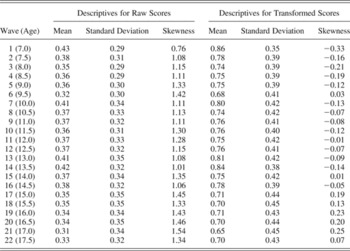
Table 2 presents basic descriptive statistics both for the raw, untransformed psychopathy scores and for the square root transformed psychopathy scores used to fit Models I and II in the later data analysis phases. The mean scores (with and without the square root transformation) were somewhat elevated in Waves 1, 7, 13, and 14. These elevations were coincident with cohorts entering the study at Waves 1, 7, and 13. Hence, they should not be taken to imply that psychopathy peaks at ages 7, 10, and 13 in the general population. Rather, these elevations may reflect the boys' lack of prior experience in being assessed, a factor for which we controlled in Model I. Except at the first wave, skewness of the untransformed scores stayed above 1.00. After the square root transformation, skewness fell between −0.33 and 0.25 at all 22 waves.
Descriptive statistics for raw and transformed psychopathy scores

Note: The Descriptives for Raw Scores pertain to the psychopathy scores prior to the square root transformation described in text footnote 2, and the Descriptives for Transformed Scores pertain to the psychopathy scores after the transformation. Skewness is the sample third central moment divided by the sample variance raised to the 3/2 power. Skewness >1 or <−1 indicates considerable asymmetry (hence nonnormality) in the distribution of sample values.
Reliability across development
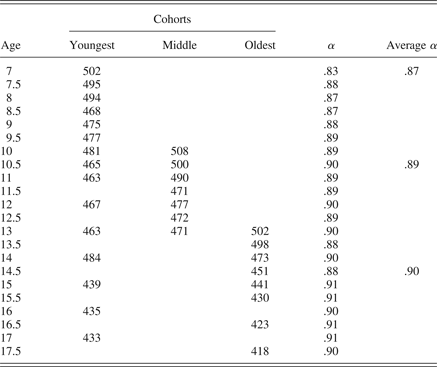
Table 3 shows Cronbach alphas for the raw, untransformed psychopathy scores at each of 22 waves. Except at the first wave, for which the reliability was 0.83, the reliabilities remained between 0.87 and 0.91. Moreover, the average reliability over Waves 1 through 7 (lower age group) was 0.87, over Waves 8 through 15 (middle age group) was 0.89, and over Waves 16 through 22 (upper age group) was 0.90. Hence, during childhood and adolescence there is remarkably little fluctuation in the reliability with which psychopathy can be assessed. In particular, reliability does not decrease with age, which would be anticipated if normative changes interfered with the assessment of psychopathy.
Coefficient alphas for the CPS-SF as a function of age
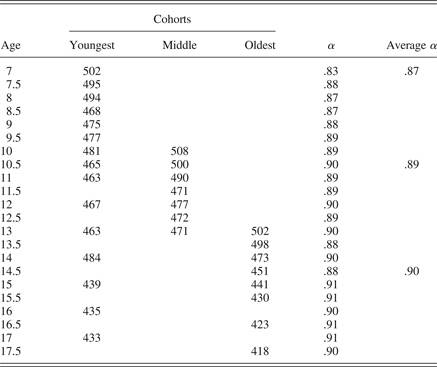
Note: CPS-SF, Child Psychopathy Scale Short Form (Lynam, Reference Lynam1997). Age is the age of participants, and cohorts provides the number of participants assessed in each cohort at each age. The coefficient alpha for the CPS-SF was computed using all available participants at each age, and the arithmetic mean of the alphas is for each of three age ranges: 7–10, 10.5–14, and 14.5–17.5.
Cross-wave stability
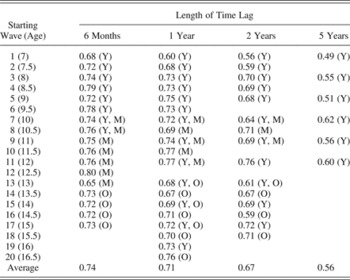
Table 4 displays double-entry correlations for the psychopathy measurements over time lags of 6 months, 1 year, 2 years, and 5 years; of importance, such correlations take into account not just rank-order stability but stability in score levels across time. Stability over a time lag of 6 months ranged from 0.65 to 0.80, but the low end becomes 0.72 if time intervals beginning with cohorts entering the study are omitted. In addition, 6-month stability did not exhibit a systematic pattern of increase or decrease through childhood and adolescence. Stability over a 1-year time lag ranged from 0.60 to 0.77. There was again no systematic pattern of increase or decrease in 1-year stability. Moreover, 1-year stability was generally similar to 6-month stability; the difference was less than 0.05 in 12 out of 16 instances for which a comparison was possible. The ranges of stability for 2-year and 5-year time lags were 0.56 to 0.76 and 0.49 to 0.62, respectively. Stability for a 5-year time lag was weaker than for shorter time lags, as expected, but the figures of 0.49 to 0.62 still suggest that (a) boys who are relatively high on psychopathy in grade school tend to remain relatively high in early adolescence and (b) boys who are relatively high on psychopathy in early adolescence tend to remain relatively high in late adolescence.
Stability of psychopathy as a function of time lag and initial assessment

Note: Starting Wave (Age) provides the beginning wave for each assessment of stability (prototypical age), and Length of Time Lag provides the double-entry correlations across various time lags using all participants who provide a given time lag from a particular starting wave (participating cohorts). For example, participants from the younger and middle cohorts provided 6-month stability information at Wave 7, but the younger and older cohorts provided information on 1-year stability at Wave 17 when participants were around 15 years old.
Mean levels of psychopathy across development
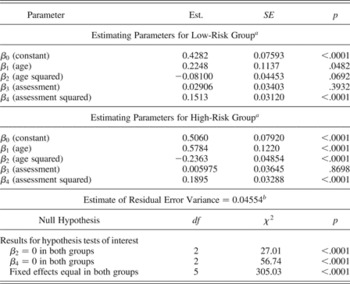
Table 5 shows the estimates of β 0 through β 4 from Model I for each of the two risk groups, along with standard errors and p values reflecting whether the estimates are significantly different from zero. The overall trend in psychopathy is estimated as

for low-risk boys and as

for high-risk boys.
Absolute (mean-level) stability of psychopathy across development for Model I

Note: Est., estimate; SE, standard error.
aParameters β 0 through β 4 are the intercept and coefficients for A ij, A ij2, M ij, and M ij2, respectively.
bThe square root of the residual error variance represents the magnitude of a typical departure from the overall trend, adjusted for random effects and serially correlated errors. Hence, the estimated residual error variance may be regarded as a measure of model fit, although it is a different kind of measure than the consistent Akaike information criterion (cAIC; Bozdogan, Reference Bozdogan1987) mentioned in text footnote 5: the cAIC is useful for determining how to structure a model, but the estimated residual error variance is useful for describing a model's performance once its structure has been determined.
For example, mean psychopathy for low-risk 12-year-olds who have been assessed once before is estimated as 0.4282 + 0.2248 (1.2) − 0.08100 (1.2)2 + 0.02906 (5/6) + 0.1513 (5/6)2 = 0.7106, whereas the corresponding estimate for high-risk 12-year-olds is 0.9964.Footnote 10
Table 5 also provides the results for the central questions. The first test indicates that there is a significant nonlinear effect of age on psychopathy scores. Similarly, the second test indicates a significant nonlinear effect of assessment on psychopathy scores. Finally, the last test indicates that the equations describing psychopathy differ across the two risk groups.
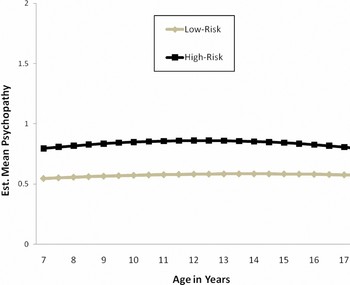
Figure 1 places these results in perspective. Estimated mean psychopathy is displayed as a function of age for high-risk boys and for low-risk boys, assuming the boys have been assessed often enough so that M ij = 0.Footnote 11 In line with different fixed effects across groups, Figure 1 shows that mean psychopathy is greater for high-risk boys uniformly throughout childhood and adolescence. Although the quadratic effect of age is statistically significant, the contribution of age is practically small. Indeed, the difference between the highest and lowest points on the curve for low-risk boys is only 0.038, which is 10.3% of a standard deviation among low-risk boys. The corresponding numbers for high-risk boys are 0.065 and 15.8%.
Fitted trends in psychopathy. Estimated mean psychopathy is displayed as a function of age for high-risk boys and for low-risk boys, assuming the boys have been assessed several times prior. [A color version of this figure can be viewed online at journals.cambrdige.org/dpp]

We more formally quantified absolute (mean-level) stability for the risk groups by dividing the mean square error from Model I (adjusted for age and assessment) by the crude mean square error. For the low-risk group, this quotient is

where the averages are taken over all observations of low-risk boys and 0.6218 represents the average of these. If mean-level psychopathy does not vary greatly with age or the number of previous assessments, then the quotient will be close to 100%. For the high-risk group, the quotient is

Where averages are taken over, all observations of high-risk boys and .8836 represents the averge. We obtain absolute (mean-level) stabilities of 97.1 and 97.0% for low- and high-risk boys, respectively. These extremely high percentages correspond to the near flat (but statistically not exactly flat) curves in Figure 1. Thus, assuming we already have knowledge of a boy's risk status, we reduce average squared error in predicting psychopathy by 3.0% with the added knowledge of age and the number of previous assessments,Footnote 12 signifying that mean-level psychopathy does not change substantially with age or the number of previous assessments.
Predictive utility of psychopathy across development
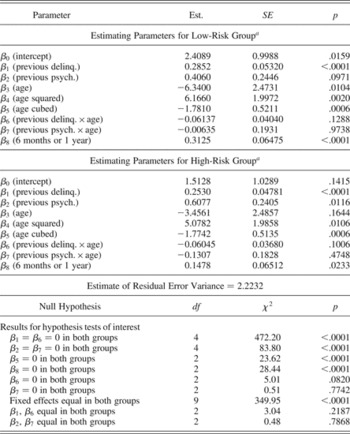
The results from Model II in which future delinquency is predicted by previous delinquency, previous psychopathy, and age are provided in Table 6. Among low-risk boys the prediction for current delinquency is estimated as

whereas for high-risk boys we have

Hence, the predictive utility of past psychopathy is estimated to be 0.4060 − 0.00635 × age for low-risk boys and 0.6077 − 0.1307 × age for high-risk boys. A 1-point increase in past psychopathy for a low-risk 12 year-old boy increases the prediction for current delinquency by an estimated 0.3984 points (0.4060 − 0.00635 × 1.2). The predictive utility of past delinquency is estimated to be 0.2852 − 0.06137 × age for low-risk boys and 0.2530 − 0.06045 × age for high-risk boys.
Predictive utility of psychopathy across development for Model II

Note: Est., estimate; SE, standard error.
aParameters β 0 through β 8 are the intercept and coefficients for X ij′, Y ij′, A ij, A ij2, A ij3, X ij′A ij, Y ij′A ij, and S ij, respectively.
Table 6 also provides results related to another of our central questions. The first two tests indicate that previous delinquency and previous psychopathy are significantly predictive of current delinquency. The next test indicates that the cubic term for age and the separation variable cannot be removed from the model. The final two tests are most central to the present purposes; these tests indicate that the predictive utilities of both previous delinquency and previous psychopathy do not change significantly with age. Furthermore, although the fixed effects in general do differ across low- and high-risk groups, the fixed effects specific to previous delinquency (β 1 and β 6) or previous psychopathy (β 2 and β 7) do not differ across the risk groups.
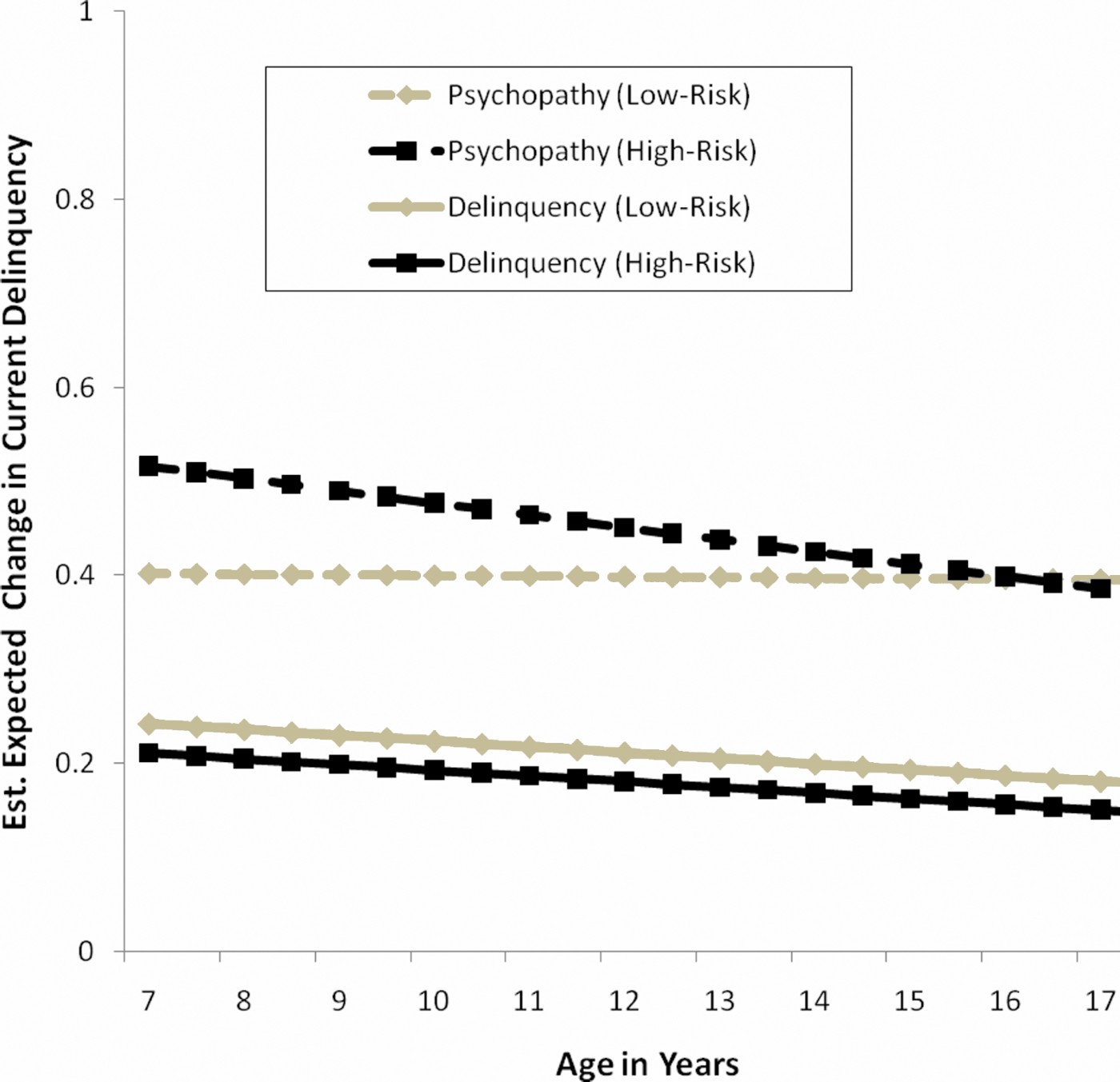
Figure 2 illustrates these results. The estimated expected change in current delinquency corresponding to a 1-point change in either past psychopathy or past delinquency is shown as a function of age for low-risk boys and for high-risk boys. None of the lines in Figure 2 approaches the horizontal axis, corresponding to rejection of the null hypotheses asserting zero predictive utility (β 1 = β 6 = 0; β 2 = β 7 = 0). The two lines for past delinquency (one for low-risk boys, one for high-risk boys) are very close, corresponding to nonrejection of the null hypothesis that β 1, β 6 are the same in the two groups. The two lines for past psychopathy are also close, corresponding to nonrejection of the null hypothesis that β 2, β 7 are the same. Finally, three of the lines in Figure 2 are nearly flat, whereas the fourth is only modestly sloped, corresponding to nonrejection of the null hypotheses asserting zero change in predictive utility over time (β 6 = 0; β 7 = 0).Footnote 13
Predictive utilities of psychopathy and delinquency. The estimated expected change in current delinquency corresponding to a 1-point change in either past psychopathy or past delinquency is shown as a function of age for low-risk boys and for high-risk boys. [A color version of this figure can be viewed online at journals.cambrdige.org/dpp]

Discussion
Reliability was relatively high at all ages (i.e., average α = .89) and showed no tendency to increase or decrease with age. Stability was quite high across 6-month, 1-year, 2-year, and 5-year periods with average intraclass correlations of .74, .71, .67, and .56, respectively. In addition, there was no evidence for change across childhood and adolescence in the levels of stability. There was evidence of age-related changes in the mean levels of psychopathy across time; specifically, the fitted trend for each risk group followed a quadratic pattern, suggesting a tendency for psychopathy to be lower at the earliest and latest ages. However, when the fluctuations in the fitted trends were explicitly examined, they were found to be quite small in magnitude. The largest fluctuation in each risk group across the entire 11-year period was less than 1/16 of the within-group standard deviation, and the error for predicting psychopathy was reduced by less than 3% when age and assessment number were taken into account. Hence, although there are statistically significant changes in the estimates of mean psychopathy across adolescence, these changes are small; conversely, mean level stability is quite high. Finally, we examined the utility of juvenile psychopathy in predicting future delinquency above and beyond current delinquency. Both juvenile psychopathy and current delinquency proved useful in predicting future delinquency, and their predictive utilities did not differ as a function of age or risk status.
Implications
The implications of the present study are relatively straightforward, particularly in relation to the construct of juvenile psychopathy. Some have raised concerns that developmentally normative changes in certain traits might masquerade as psychopathy or make the assessment of psychopathy prohibitively difficult (Edens et al., Reference Edens, Skeem, Cruise and Cauffman2001; Seagrave & Grisso, Reference Seagrave and Grisso2002). Given the number of developmental changes taking place across adolescence and the normative changes in antisocial behavior across this period, these concerns could not be dismissed a priori. The results of the present study directly address these concerns. We found little evidence for the kinds of age-related changes in reliability, stability, and predictive utility anticipated by these criticisms. Our results, along with previous work by Frick, Kimonis, et al. (Reference Frick, Cornell, Barry, Bodin and Dane2003), suggest that juvenile psychopathy is fairly stable across adolescence. In fact, the levels of stability found in the present study are very similar to the levels of stability observed for basic dimensions of personality. In their meta-analysis on the rank-order consistency of personality, Roberts and Del Vecchio (2000) found the rank-order consistency of personality to be 0.43 across 6.7 years among adolescents (aged 12–17.9). Our present estimates are also similar to the stability of scores from the Revised Psychopathy Checklist (Hare, Reference Hare2003) in adults; in a sample of 200 male methadone patients, Rutherford, Cacciola, Alterman, McKay, and Cook (Reference Rutherford, Cacciola, Alterman, McKay and Cook1999) reported a 2-year stability of .60.
Although we believe that the present results support the basic construct validity of juvenile psychopathy, its assessment in childhood and adolescence, and its predictive utility, we do not believe that these results support necessarily the use of juvenile psychopathy scores in forensic decision making, particularly in late childhood (see Frick, Reference Frick2002). The 5-year relative stabilities are fairly good given the ages of the participants and the relatively long span; however, although these levels are high enough for the developmental psychopathology field, they are not high enough for forensic decision making. Simply put, the standards of use for the juvenile psychopathy construct differ across research and applied contexts. It is widely accepted that standards of reliability differ across these settings; standards for validity and stability also differ. Referring to exams used in college admissions, Nunally (Reference Nunnally1978) writes, “… in such instances, it is frightening to think that any measurement error is permitted” (p. 246). Such error is even more frightening in the context of forensic decisions (e.g., sentencing and trial of juveniles as adults). For these more applied contexts, higher stabilities and more ecologically valid assessment contexts (e.g., assessments without the promise of confidentiality) are required to support the use of the construct.
We also believe that the current results speak to concerns about personality pathology in childhood and adolescence more generally. In the absence of much empirical data (Cohen & Crawford, Reference Cohen, Crawford, Oldham, Skodol and Bender2005) and on the basis of theoretical expectations and concerns about labeling, the American Psychiatric Association's Diagnostic and Statistical Manual of Mental Disorders—Fourth Edition, Text Revision (DSM-IV-TR) cautions against applying PD diagnoses to children and adolescents. The present results suggest that this caution may be too strong. The stability of psychopathic traits across childhood and adolescence are much higher than what is implied by the characterization provided within the DSM-IV-TR.
Although it is possible that the results obtained for psychopathic traits in the present study may not generalize to other PDs, we believe this unlikely. The assessment of psychopathy relies heavily on inferences about personality traits rather than on the assessment of specific behaviors, allowing the referents for psychopathy to be open ended (i.e., not tied to a specific behavior or set of behaviors) and to therefore be different at different ages, essentially building in a degree of heterotypic continuity. For example, within the Hare (Reference Hare2003) PCL-R a lack of remorse is described as a general lack of concern for the negative consequences that a person's actions have on others. The specific actions may differ across development; they might involve teasing or ostracism of peers in childhood, destruction of property in adolescence, and battery in adulthood. The general lack of concern for the negative consequences of these actions on others, however, is relevant at each developmental period, and can be assessed despite the changing nature of the acts. Although this was less true in previous versions of the DSM, the PD criteria in DSM-IV-TR also tend to rely on open-ended referents. For example, one criterion for narcissistic personality disorder is interpersonal exploitation: taking advantage of others to achieve one's own ends. Because the referents are open, this criterion is relevant across ages even as its specific manifestations change from getting a friend to do one's homework to getting a parent to support one in living beyond one's means as an adult.
Limitations
There are limitations to the present study. Although we resolved some potential assessment issues, other problems remain. Parents are typically capable and willing informants, particularly in a research setting, so enlisting their aid was a good choice. The problem with potentially overlapping assessments was solved by asking parents to report on the boys only since the last assessment. Nonetheless, the use of the same rater at each age is somewhat problematic, and raises concerns about negative and positive “halo” effects. Incorporating serially correlated errors into the statistical model mitigates this concern, but future research using different raters is obviously needed. Another limitation is the inclusion of only boys in the Pittsburgh Youth Study. This exclusion is understandable from a pragmatic standpoint given the focus of the Pittsburgh Youth Study (i.e., the causes and correlates of serious delinquency) and does not influence our estimates of reliability, stability, and predictive utility for boys; however, this exclusion precludes gender-based comparisons of psychopathy, an important area receiving increased interest. Also, drawing conclusions based on null results (in particular, the absence of significant age effects on the predictive utility of psychopathy) may at first appear problematic. We emphasize, however, that the sample size was large enough to ensure adequate power for detecting even moderate effects. For instance, if the change in predicted delinquency corresponding to a one-unit increase in psychopathy at age 18 differed by 1 point (one-fifth of the range of the delinquency scale) from the change at age 7, we would have had about 87% power to detect this in a given risk/race group via a significant estimate for β 6 in the second mixed model. Finally, before accepting the stability of personality pathology across childhood and adolescence in general, research will need to be conducted on other PDs.
Future Directions
Several future directions are also relatively clear. The most straightforward for the construct of juvenile psychopathy involve replication using other samples and assessment instruments. In the present study, we examined the stability of juvenile psychopathy across adolescence in a high-risk community sample from inner-city Pittsburgh using a short form of the CPS. It will be important to examine the stability of juvenile psychopathy in institutional, forensic, and rural settings. There are multiple reliable and valid means of assessing psychopathy at both the juvenile and adult levels. To the extent that similar stabilities are obtained across different settings and instruments, the greater will be our confidence in applying the psychopathy construct to youth.
Similar research should also be conducted for other PDs. Although we believe levels of stability similar to those found here should be observed for other PDs, this is ultimately an empirical question. There are several approaches available to studying the early manifestations of the DSM-IV-TR PDs. The first is to use a “downward translation” approach such as the one used in the present study in which adult PD assessments are “translated” to be more developmentally appropriate for children and adolescents. Although we noted earlier that most of the psychopathy criteria involved assessment of personality traits with relatively open referents, this was not true for all criteria. For example, the PCL-R includes items assessing promiscuous sexual behavior, juvenile delinquency, many short-term marital relations, and revocation of conditional release (i.e., parole); these criteria are less open in their referents and have stronger developmental boundaries. In the development of the CPS, these behaviors were not included. The same issue will be faced in “translating” other PDs. For example, the criteria for borderline PD include “impulsivity in at least two areas that are potentially self-damaging (e.g., spending, sex, substance abuse, reckless driving, binge eating)” (p. 710). Future research examining the stability of other PDs will need to be mindful of such closed referents if the downward translation approach is to be used.
A potentially promising alternative for identifying child and adolescent precursors of other PDs is the use of a general model of personality functioning, such as the FFM of personality (Costa & McCrae, Reference Costa and McCrae1992), which consists of five broad domains (neuroticism, extraversion, openness to experience, agreeableness, and conscientiousness) with each domain underlaid by six specific facets. A large body of research suggests that the DSM-IV-TR PDs can be understood, and even assessed, as maladaptive constellations of the FFM facets (Saulsman & Page, Reference Saulsman and Page2004). Lynam and colleagues (Miller, Lynam, Widiger, & Leukefeld, Reference Miller, Lynam, Widiger and Leukefeld2003; Lynam & Widiger, Reference Lynam and Widiger2001) have provided expert-generated FFM profiles for each DSM PD and psychopathy that have been shown to be robust across derivation methods and, when used to assess the PDs, to show expected relations to external variables (e.g., Gudonis, Miller, Miller, & Lynam, Reference Gudonis, Miller, Miller and Lynam2008; Lynam & Widiger, Reference Lynam and Widiger2007; Trull, Widiger, Lynam, & Costa, Reference Trull, Widiger, Lynam and Costa2003). The FFM has also been shown to be a viable model of personality in children and adolescents (Shiner, Reference Shiner1998). The five domains of the FFM have been identified in children and adolescents in studies using parent, teacher, and self-reports (e.g., Caspi & Shiner, Reference Caspi, Shiner, Eisenberg, Damon and Lerner2006). The 30 more articulated facets of the FFM have been validly assessed in children and adolescents using the recently revised NEO Personality Inventory 3, a revision of one of the most widely used FFM assessments in adults (McCrae, Costa, & Martin, Reference McCrae, Costa and Martin2005). Given the heterotypic continuity built naturally into personality assessments, the identification of the developmental precursors of adult PDs might profitably begin with the FFM traits in childhood and adolescence that characterize the adult PDs.
Future research should also aim to elucidate the development of psychopathy across childhood and adolescence and into adulthood. One of the more important directions entails examination of the mechanisms of stability. It may be time to move beyond asking whether personality pathology is stable and to begin asking why personality pathology is stable. Basic research in developmental personality suggests that stability is not a phenomenon in its own right but rather is underlaid by various processes. Research is needed to explore how psychopathy and other PDs remain stable across a developmental period rife with developmental changes. One place to begin is with the reactive, evocative, and proactive person–environment transactions that promote stable individual differences (Caspi, Reference Caspi, Damon and Eisenberg1997). Reactive transactions occur when individuals exposed to the same environment experience it, interpret it, and react to it according to their preexisting tendencies. Evocative transactions occur when individuals evoke distinctive reactions from their social environments based on their personalities. Finally, proactive transactions occur when individuals select or create social environments that are in line with their existing personalities. In all cases, these person–environment transactions reinforce rather than repudiate the existing personality. In the case of antisocial or psychopathic behavior, this reinforcement may come through an accumulation of negative consequences. From this perspective, adult psychopaths may be relatively resistant to treatment because of their accretion of negative consequences (e.g., alienation from family, addiction to drugs or alcohol, being part of a criminal peer group, school dropout, injuries, patchy work histories, and multiple incarcerations) that have closed the doors to more legitimate opportunities.
Another important future direction in developmental terms is a search for discontinuities in psychopathy and the factors that promote it. The present paper demonstrates that there is considerable degree of continuity to psychopathy across childhood and adolescence, suggesting that personality pathology can be assessed during these developmental periods. Stability in the present paper, however, was far from perfect; there is also a degree of discontinuity in psychopathy as seen in the average 5-year stability 0.56. Discontinuity, like continuity, should be examined and explained. Identifying factors or events that contribute to discontinuity will inform etiology and intervention. In a previous report, we searched for moderators of the relation between psychopathy at ages 13 and 24 (Lynam, Loeber, Stouthamer-Loeber, Reference Lynam, Loeber and Stouthamer-Loeber2008). Across 13 potential moderators that included demographics, parenting factors, previous delinquency, peer delinquency, and other individual factors, we found little evidence for moderation. However, these predictors were static rather than dynamic and the assessment only included two ages. Future research should include a broader array of factors assessed at multiple time points.