1. Introduction
It is a common complaint that antireductionist arguments in philosophy of science are primarily negative. They show why reductionist arguments fail in particular cases but do not provide an alternative philosophical framework. “Positive accounts of the relationship [between different sciences] are not a part of the antireductionist consensus” (Rosenberg Reference Rosenberg1997, 447). Some philosophers of biology interested in defending an antireductionist position regarding ontogeny have recognized this explicitly. Jason Robert argues that specific investigative heuristics can protect researchers from fallacious reductionist inferences (the negative argument) but that more is needed to positively guide research (Robert Reference Robert2004, Chapter 1). One of his recommendations to counterbalance reductionist biases is multidisciplinary research. This is a promising place to look in developing a more substantive nonreductionist epistemology because the explanatory task involves a relation of mutual epistemic coordination that is in some respects not reductive; that is, there is an implicit rejection of the “fundamentality” of one particular discipline producing the most empirically adequate explanations (see Sarkar Reference Sarkar1998). But the suggestion of multidisciplinary research as a positive alternative is not the alternative account itself (Love Reference Love2006a), and thus the original difficulty of providing a nonreductionist alternative remains.
The aim of this article is to describe an alternative nonreductionist epistemology based on considerations taken from multidisciplinary research in biology. Evolutionary explanations have long been dominated by formal models drawn from evolutionary genetics that emphasize adaptation by natural selection (e.g., Ridley Reference Ridley2004). These models reductively explain evolution in terms of changes in genetic properties, such as allele frequencies. Many researchers, especially those interested in the relationship between evolution and development, have increasingly found this explanatory perspective unsatisfactory for important biological phenomena, such as the origin of novel features in evolutionary history: “to state that a genetic mutation led to a favored character, which, in turn, was selected is utterly uninformative in explaining innovation” (Wagner, Chiu, and Laubichler Reference Wagner, Chiu and Laubichler2000, 822–823). Rejecting the adequacy of explanatory models from evolutionary genetics for explaining innovation constitutes a form of nonreductionist reasoning. It is also linked with a call for multidisciplinary research, specifically including disciplines where models from evolutionary genetics are not prevalent, such as developmental biology, systematics, comparative anatomy, and paleontology (Love Reference Love2003, Reference Love2006b).
The core of the alternative nonreductionist epistemological framework offered here consists in seeing scientific research as coordinated around sets of problems (problem agendas), which have associated criteria of explanatory adequacy that indicate the acceptability of answers. I begin by arguing that complex problem domains are the natural foci of multidisciplinary research and then characterize the abstract idea of a “problem agenda,” along with its corresponding notion, “criteria of explanatory adequacy.” The latter facilitates an explicit account of how different areas of research make their contribution without one being more fundamental than another. This discussion frames my case study, the explanation of evolutionary innovations and novelties, which is used to demonstrate the applicability and fruitfulness of this nonreductionist epistemological perspective. After highlighting the consequences of this approach for investigations of innovations and novelties, I close with remarks about its applicability to other issues in philosophy of science, such as conceptual change and theory structure.
2. Multidisciplinarity, Problems, and Solutions
One of the most philosophically conspicuous features of multidisciplinary investigation is that it does not arise in response to the tasks of theory construction and confirmation. The request originates from complex problem domains that elude scientific explanations arising from specific disciplinary approaches. “A common argument favoring interdisciplinary research refers to the nature of problems that science is supposed to help solve. Real life problems, as opposed to idealized experiments studied in particular disciplines, are such that their solutions require the combined effort of many traditional disciplines. … Scientists need to integrate all these facts to solve the problem” (Hansson Reference Hansson1999, 339).Footnote 1 A familiar exemplar of this type of problem domain is the “environment,” illustrated in the rationale for the formation and growth of institutionalized programs that support its study. “Environmental problems today are very complex, requiring an interdisciplinary approach to understand and solve them” (http://info.envs.lsu.edu/futureplans.html). “Solutions for complex environmental problems are best found through interdisciplinary interaction” (http://www.uky.edu/USC/New/SCAgendas/20061030/Grad%20Cert%20Enviro%20Sys_GS_Complete.pdf). These are but two illustrations of many available. The crucial point is that the emphasis falls on the need to address more than one problem. Although these problem sets are addressed in part through the application of existing, well-confirmed theories, it is the interrelation among these problems that is the key feature responsible for spurring the call for interdisciplinary research, which is often summarized by the adjective ‘complex’.Footnote 2 A pressing question is whether these complex sets of problems have structural features that can be coordinated with the purported requirement of multidisciplinarity.
To make the distinction between problems and groups of problems more precise, let us call an individual problem a specific conceptual or empirical question within a scientific research program (Laudan Reference Laudan1977; Nickles Reference Nickles1981). For example, how does plant respiration contribute to greenhouse gas accumulation? A problem agenda, by contrast, is a “list” of interrelated questions (both empirical and conceptual) that are united by some connection to natural phenomena. For example, how do questions concerning greenhouse gas contributions from plant respiration, along with many other questions about emission-related phenomena (anthropogenic or otherwise), including their interaction with systematic cycling and atmospheric dynamics, get answered with respect to global warming phenomena? Problem agendas are usually indicative of long-term investigative programs and routinely require contributions from more than one disciplinary approach. Cross-disciplinary interactions of this kind rarely occur spontaneously and are often driven by a commitment to similar questions (Bechtel Reference Bechtel1993). More can be said concerning the concept of a problem agenda, but this suffices for present purposes.Footnote 3
The pivotal component of this epistemological framework is the criteria of explanatory adequacy that are associated with problem agendas. Assessing answers to questions always requires criteria of adequacy that are used to determine acceptability. Just as there is a difference between problems and problem agendas, there is also a difference between the criteria of adequacy that attach to them. Problems have specific criteria of adequacy, such as logical consistency for a conceptual problem or the need to include a causal factor when addressing an empirical problem. These standards operate to exclude particular kinds of explanations and are based on the questions researchers think need to be addressed. Problem agendas have general criteria of adequacy that can be isolated by a process of abstraction and reconstruction with the goal of better understanding and facilitating the explanation of the problem agenda phenomena (see Wimsatt Reference Wimsatt, Cohen and Michalos1976). These general criteria do not necessarily pick out the correct explanation, as more than one investigative approach may meet them.Footnote 4 Something similar has been termed “middle range norms” to capture the burden on different areas of science to reconcile competing claims about the same domain of natural phenomena (Burian Reference Burian1993). The existence of these kinds of norms demonstrates that consensus can coalesce around a common agenda of problems prior to possessing an adequate explanation. General criteria of explanatory adequacy provide structure to problem agendas that is relevant to comprehending why multidisciplinary research is required.
The features of this epistemological perspective are observable in the introduction to On the Origin of Species where Darwin claims that an adequate account of “descent with modification” needs to address the mutual affinities of organic beings, their embryological relations, geographical distribution, geological succession, and the exquisite nature of adaptation and coadaptation (Darwin Reference Darwin[1859] 1964, 3). These features compose a complex problem agenda and point in the direction of criteria of explanatory adequacy. British natural theology of the early nineteenth century addressed the component of adaptation but said little about geographical distribution or geological succession. Lamarck's evolutionary theory did better in meeting these criteria but suffered from various empirical difficulties. A similar fate obtained for Robert Chambers in his Natural History of the Vestiges of Creation, which Darwin explicitly mentions. Darwin, as might be expected, attempted to address each of these standards and emphasizes the effect of his success on the explanatory power of his theory. It is notable that addressing these criteria of adequacy required an appeal to multiple investigative approaches, including embryology, geology/paleontology, morphology, natural history, and systematics.Footnote 5
Because general criteria of explanatory adequacy provide structure to the explanatory burden associated with problem agendas, this epistemological account has the resources for ascertaining what disciplinary contributions are prerequisites for adequate explanations. The structure of a complex problem set derived from making the criteria of adequacy explicit highlights what different conceptual resources must be drawn upon to produce an acceptable explanatory vantage point. In the context of the philosophical goal of sketching a nonreductionist epistemology, delineating the criteria of adequacy reveals why a purely reductionist approach cannot be legitimately adopted. This in turn highlights another advantage derived from articulating criteria of adequacy—the ability to discriminate between competing and complementary explanatory claims (Mitchell Reference Mitchell2003, Chapter 6).
3. The Problem Agenda of Evolutionary Innovation and Novelty
One area of biological science that can be profitably explored from a problem agenda perspective is the project of explaining evolutionary innovations and novelties, as seen in evolutionary developmental biology or evo-devo (Love Reference Love2003). Evolutionary innovations and novelties are usually understood to be key form or function features, such as avian flight or the vertebrate head, whose origination marked a significant departure from the variation available in ancestral lineages. These structures and activities often profoundly transformed the evolutionary trajectories of lineages possessing them (Müller and Wagner Reference Müller, Wagner, Hall and Olsson2003). Innovations and novelties are frequently claimed to be outside the explanatory capabilities of contemporary evolutionary theory understood as selection operating on phenotypes and sorting genotypes, thereby altering allele frequencies (Müller and Newman Reference Müller and Newman2003; Kirschner and Gerhart Reference Kirschner and Gerhart2005). This judgment largely derives from the fact that development is not factored into the explanatory models from evolutionary genetics.
There are at least two distinct reasons to investigate this area of research from a problem agenda perspective. First, evo-devo proponents have explicitly characterized their interest in explaining evolutionary novelties in the terminology of ‘problems’: “the origination of morphological structures, body plans, and forms should be regarded as a problem distinct from that of the variation and diversification of such entities (the central theme of current neo-Darwinian theory)” (Müller and Newman Reference Müller and Newman2003, preface). Thus, following the distinctions introduced above, the problem agenda of explaining evolutionary innovations and novelties contains within it numerous empirical problems such as, How did vertebrate jaws originate? or How did avian flight originate? as well as conceptual problems concerning the relative contributions of different variation-generating mechanisms, such as the regulation of gene expression or phenotypic plasticity due to environmental variables. Together they form a complex problem agenda, the structure of which requires elucidation.
Second, evo-devo has been overtly characterized as multidisciplinary in nature: “[evo-devo] draws from development, evolution, paleaeontology, molecular and systematic biology” (Hall Reference Hall1999). In a recent interview, Martin Cohn claims that the strength of evo-devo research is the integration of a wide range of disciplines in an effort to address evolutionary questions (Cohn Reference Cohn2006). In accord with the environmental studies example, Cohn's emphasis is on addressing multiple questions rather than just one. Some evo-devo researchers have explicitly attached a valuation to these multidisciplinary, synthetic approaches: “synthesis is the merging of disparate sources of knowledge to create a stronger, more compelling whole” (Gibson Reference Gibson2005, 1890). This valuation comports with philosophical discussions of how the integration of models from different disciplines is a route to increased explanatory power or robustness (Mitchell Reference Mitchell2003).
We can more carefully characterize the project of explaining innovation and novelty as explaining how qualitatively new phenotypic variation originates at particular phylogenetic junctures. This is an inquiry about development from the viewpoint of phylogeny, comparing discrepancies between past ranges of variation and those presently available, where the range of variation can be formulated mathematically (Stadler et al. Reference Stadler, Stadler, Wagner and Fontana2001). Innovation can be directly equated with the origin of function features and novelty with the origin of form features (Love Reference Love2006b).Footnote 6 Although this distinction is not widely observed, it clarifies differences in explanatory approaches and introduces our first criterion of adequacy for the problem agenda. Any adequate explanatory framework for the origin of new features must treat both form and function, ideally in terms of form-function complexes or characters (Wagner Reference Wagner2001). Explaining the origin of vertebrate jaws (a novelty) requires attention to how jaws function, and to how form and function features combine together into characters. Too much attention to novelties rather than innovations (or vice versa) introduces a problematic bias from the perspective of this criterion.
Second, any adequate explanatory framework must address the origination of innovations and novelties at all levels of biological organization and articulate relations between these levels relevant to the production of variation. These relations can be understood as spatial (‘compositional’) or temporal (‘procedural’) hierarchies, in both developmental processes and evolutionarily across generations. When combined with the first criterion, we begin to generate a possibility space for the problem agenda in terms of its criteria of adequacy, which directs us to inquire after particular relationships such as nested parts or sequences of events to comprehend the origination of pertinent phenotypic variation. A compositional hierarchy for a novelty (form) highlights the need to understand part-whole relations, whereas a procedural hierarchy for an innovation (function) draws attention to activities operating sequentially.
Adding both developmental and evolutionary dimensions of time enlarges the space of possibilities. For example, a procedural function hierarchy in developmental time for the origin of neural crest cell migration requires comprehending gene expression involved in the folding of the neural tube prior to the gene expression involved in the detachment or migration of neural crest cells; specific function features must activate serially or jointly prior to the operation of the innovation during the developmental process in a single generation. Eight areas of possibility emerge from the above distinctions (see Love Reference Love2006b) and must be taken into account when attempting to explain particular novelties such as the vertebrate jaw, as well as to assess whether a more general explanatory framework is adequate.
The final criterion of adequacy, “degree of generalization,” concerns how different explanatory answers given to individual problems within the problem agenda relate to each other. It can be encapsulated in two overarching questions: (a) Can investigations of particular novelties be generalized to other research on different innovations or novelties? and (b) Can investigations of model systems be generalized to the phylogenetic juncture relevant to the innovation or novelty under scrutiny? The former concerns generalization from one case to another and the latter assesses the relevance of generalizations from contemporary model systems used in developmental research to putative taxa at the phylogenetic juncture for a particular novelty or innovation. These abstract questions can always be related back to specific problems within the problem agenda. We can ask about generalization from one investigated novelty to another (“Do explanatory principles invoked to explain the vertebrate jaw also apply to the origin of cephalopod appendages?”) as well as from model systems to extinct taxa in which the innovation or novelty arose (“Is the developmental patterning of the branchial arches in zebrafish a relevant model for comprehending jaw origins?”). When combined with the other criteria, the explanatory burden becomes more specific: are the compositional and procedural hierarchies related to various form and function features (cell types, muscles, bones, gene expression, neural crest cell migration, muscle firing, etc.) observed in the developing zebrafish jaw appropriate models for explaining how phenotypic variation originated at the appropriate phylogenetic juncture ∼415 million years ago?
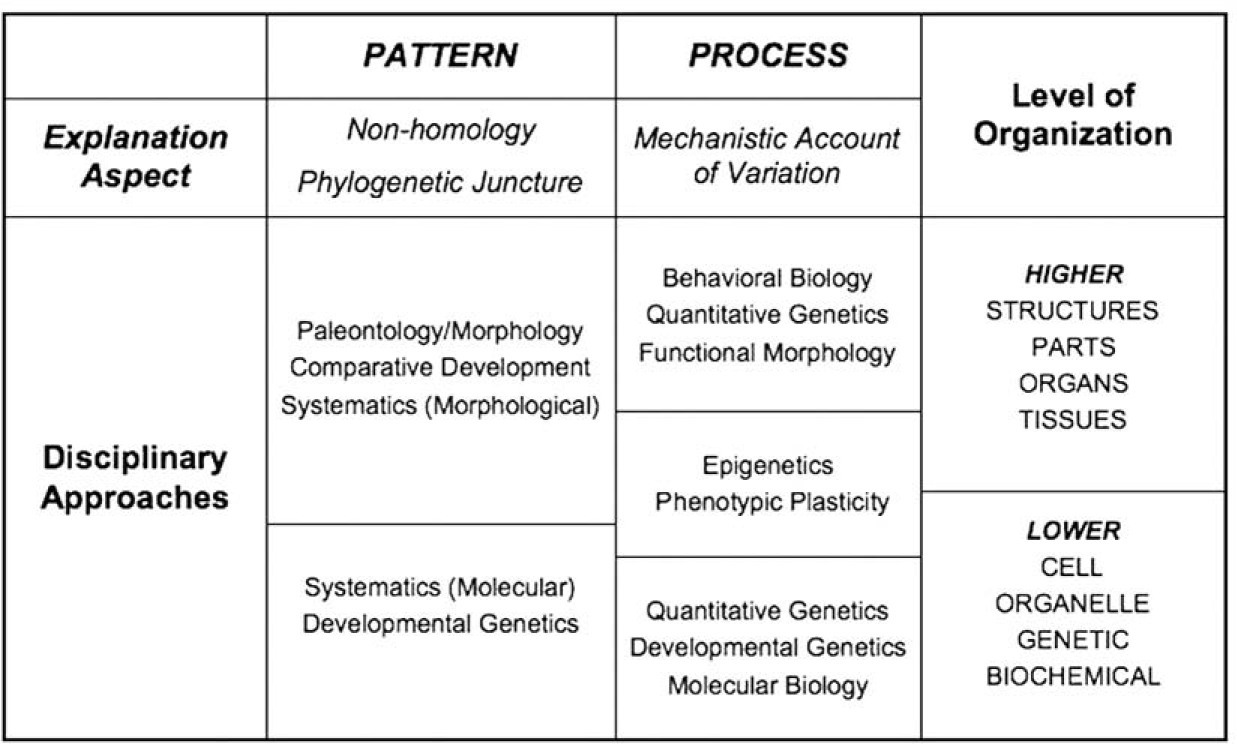
The problem agenda of innovation and novelty is clearly complex, but its criteria of adequacy show that there is structure to this complexity. Once these criteria of adequacy are made explicit they serve as a template for indicating where and how different explanatory contributions are made. If we distinguish evolutionary pattern from process, we produce a two-step explanatory structure. For the pattern component, we must establish the phylogenetic context and nonhomology of the trait in question (e.g., Love and Raff Reference Love and Raff2006). For the process component, we elucidate causes that generate phenotypic variation during ontogeny relevant to the origination of the innovation or novelty in question. Some of the multidisciplinary prerequisites of an explanatory framework for evolutionary innovations and novelties can be visualized by mapping aspects of the criteria of adequacy onto this two-step structure (Figure 1). The general criteria of explanatory adequacy abstracted from empirical and conceptual research problems produce a specific structure to the complex problem domain that partitions explanatory responsibilities, thereby identifying different disciplinary contributions and, in this case, rejecting any one discipline or explanatory style as fundamental or primary.
Visualizing multidisciplinary prerequisites: a representation of how different biological disciplines might make their explanatory contribution with respect to the problem agenda of innovation and novelty (specifically concerning form rather than function features).

4. Consequences
The short answer to why a reductionist epistemology is inadequate to fully account for the origin of innovations and novelties is that the criteria of explanatory adequacy demand more. The origination of form and function features via ontogenetic processes at many different, interacting, hierarchical levels in different dimensions of time with sufficient generality cannot be adequately explained without conceptual resources and methodologies that encompass form and function at those different levels and their many causal interactions in more than a few isolated cases. Nonreductionist aspects of the problem agenda framework come out most clearly when considering the levels of organization and degree of generalization criteria in combination. Explanatory generalizations at lower levels of organization do not propagate ‘upwards’ and break down at higher levels of organization as a consequence of dissociation between (for example) gene expression and morphology (Wray Reference Wray, Bock and Cardew1999). Since a large number of innovations and novelties exist at higher levels of organization (e.g., the vertebrate jaw), a reductionist epistemology concentrating on lower levels of organization alone cannot get purchase on the very phenomena motivating the explanatory project in the first place (Love Reference Love2006b).
This identification of the inadequacies of a reductionist epistemology makes a direct contribution to ongoing scientific investigation because evo-devo biologists interested in evolutionary novelties have put forward claims with a reductionist orientation: “we will focus primarily on the gene level and discuss the evolutionary mechanisms that generate novelty, … the principles and mechanisms are applicable to any of the organizational levels” (Ganfornina and Sánchez Reference Ganfornina and Sánchez1999, 432). The tripartite criteria of explanatory adequacy for the problem agenda of innovation and novelty immediately challenge this claim because it presumes an unwarranted transitivity of inference across levels of organization. The other criteria of adequacy yield further consequences. Because reductionist methodologies are biased toward analyses of form over function (Wimsatt Reference Wimsatt and Nickles1980), and functional data are usually more difficult to obtain, a purely reductionist strategy of explanation will tend to neglect innovations in favor of novelties. Additionally, the widespread utilization of model systems for developmental investigation means that issues pertaining to the degree of generalization, especially from contemporary experiments to the relevant phylogenetic juncture, cannot be ignored. And when the criteria of adequacy are jointly considered, problematic assertions about the nature of developmental evolution can be explicitly recognized.Footnote 7
Although this analysis identifies problematic biases associated with reductionist epistemology in the context of explaining evolutionary innovations and novelties, it should be clear that the problem agenda framework is not “antireductionist” in nature. The appropriateness of epistemological reductionism will always be a function of the criterion of adequacy pertaining to a particular problem agenda. Since the three criteria delineated here will not define other problem agendas (though there may be overlap, especially with “level of organization” and “degree of generalization”), the epistemological framework is nonreductionist because it neither favors reduction nor militates against it. The criterion of adequacy for each biological problem agenda, of which there are many, determines whether or not it is reasonable to adopt a reductionist epistemology.
5. Applications
In addition to its bearing on reductionism, the problem agenda perspective is also useful for capturing the structure, individuation, and historical continuity of scientific theories.Footnote 8 Problem agendas allow for the addition, deletion, and transformation of individual empirical and conceptual questions without (necessarily) demanding a fundamental change of topic. Instead of concentrating on the representation and succession of theory content, problem agendas direct our attention to the persistent questions exercising researchers, thereby offering a different way to characterize theoretical transitions and conceptual change. Formal epistemologists have converged on a similar outcome, acknowledging a need to incorporate research agendas into accounts of belief revision (Olsson and Westlund Reference Olsson and Westlund2006).
In line with these applications and a focus on the adequacy of evolutionary explanations, problem agendas are particularly suggestive of a way to characterize the structure of evolutionary theory that emphasizes its heterogeneous explanatory targets and characterizes its diverse disciplinary approaches. More broadly, this perspective may serve as a strategy for formulating multidisciplinary epistemologies in other domains where reductionism has been deemed inadequate.Footnote 9 Problem agendas also resonate with recent investigations into effective pedagogy; problem-oriented teaching methods have generated significant advances in student learning and concept mastery (Cooper, Hanmer, and Cerbin Reference Cooper, Hanmer and Cerbin2006).
It should be stressed that the arguments made herein have been directed at the claim that epistemological or explanatory antireductionism is primarily a negative project. Whether my argument for a particular nonreductionist epistemology supports related metaphysical claims (e.g., Are there emergent properties?) requires further analysis. The same holds for the relationship between problem agendas and other alternate, nonreductive epistemologies (e.g., Grantham Reference Grantham2004). Moreover, the nonreductionist epistemological vantage point advocated here does not entail a commitment to metaphysical or methodological antireductionism. For example, some forms of methodological reductionism (i.e., scientists should preferentially use reductionist methods to prosecute their research) are entirely compatible with my account.
In this article I have both described an alternative, nonreductionist epistemology in terms of problem agendas and criteria of explanatory adequacy, and applied it to the case of explaining evolutionary innovations and novelties. Besides illuminating a contemporary area of biological research, this perspective also has potential applications to diverse questions in philosophy of science. What remains is the task of articulating this epistemological account in more detail, both for a deeper comprehension of scientific reasoning processes and to address a variety of philosophical issues related to the topic of reductionism.