Implications
In commercial farming, there is a need for low cost, easy-to-use methods to assess animal welfare. This study showed that tear staining – a dark secretion that accumulates below the inner corners of the eyes of pigs – is a promising candidate to be developed into one of such methods for on-farm use. The method may be useful in both assessing the average level of welfare and in detecting situations where some individuals are under high stress, for example, when insufficient feeding space, floor area or other resources result in poor welfare of the lowest-ranking individuals in each pen.
Introduction
Assessment of animal welfare yields most reliable results when several independent measures are used, including aspects such as behaviour and physiology (Botreau et al., Reference Botreau, Bonde, Butterworth, Perny, Bracke, Capdeville and Veissier2007). Several validated combinations of welfare measures for on-farm use do exist, such as the Welfare Quality® system, which, however, is often perceived as problematic in on-farm use, because it is time consuming and therefore costly (Andreasen et al., Reference Andreasen, Sandøe and Forkman2014). Finding new, easy-to-use indicators would therefore further contribute to the field of assessing animal welfare.
The pig is one of the species exhibiting brown to black facial stains in and below the inner corner of the eye (McCafferty and Pinkstaff, Reference McCafferty and Pinkstaff1970). Historically, such tear staining in pigs has been described as a symptom indicative of atrophic rhinitis (Jackson and Cockroft, Reference Jackson and Cockroft2007; OIE, 2012) or environments with high levels of dust and/or ammonia (Straw et al., Reference Straw, Dewey and Wilson2006). There have been studies recording tear staining as an animal-based, on-farm, welfare indicator for pigs (Gruber, Reference Gruber2002; Whay et al., Reference Whay, Leeb, Main, Green and Webster2007; Wright, Reference Wright2012), but these studies have used staining solely as a measure of clinical disease or poor air quality, in line with historical literature, rather than as a welfare indicator per se.
More recently, tear staining in pigs has been connected to environmental stressors as well as physiological measures of stress. The size of tear stains has been shown to correlate with the level of the sympathetic nervous system index measured from heart rate variability in weaned piglets followed over a 2-week period of social isolation and regrouping (DeBoer and Marchant-Forde, Reference DeBoer, Garner, McCain, Lay, Eicher and Marchant-Forde2013). The size of tear stains has also been shown to correlate with the number of defeats in aggressive interactions over a 5-day period in an experiment inducing aggression by placing weaned piglets from different litters in small unenriched pens (Marchant-Forde and Marchant-Forde, Reference Marchant-Forde and Marchant-Forde2014). Isolated 1-month-old piglets in a barren environment have been shown to have larger tear stains, higher monocyte levels and lower eosinophil levels, as compared with treatment groups housed next to a companion pig and/or with objects such as rubber mats and mirrors; the tear stains developed from day 1 of the experiment and continued to grow through the 1-week period of observation (DeBoer et al., Reference DeBoer and Marchant-Forde2015). The abovementioned studies were carried out in experimental conditions on clinically healthy pigs sharing the same room, which reduces the possibility that the secretion from the eyes could have been caused by an infection or poor air quality.
The dark secretion forming the tear stains originates in the Harderian gland, located next to the eye, which is present in most land vertebrates but absent in some species such as humans; its morphology and functions vary across species (Chieffi et al., Reference Chieffi, Baccari, Di Matteo, d’Istria, Minucci and Varriale1996). The gland secretes a mixture of compounds, which in some species such as rodents include pigments called porphyrins (Harkness and Ridgway, Reference Harkness and Ridgway1980; Park et al., Reference Park, Satoh, Kumagai and Seyama1996). In rodents, high levels of secretion from Harderian glands result in rusty-coloured stains in and below the inner corner of the eye, called chromodacryorrhea, also known as ‘tear staining’, ‘red tears’ or ‘bloody tears’. In rats, the extent of staining has been shown to correlate with the exposure to different types of environmental stressors, suggesting it could be used as a non-invasive and easy-to-use welfare indicator for rats (Mason et al., Reference Mason, Wilson, Hampton and Wurbel2004). Other factors than stress, such as age, may also affect the extent of staining: in rats (Wetterberg et al., Reference Wetterberg, Yuwiler, Geller and Schapiro1970; Rodriguez et al., Reference Rodriguez, Menedez-Pelaez, Howes and Reiter1992) and gerbils (Buzzell et al., Reference Buzzell, Menedez-Pelaez, Blank, Nonaka and Reiter1991) the gland size and porphyrin secretion increase in the weeks after birth. As yet, there is insufficient knowledge on the effect of age on tear staining in pigs. There have been some indications of a possible lateralization effect on tear staining: social rank is correlated with the extent of left-eye but not right-eye staining (Marchant-Forde and Marchant-Forde, Reference Marchant-Forde and Marchant-Forde2014). This may be a consequence of the lateralized functioning found in the brain of many vertebrates: the right hemisphere, connected to the left eye, dominates processing of negative emotions such as aggression or threat (Leliveld et al., Reference Leliveld, Langbein and Puppe2013), but as yet there is insufficient research to determine whether left-eye staining could be a more sensitive indicator to some stressors than right-eye staining.
Among the behavioural consequences of stress in commercial pig farming, one of the major issues is tail biting. Tail biting refers to pigs chewing or biting other pigs’ tails in a way that causes wounds or a partial or total loss of the tail, and it is a severe problem for pig welfare and production economics (D’Eath et al., Reference D’Eath, Arnott, Turner, Jensen, Lahrmann, Busch, Niemi, Lawrence and Sandøe2014). Ear biting is a similar problem, resulting in wounds or in partial loss of ears (Smulders et al., Reference Smulders, Hautekiet, Verbeke and Geers2008). Tail and ear biting are multifactorial in origin. Some of the main causes are insufficient access to resources and lack of objects or substrates to root, chew and manipulate (Taylor et al., Reference Taylor, Main, Mendl and Edwards2010). Such objects or substrates also have another causal link to pig welfare, by enabling better fulfilment of behavioural needs (Studnitz et al., Reference Studnitz, Jensen and Pedersen2007).
The aim of this study was to test the validity of tear staining as a welfare indicator in commercial pig farming. We hypothesized that the size of the stains would correlate with the following measures indicative of welfare: the severity of tail and ear damage, the availability and quality of manipulable objects, and the latency to approach a novel object or a novel human.
Material and methods
The tear-staining scoring reported in this study was carried out in connection to a series of studies testing the effects of different types of manipulable objects on tail and ear biting and other welfare-related parameters. The studies were carried out on three commercial pig farms in Finland. The results of each study were used to select the object materials and designs as well as details of data collection for the next study; hence the differences in the treatments and methods described below.
Animals and housing
Of the three farms, Farm A was a fattening farm, on which 780 growing-finishing pigs were studied in 73 pens at the age of 4.5 months. The pigs were crosses of Norwegian Landrace (50%), Yorkshire (25%) and Duroc (25%). The data analysis was carried out on 768 pigs, as 12 pigs had faces too dirty to score unambiguously. Farm B had a fattening unit, in which 656 growing-finishing pigs were studied in 44 pens at the age of 4 months, and a farrowing unit, in which 29 sows and their litters totalling 303 piglets were studied in 29 pens, at the point of 3 weeks after birth. The growing-finishing pigs and suckling piglets were crosses of Hampshire (50%), Norwegian Landrace (25%) and Yorkshire (25%). The sows were crosses of Norwegian Landrace (50%) and Yorkshire (50%). Farm C was a piglet-producing farm, on which 167 breeder gilts were studied in 24 pens at the age of 4 months. The gilts were crosses of Norwegian Landrace (50%) and Yorkshire (50%). None of the pigs on these three farms were tail docked.
All farms had partly slatted floors. On Farm A, the growing-finishing pigs were kept in pens of 10 m2 at an average of 10.7 pigs/pen (ranged from 8 to 11). The mean floor area was 0.93 m2/pig and mean trough length 27 cm/pig. Liquid feed was provided four times a day. On Farm B, the growing-finishing pigs were kept in pens of 18 m2 at an average of 14.9 pigs/pen (ranged from 13 to 18). The mean floor area was 1.2 m2/pig and mean trough length 40 cm/pig. Liquid feed was provided five times a day. The sows were kept in farrowing crates 2 m2, and liquid feed was provided three times a day. The average number of piglets per sow was 10.4 (ranged from 9 to 11), and the floor area available to piglets in the farrowing pen was 5 m2 including the area under the sow, that is, 0.48 m2/piglet. Dry feed for piglets was provided ad libitum in one circular feeder per pen. On Farm C, the breeder gilts were kept in pens of 12 m2 at an average of 7.0 pigs/pen (ranged from 6 to 8). The mean floor area was 1.7 m2/pig and mean trough length 43 cm/pig. Liquid feed was provided once a day.
Treatments
The treatments for the series of the tail-biting studies that was utilized for simultaneously collecting tear-staining data for this study, consisted of providing the pigs with objects made of different materials and in different quantities. As the main aim of the studies was to identify materials and quantities yielding measurable welfare benefits at minimal material and labour costs, the within-study differences between experimental and control treatments were designed to be smaller in each consecutive study. The control treatment in each case represented the objects normally available in pens on that farm.
For the growing-finishing pigs on Farm A, there were five treatments: pieces of recently harvested and horizontally suspended pieces of birch tree trunks with a diameter of 10 cm and length of 30 cm/pig (14 pens); one suspended cross made of two 60-cm polythene plastic pipes (15 pens); two suspended metal chains with a branching design (13 pens); all of the above in the same pens (14 pens); and the control treatment with none of the above (17 pens). All the pens contained a straw rack, refilled when empty, and a single metal chain in each pen. Approximately 300 g of wood shavings per pen were manually distributed on the solid part of the floor of all the pens once a day. The pigs were in these treatments from the age of 2 months.
For the growing-finishing pigs on Farm B, there were three treatments: pieces of recently harvested and horizontally suspended pieces of birch tree trunks with a diameter of 5 cm and length of 10 cm/pig (16 pens); horizontally suspended pieces of polythene plastic pipes with a diameter of 3.2 cm and length of 10 cm/pig (12 pens); and the control treatment with none of the above (16 pens). All the pens contained a straw rack, refilled when empty. The pigs were in these treatments from weaning at the age of 4 weeks.
For the suckling piglets on Farm B, there were two treatments: 10 pieces of sisal ropes with a diameter of 1 cm suspended on the heated solid floor lying area of the piglets so that the last 20 cm of rope was horizontally on the floor (15 pens); and the control treatment without ropes. In all pens, there was a single metal chain reachable by the piglets, suspended vertically in a corner of the pen. Approximately 10 g of wood shavings were manually distributed on the heated solid floor area for the piglets once a day. The sows with these piglets did not have access to objects nor wood shavings; for the sows, the difference between treatments was whether their piglets had objects to root at and chew instead of the sow. The piglets were in these treatments from birth.
For the breeder gilts on Farm C, there were two treatments: pieces of recently harvested and horizontally suspended pieces of birch tree trunks with a diameter of 5 cm and length of 20 cm/pig (12 pens); and the control treatment following to the ordinary practice on the farm: four BiteRite® (Ikadan, Ikast, Denmark) chewing sticks per pen from weaning at 4 weeks to the age of 2 months; and one piece of suspended metal feeder per pen and one horizontally suspended 40-cm piece of dried wooden board per pen from the age of 2 months afterwards. In all pens, ~1 l of long straw per pen was provided once a day on the solid part of the pen floor. The pigs were in these treatments from weaning at the age of 4 weeks.
Experimental design
In order to test whether tear staining correlated with the selected welfare-related parameters (tail and ear damage and latency to approach novelty), and in order to test whether the same objects that reduced damage or latency also reduced tear staining, the data collection for of all of these parameters was carried out on the same day for each pig. The timing of data collection was designed to measure the differences in accumulated long-term stress: data were collected after the pigs had been in the treatments for 2.5 months (growing-finishing pigs on Farm A), 3 months (breeder gilts on Farm C), 3.5 months (growing-finishing pigs on Farm B) or 3 weeks, that is, from farrowing (sows and piglets on Farm B).
The pens of the growing-finishing pigs were located in identical adjacent rooms: five rooms on Farm A and three rooms on Farm B. The numbers of pens in each treatment, and the within-room locations of the pens in each treatment, were balanced across the rooms. The sows with piglets on Farm B, were located in two identical adjacent rooms. The sows were assigned to the treatments before farrowing, balancing the numbers of pens in each treatment, and the within-room locations of the pens in each treatment, across the rooms; the expected farrowing dates were balanced across the treatments. The breeder gilts on Farm C were all in the same room at the same time, and the treatments for each pen were balanced across the locations of the pens in the room.
Data collection
Tear staining
Data on tear staining were collected from each pig by using the DeBoer-Marchant-Forde Tear-Staining Scoring Scale (DeBoer et al., Reference DeBoer and Marchant-Forde2015; Figure 1). On Farm A and the farrowing unit of Farm B, each data point represented an average of the tear stain scores of the left and right eyes of the pig. In the fattening unit of Farm B as well as on Farm C, both of which were scored after findings of Marchant-Forde and Marchant-Forde (Reference Marchant-Forde and Marchant-Forde2014) indicating differences in staining from the left v. right eye, the stains from the left and right eye were recorded separately for each pig. On each farms, the number of pigs with a face too dirty to score unambiguously was also recorded, and these pigs were not included in the tear-staining data.
The descriptive scoring system (DeBoer-Marchant-Forde Scale) used in this study to quantify the magnitude of tear staining. Scores and descriptions: 0 – no signs of any staining. 1 – staining is barely detectable and area stained does not extend below the eyelid. 2 – staining is obvious and area stained is approximately<50% of total eye area. 3 – staining is obvious and area stained is approximately 50 to 100% of total eye area. 4 – staining is severe, area stained is approximately⩾100% of total eye area, and area stained does not extend below the mouth line. 5 – staining is severe, area stained is>100% of total eye area, and area stained extends below the mouth line.

Tail and ear damage
The other individual-level parameters included tail and ear damage in the fattening pigs and breeder gilts. On Farm A, data were collected by using the following scale for tail damage: 0 – intact tail; 1 – tail-end hair missing or blood on the tail; 2 – part of tail missing, >5 cm remaining; 3 – part of tail missing, <5 cm remaining; and the following scale for ear damage: 0 – intact ears; 1 – superficial scratches; 2 – evidence of recent bleeding; 3 – part of ear missing. Analysis of these data led to the decision to use the following, more sensitive scale for Farms B and C: for tails, 0 – intact tail; 1 – tail-end hairs missing; 2 – wound(s) or scar(s), each with a width <5 mm; 3 – wound(s) or scar(s), at least some of them with a width of at least 5 mm; 4 – part of tail missing, >5 cm remaining; 5 – part of tail missing, <5 cm remaining; and the following scale for ear damage: 0 – intact ears; 1 – one or two superficial scratches; 2 – three or more superficial scratches; 3 – wound(s) or scar(s), each with a width <5 mm; 4 – wound(s) or scar(s), at least some of them with a width of at least 5 mm.
Latency to approach a novel object or a novel human
The latency to approach was measured on the pen level on Farms B and C. For suckling piglets, a novel object test was carried out in the afternoon between 1400 and 1600 h, selecting a moment when at least 80% of the piglets were awake and at least three of the piglets were looking at the experimenter. The order in which the pens were tested was balanced across the treatments, in order to cancel out the effect of piglets in other pens habituating to seeing the experimenter leaning into other pens. A 10×15 cm piece of paper was placed on the heated solid floor area of the piglets, in the corner closest to the head of the sow. A new piece of paper was used for each pen, to exclude the effect of smells from previous pens. In order to reduce the confounding factor of an individual piglet determining the data point for an entire litter, the latency to approach the paper was defined in terms of the first three piglets touching the paper with their snouts or mouths. A stopwatch was started at the moment when the paper touched to the floor and stopped at the moment when the third piglet touched the paper. In fattening pigs and breeder gilts, among which a piece of paper would likely have been monopolized by the first individual, a human approach test was used instead. The test was carried out after feeding in the morning between 1000 and 1200 h, selecting a moment when at least 80% of the pigs in the pen were awake. The order in which the pens were tested was balanced across the treatments, in order to cancel out the effect of pig in other pens habituating to seeing the experimenter enter other pens. The experimenter entered each pen by stepping from the corridor over the pen wall at the middle point of the wall and stood still with her back against the wall, without looking at the pigs and without moving when the pigs investigated her. She started the stopwatch at the moment when both of her feet were on the floor, and stopped it at the moment when the third pig touched her with its snout or mouth.
Data analysis
The data were analysed with SPSS Statistics 21 (IBM, Armonk, New York, USA). For the pen- or litter-level data, Pearson’s correlations were used to test the interaction between tear staining and the stress-related measures (behavioural parameters and damage scores), and an independent measures t test or ANOVA was used to test the effect of treatments on tear staining and on the latency to approach a novel object or person. The pen-level data on tail and ear damage were tested with an independent measures t test, ANOVA, a Mann–Whitney U test or a Kruskal–Wallis test. For the individual-level data, Spearman’s rank correlations were used to test the interaction between stress-related measures and tear staining, and Kruskal–Wallis tests were used to test the effects of treatments on tear staining.
Results
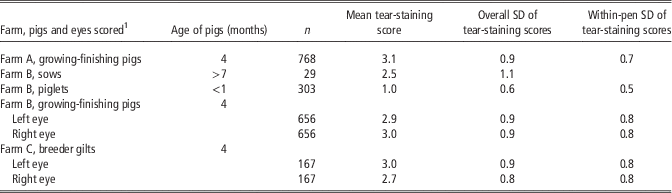
In suckling piglets, the observed tear-staining scores ranged from 0 to 2, and in all of the other age groups, from 0 to 5. The observed means and standard deviations of tear-staining scores are given in Table 1. Problems posed by dirtiness were scarce: on Farm A, 12 of the 780 pigs had too much dirt on their face to be scored unambiguously and were thus left out of the data; on Farms B and C, all of the pigs, totalling 1155 animals, could be scored unambiguously.
Descriptive data on tear-staining scores in the study

1 Farm A and the farrowing unit of Farm B were scored before the finding of Marchant-Forde and Marchant-Forde (Reference Marchant-Forde and Marchant-Forde2014) showing a difference between the left v. right eye; therefore in those parts of the study, the tear-staining score of each pig was recorded as the average of both eyes.
Correlations between tear staining and other welfare-related measures
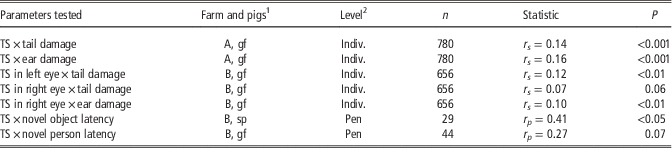
In the growing-finishing pigs on Farms A and B, significant correlations were found between tear staining and tail and ear damage; and in the growing-finishing pigs and suckling piglets on Farm B, significant correlations were found between tear staining and approach latency (Table 2). In the breeder gilts on Farm C, no significant correlations were found between these. Further details on the data on tail and ear damage and approach latency are given in Telkänranta et al. (Reference Telkänranta, Bracke and Valros2014a, 2014Reference Telkänranta, Bracke and Valrosb and 2014c).
The main findings of the study

Significant correlations and tendencies between tear-staining scores (TS) and welfare-related parameters, including both significant differences and tendencies.
1 Farms A and B with abbreviations of pig types: gf=growing finishing; sp=suckling piglet.
2 Experimental unit: pen or individual.
The effects of the manipulable objects on tear staining
The treatments with different quantities and qualities of manipulable objects had no overall pen-level effect on tear-staining scores on Farm A, but pairwise comparisons showed lower mean tear-staining sores for the pens containing all three object types as compared with the control pens with no added objects (mean scores 3.3 and 3.9, respectively, n=31, F 29=4.2, P<0.05). In the growing-finishing pigs on Farm B, the treatments tended to affect the pen-level mean scores of the left but not the right eye, with lower scores in the pens with manipulable objects made of fresh wood or polythene plastic as compared with the control pens with no added objects (mean scores 2.7, 2.8 and 3.0, respectively, n=44, F 41=2.8, P=0.07). In the suckling piglets and sows on Farm B, the treatments did not affect the pen-level tear-staining scores of the piglets, but there was a tendency for a treatment effect on the tear-staining scores of the sows. In the pens where the piglets had access to sisal ropes, the sows tended to have lower tear-staining scores as compared with the sows in the control pens (mean scores 2.1 and 2.9, respectively, n=29, t=−1.9, P=0.07). There were no significant pen-level treatment effects on Farm C.
Discussion
The tear-staining score correlated positively with the extent of tail and ear damage in the same individual on most of the farms studied. Pen-level tear-staining scores were also affected by the quantity of manipulable objects in the pen. In suckling piglets, tear stain scores correlated positively with the latency to approach a novel object. Within-pen variation in tear staining was high, almost at the same level as the variation on the entire farms, which may reflect competition over the limited resources and space in commercial pens, resulting in negative welfare effects on the lowest-ranking individuals in each pen. The dirtiness of pigs that is common on some commercial farms posed fewer problems than expected; of the total of 1935 pigs scored in this study, only 12 had too much dirt on their faces to score unambiguously.
Tear staining in the different age groups
Tear stain scores were rather low in suckling piglets and appeared to increase with age, at least in commercial farming conditions. This was not an effect of an increasing body size per se, as the scoring scale adjusts the size of the stain to the size of the pig by comparing the stained area with the size of the eye of the pig. The low score in piglets may reflect a lower level of stress in the production environments at these early stages, or alternatively, it may be that the Harderian gland and its functionality is still undergoing development and maturation.
Individual variation within pens
In all age groups, within-pen variation in tear staining was extensive. As can be seen in the standard deviations reported in Table 1, the average standard deviations per pen were nearly equal to the standard deviations of the entire farms. This is in line with the findings of Marchant-Forde and Marchant-Forde (Reference Marchant-Forde and Marchant-Forde2014) on social stress: they found that in barren pens at a high density, the extent of left-eye tear staining in weaned piglets correlated with the number of agonistic interactions lost. This explanation would be supported by the finding of DeBoer and Marchant-Forde (Reference DeBoer, Garner, McCain, Lay, Eicher and Marchant-Forde2013), showing a connection between larger tear stains and the physiological parameter for sympathetic nervous system activation. In the current study, the limited feeding space typical to commercial farms may have been another contributing factor to the social stress of the lowest-ranking individuals. Casual observations showed, for example, on Farm A that in some pens, only 10 of the 11 fattening pigs in each pen were able to simultaneously access the trough at the time of feeding. On all three farms, the within-pen variation was extensive, suggesting that tear staining may be useful as an easy-to-use indicator to identify situations in which the average level of welfare may not be alarming but some subset of individuals is experiencing prolonged stress.
Tail and ear damage
The individual-level correlations between tear-staining scores and tail and ear damage gave further support to the potential of tear staining as a welfare indicator. However, the correlation coefficients between tear staining and tail and ear damage were low. This could indicate that we are talking of two different consequences linked to the same cause. An individual’s tear staining and its risk to become a victim of biting may both be linked to the presence of stress factors, whereas still not being linearly linked to each other. One example of this is the ontogeny of tail biting. All individuals are not equally likely to start tail biting in the same environment, as there are different coping strategies to stress (Munsterhjelm et al., Reference Munsterhjelm, Brunberg, Heinonen, Keeling and Valros2013). Another source of complexity is the role of tail biting as a cause of further stress to other pigs, in addition to being a consequence of stress (Valros et al., Reference Valros, Munsterhjelm, Puolanne, Ruusunen, Heinonen, Peltonemi and Pösö2013). It is not clear as yet to which extent tear staining and tail biting may be signs of a common underlying stress level, and to which extent tear staining reflects the stress of getting bitten. It is also possible that the effect of tail and ear damage to tear-staining results was confounded by other stress factors that were not measured in this study and may have had a different distribution among individual pigs. In the case of Farm C, where no significant correlation was found between tear staining and tail or ear damage, the reason may also have been the low overall prevalence of damage on that farm (Telkänranta et al., Reference Telkänranta, Bracke and Valros2014c).
An additional reason for the low correlations may have been the method of data collection for tail and ear damage. After analysing the results of Farm A, the scoring system for the remaining farms was changed into a slightly more detailed one. As the only change was to add some categories between the extremes, the different scoring systems on Farms A v. B and C are unlikely to have had a major effect on the results. However, the results may have been affected by a limitation that was present in each of the above scoring systems: they did not differentiate between fresh and healed tail or ear damage, but included all damage accumulated during the past months under the same score. It is possible that in some cases the tails or ears with parts missing did no longer cause severe pain to the pig, yet were scored by definition in the categories of severe damage. The time course of tear staining in pigs is not yet understood. Although there is some preliminary evidence to indicate that stain score reaches a plateau at around 6 to 7 days after the imposition of housing-related environmental stress (DeBoer et al., Reference DeBoer and Marchant-Forde2015), the extent to which stain score is cumulative or cyclical over longer periods is not known.
Treatment effects of different manipulable objects
The results supported the findings by DeBoer et al. (Reference DeBoer and Marchant-Forde2015), providing additional objects for exploration is reflected in reduced tear staining. However, in the current study, there was no measurement of initial tear-staining scores before exposing the pigs to the treatments. Therefore, the data only show that access to some objects results in less tear staining as compared with other objects, but it leaves open the question whether these objects were sufficient to actually reduce tear staining or whether they merely resulted in less increase in tear staining over time.
All of the significant treatment effects on tear staining were found between pairs of treatments that also showed significant differences in tail and ear damage (Telkänranta et al., Reference Telkänranta, Bracke and Valros2014a and Reference Telkänranta, Bracke and Valros2014b), and the differences were in the expected direction. These also included the sets of treatments that had been found to differ significantly from each other in the frequency of object exploration (Telkänranta et al., Reference Telkänranta, Bracke and Valros2014a). Both tear-staining data and damage data indicated that welfare still was compromised in all of the treatment groups. Tail and ear damage did occur in all treatments, only to a differing degree; similarly, the treatment means of tear-staining scores, such as 3.9 v. 3.3, still were likely to both reflect an experience of stress. This further suggests that tear staining has potential to differentiate between different levels of compromised welfare, and not only the differences between good and poor welfare.
As the main function of the series of studies was to test objects feasible in commercial farming, the experiments on Farms A, B and C were designed to represent a decreasing difference between the experimental and control treatments, in order to test whether such lower cost settings still yielded measurable welfare benefits. On Farms B and C, the treatment effects of both tear-staining scores and tail damage were reduced to tendencies or less. This lends further support to tear staining as a potential on-farm welfare indicator, as it suggests that tear staining is not overly sensitive: when treatments had been shown to yield only small or no differences in terms of welfare, tear staining also showed small or no differences.
Left v. right eyes
On one of the farms in which staining from the left and right eyes was scored separately, there were differences found between the eyes, but only part of them were in the expected direction. Tail damage correlated with left-eye staining, whereas ear damage correlated with right-eye staining. The meaning of this is at present unclear. Earlier findings by Marchant-Forde and Marchant-Forde (Reference Marchant-Forde and Marchant-Forde2014) suggest that the left-eye staining may be a more sensitive welfare indicator. Cerebral lateralization may be the cause behind this, as it has been shown that animals may be more reactive to threats approaching within the left-eye visual field (Vallortigara and Rogers, Reference Vallortigara and Rogers2005), but the physiological mechanisms of the potential asymmetry of tear staining are as yet unknown.
Needs for further research and validation
The results suggest that tear staining has potential on-farm welfare monitoring of pigs, but a substantial amount of further research and validation will still be needed before it can be applied as a welfare indicator. Further research is needed on the physiological mechanisms and ontogeny of tear staining; the occurrence or absence of tear staining in conditions representing genuinely good welfare; whether some types of stressors have a stronger effect on tear staining than others; and on the correlation between tear staining and validated welfare indicators, including both physiological and behavioural parameters.
Conclusions
It was concluded that tear staining has promising potential to be developed into a welfare indicator in commercial pig farming. The tear stain scores correlated with several welfare-related parameters and revealed high within-pen variation. These results support earlier findings suggesting that tear staining could be a promising new indicator for pig welfare assessments, and constitute the first evaluation of its feasibility and validity in commercial farming conditions, above and beyond use as a clinical health or air quality indicator.
Acknowledgements
The study was funded by the Ministry of Agriculture and Forestry in Finland. The authors would also like to thank Tuulia Enbom, Sara Holms and Marika Hakonen for assistance with the on-farm scoring of tear staining and tail and ear damage, Antti Flyckt for technical assistance with the video recordings, Gudrun Illmann and Angela Wright for fruitful discussions during the writing of the manuscript, the pig farmers and their staff for cooperation, and the two reviewers for their fruitful comments on the manuscript.
Conflicts of Interest
None.
Ethical Standards
An ethical approval for the study was obtained from the Ethics Board of Viikki Campus of the University of Helsinki.