This study researched how mental health workers continued to work during and after Hurricane Katrina. By categorizing the actions people took in negotiating obstacles in three temporal periods (evacuation, surreal, and new normal), we established two key points: (1) periods of disasters can be inductively derived based on the lived experiences of informants; and (2) resilience requires different kinds of actions in different time periods.
Scholars have argued that it is difficult to identify distinct phases of disasters.Reference Carr1-Reference Neal11 Existing approaches do not recognize that people experiencing disasters define “before, during, and after” periods in diverse ways.Reference Quarantelli5, Reference Phillips9, Reference Bolin12 Highlighting social time, or how those affected move through a disaster, is one way to improve understanding of what disasters are and to enhance theoretical conclusions drawn about the processes that influence phases.Reference Dynes4, Reference Haas, Kates and Bowden6, Reference Neal11 Our findings, divided into three time periods according to how the disaster was experienced, support recent scholarship on impact and recovery processes that emphasize understanding resilience in affected populations.13 We have established connections between processes of resilience and phases of disaster by focusing on actions taken by informants in periods identified by them. Flexibility has been identified as an important part of resilience, as it enables the use of available resources during crisisReference Sutcliffe and Vogus14, Reference Wildavsky15 and helps people to develop coping skills by combining parts of what they used to do into new practices.Reference Weick and Sutcliffe16 We believe that our study differs from others that focus on features of social systems and organi-zationsReference Sutcliffe and Vogus14, Reference Weick and Sutcliffe16-Reference Weick, Sutcliffe and Obstfeld21 or features of individuals.Reference Frankl22-Reference Maddi24 Our study has shown how system resilience is achieved by focusing on people who worked through disaster and the kinds of adaptations they made. We have explored the role of individuals in system resilience by examining the actions of people who overcame obstacles to provide care during and after Hurricane Katrina and have identified two forms of flexibility in work called doing different tasks and doing tasks differently. How informants enacted these forms varied during the phases of disaster they identify. These differences have provided the basis for recommendations for providing care and adapting to disruptions during crises.
Methods
We collected and analyzed data using a qualitative, grounded theory approachReference Glaser and Strauss25 to there search question: How did mental health care providers who continued to provide care during and after Hurricane Katrina negotiate the obstacles they faced? To answer this question, we interviewed people who continued to provide care during and after the disruption. Our sample may not have represented the majority of mental health care providers. Indeed, evidence has shown that many providers left the New Orleans area.Reference Griffies26 Understanding how people deal with obstacles, however, provided us with insight about how services can be sustained during crises.
Data collection took place between November 2008 and April 2010. We conducted 41 telephone interviews with 32 people working in mental health care. Our target population was mental health care providers working in the New Orleans area before, during, and after Katrina. Lists of mental health care organizations and providers in this area were compiled through personal contacts and Internet searches. We called or e-mailed contacts, informed them about the project, and asked if they or someone they knew would be interested in participating. Ofthe 100 invitations sent, 24 interviews were produced. At the completion of every interview, informants were asked to suggest others to contact. These inquiries yielded eight additional interviews. This “snowball” method was used because the interviewees were most likely to know other providers who worked in New Orleans for the period of interest. Although these interviews did not represent all mental health care providers, they did provide evidence about the ways people cope with disruption.
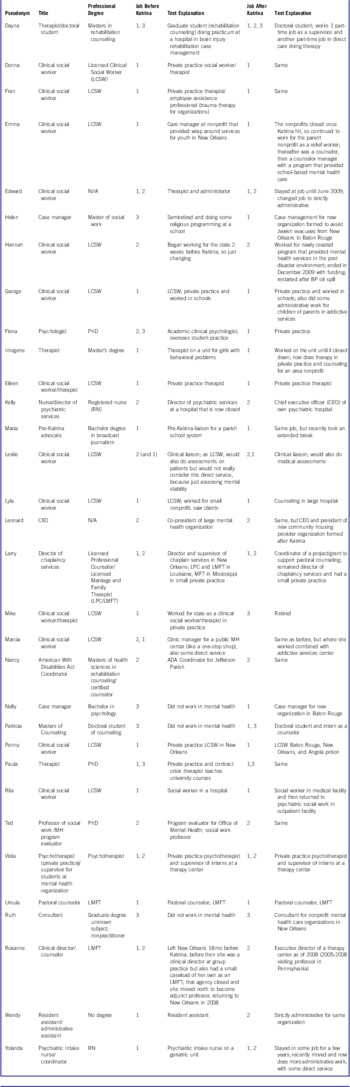
We interviewed a broad spectrum of mental health care providers. Before Katrina, 14 informants worked in direct care (eg, therapist), 5 worked in administration, 9 worked in some combination of these, and 4 were considered “other” positions (eg, academe). After Katrina, 14 worked in direct service, 7 in administration, 9 in a combination, and 2 in other positions. Although the number of people in each category remained fairly constant, many informants changed jobs during the five-year period since Katrina. Nine changes occurred immediately after Katrina, and 14 informants changed jobs sometime thereafter. Katrina generally played a role in their descriptions of job changes, but we do not know if this turnover was unusually high or whether Katrina was the cause. Of the 32 informants, 29 shared information about degrees and licenses while describing their jobs. Fifteen were licensed marriage and family therapists, licensed clinical social workers, or licensed personal counselors. Six had master's degrees, three had doctoral degrees, and two were registered nurses. Appendix A provides details about the informants’ academic degrees and jobs.
Interviews were conducted by telephone and recorded. After the researcher read the institutional review board information sheet, which explained that participation was voluntary and without incentives, informants provided oral consent to participate. Initially, interviewees were asked open-ended questions that were designed to elicit information about how people engaged in work. An interview protocol guided the conversation, but questions were not asked verbatim because the focus was on events the interviewee identified and the actions they and others took.Reference Holstein and Gubrium27 The interpretive approach allowed them to describe work experiences through all phases of Katrina. Appendix B provides the interview protocol.
Data Analysis
Data were gathered and analyzed inductively, meaning that collection and analysis are data-driven, with theory emerging “from the ground up rather than called forth by prior theoretical con-structs”.Reference Lofland, Snow, Anderson and Lofland28 Coding and data collection overlapped because the first data served as a foundation for further collection and analysis.Reference Corbin and Strauss29 The aim was to understand the informants’ experience through their words.Reference Guba and Lincoln30
All interviews were transcribed and coded using ATLAS.ti qualitative data analysis software to derive themes and categories systematically from the in vivo codes.Reference Lofland, Snow, Anderson and Lofland28 We read and coded the transcripts based on concepts that emerged from the data.Reference Corbin and Strauss29 During this stage, we went line by line through the transcript and coded a first round of concepts.Reference Charmaz31 We wrote memos that captured interpretations of particular passages that linked back to the coded concept.Reference Emerson, Fretz and Shaw32 We then performed subsequent rounds of data gathering and coding in relation to emerging concepts and categories.Reference Corbin and Strauss29
While this interview protocol focused on time as related to Katrina, temporal codes that emerged were not the same as expected. In analyzing the interviews, three relatively distinct phases of crisis were found. Based on the informants’ descriptions, these were named evacuation period, surreal period, and new normal period. We coded actions taken related to work during each phase and presented these as our results.
Results
The interviews revealed a variety of disruptions to work experienced by informants that differed temporally. The evacuation period took place from a few days before the storm to a few weeks thereafter when people started to return home. The surreal period began when people started to return home and ended when informants described a return to some normalcy in daily life (eg, electricity and postal service restored, pharmacies were reliably open). This period was approximately 12 months, starting in late September 2005. The new normal period extended into the present. In each period, informants described adapting to disruptions through a combination of doing different tasks and doing tasks differently.
Evacuation Period
The evacuation period was characterized by an almost total disruption to the work lives of informants. Most of the people who continued working reported doing different tasks. Ten informants continued working throughout the evacuation period. Of these, three evacuated with their clients, two worked outside of New Orleans, and five stayed in the city until they were forced to leave. The following descriptions focus on these groups of people.
Doing Different Tasks
Most of the informants reported doing very different tasks. Some of these tasks were normally done by other people, while some were new tasks caused by Katrina.
Tasks normally done by other people
Before Katrina, one informant worked as a clinical liaison, performing assessments on patients. During the evacuation period, however, her work expanded:
I would help out on the psych unit keeping the patients calm. You know, feeding them, wiping butts, changing them. I mean whatever they needed help with, I would do that (January 19, 2010).
New tasks caused by Katrina
Informants related a number of new tasks directly associated with the destruction of Katrina. An administrator of a major mental health care provider described his tasks as focused primarily on providing relief:
I would just go round (in shelters) and spend an hour just meeting with and holding hands and just talking with folks and being encouraging (July 12, 2009).
One informant worked as a school liaison before Katrina. During the evacuation period, her work was transformed from providing referrals for at-risk children to figuring out how to distribute “mountains and mountains” of donations. Another, a resident assistant for homeless women, transformed a hotel into a shelter and connected clients with services in Dallas, Texas. A third informant, a therapist in a residential unit for young girls, focused on providing structure for clients rather than therapy:
… when we saw that we weren't going to be going back soon, we had the kids going to school at a local group home … We'd try to arrange a few activities for them on the weekends … maybe go to a park. [Someone] got us some free tickets for the children's museum one day and we took them there (May 4, 2009).
Some of the new tasks involved taking care of staff:
There [were] a lot things that I normally [didn't do like] buy underwear for my staff … Instead of doing data collection, the data I am collecting is “what size underwear do you need me to get you?” While you take care of the patients I am going to Wal-Mart to buy underwear (October 23, 2009).
Doing Tasks Differently
Informants said little about how they did the same tasks differently during this period. One described submitting the payroll via Internet. She also described the difficulty of maintaining case notes under these circumstances. Her case notes, however, were critical for receiving reimbursements for the costs they incurred.
Surreal Period
The surreal period was marked by scarcity and unpredictability:
… it was just very surreal … like coming home to a war zone (March 9, 2009).
The number of informants actively working in the disaster area jumped from 10 to 23. Many continued to do different tasks than the ones they performed before Katrina. More than in the evacuation period, informants reported performing previous tasks, but doing them differently based on the specific disruptions of this period.
Doing Different Tasks
Informants did a wide variety of tasks in the surreal period. Of the 23 people working, 14 provided basic support for staff or clients. One informant continued to do the work of a case manager rather than a therapist. Others continued doing relief work, while another informant performed “old-fashioned social work” (July 8, 2009). Five informants described engaging in some type of outreach during the surreal period:
We started doing outreach … going out to people because there was no public transportation … We had a team of a doctor, a nurse and a social worker that went out every day … (January 7, 2010).
One informant used students to find missing clients:
We literally sent students to look at flooded houses to see if there's somebody there (May 2, 2009).
Some people started to perform new tasks because their old work was not available and there were new things to do. One informant became a crisis counselor for first responders. Another worked for the Angola prison in Louisiana. Four created new organizations or programs. One started a new housing organization, one applied for a grant to service the Gulf of Mexico region, one became a grant coordinator, and another opened a hospital because the one she worked for closed. Others, like the informant who became a Federal Emergency Management Agency (FEMA) trailer park landlord, switched to jobs that serviced the basic needs of clients and staff.
Doing Tasks Differently
Seven informants reported performing tasks differently because of the extended nature of the disruption. For instance, five people described doing therapy differently. The lack of office space for therapy provided one set of challenges, so one informant held therapy sessions in her FEMA trailer. Another described meeting clients in coffee shops and on park benches. Another informant noted how therapy changed:
…at that point all the rules were out and everybody was just doing the best they could with what was available … typically you wouldn't have a client in your living room but at that time you used what was available (April 14, 2010?).
One therapist specifically described the changed nature of sessions:
People sat in session with their cell phones on. Because the plumber could call, the contractor could call, the insurance person could call, this person could call …. Whereas in another situation I am not sure I would feel compelled to tell the opening hours of a drug store to an … intelligent functioning patient … Patients would give me information too. It was not a one-way street (July 8, 2009).
New Normal
The new normal period began when a modicum of normalcy returned to New Orleans. As one informant said,
Things are pretty much normal now. There is a new normal now; it is not the way it used to be (March 21, 2009).
Informants emphasized a shifting focus on how old tasks have changed. While this period was characterized as new normal, the provision of mental health care remained altered by the hurricane:
Katrina trauma has for some re-triggered old traumas…it never goes away and there are still people coming in who are just beginning … to deal with things that have been going on since (July 8, 2009).
Unlike the previous two periods, informants were more likely to relate doing tasks differently in the new normal period than doing different tasks.
Doing Different Tasks
When informants discussed doing different tasks, many of the changes were job mobility, although several of them also started new programs. Five people reported moving to positions that involved more or exclusively administrative work. In response to new resources for schools, four people began working primarily with children.
Doing Tasks Differently
Informants discussed two major categories of doing tasks differently. Eight informants took new approaches to evacuation. Nine discussed new resource challenges to providing care.
New approaches to evacuation
Post-Katrina, people prepared for evacuation more seriously and emphasized flexibility. One informant made sure that all of her hospital staff were licensed to operate in Mississippi. Several people related collecting more comprehensive staff and patient information. One recounted having information backed up to a server in Utah. One informant's organization provided every client with a letter detailing their treatment and medications.
Dealing with changes in resources and/or demand
Katrina changed the geography of resources in New Orleans. Some resources were more available, supporting new programs already discussed. Other resources were less available, and often coupled with increased demand:
The whole mental health system completely changed … people [and] agencies are wiped out and people leave … we started from scratch, every organization did … (January 7, 2010). You would get somebody that you were committing and you could not find a [psychiatric] bed, you just couldn't, so you would hold the patient at that emergency room until their 72 hours went (March 9, 2009).
Informants described how they dealt with the shortage of doctors and psychiatric beds:
Before Katrina, the process was we would work through our psychiatrist to get an … order of custody, but now I go to wherever that doctor is. If that doctor is in City Hall in a meeting, I will drive down there and get the form … (November 9, 2008).
Comment
Our data and analysis showed how care changed over the course of the Katrina experience. The informants described a process of change during three time periods, focusing on basic care in the evacuation period and transitioning in the surreal period. During the new normal period, informants related working to re-create a still disrupted system.
Flexibility is an important feature of resilience.Reference Sutcliffe and Vogus14-Reference Weick, Sutcliffe and Obstfeld21 We identified two forms of flexibility and how they changed during the time. Flexibility aided system resilience in two ways: (1) providing basic care and (2) maintaining a skilled workforce. Informants stayed in the area because they found ways to work and support themselves. Many also continued or started programs, employing other people.
Limitations
Using in-depth interviews provided detailed information about the experiences of informants.Reference Kendra and Wachtendorf33 Limitations of these data included not providing a representative sample of mental health care workers in general or information about the modal experience of workers. Because we gathered retrospective interview data, our focus was on what informants remembered. By asking people to relate specific incidents in detail, we focused on reporting actions rather than vague recollections. We interviewed a broad spectrum of mental health care workers rather than providing information relative to particular features of specific jobs. Focusing in on specific jobs or organizations could be a focus of future research.
Recommendations
Flexibility was an important part of providing care and maintaining a skilled workforce. The following recommendations to professionals, organizations, and policy makers may draw attention to ways of encouraging and maintaining flexibility.
Recommendations for individuals:
• Look for ways to provide basic needs.
• Stay connected to clients and those providing mental health care.
• Recognize that the effects of large-scale crises often extend beyond commonly accepted periodicities, and continued flexibility is important to responding.
Recommendations for organizations and public policy makers:
• Create incentives for skilled people to stay in the region, including:
ˆ Paying people to do work that is beneath their skill level
ˆ Providing short-term jobs to skilled workers
ˆ Paying attention to how people living and working in affected localities describe continuing or changing disruption and how they are able to continue providing care
Conclusions
We sought to understand how people adapted their actions to continue providing care during and after large-scale disasters. Previous research has shown that people can act in improvisational and inventive ways to communicate with each other and continue to work in disrupted environments.Reference Kendra and Wachtendorf18, Reference Kendra and Wachtendorf33-Reference Palen and Liu35 Our research has contributed by identifying differences in patterns of flexibility through three temporal periods. By adjusting the extent the informants were doing different tasks and the ways they were doing tasks differently during the three time periods, the informants’ actions helped to create system resilience. Through their flexibility, informants were able to provide basic care and adapt to changed circumstances. Their flexibility also contributed to maintaining a skilled workforce in the affected region.
This study was funded by grant 0712876-0013144000 from the US National Science Foundation.
Published online: April 16, 2012. doi:10.1001/dmp.2012.12

Appendix B Interview Protocol
We'd like to ask you to tell us about what you did at work before Katrina and how you completed your job-related tasks. Also, we are interested in how you do your job in the post-Katrina environment. We would like to understand how your patterns of actions may have changed as a result of Katrina. Routines are patterns of how we do things. We are specifically interested in work-related patterns of action (eg, a work routine). For example, you might have a work routine that you use in order to intake a client/patient. This could be screening a client/patient for program eligibility; performing initial intake assessment via intake form or intake computer program; taking case notes by hand, or by computer; orienting client/patient to program or organizational services). These patterns of actions might have changed as a result of Katrina. We will ask one set of questions regarding your work patterns and use of technology before Katrina, then another, very similar set of questions, about your job after returning to work, post-Katrina. We will then end with a set of general, less work-related questions. In sum, we are trying to understand what it is that people in organizational environments do to continue doing their jobs when their lives and workplaces have been disrupted.
First Period: Before Katrina
Please, briefly, in a two- or three-sentence overview, talk about your job duties/work description before Katrina. What is it you did at work and what were your responsibilities and major tasks?
Now we'd like to ask you about your typical work-related patterns of action and tasks before Katrina. Start by describing a couple of routines that you did for work (for example, you might have a work routine that you use in order to intake a client/patient, or it could be a routine you employ to de-escalate a client/patient crisis).
Could you please talk about these patterns of actions in detail and talk about specific actions you do to accomplish the work related to these actions? For example, in the case of an intake, you could encounter a client/patient at the front desk; screen the client/patient for program eligibility; perform initial intake assessment via intake form or intake computer program; take case notes by hand or by computer; orient client/patient to program or organizational services; and then log intake into a computer or file case notes).
What about the people you worked with/collaborations you were engaged in? There may be many different people/groups, as well as organizations you interact with. Please discuss the roles of these other people and organizations in the completion of your work.
How did they help you complete your work tasks?
What did they do to complete their tasks related to yours, and what did they do to do their job (for example, the front desk person called you to the desk to meet a new client/patient, you obtained initial forms from them, and their role is to answer phones and refer case managers to new clients).
How did other organizations assist you with the work you have discussed?
What were the roles of other organizations in helping you complete your work tasks, what was their general role as an organization, and what did this organization do to do its job in relation to yours?
Did you use technologies to interact with them? If so, what (e-mail, organizational letters/memos, a computer program, conference call technology)?
How long had you, your organization, and other organizations been using these technologies?
Second Period: After Katrina
Now we'd like to ask you about your typical work routines and tasks when you returned to New Orleans after Katrina until now.
Please, briefly, in a two or three sentence overview, describe any changes in your job description/duties. What is it you currently do at work and what are your responsibilities and major tasks?
How has the post-Katrina environment changed care-giving in New Orleans? How has it changed your job?
Now we'd like to ask you about your typical work-related patterns of actions and tasks after Katrina. Start by describing a couple of routines that you do for work (for example, you might have a work routine that you use to intake a client/patient, or it could be a routine you employ to de-escalate a client/patient crisis).
Could you please talk about these in detail and about specific actions you do to accomplish the work related to the routine? For example, in the case of an intake you could encounter a client/patient at the front desk; screen the client/patient for program eligibility; perform initial intake assessment via intake form or intake computer program; take case notes by hand or by computer; orient client/patient to program or organizational services; and then log intake into a computer or file case notes).
What about the people you work with/collaborations you are engaged in? There may be many different people/groups, as well as organizations you interact with. Please discuss the roles of these other people and organizations in the completion of your work-related routines.
How do they help you complete your work tasks?
What do they do to complete their tasks related to yours and what do they do to do their job (for example, the front desk person will call you to the desk to meet a new client/patient, you will obtain initial forms from them, and their role is to answer phones and refer case managers to new clients).
How do other organizations assist you with the work you have discussed?
What are the roles of other organizations in helping you complete your work tasks, what is their general role as an organization, and what does this organization do to do its job in relation to yours?
To what extent were those interactions and dependencies disrupted?
What activities related to your interactions with others/organizations do you do that enable you to deal with the disruption?
Do you use technologies to interact with them? If so, what (e-mail, organizational letters/memos, a computer program, conference call technology)?
Have these technologies changed as a result of Katrina?
What activities related to technology use do you do that enable you to deal with the disruption?
In your view, what activities in your work-life related to the completion of your tasks were the most disrupted as a result of Katrina?
Now think about any changes in technology use after Katrina. How do you think your work-life has changed by using these technologies?
General Questions
Can you tell us some things about yourself, for example, how long have you worked where you work, what kinds of training you may have, do you live with your family?
How long have you been in New Orleans? How long are you planning to live here?
Is there any other information you feel is important to tell us concerning how your work collaborations, routines, and technology use was affected as a result of Katrina?