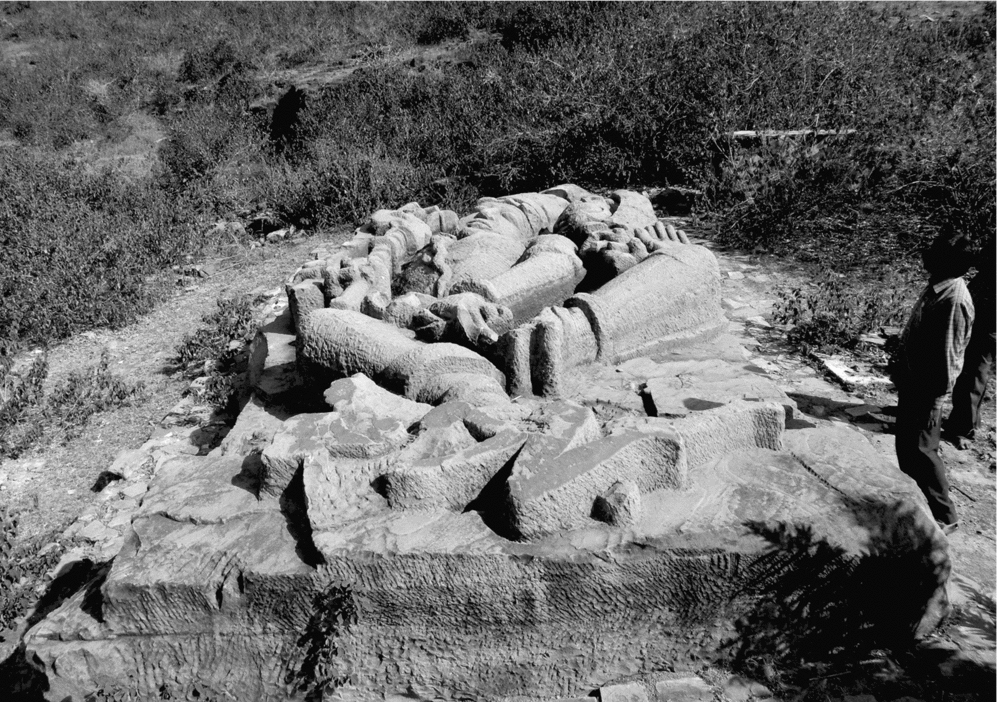
In the course of a field-survey of Paramāra sites in 2008–09, I was exploring locations with historic inscriptions, temples, memorial stones and medieval water systems. Of particular interest were places with antique statuary of Hanumān because he was a protector of the fields and thus played a role in agricultural production.Footnote 1 Udaypur, a key Paramāra site with the well-known Śiva temple built by Udayāditya, naturally formed part of the study. When enquiries about Hanumān were made at Udaypur, local residents urged us to visit Muratpur, a village about 5 kilometres directly south. We set out in that direction, making a series of discoveries along the way. The various memorial pillars, ruins and other remains cannot be recorded here in detail. Perhaps the most startling discovery (more correctly a re-discovery) was a colossal figure of dancing Śiva, more that 2 metres high. The figure lies on its back and, to judge from the chisel marks on it, was never finished (Fig. 1).Footnote 2 This joins the catalogue of monumental but unfinished work by the Paramāras. The temple of Bhojpur is the most famous example, but in this special issue attention has been drawn by O. P. Mishra to the fact that the Bijamaṇḍal at Vidiśā was also left unfinished by Naravarman.
Udaypur (District Vidishā). Unfinished image of dancing Śiva located to the south of the town, eleventh century.

Udayāditya (c. 1070–93) was able to complete the temple at Udaypur and the building is rightly celebrated as a great treasure of Paramāra architecture and sculpture. In the precinct of the temple an inscribed slab was discovered and published by F. E. Hall in 1859. Georg Bühler published an improved version of the text and a translation in 1892.Footnote 3 About a decade later, the inscription was moved to the Archaeological Museum at Gwalior where it is presently kept. The inscription is not complete but the final verse turns to praise of Udayāditya as follows:
Lo! How easy was the rescue of this earth for that Paramāra, by whom the primeval boar was restored without difficulty . . ..
In his notes, Bühler observed that this meant “he who restored a temple or statue of Viṣṇu in the boar incarnation”. Trivedi agreed with this interpretation in his edition of the praśasti, saying that this “appears to be a hint to the restoration of a Boar-temple by Udayāditya”.Footnote 4 He further suggested that the inscription “was probably laid in a part of the temple”.Footnote 5 Udayāditya's devotion to the Boar form of Viṣṇu is confirmed by the Nāgpur Museum inscription. In this we read an account of Udayāditya as follows:Footnote 6
When . . . the realm was overrun by floods of (hostile) nobles, in which its sovereign was submerged, his relation Udayāditya became king. Delivering the earth, which was troubled by kings and taken possession of by Karṇa, who, joined with the Karṇāṭa, was like the mighty ocean, this prince did indeed act like the holy Boar.
So while the main temple at Udaypur is clearly dedicated to Śiva and eponymously named after Udayāditya, it is evident that he had religious attachments to Viṣṇu and was willing to represent himself as Varāha, a metaphorical role for kings established centuries before in the Gupta period.Footnote 7
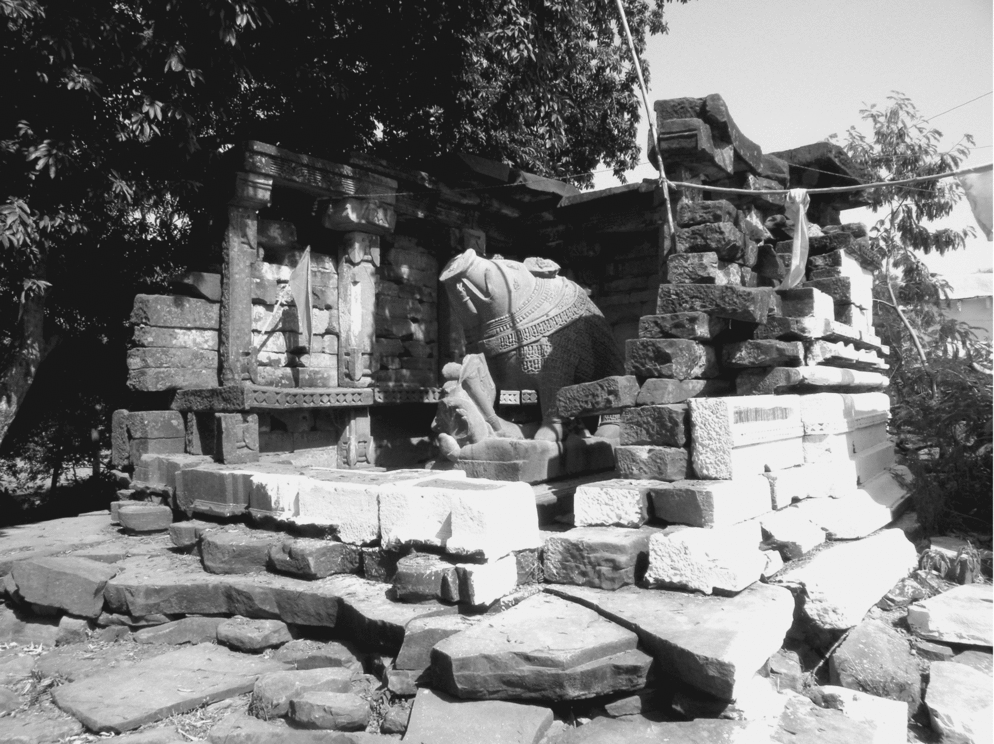
The archaeological problem with Udayāditya's documented connection to Varāha and the inscription from Udaypur is that there is no trace of a substantial Varāha temple in which such a dedicatory inscription would have been placed. Our exploration of Muratpur in search of Hanumān solved this problem. To the immediate south of the village (located at 23°52’21”N and 78°2’47”E), is an old tank with the Hanumān temple built at its edge. The Hanumān itself is a massive recumbent figure, completely covered in sindhur with no features visible. About its date nothing can be said. Over the image is a domed temple of the nineteenth century. The community of devotees living at the site have preserved part of an inscribed tablet related to the temple's construction. The temple is meanwhile being re-built. Just behind the Hanumān temple is the main building of historical interest at Muratpur (Fig. 2). As will be evident from the illustration, this temple is dedicated to Viṣṇu in his form as Varāha. The building and sculpture have not been noticed in any sources published to date. The site escaped the attention of M. B. Garde and does not appear in the reports prepared for the Department of Archaeology, Gwalior State; as a consequence it is not mentioned by D. R. Patil in his Descriptive and Classified List. The proximity to Udaypur, where the so-called Udaypur praśasti was first found, and the style of the building and sculpture, which is unmistakeably of the eleventh century, allows us to reasonably conclude that the Udaypur praśasti is from Muratpur and that the tablet was the dedicatory inscription of this building. Trivedi's suggestion that the inscription “was probably laid in a part of the temple” can therefore be set aside.
Muratpur (District Vidishā). General view of the Varāha temple, eleventh century.

The Muratpur temple is large structure of cut-stone, plain on the exterior except for the basement plinth and podium (vedibandha). The mouldings, of the usual eleventh-century type, are decorated with decorative bands carved with diamond lozenges. The upper portions of the building have fallen and one side of the temple is missing entirely, as is clear from the illustration given here. There does not seem to have been an elaborate superstructure as no remains of this are visible in the area. However, two lion-headed rain spouts from the roof of the building are preserved beside an old well nearby.
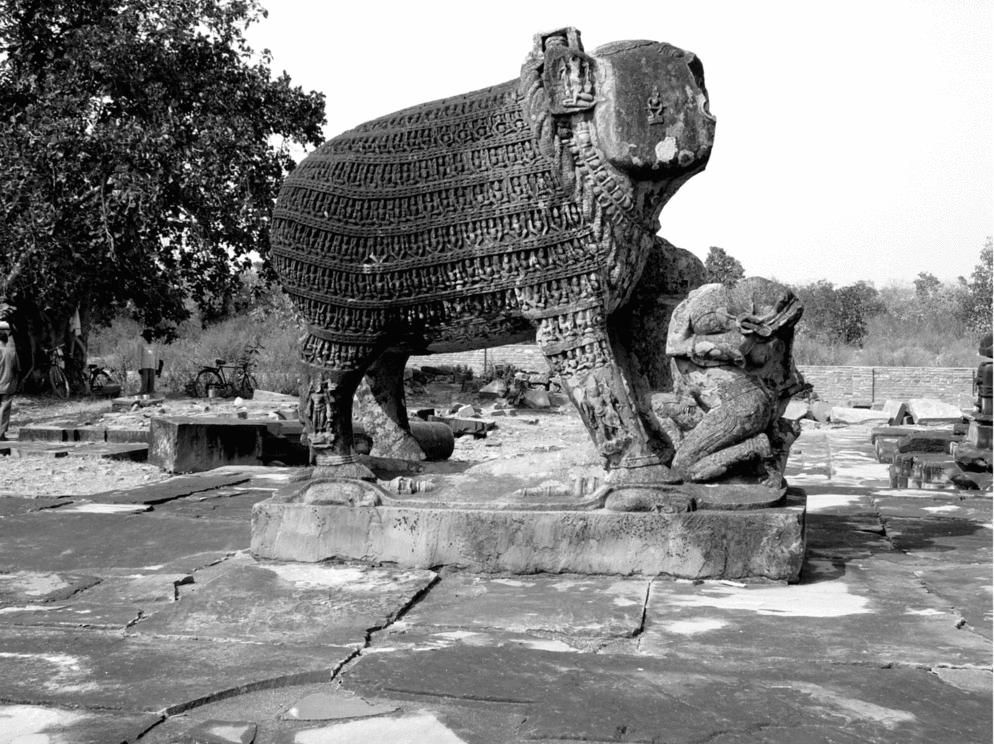
Internally, the temple has a series of pilasters round the walls supporting lintels on which the roof slabs were placed. The pilasters rest on a low bench which is decorated with diamond lozenges on its edge. The bench is supported by miniature or dwarf pilasters. In the centre of the temple is a large figure of Varāha in his zoomorphic form with all the gods seeking refuge in his body. There are a number of similar images of the period in central India, the most well-known being the Varāha at Khajurāho. The iconography of this image is discussed elsewhere, eliminating the need for a detailed account here.Footnote 8 Less known than the Khajurāho example is the Varāha at Chandpur in Lalitpur District, located at 24°29’22”N and 78°19’26”E (Fig. 3). Although protected by the Archaeological Survey of India and mentioned by Mukherji in his early volume on the antiquities in Lalitpur, this Varāha has not been published.Footnote 9 Lying within the territory of the Candella dynasty, iconographically it is close to the Paramāra example at Muratpur and similar also to the example from Badoh now kept in the Archaeological Museum at Gwalior.Footnote 10 What these examples show is that the use of Varāha by Udayāditya was not unique to him or the Paramāras. Just as their was no dynastic monopoly on Sanskrit for inscriptions, and the use of particular metaphors celebrating the achievements of kings, so too there was no exclusive hold on the Varāha image. Indeed the sculptures just mentioned are so close in style and iconography that one would be hard-pressed to identify which dynasty patronised them if we did not know their geographical location.
Chandpur (District Vidishā). Sculpture of Varāha, dated by inscription to VS 1203.