Introduction
Armed conflict has been a major cause of morbidity and mortality for most of human history.Reference Murray, King, Lopez, Tomijima and Krug1 Individuals entangled in group violence face health risks directly from injury and indirectly via the ills associated with societal breakdown, such as an increased spread of infectious disease and a lack of essential resources.Reference Degomme and Guha-Sapir2-Reference Van Herp, Parque, Rackley and Ford6 However, despite considerable health consequences, large-scale group conflict has received limited attention from public health researchers.Reference Murray, King, Lopez, Tomijima and Krug1
In Iraq, although there have been numerous setbacks, and intermittent bombings persist, the security situation in general has improved from its nadir in 2006-2007.7, 8 However, the non-conventional and protracted nature of this conflict has weakened significantly the public health infrastructure, with acts of group violence continuing to threaten the populace on an almost daily basis. Despite a breakdown of traditional surveillance mechanisms, several studies have attempted to quantify the increased mortality in Iraq from such violence.Reference Awqati, Ali and Al-Ward9-15
Similar to other conflict-stricken areas, Iraq's national health services have suffered significant deterioration due to this violence.Reference Donaldson, Hasson, Aziz, Ansari and Evans16 Indeed, insurgents and criminal gangs have purposefully targeted Iraqi physicians in the past, causing a significant exodus from the country.Reference Donaldson, Hasson, Aziz, Ansari and Evans16 The Iraqi Ministry of Health estimated that, at the end of 2006, over half of the 34,000 Iraqi doctors registered in 1990 had fled, while over 2000 doctors had been killed, and 250 had been kidnapped.8, Reference Zarocostas17
However, despite the profound disruption of the health care system, in Iraq and in many other conflict areas, national health workers remain one of the greatest resources for maintaining and improving the health of their affected populaces. A primary role of humanitarian aid organizations and other international actors should be to provide strong support to these local caregivers. Unfortunately, most international publicity and research regarding such areas focuses on outside humanitarian intervention, ignoring the fundamental role of the local providers and health systems. This oversight can, in turn, lead to the establishment of parallel healthcare systems with disjointed and unsustainable care.Reference Ugalde, Selva-Sutter, Castillo, Paz and Cañas18
To date, there has been limited organized research on the perspectives and needs of national physicians when confronted with ongoing violence. The objective of this study was to provide an assessment of national caregivers in an area of active conflict, and to provide information to support the healthcare system in the country and in other areas with large-scale group violence.
Methods
This study was a convenience sample of physicians taking the International Medical Corps (IMC) Doctor Course in Emergency Medicine, given in Baghdad from December 2008 through August 2009. The Iraqi Ministry of Health selected physicians involved in emergency medical care across Iraq to travel to the capital to take this intensive one-month course covering advanced airway instruction and related material provided by ACLS and ATLS training. In addition to didactics, the class included practice on mannequins, an animal (sheep) lab, and a clinical component with real patients.
Prior to starting the course, on the first day of orientation, class organizers distributed the survey. Organizers provided both verbal and written explanations of the survey, and those participants who volunteered gave their written consent. There were no incentives for taking the survey and no consequences for opting out. No unique identifiers were collected, except for the consent form that organizers immediately separated from the survey sheet.
After gathering the completed survey forms, IMC staff entered the anonymous survey data into an SPSS database (Version 12.0, SPSS Inc., Chicago, Illinois USA). A descriptive analysis using SPSS software was then performed. The John F. Wolf Human Subjects Committee at the Los Angeles Biomedical Institute approved this study (Project Number: 13756-01).
Results
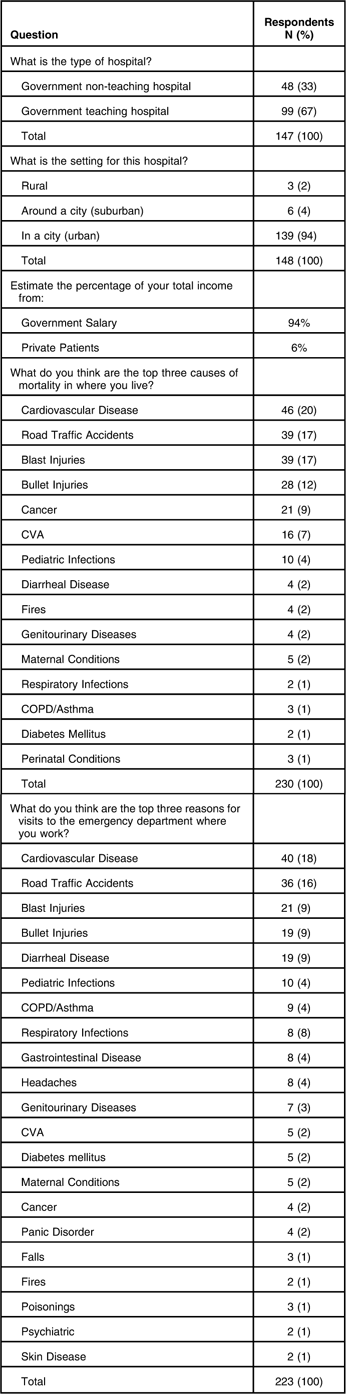
Characteristics of survey respondents’ practice environments are shown in Table 1. The respondents represented over 50 hospitals from across 11 provinces in Iraq. They were primarily from Baghdad (72%), teaching hospitals (67%), and urban areas (94%). Most physician income was from the government (94%) vs. private patients (6%). Respondents felt that cardiovascular disease, road traffic injuries, and blast and bullet injuries were the main causes of death and reasons for ED utilization.
Practice environment

Overall, respondents felt safe at home (63% agreed/strongly agreed), but less so in the hospital, excluding the ED (46%), and were split over safety during their commute to work (27%) (Table 2). Most did not feel safe while in the ED (37% disagreed/strongly disagreed).
Safety

Specifically within the ED, 80% of respondents reported being assaulted by a patient or their family member at least once within the last year, and 38% reported they had been threatened with a gun. Sixty percent of respondents knew a medical colleague at their hospital who had been injured by violence at work in the last year, and 14% had a colleague killed at work within the last year. Only a small minority of physicians felt that the security in the ED was adequate (9% agreed/strongly agreed).
On average, there were three hospitals with ED services per regional area, 25 beds per ED, and a 20% admit rate (Table 3). Pediatric patients represented 30% and geriatrics 20% of the total patient population. Respondents noted that 97% of ED patients waited <30 minutes on average to see a doctor. Of their hospitals, only 27% had a formal trauma team. The majority (63%) of EDs were broken into separate medical and surgical sections. Only 19% of respondents were aware of an established triage system for their ED. In such systems, primarily physicians (83%) performed triage, as opposed to nurses or other staff.
Emergency Department characteristics

The average physician evaluated and treated 60 patients in an eight-hour period. The average ED was staffed by four physicians and seven nurses during the day, and two physicians and four nurses at night. Most felt that the physicians in the ED were adequately trained (52% agreed/strongly agreed) and that consulting physicians were readily available (57%). However, few respondents felt that they had an adequate number of ED nurses (25% agreed/strongly agreed) or physicians (19%). Additionally, few respondents felt that the nurses were adequately trained (25% agreed/strongly agreed), or that medications (22%) and equipment (17%) would be immediately available during emergencies.
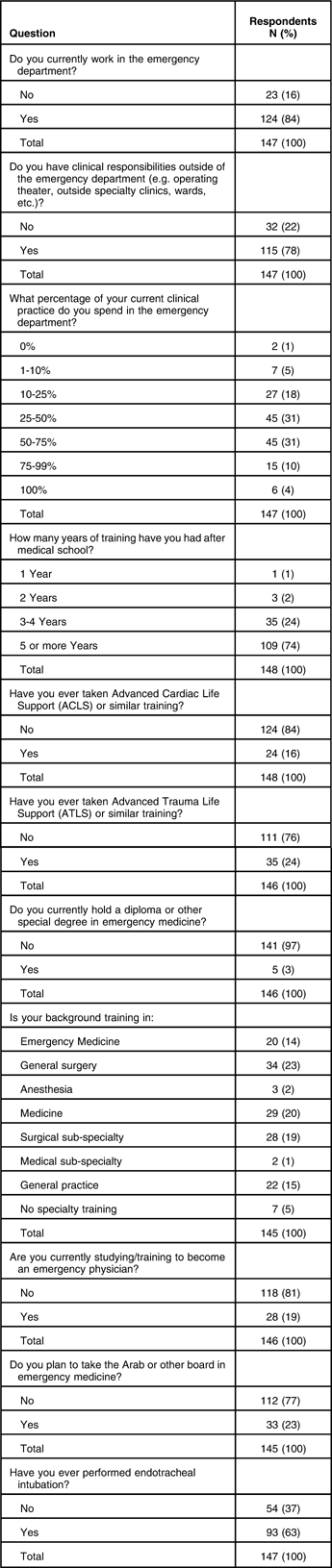
Although 84% of the respondents currently had responsibilities in the ED, with 76% spending over half of their clinical time in the ED, most (78%) also had clinical responsibilities outside the ED (Table 4). Close to three-fourths (74%) had more than five years of post-graduate training, although only a minority had taken courses covering ACLS- (16%) or ATLS-related (24%) material. Only five respondents (3%) had some type of Emergency Medicine (EM) specialty degree.
Clinical background

There was a wide range of training backgrounds, with approximately 20% of respondents consisting of current Iraqi EM residents who were scheduled to take the Arab EM boards upon completion of residency.Reference Donaldson, Hasson, Aziz, Ansari and Evans16 Of the total respondents, only 63% had performed endotracheal intubation at least once before.
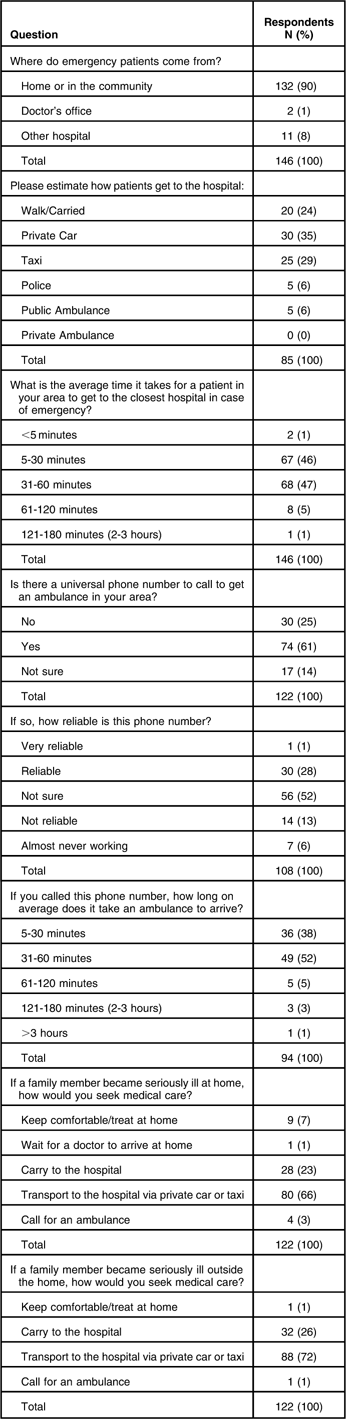
Respondents reported that the majority of ED patients came directly from home or the community (90%) (Table 5). Overall, only a small portion of patients (12%) arrived via ambulance, with the majority arriving on foot (26%), or by private car (30%) or taxi (31%).
Transportation

Respondents estimated that over 90% of patients could reach an ED within one hour. The majority of respondents (61%) were aware of a universal phone number for ambulance response, although only 28% felt that this number was reliable/very reliable and only 38% felt the average response time was <30 minutes. Only three percent of respondents would themselves use the ambulance system for an ill family member when at home, and only one percent when out in the community.
Discussion
This study is the first attempt to survey physicians working in Iraq. The national physicians came from a wide range of specialties (e.g., general surgery, anesthesia, medicine, etc.) and hospitals around Iraq, with the majority from urban government teaching hospitals.
The findings show that, similar to the Iraqi people, safety is one of the main concerns of Iraqi health workers. Although the direct targeting of physicians by insurgents has now ceased,Reference Donaldson, Hasson, Aziz, Ansari and Evans16, Reference Voelker19 the study results demonstrate that physician security at work continues to be a major concern. In particular, while a large number of physicians felt safe at home and in the general hospital facilities, they found the ED to be particularly unsafe. This is consistent with anecdotal reports of safety concerns within the EDs,Reference Donaldson, Hasson, Aziz, Ansari and Evans16 now supported by the exceedingly high numbers of reported assaults on ED staff members in our survey.
In Iraqi EDs, patients and/or their family members had assaulted 80% of the responding physicians over the last year, half of those assaults involving a gun. Sixty percent of respondents knew a medical colleague at their hospital who had been injured by violence at work in the last year, and 14% had a colleague killed at work in the last year. Similar rates of verbal assault have been found previously in accident and EDs in Kuwait,Reference Al-Sahlawi, Zahid, Shahid, Hatim and Al-Bader20 as well as in more developed and international settings.Reference Carmi-Iluz, Peleg, Freud and Shvartzman21-Reference Lyneham26 However, the incidence of physical violence, as well as violence involving a firearm, was markedly higher in Iraqi EDs as found in this survey.
While prior studies have described violence toward humanitarian aid workers, security at work is a poorly documented concern of national staff providing emergency medical assistance in conflict areas. As the assaults were directly from patients and their family members, as opposed to indiscriminant bombings, these high rates of violence may be partially attributable to an increased access to firearms in the populace. Additionally, sequelae from psychological trauma associated with violence are well documented.Reference Steel, Chey, Silove, Marnane, Bryant and van Ommeren27-Reference Sonis, Gibson, de Jong, Field, Hean and Komproe29 It may be that frequent exposures to violence within the patient populace have resulted in higher levels of aggression toward national doctors.
In addition to safety issues, our results also revealed several unique challenges facing physicians in Iraqi EDs. Although high rates of patients with cardiovascular disease and road traffic injuries will seem routine to doctors working in most EDs, the inclusion of a high incidence of blast and bullet injures are dramatically different from those seen outside of an active conflict area.
Another dramatic finding was that the case-load for Iraqi ED physicians is exceedingly high compared to international standards, with a median of 7.5 patients per hour (60 per eight-hour shift). This compares to the majority of United States emergency medicine physicians seeing 1.5-2.5 patients per hour.30 Although an overall lack of documentation requirements and malpractice concerns presumably contributes to expedited patient throughput in Iraq, this is likely a dangerously high number. Indeed, physician respondents felt that staffing levels for their EDs were inadequate, both in regards to nurses/ancillary staff and doctors, in addition to a lack of emergency medications and equipment. Overall, only 19% of respondents felt that their EDs had adequate physician staffing, a likely result of health care breakdown and the exodus of national doctors.Reference Donaldson, Hasson, Aziz, Ansari and Evans16
Our results demonstrate that Iraq is in the early development phase of emergency medical care,Reference Alagappan and Holliman31 with the majority of EDs having separate medical and surgical sections, and lacking a formal triage system. In contrast to emergency physicians in developed emergency care systems, most of our respondents had additional clinical responsibilities outside of the ED, and very few had taken courses covering the material in ACLS or ATLS. Approximately one-fifth of the participants were current trainees in the recently established Iraqi EM residency programs that had been initiated with the assistance of IMC.Reference Donaldson, Hasson, Aziz, Ansari and Evans16 Only a small handful of respondents (five) already had some type of specialized EM degree. These findings highlight the large need for structured emergency medical training in the Iraqi health sector.
Limitations
There are two limitations to this study. First, this survey was conducted using a convenience sample of physicians attending the IMC Doctor Course in Emergency Medicine. The experience of these physicians may not reflect those of the general population of physicians working in Iraq, and thus potentially limits the generalizability of the findings. Second, the vast majority of doctors surveyed worked in an urban setting. Thus, the experiences of these physicians may not reflect that of Iraqi physicians working in other settings, such as rural areas.
Conclusion
This study provides a clearer understanding of the perspectives and needs of national civilian physicians in an area of ongoing conflict, particularly with regards to workplace violence. It describes some of the risks faced by national health care workers in providing emergency care to a violence-stricken populace. It also demonstrates that staffing shortages and a lack of formal training in emergency care are some of the most pressing needs of the national physicians working in hospital EDs in a conflict zone. These findings should help humanitarian aid organizations and other international actors provide specific support to local caregivers, the principal source of health care in both Iraq and many other conflict areas.
Abbreviations
- ACLS:
Advanced Cardiac Life Support
- ATLS:
Advanced Trauma Life Support
- ED:
Emergency Department
- EM:
Emergency Medicine
Acknowledgments
The authors would like to acknowledge generous funding from the Australian Agency for International Development (AusAID) for emergency medical care development in Iraq, as well as the support of the Iraqi Ministry of Health and International Medical Corps (IMC). We would also like to thank personally His Excellency Dr. Saleh Hasnawi, Iraq Minister of Health; Dr. Chasib L. Ali, Director General of Medical Operation and Specialized Services, Iraqi Ministry of Health; and Dr. Hasnaa Rustami, Developing Programs Director, Medical Operation and Specialized Services, Iraqi Ministry of Health, as well as their supporting staff. Additionally, we would like to thank instructors of the IMC Doctor Course in Emergency Medicine for their assistance with administering the survey: Drs. Ayad Jasim Matar Almuhsin, Adel Kamil Salom, Waleed Al Ansary, Ali Hussein Matar, Yasin Mustafa, Salah Mahdi Tajer, Rasha Muhammad Salih, Tariq Kairalla, Muhammad Hasan Neamat, and Haydar Abd Alameer.
Declaration
RD had full access to all of the data in the study and takes responsibility for the integrity of the data and the accuracy of the data analysis.