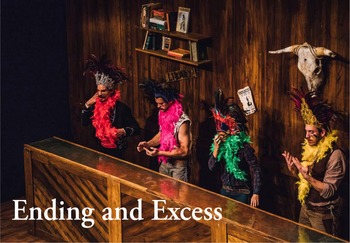
While watching Pursuit of Happiness, I lose track of time. Onstage, and for quite a while now, cowboys in feather boas and mock war paint have been executing a hypnotically repetitive square-dance routine. They display exceptional levels of precision and stamina. As they continue to circle and jump and do-si-do, a bartender narrates at great length, in terms both shocking and banal, the plot of his screenplay: The En-Knapp Dance Company has left its home in Slovenia and its hard-won international spotlight (awards, invitations, etc.) in order to work in secret on a new project, which they bring, in a kind of self-assigned peacekeeping mission, to war-torn Iraq.Footnote 1 As our narrator describes “powderized” houses, trigger-happy soldiers, and blown-off limbs, the dancer-cowboys present a stylized representation of the events. Confetti approximates the blast of a bomb; the area behind the bar becomes a foxhole. I know, roughly, the show’s runtime, and as the dancers have been in continual motion for at least half an hour, I believe us to be towards the end of the second of three parts. Not acts precisely — there has been no intermission or blackout — but when we moved from a Western saloon to a battlefield on the outskirts of Baghdad, I assumed that -eventually we would be transported a third and final time, overlaying some equally disparate-seeming place with the common themes of artistic creation, existential crisis, spectacular violence, and cowboys. When I check my watch, -however, wondering whether it is only in my imagination that this second part is lasting so much longer than the first, I realize that a third “act” is likely no longer an option — the show is going to be over before I know it. In short order, the dancers catch the last plane out of Iraq, touch down in Slovenia, and then the bartender returns us, rhetorically, to West Philadelphia in 2019, concluding his marathon monologue by inviting his audience — which we may or may not be — to join him at a local Ethiopian restaurant. He’d like to discuss our interest in purchasing his screenplay.
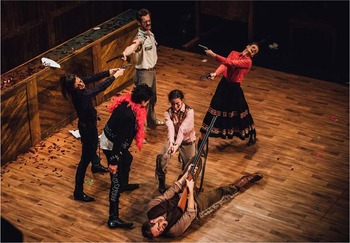
Cowboys in feather boas in their “foxhole” behind the bar (Bence Mezei, Jeffrey Schoenaers, Ana Štefanec Knez, Luke Thomas Dunne). Pursuit of Happiness, Nature Theater of Oklahoma and the EN-KNAP Group, Schouwburg Kortrijk, Belgium, 2018. (Photo by Jonas Verbeke)

That Pursuit of Happiness — a 2016 collaboration between the Nature Theater of Oklahoma and the (actual) EN-KNAP Group — led me to look at my watch does not make it unique among performance events. This entirely subjective moment of disorientation is only one, relatively minor, facet of the way in which the production led me to consider the relationship between theatre and crisis.Footnote 2 Yet, despite its seeming insignificance, this instance of confusion holds within it the problem at the heart of contemporary efforts to comprehend the scale of climate change and its consequences for life on this planet: an inability or unwillingness to perceive the unsustainability of the present.
This is not typically a problem we face when we go to the theatre. We harbor no illusions that the world built before our eyes will not come to an end, and shortly. Our understanding of the situation onstage is based, at least in part, on how much time remains — on what we imagine it will be possible to resolve or unravel. Even when we miscalculate (as I did), or misrecognize the significance of some detail or event, we are not lost forever; we catch up, recalibrating in light of how much more we know now about this world than we did before. But our spectatorial capacity for adaptation, unmoored from the clarity of bounded time, fails us in the face of our current crisis. As the reality of rising carbon emissions, sea levels, and global temperatures — along with the attendant rise in cataclysmic “natural” disasters — prompts ever shorter projections of how much time we, as a species, have left, the incomprehensibility of a collective end point (extinction or simply social collapse) precludes the possibility of responding to this reality in any meaningful way.
If there is a “we” that has failed globally to comprehend the scale and speed of the climate crisis, the particular contours of that failure in the West reflect the disorienting condition of a more specific “we”: the culture most responsible for the crisis is as yet relatively isolated from its worst effects. It is also this more specific, isolated “we” whose theatrical habits and spectatorial demands I invoke here, shaped as they are by Western paradigms of temporality, representation, and dramatic structure. In a departure from ongoing conversations that consider what kind of theatre we should make in response to the climate crisis (see McClinton Reference McClinton2019; Pickard and Fu Reference Pickard and Fu2020; Waters Reference Waters2009), I propose that theatre — as practice, form, and event, and, critically, largely without regard to subject matter — offers a model for thinking crisis, and that several performance works written over the past 10 years and staged during the last 5 are particularly useful in demonstrating the contours of this affinity. I am not arguing for or against making theatre “about” the climate crisis, or theatre as a form of climate activism; rather, I am exploring the possibility that at the intersection of its complicated temporality, its status as extravagance, and its dependence upon the spectator, theatre offers a means of recognizing the inadequacy of our current discourse and, by extension, many of our efforts to act. What can theatre — making it, watching it — teach us about how to be in a present that withholds the promise of a future?
This line of inquiry is prompted, in part, by Lauren Berlant’s assertion in Cruel Optimism that the “crisis ordinariness” she identifies as a feature of our contemporary existence has precipitated the “waning of genre” (2011:10, 6), specifically the “genre” of the good life or the happy ending (i.e., the pursuit of happiness). I am connecting the “good life” here to the structure of hope governing much of the current discourse surrounding the climate crisis, insofar as it shares cruel optimism’s “relation of attachment to compromised conditions of possibility” (24). This attachment takes two forms: first, in its only ever partial and/or cautionary acknowledgement of the climate change–induced crises already impacting the lives of millions of people across the globe; and second, in its refusal to accept that adaptation to the impending effects of climate change is incompatible with existing economic and political structures, and so requires a radical rethinking of the concept of adaptation itself. One of the most striking, if dated, examples of the “good life” genre as it pertains to climate change is the ending of Al Gore’s An Inconvenient Truth (2006). After a legitimately devastating tour through the science of climate change, the film concludes with a reassuring few minutes of “things you can do” to help the planet: turn off the lights when you leave the room; use energy-efficient bulbs; ride a bike. While it is more difficult now to find popular representations of the climate crisis that reduce our response to individual consumer choices, the call to look beyond consumerism has, in many cases, simply been folded into a climate-conscious consumer identity. In other words, the “cruel optimism” of much climate activism involves advocating for and preserving a present that has produced — and continues, inexorably, to produce — its own destruction. As Berlant writes, “the very pleasures of being inside a relation have become sustaining regardless of the content of the relation” (2). Our efforts to navigate these contradictions give rise to what Berlant calls the “impasse”: “a disturbance in the situation of the present and the adaptations improvised around it” (198). By conceptualizing the present as impasse, Berlant argues, we “open up different ways that the interruption of norms of the reproduction of life can be adapted to, felt out, and lived” (199).
As her articulations and examples of the impasse pile up, I find theatre everywhere: the impasse is a “cul-de-sac,” where “one keeps moving, but one moves, paradoxically in the same space”; it is “a live situation where actors do things”; and “the space where the urgencies of livelihood are worked out all over again, without assurances of futurity, but nevertheless proceeding via durable norms of adaptation” (200). It is hard not to see a Greek orchestra in that cul-de-sac, a chorus circling the altar; the urgencies of getting to Moscow or saving the orchard proceeding as they always do without ever changing the outcome. But far more than the plot or content of any play, Berlant’s impasse seems to describe what is often the theatrical condition itself — a world that moves without leaving the stage; a live situation where actors do things; a place where living happens, urgently, but the future does not exist. If her discussion of crisis ordinariness and cruel optimism helps to characterize the existing state of climate discourse, the “impasse” offers a means of thinking the ways in which we might make gestures that disrupt — indeed, are illegible within — this discourse. By being incoherent according to existing terms of representation, the “disturbance of the gesture” requires that the present be “sensed and shaped,” opening the possibility that an initially illegible gesture might give rise to the conditions of its own legibility. In other words, thinking the present as impasse allows that a new situation might develop in response to the gesture that “makes time […,] and then the gesture would start to look different in it” (199). The impasse, here, aligns with Erika Fischer-Lichte’s definition of theatricality as a “shift of the dominance within the semiotic function” such that signs (a gesture, for example) might appear as signs of signs (Reference Fischer-Lichte1995:88). In its precarious dependence upon the instability of signification, theatre provides fertile ground for seeking and -finding the kinds of “openings within and beyond the impasse of adjustment that constant crisis creates” (Berlant Reference Berlant2011:6–7).
If a theatre performance constitutes a kind of impasse, insofar as, at least theoretically, the same events play out every night in the same way, it also helps to illustrate the possibilities that inhere in the impasse — in the precarious, embodied, and repetitive activity of sustaining an unsustainable world. That is, at every instance, no matter how well rehearsed or prepared, the theatrical performance is menaced (in the best possible sense) by any figment of reality it attempts to keep at bay. In realist drama, for example, the actor is meant to submerge her person in the character, such that a coherent subjectivity appears before us; yet her efforts are ceaselessly threatened by her own inevitable presence before an audience. (And, of course, she will ultimately concede defeat during the curtain call.) In less avowedly realist or even antirealist forms of theatre, this menacing is welcomed as a site of political possibility. Theatre as impasse (and so as a way of figuring the historical present) invites attention to the limits of representation, the affective and contested production of conventions, and the critical intervention of the unpredictable, the to-be-determined, the unknowable contingencies of any possible future. Moreover, theatre confronts us with precisely those things that contradict the (capitalist, colonialist) fantasies of continuity and sustainability underpinning contemporary climate discourse: the sense of an end and the imperative of excess. A logic of sustainability and conservation interferes with the expenditure of energy the impasse invites and the unpromised futurity upon which it depends.
Where Berlant provides a frame for thinking about theatre as a space-time of repetition and potential, Allan Stoekl’s concept of “orgiastic recycling,” developed in the final chapter of Bataille’s Peak: Energy, Religion and Postsustainability, motivates my interest in theatre’s excessive expenditure (Reference Stoekl2007:115). Stoekl reads Bataille’s concept of energy as a way to rethink our efforts to conserve and sustain our relationship to fossil fuels. Like Berlant, Stoekl emphasizes the contingency and uncertainty of practices of adaptation, once we have dispensed with a genre or genres that, as Berlant puts it, “mark archaic expectations about having and building a life” (2011:6). In Stoekl’s case, these are “the restrained self of sustainability and the heroic self of consumer extravagance,” each of which, albeit differently, valorize autonomy and “authenticity” in service of saving the “self, whoever or whatever it is” (128). Against this cult of the self, and following Bataille, Stoekl proposes another kind of expenditure, “a politics of giving” that produces sustainability as its “unintended after-effect” (143).
As with Berlant, I cannot help but find theatre lurking in Stoekl’s writing as he describes (in the first instance, quoting Bataille) the necessity of “‘a circular agitation’ that risks, rather than preserves, the self” (142); an energy “that does work only by questioning work, that traverses our bodies, transfiguring and ‘transporting’ them” (145). Theatre not only produces the space-time of repetition and potential that characterizes the impasse; it expends energy (and “flaunts” this expenditure) without making any effort to sustain its present beyond the end it has already conceded must come (142). While I am, in fact, suggesting that theatre itself, regardless of its particular form or content, cannot help but produce useful “gestures” towards being-in-crisis, my focus here is on performances that dwell in and on these conditions, particularly through an “orgiastic recycling” of dramatic and theatrical structures. In other words, these works, self-consciously and overtly, and therefore excessively, do what most others do as a matter of course. While there is considerable overlap between the dynamic I am describing and the broader category of postdramatic theatre, the specific works I treat below share two critical features: they draw attention to theatre-making as an excessive expenditure of labor, and they demonstrate theatre’s preoccupation with worlds that end. Notably, they do not share much else, besides all being created within the last 10 years. Pursuit of Happiness I have already begun to describe; Halory Goerger and Antoine Defoort’s Germinal, which I saw as part of the Under the Radar Festival at the Public Theater in January 2016, follows a group of four largely imperturbable protohumans as they explore the stage (which turns out to be their entire world); and Jackie Sibblies Drury’s Reference Drury2019 Pulitzer Prize–winning play Fairview (which I have only ever read) transforms a Black family drama into a carnival of white entitlement, provoking a complete breakdown of the theatrical frame. They are considered together here in part simply because I happened to encounter each while trying to find a way to connect my work in theatre and performance studies to my deeply felt need to grapple with the climate crisis — personally, professionally, and politically. These works spoke to that need, each in a particular way; taken together, they form the basis for an emerging understanding of theatre as a model for being in crisis.
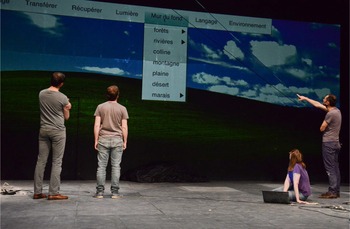
The individuals transform their world (Antoine Defoort, Halory Goerger, Ondine Cloez, Arnaud Boulogne). Germinal in La Raffinerie, Bruxelles, Kunstenfestivaldesarts, 2015. (Photo by Bea Borgers; courtesy of Antoine Defoort and Halory Goerger)

The End
This is how Germinal ends: from a packing peanut–filled hole in the middle of a mostly empty stage, four “individuals” sit and contemplate their finiteness (Defoort and Goerger Reference Defoort and Goerger2012). Over the course of roughly an hour, they have attempted to create what they call “a series of events answering to coherence criteria regarding space and time.”Footnote 3 With the help of a computer, some microphones, and a guitar, and in the absence of any sort of individual or collective history, they’ve progressed from communicating wordlessly by projecting their thoughts onto panels hanging at the back of the stage to developing the capacity to speak in multiple languages. They have explored their surroundings, discovering the possibility of altering them by ripping up the stage floor, pulling down curtains, or using the computer to make a picture of trees or a swamp appear on the now-bare back wall. All of this happens with little conflict, minimal affect, some light philosophizing, and only one brief, accidental, and, as it turns out, prohibited encounter with a “customer service representative” they contact using a telephone just outside of the stage door.
The world of Germinal is, as the title suggests, in its earliest stage of development, and as these protohumans (who, nevertheless, look and act like ordinary, young, casually dressed white people) explore and transform their surroundings, they acquire language, experience emotional states, and try to categorize all of the objects in their small universe based on whether or not they go “poc poc” when tapped with a microphone. An hour in, they have decided to occupy the “swamp” that they’ve discovered underneath the floorboards (the aforementioned Styrofoam-filled hole) and it is while here that they use the “manual” (a laptop computer) to project onto the back wall a diagram of their progress thus far in creating their “series of events.” First they scroll backwards through the diagram until they arrive at the word BLACK and conclude that this must have been their beginning. Then they scroll forwards to the present, and after a brief debate over whether or not it would even be possible to scroll into the future, they do so, only to find the word END. A little freaked out (though really only a little: “What’s the deal with this end thing now?” asks Halory), they quickly scroll back to the present and consider the implications of what they’ve just seen.
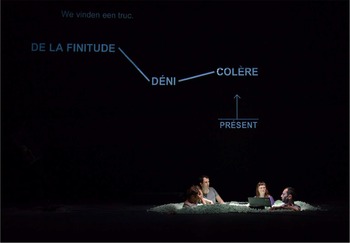
This sudden reversal of fortune — a metatheatrical peripeteia — is attended, as such instances often are, by a recognition of that reversal. However, unlike your typical Aristotelian protagonists, what the individuals discover is, simply, that they exist according to theatrical logic: that the play or performance of which they are a part — and indeed, apart from which they have no existence — will shortly end. To move forward, to pursue their singular goal of creating a series of events with coherence in regards to space and time, will result in their extratheatrical annihilation. And yet, after a quick progression through the stages of grief, the individuals conclude that they can only create a “coherent” series of events if the series is limited in time, and so they decide to accept the inevitability of conclusion and create the final “event.” They execute their plan without much discussion, though they do agree on the need to be “solemn.” Using the objects they’ve found in the swamp, and activating various lighting and sound effects using the manual/computer (“celebration mode” and “super weird” are two), they sing and play along as the diagram of events scrolls across the back wall. The swirling lights and simple harmonies produce a surprisingly affecting musical finale, until the word END arrives on the screen and the lights go out.
The individuals discover their finitude, review the events that led them to this present, and then work through the seven stages of grief (Arnaud Boulogne, Antoine Defoort, Halory Goerger, Ondine Cloez). Germinal in La Raffinerie, Bruxelles, Kunstenfestivaldesarts, 2015. (Photo by Bea Borgers; courtesy of Antoine Defoort and Halory Goerger)

Germinal renders the human condition, the experience of mortality, not through theatre but as it. There is literally no other content — the individuals’ efforts to construct a series of events do not involve imagining any narrative that presumes a place or time that is not this stage; there are no people who are not simply these people, no space that is not simply this space. If Pirandello’s Six Characters in Search of an Author (1921) seek a playwright to finish their story, or Prospero seeks to be released by our applause, Germinal’s individuals need no such things — they are not characters and they have no fiction. They are not so much metatheatrical as hypertheatrical. That they so readily concede their finiteness indexes the relative simplicity of their world, and it is precisely in the absence of any other explicit content that the performance can reflect a basic truth about human existence: we have to find something to do, and then try to do it within the time we are given. Of course, we’ve seen this before — what are Beckett’s characters if not similarly (and metatheatrically) preoccupied with making meaning before the clock runs out? Yet in Beckett, it seems, the clock never will, and this is precisely the point — if metatheatricality is a consistent feature of the Western theatrical tradition, what changes is not the theatre itself but rather the world that theatre is meant to refract and represent through the rupture of the theatrical frame. Regardless of the intentions of any particular author, metatheatricality in contemporary theatre, and particularly what I’ve called hypertheatricality, reveals a world that expires. The impasse, in turn, arises from this looming expiration, as the place where its terms can be encountered and worked out, though not denied. In Germinal, the individuals’ efforts to make the end as interesting as possible seems to be precisely the sort of improvisational play that Berlant imagines the impasse might precipitate. Instead of clinging to the fantasy of futurity and simply going through the motions, they inadvertently make for themselves a bit more time by engaging in an act of meaning-making. Critically, they do not make time in order to keep making time; they cannot make meaning except by conceding the end.
An awareness of impending conclusion also shapes our experience as spectators (of Germinal or anything else), insofar as we use the fact of an ending to make sense of what we’re witnessing in the present. At the very least, we use this fact to make sense of our own presence at the theatre, and to distinguish it from the presence of the performance. Though the end is not, in many respects, our own, we rarely resist its reality. We clap for the actors; we leave. We don’t generally insist or assume that, were we to sneak up and look behind the curtain, we’d find the characters still there, getting on with their lives. This is, arguably, why efforts to respond to the stark realities of climate change have proven so inadequate. The sense of an ending remains unreal — especially, and perhaps only, to those of us who have the privilege of as-yet remaining largely untouched by its effects. In “The Last Act of the Human Comedy,” a 2019 article for the now-defunct website Truthdig, author and activist Chris Hedges charges “hope” with foreshortening our response to the climate crisis (Hedges Reference Hedges2019). Though he does not make too much of his title’s reference to theatre, Hedges nevertheless calls on his reader to confront something very theatrical indeed: the inevitability of “the end.” After a brief summary of our present state — “the familiar disease of the end of a civilization” — he concludes that, “The only existential question left is how we will choose to wait out the finale.” Critically, Hedges’s point should not be misread as fatalism or defeatism, and he himself remains active in the climate justice movement.Footnote 4 Far from suggesting that we do nothing in the face of crisis, Hedges proposes that we give up on “hope” in order to “live fully,” by “summoning the courage to confront the starkness of the human condition and demanding justice” (2019). Even if we were suddenly to develop the political will to implement the most aggressive climate policies, the effects of -climate change will still produce what remain at present unthinkable levels of upheaval, including social collapse, mass migration, and mass death.
It is also by giving up “hope” that those of us who remain untouched by the worst effects of climate change might more closely ally with and support communities globally that are already experiencing these effects. The orientation towards hope depends upon privileging a sense not simply of remaining time but of time as a renewable resource; an unexamined futurity prioritizes sustaining or extending the present in its current form, and necessarily makes any efforts to address injustices that already exist within that present a secondary consideration at best. This logic prevents or covers over the experience of “disturbance” that, for Berlant, might hold “the present open to attention and unpredicted exchange” (199). In Germinal, the initial desire to avoid an end point is revealed as precisely that which would prevent the individuals from achieving their singular goal. Their recognition — not of their fate, but of the way in which that fate structures their relation to the present — is nothing if not an impasse, a “delay that demands activity.” What this suggests is that, by precluding a productive confrontation with the ongoingness of social collapse, “hope” effects a distinctly theatrical failure. The absence of an ending matters because it is only in recognizing “the end” that the possibilities of “reversal” — so central to Western dramatic structure — become available. Critically, I do not mean “reversal” in the sense that we can “reverse” the effects of climate change, but simply as a turning point, a “veering around,” in S.H. Butcher’s translation of Aristotle ([1895] Reference Butcher1902:41). We become aware of moving in “the same space,” and the reversal affords the possibility of incorporating new information into an “extended now,” the “parameters” of which are “always there for debate” (Berlant Reference Berlant2011:4). No future is promised; the fantasy of the good life — or hope, or sustainability — must be relinquished in the interest of “unpredicted exchange” (199).
Suddenness, then, appears historically as a theatrical imperative, the absence of which makes room for “hope,” as a willful misrecognition of our place in the plot: we have not yet reached the point at which we must radically reassess the conditions in which we exist. And indeed we will not. Messengers arrive daily with new data, projections, images of wildfires and floods. But none effect the recognition we require, the definitive singularity that reveals the fate of Thebes as a prophecy fulfilled. Yet by following Hedges in acknowledging an end point, we might displace our seeming dependence upon the sudden and the singular, and so reverse-engineer the reversal, so to speak. Beginning with the end and recognizing, in the process, the ongoingness of the present interval, we become capable of perceiving its paradoxical “unbounded temporality” (Berlant Reference Berlant2011:199). If the end is in sight, then we have reached the turning point; we no longer have to wonder when it will come. From this other vantage point, after we’ve “turned,” we would see the nonsingularity of crisis, its varied effects and meanings, the diverse tactics of coping that index the inadequacy of “hope”; we may become a part of a “precarious public sphere,” trading “paradigms for how best to live on, considering” (3). Considering, that is, that we may well be approaching the end.
If in Germinal the individuals manage quickly to adapt to their inevitable ending, it is because they have no historical context in need of resolution. There are no persistent conditions of injustice that need to be addressed. They are on equal footing with each other, equally new to the world and equal participants in its construction and conclusion. The same obviously cannot be said of our current condition, or our state(s) of crisis. One need only consider, within the US especially, the debates surrounding the climate movement’s pivot (or lack thereof) to address the renewed fight for Black lives that has stormed onto the scene, in the midst of a pandemic. The question of the order of concerns, their relative urgency, has challenged climate activists, in particular the white ones, to frame the issue with reference to its intersection with racism. Much of the climate movement has or had already recognized, and foregrounded, the outsized impact of the climate crisis not only on poorer countries, but on Indigenous communities and communities of color within wealthier countries as well. Nevertheless the debate on this latter point has, in some circles, been framed as whether to argue, simplistically, that the task of climate activism is to make possible a future in which other concerns can be redressed, and that therefore the climate crisis should remain the primary focus of social justice activists, OR to recognize the urgency and legitimacy of liberation movements as entitled to unqualified, immediate attention and effort.Footnote 5 Though the former position has become increasingly untenable insofar as it fails to acknowledge the structural codependency of environmental and human exploitation, its underlying logic continues to encourage, culturally and politically, that we depend upon the existence of the future in order to make sense in and of the present. Yet we know from the science, however conservatively it is read, that we have set in motion changes that we may or may not be able to manage or mitigate; we cannot be certain of any particular future. We can, however, refuse to make the fight for justice contingent upon the premise of that future’s arrival.
The Excess
If theatre hurtles us always towards the end of the/a world, it does not, for that reason, skimp on the costs associated with world-building. Consider the relationship between finitude and labor that theatre represents, the very condition confronting Germinal’s individuals: inevitable, near-term annihilation is not the basis for an argument against expenditure; indeed, it becomes, in Germinal, an argument in its favor. Insofar as theatre nearly always involves devoting resources, human and otherwise, to creating a world that only ever briefly exists, there might be something to gain in marking that expenditure as excessive in the sense that Stoekl proposes — as working against a logic and rhetoric of austerity and sustainability that has so far failed to produce any coherent or adequate response to the present and future effects of resource depletion and climate change.
With theatre’s inherent excess and Stoekl’s “orgiastic recycling” in mind, I return now to Pursuit of Happiness, and its elaborate, exhaustive screenplay/square dance. As mentioned previously, the screenplay/square dance comprises the second “part” of Pursuit. While the screenplay narration transports us to an active war zone somewhere near Baghdad, the scene’s physical backdrop remains the old-timey saloon that frames the first part of the performance. A long wooden bar stretches the length of the stage, and as the show opens a bartender at one end and a cowboy at the other wordlessly sling a glass back and forth with such velocity that only a fraction of each refill makes it to its destination. Other cowboys and womenfolk, attired in varying degrees of caricatured dress, enter and mingle, regarding each other with more or less suspicion and revealing one or a couple missing teeth. The dialogue (which is in English), when it finally begins, is delivered in a loud, heavily accented deadpan, a kind of Eastern -European–inflected Southern drawl. The exaggerated enunciation and flat delivery collide with the scene. One woman discusses her divorce, another her inability to get away from her father, even in her dreams, a third her feeling that euthanizing a horse with a broken leg right there on the racetrack is “beyond barbarous” (Copper and Liska Reference Copper and Liska2016:5). Two of the men contemplate the meaning of happiness, noting the absurdity of “making art” (8). The bartender remains silent. The conversations are sustained even as those having them engage in acts of cartoonish violence, punctuated by precisely timed but altogether ridiculous Batman-style sound effects — punches are thrown, people are tossed across tables, guns go off. With each entrance and exit, the swinging saloon doors produce impossibly loud squeaks and slams.
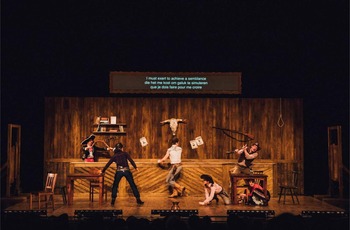
Articulating the conditions of crisis ordinariness, from within an explosion of the Western movie genre (Bence Mezei, Ana Štefanec Knez, Jeffrey Schoenaers, Luke Thomas Dunne, Ida Hellsten, Rada Kovačević). Pursuit of Happiness, Nature Theater of Oklahoma and the EN-KNAP Group, Schouwburg Kortrijk, Belgium, 2018. (Photo by Jonas Verbeke)

It is almost too easy to read Pursuit of Happiness as an illustration of Berlant’s “impasse,” to the extent that its characters articulate the conditions of crisis ordinariness from within an explosion of the “Western” — a genre associated with a now-mythic figure whose existence is premised upon the possibility and promise of unbridled territorial expansion and genocidal violence. This is true as well of the performance’s second part, which again laminates an existential crisis — the dance company that retreats to the shadows in order to make work that can do something — onto an exaggerated representation of an already bombastic genre: the war movie. While compelling, such a reading fails to account for the experience of being present at the performance, in which case the audience is confronted, in every moment, with incredible levels of exertion. Significantly, this exertion is directed entirely towards execution rather than generation, as we do not see anyone, ever, actor or character, struggle to find the right words, the right step, the right gesture. This reflects and amplifies what is, as it turns out, true about the process of creating the work: that it proceeded by finding ways to demand ever more energy and effort of its performers, deliberately requiring the cultivation of skills they did not already have. In parallel interviews for FringeArts.com (the website of the Philadelphia Fringe Festival, which presented the performance I attended), NTOK’s coartistic director Kelly Copper and EN-KNAP member Bence Mezei each discussed the challenges the process posed. Copper notes that while none of the dancers had spoken onstage before, at a certain point in the development of the piece, “the performers were getting too good at speaking the text” (FringeArts 2019a). So she and coartistic director Pavol Liska “asked them to speak in a southern accent and chew tobacco.” Mezei describes how, in the long interim between their first and second meetings with Copper and Liska, the dancers would hold “speech nights”: “we would all pick a monologue or some fragment from a play or film, memorise it and perform it to each other for fun and further practice. At times, also, we would meet up and read to each other out loud to strengthen our voices” (FringeArts 2019b). The labor that went into preparing vocally to perform manifests not only as the ability to perform, but as the performance itself.
If it seems like I am simply pointing to an extreme version of a truth about theatre and, say, actor training generally, that is precisely my point. What Pursuit makes apparent is a feature of theatre: theatre proceeds against a logic of efficiency and necessity, most notably in its requirement that people who are not one thing learn how to look and sound like that thing. Pursuit compounds this excessive expenditure, offering us dancers who’ve become actors who become characters. The production’s preoccupation with this kind of overspending of effort manifests in the second part of the performance as well, in the extended dance routine and emphatic narration that provoked the temporal disorientation I described earlier. The transition to the second part of Pursuit comes when the bartender, played by Mezei (who has been silent up to this point), abruptly asks if he can get some “constructive feedback on ideas [he’s] been working with in the screenplay [he’s] writing” (Copper and Liska Reference Copper and Liska2016:11). No one gives any kind of consent, verbal or otherwise, which he takes to mean that they are “all in.” Shortly thereafter, the dancing begins. The level of precision is staggering, particularly because the routine feels like an improvisational response to Mezei’s request. It clearly isn’t actually improvisational, but it gestures towards improvisation, in the use and reuse of a set of terms to construct ever more elaborate configurations and maneuvers, complimenting a narrative that, in theory, the dancers are encountering for the first time. In its absurd transposition of bodies and objects, and their deliberate contradiction with the events described — a square dance is meant to stop bullets, a Red Bull™ delivery van is the only safe vehicle for traversing the war zone — we encounter an incredible inventiveness that is simultaneously inadequate and inappropriate. The film the screenplay portends remains to be made, and the medium of theatre and dance is ill-disposed to realize the events described. What are we doing here? This cannot be the screenplay; it does not want to be the screenplay. The screenplay becomes a genre with which to play, a basis for ceaseless activity, a logic of world-making expenditure unto itself.
A dancer-actor-cowboy-soldier shoot-out (Luke Thomas Dunne, Ida Hellsten, Bence Mezei, Ana Štefanec Knez, Jeffrey Schoenaers, Rada Kovačević). Pursuit of Happiness, Nature Theater of Oklahoma and the EN-KNAP Group, Schouwburg Kortrijk, Belgium, 2018. (Photo by Jonas Verbeke)

Theatre, then, appears here as the “general economy” Stoekl, after Bataille, describes, and its profligate spending of the human capacity to make and unmake worlds (2007:144). In Pursuit, this “spending” is at once on the level of form and content, as it laboriously “recycles” objects and bodies and genres, into ever more elaborate configurations, producing these seemingly as an “unplanned aftereffect of the tendency to expend” (144). Stoekl links this kind of recycling (which he suggests is also a kind of “trashing”) to a “blind spending of the intimate world,” in which conservation is inseparable from expenditure: “we conserve in order to spend, gloriously, just as the worker (according to Bataille), unlike the bourgeois, works in order to have money to blow” (144). Against a logic of sustainability that clings to the genre of the good life and so fails to recognize the sacred function of expenditure, Stoekl posits postsustainability: “the revelation of the finitude, the depletion, of the calculable world” — what I have simply called “the end” — as “the blowout at the summit of a reason through which society has tried to organize itself” (144). Pursuit seems to imagine this “blowout,” showing us what it might look like to build something out of the exploded remains of Western society’s efforts to organize itself. Here is a world in which the right tool is never at hand and so human energy must take its place. All is reused, but in order to spend, and what counts, in Stoekl’s words, “is how one spends, not what one hopes to accomplish by it” (141). This is one way of reading the performance’s genre trouble, its Western as screenplay as square dance as floorshow as action movie as theatre. It “spends” these genres freely, seemingly against the intentions of Bence, the bartender, who just wants to sell us his screenplay. This is a “gifting” that escapes his best efforts at normal, monetary exchange and instead “opens another economy and another ethics” (141). When Bence concludes his screenplay treatment with an appeal to us as potential investors, the absurdity of his invitation, and the impossibility of our acceptance, marks the performance’s refusal to be sustained on terms that are not its own.
The Spectator
If, as I have been arguing, theatre offers a model for being-in-crisis, we might ask whether the spectator poses something of a problem in relation to my premise. Isn’t the implied passivity of watching, waiting for someone else to take action, what got us into this situation in the first place? It is in addressing this point that I turn to Jackie Sibblies Drury’s play Fairview. Like Germinal and Pursuit, Fairview self-consciously stages theatrical labor as necessary excess, and flaunts its expenditure within a now that refuses any promise of futurity. At the same time, its particular contribution to the argument I am advancing here is that Fairview’s turning point — its reversal — is not only dramaturgical but also physically articulated by the body of the white spectator, which is to say, the spectator historically implicated in the production of a crisis that they acknowledge exists, but which they fundamentally fail and/or refuse to grasp in the fullness of its implications. In Fairview, quite literally, at the end of the play, the white spectator is called upon to veer around, to move from the seat they occupy and climb the steps to the stage, turning to look out at the place they no longer are and yet which, in another sense, they have not really left.
What the spectator is to have witnessed prior to this point in the play is somewhat more difficult to describe, but an overview is necessary in order to situate the significance of Fairview relative to my argument, and also to give some indication of its ingenuity.Footnote 6 At the outset, Fairview appears to offer its audience a familiar theatrical world, populated by a middle/upper-class Black family. It’s Mama’s birthday, and her daughter Beverly is anxiously making all the necessary preparations. While Mama rests, unseen, upstairs in her room, we meet Beverly’s husband Dayton, her sister Jasmine, and her daughter Keisha. Eventually, after a series of minor mishaps that culminate in a burnt cake, Beverly faints, still holding the carrots she’s been trying to chop since the play began. This is, the script tells me, the end of act 1. Act 2 is -identical to act 1, beginning and proceeding in exactly the same way, except that now the lines are only mouthed, not spoken aloud, and the action is overlaid with the voices of other people who seem to be somewhere else holding an unrelated conversation. Two of the voices, Suze and Jimbo, whose whiteness quickly becomes apparent, discuss which race they’d like to be and why, in terms that range, in the manner of their offensiveness, from spectacular and aggressive to oblivious and banal. Eventually a third white voice joins the conversation, and then a fourth. For quite a while the play sustains the impression that the people behind the voices are not connected, except by the viewer or reader, to the scene playing out onstage.Footnote 7 Then, just as Mack is elaborating on the premise that “maybe you’d have to be poor / if you wanted to be a black man, / but if you wanted to be a black woman you could be like… / a fabulous entertainer” he breaks off and says simply “Like look at the way they talk to each other” (Drury Reference Drury2019:56). He is referring to Beverly and Jasmine. The four voices continue their conversation, with intermittent reference to the scene playing out onstage. We reach, again, the conclusion of act 1, when Beverly (again) faints, but this time the action continues; Beverly is revived, and over the course of the next few pages, the family waves away the smoke and pulls together the party. As the family dances and sets the table, Jimbo, the most openly racist of the voices, delivers a lengthy, violent monologue that concludes with “I’M TALKING TO YOU FUCKERS. DO YOU KNOW WHAT I FUCKING MEAN????!!” (73).
It seems reasonable to assume that his question might be directed at the audience, in addition to the family onstage. This is not the first clue we’ve had that we might be present in this world in some way, rather than merely witnesses to it. In reading the play, these clues come in the form of stage directions that seem at pains to emphasize the world’s theatricality. In act 1, “Beverly is peeling carrots, real carrots,” and then “does that thing: she looks at herself in a pretend mirror hung on the fourth wall” (7, 8). Later, in act 2, as they set the table, the pretend food gets “stranger and stranger, in different ways, some of it is faker and some of it is less food-like” (78). When the family sits down to dinner, “They pretend to eat” (82). In act 2, Keisha “might” check herself in the “pretend mirror hung on the fourth wall and then, she might be able to look through it, and see the audience” (59). Paired with the literal requirement that what has already been performed be performed again, this hypertheatricality marks the world of Fairview as unstable repetition. As in Germinal, the characters must contend with the logical limits of the theatrical frame. At the same time, the contrast and conflict between the highly physical and choreographed labor required to realize act 1/act 2 and the white voices’ lack of physical presence might productively be read as representing the “wrong” kind of excessive expenditure but by way of the “right” kind of excessive expenditure. Which is to say, in order to represent the destructive excess of white supremacy the play requires a profligate, even -exuberant expenditure of human energy. And yet, critically, that labor is still primarily performed by Black bodies, at once reproducing and representing the failure of white people to spend the energy we’ve stockpiled (and which is largely stolen property in any case) in the service of dismantling white supremacy.
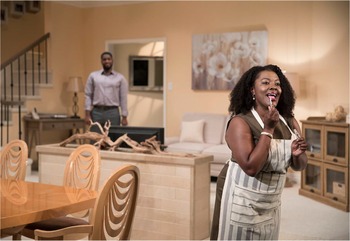
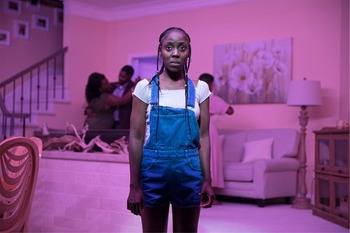
“And then Beverly does that thing: she looks at herself in a pretend mirror hung on the fourth wall. It’s a very normal thing to have happen in a play” (Heather Alicia Simms; background: Charles Browning). Fairview at Soho Rep, New York, 2018. (Photo by Julieta Cervantes)

Keisha (MaYaa Boateng) “might be able to see the audience through the fourth wall” (background: Heather Alicia Simms, Charles Browning, and Roslyn Ruff). Fairview at Soho Rep, New York, 2018. (Photo by Julieta Cervantes)

In act 3 (which is also not act 3, but rather, as the published script explains, “Act Two [pushing] further into Act One and [trying] to drive it forward to make Act Three” [5]) the four voices, now in bodies, enter the play as characters previously referenced by the family, but who have not yet appeared onstage (5). To be clear, the play leans on the theatrical logic that white characters Suze, Jimbo, Mack, and Bets become these Black characters in the world of the play. It is not quite as if they are actors, but rather more like an inverted version of Pirandello’s Six Characters. They are “real people” who have entered a play, rather than characters entering the “real world.” With the exception of Keisha, none of the primary characters (for lack of a better word) register that anything is amiss. Even Keisha, though she looks strangely at her white “grandmother” (Suze), responds “Um. I’m just confused I guess,” when asked by her aunt why she isn’t eating (81). Not long after Suze’s appearance, Jimbo enters as Beverly’s brother Tyrone, Mack as Keisha’s friend Erica, and finally Bets as a more outrageous version of Mama with a “bigger, golder turban” (90). In each case, the theatrical premise is treated as inviolable, even as the new “characters” vamp to entrance music and solicit applause from the audience. Everything these new characters say and do must/can only be true, however much their undermotivated revelations stomp all over what has already been established: Jimbo-as-Tyrone accuses Dayton of gambling away the family home; Mack-as-Erika declares that Dayton has syphilis; Bets-as-Mama calls Beverly a crack addict. The most remarkable instance of this dynamic is when Mack-as-Erica announces that Keisha is pregnant. Earlier it had been implied that Keisha might be hiding a romantic involvement with Erica, but Mack’s decision to use Erica to impose the trope of the Black pregnant teenager on Keisha is unassailable, because it is theatrical. The pregnancy test Mack-as-Erica presents to the family as Keisha’s is positive. Because that is how theatre works.
After Jimbo-as-Tyrone starts a food fight, Keisha and Suze-as-Mama begin to talk and then, the stage directions indicate, “Everything stops or gets let go. All listen to Keisha” (99). Eventually, as she tries to decide what to call Suze — “Not Grandma” — “white” Keisha wonders whether she could ask the white people in the audience to “come up here” (101)? She repeats the question a couple of different ways and then: “Keisha steps through the fourth wall. / It’s as simple as that” (102). In what remains of the play, Keisha talks first to the white spectators, telling them (and also wondering at the fact that she has to tell them) why she wants them to be up on the stage. It is so, she explains, she can be “out down here with all [her] people of color” (104). Her monologue ends with a story for her “colorful people,” “about us, by us, for us, only us,” about a person who tried “many many times” to work hard and do their best, and when they looked around, finally, at what they had built, and what their neighbors had built, “they found all of it, / their view over all of it, / the sum of all of it, / to be fair” (104, 105, 106). Far from the fantasy of the good life, the story’s conclusion represents such a fantasy’s undoing; the repetition and duration of the impasse, marked by the repetition and duration of Keisha’s lines, gives way to a change at the moment that someone “took in the view.” While the story is not, Keisha explains, for the white spectators now onstage, it nevertheless frames their (our) appearance there. She tells the story to the people for whom it is not yet “fair,” as they gaze upon those who have built their own “fantasy of the good life” on the premise that it is.
From the beginning, Fairview tears tiny holes in the fabric of its own reality. When this reality finally collapses, under the spectacular weight of the racist surveillance and white narrative entitlement that it has generated, the characters, critically, do not become not-characters. When Keisha speaks to the audience at the end, she has not ceased to be Keisha. She does not now speak to us as an actor, but rather as a character confronted with the problems of theatricality, which include the problem of being also an actor. Like the “individuals” in Germinal, she responds to a seemingly external force, one usually unseen but that has been permitted, by the vagaries of playwriting, to break through. The fourth wall breaks but it breaks within the world of the play. The tiny holes, then, that the play tears in itself are almost literally the “gestures” Berlant discusses in Cruel Optimism. “The gesture,” she writes, “does not mark time, if time is a movement forward, but makes time, holding the present open to attention and unpredicted change” (Reference Berlant2011:199). The gesture of asking white spectators to come up onstage does not move the white spectator, or anyone else for that matter, forward in time, but holds the present open by tethering it to the “perpetual present” of the play (Wilder [1941] Reference Wilder and Dukore1974:892). Keisha’s story, invoking, as it does, the mythic past of “Once upon a time,” draws attention to its non-futurity, its contingency, not upon a future, but upon redress in the present. This past appears as a way of getting stuck; she searches for a way of proceeding from “Once” (once “there was a bright little girl;” “once, there was a little boy”) before finally conceding “Well, not once, / not at all once. / Many many many many times” (105). The mythic past is revealed as a way of avoiding the present as an ongoing repetition of the past.
Fairview, finally, leads me to propose that it is as spectators that we produce what Berlant calls the “shared historical present” and that we do so by validating the excessive expenditure before us and following its example. When Fairview asks its white spectators to appear onstage, it does so not primarily in order to facilitate individual soul-searching and inner transformation, but so that the play can make use of — which is to say, expend — all available theatrical resources in its effort to represent the intractability of white supremacy, as well as the radical collapse of existing structures that dismantling it will require. The spectator is enlisted in this representation, but remains, critically, its witness. In what we choose to see, what gestures we render legible, we participate in determining the “contents and contours” of the present, signaling “what forces should be considered responsible and what crises urgent” (Berlant Reference Berlant2011:4). Like Fairview, Pursuit and Germinal trace our attention, tracking our expectations and upending them — not so much on the level of plot, but on the level of theatrical possibility. This is, I believe, why it is so difficult to describe them — things just keep happening, as if what came before was not enough. Continually, each of these works seems to ask, what can be spent in service of this world, and why not spend it? By the time this question is offered to us, we are sitting in the darkened house, already implicated in the emphatic answer: “Absolutely no reason at all.” The impasse provides the time and space for working out gestures, means of coping, modes of resistance and refusal. In working them out, again and again, the theatre effects the excessive expenditure Stoekl describes, catching it within the cul-de-sac of the impasse, its illegible gestures prompting the spectator to consider that we may be looking at things all wrong: more energy, rather than less, will be required to account for the present; an ending should be expected, an exit should not; we are our own and only spectators. There is nothing that is not worth expending now.