INTRODUCTION
Micronutrients are needed in very small quantities but they are equally vital for plant to complete and carry out important physiological processes (Imtiaz et al., Reference Imtiaz, Rashid, Khan, Memon and Aslam2010; Mengel, Reference Mengel1980). Application of micronutrients not only increases the grain yield but also the grain micronutrient concentration (Rehman et al., Reference Rehman, Farooq, Nawaz and Ahmad2016). However, every micronutrient has a very narrow range of deficiency and toxicity (Imtiaz et al., Reference Imtiaz, Rashid, Khan, Memon and Aslam2010). Manganese (Mn) is an important micronutrient involved in many physiological processes of plants (Malavolta et al., Reference Malavolta, Vitti and Oliveira1997). Mn in high concentration reduces the availability of other nutrients like iron (Fe), magnesium (Mg), calcium (Ca) and zinc (Zn) (Fageria et al., Reference Fageria, Filhoa, Moreirab and Guimaresa2009). On the other hand, Mn deficiency reduces tillering, impedes root development, causes interveinal chlorosis and may cause P deficiency and Fe toxicity (Alam, Reference Alam1985; Mengel, Reference Mengel1980).
Wheat is staple for about 35% of world population and is highly sensitive to Mn deficiency (Jiang, Reference Jiang2006; Jhanji et al., Reference Jhanji, Sadana, Shankar and Shukla2014). Deficiency of Mn in wheat in alkaline calcareous soils has become a prominent nutritional disorder, where rice–wheat rotation is followed (Jhanji et al., Reference Jhanji, Sadana, Shankar and Shukla2014). Continuous flooding during rice cultivation brings various electrochemical changes, which influence the availability of micronutrients including Mn (Swarup, Reference Swarup1992). In flooded soil, different forms of Mn (MnO, Mn2O and Mn3O4) are reduced to Mn2+ (Ponnamperuma, Reference Ponnamperuma1972). After the cultivation of rice by conventional production system, Mn leaching is responsible for Mn deficiency in wheat (Takkar, Reference Takkar, Nayyar and Sadana1986). Soil Mn concentration ranges from 20 to 3000 mg kg−1 (Lindsay, Reference Lindsay1979). Several factors like soil depth, soil pH, calcareousness, low organic matter, exposed sub-soils and flooding limit the availability of micronutrients (Mengel, Reference Mengel1980). Mn availability is largely dependent on soil pH; as the pH decreases its availability increases, with its concentration decreasing 100 folds with each unit increase in pH (Fageria et al., Reference Fageria, Baligar and Wright1997). Comparison of Mn deficient and Mn sufficient winter and spring wheats showed that plants grown at Mn deficient soils had stunted growth and reduction in absolute dry weight. Mn deficient wheat plants also had low leaf chlorophyll contents, and reduced photosynthetic efficiency (Jiang, Reference Jiang2006).
In the developing countries, more than 2 billion people suffer from micronutrient deficiencies. The world's population is expected to reach about 10 billion by 2050; thus, improved demand for food quantity and quality in near future is obvious. Biofortification aims to provide the higher concentration of micronutrients in the edible plant parts along with improved yields, complementing the traditional cost effective food habits of rural and remote population around the staple cereals (White and Broadley, Reference White and Broadley2005). Biofortified crops have potential to deliver a wide variety of micronutrients such as Fe, Zn, vitamin A and Mn, to people with limited access to diversified nutrient-rich diet (Mayer et al., Reference Mayer, Pfeiffer and Beyer2008). Micronutrient can be applied through foliar spray and seed treatments (seed priming and seed coating) (Rehman et al., Reference Rehman, Farooq, Nawaz and Ahmad2016). Foliar application has been proved ineffective in several crops with high chances of leaf burn. Moreover, plants respond temporarily to foliar application of nutrients (Fageria et al., Reference Fageria, Filhoa, Moreirab and Guimaresa2009). Seed treatments help in the nutrient availability to the plants even under less than optimum conditions (Farooq et al., Reference Farooq, Wahid, Basra, Siddique and Pessarakli2010). Seed priming is an effective approach of nutrient relief to the plants, as in seed priming seeds are soaked in the nutrient solution and these nutrients are taken-up by seeds (Farooq et al., Reference Farooq, Wahid, Basra, Siddique and Pessarakli2010). Seed coating could also be an effective way of nutrient application, which involves the adhering of target nutrients onto the surface of seeds (Farooq et al., Reference Farooq, Wahid and Siddique2012). Coating on seed surface acts as an efficient hauler of any chemical material, which may be beneficial for younger seedling growth (Scott, Reference Scott1989). Coated seeds of barley with P showed poor emergence but later it caused yield gain (Zeļonka et al., Reference Zeļonka, Stramkale and Vikmane2005). Seed pelleting with borax (100 mg kg−1) improved the cowpea grain yield by 37% as compared to untreated seeds (Masuthi et al., Reference Masuthi, Vyakaranahal and Deshpande2009). Boron application through foliar spray and seed priming is also an effective strategy for improving rice yield and quality (Rehman et al., Reference Rehman, Farooq, Nawaz and Ahmad2016).
To best of our knowledge, no study has been conducted to evaluate the potential of Mn application in improving the productivity and grain biofortification of bread wheat. This study was, therefore, carried out to evaluate the potential impact of Mn on the wheat productivity and grain Mn concentration and to find the most economical method of Mn application for improving the productivity and grain Mn concentration in bread wheat.
MATERIALS AND METHODS
Site and soil
This study was comprised of two experiments. The first experiment was conducted at the Agronomic Research Area, University of Agriculture, Faisalabad, Pakistan (31.25 °N, 73.06 °E and 183 m asl), during winter season of 2012–2013. The second experiment was conducted at two different locations viz. Agronomic Research Area, University of Agriculture, Faisalabad, Pakistan during winter season of 2013–2014 and 2014–2015, and at Farmer's field at Bahalike, district Sheikhupura, Pakistan (73.98 °E, 31.7 °N, and 236 m asl), during winter season of 2013–2014. Maximum average air temperature during the course of experimentation was recorded in April, reaching 33.5 °C, 33.2 °C, and 33.2 °C in 2012–2013, 2013–2014 and 2014–2015, respectively. Minimum air temperature of 3.5 °C and 6.1 °C was recorded in January during 2012–2013 and 2013–2014, while 5.9 °C was recorded in December during 2014–2015. Average air temperatures at Faisalabad were 17.6 °C, 21.5 °C, 27.7 °C and 34.5 °C at peak tillering, booting, anthesis and maturity, respectively. At Sheikhupura, average air temperatures at peak tillering, booting, anthesis and maturity were 16.8 °C, 20.5 °C, 26.1 °C and 33.0 °C, respectively. Maximum monthly total rainfall was recorded in February (55.1 mm) during 2012–2013; and in March during 2013–2014 (41.7 mm) and 2014–2015 (67.9 mm).
The soil at district Sheikhupura was clay loam from Bahalike soil series with pH of 7.8, electrical conductivity of 0.53 dS m−1, soil organic matter of 0.40%, total N of 0.32%, available P of 15.5 mg kg−1, exchangeable K of 166 mg kg−1 and Mn of 0.96 mg kg−1 soil. The soil at Faisalabad was sandy loam from Lyallpur series with pH of 7.9, soil organic matter of 0.46%, electrical conductivity of 0.47 dS m−1, total N of 0.28%, available P of 9.98 mg kg−1, exchangeable K of 170 mg kg−1 and Mn of 0.83 mg kg−1 soil.
Plant material
In experiment 1, two wheat (Triticum aestivum L.) cultivars Lasani-2008 and Faisalabad-2008 were sown. In experiment 2, cultivar Faisalabad-2008 was sown at both sites. Seed of these cultivars were provided by the Wheat Research Institute, Ayub Agricultural Research Institute, Faisalabad, Pakistan during each year.
Experimental details
Experiment 1: This experiment was laid out in randomized complete block design (RCBD), in factorial arrangement with three replications having net plot size of 1.8 m × 7 m. It was carried out at Agronomic Research Area, University of Agriculture, Faisalabad, and consisted of two Mn seed priming levels (0.1 and 0.01 M Mn), two Mn seed coating levels (250 and 500 mg Mn kg−1 seeds) and Mn foliar spray (0.75 M Mn).
Experiment 2: This experiment was also laid out in RCBD with three replications having net plot size of 1.8 m × 7 m. The pre-optimized treatments viz. seed priming with 0.1 M Mn solution, seed coating with 250 mg Mn kg−1 seed and foliar application of 0.75 M Mn solution were used as experimental treatments at Faisalabad and Sheikhupura sites.
For seed priming, wheat seeds were soaked in aerated solution of MnSO4 (0.1 M Mn solution) for 12 h keeping seed to solution ratio 1:5 (w/v). During soaking, aeration was provided by an aquarium pump. After removing from the solution, seeds were thoroughly rinsed with water and dried with forced air under shade till original weight. Then seeds were sealed in polythene bags and stored in refrigerator at 4 °C until sowing. For seed coating, sticky slurry was prepared from inert Arabic gum in distilled water. MnSO4 (250 mg Mn kg−1 seed) was adhered to wheat seeds with the help of slurry and allowed to dry under shade. Dry coated seeds were sealed in polythene bags and were stored in refrigerator at 4 °C until sowing. For foliar spray, MnSO4 (0.75 M) solution was prepared in distilled water just before the use. Solution was applied (200 L ha−1) with the help of manual sprayer at tillering (BBHC 23).
Land preparation and crop husbandry
Details on land preparation, sowing time, seed rate, weed control, irrigation, fertilizer and harvesting are given in Supplementary Table S1, available online at https://doi.org/10.1017/S0014479717000369. Urea (46% N), di-ammonium phosphate (18% N, 46% P2O5) and sulphate of potash (50% K2O) were used as the sources of N, P and K, respectively. Whole amount of K and P and one-third of N was applied at the time of seedbed preparation. Remaining N was split into two doses i.e. at tillering and at milking stage.
Evaluations
Number of productive tillers was counted from each unit area in each plot at final harvest. Ten spikes were randomly collected from each experimental unit to calculate the spikelet per spike. Grains per spike were counted from the same spikes after manual threshing. Furthermore, 1000-grain weight and grain yield were recorded with the help of weight balance for each plot. At final harvest, grain samples were collected for Mn analysis. Samples were oven dried after harvesting; and were grinded to pass a 30-mesh screen. One gram of grounded sample was placed in 10 mL mixture of HNO3 and 70% HClO4 (2:1 v/v) in Pyrex digestion flasks overnight. These samples were heated first at 150 °C on a hot plate until the production of red NO2 fumes was ceased, and were moved to 250 °C until the samples were transparent. These digested samples were then transferred to a 50 mL volumetric flask and diluted to 25 mL with distilled water and filtered. The concentration of Mn in grains was determined using atomic absorption spectrophotometer (Prasad et al., Reference Prasad, Shivay, Kumar and Sharma2006).
Economic and marginal analyses
Economic analysis was calculated as the ratio of net benefits to the total cost. To know the comparative net benefits, economic analysis was carried out following CIMMYT (1998). For economic analysis, grain yield and the biological yield was reduced by 10% to get adjusted grain and biological yield. Variable cost included cost of seed priming, and harvesting/threshing costs. Total fixed costs varied with years and this cost included the fertilizer, seed, seedbed preparation, plant protection, irrigation and fertilizers. Net benefits were calculated by subtracting the total cost from gross income per treatments. Likewise, marginal analysis was done for each experiment to know the net marginal benefit.
Data analysis
Data were subjected to the analysis of variance (ANOVA), considering two causes of variation: Mn treatments and cultivars. Least Significance Difference test was used for post-ANOVA mean separation at 5% probability level.
RESULTS
Experiment 1
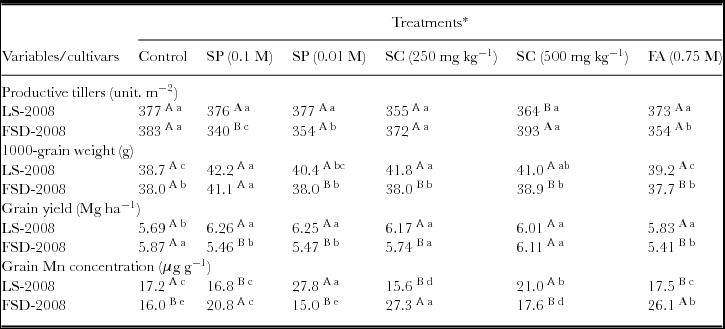
Highest productive tillers were produced with Mn seed coating (500 mg kg−1 seed) in cultivar Faisalabad-2008 while, in cultivar Lasani-2008 the productive tillers were reduced with Mn seed coating (250 mg kg−1 seed) (Table 1). Compared with control, the maximum 1000-seed weight was recorded with seed priming at 0.1 M Mn in both wheat cultivars (Table 1). Maximum grain yield was recorded in cultivar Lasani-2008 when Mn was supplied through seed priming at 0.1 and 0.01 M Mn solution whereas, in cultivar Faisalabad-2008 Mn foliar application reduced the grain yield as compared to control (Table 1). Highest grain Mn concentration was recorded with Mn seed priming at 0.01 M Mn solution in cultivar Lasani-2008 while, in cultivar Faisalabad-2008 Mn seed coating (250 mg kg−1 seed) was best (Table 1). In case of cultivars, 1000-seed weight and grain yield was more in cultivar Lasani-2008, while productive tillers and grain Mn concentration was higher in cultivar Faisalabad-2008 (Table 1).
Influence of manganese application on grain yield, related traits and grain Mn concentration of two wheat cultivars at Faisalabad during year 2012–2013.

*SP= Seed priming with Mn; SC= Seed coating with Mn; FA= Foliar application of Mn; LS-2008= Lasani-2008; FSD-2008= Faisalabad-2008. Different capital letters represent statistical difference between cultivars (P < 0.05), whereas different small letters mean statistical differences among treatments (P < 0.05).
Experiment 2
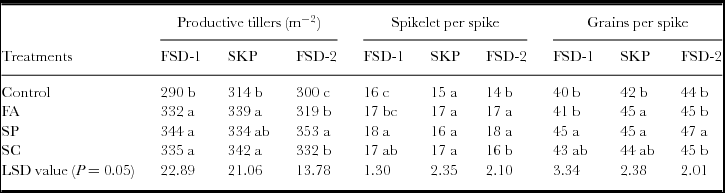
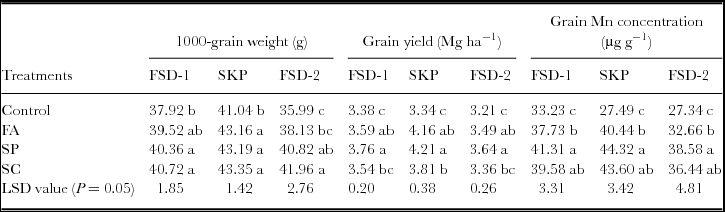
Manganese application significantly affected the productive tillers, spikelet per spike, grains per spike, 1000-grain weight, grain yield and grain Mn concentration of wheat at Faisalabad and Sheikhupura site during both years (Tables 2 and 3). At FSD-1 site, all the Mn application treatments were equally effective in improving the number of productive tillers as compared to the control (Table 2). At SKP site, highest number of productive tillers (342 m−2) was observed when Mn was applied through seed coating and foliar application (Table 2). At FSD-2, maximum number of productive tillers (353 m−2) were recorded when Mn was applied through seed priming (Table 2). At FSD-1, maximum spikelet per spike (18) was recorded with Mn seed priming followed by Mn seed coating. At FSD-2, spikelet per spike was maximum (17 and 18) when Mn was applied through foliar and seed priming technique. However, there was no effect of Mn application through either method on spikelets per spike at SKP site (Table 2). At FSD-1, grains per spike were maximum with Mn application through seed priming followed by seed coating (Table 2). At SKP site, Mn application through foliar and seed priming techniques caused higher number of grains per spike (Table 2). At FSD-2 site, maximum grains per spike was recorded when Mn was applied through seed priming (Table 2). At FSD-1 site, the highest 1000-grain weight (40.72 g) was noted with Mn seed coating and Mn seed priming (Table 3). At SKP site, all Mn application methods were equally effective for improving 1000-grain weight than control. The highest 1000-grain weight was recorded with Mn seed coating followed by Mn seed priming at FSD-2 site (Table 3). The highest grain yield at all sites was recorded with Mn seed priming (0.1 M Mn) followed by Mn foliar application (Table 3). Moreover, the highest grain Mn concentration at all sites was noted with Mn seed priming, followed by Mn seed coating (Table 3).
Influence of manganese application on productive tillers, spikelets per spike and grains per spike of wheat at different locations.

FSD-1= Faisalabad site during 2013–2014; SKP= Sheikhupura site during 2013–2014; FSD-2= Faisalabad site during 2014–2015; SA= Soil application; FA= Foliar application; SP= Seed priming with Mn; SC= Seed coating; Means sharing the same case letter, for a parameter, do not differ significantly at P ≤ 0.05.
Influence of manganese application on grain weight, grain yield and grain Mn concentration of wheat at different locations.

FSD-1= Faisalabad site during 2013–2014; SKP= Sheikhupura site during 2013–2014; FSD-2= Faisalabad site during 2014–2015; SA= Soil application; FA= Foliar application; SP= Seed priming with Mn; SC= Seed coating; Means sharing the same case letter, for a parameter, do not differ significantly at P ≤ 0.05.
Economic and marginal analyses
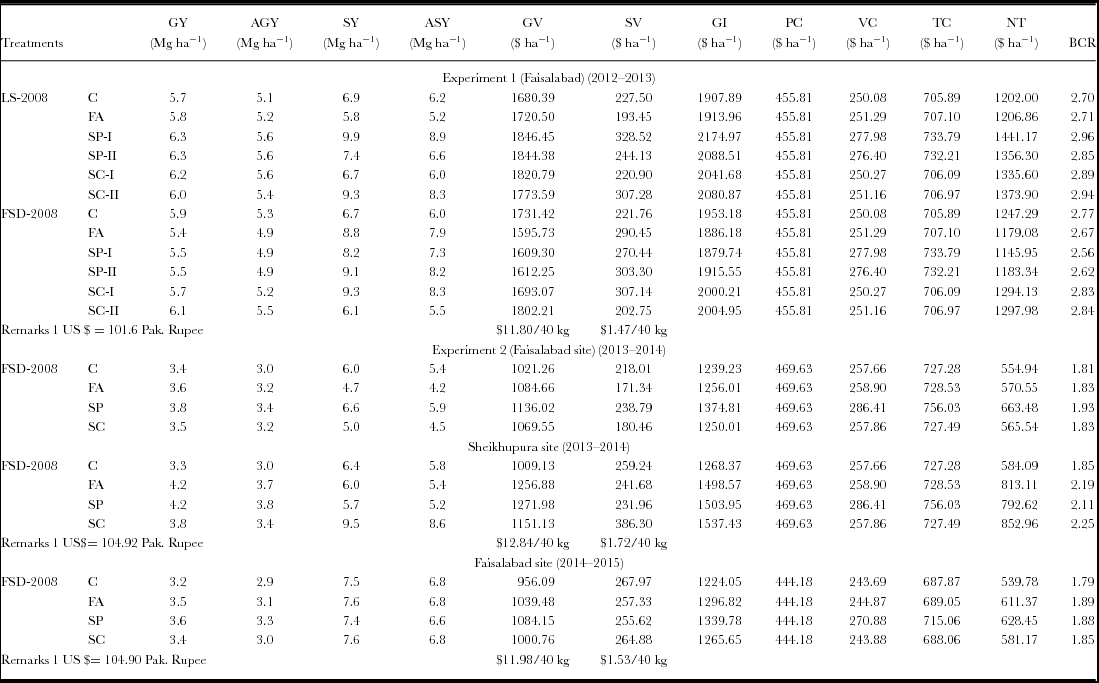
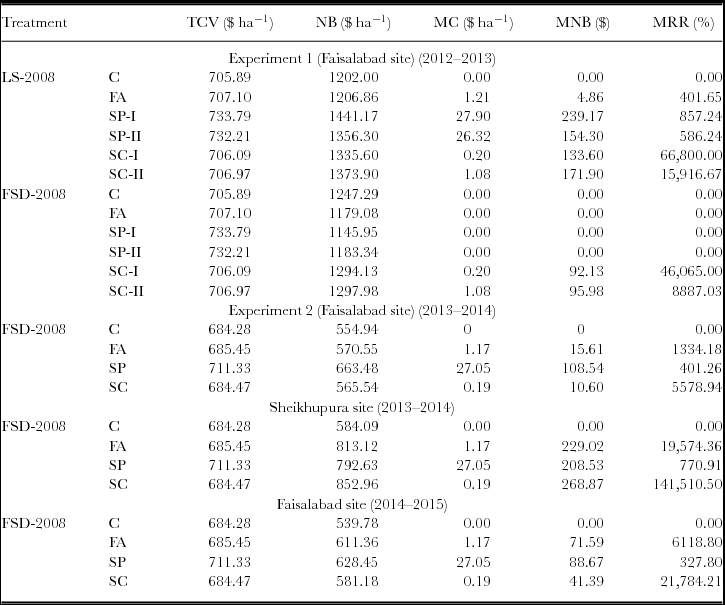
In the experiment 1, the maximum net benefit and benefit cost ratio were obtained with Mn seed priming (0.01 M Mn) for cultivar Lasani-2008 and with Mn seed coating (500 mg kg−1 seed) for cultivar Faisalabad-2008 (Table 4). However, the maximum marginal rate of return was produced through Mn seed coating with 250 mg kg−1 for both cultivars (Table 5). In the experiment 2, the maximum net benefit and benefit cost ratio at Faisalabad site during 2013–2014 and 2014–2015 were obtained through Mn seed priming (0.01 M Mn). At Sheikhupura, the highest net benefit and benefit cost ratio were obtained with Mn seed coating (250 mg kg−1 seed) (Table 4). The maximum marginal rate of return was noted from Mn seed coating (250 mg kg−1 seed), regardless site and season (Table 5).
Economic analysis for the influence of manganese application in wheat.

GY= Grain yield; AGY= Adjusted grain yield; SY= Straw yield; ASY= Adjusted straw yield; GV= Grain value; SV= Straw value; GI= Gross income; PC=Permanent cost; VC=Variable cost; TC=Total cost; NT= Net benefit; BCR= Benefit-cost ratio; C = Control; SP-I = 0.1 M; SP-II = 0.01 M; SC-I= 250 mg kg−1 seed; SC-II = 500 mg kg−1 seed; LA = Lasani-2008; FSD = Faisalabad-2008; SA = Soil application of Mn; FA = Foliar application of Mn; SP = Seed priming; SC = Seed coating with Mn.
Marginal analysis for the influence of manganese application in wheat.

TCV= Total cost that varies; NT= Net benefit; MC= Marginal cost; MNB= Marginal net benefit; MRR= Marginal rate of return; C = Control; SP-I = 0.1 M; SP-II = 0.01 M; SC-I = 250 mg kg−1 seed; SC-II = 500 mg kg-1 seed; LS-2008 = Lasani-2008; FSD-2008 = Faisalabad-2008; SA = Soil application of Mn, FA = Foliar application of Mn; SP = Seed priming with Mn; SC = Seed coating with Mn.
DISCUSSION
Manganese application at pre-optimized rates significantly improved the grain yield and yield related traits of wheat (Tables 1–3). Manganese seed treatments were optimized in the first experiment and then the optimized treatments were used in further experiments. It is well documented that the deficiency of Mn causes poor anther development, pollen infertility and reduction in assimilate supply, resulting in poor grain setting and yield reduction (Longnecker et al., Reference Longnecker, Marcar and Graham1991). In addition to its biological role in plants, Mn is absolutely required for photosynthesis. Without this element, photosynthesis cannot be carried out as Mn is the central part of the oxygen evolving complex at photosystem II (Malavolta et al., Reference Malavolta, Vitti and Oliveira1997). In fact, adequate supply of Mn improved the grain yield (Tables 1 and 3) through better fertilization, grain setting and assimilate supply (Longnecker et al., Reference Longnecker, Marcar and Graham1991).
Manganese availability to plants is controlled by its concentration in soil solution, which depends on the chemistry of the soil matrix and Mn forms (Uren, Reference Uren1989). Mn in soil solution, generally a very small proportion of total soil Mn, exists in equilibrium with mineral forms and with organically complexed and exchangeable Mn. However, supplementation may increase the uptake and availability to plants (Rehman et al., Reference Rehman, Farooq, Nawaz and Ahmad2016). Wheat yield at FSD site was lower as compared to SKP site (Table 3), and this was likely caused by high air temperature at FSD site for flowering (27.7 °C) and fruiting stage (34.5 °C) compared with SKP site for fruiting (26.1 °C) and fruiting (33.0 °C), respectively. However, maximum average air temperature was 34 °C and 33 °C at FSD and SKP site, respectively. In fact, high air temperature during reproductive and grain filling phases strongly suppress the grain filling (Farooq et al., Reference Farooq, Bramley, Palta and Siddique2011), especially in wheat (Nawaz et al., Reference Nawaz, Farooq, Cheema and Wahid2013).
Manganese nutrition is crucial for human health as well. As wheat is a leading staple, grain biofortification is an effective and economical way for improving Mn supply to human nutrition. In addition to improvement in grain yield, Mn application also improved the grain Mn concentration (Tables 1 and 3). This indicates that agronomic biofortification is a cost effective and safe technique of micronutrient supply through edible grains. Grain Mn concentration depends on the amount taken up by roots during grain development and partitioning to grain. The amount remobilized via phloem depends on the phloem mobility of the element and Mn has low phloem mobility and depends on the plant developmental stage and supply through xylem (Page and Feller, Reference Page and Feller2005).
Although Mn application, by either way, improved the net income and benefit:cost at both experimental sites during both growing seasons, Mn seed priming and seed coating were the most cost effective treatments (Table 5). Nonetheless, marginal analysis indicated that seed coating is the most profitable mode of Mn application with the maximum marginal rate of return as only small amount of Mn, with quite low cost, is required for seed coating (Table 5). Interestingly, Mn delivery as seed treatment was quite effective in regulating plant growth, grain yield and grain biofortification of wheat. In conclusion, Mn application through seed treatment (seed priming and seed coating) was cost-effective for improving the productivity and grain biofortification of bread wheat.
Acknowledgements
We are thankful to the Higher Education Commission of Pakistan for financial support for the study.
SUPPLEMENTARY MATERIAL
To view supplementary material for this article, please visit https://doi.org/10.1017/S0014479717000369