Despite the challenges of analyzing collections that are often plagued by limited contextual information and unknown or biased collection methods, faunal remains housed in museums do offer exciting research possibilities. New theoretical frameworks and interpretations can be tested using the data available from such collections. To this end, a small but significant sample of faunal remains from the 1954–1962 University of California, Los Angeles (UCLA), Cerro Portezuelo excavations are examined in this article. This study forms part of the larger theoretical reach of a collaborative project (Nichols et al. Reference Nichols, Neff and Cowgill2013) comparing the Cerro Portezuelo collections with those from other Basin of Mexico sites, with a particular focus on Late Formative through Postclassic period (ca. 100 b.c. to a.d. 1500) collections from Teotihuacan. While the sample size is too small to make definitive statements, the data do offer pertinent information regarding the types of animal species used by local inhabitants and some of the domestic activities they engaged in using tools made from worked bone. Interestingly, the taxa recovered from Cerro Portezuelo are strikingly similar to the animal remains recovered from Teotihuacan. But there is no evidence that nonlocal meat sources were imported, as seen in Teotihuacan's foreign barrios, or of what might have occurred in the context of highly developed exchange systems (Valadez Azúa Reference Valadez Azúa and Götz2012).
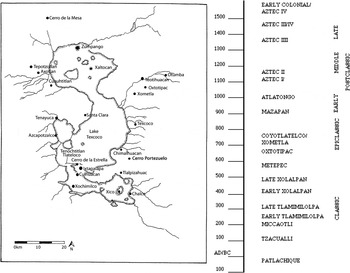
Cerro Portezuelo lies 40 km south of the great city of Teotihuacan, in the eastern Basin of Mexico (Figure 1). The site itself is located in the lower piedmont, in the modern municipality of Chimalhuacan. Occupation at Cerro Portezuelo, today known as Xolhuango, began in the Late Formative period and continued into the sixteenth century (Garraty Reference Garraty2013; Hicks Reference Hicks2013; Nichols et al. Reference Nichols, Neff and Cowgill2013). It became an important regional center in the Epiclassic period (a.d. 600/650−850), which is unusual for having occupations from the Late Formative (400 b.c.−a.d. 100) and Classic (a.d. 200−850) periods, as well as the Epiclassic and Postclassic (a.d. 1000−1500) periods, extending into the sixteenth century. In addition to understanding Cerro Portezuelo's relations with Teotihuacan in the Early Classic period, Deborah Nichols and George Cowgill are also interested in the change to the Postclassic city-state system and the city's relationship to Tula and the Aztec empire, even though Cerro Portezuelo lost its status as an independent city-state capital by the Middle Postclassic period. Thus, Nichols and Cowgill organized a collaborative research team to reexamine collections from this site. While the faunal analysis reported here is an integral part of this larger project, the focus of the present paper is on identifying the types of animal remains recovered from Cerro Portezuelo and the types of household activities residents may have engaged in using tools fashioned from worked bone.
Location of Cerro Portezuelo in the Basin of Mexico and chronology of pre-Hispanic occupation in the Basin.

ARCHAEOLOGY AND ENVIRONMENTAL SETTING
Cerro Portezuelo measures 1.8 km east-west and 1 km north-south, and is located approximately 2,240 m (7,500 feet) asl. During the pre-Columbian era, the Basin of Mexico contained a series of interconnected shallow lakes. Lake Texcoco, the largest lake and the closest to Cerro Portezuelo, was a saltwater lake and thus not suitable for chinampa agriculture (Sanders et al. Reference Sanders, Parsons and Santley1979). Drinking water likely came from the many springs found in the area, which provide potable water for residents of the area even today. The climate is dry, and vegetation, though not abundant, consists mostly of maguey, prickly pear cactus, and kapok trees.
Some of the wild animal species found today in the region include wild rabbits, squirrels, pocket gophers, rats, skunks, chameleons, lizards, snakes, toads, doves, mockingbirds, sparrows, hummingbirds, canaries, and vultures.
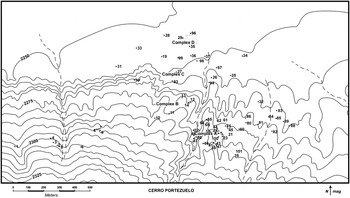
The southern part of the site is on the hill slope and the northern part on a plain. The site has been significantly impacted by the modern growth of Mexico City, although parts of the site are still intact (Nichols et al. Reference Nichols, Neff and Cowgill2013). UCLA researchers began excavations at the site under George Brainerd in 1954. Brainerd's crew dug test pits (usually 2 × 3 m) in different areas of the site and conducted more extensive excavations (5 × 5 m) in places where they encountered complex architecture (Figure 2). Excavations that were expanded to identify architectural features were named “Complexes.” Complexes A and B consisted mostly of Epiclassic platforms with no specific use assigned. Complex C (Trench 93) consisted of a 2m-high Classic period platform, which was used until around a.d. 600. No particular activity could be identified for the structure, but it did include the remains of a simple mural and several burials (Hicks Reference Hicks2005). Complex D (Trenches 35 and 96) revealed the remains of a Late Postclassic residence with Early Postclassic components (Hicks Reference Hicks2013; Nichols et al. Reference Nichols, Neff and Cowgill2013). Brainerd died suddenly in 1956 and Henry B. Nicholson conducted some additional investigations at the site in 1957 and worked with Frederic Hicks to report the findings. In 1961 and 1962, Clement Meighan and Nicholson conducted a surface survey of the site and surrounding areas (Hicks Reference Hicks2005).
The Cerro Portezuelo site, showing the location of numbered excavation units (trenches) and lettered architectural complexes.

ANALYSIS AND DISCUSSION
No comprehensive inventories were completed for the excavated materials during fieldwork or after they were brought to UCLA. Notes indicate that some artifacts were lent to other institutions for analysis. Other materials, including many of the human remains, were stored near the site for future research. Since the excavated soil was not screened, it is difficult to assess what may not have been recovered. However, the collaborative research project led by Cowgill and Nichols has now completed a comprehensive inventory of the collections, permitting better collections management and expanding research possibilities. We may never know what has been lost, but on rare occasions missing materials are found by previous researchers and returned to UCLA for curation and reintegration into the collection.
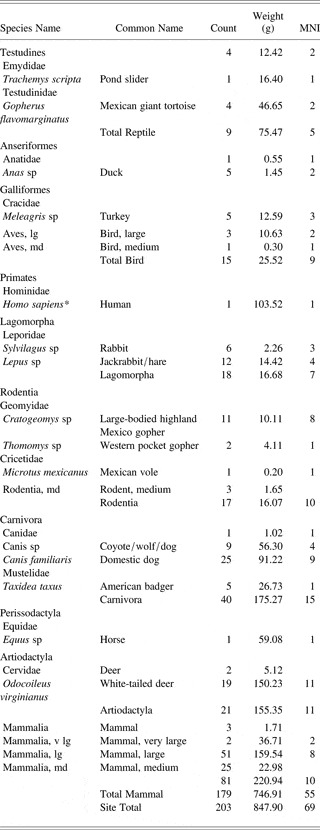
A total of 203 pieces of animal bone were recovered from the Cerro Portezuelo collections, weighing 847.9 g and representing a minimum of 71 individuals (Table 1). Unworked animal bone was not always collected 50 years ago, making it difficult to determine what types of materials were not recovered. Therefore, photographs and excavation notes were used to supplement the contextual information available for the faunal material. Approximately 16 contexts with animal bone were identified in site records but were not represented in the collection. Of the animal bone fragments in the collection, 19 lost their provenience at some point after excavation and could be part of the missing items. Given the small quantity of material that is unaccounted for or lacking contextual information, examination of the materials present in the collections may offer important insight into the types of animal species used at Cerro Portezuelo and the types of domestic activities inhabitants engaged in using worked bone tools. While the sample is small, proportionally it matches other faunal collections found in open sites in the Basin of Mexico (Valadez Azúa Reference Valadez Azúa and Götz2012). Taphonomic factors, like preservation and trash disposal, significantly reduce the amount of bone that may be recovered today from this region.
Vertebrate taxa identified in the animal remains and worked bone recovered from Cerro Portezuelo, Mexico State

*Note: The only human remains included in this study consisted of a single worked human bone. See Spence et al. (Reference Spence, White and Longstaffe2013) for the analysis of the human osteological remains.
Despite these limitations, considerable information can be gleaned from animal bone collections. Judith Porcasi, Mercedes Duque, Thomas Wake, and Wendy Teeter sorted all of the animal bones by vertebrate class. Each class was then identified to the most discrete taxonomic level, noting skeletal element, side, portion, weight, and taphonomic characteristics such as fragmentation, gnawing, burning, cut marks, or any other modification. All bone was identified using the comparative collections located at the Cotsen Institute of Archaeology's (UCLA) Zooarchaeology Lab, which includes a representative sample from the region.
The Cerro Portezuelo vertebrate remains were tabulated using count (number of identified specimens) and minimum number of individuals (MNI). The count includes all identified bone specimens for which a taxonomic category could be assigned. The MNI is the minimum number of individual animals represented in the sample and is calculated based on the greatest number of paired elements from either side (right or left) of a given taxon or of unique skeletal elements represented, whichever is greater. In addition, weight was recorded in grams. Although each of these methods has its inherent biases (see Grayson Reference Grayson1984; Lyman Reference Lyman1994; Ringrose Reference Ringrose1993), together they provide a more balanced representation of the relative abundance of elements in the assemblage.
Reptiles
Of the total elements assigned to a taxonomic group, nine (75.47 g) were identified as tortoise shell (4% of the collection) (Table 1). Four pieces could be further identified as Mexican giant tortoise (Gopherus flavomarginatus), of which two separate individuals could be distinguished. Some 10,000 years ago, the range of this species extended from the Great Plains west to Arizona and south into Mexico. Today, it is restricted to an area of Chihuahua known as Bolsón de Mapimi, where modern inhabitants continue to hunt the species for food, as well as utilizing its shell for a variety of domestic purposes (Enkerlin Reference Enkerlin2006). The four pieces of shell were recovered from Complex D, a Postclassic residential structure. One was quite large and included a plastron fragment (which is the nearly flat part of the shell on the “belly” or ventral surface) with scoring marks, indicating that the shell was likely part of a larger object.
Another plastron element identified to the species belonged to a pond slider (Trachemys scripta), a semiaquatic turtle commonly found in the more humid and hotter regions of the United States and Mexico (Valadez Azúa and Rodríguez Reference Valadez Azúa, Rodríguez and Manzanilla2009). The shell piece was recovered from Pit 7 (Figure 2), which was not dated.
Both species are found in the Valley of Mexico and have been used for food since the Early Classic period (Starbuck Reference Starbuck, de Tapia and Rattray1987). Remains of pond slider turtles have been recovered from Teotihuacan and the surrounding area. These remains included worked pond slider shells and remains recovered in ritual contexts due to the association of this species with water and fertility (Valadez Azúa and Rodríguez Reference Valadez Azúa, Rodríguez and Manzanilla2009:97).
Birds
Identified in the Cerro Portezuelo collections were 15 bird elements (weighing 25.52 g), representing 7% of the faunal material (Table 1). Some elements (n = 4; 10.93 g) could not be distinguished beyond the Aves class. In such cases, items were distinguished by size based on the following size categories: large (e.g., turkey), medium (e.g., jay), and small (e.g., sparrow) birds. Two species were further identified based on characteristics of the bone, Anas sp. (duck) and Meleagris sp. (turkey). Both are common in Basin of Mexico collections and are excellent sources of protein (Howell and Webb Reference Howell and Webb1995). Turkey is native to North America and prefers mixed conifer-hardwood forests with scattered openings, such as pastures, fields, orchards, and seasonal marshes, where they can often be found eating fruits and seeds. They adapt easily to the presence of humans, making them easier to manage and use as a food source. A minimum of three turkeys were identified in the collection: one each from an Epiclassic context, a Postclassic context, and undated Pit 1 (Figure 1). In Teotihuacan, turkeys were a staple food source. They were also used in ceremonial offerings of food (Valadez Azúa Reference Valadez Azúa and Götz2012). In addition, their large hollow limb bones can be used to make different kinds of tools. Evidence of such use was identified in the Cerro Portezuelo collections in the form of limb elements with a series of rings cut into them (Figure 8). As with turkey, duck has been part of the central Mexican diet for thousands of years, serving as an important and steady food source (Serra and Valadez Azúa Reference Serra and Azúa1986). The presence of duck in an Epiclassic context (Pit 24) may indicate trade with sites along the lakeshore. A minimum of three individuals were identified in the faunal assemblage. However, only one derives from a dated context—the Postclassic residence at Complex D.
Mammals
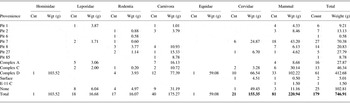
The third and final order of animals recovered from Cerro Portezuelo was Mammalia (n = 179; 746.91 g), representing 88% of the faunal collection (Tables 1 and 2). One (103.52 g) human bone element was included in this group because it was modified. This represents less than 1% of the human remains found at Cerro Portezuelo (Spence et al. Reference Spence, White and Longstaffe2013). Some elements (n = 81; 220.94 g) could not be identified beyond the Mammalia class. Class identifications were grouped by size whenever possible. The following size categories were used when more specific identification was not possible: very large (e.g., cow/horse), large (e.g., deer), medium (e.g., rabbit), and small (e.g., rodent) mammals. In addition to the single piece of worked human bone included in this study, nine other mammal species were identified. All of them have previously been identified in other Basin of Mexico faunal assemblages (Valadez Azúa Reference Valadez Azúa and Götz2012).
Distribution of mammal remains across Cerro Portezuelo

Note: All provenience information is consolidated to the most discrete area provided to allow for comparisons.
Eighteen elements of rabbit and hare (Leporidae), representing 10% of the identified mammal species, were recovered from four Classic and Epiclassic period contexts at Cerro Portezuelo, including Pits 1 and 7, Trench 18 (part of Complex A), and Complex C (Trench 93). Interestingly, no Leporidae remains were recovered from the Postclassic residence at Complex D even though this area shows the most diversity (Table 2). Leporidae was, and still is, a common meat source for residents of the Basin of Mexico—it was a common meat source at Teotihuacan and contemporary sites. These animals would have certainly been attracted to the agricultural fields of Cerro Portezuelo. Rabbits were also used in ritual offerings and were frequently depicted iconographically in various forms of art (Valadez Azúa Reference Valadez Azúa and Götz2012). The assemblage includes a minimum of seven individuals. Both juvenile and adult bones were identified, although in some cases no side or element could be assigned to a particular fragment. None of the elements were worked or showed signs of cut marks. However, one piece was burned, possibly during food preparation.
Two types of pocket gophers were recovered in the Cerro Portezuelo excavations (Cratogeomys sp. and Thomomys sp.) (Table 1). Pocket gophers inhabit evergreen deciduous forests in tropical lowlands and mountain valleys, areas that are also often selected for agriculture (Reid Reference Reid2009). In addition to the pocket gophers, a frontal cranial element from a Mexican vole (Microtus mexicanus) was recovered from Burial 2 in Complex C. According to Hicks (personal communication 2009), rodents—particularly gophers—were a problem during excavation, so it is possible that at least some of the gopher remains recovered are intrusive. Overall, rodents represent 9% of the identified mammals. None of the recovered elements were modified. Their remains were recovered throughout the site, with a minimum of 10 individuals found in Pits 2, 6, 8, and 27 and in Trench 35 of Complex D (see Figure 2 for locations). A carnivore species identified in the Cerro Portezuelo collection was the American badger (Taxidea taxus). Five elements, likely from a single badger skull, were recovered from Postclassic period Complex D. While badgers have been identified in Teotihuacan assemblages, the contexts in which they have been recovered suggest they are likely intrusive (Valadez Azúa Reference Valadez Azúa and Götz2012). Badgers prey mostly on rodents and other small animals but will also eat some plants, including corn and sunflower seeds (Long Reference Long, Wilson and Ruff1999; Sullivan Reference Sullivan1996). They may have been tolerated because they hunt common pests that carry disease or damage crops. Furthermore, their fur is attractive, and its use has been documented elsewhere. For example, badger fur was used as a trim on Native American garments and to make shaving and painting brushes (Long Reference Long, Wilson and Ruff1999).
The most representative mammal species in the Cerro Portezuelo collection comes from the canine family, particularly domesticated dogs (Canis familiaris). At least 14 individuals were identified, with dog making up 20% of all identified mammals. Dogs were found in almost every pit where faunal remains were present. Ten of the elements were recovered from Complex D. Half of the Complex D collection came from Cache 1 in Trench 35. This cache dates to the Aztec II/III (Middle Postclassic; a.d. 1150−1400) period. Osteological remains from this cache include a human burial, most of a juvenile dog, and a pocket gopher incisor. On the surface, it might seem that the dog was included whole, with the fragmentary nature of the remains resulting from site formation processes. But one of the elements (a humerus) showed signs of extensive working. Dog remains were also recovered from another ritual context: Burial 16 from Complex C, which dates to the Classic period. An adult maxilla from a short-faced dog was recovered. The only other faunal element identified from the burial collection was an unmodified deer rib. Most elements were unmodified. The remains recovered came from right and left sides of both adult and subadult individuals, representing different parts of the body without noticeable patterning. None of the elements were burned, and very few pieces showed other evidence of food preparation. The only exception was the juvenile dog calcaneus with cut marks recovered from Pit 2, one of three dog elements from this context.
One of the most interesting finds was a single—possibly fossilized—horse molar from an Early Postclassic context in Complex D (96 K8 D-27). Its recovery from this context is perplexing. One other element that was identified only as a very large mammal also appears to be fossilized. However, it was derived from a Classic period context, Complex C (93 K3 NW B). Horse/donkey elements have also been recovered from Cueva del Camino, Cueva de la Basura, and other sites in the Basin of Mexico. In these cases, they were identified as colonial intrusions (Valadez Azúa and Rodríguez Reference Valadez Azúa, Rodríguez and Manzanilla2009). With an open context like that at Cerro Portezuelo, it is possible that the recovery of these remains in excavation is due to bioturbation by the many gophers at the site.
Finally, white-tailed deer, Odocoileus virginianus, and the Cervid family are well represented. These remains compose 12% of the identified mammals and represent a minimum of 11 individuals. When protected, their population can grow to sizeable numbers, even in fairly urban areas (Emmons Reference Emmons1997:180–181; Janzen Reference Janzen and Janzen1983:482). With proper management, they can supply a steady source of meat for food, hides for clothing, and bone for tools.
Of the 21 elements identified, seven were worked into finished products. Another 17 pieces of finished bone items recovered from Cerro Portezuelo were also likely deer bone (Table 4). Two of the antler tine fragments were heavily burned (Table 4), and the third showed evidence of cutting at the base, likely from removing the antler from the cranium. Of the elements identified to species, almost all were recovered from Trench 96, a Late Postclassic residential structure with Early Postclassic components. Only two elements were recovered from Classic period Complex C. One is a rib fragment recovered, along with dog remains, from Burial 16. The other is a rib fragment from an unspecified location in Trench 93. Several fragmentary deer elements were recovered from Pit 7 (undated) and from the surface of the site.
In terms of spatial distribution, deer remains follow the general pattern seen for other faunal remains, with 23 of the 53 mammal fragments being recovered from Complex D. Another 14 fragments were recovered from Complex C, and the rest were recovered from undated pits throughout the site.
Faunal Discussion
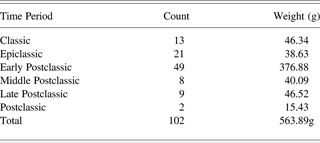
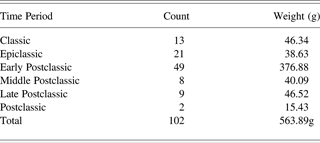
Less than half of the faunal elements come from dated contexts—from Classic through Late Postclassic times (Table 3). The faunal remains recovered derive from animals that were common in the Basin of Mexico during these periods. It is not surprising that most of the faunal material was recovered from Complex D, which was identified as a residence during the last period of pre-Hispanic occupation (Hicks Reference Hicks2013).
Faunal remains for each major period of pre-Hispanic occupation at Cerro Portezuelo
Other researchers have argued that the faunal remains recovered from Teotihuacan indicate that residents of the city were supplied with meat and animals via a well-developed exchange system. While the sample from Cerro Portezuelo is modest, both the variety of animal species represented and the way in which some offerings with faunal remains were interred echo patterns found at other Valley of Mexico sites (Manzanilla Reference Manzanilla1996; Pérez Roldán Reference Pérez Roldán2005; Starbuck Reference Starbuck, de Tapia and Rattray1987). For example, Cache 1 in Trench 35 (Aztec II/III) included at least one juvenile dog with the remains of at least three human infants (Spence et al. Reference Spence, White and Longstaffe2013), a practice also found at Teotihuacan (Manzanilla Reference Manzanilla1996).
Interestingly, a very limited collection of faunal remains was recovered from Epiclassic Complex A, with only three species represented in the collection: dog, turkey, and rabbit. Linda Manzanilla (Reference Manzanilla1996:237) entertains the idea that these three animals may have been raised together at Oztoyahualco, Teotihuacan. While the Cerro Portezuelo sample is not large enough to definitively say the building was used to raise semidomesticated animals, this pattern is quite suggestive, and perhaps future work at the site will provide more data (Clayton Reference Clayton2013).
WORKED BONE
A simple typology was developed for reviewing the modified bone from Cerro Portezuelo. This typology follows Edward Gifford's (Reference Gifford1940) model developed for California bone tools and was further modified based on research at Caracol, Belize (Teeter Reference Teeter2001). The resultant typology presented here is primarily based on form and does not necessarily translate directly to function, unless otherwise stated. Only bone altered by humans in manufacturing has been included here. Bones with burning, gnawing, or dismemberment cut marks were not included.
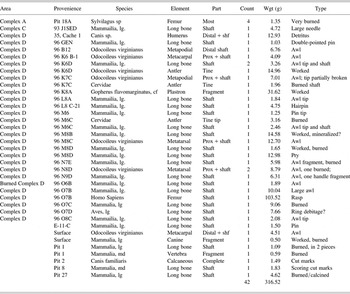
As previously mentioned, the distribution of worked bone is quite restricted (Table 4). It seems unreasonable to assume that bone tools were not used throughout the entire occupation of Cerro Portezuelo. The only tool from a context dated to a period other than the Postclassic was a single large needle from Complex C. The only ceremonial context in which faunal remains were recovered was a Middle Postclassic cache (Trench 35, Cache 1) in the Complex D residential structure. The cache included worked bone, a burial, and several ceramic items. Only two faunal items—an awl and a pin—were recovered from undated contexts. The rest were recovered from Trench 96 and were not associated with any features.
Provenience of modified bone recovered from Cerro Portezuelo

Bone Typology
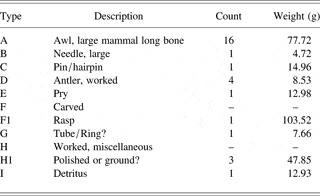
There are many ways to group modified bone. These categories may be used to determine what these items were used for and to reflect the extensive and diverse uses for bone at Cerro Portezuelo. In the most general terms, the modified faunal remains from Cerro Portezuelo can be identified as either tools, pieces of art, or manufacturing debris (Table 5). Tools are bones altered for use in completing tasks and include pointed objects like awls, needles, pins, and hairpins. Engravers can also be included in this category, but the tips were probably inserted into a larger handle (hafted) for use; thus, they form part of a larger composite tool. Initial preparation of most of these tools was very similar, and generally it wasn't until the final stages of production that the object could be distinguished from other artifacts.
Typology of Cerro Portezuelo worked bone

Pieces of art comprise bone altered as an end product. This category includes jewelry, tubes, rings, and musical instruments.
Manufacturing debris results from the production of tools and pieces of art. In many cases, the intended final product cannot be determined from the debitage. This group includes material that was left over, broken, or lost during the production process.
Awls
Gifford (Reference Gifford1940:161) defines an awl as a “single-pointed perforating implement without eye or groove for cord attachment.” Based on this definition and other similar ones, the ways in which awls were used remain vague. Most definitions and discussions of awls focus on their sharp end being used as a perforator or punch in basketry, sewing, or other hide-preparation activities (Beach and Causey Reference Beach, Causey, Lang and Harris1984; Pérez Roldán Reference Pérez Roldán2005:60–61). In the absence of residue and use-wear analyses, it is difficult to determine what awls were used for. However, the artifacts found in association with awls may offer some insights into their possible functions.
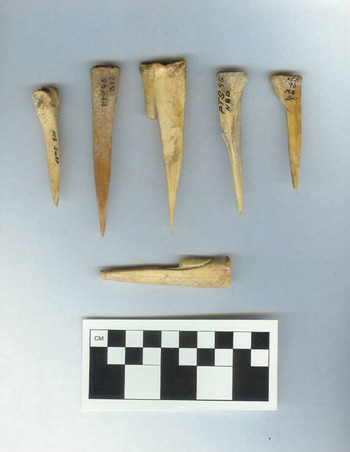
Sixteen whole and fragmentary awls were recovered from the Postclassic residence at Complex D, while one came from the surface. Awls comprise 55% of the bone artifacts (Figure 3). Most awls were crudely made and then became polished from use. The form of an awl and any evidence of manufacture offer some clues regarding how they were made. First, the metapodial was split vertically. The epiphyiseal end that remained was generally left unaltered after this initial cut. The next step was to cut away part of the end used to form a point. Marks are evident from a possible string saw being used to make a horizontal cut over a small section and then a vertical cut weakening the area so that a diagonal piece could be snapped off. Although the area was smoothed to form a nice point, the scarring was not completely removed, leaving manufacturing evidence (Teeter Reference Teeter2001).
Awls from Cerro Portezuelo.

Needles
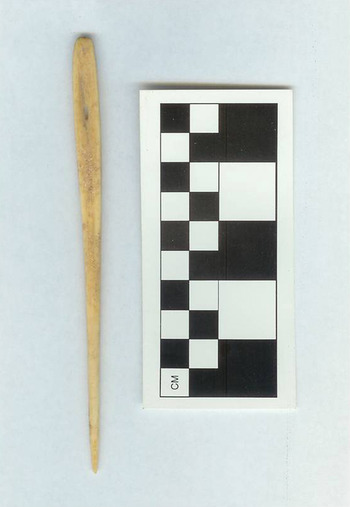
Another universally recognizable tool is the needle. Although sizes vary, the general form is a thin cylindrical shape with an eye, or small opening, at the top. At Cerro Portezuelo, only one needle was recovered (Figure 4) from Trench 93 in Classic period Complex C. It should be noted that only artifacts with evidence of an eyelet were classed as needles. Other similarly sized and shaped fragments were identified as pins but could have been needles before breakage.
Large needle from 93 J1SED, Cerro Portezuelo.

Based on ethnographic data from the Maya highlands, larger bone needles were used for sewing wool or leather items. Smaller, finer needles were used for embroidery and for sewing cotton and other fine mesh fabrics (Hayden and Cannon Reference Hayden and Cannon1984:89).
A large needle can also be used as a corn husker (pizcadora). These tools are inserted between the husk and the kernels and then moved down the side of the maize ear. They help reduce the amount of wear on the hands from the rough spikes and high silica content of corn husks (Hayden and Cannon Reference Hayden and Cannon1984:83; Pérez Roldán Reference Pérez Roldán2005:61). Some modern Maya groups still prefer deer bone (generally metapodials) for this use. Most corn huskers are pierced at the proximal end so that it can be attached to a cord around the husker's wrist to prevent loss while working (Hayden and Cannon Reference Hayden and Cannon1984:83–86).
Pins
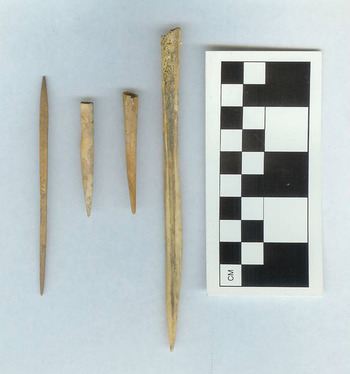
Four pins were identified in the Cerro Portezuelo collections (Figure 5). All but one derives from the Postclassic residential area excavated in Trench 96. Pins are nonperforated objects with rounded ends and a circular, elliptical, or even flat cross section. They are not robust enough to be awls and not wide enough to be scrapers. Many of them are likely hairpins or were used as clasps to hold clothes together (Pérez Roldán Reference Pérez Roldán2005:60). Kitty Emery (personal communication 2001) has reported seeing highland Maya women use their hairpins as weaving tools while at the loom. It is likely that many tools served multiple functions in ancient times as well.
Pins from Cerro Portezuelo.

Pry/Chisel
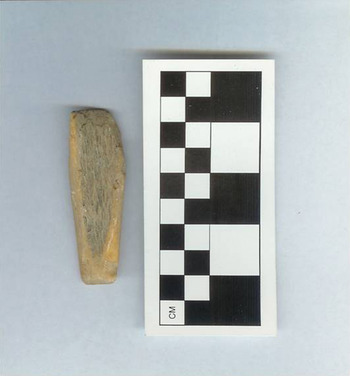
One pry was recovered from a domestic area (96 M8D) in Complex D (Figure 6). It was made from a large mammal bone cut to produce a triangular profile and enough of a shaft to serve as a handle. The shape makes this tool ideal for prying open closed objects (such as shellfish) or for use as a chisel.
Pry recovered from a Postclassic residential structure at Cerro Portezuelo.

Carved Rasp (Omichicahuaztli)
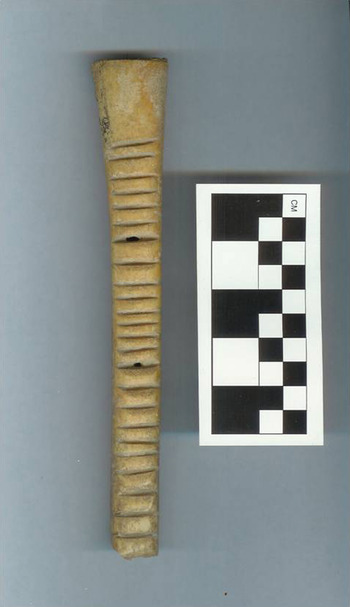
A human femur shaft, modified into a musical instrument, was recovered from Complex D (96 O7B) (Figure 7). Rasps are generally made using one of the long bones of a large mammal, with incised transverse grooves running down the length of the bone. A deer antler or any other slender bone could be used to scrape over the grooves like a rasp. Regarding the artifact recovered from Cerro Portezuelo, two small holes were drilled into the shaft of the bone, either to make it a resonating chamber or to provide finger holes for a wind instrument (Pérez Roldán Reference Pérez Roldán2005:65). This instrument was found with a large slender “awl,” which may have been used as the scraper when playing.
Human bone rasp from Complex D, a residential area.

Tubes/Rings/Whistles
Tubes, rings, and whistles are all similar in shape and manufacturing technique. Both epiphyseal ends are removed from a mammal or bird long bone shaft using a string saw to form a circular blank. Then, the snapped ends are ground smooth to form a tube. Further cuts can be made to separate the tube into shorter rings. Alternatively, whistles call for one or more holes to be drilled into one surface of the tube shaft.
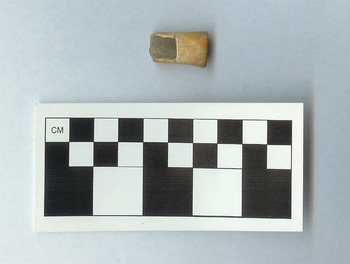
A large bird long bone shaft from Complex D is an excellent example of one of these items (Figure 8). It is impossible to determine whether this piece was a discarded section or an in-process ring. One end is finished, and the other shows evidence of preparation for further cuts—possibly to create a ring. However, it may be that the end is simply production waste from making rings or a tube from the long bone shaft.
Fragment of a bird bone ring/tube from a Postclassic Cerro Portezuelo residential structure.

Worked Bone Discussion
The worked-bone items examined in this study represent implements used in a variety of household activities. Awls comprise 38% of the worked faunal assemblage. This is a reasonable expectation, as the size and narrowness of the tip determines its strength and ease of use. Antler tines could be used for percussion flaking and as hide punches. Pins and needles can be used in weaving and other domestic activities as a pry. Scored turtle shell may have been used as a container. The fragmentary state of the tube/ring fragment and other small items makes it impossible to determine their use with any confidence.
The rasp was likely used in rituals of some significance considering it was made from human bone. Many animal remains have been excavated in ritual contexts at Teotihuacan in the form of both worked bone and animals given as offerings of food. Unlike Teotihuacan, the burials and caches at Cerro Portezuelo included very few examples of bone items or animal remains. Does this distinct ceremonial characteristic reflect different socioeconomic statuses or cultural norms? This question may be addressed with further data from future excavations already planned for Cerro Portezuelo (Clayton Reference Clayton2013).
CONCLUSIONS
The taxonomic representation of animal remains and bone artifacts recovered from field excavations at Cerro Portezuelo provides a glimpse into daily life and resource use from approximately 100 b.c. to a.d. 1500. Sixteen different genera/species were identified, representing an assemblage of animals typically found in environments readily accessible to the inhabitants of Cerro Portezuelo. Although the faunal bone collection from Cerro Portezuelo is quite limited, it is intriguing to note that these same variety of taxa have been recovered from Teotihuacan and other nearby sites (Valadez Azúa Reference Valadez Azúa and Götz2012). While ceramic and lithic materials provide evidence for expanding trade relations and shifting alliances (Clayton Reference Clayton2013), there is no discernable presence of animals from the Gulf Coast or other more distant locations that might have arrived at the site through long-distance trade. It is interesting that there are no fish in the faunal assemblage, which could be due as much to disposal practices as to access or preference.
When compared with the patterns observed at Oztoyahualco, the presence of dog, turkey, and rabbit exclusively in Complex A at Cerro Portezuelo is suggestive and may indicate that these animals were being raised together, as was the case at the Epiclassic Teotihuacan residence (Manzanilla Reference Manzanilla1996).
Overall, the Cerro Portezuelo faunal remains offer important information regarding the types of species and household implements used at Cerro Portezuelo and point to similarities with sites in other parts of the Valley of Mexico. They also demonstrate that research collections housed in museums provide many exciting research possibilities, despite provenience limitations and unknown or biased collection methods. New theoretical frameworks and interpretations should be tested against data already collected and curated as part of previous research projects.
RESUMEN
Análisis de los restos de fauna de Cerro Portezuelo indican que los residentes del sitio prehispánico emplearon animales, tanto silvestres como domesticados, que frecuentan orillas de lago y campos agrícolas. La mayoría de la colección de fauna analizada aquí proviene de una estructura del período posclásico, proporcionando información sobre las especies utilizadas por los habitantes tempranos y las clases de actividades domésticas que realizaron con herramientas de hueso labrado. Una inspección de las colecciones de otras partes del sitio muestra similitudes fascinantes con las prácticas de selección de animales anteriormente identificadas en las colecciones del periodo epiclásico en Oztoyahualco, Teotihuacan.
ACKNOWLEDGMENTS
As the Curator of Archaeology at the Fowler Museum at UCLA, I would like to thank Deborah Nichols and George Cowgill for convening this research team, and the National Science Foundation for providing the financial support (Grant Nos. 0514187 [Dartmouth College], 0513979 [Arizona State University], and 0504015T [University of Missouri Research Reactor (MURR)]). Funding for this project was also generously provided by grants from the Claire Garber Goodman Fund and the Rockefeller Center Urban Studies at Dartmouth College, and Arizona State University's School of Human Evolution and Social Change and the Archaeological Research Institute. I also want to thank Fred Hicks and the late Nick Nicholson for their invaluable assistance in answering questions regarding the original project. The recovery of data from this project is a huge achievement and one that needs to be replicated with other collections. I want to thank the National Endowment for the Humanities Preservation and Access Division for sponsoring the rehabilitation and archiving of the primary documentation (Grant No. PA-23528-00). I am grateful to Dr. Judy Porcasi, Dr. Tom Wake, and Mercedes Duque of the UCLA Zooarchaeology Lab for their assistance with species identification. I also thank the anonymous reviewers and Kristin Sullivan, whose helpful comments and edits greatly improved this article. I also thank Christopher Götz, Raúl Valadez Azúa, and Nawa Sugiyama for providing invaluable literature. Any errors or omissions are the sole responsibility of the author.