INTRODUCTION
Holothuria tubulosa Gmelin, 1788 is among the most common holothurian species (phylum Echinodermata, class Holothuroidea, order Aspidochirotida, family Holothuriidae) widely distributed in the Mediterranean Sea and the Atlantic Ocean (Tortonese & Vadon, Reference Tortonese, Vadon, Fischer, Bouchon and Scneider1987; Koukouras et al., Reference Koukouras, Sinis, Bobori, Kazantzidis and Kitsos2007). The species lives on various bottom types from the surface waters down to 100 m depth commonly forming dense populations in the shallow sublittoral seagrass meadows (Massin & Jangoux, Reference Massin and Jangoux1976; Tortonese & Vadon, Reference Tortonese, Vadon, Fischer, Bouchon and Scneider1987; Bulteel et al., Reference Bulteel, Jangoux and Coulon1992; Simunovic & Grubelic, Reference Simunovic and Grubelic1998). Holothuria tubulosa is an epibenthic deposit feeder selectively ingesting superficial sediment and feeds on non-living detritus and associated microorganisms (Massin & Jangoux, Reference Massin and Jangoux1976; Amon & Herndl, Reference Amon and Herndl1991). Thus, the species contributes to the recycling of bottom detritus (Bulteel et al., Reference Bulteel, Jangoux and Coulon1992; Coulon & Jangoux, Reference Coulon and Jangoux1993) having an important ecological role as it has been also reported for various congeneric holothurians (Uthicke Reference Uthicke1999, Reference Uthicke2001a, Reference Uthickeb).
Holothuria tubulosa is exploited in the Mediterranean either as fishing bait or as a food source; various countries export the species to Japan, where it is consumed as a gastronomic delicacy (Tortonese & Vadon, Reference Tortonese, Vadon, Fischer, Bouchon and Scneider1987; Simunovic & Grubelic, Reference Simunovic and Grubelic1998). On the other hand, the species is also studied for its bioactivity with promising results for the treatment of inflammatory disorders (Herencia et al., Reference Herencia, Ubeda, Ferrandiz, Terencio, Alcaraz, Garcia-Carrascosa, Capaccioni and Paya1998). In the Aegean Sea H. tubulosa is commercially exploited in some Turkish areas (Cakli et al., Reference Cakli, Cadun, Kisla and Dincer2004; Aydin, Reference Aydin2008), in contrast to Greece, where the species is not included in the explored benthic invertebrates (Chintiroglou et al., Reference Chintiroglou, Antoniadou, Vafidis and Koutsoubas2005). Still divers harvest it by hand, or using hooks, while it is also randomly collected by trawls as by-catch from deeper waters. The species is processed and used as bait in long-line fisheries; accordingly a severe depression of populations has been reported mostly in the southern part of the Aegean (Vafidis et al., Reference Vafidis, Tsagridis, Chintiroglou, Stamatis and Antoniadou2008).
Several aspects of the biology of this species have been studied, such as population dynamics (Gustato et al., Reference Gustato, Villari, Del Gaudio and Pedata1982; Bulteel & Jangoux, Reference Bulteel and Jangoux1989; Bulteel et al., Reference Bulteel, Jangoux and Coulon1992; Simunovic & Grubelic, Reference Simunovic and Grubelic1998; Simunovic et al., Reference Simunovic, Piccinetti, Bartulovic and Grubelic2000), reproduction (Pladellorens & Subirana, Reference Pladellorens and Subirana1975; Bulteel et al., Reference Bulteel, Jangoux and Coulon1992; Despalatovic et al., Reference Despalatovic, Grubelic, Simunovic, Antolic and Zuljevic2004), feeding ecology (Massin & Jangoux, Reference Massin and Jangoux1976; Amon & Herndl, Reference Amon and Herndl1991; Coulon & Jangoux, Reference Coulon and Jangoux1993; Mezali et al., Reference Mezali, Chekaba, Zupo and Asslah2003) and fisheries (Simunovic & Grubelic, Reference Simunovic and Grubelic1998; Aydin, Reference Aydin2008). However, all the above information has been derived from the Adriatic and the western Mediterranean H. tubulosa populations; relevant data for the Aegean populations are missing and the existing information is limited to the geographical and bathymetric distribution of the species (Koukouras & Sinis, Reference Koukouras and Sinis1981; Koukouras et al., Reference Koukouras, Sinis, Bobori, Kazantzidis and Kitsos2007).
Taking into account all the above, the present work aims at studying the population dynamics of H. tubulosa in the Aegean Sea, focusing on the assessment of population structure, allometric relationships and reproductive status of its natural stocks.
MATERIALS AND METHODS
Study area
The study area was Pagasitikos Gulf located in the western Aegean Sea, north of Evia Island. It is a semi-enclosed shallow water basin (mean depth is 69 m) connected with the western Aegean Sea and the North Evoikos through the narrow (5.5 km) and relatively deep (80 m) Trikeri Channel (Petihakis et al., Reference Petihakis, Triantafyllou, Pollani, Koliou and Theodorou2005). No major rivers discharge in the wider area; still nutrients produced by intense agriculture enter the system through a network of small torrents, while urbanization and industrialization has strongly affected the area, mostly in the northern part of the Gulf, where the city of Volos is located (Petihakis et al., Reference Petihakis, Triantafyllou, Pollani, Koliou and Theodorou2005). The basic physical, chemical and biological parameters of the water column have been studied since 1975. Water masses are cold and homogeneous in winter (12.5°C) and highly stratified in the warm season of the year (27.4°C) following the seasonal pattern of atmospheric warming at this temperate region. Salinity exhibits some fluctuations (32–38 psu) with values increasing with depth due to the inflow of low salinity surface waters from the Aegean Sea (Triantafyllou et al., Reference Triantafyllou, Petihakis, Dounas and Theodorou2001). Unlike other semi-enclosed gulfs, and besides the significant nutrient inputs, Pagasitikos Gulf has been characterized as meso-oligotrophic undergoing periods of P or N limitation (Petihakis et al., Reference Petihakis, Triantafyllou, Pollani, Koliou and Theodorou2005).
Field sampling—processing of samples
Preliminary surveys along the coastline of Pagasitikos Gulf, revealed the occurrence of the species Holothuria tubulosa at Kato Gatzea in depths from 3 to 8 m; accordingly one sampling station was set (N39°18′457″E 23°05′869″). The sea bottom consists of soft substratum with a sparse meadow of the seagrass Zostera marina, up to a maximum depth of 10 m. The sediment is composed of sand fractions and silt. Samples were collected from June 2007 to July 2008, on monthly or semimonthly basis, by scientists using SCUBA diving, in depths up to 10 m. In order to estimate the abundance of H. tubulosa transect methods (5 randomly replicated belt transects of 2 × 10 m each) were employed (Uthicke, Reference Uthicke1997); from these data the population density was assessed as the number of individuals per 100 m2. Twenty to twenty-five specimens larger than 3 cm were randomly collected by hand, measured in the field for total length (Lt) using a tapeline (0.1 cm precision), with care to avoid body contraction, and then put into individual plastic bags (Despalatovic et al., Reference Despalatovic, Grubelic, Simunovic, Antolic and Zuljevic2004). Surface seawater temperatures were recorded at the study site at each sampling.
All the collected H. tubulosa individuals were transferred to the laboratory, relaxed and dissected. The total drained weight (W) following the opening of the body and the removal of coelomic fluid, the gonad weight (Wg), and the gutted weight (Wgt) following removal of gonads, alimentary canal and respiratory trees (Conand, Reference Conand1981) were recorded with an electronic scale to the nearest mg. The length of the uncoiled digestive tract (Ld) and the width of the peripharyngeal calcareous crown (Pc) (Bulteel et al., Reference Bulteel, Jangoux and Coulon1992) were also determined for each holothurian. These measurements were taken with a digital Vernier caliper to the nearest 0.1 mm.
The removed gonads were macroscopically examined in order to classify the H. tubulosa individuals to sexes and then fixed in 9% formaldehyde (Despalatovic et al., Reference Despalatovic, Grubelic, Simunovic, Antolic and Zuljevic2004).
Data analysis
The null hypotheses of no significant differences among temporal samplings in the mean values of the estimated biometric characters (i.e. Lt, Ld, Pc, W, Wgt and Wg) of the holothurian were tested with one-way ANOVA. Prior to the analyses, the homogeneity of variance was tested by Cohran's test and, when necessary, data were log-transformed. The Fisher's LSD test was used for post-hoc comparisons.
Size–frequency distributions were estimated seasonally, on the basis of gutted weight, in order to study the population structure (Conand, Reference Conand1981; Bulteel et al., Reference Bulteel, Jangoux and Coulon1992). The distributions were calculated per 20 g size-classes, and the modal was identified applying the Battacharya and the NORMSEP analysis using the FISAT software package (Gayanilo & Pauly, Reference Gayanilo and Pauly1997).
Morphometric relationships were estimated using power function (Y = aXb which is solved as LogY = loga + bLogX) applying a linear regression analysis (Zar, Reference Zar1984). Weight measurements were used to estimate the gonadosomatic index (GS = Wg/Wgt) expressed as the ratio of gonad weight to gutted weight (Shiell & Uthicke, Reference Shiell and Uthicke2006), in order to study the reproductive status of H. tubulosa. GS was also tested for temporal differences with ANOVA. A Chi-square test was applied to determine whether sex-ratio deviates from 1:1.
RESULTS
Holothuria tubulosa individuals were found in shallow waters (6–8 m depth) and mostly in unvegetated sediments. Its population density ranged from 5 (September 2007) to 20 (July 2007) individuals /100 m2 with an overall mean of 9.93 ± 3.28 individuals/100 m2.
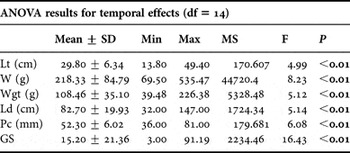
Overall, 314 specimens of H. tubulosa were collected and measured. All the estimated biometric characters showed significant temporal variations (ANOVA results; Table 1). These variations produced a rather complicated pattern (Figure 1) revealing a high morphological plasticity of H. tubulosa population. In general, holothurians were larger in size in the warm season of the year, at least considering W and Wgt.
Temporal variability of the measured biometric characters and the gonadosomatic index (GI) of Holothuria tubulosa population in Pagasitikos Gulf.

ANOVA results for the effects of time on the biometric variables and the gonadosomatic index (GI) of Holothuria tubulos a. Significant differences in bold.

SD, standard deviation calculated across all H. tubulosa specimens; Min, minimum; Max, maximum; Lt, total length; W, drained weight; Wgt, gutted weight; Ld, length of the uncoiled digestive tract; Pc, width of the peripharyngeal calcareous crown.
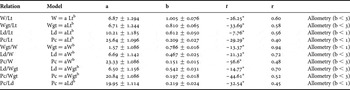
Length/length, weight/length, width/length and weight/weight relationships followed negative allometry considering the drained and the gutted weight, the length of the body and of the digestive tract, as well as the width of the peripharyngeal crown (Table 2). A strong relationship was established only between gutted weight/drained weight. In most relationships the correlation coefficient had moderate values varying around 0.6.
Morphometric relationships of the Holothuria tubulosa population in Pagasitikos Gulf. Asterisk (*) denotes statistically significant values, P < 0.01.

N, number of individuals examined equals 314; a, intercept; b, slope; t, t-test value; r, correlation coefficient.
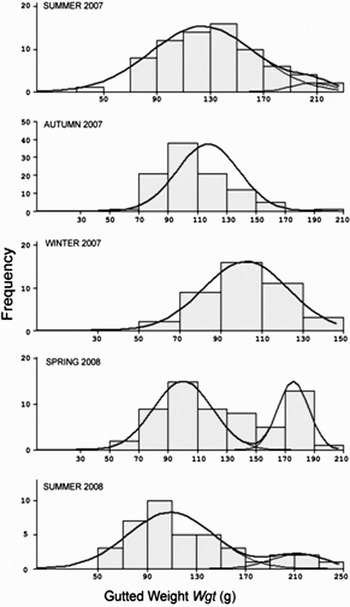
Gutted weight–frequency distribution analysis was unimodal in autumn and winter consisting of medium-sized individuals (Figure 2). In both summers one main mode and a minor second one were detected at 120g and 210g, respectively; in spring multimodality appeared clearly as the H. tubulosa population was constituted by two size-groups at 100g and 175g (Figure 2).
Modal progression analysis of Holothuria tubulosa size–frequency data (thick line, NORMSEP method based on previous results of Battacharya method).

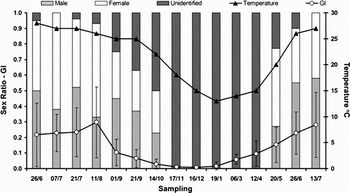
Holothuria tubulosa is a gonochoristic species. In total, 26.75% of the collected holothurians were males, 26.11% females and 47.13% had undifferentiated gonads; thus the sex of almost half of the specimens remained undetermined. In the cold season of the year, from November up to April, all H. tubulosa individuals had undifferentiated gonads, while in the warm season the portion of female and males was almost equal. Overall, the sex-ratio of the studied population did not significantly deviate from 1:1 (χ2 = 5.88, df = 9, P > 0.05). The GS of H. tubulosa showed significant temporal variations (F = 16.43 P < 0.01), with the minimum values recorded in November up to January and the maximum in June–July, coinciding with the gradual buildup of the gonad (Figure 3). GS followed a clear annual pattern and strongly correlated with seawater temperature (Spearman rank-correlation 0.81 P < 0.01).
Temporal variability of temperature (T), sex-ratio and gonadosomatic index (GI) of Holothuria tubulosa population in Pagasitikos Gulf.

DISCUSSION
Holothuria tubulosa is widely distributed in the sublittoral zone of the Aegean Sea, being most frequently found in shallow depths, usually down to 10 m (Koukouras & Sinis, Reference Koukouras and Sinis1981). In the present study the surveys covered 30 m depth, but the species was restricted up to 8 m depth with densities varying temporally around 0.1 individuals/m2. This value was rather low, since about 3.77 individuals/m2 have been reported from a dense Posidonia oceanica meadow in similar depths from the Gulf of Naples, with a significant decrease according to depth reaching only 0.34 individuals/m2 in 30 m depth where the meadow was sparser (Coulon & Jangoux, Reference Coulon and Jangoux1993). In the latter area, earlier studies reported a density of 0.17 to 0.34 individuals/m2 in various habitats (Gustato et al., Reference Gustato, Villari, Del Gaudio and Pedata1982). In the Adriatic H. tubulosa density estimated from trawl surveys, ranged from 0.33 to 492.72 individuals/km2 according to the sediment composition and depth (Simunovic et al., Reference Simunovic, Piccinetti, Bartulovic and Grubelic2000). Thus, the density of the animal populations seems to be highly variable according to the habitat type and depth. The bottom type in the study area consists of a sparse Z. marina meadow interspersed with silt sediments, which seems not to be the preferred habitat of the species.
Holothuria tubulosa showed a high plasticity level of the measured biometric characters, mostly with respect to the length. This plasticity can be interpreted by taking into account the general body form of the animal, which is soft with strong transversus and longitudinal muscles. Thus, the estimation of body length and width is subjected to increased error, since it is very difficult to obtain a complete relaxation of the body muscles (Conand, Reference Conand1981). In our case body length measurements were performed underwater and care was taken to avoid body contraction (Despalatovic et al., Reference Despalatovic, Grubelic, Simunovic, Antolic and Zuljevic2004); nevertheless we cannot exclude methodological artefacts from the observed variability. Therefore, weight measurements seem to be more reliable for estimating holothurians population dynamics, as stated by various authors (Conand, Reference Conand1981; Bulteel et al., Reference Bulteel, Jangoux and Coulon1992; Tuwo & Conand, Reference Tuwo and Conand1992).
All the examined morphometric relationships followed negative allometry. Such a pattern, also reported from other Mediterranean populations (Bulteel & Jangoux, Reference Bulteel and Jangoux1989; Bulteel et al., Reference Bulteel, Jangoux and Coulon1992), indicate a change in the shape of the animal's body as it grows, since the relative volume growth rate is lower than the linear one. However, most of these relationships had a rather low determination coefficient probably for the same reasons as stated above. Similar results have been reported from other congeneric species attributed to the ‘variability of biological material’ (Conand, Reference Conand1981). Holothurians’ length appeared to be a moderate predictor of biomass. In contrast a very strong relation was observed between drained and gutted weight, supporting the utility of the latter parameters in population dynamic studies.
Holothuria tubulosa is a continuous deposit feeder ingesting large amounts of sediment (Coulon & Jangoux, Reference Coulon and Jangoux1993) and consequently its weight is strongly influenced by its feeding rate. Therefore, the gutted weight was used to estimate population dynamics as the most consistent biometric variable (Conand, Reference Conand1981; Bulteel et al., Reference Bulteel, Jangoux and Coulon1992; Despalatovic et al., Reference Despalatovic, Grubelic, Simunovic, Antolic and Zuljevic2004). Gutted weight–frequency analysis of H. tubulosa populations was unimodal, with the exception of: (1) summer, where few large sized individuals constitute a minor second mode; and (2) spring, where a second mode was clearly defined. The size spectra of the population were rather similar among temporal samplings; nevertheless significant differences in the mean value were seasonally detected. From summer to autumn the population studied decreased in size; afterwards weight is increasing towards next summer. The failure to detect a separate mode of juveniles may be due to the sampling method, which is size-selective; individuals measuring less than 3 cm in length are not easily observed and they are occasionally collected. Alternatively, a very fast growth during the first age of the species could explain the scarcity of small-sized specimens (Massin & Jangoux, Reference Massin and Jangoux1976). Interestingly, prior studies of various aspidochirote holothuroids report few or no juveniles in the populations (Conand, Reference Conand1981; Tuwo & Conand, Reference Tuwo and Conand1992; Despalatovic et al., Reference Despalatovic, Grubelic, Simunovic, Antolic and Zuljevic2004).
A well-marked size distribution related to depth has been reported for H. tubulosa populations with small individuals in the shallow and large ones in deeper waters. This pattern has been attributed either to a downward migration of growing individuals or to different growth constraints according to depth (Bulteel et al., Reference Bulteel, Jangoux and Coulon1992). This pattern was not supported by our data since multimodality appeared in shallow depths and not any individual has been recorded beyond 10 m depth and up to 30 m, at each of the 15 sampling attempts. Thus, the two modes observed may represent different age-classes of the studied population, or they may be ascribed to differences in the microhabitat and specifically to the concentration of detritus and microorganisms into the superficial sediment, i.e. food availability, that could influence the growth rate of this slowly moving species implying that similar in size individuals may be of different age (Bulteel et al., Reference Bulteel, Jangoux and Coulon1992).
Holothuria tubulosa is a gonochoristic species with no external sexual dimorphism, in which sex can be macroscopically determined by the appearance and the colour of gonads (Despalatovic et al., Reference Despalatovic, Grubelic, Simunovic, Antolic and Zuljevic2004). The sex-ratio of the studied population approximated 1:1, conforming to results of similar studies (Despalatovic et al., Reference Despalatovic, Grubelic, Simunovic, Antolic and Zuljevic2004), while a predominance of females has been reported from a central Adriatic population (Simunovic & Grubelic, Reference Simunovic and Grubelic1998). A proportion of individuals with undifferentiated gonads, and thus of undetermined sex, were also caught during the warm period; these were all of small size (below 60 g in gutted weight) implying the presence of a small cohort of juveniles in the studied population.
A good homology between the GS and the stages of the gonads recorded with a histological analysis has been reported for various aspidochirote holothurians (Conand, Reference Conand1993; Shiell & Uthicke, Reference Shiell and Uthicke2006) and therefore GS seems to be reliable for the description of the reproductive cycle. In Pagasitikos Gulf, the reproductive cycle of H. tubulosa, as manifested by the GS, was annual with one annual spawning event, after mid-summer when maximum GS values occurred, as also reported from other Mediterranean populations (Bulteel et al., Reference Bulteel, Jangoux and Coulon1992). GS variability coincides with sea surface temperature and gonad development seems to be induced by the gradual warming of the water masses in spring. These findings conform to the results of a comprehensive study of the reproductive biology of H. tubulosa in the Adriatic, according to which the species spawns once per year during the warm season, from July to September (Despalatovic et al., Reference Despalatovic, Grubelic, Simunovic, Antolic and Zuljevic2004). These data suggest that temperature is the most likely factor determining the reproduction of the species, as is the case for other congeneric species (Conand, Reference Conand1981; Tuwo & Conand, Reference Tuwo and Conand1992; Despalatovic et al., Reference Despalatovic, Grubelic, Simunovic, Antolic and Zuljevic2003).
Concluding, the H. tubulosa population studied was constituted by moderate-sized individuals with most specimens having a drained weight around 220 g. However, the recently induced fishing pressure in several Mediterranean populations and the increased economic profit of the processed product, ‘trepang’, in the Asian market (Simunovic & Grubelic, Reference Simunovic and Grubelic1998; Cakli et al., Reference Cakli, Cadun, Kisla and Dincer2004; Aydin, Reference Aydin2008; Vafidis et al., Reference Vafidis, Tsagridis, Chintiroglou, Stamatis and Antoniadou2008) necessitate the monitoring of its populations. This became imperative considering that H. tubulosa is an ecosystem-engineering species; thus any disruption of its populations could cause cascading effects on the associated community (Amon & Herndl, Reference Amon and Herndl1991; Coulon & Jangoux, Reference Coulon and Jangoux1993).