Introduction
Epidemiological studies have consistently identified a high level of co-morbidity between DSM-IV major depressive episode (MDE) and generalized anxiety disorder (GAD) in large community-based samples (Judd et al. Reference Judd, Kessler, Paulus, Zeller, Wittchen and Kunovac1998; Hunt et al. Reference Hunt, Issakidis and Andrews2002, Reference Hunt, Slade and Andrews2004; Grant et al. Reference Grant, Hasin, Stinson, Dawson, Ruan, Goldstein, Smith, Saha and Huang2005; Kessler et al. Reference Kessler, Chiu, Demler and Walters2005). Given that MDE and GAD are the most common form of anxiety–mood co-morbidity and they occur together beyond the level of chance (Sanderson et al. Reference Sanderson, Beck and Beck1990), researchers have begun to question the source and nature of the co-morbidity (Angold et al. Reference Angold, Costello and Erkanli1999). For instance, does the observed co-morbidity between MDE and GAD represent a common aetiology for the two disorders (Hettema et al. Reference Hettema, Neale, Myers, Prescott and Kendler2006; Kendler et al. Reference Kendler, Gardner, Gatz and Pedersen2007), or is the co-morbidity merely a diagnostic artefact (Frances et al. Reference Frances, Widiger, Fyer, Maser and Cloninger1990; Maj, Reference Maj2005; Jorm, Reference Jorm2006)?
The issue of co-morbidity between mood and anxiety disorders has important implications for both diagnostic decision making and treatment planning, which can lead to increased direct and indirect patient costs (Clarkin & Kendall, Reference Clarkin and Kendall1992). For instance, Andrews et al. (Reference Andrews, Slade and Issakidis2002) identified increased service utilization and associated disability in survey respondents who reported more than one disorder in comparison to respondents who reported one disorder only. Furthermore, patients who receive more than one diagnosis report higher levels of distress, often have a poor prognosis (Brown et al. Reference Brown, Antony and Barlow1995a) and increased heritability of co-morbid conditions (Carter et al. Reference Carter, Pollock, Suvak and Pauls2004). MDE is one of the most common mental disorders observed in communities worldwide (Kessler & Ustun, Reference Kessler and Ustun2008), is one of the leading causes of global disease burden (Murray & Lopez, Reference Murray and Lopez1996), and is associated with a decrement in health that is significantly greater than the decrement in health associated with angina, arthritis, asthma and diabetes (Moussavi et al. Reference Moussavi, Chatterji, Verdes, Tandon, Patel and Ustun2007). Therefore, considering that co-morbidity between MDE and GAD is the rule rather than the exception, it is important to investigate the source of this co-morbidity and to gather a greater understanding of how and why these two disorders co-occur so often in the population.
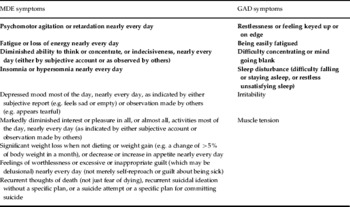
Researchers have debated whether the observed co-morbidity represents a common underlying aetiology between the two disorders (Hettema et al. Reference Hettema, Neale, Myers, Prescott and Kendler2006; Kendler et al. Reference Kendler, Gardner, Gatz and Pedersen2007) or whether it is an artefact of the current diagnostic system (Frances et al. Reference Frances, Widiger, Fyer, Maser and Cloninger1990; Maj, Reference Maj2005; Jorm, Reference Jorm2006). More specifically, there is the concern that co-morbidity between MDE and GAD is a product of the observed similarity or overlap between the DSM-IV diagnostic criteria required for both disorders (Brown & Barlow, Reference Brown and Barlow1992; Frances et al. Reference Frances, Manning, Marin, Kocsis, McKinney, Hall and Kline1992; Brown et al. Reference Brown, Antony and Barlow1995 b; Maser, Reference Maser1998; Hunt, Reference Hunt2000; Slade & Watson, Reference Slade and Watson2006). The DSM-IV symptom criteria required for MDE contains a strong anxiety component that is reflected by the inclusion of sleep disturbance, fatigue or loss of energy, psychomotor disturbance, and a diminished ability to think or concentrate (APA, 2000; see Table 1). Furthermore, the DSM-IV definition of MDE is polythetic in nature, which means that any five out of the nine symptoms, with at least one of the five being depressed mood or lack of interest/pleasure, can result in a positive diagnosis. Two individuals with different symptom profiles, and therefore different clinical characteristics, could be classified under the same definition (Krueger & Bezdjian, Reference Krueger and Bezdjian2009). In other words, the polythetic-categorical classification system implemented in the DSM-IV creates significant within-category heterogeneity. The symptom overlap exhibited between MDE and GAD combined with the polythetic nature of MDE begs the question of whether respondents with GAD differ in their MDE symptom profile compared to those without GAD. It seems likely that patients with GAD may present with a distinct symptom profile, one that could be considered an anxious-depression, in comparison to those without GAD who present with a typical depression profile, one that is consistent with symptoms that are specific to MDE. Co-morbidity between GAD and MDE could therefore be considered, in part, artificial in the sense that these respondents could be better conceptualized as belonging to one distinct form of anxious-depression rather than receiving two diagnoses.
DSM-IV MDE and GAD symptom comparison

MDE, Major depressive episode; GAD, generalized anxiety disorder.
Symptoms similar in respect to wording/definition are shown in bold.
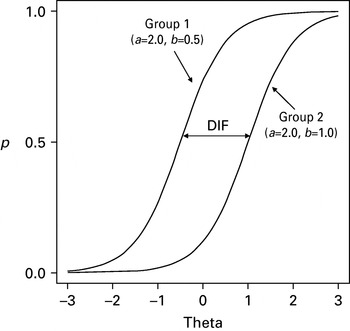
Item response theory (IRT) provides a method for examining whether the pattern of symptoms in MDE is consistent in cases with or without co-morbid GAD through the examination of differential item functioning (DIF; Holland & Wainer, Reference Holland and Wainer1993; Embretson & Reise, Reference Embretson and Reise2000). Higher prevalence of MDE in the presence of GAD and the reverse, higher prevalence of GAD in the presence of MDE, might confound the comparison of symptom profiles as co-morbid cases may simply be more severe. However, DIF equates the two groups on their level of the underlying trait or theta (in this case the level of underlying MDE pathology) before comparing the performance of items, symptoms or criteria (here after symptoms). The performance of symptoms in IRT is modelled by one or more item response parameters and is best conceptualized in the item characteristic curves (ICCs) detailed in Fig. 1. The first parameter b, commonly called the difficulty or threshold parameter, represents the point on the underlying dimension of depression (x axis) where the predicted probability (y axis) of endorsing the symptom equals 0.5. The second parameter a, commonly called the slope or discrimination parameter, represents the symptom's ability to discriminate between respondents with higher and lower levels of the underlying dimension of depression. The steeper the slope of the curve, the better the symptom is at discriminating between respondents (Hays et al. Reference Hays, Morales and Reise2000). The third guessing parameter has no application in the current context and is ignored. A given item is judged to display DIF when the threshold and/or the discrimination parameters differ significantly between the two groups examined. For example, if DIF is detected between respondents with GAD and without GAD, it indicates that respondents from one group are more or less likely to endorse that particular symptom of MDE.
Graphical representation of uniform differential item functioning (DIF) between two groups.

Small et al. (Reference Small, Simons, Yovanoff, Silva, Lewis, Murakami and March2008) used DIF to examine different MDE symptom profiles in adolescents across cases without co-morbidity, with internalizing co-morbidity and with externalizing co-morbidity. They found that psychomotor disturbance and cognitive impairments functioned differently between the co-morbidity groups and concluded that adolescents with varying levels of co-morbidity have important differences in their symptom profile that may indicate distinct forms of depression. They suggested that there is a need to develop tailored treatments depending on the extent of co-morbidity.
In the current study, we hypothesized that if the DSM-IV diagnostic system was artificially contributing to the level of co-morbidity observed between MDE and GAD, then cases with co-morbid GAD would be more likely to have a distinct MDE symptom profile from cases without GAD, one that is consistent with the selection of overlapping anxiety symptoms outlined in Table 1 (sleep disturbance, fatigue or loss of energy, psychomotor disturbance, and diminished ability to think or concentrate). The finding of DIF implies that co-morbidity between the two disorders could be the result of a direct relationship between the overlapping MDE symptoms and a GAD diagnosis, more specifically the MDE symptoms could be measuring both GAD and MDE diagnostic constructs. If, however, cases with co-morbid GAD experience a symptom profile that is no different to cases without GAD, then we would expect to see no indication of DIF. This implies that an indirect relationship exists between MDE symptoms and a GAD diagnosis, and therefore high co-morbidity between the two disorders may be better explained by an underlying relationship between the MDE and GAD diagnostic constructs instead of overlapping symptom criteria. To our knowledge, no previous study has specifically examined DIF occurring in the symptom profile of MDE between cases with and without a diagnosis of GAD.
Method
Sample
Data were from the 2001–2002 National Epidemiological Survey on Alcohol and Related Conditions (NESARC). The NESARC uses a nationally representative household sample of 43093 (overall response rate of 81%) non-institutionalized US civilians aged ⩾18 years. The sample consists of 18518 (43%) males and 24575 (57%) females with a mean age of 46 (s.d.=18) years. A multi-stage stratified sampling design was used to stratify according to certain sociodemographic characteristics of the US general population, with oversampling of non-Hispanic Black households and young adults aged 18–24 (see Grant et al. Reference Grant, Kaplan, Shepard and Moore2003a for more information on the complex sampling design and methodology).
Diagnostic assessment
The DSM-IV criteria for MDE and GAD were assessed using the Alcohol Use Disorder and Associated Disabilities Interview Schedule (AUDADIS). The AUDADIS is a fully structured lay-administered diagnostic interview with good to fair reliability for the common DSM-IV Axis I disorders (Grant et al. Reference Grant, Dawson, Stinson, Chou, Kay and Pickering2003b). Apart from the initial screening of depressed respondents, the AUDADIS assessed the remaining symptoms of MDE without the use of skip-outs. As a result of the initial screening of depressed respondents, the DIF analysis was restricted to the remaining seven symptoms of depression. The following MDE symptoms assessed in this study include: (1) weight disturbance, (2) sleep disturbance, (3) psychomotor disturbance, (4) fatigue/loss of energy, (5) worthlessness or extreme guilt, (6) trouble concentrating, and (7) thoughts of death or suicide. Although this is not ideal for the investigation of DIF, it is argued that the benefits of using such a data-rich large-scale community sample far outweigh the negatives if we do not analyse the data.
The AUDADIS assesses the presence of each DSM-IV MDE symptom occurring at the same period of time across the lifespan using aggregated self-report items. For example, the symptom of weight/appetite disturbance is assessed by four binary self-report items: one for increased appetite, one for decreased appetite, one for weight gain, and one for weight loss. The responses to each of the four items are combined in computerized algorithms so that the respondent will be coded as either positive or negative for the symptom of weight/appetite disturbance. In the present example, weight/appetite disturbance is coded as positive if at least one of the four items is endorsed by the respondent. A total of 19 items were aggregated in this manner to assess the presence of the seven DSM-IV symptoms under investigation.
A separate module containing a series of binary self-report questions was used to assess the lifetime prevalence of GAD. These questions were designed to assess periods of feeling intense nerves, anxiety or worry and the associated symptom profile, excessiveness, onset, recency and duration. The anxiety or worry was then checked against the relevant DSM-IV exclusion criteria, such as: the anxiety or worry must not be the direct effect of a substance or physical illness or occur exclusively during a mood disorder, psychotic disorder, or pervasive developmental disorder; the focus of the worry is not confined to features of another Axis I disorder; and the anxiety or worry must cause clinically significant distress. The items were combined using computerized algorithms that were designed to specifically match the DSM-IV diagnostic decision rules to produce the final variable for a lifetime diagnosis of GAD. The final diagnostic variable was used to stratify the population into those with GAD and those without GAD.
Statistical analyses
The analysis proceeded in three phases: (1) the symptom prevalence rates and standard errors were estimated; (2) the dimensionality of the MDE symptoms was examined; and (3) DIF was examined. The prevalence rates were weighted for the US general population and the standard errors and confidence intervals were estimated using the Taylor series linearization method to adjust for the complex sampling design of the NESARC. The odds of endorsing a particular MDE symptom given the respondent has GAD in comparison to the respondent not having GAD were calculated using separate univariate logistic regression models. The prevalence and logistic regression analyses were conducted using the SUDAAN statistical software package (Shah et al. Reference Shah, Barnwell and Biegler1997).
The IRT model implemented to detect DIF in the current study relies on the underlying assumption that all items examined load significantly on one underlying factor, commonly referred to as unidimensionality. It is generally acknowledged that unidimensionality, in the strictest sense, may not be required to satisfy the IRT assumption but instead for most practical applications the notion of ‘essential’ unidimensionality will suffice (Drasgow & Parsons, Reference Drasgow and Parsons1983). Essential unidimensionality holds when the data exhibit one dominate factor that is strong enough so that it is not influenced by the presence of smaller factors (Hays et al. Reference Hays, Morales and Reise2000). This assumption was examined in the current study by conducting a confirmatory factor analysis (CFA) of tetrachoric correlations and fitting a one-factor solution in the whole sample and in the two subsamples under examination. The one-factor model was fitted to the symptom data using the weighted least squares mean and variance adjusted (WLSMV) method of estimation.
The choice of model fit statistics was informed by previous studies that indicate that the χ2 goodness-of-fit statistic is overly sensitive to minor differences in very large samples (Browne et al. Reference Browne, MacCallum, Kim, Anderson and Glaser2002). Yu (Reference Yu2002) recommends, as an alternative, the use of the Comparative Fit Index (CFI), the Tucker–Lewis Index (TLI), and the root mean square error of approximation (RMSEA). Good model fit is evidenced by a CFI score ⩾0.96, TFI ⩾0.95 and RMSEA ⩽0.05. These fit statistics have been reliably applied previously to estimate the factor structure of alcohol and cannabis use disorders in a large community sample (Teesson et al. Reference Teesson, Lynskey, Manor and Baillie2002; Proudfoot et al. Reference Proudfoot, Baillie and Teesson2006). The CFA and model fit statistics were generated using Mplus version 5 (Muthen & Muthen, Reference Muthen and Muthen2007).
A parametric approach, known as the item response theory log-likelihood ratio (IRTLR) procedure (Thissen et al. Reference Thissen, Steinberg, Wainer, Holland and Wainer1993), was implemented to detect DIF (see Teresi et al. Reference Teresi, Ocepek-Welikson, Kleinman, Cook, Crane, Gibbons, Morales, Orlando-Edelen and Cella2007 for a detailed description of this approach). IRTLR uses a two-parameter logistic item response model. To clarify some specific terms, a-DIF involves the identification of DIF in the slope parameters and b-DIF involves the identification of DIF in the difficulty parameters between the two groups examined.
The DIF procedure implemented in the current study requires that members from each group are matched on an estimate of theta (the underlying trait). To achieve a valid estimate of theta it is best to match members of the two groups using items that are presumed to be group invariant. This set of items is referred to as the anchor set and, if there is no prior knowledge that certain items do not exhibit DIF, several methods have been developed to ‘purify’ items to assist with the selection of appropriate anchors (Woods, Reference Woods2009). A simulation study found that purification of the anchor items prior to DIF detection significantly improved the accuracy rate and reduced false-positive results, particularly in IRT-based methods of DIF detection (Navas-Ara & Gomez-Benito, Reference Navas-Ara and Gomez-Benito2002).
As a means of generating the purified anchor set, we decided to implement an iterative purification process demonstrated in the study by Edelen et al. (Reference Edelen, Thissen, Teresi, Kleinman and Ocepek-Welikson2006). All symptoms were first entered into the IRTLR-DIF program to test for the presence of DIF. At this stage no specific anchor set had been identified; therefore, all symptoms were tested using all the other symptoms as the temporary anchor set. For each item the likelihood-ratio test statistic (G 2) was produced, which compares a model with the parameter estimates constrained to be equal between the two groups with a model that frees the parameters to be estimated separately between the two groups. If the omnibus G 2 statistic exceeded the threshold point of 3.84 [the critical value associated with α=0.05 in a χ2 distribution with 1 degree of freedom (df)], then the item is judged to display DIF in one or both item parameters. The choice of G 2⩾3.84 as the threshold point, regardless of the degree of freedom associated with the omnibus test and multiple comparisons, was made to protect against the possibility of type II error and therefore ensuring a conservative selection of anchor items (Thissen, Reference Thissen2001). The symptoms exhibiting possible DIF were removed from the analysis and the remaining symptoms were reanalysed. This purification process was repeated until no symptoms exhibited any indication of DIF. The final DIF-free set of symptoms formed the purified anchor set that estimates theta between the two groups and the remaining symptoms formed the test symptoms for the subsequent DIF analysis.
The next step of the DIF analysis involved conducting the final IRTLR procedure for all target symptoms to detect DIF while using the purified anchor set to estimate theta. The log-likelihood ratio test statistic (G 2) was again used as an omnibus test for significant DIF in the difficulty and slope parameters. Assuming the theoretical probability that all DIF may be located in one parameter, the statistical significance of the omnibus test statistic was calculated using 1 df, as suggested by Thissen (Reference Thissen2001). If the omnibus test was significant at the 0.05 level (i.e. a G 2 statistic ⩾3.84), follow-up tests (df=1) were then conducted on the individual parameters to identify if the DIF was present in the difficulty or slope parameter. It was at this stage that the Benjamini–Hochberg method (Benjamini & Hochberg, Reference Benjamini and Hochberg1995; Thissen et al. Reference Thissen, Steinberg and Kuang2002) was used to adjust the critical p value for multiple comparisons to reduce the possibility of type I error. The log-likelihood ratio tests were conducted using the IRTLR-DIF version 2.0 software package (Thissen, Reference Thissen2001).
Results
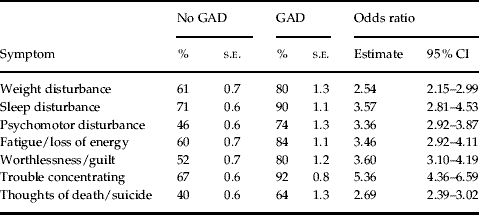
Of the total sample, 13753 respondents (32%) reported feeling sad, blue, depressed or lacked interest/pleasure for a period of 2 weeks at some point in their life. Respondents who did not experience 2 weeks of depressed mood or lack of interest or pleasure were excluded from the current analysis, as they were not assessed for the remaining MDE symptoms. Of the studied sample, there were 1645 (11.9%) respondents with a lifetime diagnosis of GAD. The prevalence estimates and odds ratios of MDE symptoms stratified by GAD are presented in Table 2. In respondents with GAD, the odds of reporting any MDE symptom were higher than in respondents without GAD.
Prevalence and odds ratios of MDE symptoms stratified by co-morbid GAD

MDE, Major depressive episode; GAD, generalized anxiety disorder; CI, confidence interval; s.e., standard error.
Figures were estimated using the weight and sampling design of the 2001–2002 National Epidemiological Survey on Alcohol and Related Conditions (NESARC).
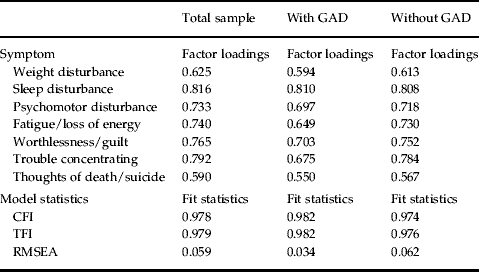
Table 3 shows the results of the CFA in the total sample and in the two subsamples. The CFI, TLI and RMSEA statistics provide evidence of a reasonably well-fitting one-factor model in the total sample and the two subsamples. Loadings on the one factor were sufficiently high for all symptoms, ranging from 0.59 to 0.82 in the total sample, and from 0.55 to 0.81 in the two subsamples. Taking these results into account we can conclude that the symptom data showed an adequate level of essential unidimensionality required by the IRT model.
Confirmatory factor analysis (CFA) of symptom criteria for DSM-IV MDE

MDE, Major depressive episode; GAD, generalized anxiety disorder; CFI, Comparative Fit Index; TFI, Tucker–Lewis Index; RMSEA, root mean square error of approximation.
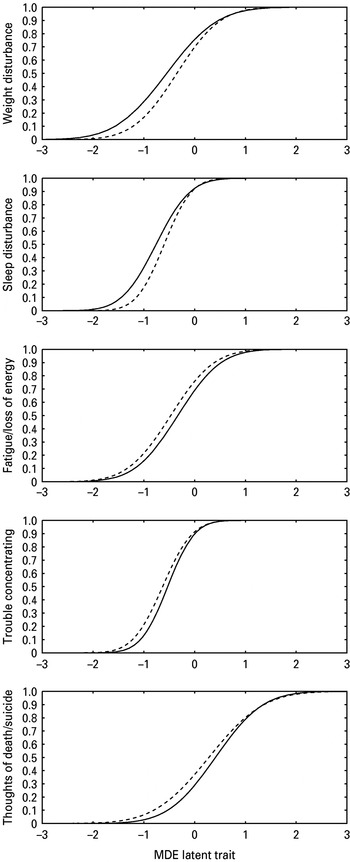
In the purification process prior to the DIF detection, two symptoms, psychomotor disturbance and worthlessness/guilt, were identified as the DIF-free anchor items and the remaining five symptoms identified as the target symptoms for the DIF analysis. Figure 2 presents the results of the DIF analysis for each symptom in the form of ICCs for the two groups studied. Assuming a theoretical probability that all DIF is located in one parameter, using 1 df indicates that DIF may be present in the a or b parameters in two symptoms, fatigue/loss of energy (G 2=4.8, p=0.03), and thoughts of death/suicide (G 2=4.1, p=0.04). In follow-up comparisons before adjustment, only one test symptom, fatigue/loss of energy, indicated significant b-DIF (the difficulty parameters were different between the two groups but the slope parameters remained the same: G 2=4.8, p=0.03). However, after adjusting the critical p value for multiple comparisons using the Benjamini–Hochberg method, no symptom of depression indicated significant b-DIF or a-DIF between respondents with and without GAD.
Item characteristic curves (ICCs) for the five major depressive episode (MDE) symptoms examined. Psychomotor disturbance and worthlessness/guilt were anchor items and assumed to be differential item functioning (DIF) free. ––––, Without generalized anxiety disorder (GAD); ·······, with GAD.

Discussion
The aim of the current study was to further understand the nature and source of co-morbidity between MDE and GAD by comparing MDE symptom functioning in those with co-morbid GAD and those without. The current study analysed data from a large community-based epidemiological survey to examine whether conceptually similar symptoms required for MDE and GAD may contribute artificially to co-morbidity. The data did not support the hypotheses of the current study that symptoms thought to be similar in wording and definition would exhibit significant DIF. After controlling for multiple comparisons, no symptoms of MDE were found to exhibit significant DIF between respondents with and without GAD. This result indicates that there is no evidence to suggest that cases with GAD differ in their MDE symptom profile to cases without GAD.
Many researchers have suggested previously that co-morbidity between MDE and GAD may be, in part, a function of the high degree of similarity in diagnostic criteria operationalized by the DSM-IV classification system and the associated endorsement of MDE symptoms is biased as a result (Brown & Barlow, Reference Brown and Barlow1992; Frances et al. Reference Frances, Manning, Marin, Kocsis, McKinney, Hall and Kline1992; Brown et al. Reference Brown, Antony and Barlow1995 b; Maser, Reference Maser1998; Hunt, Reference Hunt2000; Slade & Watson, Reference Slade and Watson2006). However, the findings from the current study do not offer further support for this hypothesis. If it were true we would have expected to see a different symptom profile, one associated with the endorsement of overlapping anxiety symptoms, emerge in cases with GAD compared to cases without GAD. However, some caution is required when drawing this conclusion because DIF detection using the IRTLR procedure is only one method to investigate differential symptom profiles between experimental groups and there is ongoing debate regarding which methodology is the most accurate (Millsap & Everson, Reference Millsap and Everson1993). Furthermore, the procedures of IRT and particularly DIF are relatively new to the field of psychiatry and clinical psychology and there is still a need for further refinement to the procedures used in this study. There is a need to replicate the current findings using alternative methods of DIF and in a variety of samples to provide additional support for our findings.
Despite the above concerns, the current findings can tentatively provide some conclusions regarding the source and nature of co-morbidity between MDE and GAD. As there was no finding of DIF, this seems to indicate that there is no interaction between the endorsement of anxiety symptoms in MDE and the presence of GAD. The presentation and experience of MDE could therefore be considered the same in cases with and without GAD. Why then do these two disorders co-occur, and why are the observed odds of endorsing MDE symptoms increased with the presence of GAD? One possible explanation stems from the literature addressing the latent structure of mental disorders. Clark & Watson (Reference Clark and Watson1991) argued that mood and anxiety disorders could be understood in terms of three underlying factors (negative affect, positive affect, and physiological hyperarousal). This model has since been extended to investigate the higher-order factor structure of the common DSM mental disorders, which has indicated that anxiety and unipolar mood disorders exist together on one underlying construct or dimension, similar to negative affect but now labelled the internalizing factor (Krueger, Reference Krueger1999; Clark & Watson, Reference Clark and Watson2006; Slade & Watson, Reference Slade and Watson2006).
Krueger & Finger (Reference Krueger and Finger2001) fitted a two-parameter IRT model to examine the relationship between the seven anxiety and unipolar mood disorders and the internalizing latent dimension. They found that MDE tended to occupy the lower end of the internalizing spectrum whereas GAD occupied the upper end. This model indicates that MDE is an easy disorder to meet criteria for and respondents with GAD (indicating a high level of internalizing) should more often meet criteria for the disorders that are indicators of a lower level of internalizing. Integrating this conception of co-morbidity with the results of the current study, it could be argued that the symptoms of MDE function as similar indicators of the underlying trait regardless of the presence of GAD. Respondents with GAD, however, are more likely to have endorsed the full range of MDE symptoms and therefore a reduced chance of having pure GAD, as they are considered higher up on the internalizing spectrum.
There are several limitations of the current study that should be considered in light of the results. First, the data were based on retrospective self-reports of MDE and GAD. There is some concern that the retrospective nature can influence the results due to recall bias (Simon & Von Korff, Reference Simon and Von Korff1992; Simon et al. Reference Simon, Von Korff, Ustun, Gater, Gureje and Sartorius1995; Kruijshaar et al. Reference Kruijshaar, Barendregt, Vos, de Graaf, Spijker and Andrews2005). Certain MDE symptoms may or may not have been reported depending on the limits of each respondent's memory. This is a common problem faced in the field of psychiatry and clinical psychology as there are relatively few, and in some cases no, strict laboratory tests that can be applied to corroborate the patient's self-report. As a result, the current study must assume that the majority of patient self-report responses are an accurate reflection of past life events.
Second, the interview contained embedded gate/skip questions that automatically partition the respondents into smaller subsamples depending on their responses. For the current study, the sample was partitioned into respondents who reported at least one of the first two symptoms of depression. An accurate analysis of these two symptoms was not possible; nor was it possible to examine respondents who might endorse symptoms of depression without these two symptoms. A study by Zimmerman et al. (Reference Zimmerman, McGlinchey, Young and Chelminski2006) using a skip-free diagnostic assessment found that almost all patients (98.5%) who endorsed five or more symptoms of MDE, therefore meeting the DSM-IV symptom criteria, indicated at least low mood or lack of interest/pleasure as one of their symptoms. Therefore, although an accurate analysis of the first two symptoms could not be attained, we are confident that the sample examined in this study is representative of a subpopulation at greater risk of developing MDE. Furthermore, the benefits of examining data-rich community-based epidemiological studies, despite the restricted sample, far outweigh the negatives if we do not. One major benefit includes the ability to investigate the symptom profiles in a large sample of respondents from the wider community with a diverse range of sociodemographic features.
Third, despite the significant strengths of the IRTLR approach, including the ability to detect differences in groups that are matched according to a common underlying trait, there are some unresolved limitations that are often neglected in previous studies that implement the same procedure. Foremost is the IRT assumption that the underlying trait is normally distributed in the population under investigation. In the field of psychopathology, where the focus is on abnormal or maladaptive behaviour, the underlying latent trait is often unlikely to have a normal distribution. Woods (Reference Woods2008a), in a simulation study, found that violations of this assumption can lead to greater type I error rates, particularly when no anchor set is specified. The current study attempted to address this issue by setting an explicit DIF-free anchor set and then using the Benjamini–Hochberg method to control type I error at 5% across the study. Woods (Reference Woods2008b) has recently developed a method that can reliably detect DIF using IRTLR methods in non-normal distributions. However, the procedure has been developed assuming a non-normal distribution in the focal group only, and it is not expected to work well when the reference group is non-normal yet presumed normal. We had no reason to believe that, in the current study, the focal group had a non-normal distribution but the reference group was normal; therefore, it was decided not to proceed with this additional testing.
The current study is the first to specifically investigate the hypothesis that conceptually similar symptoms contained in the DSM-IV diagnostic system may artificially contribute to the co-morbidity between MDE and GAD. Using an IRT-based procedure, our results show that there is no evidence of differential reporting of MDE symptoms between survey respondents with and without GAD. Nevertheless, high co-morbidity between MDE and GAD remains. Fortunately, the current findings indicate that co-morbidity is less likely to be an artefact of the diagnostic system and more likely to be the result of a true underlying association between diagnostic constructs. Additional research is required to support and confirm the findings of the current study.
Acknowledgements
This study was funded in part by an Australian Postgraduate Award doctoral scholarship and NHMRC project grant no. 510137.
Declaration of Interest
None.