Despite widespread fear of a regulatory race to the bottom, states with large markets routinely shield domestic regulatory policies from global pressure and force the costs of adjustment onto foreign corporations and governments.Footnote 1 Both through extraterritoriality and “leveling the playing field,” these states coerce firms into following their rules even when a firm operates outside their jurisdictions.Footnote 2 Scholars have demonstrated such regulatory reach, often under the broad banner of “market power,” across a host of sectors and issue areas including corruption, economic sanctions, finance, pharmaceuticals, and international trade.Footnote 3
These findings are largely based on America's experience in the context of economic unipolarity.Footnote 4 But with the rise of other significant economic players, we regularly see empirical phenomena that no longer fit such general theorizing. In a number of sectors the United States has been outfoxed: European Union (EU) rules have become the de facto global standard in areas like data privacy and environmental regulation despite repeated US attempts to export its rule book.Footnote 5 At the same time, global firms have not shied away from cutting ties with states that, by virtually all conventional measures, possess substantial market power. For example, American companies like Uber and Google left the Chinese jurisdiction because of the country's convoluted market structure, and the adverse restrictions placed on the tech giants. These anomalies indicate that scholars need to shift the debates about market power away from a focus on whether states are able to regulate the behavior of foreign jurisdictions or firms to, instead, analyze the conditions under which this is more or less successful.
In this article, we reexamine the building blocks of what constitutes market power, emphasizing how political development in one state reshapes its rival's ability to export adjustment.Footnote 6 While studies generally look at economic fundamentals to assess such coercive capabilities,Footnote 7 this underestimates the role played by political institutions. Even if a state has surplus capital or numerous consumers within its borders, it relies on political institutions to effectively mobilize such abundance. Importantly, the political organization of markets varies across and within even the most “powerful” states.Footnote 8 We argue that such variation in political organization and oversight of market rules dictates a state's ability to exert or limit adjustment forces.
More specifically, we expect that when a state expands its jurisdiction, harmonizing rules across otherwise distinct subnational or national markets, it can enhance its market power and curtail that of its competitors. Market power ultimately depends on firms’ decisions to comply with the rules and standards set in one country. By diminishing the transaction costs associated with border effects and creating a focal point of authority, jurisdictional expansion increases the attractiveness of a firm's home market and its rule set. This makes the institutions and markets of other economic powers more substitutable. Firms weigh these opportunities at home against the benefits of participating in the foreign market, including the value of their prior investments and the potential costs associated with adjustment pressure. For an important segment of firms, then, domestic institutional changes blunt the extraterritorial pressures of competing economies.
To assess the effects of changes to jurisdictional boundaries on firm responses to adjustment pressure, we examine how institutional reforms within the European Union (EU) reshaped the reach of US market power in finance during the 1990s and 2000s.Footnote 9 While financial markets within Europe had grown increasingly interdependent in the 1990s, they lacked a common governance structure until the introduction of the Financial Services Action Plan (FSAP) in 1999.Footnote 10 We expect that this transformation in the internal governance of the EU, which consolidated oversight and rules for cross-border finance at the supranational level, expanded its market power. This had important ramifications for the extraterritorial reach of the major financial power at the time—the United States.
In particular, we examine foreign firm reactions to the US's Sarbanes–Oxley (Sox) corporate governance legislation of 2002. Following the massive WorldCom and Enron scandals, American financial regulators quickly came together to pass the act, which substantially increased reporting requirements and altered the corporate governance practices of firms traded on American stock exchanges. Crucially this legislation affected not only US-incorporated firms but also any foreign firm listed on US exchanges, forcing these firms to alter their business practices in the US and also their operations at home. In a shift from the past, a large number of non-American firms delisted from US exchanges. We examine the determinants of this delisting. Since the literature on market power frequently uses US financial markets as its primary empirical site of investigation,Footnote 11 exiting from these markets becomes a hard case for our theory.
To test the argument, we use firm-level data from a number of financial databases to examine foreign-traded firms on major US exchanges. Moving to the level of the firm, we can better scrutinize the microfoundations of market power, which have been typically studied at the level of the state with a focus on issues of policy adoption. This allows us to understand how different groups of market actors alter their behavior in response to changes in market power rather than just focusing on aggregate interstate bargaining. We find that jurisdictional expansion is correlated with firm decisions to delist from the US following the implementation of Sarbanes–Oxley: firms that are incorporated in the European Union are substantially more likely to delist than non-EU-based firms.
The finding is statistically significant, substantively large, and robust to a battery of checks that account for both firm and home-market economic characteristics. For example, we conduct quasi-placebo tests by including dummy variables for major developed markets that could otherwise provide economic exit opportunities for their home firms. In the absence of changes in political organization in these jurisdictions, we find no statistically significant relationship between economic market size and firm delisting patterns. In addition to evidence linking political institutions to market power, we further specify the channel through which market forces shape firm behavior because investment mobility influences delisting decisions. We generalize the plausibility of the finding through brief narrative vignettes including global insurance regulation, Brexit, and India's Goods and Services Tax (GST).
Our argument provides insight into a number of conversations in International Relations. First, it reconceptualizes the literature on the role of market power in international political economy.Footnote 12 More than market size, we find that scholars must pay attention to institutional developments in competing jurisdictions. Second, we add to the body of work that attempts to understand the rise of economic multipolarity on global governance.Footnote 13 Instead of focusing on economic development in the European Union, China, or other rising powers, we show that political development relative to peer competitors is a key source of power. In this vein, our findings highlight a need to consider the sequencing of domestic reforms across important economies, and firm heterogeneity, as key constraints on economic statecraft.Footnote 14 In terms of public policy, it underscores how states frustrated with great-power regulatory expansion will need to develop their internal regulatory capacity if they want to protect their firms from adjustment pressure and signals the international costs of excessive domestic decentralization and deregulation.
Who Governs Global Firms?
As tariff barriers eroded and capital markets integrated, early globalization scholarship emphasized the degradation of state authority.Footnote 15 Some went as far as to call global finance a new structural condition of the international system,Footnote 16 while others focused on how corporations might skirt rules by bouncing from one jurisdiction to another.Footnote 17 Rather than globalization heralding an end of rules, it has been characterized by significant reregulation that creates a new set of distributional consequences.Footnote 18 Scholars of political economy emphasize that large economies naturally have a disproportionate ability to become rule setters by deploying market power.Footnote 19 Instead of countries all racing to the bottom, allowing multinational corporations to pick those states with the weakest regulation, firms often follow the practices dictated by these jurisdictions.Footnote 20 Such states leverage market power to externalize their domestic rules through two general channels: by directly coercing multinational corporations or by indirectly altering the bargaining between a global firm and its home government.
States may condition market access to impose regulatory change. In this brand of extraterritoriality, firms face barriers to entry if their home markets do not adopt equivalent regulations or firms may face regulatory oversight regardless of where their activity occurs.Footnote 21 For example, within antitrust regulation, it has long been American policy to investigate mergers that might affect the operation of US domestic markets, making Department of Justice (DOJ) approval a global necessity.Footnote 22 China has replicated this, adding an explicit extraterritorial clause into its competition policies, using it as a mercantilist tool to satisfy it appetite for commodities.Footnote 23 Increasingly, states attempt to regulate global firms based on the presence of some assets within its jurisdiction. The Foreign Corrupt Practices Act, for example, was initially set up to weed out American firms bribing foreign government officials.Footnote 24 But over the past decade the Securities and Exchange Commission (SEC) and the DOJ have charged a number of multinational corporations (MNCs) ranging from Siemens to Statoil for such “corrupt practices,” claiming jurisdiction based on the fact that these firms raise funds through US markets.Footnote 25 The European Union's latest efforts to regulate online privacy means that any firm dealing with the data of a European citizen, regardless of whether the firm is located in Germany or India, must follow European data privacy law.Footnote 26 In many cases, such global extensions of domestic law are relaxed if countries or firms adopt equivalent regulations or practices. Such adjustment pressures occur in a host of sectors ranging from finance to chemicals to the Internet.
Large states can also have a more indirect effect by changing the relationship between foreign firms and their home market governments. Firms competing in multiple jurisdictions may seek to level the playing field to reduce the competitive burden of producing different products for different markets.Footnote 27 In particular, firms may lobby their home governments to adopt similar rules to those maintained by a large market to equalize the regulatory burden that they face at home against domestic producers.Footnote 28 This has lead scholars like Vogel to emphasize that globalization regularly leads to a “trading up” where the environmental and safety standards of major powers become the global de facto rules, curtailing the effects of a race to the bottom.Footnote 29 Trading up unfolds despite the absence of overt international coordination, interstate bargaining, or great-power coercion. By leveling the playing field, firms externalize the cost of doing business in large markets.
These theoretical and empirical examples illustrate that states have not shied away from flexing their financial muscles to alter the behavior of foreign actors to achieve their governance goals. Nevertheless, analysts recognize key limits on the effective exercise of market power. Important economies have not always been able to leverage market size to change global practices.Footnote 30 It is unclear how to understand the interaction of large markets when they diverge. Drezner, for example, argues that when great powers agree, global governance is possible; when they disagree, the result is rival or sham standards.Footnote 31 Instead, a growing number of examples demonstrate one great power outmaneuvering the other.Footnote 32 What accounts for such variation in the politics of adjustment? In other words, under what conditions is market power likely to be more or less effective? To answer these questions, we believe that the literature must make two important analytical steps. First, it requires more attention to the institutions in which markets are embedded. Second, scholars must consider the interaction of these institutions across large economies.
Jurisdictional Boundaries and the Limits of Market Power
Market power is often used loosely in international political economy (IPE).Footnote 33 At various times it refers to the stock of one's consumers,Footnote 34 bilateral trade flows,Footnote 35 or surplus capital.Footnote 36 While operationalizations vary, they typically focus on economic indicators. We recognize the important role that market size plays in its various incarnations, but argue that political institutions, not just economics, dictate market power. Moreover, we expect that market power exists in relation to other states so that changes in political institutions in one jurisdiction constrain or enable the market power of another. Specifically, we examine the relationship between jurisdictional boundaries and market power, exploring how harmonization of governance in a firm's home state reshapes the substitutability of a rival's market and in turn weakens the adjustment pressures faced by those firms.
We start from the premise that firms participate in foreign jurisdictions because they deem the benefits of entry, such as new consumers, as outweighing the costs of entry. They are unable to fully reap these benefits in their home market. Entering a foreign jurisdiction is seen as beneficial by virtue of the economic potential of participation in it. A firm cannot generally replace the advantages of the host market by switching the location of its business activity and thus complies with the rule set of the foreign jurisdiction. This lack of substitutability undergirds virtually all the definitions of market power referenced here but current theories almost exclusively look at the economic bases for substitution or exit.Footnote 37
A large body of work in comparative political economy, however, illustrates that predictable political institutions with clear rules reduce transaction costs and make markets possible. States always have some baseline set of institutions that allow their markets to function. As literatures like the Varieties of Capitalism (VoC) comprehensively document, even the most developed or economically dynamic states display broad variations in political institutions and this pattern has persisted despite many expecting convergences as a result of globalization's pressures.Footnote 38 While the economic fundamentals of a firm's home state are relatively constant and difficult to wholesale engineer, states regularly alter their domestic institutions to make their markets more efficient and attractive.
Research on global governance generally assumes that, when it comes to formulating and maintaining the foundations for markets, authority resides at the national level. But potential market size is not always coterminous with regulatory authority.Footnote 39 Countries following a federal system, for example, often leave product standards to the whims of various subnational units, creating a number of disconnected subnational markets. In other words, the delegation of political authority to the subnational, national, and supranational level may not align with the territorial boundaries of markets.Footnote 40 Firms have to abide by a host of different regulations before they de facto have access to an entire market. One could imagine an analogous situation when few uniform regulatory rules exist and private actors at the local level are largely left to regulate market behavior. In these cases, where a misfit between size and authority exists, markets are characterized by political fragmentation.Footnote 41 Before it can completely tap diverse consumer pockets, a firm faces numerous barriers to entry depending on where governance authority is located. The higher the fragmentation, the higher the costs firms face, and thus the lower the gains from doing business in the state.
At the same time, leveraging market access—a key channel of market power—implicitly relies on political foundations. If decisions concerning market access are decentralized, it becomes more difficult to coordinate entry rules vis-à-vis foreign firms. Subnational jurisdictions may also face race-to-the-bottom incentives, lowering standards to attract investment. Fragmented oversight, whether through private actor or subnational governance, will hinder the development of clear rules that can be monitored and implemented in a way that is equivalent to the economic size of the market and may constrain international representation of those rules in negotiations.
The importance of such domestic political coordination for global governance outcomes is supported by a growing body of work linking regulatory capacity to market power.Footnote 42 For example, despite China's vast stores of capital and American treasuries, it has been unable to flex this might in international financial negotiations. In part, this stems from the lack of a clear, independent bureaucratic apparatus that can oversee and coordinate national market rules.Footnote 43 Similarly, the fact that insurance regulation is left up to states, as opposed to the United States federal government, has regularly prevented the US from exporting its insurance regulations.Footnote 44
One option open to states to enhance their markets and global authority is to alter the boundaries of their jurisdiction. By making market oversight more expansive, for example, by moving from the subnational to national level, governors reduce the burden for firms operating in any one of the submarkets. Decreasing the number of actors dictating rules of exchange generally standardizes the content of an otherwise fragmented system. As transaction costs decrease and oversight is centralized, internal clashes of different regulatory regimes diminish, and the change in boundaries mobilizes latent market power. We could still have, economically or geographically speaking, separate national or subnational markets, but when brought under the same set of regulatory institutions, this alters the costs firms need to pay for access and in turn the costs of compliance.
Jurisdictional expansion may attract greater investment from foreign firms but it also has global consequences for other states as they attempt to exercise market power. Such institutional changes create a new set of exit options for globally active firms from that home jurisdiction—home states can now better provide, all else equal, many of the economic benefits that lead the firm to initially invest in a rival jurisdiction. The increases in efficiency can unlock the home market's potential and, since the firm by definition will need to abide by these rules, has few additional costs.
However, such increases in market power by a firm's home jurisdiction may have varied effects on firms. Increased market power is likely to induce exit for the firms that assess the benefits of the expanded home market as outweighing the value of prior investments and future compliance costs in the foreign market. It may also serve as a prospective measure to limit the number of firms that enter the foreign market in the future. While it is difficult to measure the latter effect, exiting decisions should be most observable as rival states attempt to externalize adjustment costs. We expect that global firm behavior is relatively path dependent because firms will have already invested in a rival state.Footnote 45 The greater the costs of moving operations to another jurisdiction, the less likely firms should be to alter their business practices even when faced with new adjustment pressures. When, however, a rival state tries to exercise its market power, such as through extraterritorial regulation, the new exit options provided by jurisdictional expansion at home alters the corporation's calculus. In other words, we also need to pay attention to the diversity of firm investment portfolios to fully understand a state's ability to extraterritorially extend its authority.
Rather than simple market size defining the ability of a state to dictate global rules and firm behavior, market power depends on the home market's political, rather than solely economic development. Our approach, then, captures how market power is conditioned by institutional developments in rival markets while controlling for the heterogeneity of firm practices. It leads to our core testable expectations:
Globally active firms are more likely to exit from, rather than adjust to, a rival market's pressure if their home government creates a more efficient market through jurisdictional expansion.
EU Jurisdictional Change and the Limits of US Market Power
We seek to test how a firm's response to adjustment pressure is conditioned by its home market's political development. With this in mind, we focus on EU firms, which gained from the harmonization of financial regulation across European jurisdictions known as the Financial Services Action Plan (FSAP), as they responded to the introduction of US extraterritorial corporate governance legislation.
Creating a single market for financial services was always a central goal for European integrationists and the EU made huge strides toward achieving this aim with the introduction of the FSAP. First openly discussed in 1998, the commission and council endorsed the plan in 1999 and 2000 respectively.Footnote 46 It is composed of forty-two major regulatory changes that radically diminished the costs of raising money and trading shares across EU member state borders.Footnote 47 It enacted a host of new retail financing and insurance measures, a coordinated initiative to prevent market abuse, and reduced charges for cross-border money transfers. Implementation proceeded rapidly.Footnote 48 Particularly relevant to our investigation, a pan-European framework for corporate reporting using International Financial Reporting Standards (IFRS) was agreed to in 2000, requiring all companies listed on European exchanges to use a common set of accounting rules.
The FSAP is a quintessential example of jurisdictional expansion where disparate markets are brought under one regulatory framework. But it is not simply the creation of a new economic marketplace—firms trading in London or Paris still, de jure, operate in these markets. Instead, by harmonizing rules, it creates a set of complementary financing mechanisms with minimal regulatory burden. To paraphrase EuropeanVoice, if the euro was like giving birth to a baby, FSAP and its changes were like decorating the nursery, announcing the EU's arrival as a coordinated player in global finance.Footnote 49
While EU representatives tended to focus on the benefits of new investment opportunities for consumers, the real winners were EU-based corporations. FSAP fortified the famous “single passport” implemented in 1993, which allows firms to access products from across Europe through one consolidated entry point. It standardized a host of accounting and reporting requirements, and allows financial service providers to operate across borders with virtually no regulatory hurdles. This is in stark contrast to the previous nationally fragmented regime, where European firms were forced to comply with national rules of multiple EU member states.
FSAP was universally seen as positive by the European commercial community. The likes of Standard Bank celebrated “the major benefits in terms of compliance and administration” while others stressed the role of the single passport in increasing “real scope for market expansion.”Footnote 50 FSAP would bring together the EU's thirty-three different markets under one regulatory banner. Prior to FSAP the cost of a cross-border trade was six to seven times higher than domestic trades. Standardization through jurisdictional expansion meant that new stores of capital could be released to fund European business. As Fritz Bolkestein, European commissioner for the Internal market noted in 2000, “the capitalisation of European investment funds/pension funds/insurance products alone is about Euros 10,000bn ($9,500bn)—more than the EU's GDP. Small efficiency gains will have a significant impact.”Footnote 51
A number of IPE scholars have documented the importance of the reforms. The introduction of FSAP changed global financial regulation from a world dominated by a single economic great power to one where the European Union emerged as a clear challenger.Footnote 52 While commission officials generally emphasized the domestic benefits of the new regulations, they, and particularly Bolkestein, were not shy to express these global ambitions: “Financial services is the oil in the machine. We cannot seriously compete with the US and other industrialised countries unless we have a financial system which provides the liquidity in the market which our businesses need.”Footnote 53
Discussing the need for a uniform set of accounting standards, the commission expresses the core concerns featured in our approach, emphasizing the costs of internal fragmentation and the need to reduce US market power by expanding jurisdictional scope:
[Maintaining multiple accounting books] is burdensome and costly and constitutes a clear competitive disadvantage. Producing more than one set of accounts also causes confusion. Moreover, it involves companies in conforming with standards (US Generally Accepted Accounting Principles or GAAP) which are developed without any European input … This situation is not satisfactory. It is costly and the provisions of different figures in different environments is confusing to investors and to the public at large. There is a risk that large companies will be increasingly drawn towards US GAAP … Externally, the absence of a common position on accounting issues has prevented the EU from playing an effective role in international fora.Footnote 54
Our primary research question, then, explores how institutional changes in Europe can enhance its market power and dampen the market power of other states such as the United States. The US has consistently set the rules for foreign financial entities, with a number of market-power theories explicitly based on America's dominance of global financial regulation. The US asserted its preferences in a range of international cooperation areas such as capital requirements and insider-trading rules. Moreover, US regulators have been able to leverage a firm's presence on US securities markets to investigate the bribery of government officials, and charge foreign firms for corporate violations, like sanctions evasion and financial fraud, that occur outside American borders.Footnote 55
Despite this broad authority, the success of America's extraterritorial endeavors has varied across time. Given that such measures are often triggered by the infractions of non-American firms, issues of endogeneity can be hard to overcome. To resolve this issue, we focus on the passage of the “Corporate and Auditing Accountability Act,” more commonly known as Sarbanes–Oxley, or just “Sox,” which, we argue, struggled to fulfill its global mandate as FSAP created new exit options for EU firms trading on American exchanges.
Passed in early 2002, Sox is generally regarded as a near overhaul of American corporate governance. The bill made a number of crucial interventions in organizational practices including introducing salary claw-backs for executives, mandating the need for third-party auditors, and increasing white-collar-crime penalties and their enforcement by boosting funding of the Securities and Exchange Commission. A number of provisions directly affected publicly traded firms’ profits. In particular, Sox dramatically increased the financial information a firm needed to provide shareholders, taking into account stock trades, and any off-balance-sheet business.Footnote 56 These measures were far more stringent than any of the reporting requirements for stock exchanges in other markets. Importantly for our purposes, non-American firms were required to change not only their US reporting practices but their global ones as well, creating significant extraterritorial costs.
Reactions by foreign firms doing business in the US signal both the limits of US market power as well as the potential of jurisdictional expansion in the EU. Jurgen Halbrecht, CEO of the German company BASF, a listed company on the New York Stock Exchange, called Sox nothing short of “bureaucratic overkill.”Footnote 57 Simon Watkins, company secretary of UK-based Lastminute, which was considering listing in New York, said that “when Sarbanes Oxley was enacted, we felt that it was going to be a cost that was so significant for us that the benefits of having an additional listing in the States were more than outweighed.”Footnote 58 He expected that the firm would still find a way to attract US investors via listings in other markets that were now developing.Footnote 59 Sports-car maker Porsche quickly canceled its plans to IPO in New York, citing Sox's new compliance requirements as too cumbersome.Footnote 60 Representatives of the London Stock Exchange, on the other hand, were ecstatic when a number of international issuers told them that Sox meant that the balance of power was going to move away from New York.Footnote 61 With the costs and contradictions in mind, and in spite of US market power, dozens of foreign firms voluntarily delisted from US exchanges between 2002 and 2005. In response to Sox, David Sun, partner at Ernst and Young, noted that firms with “overseas operations generally want a ‘one-stop shop’ when it comes to their accounting,” which was, ironically, precisely what the EU was now implementing with FSAP.Footnote 62
Numerous studies have since validated the expectations of frustrated executives—the cost of complying with Sox, for the average firm, is in the millions of dollars on an annual basis.Footnote 63 The costs on the US markets, writ large, should also not be underestimated. Econometric analysis shows that new firms listing in the US after Sox generally come from countries with weaker corporate governance, implying that American exchanges began to lose out on a number of high-quality firms.Footnote 64 Over time, the frictions created by the legislation even forced the SEC to provide a number of concessions to European companies surrounding reporting requirements and auditor independence.Footnote 65
For our research design, three specific features of the legislation are worth noting. First, the extraterritorial move caught virtually every company off guard and had a minimal relationship to the behavior of the foreign firms whose reactions we seek to assess. Sarbanes–Oxley was primarily the result of a series of domestic scandals and the huge amounts of value that were sucked out of American exchanges following the collapse of Enron and Worldcom. The accounting changes were forced through because of the various conflicts of interest that were uncovered during those investigations, specifically concerning the way “independent” auditors aided and abetted such malpractices. While globally active firms found themselves subject to many of the requirements of the legislation, Sox was exogenous to the behavior of foreign corporations. Second, the contents of Sox and FSAP were unaffected by each other—if anything Sox went out of its way to ignore the political developments in Europe. This ensures that both our treatment, FSAP, and the increase in adjustment costs that cumulatively allow us to test the expectations of our theory, were independent events.
Third, Sox offers an observable instance of firms responding to US adjustment pressures in the context of a changed balance of relative market power between the United States and the European Union. Owing to reforms in internal European political institutions, EU firms could raise equity through the centrally regulated stock markets, or issue Euro-denominated bonds, all for a fraction of the price compared to pre-FSAP years. We expect that these increasingly efficient financing options that FSAP provided made the US equity markets more substitutable to EU firms, which made them less likely to obey Sox's adjustment pressures.
Leaving US equity markets restricts the channels through which a firm can tap into the vast stores of American capital. This potentially hinders future firm growth and places the firm in a tenuous position if any unforeseen expenses arise. It further increases the costs of funding US-based ventures as investments will be raised or funded from abroad and will incur additional transaction costs. Finally, although firms can continue operating in the broader American market, delisting degrades the value of their prior investments, particularly if these investments are relatively immobile, because listing acts as a substantial reputational boost.Footnote 66 In other words, listing allows a firm to both raise funds in an efficient manner and boosts the value of other non-equity-related business, fully realizing the potential of a firm's business operations. European firms needed to weigh these competing prerogatives—access to new financing options in the EU against compliance costs and a loss of equity market access in the United States—before they chose to adjust to American pressure or exit.
Data and Empirical Analysis
To assess the impacts of the EU's jurisdictional expansion through FSAP on the choice to adjust or exit following Sox, we collected firm-level data on all companies traded on American exchanges through the Compustat database for the years 1996 to 2006, and then excluded all US-based firms. We start the collection earlier than Sox to ensure that we analyze only companies that were already listed on exchanges prior to the regulation, and to verify that our hypothesized effect is not a generic relationship and is instead triggered by adjustment pressures generated by Sox.
To identify firms that voluntarily delist, we start with the list of foreign firms that exited the major American exchanges originally collected by Chaplinsky and Ramchand through the Center for Research in Security Prices (CRSP) database.Footnote 67 To verify and categorize their data, we conducted individual firm searches of Securities and Exchange Commission filings, and the news databases Factiva, LexisNexus, and GoogleNews. Keeping with standard corporate finance practices, we classify exits into three general categories—voluntary, involuntary, and through a merger or acquisition.Footnote 68 We then integrated the delisting decisions with the firm-level financial information from Compustat, and narrowed down the sample by analyzing only companies whose finances were adequately reported.
We identified over 1,400 foreign firms trading on American markets prior to Sox—approximately 22 percent of these firms were EU-based. Within three years after Sox, fifty-nine foreign firms voluntarily left American exchanges, nearly half of which belonged to EU jurisdictions. To put this shift in perspective, between 1980 and 1995 only seven firms voluntarily left the major US exchanges,Footnote 69 while between 1998 and 2001, EU firms constituted less than 15 percent of the firms that voluntarily left. The fifty-nine firms delisting post-Sox controlled approximately $86 billion in assets prior to leaving; EU-based firms accounted for $68 billion of those assets and came from a diverse array of industries from manufacturing to financial services and telecommunications.Footnote 70 This likely underrepresents the effect of jurisdictional expansion because it does not capture those European firms that decided against future new listings.
To assess the importance of jurisdictional expansion econometrically, we create a dummy variable if the firm's location of incorporation is a country that belongs to the EU and was, as such, set to reap the gains from more centralized governance. To control for the role that asset mobility may play in the delisting decision, we follow past IPE studies and assume that the mobility of firm investments generally depends on the nature of the industry they operate in.Footnote 71 We first create a dummy variable that indicates whether or not a firm is from an industry with immobile assets based on the North American Industry Classification System (NAICS). We treat agriculture, mining, utilities, construction, and manufacturing as industries that are characterized by large immobile investments and code the remaining sectors, such as finance and insurance, educational services, and health care as mobile. To ensure that these firms have investments in the US, we include only firms that report paying US state-level taxes. We focus on the state level because firms may report federal taxes as a result of their listing on American exchanges as opposed to their domestic business activity. The final operationalization then takes a 1 for firms that operate in immobile sectors and pay US state taxes and is a 0 for all remaining firms.
We also collect data to represent a host of alternate firm- and country-level explanations. Large firms generally have resources to withstand additional regulation while more efficient and profitable firms should also be able to absorb these costs. In line with other studies that investigate the determinants of delisting, we proxy for these using the natural log of a firm's assets and its Return on Assets (ROA), respectively.Footnote 72 The higher these values, the less likely a firm should be to exit. When companies delist, they regularly cite that they are not actually taking advantage of financing opportunities or that their firm is not being traded frequently enough to merit the costs of listing. We use the change in the firm's highest stock price to proxy for usage and trading.
At the country level, we include the strength of shareholder rights as measured by Djankov and colleagues’ Anti-Self-Dealing Rights index.Footnote 73 One of the key findings of the corporate finance literature on stock exchange use is that foreign firms list on US markets to illustrate that they are meeting high corporate governance standards and provide shareholders a structure that grants them stronger rights.Footnote 74 The index allows us to proxy for this “bonding” hypothesis. Next, we also incorporate market capitalization of a firm's home country stock market, which is collected by the World Bank. This allows us to assess whether basic economic substitutability plays a role in delisting decision making. For country-years where this is missing, we assume that the state has a negligible home equity market and recode the missing values as zeroes.
We follow the standard practice of delisting studies by employing event-history analysis.Footnote 75 We run a series of Cox proportional-hazard models to assess the probability that a firm will take a specific action—delisting—in a period of time, assuming it has not already done so.Footnote 76
Econometric Analysis
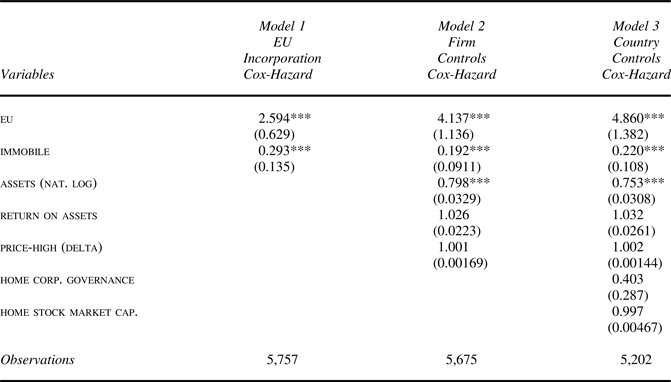
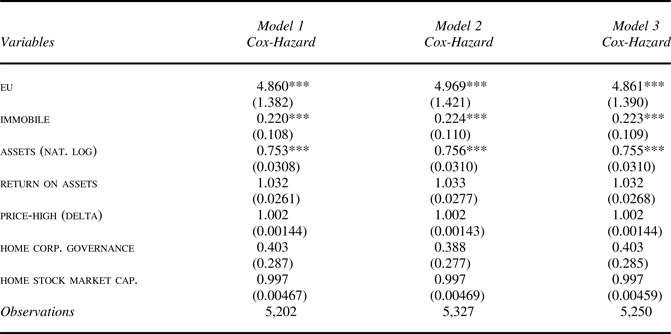
Table 1 reports results of the Cox proportional-hazard models for firm delisting. We begin with a Cox proportional-hazard model initially accounting for only our primary variable of interest, eu incorporation, and the degree of a firm's investment mobility (Model 1). The next model then adds additional firm-level factors that generally shape delisting decisions. The final model adds country-level covariates, the anti-self-dealing index, and degree of stock market development that account for general home-market substitution. In line with event-history practices, the table presents the hazard rates rather than regression coefficients. Models analyze the year Sox is passed and the following three years, in line with other delisting papers.Footnote 77 The three-year cut-off point is used assuming that this is enough time for firms to fully analyze its effects and that future delistings are unlikely to be directly affected by the legislation.
Determinants of firm delisting from US exchanges, 2002–2005

Note: Standard errors clustered by firm in parentheses; *p < .1; **p < .05; ***p < .01.
The results support the importance of changing jurisdictional boundaries. Across the models, incorporation in the EU means firms are more likely to exit US markets. This hypothesis is statistically significant and also has strong substantive effects. When accounting for just firm-level financials, Model 2 implies that businesses incorporated in the EU are 314 percent more likely to delist from US equity markets, all else equal, following Sox. The hazard model that includes the full set of controls suggests that firms belonging to the EU are 386 percent more likely to exit than non-EU-based firms. The results are significant at the .01 level. At the same time, we also see the importance of asset mobility in shaping firm decisions to adjust. Across all three models, firms with immobile investments in the US are less likely to exit US equity markets.Footnote 78
Some alternate hypotheses are also corroborated by our analysis. Large firms, proxied by the natural log of their assets, are less likely to exit—a finding that is statistically significant across models. Firm efficiency, however, does not appear to be a statistically significant predictor of voluntary delisting while the stock market capitalization of a firm's home market, which represents basic substitutability, does not appear to consistently affect post-Sox exit outcomes. The other political variable included in our analysis, a country's home market corporate governance, while in a negative direction in line with the bonding hypothesis, does not appear to be statistically significant. Jurisdictional expansion, and the reduced transaction costs it triggers, curbs the ability of the US to extraterritorially regulate corporate behavior.
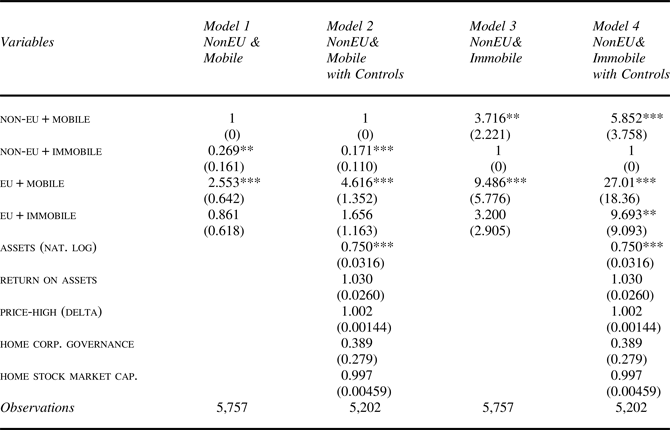
Next, we further examine the relationship between jurisdictional expansion and firm investments by running a series of models with interaction terms. Interaction terms in nonlinear models are generally difficult to interpret and assess, so we follow Buis's recommendation of choosing a reference category to then compute the ratio of hazards ratios of the interaction's elements.Footnote 79 In other words, we pick one subset of firms and compare how likely another subset of firms is to delist compared to that reference category. Models 1 and 2 use non-EU-based firms with mobile investments as the reference category, and Models 3 and 4 use non-EU firms with immobile investments as the reference. The initial model includes only the interactions and the second model includes all the relevant firm- and country-level covariates. Model 2 illustrates that EU firms are 362 percent more likely than firms with similarly mobile investments to eventually delist from the US markets, while Model 4 indicates that EU firms with immobile investments are approximately 870 percent more likely to delist than non-EU firms with similar investment profiles. These results bolster our argument about the importance of jurisdictional expansion.
The results also indicate the broader significance of taking into account a firm's investment profile to understand global governance outcomes. We see from Model 2 that there is no statistically significant difference between EU firms with immobile assets and non-EU firms with mobile assets. At the same time, firms with immobile investments are consistently less likely to exit compared to firms with mobile assets.
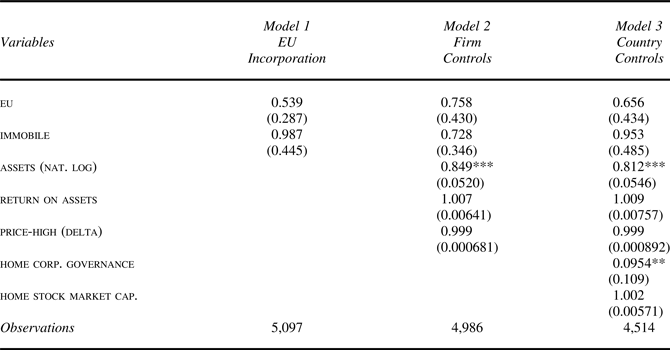
To further verify the importance of extraterritorial adjustment costs in firm decision making, we assess the determinants of firm delisting for the four years prior to the passage of the extraterritorial legislation. Of the firms listed by 1998, we identified twenty-six firms that voluntarily exited. Only four of these firms came from EU jurisdictions. We follow the same modeling strategy from Table 1 utilizing event-history analysis including firm- and country-level controls. From 1998 to 2001, the costs of complying with US regulations were relatively static with no major changes, but the EU was already implementing many of FSAP's biggest policy priorities like the move toward IFRS accounting standards. Results are presented in Table 3.
Incorporation in the EU appears to have no substantive or statistically significant effect on firm delisting decisions. At the same time, investment mobility does not appear to influence firm exit. Nonetheless, we find that the size of the firm is still one of the key predictors of delisting and the nature of a firm's home-market governance also appears to have a negative effect on exiting the US. The bonding hypothesis is also supported by these models. Coupled with the findings presented in Table 1 and Table 2, the results imply that the importance of being based in the EU is not a generic relationship but observable as US adjustment pressures increase. Rather than simple substitutability, or market size, the importance of reduced transactions costs comes to the fore as US adjustment efforts are blunted by political development in the EU.
Determinants of firm delisting from US exchanges, 2002–2005, including interactions with mobility
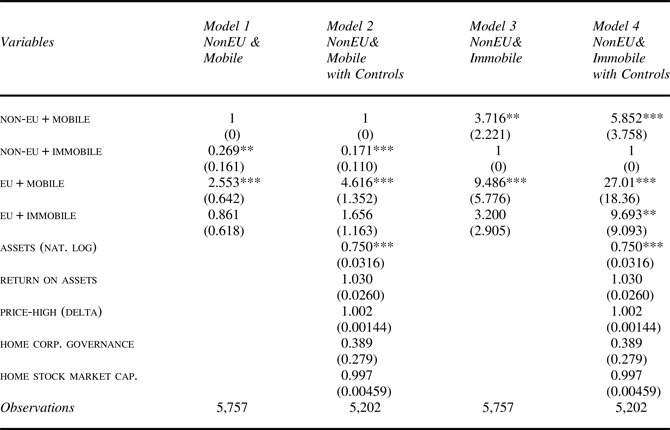
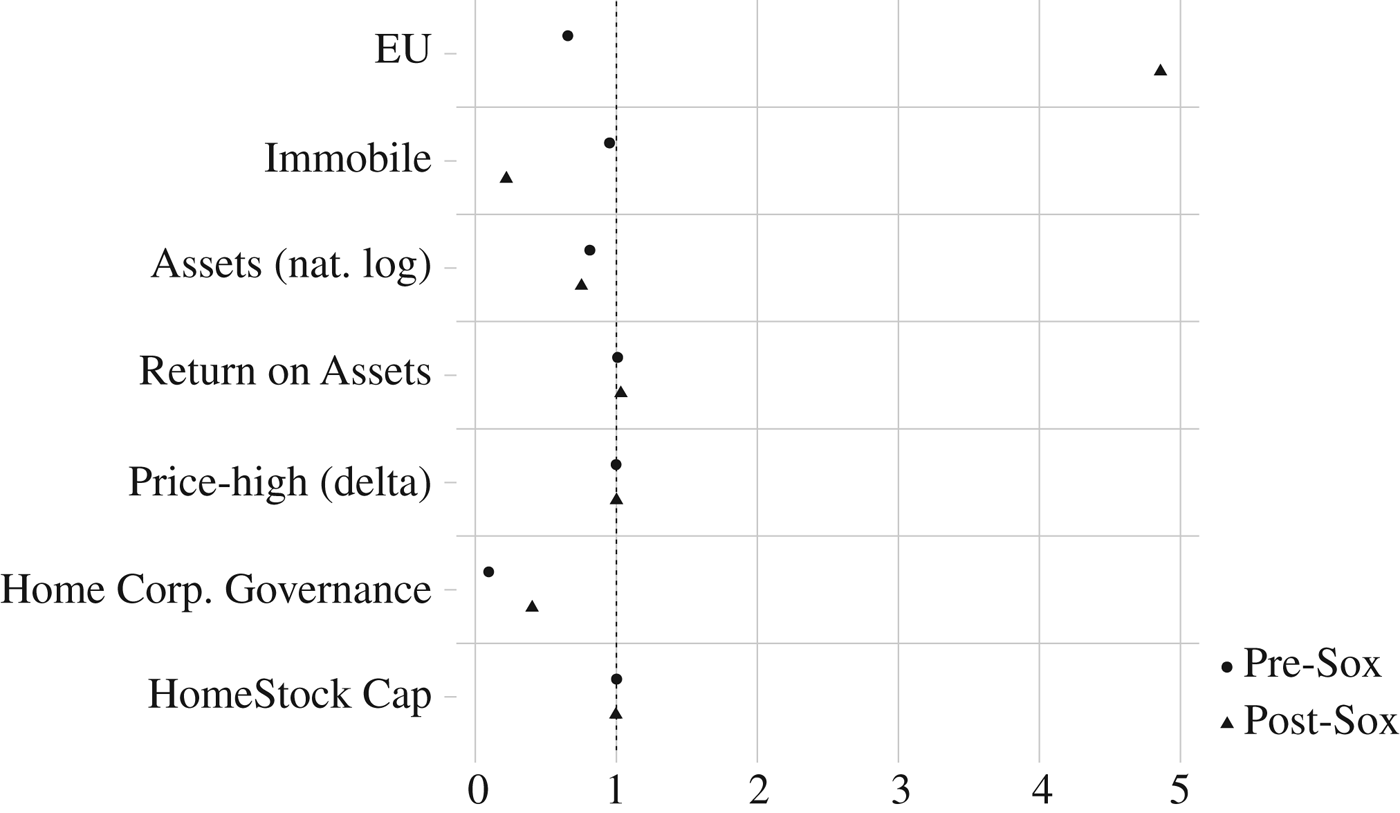
Figure 1 is a visual illustration of the differences in firm decision making before and after Sox. Specifically, it plots the hazard rates for each of our explanatory and control variables, with the vertical line at 1 allowing us to distinguish between covariates that have a positive or negative effect. The direction and substantive effects of virtually all the factors that affect delisting remain generally unchanged after the Sox treatment with the exception of EU incorporation and firm investment mobility. While some firm-specific characteristics are always predictors of leaving a market, those that we identify are activated once additional costs are placed on firms. Changes to jurisdictional boundaries appear to be the primary factor shaping delisting decisions following an extension of extraterritorial authority.
Hazard rates before and after Sox

Determinants of firm delisting from US exchanges, 1998–2001
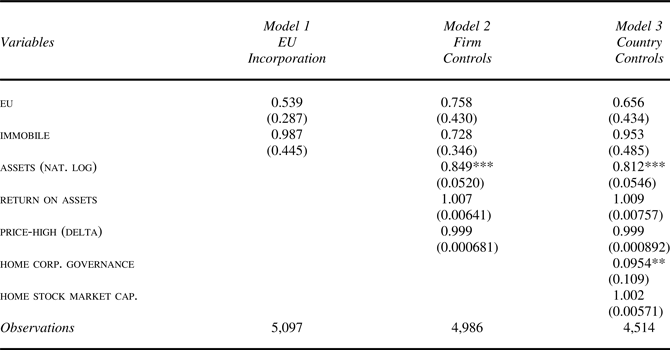
Note: Standard errors clustered by firm in parentheses; *p < .1; **p < .05; ***p < .01.
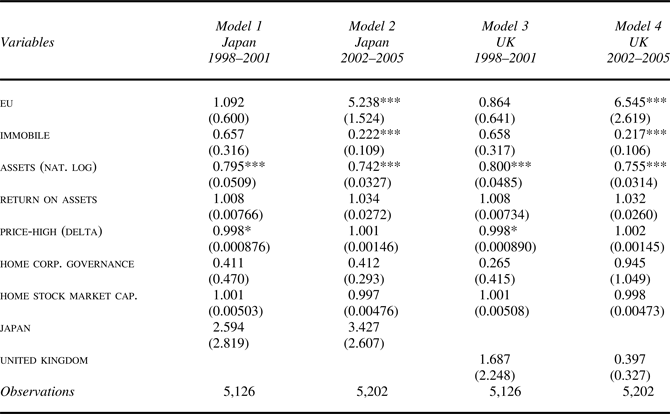
While the tests thus far provide substantial evidence for our jurisdictional expansion hypothesis, we bolster the claim by using a series of quasi-placebo tests. If the effect was driven solely by the new adjustment pressures of Sox and not jurisdictional expansion, we would expect firms with large home equity markets to also delist post-Sox. Therefore, we include a dummy variable for Japan, which had one of the most robust stock markets but had limited changes to its governance structure before Sox. Models 1 and 2 of Table 4 illustrate that contrary to the basic economic logic of prior market-power studies, incorporation in Japan has limited influence on pre- or post-Sox delisting but the effect of the EU post-Sox is robust to its inclusion.
Cox-proportional hazard analysis of firm delisting from US exchanges, with country placebos
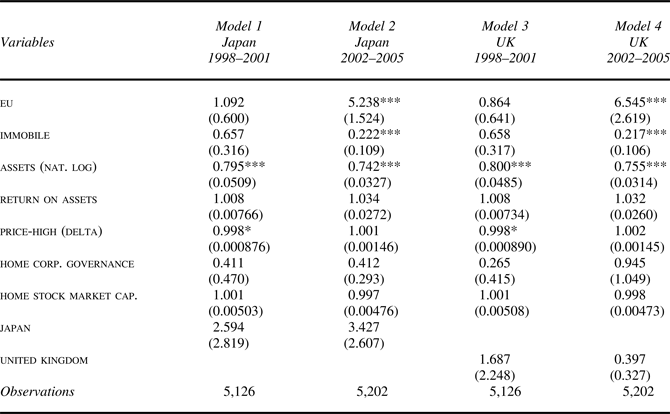
Note: Standard errors clustered by firm in parentheses; *p < .1; **p < .05; ***p < .01.
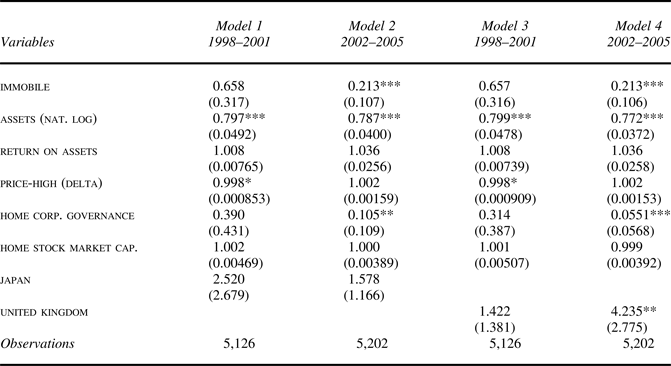
Next, if only economic fundamentals were driving the EU correlation as per existing market-power accounts, we would expect that firms from the UK, which had the most developed equity market within the EU, would be most likely to leave. In other words, standard market-power theories would predict that UK incorporation would drive delisting patterns before and after Sox, causing a spurious correlation between the EU and delisting. Instead we find no clear statistically significant relationship for UK incorporation while the EU variable continues to have positive, substantive effects despite the dummy inclusion. If anything, the substantive effects of the EU appear to be larger once these other country dummies are included. We also run these models without including the EU. The UK attains a positive significant effect post-Sox but Japan is not statistically significant. This further suggests the importance of FSAP over general economic shifts because the UK firms gained from the jurisdictional expansion, since it was then part of the EU, but the Japanese home market remained unaffected.Footnote 80
Robustness Checks
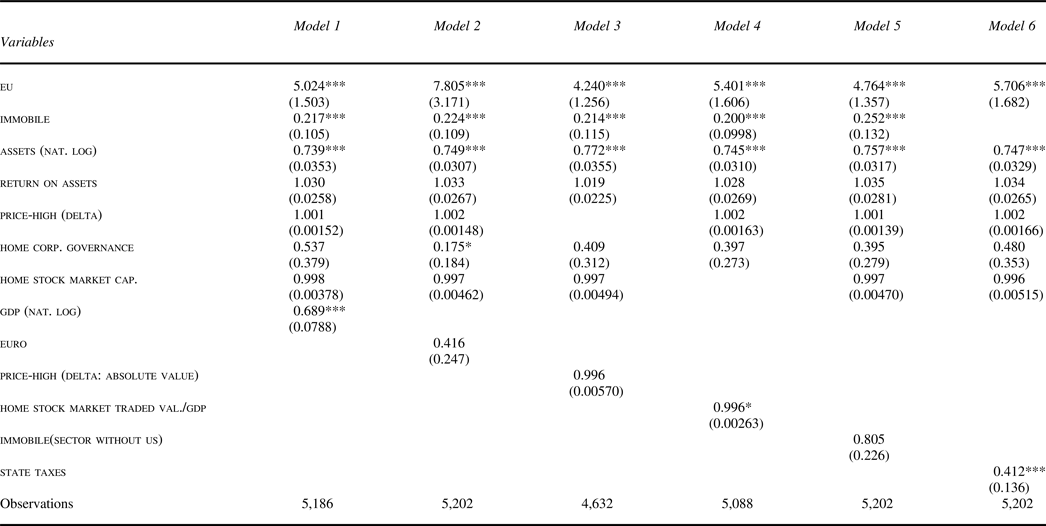
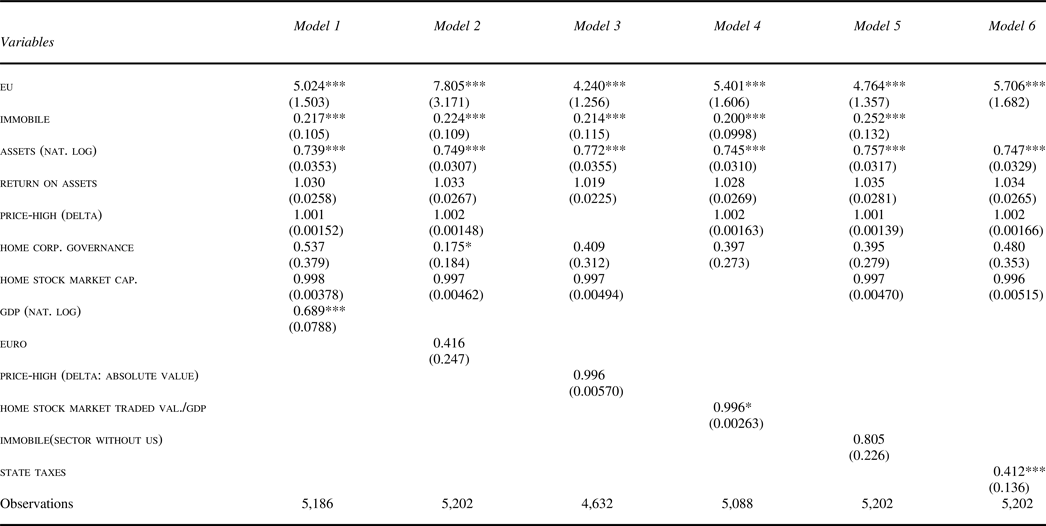
To boost confidence in our core findings, we run a series of robustness checks on the main post-Sox model presented in Table 1. We assess whether or not the results are subject to how we selected our sample. We run the Cox proportional-hazard model excluding only firms that involuntary delist and then firms whose delisting decisions we could not verify. The statistical and substantive importance of EU incorporation holds across these models.Footnote 81
Next, we assess whether our findings are a result of our control variables and how we operationalize them. First, we include the natural log of GDP, which has been used to capture market size and governance capabilities of the firm's home market. Second, we also include a dummy variable for whether or not the firm's home state was a member of the Eurozone to test whether the currency, rather than FSAP, is driving the results. Our results remain largely unchanged. We use the absolute value, rather than the basic change, in the stock's high price and a different measure for stock market development—the value traded on the stock market over GDP—to assess the importance of firm and home-market characteristics. Scholars may also be concerned that our proxy for fixed investments captures general capital-raising needs because firms in those industries tend to require more capital, rather than the importance of mobility in shaping delisting. We therefore include a dummy for whether or not a firm paid state taxes as an alternate proxy regardless of their sector. Throughout these models, the EU continues to have a positive, statistically significant effect on firm delisting decisions, while immobile investments consistently deter firms from exiting.Footnote 82
Narrative Extensions
The econometric analysis focused on the role of the EU's FSAP in changing firm behavior and the regulatory dynamics in the case of capital market listing decisions. Here we provide narrative evidence that illustrates the importance of political institutions in shaping market power. In particular, the examples illustrate how changes to jurisdictional boundaries (both expanding and contracting) are rearranging sovereign authority and firm decision-making patterns in a diverse array of contemporary political economy settings.
Dodd-Frank and America's global insurance game
For much of the postwar period, the United States struggled to implement its international agenda in insurance despite the fact that, economically speaking, it accounts for more than a quarter of the global market.Footnote 83 Instead, the European Union has dominated transnational regulatory venues like the International Association for Insurance Supervisors.Footnote 84 Most important, Europe has successfully exported its solvency rules, which detail the amount of assets insurance companies must maintain in the case of a crisis, putting US insurance firms under considerable adjustment pressure.Footnote 85
In keeping with our argument concerning the scope of jurisdictional boundaries, qualitative evidence highlights the timing of political developments in the two jurisdictions and how that has shaped relative market power. For a number of historical reasons, insurance in the United States has been regulated at the state level.Footnote 86 As a result, its national oversight is fragmented politically and has left the US flat footed in international negotiations. David Snyder, assistant general counsel for the American Insurance Association, concluded that “the state regulatory system is structurally incapable of representing US interests effectively, because it … lacks the legal authority to bind the United States.”Footnote 87 The European Union, by comparison, unified insurance oversight as part of the FSAP process and saw corresponding rewards in shaping global rules and promoting its Solvency II standards.Footnote 88 As in the case of Sox, Solvency II contains significant extraterritorial consequences for firms active in the EU in terms of their global holdings. To avoid such pressure, home markets may be deemed as maintaining equivalent standards to those in the EU. The US state-based system, however, hindered its ability to be deemed equivalent and thus put US firms at a competitive disadvantage.Footnote 89
US reforms responding to the global financial crisis suggest that US policymakers understood the limits of jurisdictional fragmentation. The 2010 Dodd-Frank Law created a Federal Insurance Office (FIO) housed at the Department of the Treasury, which was given the authority to represent the US at international financial organizations. Many insurance agencies that operate across state and national boundaries heralded the change as crucial to safeguarding American interests. As Gail Ross and Joy Schwartzman of global actuarial company Milliman noted, the change was about time: “Until now, the US has lagged behind many other countries—those in the European Union (EU), for example—in presenting a unified face to the world insurance market. For the US to compete effectively in the global environment, we need to streamline the rules and regulations governing the insurance business and speak as one country when negotiating international agreements.”Footnote 90
The shift has started to pay off and validated Milliman's perspective. The US, led by Treasury/FIO efforts, and EU regulators concluded an agreement that allowed the US to actually maintain its state-based form of regulation while still resolving a number of the extraterritorial pressures of Solvency II.Footnote 91 The transatlantic deal reversed a trend in which postcrisis reform initiatives had an EU slant that criticized the American approach.Footnote 92 The vignette demonstrates that even the US, which is typically viewed as a regulatory hegemon in finance, relies on domestic political institutions to activate its market power.
Brexit: Devolution's effect on market power
In a June 2016 referendum, the United Kingdom voted to leave the European Union. While it is too soon to fully assess the economic fallouts of Brexit, initial evidence illustrates how restricting the boundaries of jurisdiction weakens the UK's ability to exert market power. The devolution of authority from the supranational to national level not only means that the UK will lose access to the European single market, and a host of trade deals, but also ensures that London-based banks will lose the benefits of FSAP. The single passport rights, which make Euro-denominated transactions the bedrock of their profits, could soon be discarded.
The UK's ability to influence firm behavior is already diminishing. British behemoth HSBC will relocate at least 1,000 employees to Germany, while Swiss-headquartered UBS plans to cut a fifth of its employment in the city.Footnote 93 Price Waterhouse Cooper expects that London will lose 70,000 financial services jobs, accompanied by a 14- to 20-billion-pound loss in revenue over the coming years as a function of now falling outside EU jurisdiction.Footnote 94
This is not simply a firm-level story about economic market potential. Political decisions regarding the boundaries of jurisdiction are altering the balance of market power between the UK and the EU. Firms located in the UK can no longer take advantage of the institutions that make international financial transactions cost effective, thereby incentivizing companies to search for locations that can act as institutional substitutes, that is, cities still part of the EU jurisdiction. In fact, the European Central Bank had tried to move Euro-based financial services from London to the continent a few years back, but was thwarted by the EU General Court.Footnote 95 The devolution of jurisdictional boundaries has firmly placed the financial ball in the EU's court as Frankfurt, Paris, and Dublin all vie to lure financial services jobs to the EU-governed markets. Jamie Dimon, head of JP Morgan, neatly summarized the EU's gains that roughly translate to the UK's losses: “If the EU determines over time that they want to move a lot of jobs out of London into the EU, they can simply dictate that.”Footnote 96
India's GST: A new China through jurisdictional centralization?
Despite its impressive growth rates, BRIC status, and 1.3 billion population of consumers, India has consistently struggled to build a large manufacturing base and exert its preferences in global negotiations. The country's failure to fulfill its economic potential is frequently traced to its cumbersome bureaucracy, red-tape-based bribery, and the strength of state governments in overriding and altering policies.Footnote 97 Much of this is set to change with the introduction of the country's first nation-wide goods and services tax (GST). More than a decade in the making, GST moves the authority over indirect taxes to a centralized national authority and represents a key example of changes in jurisdictional boundaries from the subnational to national level.
Passed through the Indian legislature in August 2016, the initial aim of creating one single tax has been moved to creating a six-tier, nation-wide system.Footnote 98 Prior to GST, firms were taxed as their goods crossed subnational borders, divvying up India into effectively twenty-nine markets, with double charges preventing the creation of efficient value chain production. In line with our expectations, jurisdictional expansion is changing both domestic and foreign firm decision making as those already involved in the country look to expand their operations. Global logistics company DHL is set to invest $100 million to upgrade its existing Indian infrastructure because the firm expects its local customers to reconfigure their supply chains to harness more efficient cross-state networks.Footnote 99As Rajesh Shah, the CEO of Bombay-based Edelweiss group, put it, “By simplifying the tax structure, the government is effectively incentivising foreign investors to increase their investment quantum in India.”Footnote 100
Although still in its early stages, and experiencing inevitable implementation problems, GST appears to provide the market-making institutions needed for global manufacturing. For example, Foxconn announced a five-billion-dollar investment to add to its current Indian manufacturing capacity, while capital markets have seen a surge of foreign inflows.Footnote 101 “Arvind Subramanian, the government's chief economic adviser, calls the whole construct ‘a voluntary pooling of sovereignty in the name of co-operative federalism,’ borrowing freely from the lexicon once used by the builders of the EU's common market a generation ago.”Footnote 102 Changing jurisdictional boundaries is a key strategy for India to turn its potential market power into kinetic form.
While far from exhaustive, these anecdotes demonstrate the plausibility of our key causal mechanism linking political jurisdiction to market power and suggest its generalizability to a wide range of countries and sectors, and to both theoretically important and policy-relevant issues.
Conclusion
The concept of “market power” plays a central role in the study of global politics, demonstrating how key countries use adjustment pressures to influence the rules and processes that structure the global economy. Past work underscores its importance across a wide range of substantively important sectors and settings, including corruption, digital markets, economic sanctions, and international trade, to explain differences in international negotiations and institutional design.Footnote 103 That said, existing literature has devoted scant attention to its sources, assuming that market power is largely synonymous with economic indicators of market size. At the same time, market-power arguments face mounting empirical and theoretical challenges because existing accounts either do not offer clear expectations or face puzzling realities on the ground.
In this article, we reexamine the basis of market power, shifting attention from economic indicators to political institutions.Footnote 104 While GDP, consumer bases, or surplus capital are no doubt important, they signal potential power. For these measures of economic weight to matter, they must be activated by political institutions that set the rules for market actors, condition access, and determine state representation in global negotiations. Research on the comparative politics of capitalism offers overwhelming evidence that these institutions vary considerably across advanced as well as emerging market economies. In this study, we focus on one critical difference—the site of political authority. Since the location of authority—at the sub-, national, or supra-national level—affects the transaction and compliance costs of a market, we argue that where states choose to draw their jurisdictional boundaries impacts their ability to exert influence. Expanding jurisdictional boundaries, by minimizing the costs of doing business, can then mobilize latent power.Footnote 105
Focusing on the institutional underpinnings of market power helps us understand who wins and loses when great powers compete over global regulation—all else equal, we should expect the state with more harmonized governance to effectively incentivize others to follow their rules. To assess our argument, we move to the firm level by analyzing the delisting decisions of foreign firms in the face of an exercise of US market power in the form of extraterritorial provisions in the Sarbanes–Oxley legislation. We find significant evidence supporting the claim that European financial harmonization curtailed American authority because firms incorporated in the EU were more likely to delist from US markets than their foreign peers. Our framework helps unravel why the European Union has been able to challenge the US in some arenas, like privacy and antitrust, but has struggled in others like anti-corruption efforts or energy policy. More than simple market size, EU market power relies on regulatory authority residing at the supranational level. And this is not a one-way street: the US has now mirrored the EU's coordinated bargaining approach in the insurance sector. Our approach emphasizes institutional developments across great powers in relation to one another. These are sometimes intentionally targeting the international arena and other times are unintentional products of political history. It thus helps to break up an overly monolithic view of “US” or “EU” power, offering concrete tools to explain crossnational variation across and within sectors and over time.Footnote 106
Our study offers an important research agenda looking at the intersection of political institutions and market power, which has broad implications for scholars of global governance as well as IPE. First, future work should reexamine how the nature and content of the rules themselves shape such interactions.Footnote 107 In some cases, for example, conflicts center on the distributional burden of adjustment rather than the underlying norms involved.Footnote 108 In our example of delisting, firms from the EU had new options to skirt US extraterritorial pressure because of jurisdictional changes in the EU. Following firm exit, the clash led to bargaining between the EU and the US, and exceptions to US compliance costs were ultimately carved out for some EU-based companies.Footnote 109 One could argue that such an outcome was possible because the nature of the conflict focused primarily on the adjustment burden rather than differing fundamental norms such as those present in online privacy or climate negotiations. That said, significant qualitative work demonstrates the importance of domestic political institutions for market power even when substantive rules differ.Footnote 110 Future work should investigate how the effects of domestic institutions vary depending on the nature of the regulatory battle, focusing on when firms exercise their voice or instead choose to exit, as Hirschman explored.Footnote 111
Second, we call attention to the importance of moving scholarship on global governance to the firm level. After all, the ability of firms to threaten credible exit options underpins many of IPE's most central theories.Footnote 112 Specifically, we argue that market power often rests on the decisions of firms to comply or not comply with adjustment pressure. Our evidence demonstrates important differences based on the location of firm incorporation as well as the mobility of a firm's investments in a jurisdiction. The latter helps unravel why only some American firms like Google have left China while others like Apple have continued their engagement despite repeated regulatory concerns. But in contrast to many standard theories, our argument underscores how political institutions asymmetrically affect firm exit decision making. We join a growing body of work in IPE that recognizes the importance of firm heterogeneity theoretically, and exploits firm-level data methodologically, to better test the microfoundations of global governance and important interactions between actor types and levels of analysis.Footnote 113
Third, and finally, our argument highlights the important ways through which domestic political institutions serve as a vital component of internal balancing in an increasingly multipolar economic order. There is a long tradition of scholarship in International Relations concerned with economic statecraft that demonstrates how domestic institutions shape foreign policy.Footnote 114 Our move is to put this into systemic terms by emphasizing the relative distribution of institutions between competing players. In our example of firm delisting behavior, a change in jurisdictional boundaries, not aggregate market size, altered the balance between the US and the EU. This has important implications for the emerging multipolar system because rising powers will not only need to generate large markets but will also need to create the political institutions that can oversee and, thus, mobilize them. In some cases, these states may intentionally alter institutional configurations to address international goals, but in others, domestic objectives will determine the available institutional mix. Work on the governance of finance, for example, demonstrates the difficulties China faces in international banking negotiations where it is represented by an arm of the party state rather than an independent central bank.Footnote 115 This final point suggests a broader research agenda on contested multilateralismFootnote 116 in which the diffusion of power plays out not only in the confines of traditional international organizations but also through economic statecraft and transnational relations.Footnote 117 In other words, domestic institutional trajectories will play a central role in the global distribution of power.
Appendix
Robustness Checks
Determinants of firm delisting from US exchanges, 2002–2005, robustness checks (sampling)
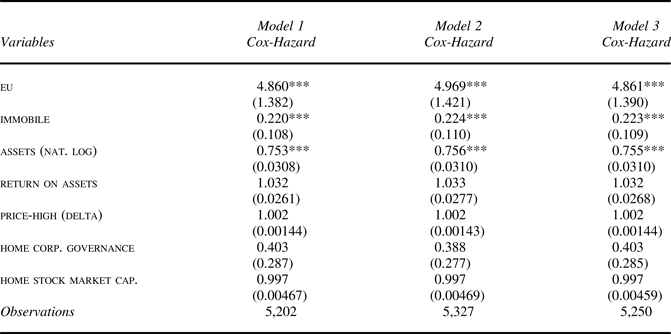
Determinants of firm delisting from US exchanges, 2002–2005, robustness checks (variable selection)
Cox-proportional hazard analysis of firm delisting from US exchanges, with country placebos excluding the EU