Introduction
The proteinogenic amino acids are amino acids that are precursors to proteins and are incorporated in proteins by translation. There are 23 proteinogenic amino acids: (1) twenty in the standard genetic code and (2) three that can be incorporated by special translation mechanism (Ambrogelly et al. Reference Ambrogelly, Palioura and Söll2007). In this paper we refer only to the first 20 proteinogenic amino acids.
The appearance of life is undoubtedly related to the formation of proteinogenic amino acids and proteins. Specialized literature related to chemistry, biochemistry and biology offers a plethora of information regarding the synthesis of proteinogenic racemic amino acids, starting with simple structure chemical compounds, which are constituents of the so called primordial atmosphere and interstellar compounds (Miller Reference Miller1953; Schesinger & Miller Reference Schesinger and Miller1983; Wincel et al. Reference Wincel, Fokkens and Nibbering2000; Ehrenfreund et al. Reference Ehrenfreund, Bernstein, Dworkin, Sandford and Allamandola2001; Sorrell Reference Sorrell2001; Blagojevic et al. Reference Blagojevic, Petrie and Bohme2003; Thaddeus Reference Thaddeus2006; Brack Reference Brack2007; Takano et al. Reference Takano, Takahashi, Kaneko, Marumo and Kobayashi2007; Elsila et al. Reference Elsila, Glavin and Dworkin2009).
On another hand, polypeptides can be obtained in vitro by chaining the proteinogenic acids. The syntheses of specific polypeptides through efficient functionalization techniques and starting with proteinogenic amino acids are notorious (Merrifield Reference Merrifield1963; Geysen et al. Reference Geysen, Meloen and Barteling1984; Atherton & Sheppard Reference Atherton and Sheppard1989; Schnölzer et al. Reference Schnölzer, Alewood, Jones, Alewood and Kent1992; Bodanszky Reference Bodanszky1993; Beavis Reference Beavis1997). An interesting fact is that in aqueous media polypeptides cannot be synthesized starting with proteinogenic amino acids, in laboratory conditions.
Some general aspects related to the structure of the proteinogenic amino acids need to be highlighted. All proteinogenic amino acids can be considered as derivatives of glycine, the only optically inactive term of the series. They can be obtained by substitution of one hydrogen atom in the methylene moiety with fragments specific to each amino acid. As a result of this substitution, only L (levo) configurations can be obtained for all chiral centres in the proteinogenic amino acids. These centres will form the polyamide backbone of the protein polypeptide structure, which means that the α-amino acid unit is the fundamental structural support for the protein formation. It is logical for the structure of the polypeptide chain to be given by the nature of the ‘R’ radicals (Scheme 1). From the entire series of proteinogenic amino acids only two have an additional chiral centre with a D (dextro) configuration in threonine and with an L configuration in isoleucine. In other words, the S,R threonine and S,S isoleucine participate to the protein formation (R = rectus, S = sinister) (Kisumi et al. Reference Kisumi, Komatsubara and Chibata1977; Wall et al. Reference Wall, Coleman, Lee, Iñiguez-Lluhi, Posner, Gilman and Sprang1995).
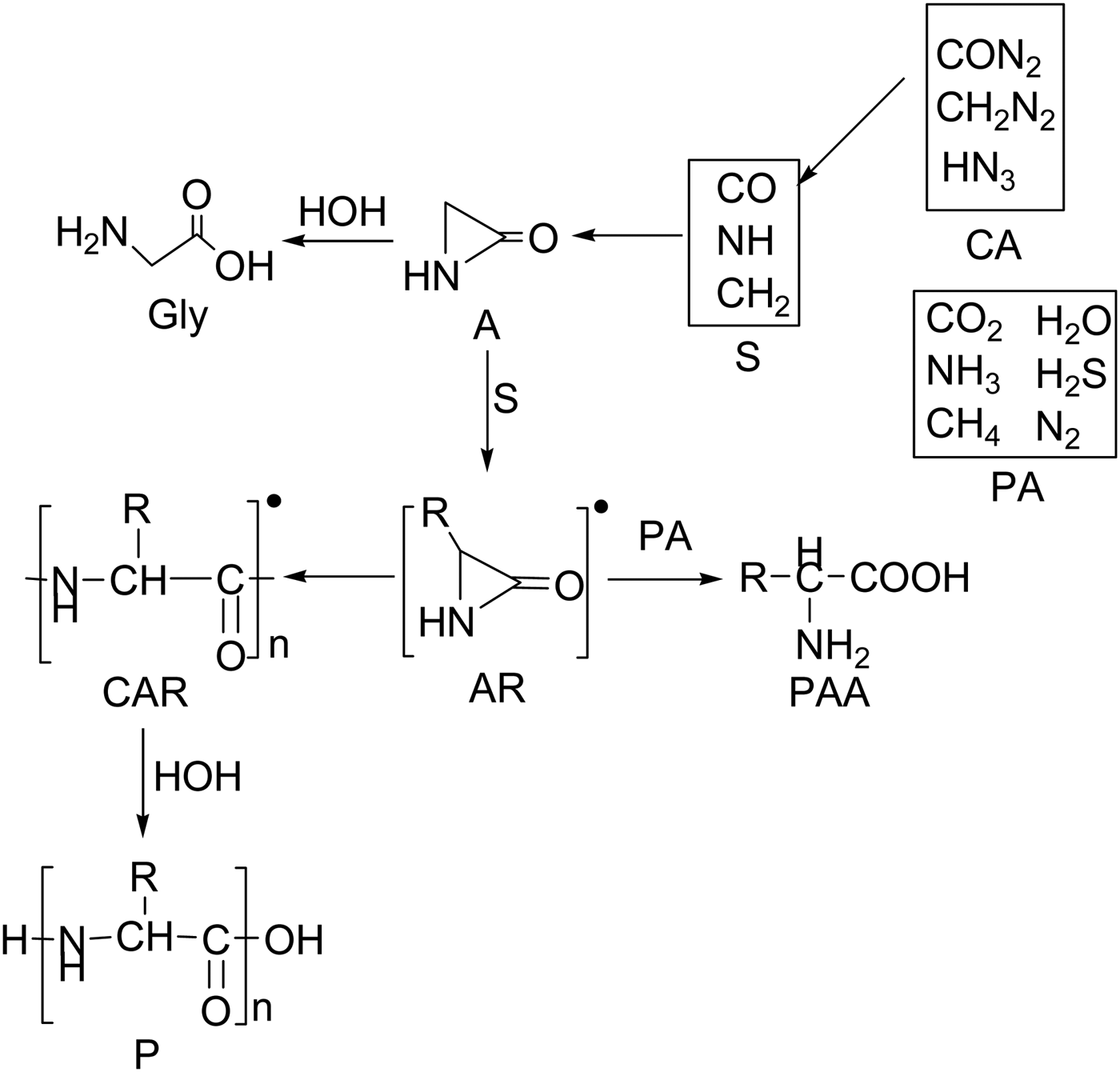
Synthesis of proteinogenic amino acids and polypeptides from aziridinone (Gly, glycine; A, aziridinone; S, synthons; CA, chemical agents; PA, primordial atmosphere; CAR, copolymerized aziridinone radicals; AR, aziridinone radicals; PAA, proteinogenic amino acids; P, polypeptides).

In this paper we proposed a theoretical model for the synthesis of proteinogenic amino acids and the corresponding polypeptides, using as key intermediate the 2-aziridinone.
Shortly, aziridinone is the simplest α-lactam and it can be synthesized like all the α-lactams by cyclization of α-halide amides in presence of sodium hybride (Sheehan & Izzo Reference Sheehan and Izzo1949; Cesare et al. Reference Cesare, Lyons and Lengyel2002). As a convenient characteristic, the α-lactam cycle is readily broken giving through polymerization polyamide chains (Williams & Brodbelt Reference Williams and Brodbelt2004).
We emphasize that in the last part of the paper we proposed a general experimental scheme for the synthesis of amino acids and polypeptides. At this time they can be only in their racemic forms.
Results and discussions
Firstly, some general aspects concerning the theoretical model proposed for the formation of the proteinogenic amino acids and of polypeptides are presented. Then, the results of some thermodynamic and kinetic studies are presented and discussed, as a support for the proposed model. We also tried to establish a structural hierarchy of the proteinogenic amino acids, function on the nature and the number of synthons involved in the synthesis. Further on, we present the procedures and theoretical methods used for this study. In the last part we present a general experimental scheme based on the theoretical results we obtained and which is conceived for the practical synthesis of some amino acids, even of some peptides.
General aspects
Scheme 1 depicts the formation of some amino acids and related polypeptides, using synthons as carbon monoxide, nitrene and methylene, as well as constituents of the primordial atmosphere that could generate moieties useful for synthetic applications. Through dehydration glycine could give aziridinone. This last one could also be obtained using three synthons: carbon monoxide, nitrene and methylene. With only these three synthons, together with carbon dioxide, ammonia, water and hydrogen sulphide, we can construct the substitute aziridinone radicals. By hydrolysis these last ones could give the proteinogenic amino acids or by polymerization followed by hydrolysis they could give the corresponding polypeptides.
We could speculate that even before the formation of the primordial atmosphere, the three synthones carried by molecular nitrogen in certain temperature conditions formed aziridinone (probably very low temperatures). This aziridinone in contact with its initial synthones always at low temperature formed substituted aziridinones. In the next step, substituted aziridinones as radical intermediates at the least temperature increase reacted with the constituents of primordial atmosphere to give amino acids, as shown in our thermodynamic study. In contact with the components of the primordial atmosphere the copolymerized aziridinone radicals, give neutral polypeptides.
According to our model the polypeptide backbone is formed before the contact with water. It is likely that the polypeptide structures formed in the same time with the amino acids, when the aziridinones got in contact with water. We refer here to the formation of ‘the first’ molecules of proteinogenic amino acids and their polypeptide macromolecules. The source of the two types of molecules, ‘amino acid and polypeptide’ is the same aziridinone, which underwent two different reaction paths at a certain moment.
This model suggests without any doubt that the first polypeptide structures were not obtained from amino acids and the contact with water took place after the formation of the polypeptide backbone. Later on we will bring arguments that support this model.
We believe that molecular nitrogen played an essential part in the transport of the three synthons and it could act as reaction medium. This is not surprising since nitrogen is a molecule relatively stable from thermodynamic point of view and a weakly reactive molecule from chemical point of view.
The goal being the experimental synthesis of amino acids and of polypeptides, we also considered obtaining some accessible chemical agents otherwise known as generators of the three main synthons. These agents could be diazomethane, hydrazoic acid and maybe diaza carbonyl. Concerning the composition of the primordial atmosphere, hydrogen sulphide must be added (Atreya et al. Reference Atreya, Mahaffy, Niemann, Wong and Owen2003).
Also, the lack of molecular nitrogen from the primordial atmosphere could be compensated along with the three synthons.
General procedure
The calculations were performed using the Cache Worksystem Library, version 7.5.0.85 (2006) (Computer Added Chemistry Library).
The structures of the chemical samples are refined performing a geometry optimization by successive use of augmented MM3 parameters and AM1 parameters in MOPAC, and in DGauss using the B88-LYP, GGA functional with DZVP basis sets. The heats of formation, were extracted from AM1 and B88-LYP methods. In order to obtain the reaction map the structures for each map point are optimized. We added an appropriate number of geometry labels to the molecule file. A single geometry search label is varied in order to generate a potential energy map. The energy of each conformation is determined using the B88-LYP DFT method with the DZVP basis set. The optimization is made in internal coordinates. The structure and the energy of an approximate transition state and its subsequent refined state are calculated using the B88-PW91 GGA energy functional with the DZVP basis set. In order to verify the calculated transition state, the current vibrational transitions of the molecule are calculated. A single negative vibration confirms a true transition state. The vibrational transitions are also calculated in the same conditions using DGauss with the B88- LYP GGA energy functional. The geometry of the molecule has to be optimized first. Finally, the reaction path from a transition state to reactants or products is generated using the same functional. To achieve this, all kinetic energy is discarded during every step of the reaction path. This calculation requires an input file as transition state geometry. In all calculations a high integral accuracy has been maintained.
The structure of 2-aziridinone
A careful analysis of the literature (Liebman & Greenberg Reference Liebman and Greenberg1974; Treschanke & Rademacher Reference Treschanke and Rademacher1985; Greenberg et al. Reference Greenberg, Chiu, Johnson and Liebman1991, Reference Greenberg, Hsing and Liebman1995, Reference Greenberg, Moore and DuBois1996; Shustov et al. Reference Shustov, Kachanov, Chervin, Kostyanovsky and Rauk1994; Harrison et al. Reference Harrison, Csizmadia, Tang and Tu2000; Goumans et al. Reference Goumans, Ehlers, Lammertsma and Würtherwein2003; El Firdoussi et al. Reference El Firdoussi, Esseffar, Bouab, Abboud, Mó and Yáñez2004, Reference El Firdoussi, Esseffar, Bouab, Abboud, Mó, Yáñez and Ruasse2005; Tang et al. Reference Tang, Fang, Harrison and Csizmadia2004; Bach & Dmitrenko Reference Bach and Dmitrenko2006; Kassaee et al. Reference Kassaee, Musavi and Jalalimanesh2008) concerning the structure of 2 – aziridinone reveals two somehow antagonistic aspects. Structural evaluations obtained through semiempirical mecano-quantic calculation identify as the most stable structure the planar one with the imine hydrogen H 5 in the plane of the α-lactam cycle (Table 1). The most stable molecular structure calculated through DFT methods is totally different, the nitrogen atom N 1 adopting a triangular pyramidal configuration with the imine nitrogen out of the plane of the α-lactam cycle.
Structural data of aziridinone

As a result, in Table 1 are presented the enthalpies of formation, ∆H and E calculated using the AM1 and B88-LYP DFT methods, respectively. We repeated the calculations and reached the previously published conclusions.
There is the same 3.4 kcal mol−1 difference between the two conformations, which favours one or the other conformation depending on the calculation procedure.
Undoubtedly, DFT procedures offer more trusty results. We are tempted to consider the nonplanar structure as the most stable one.
We emphasize that Table 1 presents only the bond lengths and the angles obtained through the DFT calculations that correspond to the two planar/nonplanar structures.
The fact the nonplanar structure could be more stable suggest a very bold interpretation, namely that the low temperature induces an asymmetry in the structure of aziridinone. This means the two methylene hydrogen atoms are not equivalent anymore, leading to the possibility of realizing asymmetric syntheses.
In this interpretation, the low temperatures would allow the obtaining of different ratios of chiral centres at the level of the methylene carbon atom, due to the asymmetric induction resulted from the deviation of the imine hydrogen atom. This raises the next question: Can the low temperature induce this nonplanar configuration and maintain the molecule/molecules of aziridinone in it?
Thermodynamical
This study addresses several quantitative aspects related to the three synthons – methylene, nitrene, carbon monoxide – and their involvement in the formation of aziridinone, which is the key compound for the preparation of proteinogenic amino acids and the corresponding polypeptides.
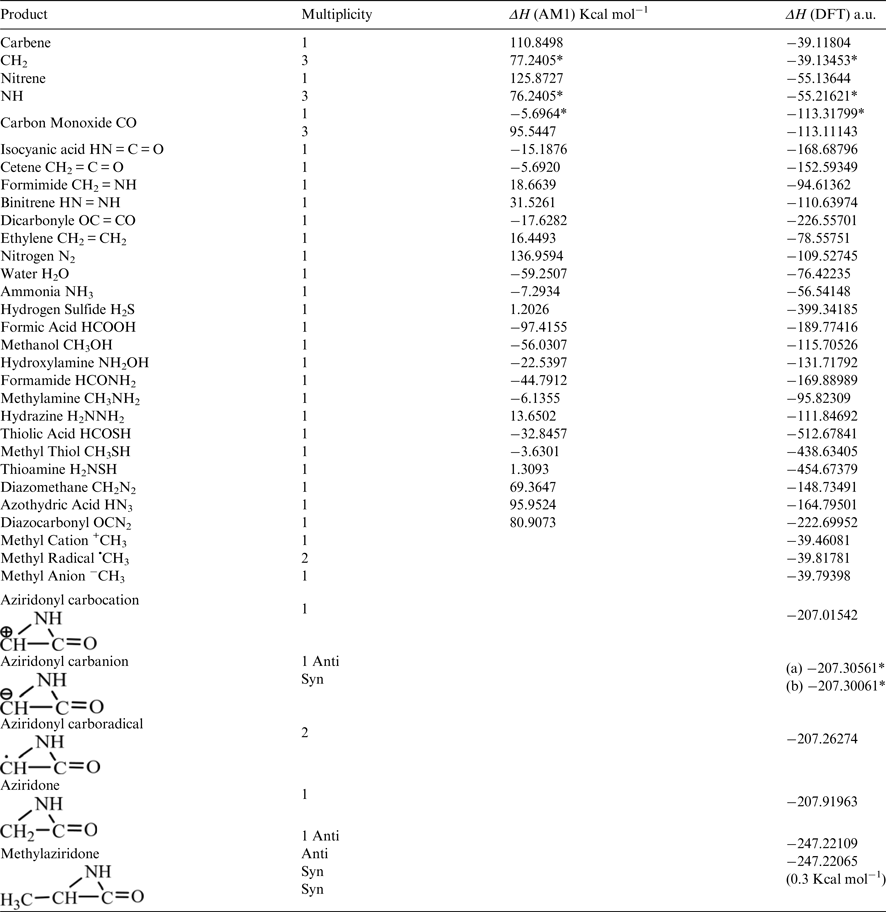
The values for the standard enthalpies of formation (AM1) and (DFT) for the three synthons, their corresponding dimers and for potential compounds that would form through the immobilization of the three synthons by molecular nitrogen are summarized in Table 2. The additional thermodynamic data in the table relate to a series of neutral compounds and neutral or charged intermediates involved in the formation of aziridinone methylaziridinone and more generally the formation of several proteinogenic amino acids.
Thermodynamical data

*Imposed geometry.
The foundation of our study is the hypothesis that if nitrogen is used as reaction media, the three synthons will form initially aziridinone and some of its neutral and radical derivatives as precursors of the essential amino acids and of the polypeptides. More exactly, in nitrogen, the synthons and the precursors will encounter at a certain point the components of the primordial atmosphere (water, ammonia, carbon dioxide, hydrogen sulphide and methane). Two things have to be pointed out. On one hand, hydrogen sulphide has to be included among the components of the primordial atmosphere. On the other hand, although methane is recognized as a component of the primordial atmosphere (Urey Reference Urey1952; Abelson Reference Abelson1966; Abe Reference Abe1997) it would not interfere with the formation of the final structures of the proteinogenic amino acids and their corresponding polypeptides, but that is not ‘unable’.
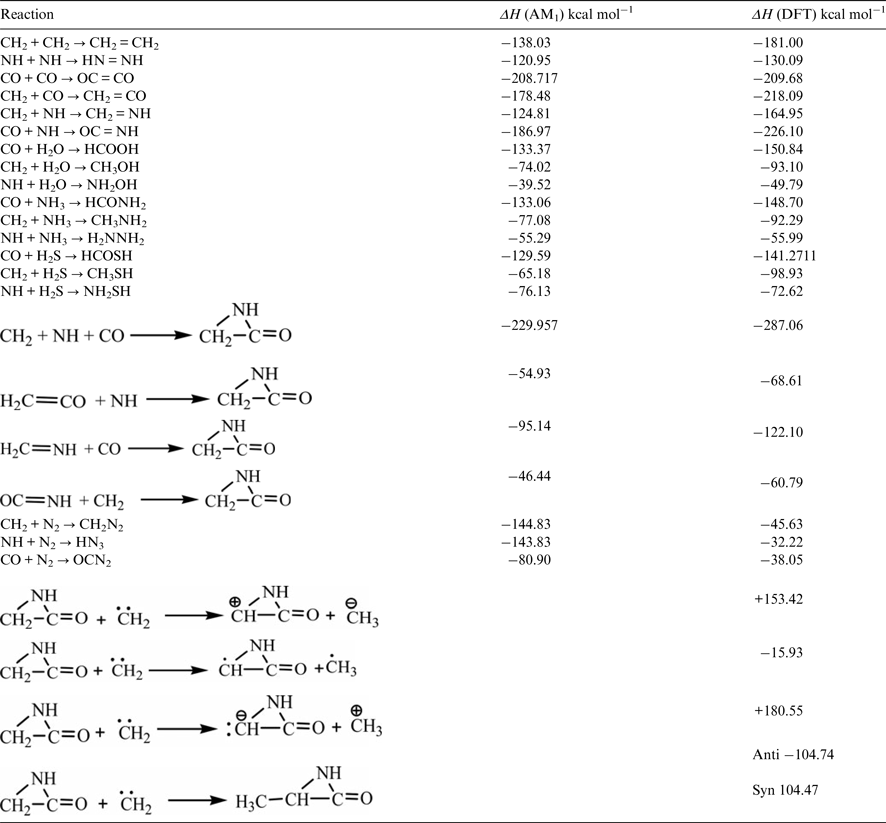
Table 3 summarizes the enthalpies of reaction calculated through the same two methods (AM1 and B88-LYP) for the synthons dimerization, inter synthons reactions, synthons immobilization by molecular nitrogen, aziridinone formation and methylaziridinone (alanine precursor) formation.
Enthalpy of reaction

*Imposed geometry.
Most of the reactions are exothermic. Only two of them are endothermic and they are related to the formation of methylaziridinone through an aziridinone carbocation or carbanion. This makes us believe that the aziridinone derivatives corresponding to the formation of proteinogenic amino acids and of mixt polypeptides are obtained through a radical mechanism. One can see there are differences between the enthalpies of reaction. This suggests that these intermediates are formed and involved in different amounts in the formation of amino acids and polypeptides.
Concerning the formation of aziridinone, the values of the entahlpies of reaction indicate the formation of isocyanic acid in a first step, followed by its reaction with methylene. We use the highest value ∆H = −226.10 kcal mol−1 corresponding to the formation of isocyanic acid. Aziridinone formation through a trimolecular reaction involving all the three synthons is steric less probable, although it is energetically favoured. We assume that the nitrogen will immobilize the three synthons in equal amounts and the methylaziridinone formation would follow a radical mechanism. The latter one makes us consider the presence of light in the experimental setup we propose for the synthesis of amino acids and polypeptides. When studying the chemistry of these synthons their triplet states for methylene and nitrene and singlet state for carbon monoxide as most stable structures have been considered.
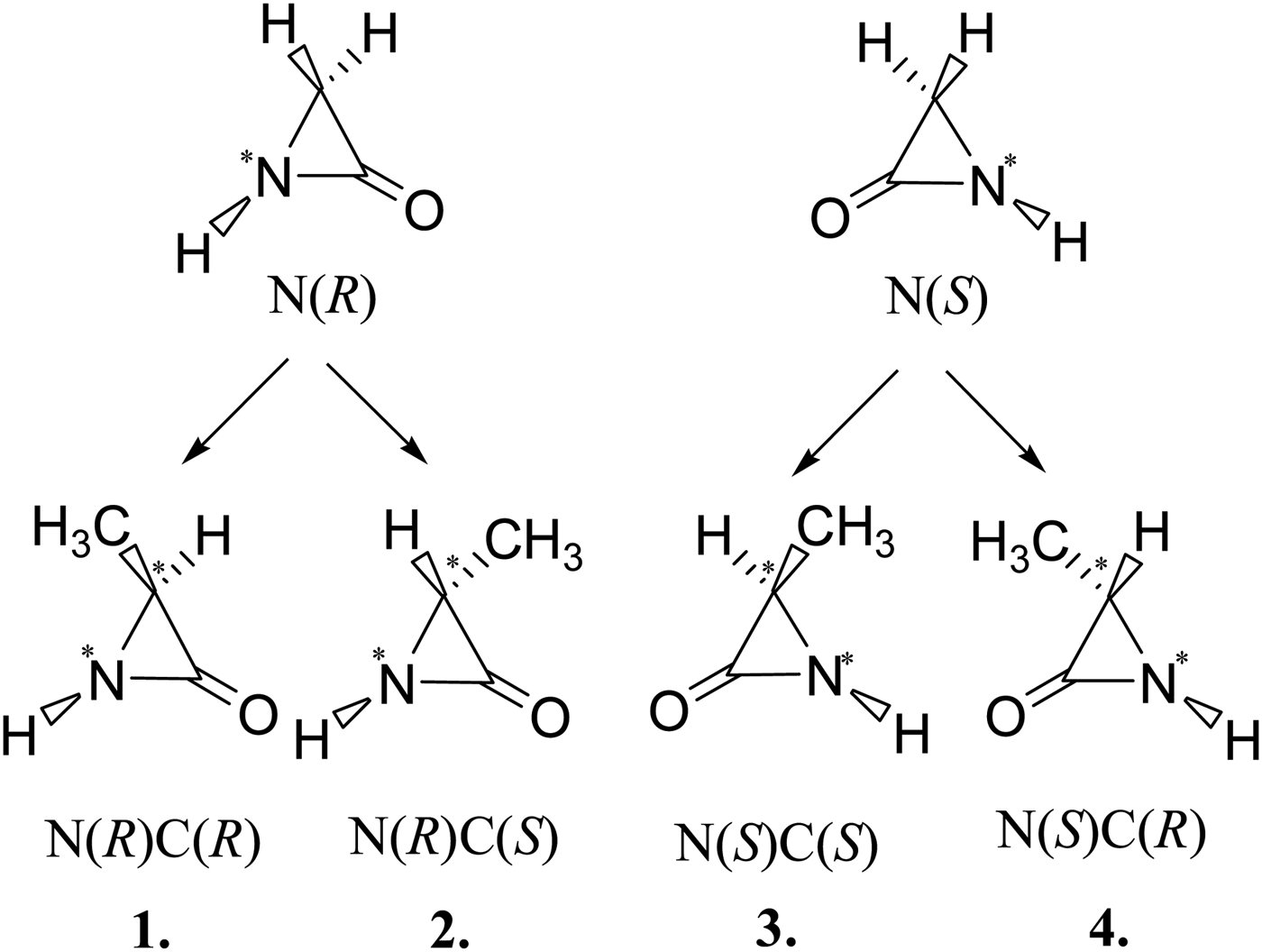
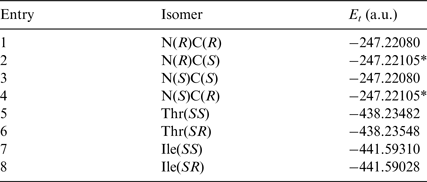
Aziridinone can exist as two enantiomers, N(R) and N(S), as depicted in Scheme 2, assuming the low temperature in nitrogen will create a chiral centre. Each of these enantiomers can form two corresponding diastereisomers (1 or 2 and 3 or 4). The values for the thermodynamic stabilities of diastereisomers 1–4 are summarized in Table 4.
Enantiomers and diastereoisomers of aziridinones.

Energies of aziridinone, methylairidinones, threonine and isoleucine

*Imposed geometry.
We have two enantiomer pairs, 1–3 and 2–4. In Table 4 it is easy to see that the 2–4 pair is more stable thermodynamically. Considering that the backbone of all essential amino acids has an S configuration, we have to use the starting aziridinone N(R) in order to obtain the final alanine (S) (enantiomer 2). The fundamental question is what species can immobilize aziridinone in the N (R) form? Several options are considered: use of a catalyst, use of an induced magnetic field, use of polarized light, use of a crystalline matrix, etc.
At the end of this thermodynamic study we will make some interesting comments regarding threonine (Thr) and isoleucine (Ile), which are two essential amino acids containing a second chiral centre in their structure. Considering that the backbone is always in an S configuration, we have calculated the thermodynamic stabilities for the two diastereoisomer pairs, Thr (SS) – Thr (SR) and Ile (SS) – Ile (SR), respectively. According to the total energy values (DFT) corresponding to the two isomers (entries 5–8 in Table 4), the most stable diastereoisomer for threonine is Thr (SR) while Ile (SS) is the most stable diastereoisomer for isoleucine. In nature, in well-known protein structures, threonine and isoleucine components appear in these configurations exactly. Indeed, the Ile (SS) more stable as Ile (SR) with 1.76 kcal mol−1 is sole diastereoisomer present in proteins, while Thr (SR) more stable as Thr (SS) with 0.41 kcal mol−1 is only an abordant diastereoisomer (Kisumi et al. Reference Kisumi, Komatsubara and Chibata1977; Wall et al. Reference Wall, Coleman, Lee, Iñiguez-Lluhi, Posner, Gilman and Sprang1995). One conclusion is obvious: when a selection had to be made among these syntheses of diastereisomers, it must have been done only under a well-defined thermodynamic control. Our thermodynamic study is encouraging with respect to the experimental setup.
We have to mention that the chemical intermediates depicted in Table 3 are well-known interstellar compounds (Geballe & Oka Reference Geballe and Oka1996; Wiklind & Combes Reference Wiklind and Combes1996; Dalgarno Reference Dalgarno2006; Mulas et al. Reference Mulas, Malloci, Joblin and Toublanc2006; García-Hernández et al. Reference García-Hernández, Manchado, García-Lario, Stanghellini, Villaver, Shaw, Szczerba and Perea-Calderon2010; Loeb Reference Loeb2014). This means that their formation from synthons allows using them as reaction components when obtaining the structures of some amino acids (Fegley et al. Reference Fegley, Prinn, Hartman and Watkins1986; Anders Reference Anders1989; Kobayashi et al. Reference Kobayashi, Kasamatsu, Kaneko, Koike, Oshima, Saito, Yamamoto and Yanagawa1995, Reference Kobayashi, Kaneko, Saito and Oshima1998, Reference Kobayashi, Ogawa, Tonishi, Kaneko, Takano, Takahashi, Saito, Muramatsu, Yoshida and Utsumi2008; Kasamatsu et al. Reference Kasamatsu, Kaneko, Saito and Kobayashi1997; Barbier et al. Reference Barbier, Chabin, Chaput and Brack1998; Cottin et al. Reference Cottin, Gazeau and Raulin1999; Cooper et al. Reference Cooper, Kimmich, Belisle, Sarinana, Brabham and Garrel2001; Bernstein et al. Reference Bernstein, Dworkin, Sandford, Cooper and Allamandola2002; Pizzarello & Weber Reference Pizzarello and Weber2004; Tian et al. Reference Tian, Toon, Pavlov and De Sterck2005; Elsila et al. Reference Elsila, Dworkin, Bernstein, Martin and Sandford2007). They could accompany these amino acids. This aspect will be addressed in the following chapter.
Reactions
To form the proteinogenic amino acids and polypeptides, several chemical ways have been investigated.
Methylaziridinones
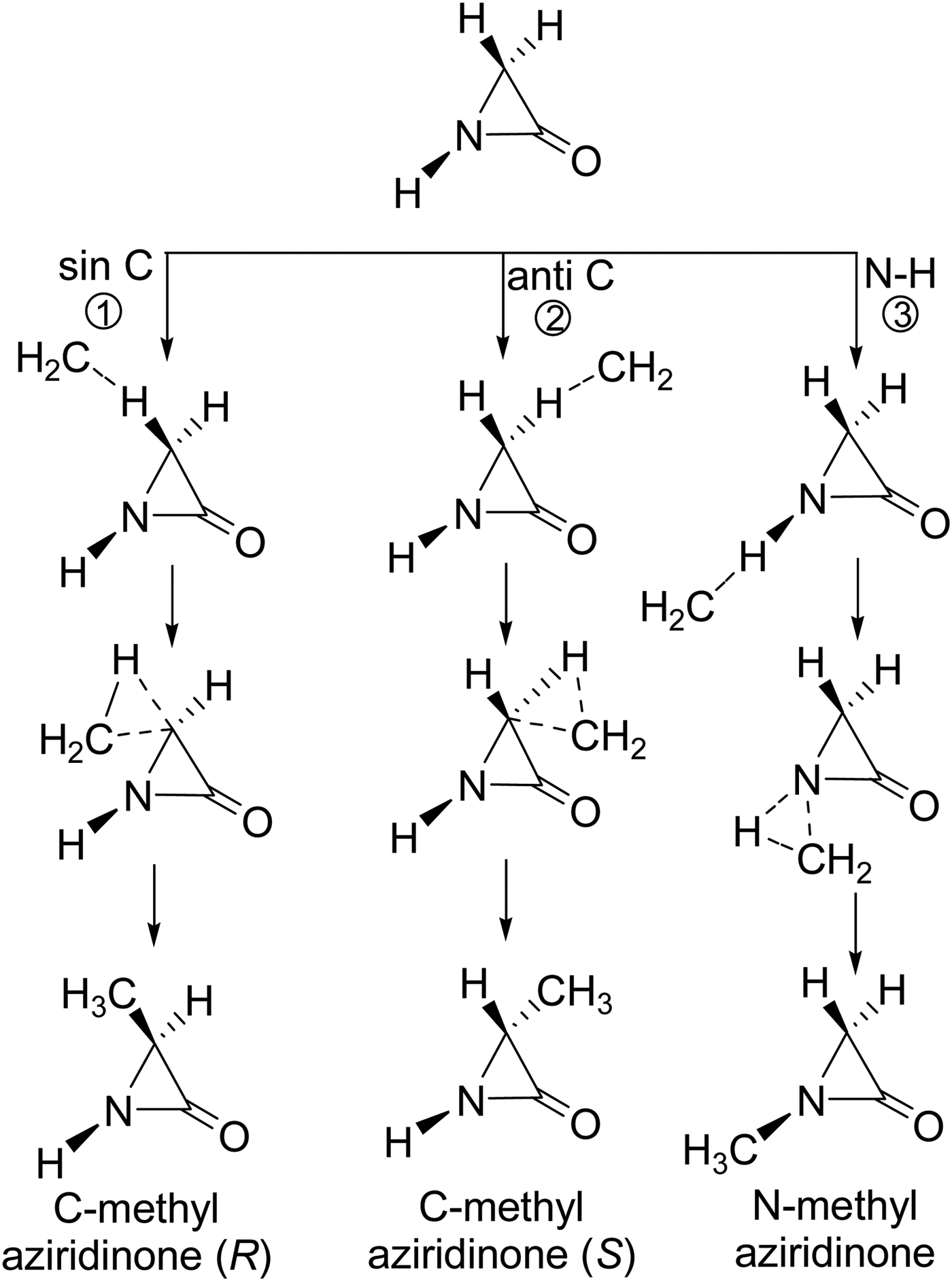
Initially we studied the attack of methylene, both in singlet and triplet state, on aziridinone. The goal was to find the reaction pathways for the extraction or the insertion of methylene at the level of the sin and antiC-H bonds as well as at the level of the N-H bond in aziridinone.
As a procedure, we explored the entire conformational space around the carbon and nitrogen atoms in aziridinone. We started with imaginary transition states and then established the reaction pathways towards the initial states and the final states. The initial state refers to aziridinone and methylene. As final states we envisaged the extraction of hydrogen from aziridinone, meaning the formation of C-aziridonyl and N-aziridonyl radicals together with the methyl radical, as well as the formation of the three methylaziridinones: sin C-methylaziridinone, anti C-methylaziridinone and N-methylaziridinone through insertion reactions.
While C-methylaziridinones can be considered alanine precursors because of a possible hydrolysis of the lactam cycle, N-methylaziridinone could lead to the formation of proline, which is the only amino acid with a secondary nitrogen atom in the backbone.
After finding the forward and the reverse reaction pathways we established the global reaction pathway (internal reaction coordinate).
We mention that for each reaction we found a single cyclic transition state corresponding to an insertion at the level of the C-H and N-H bonds. Of course, these transition states have been refined and checked.
Table 5 summarizes the numerical data found and calculated for all involved structures. E 1, E 2, E 3 and E 4 are the enthalpies of formation corresponding to the initial states, transition state and final states. The last two columns (∆G and ∆E≠) contain the values for the free energies and the activation energies, respectively.
Quantitive data in reaction between aziridinone and methylene

E 1 and E 2 values represent the sum of the enthalpies of formation of aziridinone and methylene in its triplet and singlet state, respectively. The activation energies ∆E≠ correspond to methylene in its triplet state. The free energies ∆G values correspond to 200 K temperatures.
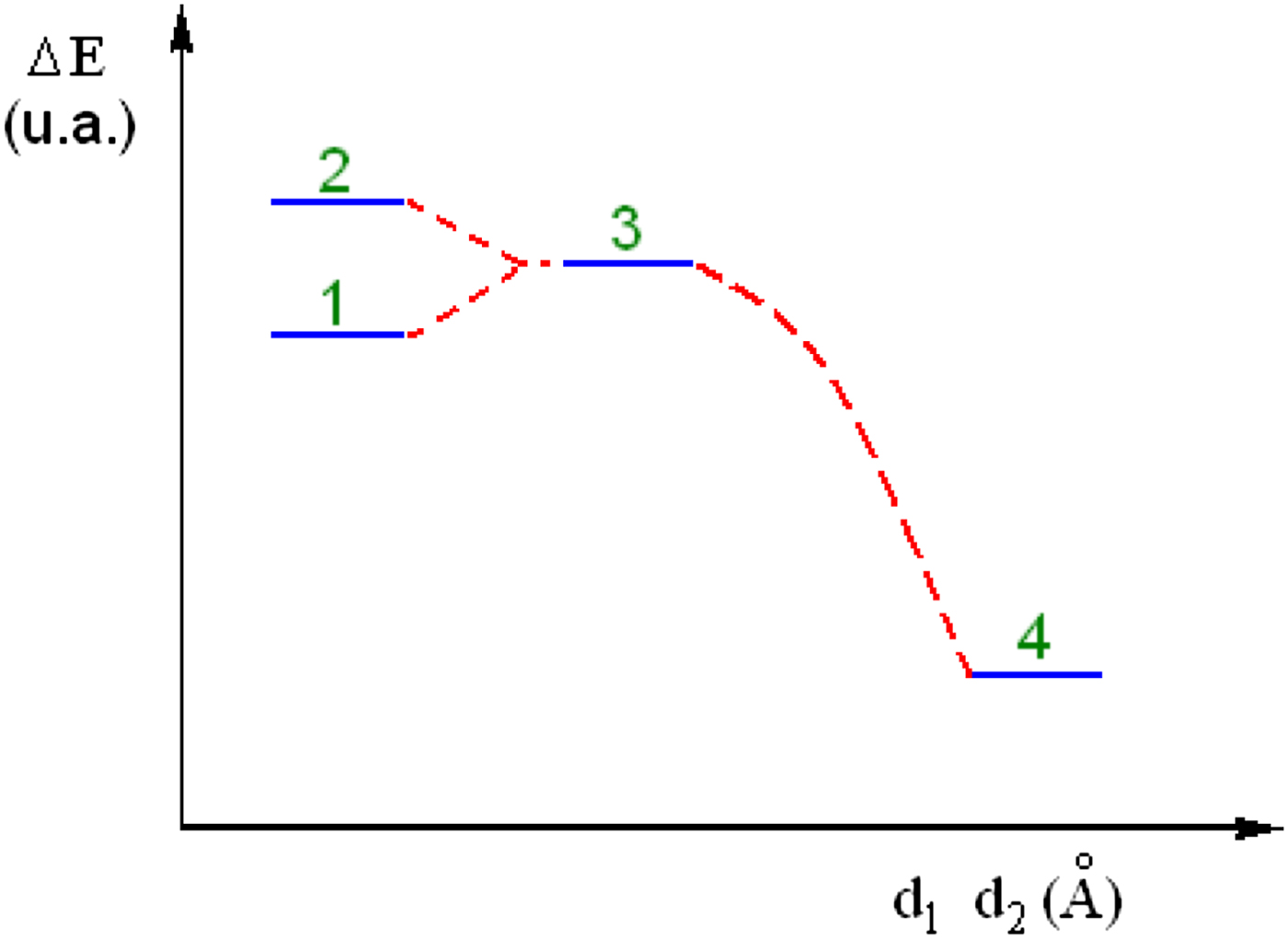
In all three cases the reaction pathways are similar and can be suggested by the graphical representation from Fig. 1.
Chemical ways in formation of methylaziridinones.
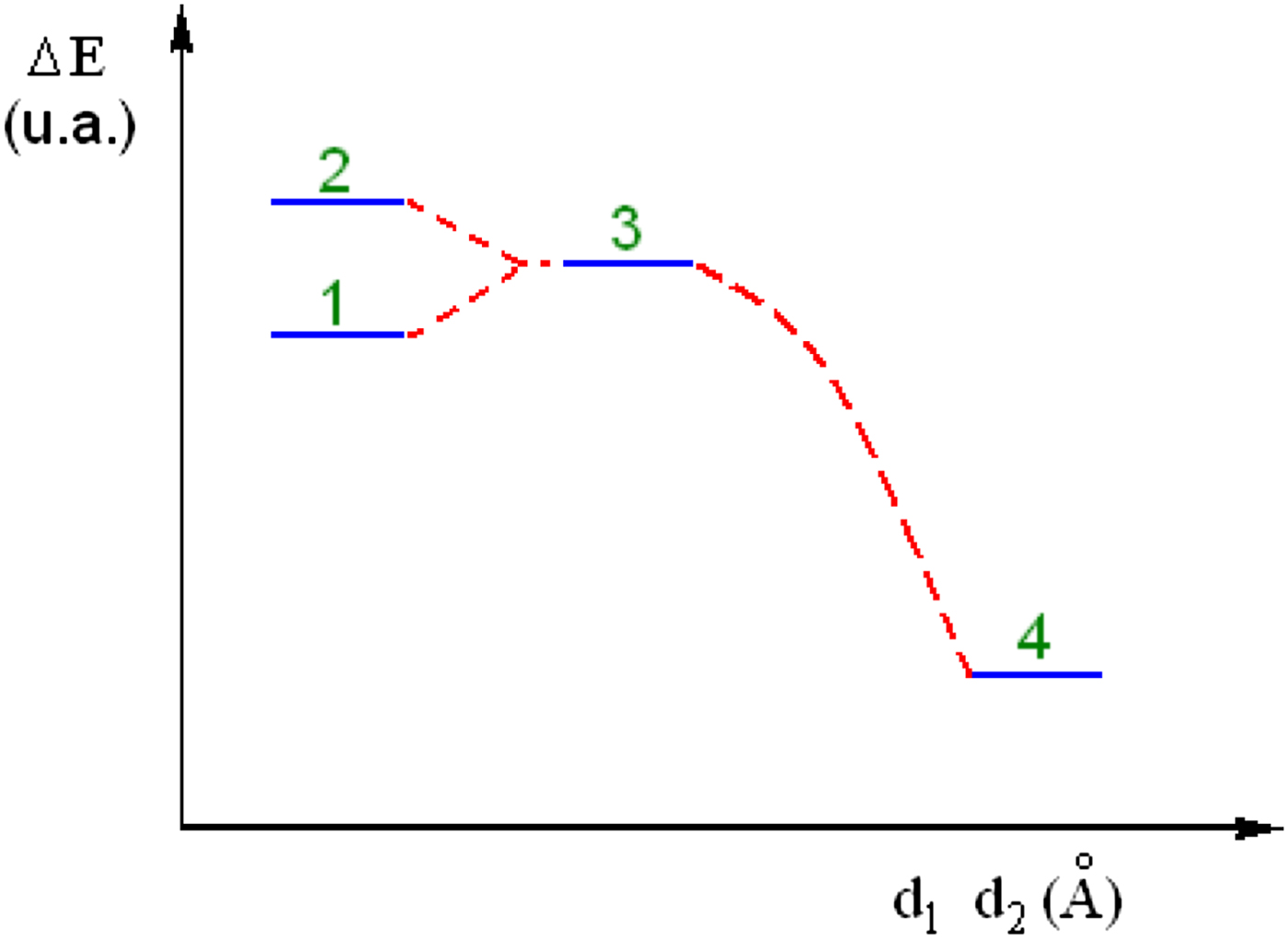
For a better understanding of these reaction pathways, Scheme 3 shows in detail all the stages of the attack of methylene on the hydrogen connected to carbon and nitrogen (d 1) as well as its insertion at the level of these two bonds (d 2).
Insertion of methylene into C–H and N–H bonds of aziridinone.

If methylene would react in its singlet state the corresponding reaction pathway should be of photochemical type. This would involve the lowering of the reaction system energy in a cascade pattern. Because most probably methylene participates in the reactions in its triplet state, the reaction path E 1 → E 2 → E 3 requires activation. This is unlikely since all these transformations are performed at low temperature. However it is worth noticing that the attack of methylene in the antiC-H bond is energetically favoured, which is in good agreement with the result previously obtained and presented in the Thermodynamic study section.
Formally our attempts to generate precursors of the proteinogenic amino acids through insertion reactions of the three synthons (methylene, nitrene and carbon monoxide) would not yield a positive result. The major inconvenient would be the generation of neutral molecule intermediates, which would require activation every time. This is improbable and made us consider that only photochemical transformations could form the desired precursors. In other words, we have to start with reaction systems containing high energy molecular species. Together with the three synthons in their lowest energy states (triplet methylene, triplet nitrene and singlet carbon monoxide) these would lead to intermediates corresponding to the formation of proteinogenic amino acids and polypeptides. For this reason we present in the following section only the results of our studies that targeted the generation of amino acids and polypeptides.
We will summarize all the reactions required for the construction of the precursors of proteinogenic amino acids. Those do not need activation. For example they occur in a cascade pattern E 2 → E 3 → E 4 with those which need activation energies. The first type of reaction is very well described in literature (Sims & Smith Reference Sims and Smith1995; Bernardi et al. Reference Bernardi, Olivucci and Robb1996; Baltrusaitis et al. Reference Baltrusaitis, Patterson and Hatch2012; Jung et al. Reference Jung, Jang, Kim, Kim and Choi2015). We believe these reactions can occur at low temperature, under 0 °C and the resulting intermediates can be stable until the contact with some components of the primordial atmosphere (water, carbon dioxide, ammonia, hydrogen sulphide and methane) when in favourable thermodynamic conditions they will form simultaneously proteinogenic amino acids and the corresponding polypeptides.
Aziridonyl radicals
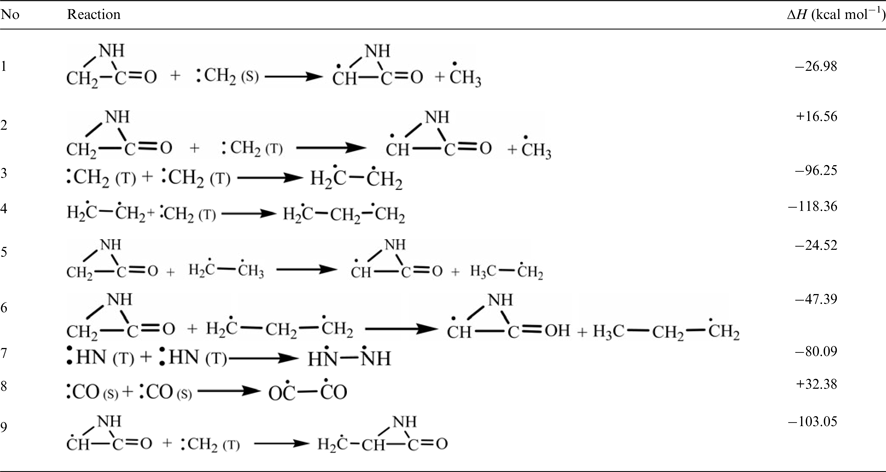
We have shown previously that the extraction of hydrogen from aziridinone through a triplet methylene attack is not possible without energy intake. This is also confirmed by the positive reaction enthalpy corresponding to the transformation (Table 6).
Reaction enthalpies. Formation of aziridonyl radicals

We considered the extraction of hydrogen from aziridinone can be performed by a methylene singlet or by some ethylenic or proylenic type biradicals. These are easily accessible by the methylene oligomerization. We will not insist on the nature of the polyradicals able to participate in the extraction of hydrogen. Apparently, those obtained by nitrene oligomerization could perform similar reactions. This is different in the case of carbon monoxide, where the dimerization reaction enthalpies have positive values.
Once the aziridonyl radical is formed it is active from chemical point of view and it will react with methylene to form a new methylaziridonyl radical. Consequently, this will allow continuing the reactions chain needed for the formation of the basic backbone of the amino acids. We refer here to structure much more complex than alanine, which can be obtained from the methylaziridonyl radical.
Chain reactions
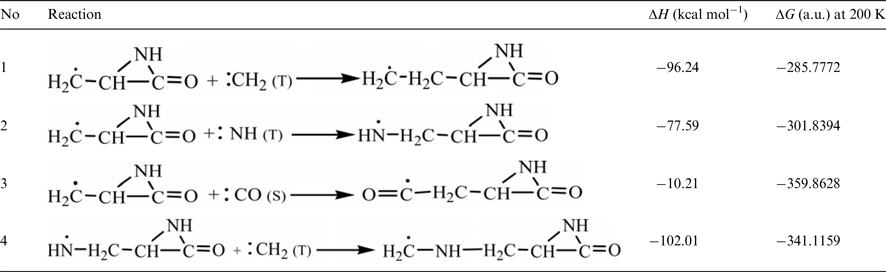
We will not study from a quantitative point of view of all the chain reactions specific to each proteinogenic amino acid. We will choose only a few types of chain reactions (carbon-carbon, carbon-nitrogen, carbon- carbonyl and nitrogen-carbon) found in the structures of proteinogenic amino acids and the corresponding polypeptides.
Table 7 summarizes the four types of chain reactions we studied. The last two columns contain the enthalpies and the free energies corresponding to these chain reactions.
Enthalpies and free energies for some chain reactions

We did not consider other types of chain reactions (nitrogen-nitrogen, nitrogen-carbonyl, carbonyl-carbonyl, carbon-oxygen and carbon-sulphur) because they are not found in the basic backbone of proteinogenic amino acids. These bonds appear just at the level of some terminal functional groups and we will explain their formation later on.
As a general rule, these chain reactions seem to occur according to the reaction pathways specific to photochemical and interradicals transformations. We observe the same lowering of the energy when passing from the initial state and the transition state towards the final state.
It would be interesting to correlate the absolute values of the reaction enthalpies corresponding to the C-C, C-N and C-CO bond formation (Table 7) with the presence of these bonds in the structure of the proteinogenic amino acids. Obviously, there is a good qualitative correlation. The number of C-C bonds is dominating. It follows the number of C-N bonds and in the last position there is a single C-CO bond which would allow for the formation of the hydroxyl moiety in Tyrosine. We will develop this in another section.
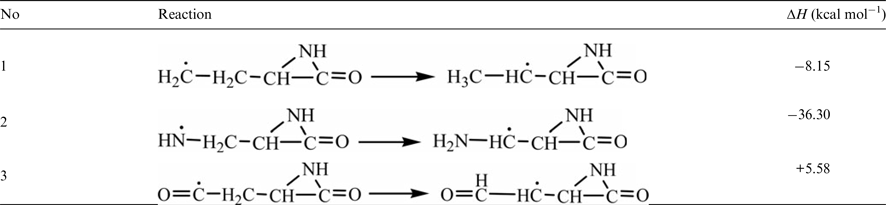
Isomerization
Three types of isomerization are needed in the construction of the proteinogenic amino acids. Table 8 summarizes three such transformations that can explain all the isomerization reactions involved in the formation of the amino acids and polypeptides precursors.
Reaction enthalpies for isomerizations

The alkyl isomerization would explain the formation of leucine, isoleucine, valine and threonine. The isomerization suggested in Reaction 2 (Table 8) could be responsible for the generation of the guanyl moiety in arginine. One question remains: why don't we find the aldehyde or ketone moieties in the structure of the essential amino acids?
We estimate that the presence of the carbonyl moiety in the tyrosine structure would be the precursor for the formation of its hydroxyl moiety and we will justify this later on.
Cyclization
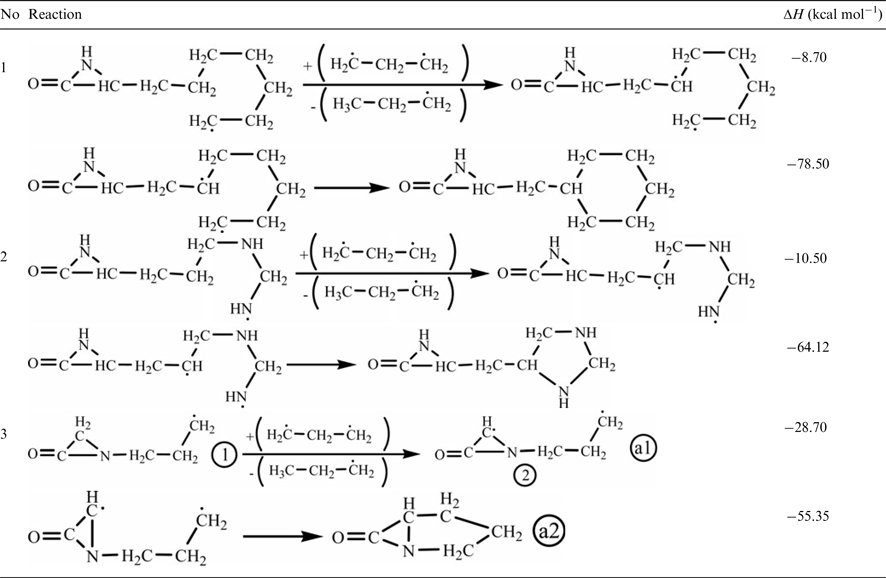
We consider the formation of cycles and heterocycles in the case of phenylalanine, tyrosine, proline, histidine and tryptophan would involve the generation of biradicals. Of course, these biradicals would have to be generated at the level of the two atoms between which the bonds forming the cycle will occur. Table 9 summarizes the model reactions for the formation of the five heterocyclic precursors that will generate the five proteinogenic amino acids mentioned before.
Reaction enthalpies for cyclizations

In Table 9 we presented only three reaction models that follow the requirements we imposed throughout this study (lowering the energy in a cascade pattern between the initial, transition and final states corresponding to each reaction pathway). Only the reaction enthalpies corresponding to each reaction step are given. We chose the propenyl radical as a potentional extractor for hydrogen but obviously many different biradicals can perform similarly. For cyclization that can take different routes we presented only the ones that are advantageous according to the values of the reaction enthalpies. All these transformations are exothermic according to the values of the reaction enthalpies (Table 9).
Elimination
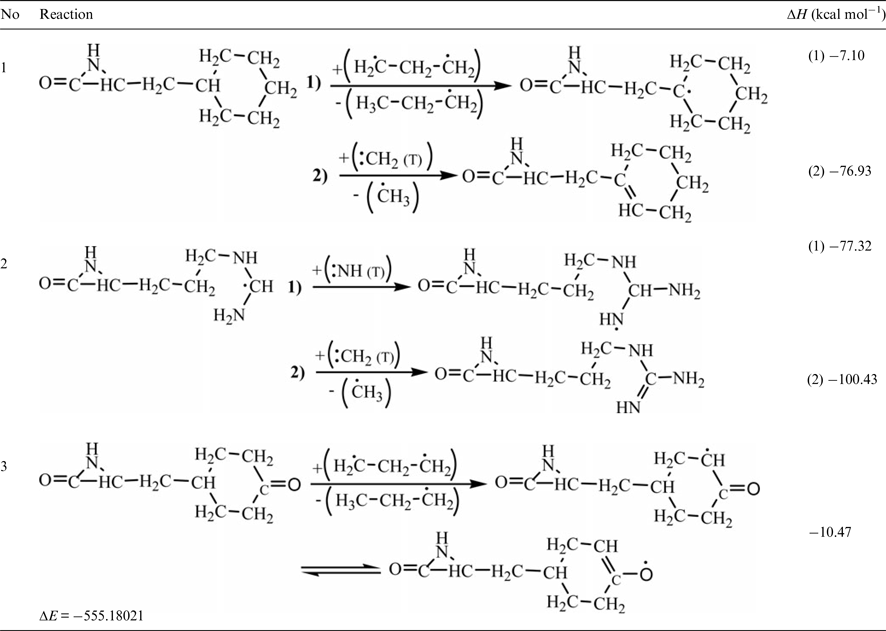
In our case the elimination reactions are intended to form the aromatic moieties in phenylalanine, tyrosine, histidine and tryptophan. We are targeting mainly the formation of ‘double’ bonds like C = C and C = N. The only exocyclic double bond C = N would be formed at the level of guanyl residue in arginine.
Table 10 summarizes a few selected model reactions for the formation of the previously mentioned double bonds. We start with the obvious observation that the thermodynamic stability of the molecular systems increases from acyclic to lateral chain to cyclic and to aromatic. We imagined the examples from Table 10. They picture the extraction of one hydrogen atom by a reactive radical (propenyl radical in this case) from the already formed cycles. It is natural to think that the loss of a second hydrogen atom from the newly formed cyclic radical must be assisted by species able to capture hydrogen. For this we chose methylene in its triplet state. All values for the reaction enthalpies in Table 10 are negative so there is no reason we would not accept as possible such transformations.
Reaction enthalpies for eliminations

For the formation of arginine (reaction 2 in Table 10) we started with a secondary radical suggested by Reaction 2 in Table 9. After a chain reaction with triplet nitrene followed by the loss of one hydrogen atom, the guanyl moiety will form. This is a precursor of arginine.
Among the 20 proteinogenic amino acids there is none that contains in its structure the carbonyl moiety. In the same time tyrosine is the only proteinogenic amino acid, which contains the hydroxyl moiety in its internal structure and not as a terminal functional group. This is why in Reaction 3 Table 10 we suggest the formation of the hydroxyl group through a reaction that first produces a carboradical on the Carbon atom in position α relative to the carbonyl. This will consequently react through its enol resonance structure found at the level of the corresponding oxoradical (see hydrogen trapping and aromatization). The enthalpy of formation mentioned in Table 10 refers to the two resonance structures.
Polymerization
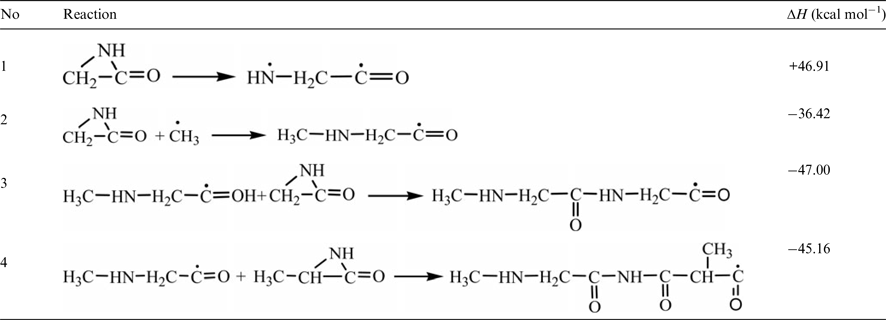
In the context of open reaction systems, with radicalic and photochemical reactions, we studied the behaviour of the precursors of essential amino acids in eventual polymerization and copolymerization reactions. The opening of the aziridinone cycle into a biradical it is not thermodynamically favoured (Reaction 1 in Table 11).
Reaction enthalpies for polymerizations

It suffices to open the aziridinone cycle using one radical and the resulting open monoradical initiates the polymerization process. This results in the formation of a polypeptide. Later on we will develop more the polymerization and copolymerization processes, especially the reaction conditions and the stage when they occur.
Final reactions
The aziridonyl radical formations followed by isomerization, cyclization, elimination, polymerization and chain reactions previously discussed allow the formation of precursors of proteinogenic amino acids and the corresponding polypeptides. The precursors and the three synthons, together with the other compounds resulting from methylene, nitrene and carbon monoxide are in a nitrogen environment. All the components of this complex mixture are in high energy states and have open molecular systems structures (radicals and polyradicals).
In this section we inventory the types of reactions that could occur between the precursors and the components of the primordial atmosphere. We considered the structures of the precursor amino acids, more exactly the nature of their final moieties, before the hydrolysis leading to the formation of the backbone. The methylaziridonyl radical is considered as model of precursors of proteinogenic amino acids, from chemical behaviour point of view.
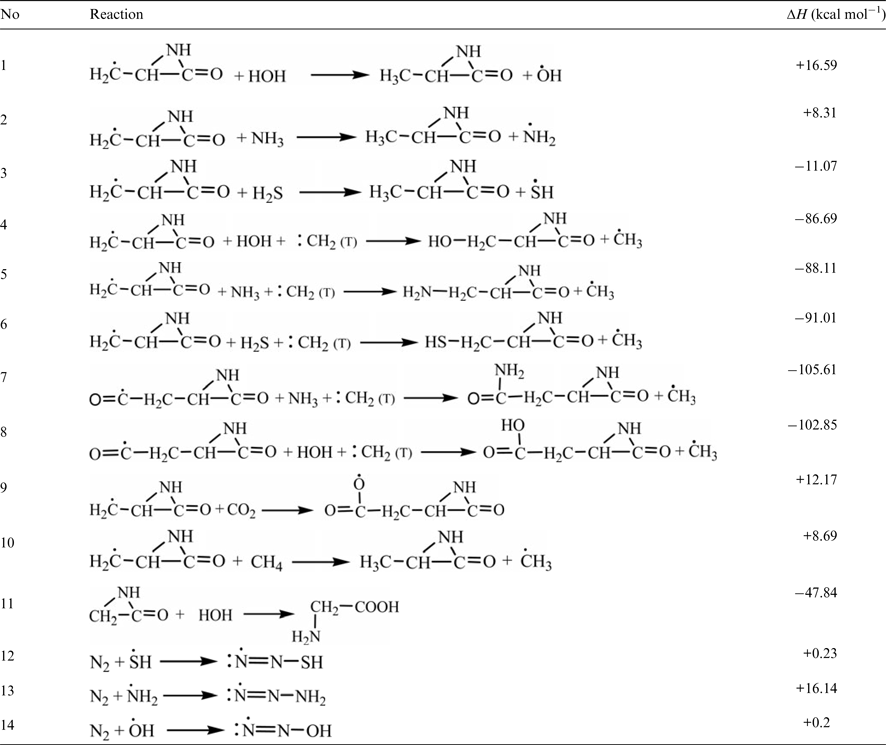
We believe this type of final reactions, which transform radicalic structures in neutral molecules, occur in different thermodynamic conditions. The reactions themselves are generating heat. In these conditions, the endothermic character of some of the reactions in Table 12 does not prevent them from occurring.
Reaction enthalpies for final reactions

In more detail, following the model of the first three reactions in Table 12, some aziridinone derivatives would be formed and they would hydrolize at the lactam cycle level to produce glycine, alanine, leucine, isoleucine and valine. At this point some carboradicalic structures would trap one hydrogen atom. Because of the positive values of the reaction enthalpies it seems that these transformations are not favoured but the reaction conditions they require can be achieved. The sources of hydrogen can be structures with mobilehydrogen, like HO, HN, HS.
According to the reactions 4 and 6 (Table 12) aziridinone derivatives are formed and they generate the pairs of amino acids serine – threonine and cysteine – methionine, respectively. Lysine is formed according to the model reaction 5 (Table 12). We believe that these three reactions, in which hydrogen appears, are assisted by hydrogen trapping agents.
An interesting case is the formation of two proteinogenic amino acids containing the amide moiety, glutamine and asparagine. Most probably their formation requires the presence of carbonyl type carboradicals (Reaction 7 Table 12). Dehydration between a carboxylic acid and ammonia occurs at high temperatures and never in aqueous medium (Montalbetti & Falque Reference Montalbetti and Falque2005; Al-Warhi et al. Reference Al-Warhi, Al-Hazimi and El-Faham2012).
Next, if we consider the endothermic character of Reaction 9 (Table 12) we opt for type 8 reactions (Table 12) for the formation of the aspartic and glutamic dicarboxylic acids.
For the formation of the three heterocyclic amino acids (histidine, proline, tryptophan) and the two amino acids containing aromatic rings (phenylalanine and tyrosine) the explanation is much simpler. Their precursors as aziridinone derivatives can be radicals, which are trapping hydrogen or even neutral molecules.
For reactions 1, 2 and 3 (Table 12) several observations have to be made. If reaction 1 occurs it means that it will lead to the ‘generation of oxygen’, via hydrogen peroxide. The water that gets in contact with the complex mixture of radicals and polyradicals gains the oxygen. The amino acids and the corresponding polypeptides cannot be destroyed anymore either by oxidation reactions or by hydrolysis. The amides are insoluble in water at neutral values of pH. The polypeptides should be even more insoluble in the same conditions (Schowen et al. Reference Schowen, Jayaraman and Kershner1966; Park et al. Reference Park, Suh and Lee1999; Duan et al. Reference Duan, Dai and Savage2010).
Because of the positive values of the reaction enthalpies (Reactions 10, 11 and 12 in Table 12) the radicals ·OH, ·NH2 and ·SH formed at the interaction of the precursors mixture with the free radicals would not be stabilized by nitrogen. They would become deactivated through different reactions, including the formation of functional terminal groups of the hydroxi-, amino- and thioamino acids.
The hardest to explain is the final structure of methionine. A first hypothesis is that the methylthioethericradical would be trapped after the formation of the thiol moiety. A second hypothesis is that the ·SCH3 radical would be generated from hydrogen sulphide and methylene or the methyl radical, after which it would be trapped by the intermediate precursor corresponding to methionine. One should not forget that the S-H bond is much weaker than the O-H or the N-H bonds. This increases the possibility of its attack through insertion by methylene (Baslé et al. Reference Baslé, Joubert and Pucheault2010; Díaz-Rodrígueaz & Davis Reference Díaz-Rodrígueaz and Davis2011).
The final hydrolysis reaction at the level of the aziridinone cycle is exothermic and most probably it occurs through an ionic mechanism. It is important to mention that the polymerization has a radicalic mechanism and occurs before the heterolytic hydrolysis, which leads to the formation of the backbone.
A short evaluation of the participation of the components of the primordial atmosphere to the formation of the essential amino acids and polypeptides leads to the conclusion that only water, ammonia and hydrogen sulphide are needed in order to achieve this. The other two components (carbon dioxide and methane) are not mandatory and they could be formed during the multiple chemical transformations presented in this work. Carbon dioxide can be formed from carbon monoxide and oxygen and methane can be generated from methylene or the methyl radical. The reactions 9 and 10 in Table 12 in new thermodynamical conditions are not excluded and thus, the presence of CO2 and CH4 in primary atmosphere is normally accepted.
We have to do two more observations: (a) the role of the nitrogen as a reaction medium ends apparently when the mixture of precursors, synthons and radicals gets in contact with the essential components of the primordial atmosphere, water, ammonia, hydrogen sulphide carbon dioxide and methane; (b) the proteinogenic amino acids and their corresponding polypeptides formed simultaneously from the same precursors. These precursors are the radicals derived from aziridinone, without their functional groups in some cases. The precursors hydrolize and generate proteinogenic amino acids, or they form polypeptides through copolymerization followed by hydrolysis.
The conclusion of this section is that the proteinogenic amino acids and their corresponding polypeptides have the same precursors at a certain stage. In other words they have the same origin. The copolymerization of the precursor syntones before hydrolize remains the essential moment in appearance of the first polypeptides.
Proteinogenic amino acids
First, in this chapter two structural parameters, specific to each proteinogenic amino acid are proposed. That based on the number and the nature of syntones (methylene, nitrene and carbon monoxide) and primary atmosphere components (water, ammonia and hydrogen sulphide) also as on the type of chemical transformations involved in formation of each amino acid.
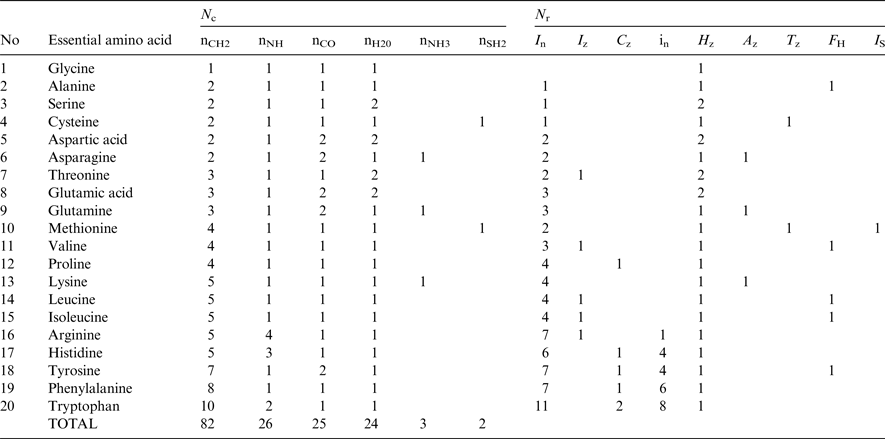
Successively, in Table 13, by nCH2, nNH, nCO, nH2O, nNH3 and nSH2 are noted the number of syntones and primary atmosphere components, which by addition give a certain number of reaction components Nc.
Number of components and reactions in proteinogenic amino acid formation

Analogously, by I n, I z, C z, E n, H z, A z, T z, F H and Is are specified the number of the next chemical transformations: chain reaction, isomerization, cyclization, elimination, hydrolyze, amonolise, tiolise, fixation of hydrogen and one insertion reaction at the level of H-S bond in methionine, of cause by addition is obtained N r, as a measure of a chemical evolution in every amino acid synthesis.
Concretely, a new parameter F c named structural complex factor, as a some of the two, previous defined numbers N c and N r is proposed:
 $$F_{\rm c} = N_{\rm c} + N_{\rm r}$$
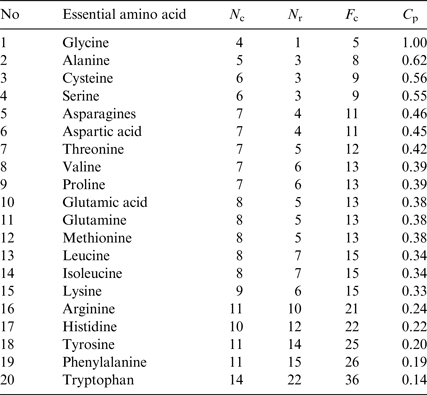
Evidently, glycine with F c = 5, could be formed in a greater quantity in respect to others proteinogenic amino acids. In an opposite position could be placed tryptophan with F c = 36.
We recall that the proteinogenic amino acids and their corresponding polypeptides have the same precursors. That is why we consider the structural complex factor F c, as being responsible of the frequency of each amino acid moiety in the polypeptide chain (King & Jukes Reference King and Jukes1969; Dyer Reference Dyer1971). Also, that is supported by the two near values of enthalpies of the polymerization and copolymerization reactions 3 and 4 in Table 10.
Moreover, a parameter C p, named coefficient of participation, relation (2) could be introduce in order to establish the ability of each protogenetic aminoacid fragment to the polypeptide formations:
 $$C_{\rm p} = {\rm 5\! \cdot\! 1}/F_{\rm c}$$
Consequently, the 20 proteinogenic amino acids could be classified in a decreasing order of their ability of polypeptide formation in respect to glycine with C p = 1 (Table 14).
Structural parameters of proteinogenic amino acids

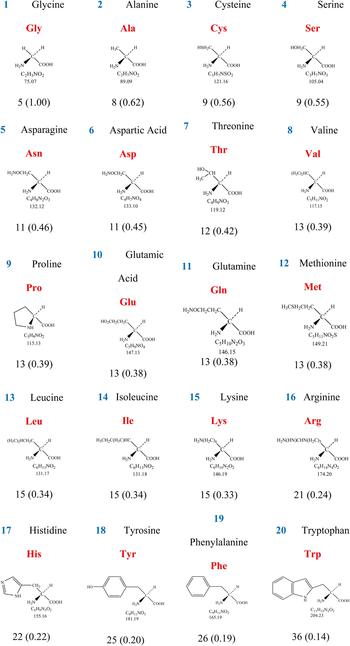
In the same Table 14 are shown together all proposed parameters, which permitted us to order the proteinogenic amino acids.
Finally, it is proposed a representation of proteinogenic amino acids by a border number, e.g. coefficient of participation C p, in a decreasing order, like in Fig. 2.
Proteinogenic amino acids. Order number/Chemical Name/Acid Code/Chemical structure/Molecular formula/Molecular Mass/Structural Complex Factor F c/Coefficient of participation C p.
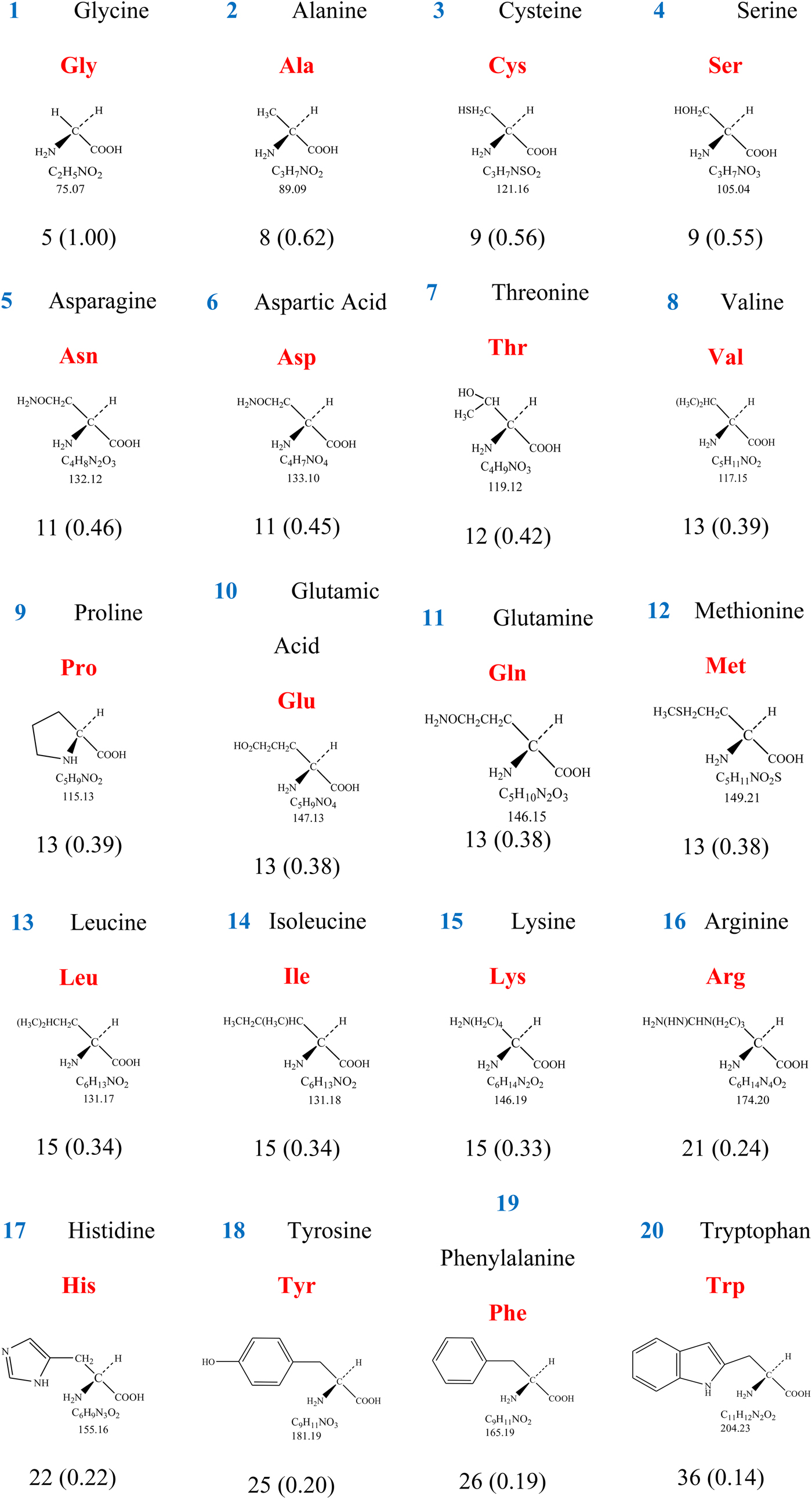
In the same Fig. 2 near new two parameters F c and C p are added an order number, the chemical name, the acid code, the chemical structure, the molecular formula and the molecular Mass of all proteinogenic amino acids. Where, the proteinogenic amino acids have the same participation coefficients C p, remain to explore the chemical ways involved in formation of each amino acids.
Indeed, to prove our theoretical results concerning the participation of the proteinogenic amino acids to the formation of the polypeptides a study of composition of certain proteins could be taken in consideration (Allen et al. Reference Allen, Metz, Timmer, Rhoads and Browning1992). At the end of this chapter some general remarks could be point out.
The nitrogen accompany the others components of the atmosphere even today. As syntone methylene is the most important compound in formation of various organic compounds (Zugravescu et al. Reference Zugravescu, Rucinschi and Surpateanu1970, Reference Zugravescu, Rucinschi and Surpateanu1971; Kirmse Reference Kirmse1971; Surpateanu et al. Reference Surpateanu, Catteau, Karafiloglou and Lablache-Combier1976; Becerra & Monty Frey Reference Becerra and Monty Frey1987; Surpateanu & Lungu Reference Surpateanu and Lungu2011; Grainger & Munro Reference Grainger and Munro2015). Some methylation of proteic chains shows an epigenetic role (Wegner et al. Reference Wegner, Neddermann, Piorunska-Stolzmann and Jagodzinski2014; Guan et al. Reference Guan, Xie and Ding2015; Nickel & Stadler Reference Nickel and Stadler2015). The carbon monoxide is a very dangerous product against life. Today it is less known the role of nitrene on the proteic chain more exactly its behaviour in respect to the life.
Experimental
In a previous study (Surpateanu & Lungu Reference Surpateanu and Lungu2011) we analyzed the chemical behaviour of methylene when in contact with (a) carbon dioxide in water, (b) ammonia in water and (c) carbon dioxide and ammonia in water. Practically, diazomethane ethereal solutions have been treated with the previously mentioned mixtures, at 0°C. Samples of reaction products mixtures have been obtained by removing the liquid fractions and 1H-NMR spectra and ESI-MS data have been recorded. For each contact between methylene and the components of the primordial atmosphere (previously coded as a, b and c) we identified the resulting carboxylic acids, amines and amino acids. For the amino acids the ESI-MS spectra show m/z maximum values of over 374 units.
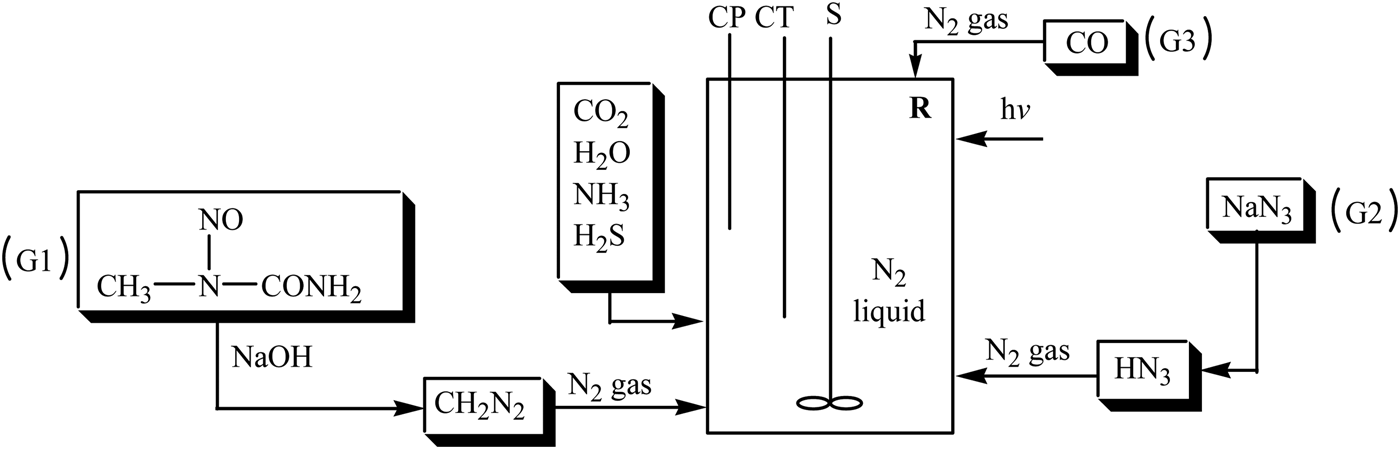
Based on our results when studying the chemical behaviour of the three synthons (methylene, nitrene and carbon monoxide) before and during the interaction with the components of the primordial atmosphere, in this work we propose an experimental assembly for obtaining essential amino acids and polypeptides (Fig. 3).
Experimental assembly.

The assembly contains a reactor (R) equipped with a pressure controller (CP), temperature controller (CT), stirring device (S) and inlets for the three gas synthons carried by Nitrogen gas. This quartz reactor should be filled initially with liquid Nitrogen, which will become the reaction medium.
We suggest that for the synthesis of methylene we use nitrosomethyl-urea (G1) (Arndt & Amende Reference Arndt and Amende1930; Adamson & Kenner Reference Adamson and Kenner1935; Arndt Reference Arndt and Blatt1943). For generating nitrene one can use sodium or potassium azides (G2) (Miller et al. Reference Miller, Audrieth and Filbert1946; Brase & Banert Reference Brase and Banert2010). Carbon monoxide is easily accessible. In this case we suggest its feeding from a pressurized reservoir. The feeding lines G1, G2 and G3 must deliver ultra-pure synthons to the reactor. Light should be generated inside the quartz reactor. A cooling mantle using liquid nitrogen is needed to cool the light source. Considering the numerical data from Table 13 we recommend using a mixture of methylene, nitrene and carbon monoxide in a molar ratio of 1 : 0.32 : 0.30 for the initial experiments. After running some experiments (by us or maybe other scientist interested in the field) we will come back with more data and suggest reaction times and ways of performing the interaction with the components of the primordial atmosphere, either as aqueous solutions or as aerosols.
Although carbon dioxide and methane does not appear to be necessary in our investigations we recommend performing the interaction with the atmospheric components both in their presence and their absence.
General conclusions
1. Three synthons (methylene, nitrene and carbon monoxide) are the foundation for the synthesis of the first amino acids and the first polypeptides. The most important thing to notice is that these polypeptides did not form directly from the corresponding amino acids. The proteinogenic amino acids and the polypeptides have the same precursors at a certain stage. In other words they have the same origin.
2. The three precursors (methylene, nitrene and carbon monoxide) could produce aziridinone in Nitrogen. This is a key compound in the formation of proteinogenic amino acids and polypeptides. Aziridinone would be obtained most probably in two stages: (a) synthesis of isocyanic acid from nitrene and carbon monoxide and (b) its reaction with methylene.
3. The synthons can be stabilized by attaching them to molecular nitrogen.
4. Reactions between synthons and their reactions with the components of the primordial atmosphere result in a wide range of products found among interstellar compounds.
5. By the values for the enthalpies of formation obtained using the B88LYP DFT method, aziridinone is an asymmetric molecule with a chiral centre situated at the level of the Nitrogen atom.
6. All the intermediate precursors and the final neutral molecules could be formed by radicalic and photochemical reactions and would require the mandatory presence of light. We considered only chemical transformations of the molecular systems that involve lowering the energy when passing from the initial to the final states.
7. According to the thermodynamic data, in order to obtain the final structures of the proteinogenic amino acids and polypeptides with an S configuration backbone one should start from aziridinone with an R configuration at the Nitrogen atom level.
8. The higher thermodynamic stability of the Thr (SR) and Ile (SS) diasteroisomers found in natural polypeptides compared with those absent in natural polypeptides convinced us that such a precise thermodynamic control could occur only at low temperatures.
9. The results of the kinetic study on the formation of the three methylaziridinones suggested us the model consisting of radicalic and photochemical reactions for the formation of proteinogenic amino acids and the corresponding polypeptides. This model follows the conditions imposed by the sixth paragraph of this section.
10. The reactions for the formation of the aziridonyl radicals, their chain reactions, the isomerization, cyclization, elimination and polymerization reactions presented in this work as a ‘reaction model’ use only intermediates involving the three synthons (methylene, nitrene and carbon monoxide). These reactions can produce the precursors for the proteinogenic amino acids and polypeptides. These precursors are involved in the final reactions with the three components of the primordial atmosphere (water, ammonia and hydrogen sulphide). Thus, the first proteinogenic amino acids and the first polypeptides can be obtained.
11. Three precursors (methylene, nitrene and carbon monoxide) and three components of the primordial atmosphere (water, ammonia and hydrogen sulphide) could be sufficient for the formation of the first proteinogenic amino acids and the corresponding polypeptides. Because of the necessity to synthesize methionine after the formation of the S-H bond by insertion of methylene we considered the precursors coexist with the synthons during their interaction with the components of the primordial atmosphere.
12. We remind that the radicals and the polyradicals precursors of the amino acids and polypeptides can form hydrogen peroxide, atomic oxygen and even carbon monoxide when in contact with water. Surely, atomic oxygen and carbon monoxide can produce carbon dioxide.
13. Once the polypeptides are formed they cannot be hydrolyzed in aqueous media and at neutral pH. Also, at very low concentrations the Oxygen cannot promote oxidations of the amino acids and the primordial polypeptides. In what concerns the molecular Nitrogen, a primordial component in this entire complex process for the formation of amino acids and polypeptides, its stabilizing role for the atmospheric components continues even today.
14. As quantitative parameters for the estimation of the presence of proteinogenic amino acids in isolated form or in the structures of the primordial polypeptides, we propose two parameters characteristic to every proteinogenic amino acid: one is the factor of structural complexity (F c) and the second is the participation coefficient (C p).
15. We propose an experimental assembly which can perform the syntheses for the racemic amino acids and the corresponding polypeptides. We suggest the sources for the synthons, their combination ratio and a possible operating procedure up to the interaction of the precursors with the components of the primordial atmosphere.
16. Based on the results presented in this work we boldly address several aspects: (a) the formation of Oxygen at the interaction of the precursors of amino acids and polypeptides with the components of the primordial atmosphere; (b) the presence or the absence of carbon dioxide and methan components of the primordial atmosphere at the moment of the before mentioned interaction; (c) the effect that methylene and nitrene had on some living tissues.
17. Undoubtedly, the main goal of this work is the passage from the asymmetric induction at the aziridinone level to the formation of proteinogenic amino acids and polypeptides. The relation synthons – proteinogenic amino acids – polypeptides opens new avenues that deserve attention from fundamental point of view, but could also have spectacular applied consequences. Three syntones at the contact with simple molecules in different thermodynamic conditions could furnish a great variety of organic molecules.
18. Concretely, the passage: simple syntones → aziridinone → substituted aziridinones → proteinogenic amino acids and those of substituted aziridinones to polypeptides represent the new theory on the appearance of the first prebiotic molecules presented in this paper.
19. We believe that the role of syntones as intermediaries in the construction of ‘live’ deserve special attention from specialists in this field.
20. We will return with a cycle of papers concerning the construction of all proteinogenic amino acids according to the model proposed in this paper.
Disclosure statement
No competing financial interests exist.