Introduction
To the archaeologist, the term ‘Maya’ immediately conjures up images of temples and stelae. The cultural heritage also has special meaning for contemporary people of the Maya region. In this study, we examine ways in which ethnic Maya peoples think about their heritage from primordial times, through the ravages of the Colonial era, and up to the present. In view of the fact that more than five million people self-identify as ethnically Maya, speak a diversity of Mayan languages and are distributed across five different nation-states (southern Mexico, Belize, Guatemala, western Honduras and El Salvador), the task of examining how Maya peoples today relate to the past is too large to be fully explored within this article. Their diverse experiences, both today and in the past, belie the implied homogeneity of terms such as ‘The Maya’ or ‘The Ancient Maya’, which evoke an image of sameness over a large area. In contrast, the two ethno-linguistic areas examined here are strikingly dissimilar while facing similar challenges in terms of cultural survival. We focus specifically on Santiago Atitlán in the Guatemala highlands, and on the community of Tahcabo in the eastern part of Yucatán, Mexico (Figure 1).
The Maya region, showing the locations of Santiago Atitlán in southern Guatemala, and Tahcabo in Yucatán, Mexico (map created by L.A. Brown).

Contemporary heritage concerns take centre stage in both places; the past is actively present and its meaning and significance are a source of contestation and intolerance as well as creative hybridity (Bhabha Reference Bhabha1994). In Santiago Atitlán, Tz'utujil ritual practitioners interact with their past through objects that instantiate both time and their ancestors, while Evangelicals attempt to thwart non-Christian ritual practices. At Tahcabo, Yucatec heritage is filtered through incorporative and hybrid strategies of survival that have allowed the community to negotiate the extractive economies that accompanied colonialism and Christianity, as well as proscriptions against speaking and writing Mayan that formed part of post-revolutionary mestizaje—a state-engineered strategy of replacing specific ethnic identities with a supra-Mexican identity that merged Spanish and Indigenous identities into one.
Contested ontologies and the volition of heritage in Santiago Atitlán
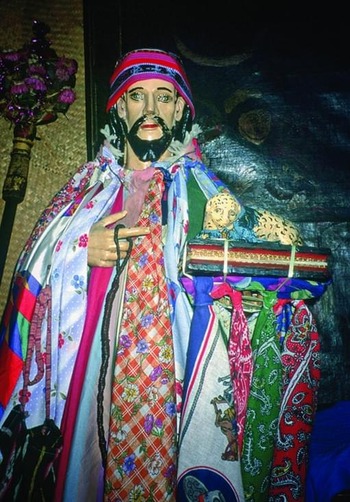
Lake Atitlán is rimmed with the topographic remnants of its volcanic past. This majestic setting is a major international tourist attraction and home to several Mayaethno-linguistic groups in the Guatemalan highlands, one of which is the Tz'utujil Maya. Globalisation and a prolonged civil war (1960–1996) have affected all Maya communities around the lake, reshaping local economies, shifting social relationships and significantly undermining support for the traditional religious practices known collectively as costumbres or the ‘Old Ways’. Throughout most of the post-European Contact period, the costumbres sustained traditional knowledge in Santiago Atitlán. Local deities melded with intrusive foreign elements as Atitecos, the name town residents give themselves, converted the saints into deities that made sense in the local idiom (e.g. Figure 2), and costumbres maintained a predominant focus on ancestral renewal and the perpetuation of their existence in contemporary society (Carlsen Reference Carlsen2011: 64). Today, however, most Atitecos are either Orthodox Catholics or belong to one of many Evangelical sects that assume a hostile stance towards costumbre. Despite this hostility, there are individuals who retain knowledge of the costumbres, including the ceremonial prayer-maker and healer known as the aj'kun. It is these people that we have turned to for our discussion of the use of archaeological materials in maintaining an experience of time where the past emerges in the present.
Statue of San Juan Bautista (St John the Baptist) illustrating how Catholic saints were co-opted to preserve older Tz'utujil nawales; followers of the ‘Old Ways’ recognise San Juan as the Lord of the Wild Animals; accordingly, his lamb is painted with jaguar spots, transforming the lamb into an animal more suited to this ancestral deity (photograph by L.A. Brown).

In Santiago Atitlán, ritual practitioners are called to their profession via the process of divine election. When a person undergoes this process, they usually experience a series ofphysical or emotional life crises, such as recurrent illness or repeated deaths in the family that will not resolve until the individual accepts their new calling. In the midst of this turbulent recruitment period, initiates begin to encounter objects—archaeological and historic artefacts as well as unworked materials—with unusual attributes and a certain personal resonance, such that they stand out and demand the attention of their finders (Brown Reference Brown2000). These charismatic objects possess animate qualities and can display independent agency, as noted by various practitioners who told us that sacred objects move of their own volition, appear and disappear at will, and make noises, all signs that they are not normal everyday items. Both incipient and seasoned ritual practitioners collect these items over the course of their lives. Thus, each person can acquire an assemblage of sacred objects consisting of materials from various time periods: an amalgam of archaeological, historic and unusual recent artefacts combined with non-cultural materials (Figure 3).
An assemblage of sacred objects collected by a Tz'utujil ritual practitioner and displayed on an altar (photograph by L.A. Brown).

Sacred objects are key participants in how the past is made known in the present (Brown Reference Brown and Aveni2015). Pertinent to this is the understanding that these objects are enmeshed within local “deep-time narratives” (Bruchac Reference Bruchac, Smith and Wobst2005: 56), in this case, oral traditions that convey how things were in a faraway time and place, long before Europeans arrived upon the continent. One widespread deep-time narrative, documented in the Popol Vuh and surviving in various local accounts throughout Mesoamerica, explains the existence of multiple worlds or eras prior to that which survives today (Tozzer Reference Tozzer1907: 153; Redfield & Villa Rojas Reference Redfield and Villa Rojas1934: 330–31; Tedlock Reference Tedlock1985; Monaghan Reference Monaghan1995: 32; Christenson Reference Christenson2007). In Santiago Atitlán, followers of the ‘Old Ways’ understand that during a previous era, before the creation of humans, ancient beings known collectively as nawales roamed the earth. The nawales take many forms and guises, but a common attribute is their association with this earlier world, a magical ancestral past that continues to empower the present (Mendelson Reference Mendelson1957: 484–85; O'Brien Reference O'Brien1975: 43; Stanzione Reference Stanzione2003: 21; Carlsen Reference Carlsen, Cecil and Pugh2009: 312). At the end of their time here on earth, the nawales retreated into the mountains from where they continue to watch over the community as the powerful AchiJab or Rain Men. As they departed, they left behind relics—tangible pieces of themselves—in the form of special objects that embody their powerful presence. These are the sacred materials collected by ritual practitioners today. Atitecos describe these objects as being puro-nawal (‘pure-nawal’), meaning that they are infused with nawal essence (Carlsen Reference Carlsen, Cecil and Pugh2009: 312); they literally embody deep-time beings from a previous world.
Ritual practitioners’ relationships with embodied puro-nawal objects provide an intriguing example of how things can instantiate ancestral deities. Engagement with these powerful animate materials offers individuals a direct and personal experience of the “present past” (see Watson et al. Reference Watson, Zimmerman, Peterson and Topping1989: 33). The present past can be understood as a space in which time is not bounded in a one-way linear progression of past, present and future, but is, instead, permeable. Past cycles can fold into the present and are performed in stories, sacred songs, and ceremonies passed through generations and experienced in the deeply personal relationships between ritual practitioners and assemblages of sacred objects. As vestiges of the still existing yet transformed nawales, objects that are puro-nawal are central to this experience and possess significant aspects of personhood. A distinguishing characteristic of this personhood is the understanding that puro-nawales have the power to communicate, as explained by an aj'kun:
In the old days, the sky was on the ground and those guys [puro-nawal], they lived in the dark. The black dancers, they represent the night, they started to dance. They have a kind of a dance that they do and they lifted up the sky and then the sun came up, the light came out. Nowadays we have the light of the sun and it's okay, but, mostly, in the old days they were living in the dark. Before the sun rose, all of these guys [puro-nawal] were there. They are from the beginning. All those rocks [puro-nawal] were there and they were talking to each other. Then, when the Maya people came, they talked to them in dreams. They talked to each other first, but after the day dawned and the sun first rose they started to talk to the Maya people in dreams (interview by L.A. Brown in 2011, translated by Dolores Ratzán).
Puro-nawales are communicative objects that transmit cultural knowledge during dreams (see Astor-Aguilera Reference Astor-Aguilera2010; Brown Reference Brown and Aveni2015). In dreams, ritual practitioners foster personal relationships with the nawales who appear in various guises to provide diagnoses for gravely ill patients, reveal new medicines and share insights from the vast pool of ancestral knowledge from the past, where they will be incorporated into ceremonies and cures enacted in the present.
In approaching puro-nawales as persons and situating them as sentient beings within an intimate familial network of mutually beneficial social interactions, ritual practitioners follow an Indigenous ontology that preserves traditional Tz'utujil knowledge and provides a bulwark against the culturally intrusive forces of globalisation. Occasionally such resistance is mobilised against economic forces, as made clear by an aj'kun caring for a puro-nawal found by his father. As he told us, one day when his father was fishing along the shore of the lake, he looked down and saw a stone carving resting underwater in the mud. His father retrieved the stone and brought it home. The watery submergence of this sculpture, and subsequent dream communications after its recovery, confirmed its identification as Mar (‘Ocean’), a powerful female nawal and protector. Mar consists of a large stone tenoned sculpture, an architectural piece that would have adorned the façade of an ancient building. The carving depicts a zoomorphic being peering out from the gaping mouth of a large serpent. Notably, the face of the emerging creature has been enlivened with vivid red paint (Figure 4).
Mar (‘Ocean’), a powerful female nawal and protector whose face was highlighted with red paint to discourage an aggressive antiquities collector (photograph by L.A. Brown).

The circumstance under which the face of Mar was painted is noteworthy because it illustrates how nawales can work to fortify Tz'utujil heritage against the threat of commodification. Sometime after finding Mar, a Ladino, the common term used to refer to non-Indigenous, Spanish-speaking Guatemalans, visited Santiago Atitlán. The Ladino approached the father (the one who had found Mar) of the aj'kun and wanted to purchase the sculpture. The foreigner was persistent, increasing his price with each offer, until his father began to consider selling. That night, the nawal visited his father in a dream, confronting him: ‘Why do you keep bothering me? Why do you want to give me to this guy?’ On waking, his father knew he could not sell the nawal but needed a way to stop the persistent Ladino. It was then that he decided to use the bright red paint. When the man arrived that morning to offer more money, he saw that vivid red paint had been added to the face of the sculpture. He promptly left and did not return.
The story of Mar illustrates two things: first, how humans and nawales together can resist the forces of an antiquities market that would commodify puro-nawales. The impetus to disrupt the potential sale of Mar was initiated by the sculpture, who voiced objection in a dream, and, in the process, reinforced her ontological status as an object possessing personhood rather than as a commodity. Second, the relationship between Mar and the ritual practitioner is one of mutual respect and social reciprocity in which the sculpture is accorded a form of agency.
Nonetheless, as costumbres have become marginalised in Santiago Atitlán, the uses of the past familiar to followers of the ‘Old Ways’ are increasingly contested. For some Atitecos, archaeological objects are simply commodities to be taken to one of the many tourist shops along the dock and sold to visitors. One entrepreneurial tour guide, with property in a nearby archaeological site, quietly offers excursions to tourists wanting to dig up their own piece of the Maya past. More serious conflicts over the use of the past have emerged with the escalation of religious factionalism. Over the past several decades, members of conservative religious sects increasingly view traditional sacred sites, puro-nawal objects and ritual practitioners as evil. This has created a dangerous environment where ritual practitioners have been targeted and even murdered by local Tz'utujil ‘social cleansing’ groups. Emerging from Protestant sects fostering millenarian beliefs, social cleansers perceive the present world as corrupt and one soon to be replaced by a harmonious and moral world heralded by the return of Christ; something that will not occur until the righteous have purged all evil, which includes gang members, adulterers and thieves from the community, as well as those who engage with nawales (see Carlsen Reference Carlsen2011: 183–86). Within this perspective, ritual practitioners and their puro-nawal collaborators are primary targets in an “epic battle against Satan, whose devotees lurk among the followers of the Old Ways” (Carlsen Reference Carlsen2011: 183–84). While Santiago Atitlán presents an extreme example of such factionalism, it is not unique among Maya communities in exploiting the past as an arena for religious conflict.
Incorporative hybridity in Tahcabo
In contrast to the spectacular volcanic and lacustrine setting of Santiago Atitlán, Tahcabo is situated on the flat limestone plain of northern Yucatán—an area famous for its lack of surface water. Instead of lakes, solution sinkholes (locally called cenotes) dot the landscape and provide sources of permanent water and points of entry into the karstic subterranean worlds that figured prominently in traditional Maya religious beliefs. As a further contrast, Tahcabo is not a magnet for tourists as is Santiago Atitlán. In Yucatán, heritage tourism is restricted to a deeply incised east–west path that deviates little from a circuit connecting Cancun, Chichén Itzá, Mérida and Uxmal. Globalisation affects Tahcabo not by bringing in curious tourists and acquisitive antiquities collectors but by pulling residents away from the town in search of stable employment on the Maya Riviera along the Caribbean Coast. The commodification is an embodied one. Specifically, residents can try to make ends meet within the culturally rich but limited economic opportunities of their community by farming on community lands and caring for their own or someone else's livestock, or they can sell their labour to the hotels and restaurants that dot the Caribbean coastline a few hours to the east.
The costumbres of Tahcabo look very different from those practised by Tz'utujil ritualists. For example, females don the traditional attire of white cotton embroidered huipiles primarily for special occasions, and the Cha'Chaak ceremony conducted at the onset of the rainy season to propitiate the rain deity is performed sporadically. On the other hand, duendes—locally construed as spirits or ‘owners’ of places such as caves and cenotes—is still an operative concept in Tahcabo. Annually, a large fiesta—complete with bullfighting—takes place, during which San Bartolomé, the patron saint of Tahcabo—is celebrated. In the words of Connerton (Reference Connerton1989), social memory at Tahcabo is both inscribed and incorporated. The residents of Tahcabo are well aware, at least broadly, if not in detail, of the extraordinarily deep history of their community, which includes an early Colonial church (Figure 5), probably constructed by 1612 (de Cogolludo Reference de Cogolludo1688: 238), and situated directly beside the base of a large pre-Hispanic shrine (Figure 6). Municipal improvement projects, such as the re-building of the church after the nave was destroyed in 1988 by Hurricane Gilbert, are a source of anxiety among community members because any excavation of the ground around the church inevitably disturbs burials placed within the large Colonial cemetery that extends beneath and beyond the limits of what was once a much larger structure.
Stone sanctuary with an intact arch from the early seventeenth century, Tahcabo, Yucatán (photograph by P.A. McAnany).

The much-reduced but still substantial base of a pre-Hispanic shrine in the background (left) with the rear of the Colonial church sanctuary in the foreground (right) (photograph by P.A. McAnany).

In 2012, Adolfo Iván Batun Alpuche and Patricia A. McAnany initiated a project called ‘Proyecto Arqueológico Colaborativo del Oriente de Yucatán’ (‘Collaborative Archaeological Project in Eastern Yucatán’) in order to study the chaotic and painful Colonial period from a materially grounded community perspective. After reconnoitring 25 small communities with Colonial architecture in the eastern part of Yucatán, Tahcabo was selected due to its massive seventeenth-century stone church sanctuary, complete with laboriously hand-pecked veneer masonry and intact archway (Figure 5) that is set back from the current plaza. The Tahcabo church is characteristic of what were colloquially called ‘Indian churches’ during Colonial times. Archaeologists refer to them as ramada churches because, in such constructions, the sidewalls were left open and the congregational area roofed with a massive thatch covering (Andrews Reference Andrews and Thomas1991; Graham Reference Graham2011). During the sixteenth century, Tahcabo began to appear on tribute lists and was well known for the production of honey and cotton (Quezada Reference Quezada2001, Reference Quezada and Rugeley2014).
To document the historical experience of the residents of Tahcabo, the project surveyed the town landscape for Colonial and post-independence dwellings, as well as earlier pre-Colonial constructions (Figure 6). Maya houses from Colonial times can be elusive in continuously inhabited landscapes (Alexander Reference Alexander2003; deFrance & Hansen Reference deFrance and Hanson2009; Meyers Reference Meyers2012). The lived experience of colonialism and its aftermath—intimated by the linguistic hybridity examined by Hanks (Reference Hanks2010)—have been incorporated into the fabric of the community in paradoxical ways. For instance, there is a strong sense of community pride in the antiquity of the Colonial church ruins. At the same time, the church ruins embody the violence and abuse that accompanied colonialism and the early Republican period. Among Yucatec peoples, the nineteenth century is referred to as ‘tiempo de esclavos’—the time of slavery.
At town meetings held to discuss archaeological research in Tahcabo, townspeople voiced concern over the loss of their language—Yucateko or Maya t'aan. In Tahcabo, Maya t'aan is spoken among family members and friends but not in school. The younger generation, therefore, is vulnerable to a lingering post-revolutionary policy in which Indigenous languages were ‘cleansed’ from rural schools in the interests of building a strong, Spanish-speaking mestizo nation. Still, there are currently millions of Maya t'aan speakers—far outnumbering those speaking other Mayan languages such as Tz'utujil—but residents of Tahcabo are painfully aware of how quickly a language can become locally endangered. While monolingual Maya t'aan speakers are still stigmatised by Yucatec society at large, in Tahcabo and other parts of Yucatán, language—even more so than the impressive places built by their ancestors and controlled by federal and state agencies—is perceived as a vitally important part of their cultural heritage.
This Indigenous language and associated scripts have a deep history that goes back, in hieroglyphic form, to the Preclassic period, about 300 BC. In sixteenth-century Yucatán, Bishop Diego de Landa unwittingly created the first syllabary or concordance between Mayan hieroglyphic phonemes and letters of the Spanish alphabet. Possibly the largest corpus of Colonial American prose written in an Indigenous language was created by Yucatec ritual practitioners and town clerks using an alphabetised version of Maya t'aan (Restall Reference Restall1997; Tedlock Reference Tedlock2010). Colonial Yucatec Books of the Chilam Balam were composed and written in the folded time ontology described earlier for Tz'utujil Maya ritual practitioners. Despite, or perhaps because, of this strong persistence of the native language, linguist William Hanks (Reference Hanks2010) has written of the deep entanglement—in a semantic sense—of Maya t'aan with Spanish. He further alleges that ritual practices performed in this language are not necessarily Indigenous in origin because they contain Christian structure and meaning (Hanks Reference Hanks2010: 8). Of course, hybridity is dialectical, and Yucatecos who claim no Maya ancestry nonetheless speak a version of Spanish that contains a significant number of Maya t'aan words.
In recent decades, the government of Mexico has reversed its discriminatory policy against the use of native languages and now actively values prose and poetry written in one of the 58 native languages (González Reference González2004). Spoken and written Maya t'aan can be said to be making a modest comeback, but language revitalisation faces daunting challenges as the forces of globalisation drain the populace of rural villages, with women and men seeking employment in the tourist industries of the Maya Riviera. Where does this leave the approximately 500 people of Tahcabo, who express great concern about the loss of their language, and who ask for curricular materials in their natal language to be produced for their schools? There is a strong sense from the community that this is the kind of collaborative contribution expected from a community archaeology project.
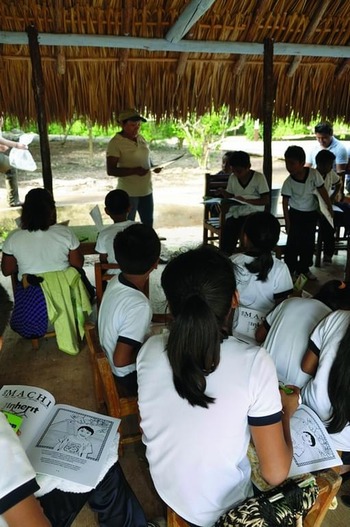
As part of a previous heritage project, we had generated a colouring book that contains images of Yucatec cultural heritage, both past and present. The images are accompanied by two–three short sentences written in both Maya t'aan and Spanish (Figure 7). In 2014, at a heritage day celebration held at the local primary school, we distributed the colouring books and conducted an interactive read-along in both languages (Figure 8). This event quickened the curiosity of students about their natal language and also about the deep history of their town.
Page of the Maya t'aan/Spanish colouring book distributed to Tahcabo students; this page illustrates a pre-Hispanic ballcourt at Chichén Itzá with players past and present (courtesy of InHerit: Indigenous Heritage Passed to Present).

Lourdes Chan Caamal leads an interactive read-along in Maya t'aan during heritage-day celebrations at the local primary school (photograph by P.A. McAnany).

Hanks (Reference Hanks2010) is correct in pointing to the cross—and Christianity—as having played a powerful role in the colonial experience of Yucatec peoples. Massive mission churches and cathedrals built during the sixteenth–eighteenth centuries are still the largest architectural features next to the pre-Hispanic mounds in this relatively flat landscape. The violence, both structural and physical, that accompanied the colonisation of Yucatán has left an enduring legacy of inequality that is materialised quite literally in mission churches. These buildings often contain worked stone (piedras labradas) removed from pre-Hispanic buildings. During early Colonial times, the northern part of Yucatán was carved into land for encomiendas and missions. The former—a grant to Spaniards of the labour of Indigenous occupants and a right to their produce—was implemented at Tahcabo by 1579 (Relaciones Histórico-Geográficas de las Provincias de Yucatán 1900: 50–60). By 1612, a church that was visited periodically by a friar (a visita) was established (de Cogolludo Reference de Cogolludo1688: 238). The latter indentured the inhabitants of a place to build a church, provide for periodic visits by clergy and pay various forms of ecclesiastical taxes. Although this extractive form of colonisation was curtailed after Mexican Independence (1821), and outlawed entirely after the Mexican Revolution (1910), it has lingered in social memory.
One of our project members, Lourdes Chan Caamal, collected oral histories, and it soon became clear that a historical memory was preserved in local narratives. Community members recall a story from an unspecified time in the past during which a priest was murdered and the ramada church burned. In some versions, the priest was hung from a tree behind the church. His lifeless body reportedly was then buried within the pre-Hispanic mound next to the church. Some say that the town is cursed as a result of this transgression; others state that an apparition of the priest was later seen in Tahcabo. Many stories include reference to outside agitators who allegedly did the killing and burning—possibly during the violence of the nineteenth-century Caste War. The various versions of this oral history encode a cryptic message about abusive practices, lethal violence and collective agency.
The newer chapel-sized church at Tahcabo contains a statue of San Bartolomé, which has undergone significant restoration (Figure 9a). San Bartolomé wears a metal halo, which is detachable, and holds a metal sword (also detachable) hafted onto a wooden handle (Figure 9b). Although, the same patron saint has looked out for the welfare of this community for over 400 years, the age of this particular statue is not clear. The Yucatec artist who fabricated the detachable halo left his maker's mark, Juan B. Chan, and inscribed the year that he created the halo—1892. The style of the statue is Orthodox Catholic but the iconography carved into the halo and sword references Indigenous aesthetics. Flowers with white centres and four petals adorn the crown and knife (Figure 9b). They probably represent a stylised version of the fragrant Plumeria flower—nicte’ ch'um in Maya t'aan—combined with Indigenous concepts of quadri-partitioning and centring. Etched into metal, the outline of the petals and connecting vines was impressed with red pigment, imparting a sense of vitality. The colour palette and iconography draw upon the deep cultural heritage and aesthetics of earlier times, as does the intent of the composition—to adornSan Bartolomé fragrantly. The entanglement of Orthodox Catholic symbols with older Maya iconography pervades Yucatán, where incorporative strategies are pronounced. Significantly, and in contrast to the Tz'utujil example cited earlier, incorporative strategies still function to conserve the cultural knowledge of the community. At Tahcabo, inroads by Evangelicals have not yet driven a wedge of religious intolerance between the ‘Old Ways’ and Evangelical ways through which the world is known.
Patron Saint of Tahcabo: a) San Bartolomé; b) close up of his halo and knife (photographs by P.A. McAnany).

Between the new chapel-sized church, which directly fronts the plaza, and the seventeenth-century stone sanctuary, there is a bullfighting ring (Figure 10). For some Christians, the juxtaposition of an athletic event with a religious sanctuary seems contradictory, but before the sixteenth century, ballcourts were routinely positioned next to temples. Today, and from a conservation standpoint, the act of herding bulls past the stone ruins does not help to conserve the old sanctuary. The churchwarden has askedthe townspeople to consider re-locating the ring away from the church grounds (its current position probably postdates Hurricane Gilbert), but there is resistance to this idea. Bullfights take place on the four days preceding the feast day of San Bartolomé (24 August), and some feel that as the bullfighting is done to honour the patron saint of Tahcabo, it is fitting that the bullring is situated close to the church. On his feast day, San Bartolomé is carried on a litter from the church and paraded past the bullring and through the streets of the town.
Map of the central portion of Tahcabo, showing the Colonial church ruins, the newer church and the bullfighting ring (map created by Alfred Berry).

Discussion: Indigenous ontologies and subjects of heritage
The recent turn towards decentring human agency and emphasising the vitality of non-human subjects—popularised by Latour (Reference Latour2005), among others—is anticipated by Tz'utujil ontologies and Yucatec commemorative religious practices in which non-human subjects display agency. Within the daily landscape of Tz'utujil ritual practitioners, such deeply seated ontologies instantiate creation narratives and reveal ancestral deities that reside within found objects. The materiality of a nawal thwarts an impulse to sell an object to a persistent purchaser of antiquities. Houston (Reference Houston2014) has examined similar ontologies from the Classic period, particularly among royal heirloom objects described hieroglyphically as possessing radiance or heat.
A modified version of ‘thing theory’ (Brown Reference Brown2001) without object sentience has found its way into archaeology, most notably in the work of Hodder (Reference Hodder2012), contributors to Miller (Reference Miller2005), and in the symmetrical archaeological approach of Olsen (Reference Olsen and Hodder2012) and others. This convergence may enable deeper collaborative research between archaeologists and local Indigenous communities by de-emphasising a persistent roadblock to deeper partnerships: incommensurable ontologies for understanding the past or very different ways of understanding how things come into being, and thus how the past and present relate to each other. The way in which agency is instantiated in things that are viewed as dynamic subjects rather than passive objects also calls into question the ‘top-down’ approach to heritage conservation, in which a contrast is drawn between tangible and intangible heritage. That the Tz'utujil nawal Mar can be embodied in a submerged piece of carved stone renders conventional distinctions between religion and architecture open to greater scrutiny. This example highlights the one-dimensional debate on where heritage resides: a) only between humans and objects, and not within the objects themselves (Smith Reference Smith2006); or b) in things that possess affordances and should be respected for their alterity in and of themselves (Olsen Reference Olsen and Hodder2012). Obviously, heritage resides both in our minds and in things, which, by their physical characteristics, prompt humans to build histories and create meaning.
In the Yucatec case, colonialism has complicated the subjective experience of heritage in both expected and unexpected ways (Hart et al. Reference Hart, Oland, Frink, Oland, Hart and Frink2012: 1). Strategies of negotiation—manifest in linguistic hybridity, the social memory of structural violence, the pairing of Christian and Maya iconography on a cherished patron saint and the spatial juxtaposition of a bullring with church structures—demonstrate the ways in which social memory can be inscriptive (physically marked) and also incorporated into speech and oral histories (Connerton Reference Connerton1989: 72–73). Colonialism and its aftershocks hover close to the surface at Tahcabo and begin to merge with the experience of globalism as residents work to hold their community together in the face of formidable challenges and with only limited available options.
Conclusions
Despite the deep differences between landscape and life in Santiago Atitlán and Tahcabo, certain individuals in both communities are concerned with the “means to transmit situated Indigenous cultural knowledge from one generation to the next” (Wickens & Pualani Louis Reference Wickens and Louis2008: 110). Persons in each community also employ historically situated strategies for negotiating survival. Among traditional Tz'utujil ritual practitioners, ontological discreteness seems key to maintaining an inner balance in a world of shifting values and an increasing intolerance of the practice of costumbres. In Yucatán, and particularly in Tahcabo, an incorporative hybridity—encoded in language and religious practices—continues to be central to resilience and survival. These different means of coping with the cultural onslaughts of colonisation, nation-building and aggressive religious proselytisation highlight the multivocality among Indigenous peoples of the Maya region. Alison Wylie (Reference Wylie, Habu, Fawcett and Matsunaga2008) has called for incorporative multivocality in archaeological research—a goal we heartily support—but here we have documented another kind of multivocality that creates distinct forms of cultural heritage among ethnically diverse Maya peoples.
Acknowledgements
Research in Santiago Atitlán, Guatemala, was supported by the Wenner-Gren Foundation for Anthropological Research, Dumbarton Oaks Research Library and Collection Pre-Columbian Studies and the National Science Foundation Short Courses on Research Methods in Cultural Anthropology. Brown wishes to thank the ritual practitioners who so generously shared their time and knowledge. At Tahcabo, Yucatán, Mexico, research support was provided by the National Science Foundation (OISE, Catalyzing International Collaboration, award 1134331), the Kenan Foundation of the University of North Carolina, Chapel Hill, and the Archaeological Institute of America. Patricia McAnany wishes to acknowledge the contribution of her co-director, Adolfo Iván Batun Alpuche, and the institutional support of the Instituto Nacional de Antropología y Historia. Our collaborators deserve special recognition: Lourdes Chan Camaal, Sarah Rowe, Maia Dedrick, Alejandro Tuz Bacab, Miguel Kanxoc, Adolfo Iván Batun Cante, Guy Duke and Alfred Berry. As do the people of the community of Tahcabo who support this project with their time and enthusiasm. The UNC heritage programme, ‘Inherit: Indigenous Heritage Passed to Present’ (www.in-herit.org) provided funding for the creation of the colouring books, and we thank the private family foundation and other donors who have supported our cultural heritage programmes.