We’ve all been warned sometime in our lives that “those who cannot learn from history are doomed to repeat it.” Forrester and colleagues’ article, The Golden Hour After Injury Among Civilians Caught in Conflict Zones appears in this month’s issue.Reference Forrester, August and Cai1 It is critically important for many reasons. The study, by comparing transport times to trauma care, captures over 27 years of civilian casualties articulating the increasing burden placed on innocent civilians in modern day wars and internal conflicts. I trust many in the humanitarian field will ask “How and why did civilians become the major target?”
It immediately brought back memories of how war was first defined for me during 1968 Viet Nam and how every war and conflict I subsequently experienced offered both glaring similarities and marked differences. I also pondered the experience, in the mid-1980s, of attending the International Committee of the Red Cross (ICRC) Health Emergencies in Large Populations’ (HELP) course in Geneva that first prepared me to enter the much broader world of humanitarian health during war and conflict. It was then I read for the first time Henry Dunant’s book A Memory of Solferino, which passionately detailed the consequences of what was one of the bloodiest battles of the 19th century.Reference Dunant2 I decided to reread the book in anticipation of writing this Commentary. I asked myself what, if anything, has changed? With the fast moving “troubles” of the world that often occupy our daily consciousness; we rarely have time to reflect on the lessons of the past and whether they teach us more about the present while lessening the burden of repeating the same flaws in the future. I anticipate that readers of this commentary will experience a similar reflection on just how similar the details of Dunant’s war mirror their own experiences in today’s wars and conflicts. While the circumstances and causes of war and conflict may differ across borders and cultures, in the end, the real victims of war’s insanity silently become dominated by innocent civilians.
THE BATTLE OF SOLFERINO
June of 1859 found Napoleon immersed in the ongoing Franco-Austrian war commanding his fast moving French army who, along with his Italian allies, were driving the Austrians out of Italy. At the same time, Henri Dunant, a Swiss businessman found himself desperately seeking a brief audience with Napoleon to argue for the immediate and exclusive water rights on a large tract of land in Algeria crucial for a family led “financial scheme.” While Dunant had lived a life where he “enjoyed all the privileges accruing to him by virtue of his family’s social and economic position,” he also had a history of allying himself with charitable and religious causes. In attempts to find Napoleon’s field headquarters, a frustrated Dunant traveled from 1 battle site to another, staying just 1 step behind Napoleon’s victorious battles.
Eventually, near the northern Italian town of Solferino, Dunant arrived immediately after a 15-hour battle, just in time to witness the consequences of thousands of Italian, French, and Austrian soldiers having just killed and maimed each other. With massive numbers of unattended injured left lying in the open fields, Dunant’s priorities immediately changed. On his own initiative, Dunant rallied and organized aid work with the assistance of the civilians in a nearby village who hours before had fled for their own protection. It was the unprepared civilians who became the major rescuers and responders of the extended recovery that followed.3
Just 3 years later, in 1862, Dunant published “A Memory of Solferino” a book passionately detailing the consequences of what was one of the bloodiest battles of the 19th century with 6000 dead and more than 35,000 wounded or missing.Reference Dunant2 Civilian deaths during the Napoleonic wars are “impossible to accurately estimate.” While military deaths are invariably put at between 2.5 and 3.4 million, civilian death tolls vary from 750,000 to 3 million mostly from being in the wrong place at the wrong time and suffering from starvation, disease outbreaks, and civil upheaval following the use of “scorched earth tactics.” Epidemics of both typhus and typhoid ravaged civilians and soldiers alike.4–Reference White6 But it is fair to say that civilians were not seen as the “enemy.” It is important to note that only 1 civilian died in the Battle of Solferino.Reference Dunant2
Dunant recounts in great detail multiple “harrowing experiences and cruel disappointments” of villagers and surviving military. He cited survivors who, “coming across someone they knew would kneel at his side trying to bring him back to life, press his hand, staunch the bleeding, or bind the broken limb with a handkerchief. But there was no water to be had for the poor sufferer.” Those only slightly wounded were “so weakened by loss of blood that they too died miserably from exhaustion and hunger.” The equivalent of “field hospitals” were set up in farms, houses, churches, convents, in the open under the trees, public squares, courtyards, streets, and pathways completely transforming the village into one “vast improvised hospital.” With sheer numbers and lack of adequate supplies and trained personnel… “somehow or other a volunteer service had to be organized…but it was very difficult amid such disorder.” Because cases could not be evacuated nearly as quickly as new ones came in, “the congestion grew worse and worse.” Volunteer helpers went first to those who cried the loudest…not always the worst cases. Too late did they become aware of the consequences of those who suffered in silence, the unexpected number of wounded, and the “relatively very small effectiveness of doctors, helpers, and orderlies.”Reference Dunant2
Dunant later reflected on “how valuable it would have been in those towns to have had a hundred experienced and qualified voluntary orderlies and nurses! Such a group would have formed a nucleus around which could have been rallied the scanty help and dispersed efforts which needed competent guidance.”Reference Dunant2 While the culture of the time demanded that officers were treated first, this favoritism disappeared over the coming days. In many respects the civilians, empowered by the realities of everyday illnesses and injuries, were savvy enough to know who would benefit from scarce supplies, and who was appropriate for transport. Civilians also knew firsthand the signs of pending death, all rudiments and basic lessons of what would eventually evolve over coming decades into a future triage and emergency management system we depend on today.
Dunant’s descriptive writing about the wounded did not stop with ensuring that readers had adequate visual reminders of war’s chaotic disorder, unspeakable despair, and every kind of unmanageable misery. He followed with a plan where all countries would form associations to help the sick and wounded on the battlefield, whichever side they belonged to, each sponsored by a governing board composed of the nation’s leading figures. The associations would appeal to everyone to volunteer and train volunteers to aid the wounded on the battlefield and to care for them until they recovered. The book was widely read even by Napoleon. On February 7, 1863, the Société genevoise d’utilité publique (Geneva Society for Public Welfare) appointed a committee of 5, including Dunant, to examine the possibility of putting this plan into action. This committee, in effect, founded the Red Cross, now known as the International Committee of the Red Cross (ICRC), and the International Federation of Red Cross and Red Crescent Societies (IFRC), the world’s largest humanitarian organization. Dunant transformed his personal vision into an international treaty known today as the Geneva Convention.3
The Emerging Plight of the Civilian Casualty
In honoring the 150th anniversary of the Battle of Solferino in 2009, ICRC’s director of operations, Pierre Krähenbühl, emphasized that much has changed over the decades in the way wars are fought and how people are affected.7 During Napoleon’s time casualties were primarily soldiers who suffered wounds in cross border wars, leaving local civilians to flee their villages and hide to protect themselves. Since then, civilian fatalities in wartime climbed from 5% at the turn of the 19th century, to 15% during World War I, to 65% by the end of World War II, to more than 90% in the wars of the 1990s, which killed more children than soldiers.8
According to the Geneva Conventions of 1949 and their Additional Protocols of 1977, civilians and all persons not taking part in combat may under no circumstances be the object of attack and must be spared and protected. The ICRC acknowledges that unfortunately this principle has been “undermined, because the civilian population, particularly since WWII has suffered most of the consequences of armed violence.” This rise can be “attributed to the rise of religious and ethnic hatreds, the collapse of State structures, the battle for control of natural resources, the vast availability of weapons, the proliferation of acts of terrorism, and the spread of so-called asymmetric conflicts.”9 Civilians in current conflicts, especially those reviewed by Forrester and colleagues, sustained much greater losses at a generally higher rate than those seen among military weapon bearers.
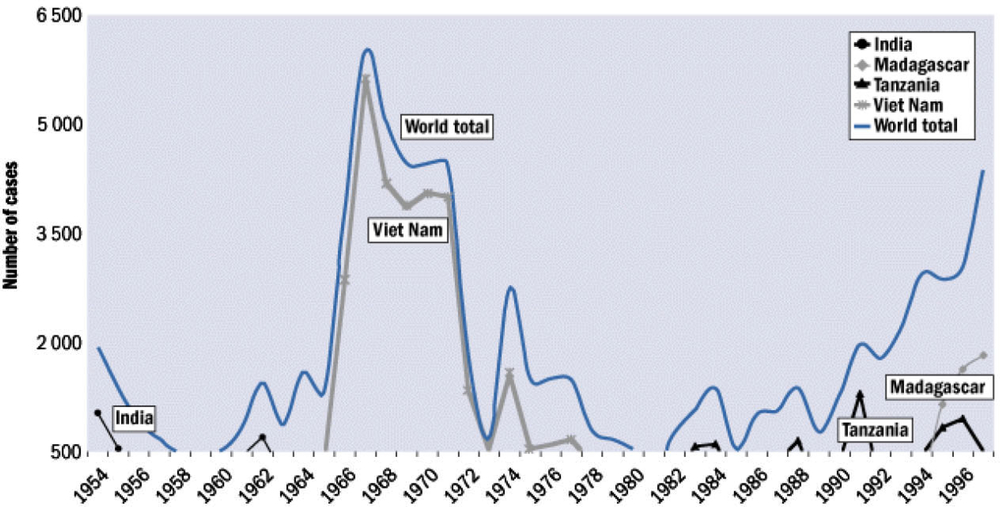
For medical personnel, both military and civilian, who treated Vietnamese civilians during the 20-year war that extended to both Laos and Cambodia, it was not just the horrendous wounds suffered by the civilians, especially children, but the severe malnutrition including unthinkable scurvy and the risk of unleashing outbreaks of infectious diseases such as the bubonic plague epidemic which was the worst of the 20th century (Figure 1).10 While the data of military wounded and dead from the war are well documented, disputes remain over the civilian death, which range from 1.3 to over 4 million.11 The arrival by helicopter of military casualties at the Marine Forward Casualty Receiving Facility occurred within minutes of injury, while civilian casualties, if cared for at all, took hours or days. A prevailing attitude, probably triggered in part by history, was that there is a war to win and concerns over civilians caught in the cross hairs had to wait.
FIGURE 1Dominance of the World’s Plague Cases Reported From the Viet Nam War: 1966–1972. WHO Reported Cases of Plague: 1954–1996.10
The current conflicts in Iraq, Afghanistan, and Pakistan have taken a tremendous human toll on civilians. The number of direct civilian deaths from October 2001 to October 2018 amount to 266,427 of a total of 507,236 deaths.12 However, an accurate total direct death toll is rarely known. For example, in Iraq, tens of thousands of civilians may have died in retaking Mosul and other cities from ISIS but their bodies have most likely not been recovered.
In 2002, unknown numbers of civilian deaths have also resulted from military operations in Yemen.12, 13 Increasingly, with the changing landscape of war, people living in war zones have been killed in their homes, markets, and on roadways by bombs, bullets, fire, improvised explosive devices, and drones. Civilians die at checkpoints. They are run off the road by military vehicles. They step on mines or are killed by cluster bombs as they collect wood or tend to their fields. They are kidnapped and executed for purposes of revenge or intimidation. Death can also occur weeks or months after a battle especially as they lose access to a stable food supply, to a damaged or now nonexistent health care system, and their employment. All this results in increased malnutrition and vulnerability to disease.12–Reference Crawford14
One can legitimately ask whether this trend contributed to a subtle yet increasing discrediting of “civilians as victims,” a mindset transferred over the decades to subsequent wars and conflicts. To date, the US government does not include civilian deaths and injuries in public reporting of war deaths, including a tally of children killed.12
The Center for Systemic Peace clearly states that those losing their lives in modern wars are increasingly the people not fighting them. The horrors of war are not new, but its disproportionately devastating impact on civilians is.Reference Hendricks and Raley15 This trend has continued unabated with today’s wars, which are increasingly fought in cities, not the traditional battlefields of past decades. In addition to the shift of conflict to urban areas, this increase in civilian casualties is due to a change in the type of munitions.Reference Hendricks and Raley15 Since 2013, CIVIC has focused on Explosive Weapons in Populated Areas (EWIPA), and along with ICRC advocate limiting the use of explosive weapons with “wide area” effects.Reference Hendricks and Raley15–Reference Robinson and Nohle17 Humanitarian groups, human rights organizations, and the UN Secretary General himself consider EWIPA a key issue in addressing the effective protection of civilians in conflict today.16–18 Banned chemical weapons, primarily chlorine, have been used by Syria against civilians on at least 15 occasions in 2018 compared with 10 incidents in 2017, including the banned chemical sarin, which was confirmed to have been used at least once on a Syrian town in 2013.Reference Rodriguez-Llanes, Guha-Sapir and Schlüter19, 20
Armed actors flagrantly violate international humanitarian law, which is increasingly ignored with civilians suffering the major consequences. Civilians who have not, or could not, flee, often bear the brunt of the violence.9 Civilian infrastructure, especially the protective public health base necessary for survival, is regularly the target of airstrikes with civilian casualties increasingly “accepted” as an outcome or by-product of conflict.Reference Robinson and Nohle21 While news reports prioritize direct casualties resulting from weaponry, over time, indirect or preventable mortality will account for up to 70-90% of deaths from the loss of protective public health infrastructure (water, sanitation, food, shelter, access and availability of healthcare, energy).Reference Burkle and Greenough22 Failures to restore these protections, as mandated by Articles 55 & 56 of the Geneva Convention, occurred in the 2003 Iraq war.Reference Burkle and Garfield23
Admittedly, civilians are harmed in every conflict. Many flee and become internally displaced persons or refugees. These numbers are increasing as they can no longer bear the brunt of the violence. Early in my career, there were 50 million refugees, today there are over 68.5 million, and the numbers are projected to rise to 140 million within a decadeReference Kirby24 from a mixture of sustained violence, wars, or conflicts, which are increasingly complicated by the consequences of climate extremes, unsustainable urbanization of different ethnic populations, biodiversity losses, and scarcity of food, water, and energy. Civilians may stay in conflict zones for many reasons: armed actors may prevent the population from leaving, they may lack the economic resources to move to safety, they may fear their homes and livelihoods will be lost forever, or they or a relative may be too sick or aged to travel.25, Reference Mahanty, Hussein and Moorehead26
DRAWING THE SHORT STRAW
In today’s conflicts, civilians have continually drawn the short straw for too long. Despite the presence of a large and vulnerable civilian population, when a favorable outcome of a battle is considered necessary, decisive war is the only operational outcome considered. Worse are the decisions to do so. The Guardian newspaper appealed to one’s sense of justice in warning that, in the Middle East, coalition forces are “fighting a brutal enemy that, unlike them, has no concerns about killing civilians.” They further cautioned that “Western militaries have a moral responsibility to take extraordinary care that innocent lives are not lost” a task made harder when nations are unable or unwilling to confess to the scale of their own mistakes. If allowed to continue unchallenged, military operations might fail to take adequate precautions to avoid noncombatant deaths or to ensure bombing raids are proportionate to the threat posed.27 The total destruction by Syria of east Aleppo and Western-based bombing campaigns that destroyed Raqqa have been condemned as violations of proportionality, risking efforts to increase respect of international humanitarian law and to regulate the behavior of the parties to conflicts.Reference Burkle, Kushner and Giannou28–Reference D’Ascanio30 Furthermore, it is said that Western countries, as parties to the conflict, must “shrink the credibility gap in accounting for the death of innocents” or risk waging wars without a true understanding of the costs.27
I argue that, whereas both scenarios, although decades apart and while not aware of the existence of the other, demonstrate that rapid and safe transport and resuscitation, which remains the “standard of care,” are the definable rudiments in which all survival in the field ultimately depends. That’s the good outcome of history learned. However, many bad global decisions made during the scan of the 27 years covered by Forrester and colleagues have led to reporting of serious and worsening trends in civilian deaths that shows no sign of improving. While the reasons for conflicts and how the world responds to them change every 10-15 years or less, some crucial aspects of what victims need to survive remain universal. This was first by the civilians who served as rescuers and responders at the Battle of Solferino. Their descendents have become in this 21st century study the undeserving primary targets of conflict themselves. What has become the disturbing norm for civilians is that they are simply being deprived of basic healthcare services, which is not available or has been destroyed. Secondly, the demand for some semblance of first aid and rapid transport that is today the global norm is either not afforded to them or given to others. The concept of “civilian innocence,” which first served as the basis of international law and the human rights of civilians in the West and later shaped the cultures of the Third World, has never been so threatened.Reference Berg-Petersen31





 You have
Access
We’ve all been warned sometime in our lives that “those who cannot learn from history are doomed to repeat it.” Forrester and colleagues’ article, The Golden Hour After Injury Among Civilians Caught in Conflict Zones appears in this month’s issue.Reference Forrester, August and Cai1 It is critically important for many reasons. The study, by comparing transport times to trauma care, captures over 27 years of civilian casualties articulating the increasing burden placed on innocent civilians in modern day wars and internal conflicts. I trust many in the humanitarian field will ask “How and why did civilians become the major target?”
It immediately brought back memories of how war was first defined for me during 1968 Viet Nam and how every war and conflict I subsequently experienced offered both glaring similarities and marked differences. I also pondered the experience, in the mid-1980s, of attending the International Committee of the Red Cross (ICRC) Health Emergencies in Large Populations’ (HELP) course in Geneva that first prepared me to enter the much broader world of humanitarian health during war and conflict. It was then I read for the first time Henry Dunant’s book A Memory of Solferino, which passionately detailed the consequences of what was one of the bloodiest battles of the 19th century.Reference Dunant2 I decided to reread the book in anticipation of writing this Commentary. I asked myself what, if anything, has changed? With the fast moving “troubles” of the world that often occupy our daily consciousness; we rarely have time to reflect on the lessons of the past and whether they teach us more about the present while lessening the burden of repeating the same flaws in the future. I anticipate that readers of this commentary will experience a similar reflection on just how similar the details of Dunant’s war mirror their own experiences in today’s wars and conflicts. While the circumstances and causes of war and conflict may differ across borders and cultures, in the end, the real victims of war’s insanity silently become dominated by innocent civilians.
THE BATTLE OF SOLFERINO
June of 1859 found Napoleon immersed in the ongoing Franco-Austrian war commanding his fast moving French army who, along with his Italian allies, were driving the Austrians out of Italy. At the same time, Henri Dunant, a Swiss businessman found himself desperately seeking a brief audience with Napoleon to argue for the immediate and exclusive water rights on a large tract of land in Algeria crucial for a family led “financial scheme.” While Dunant had lived a life where he “enjoyed all the privileges accruing to him by virtue of his family’s social and economic position,” he also had a history of allying himself with charitable and religious causes. In attempts to find Napoleon’s field headquarters, a frustrated Dunant traveled from 1 battle site to another, staying just 1 step behind Napoleon’s victorious battles.
Eventually, near the northern Italian town of Solferino, Dunant arrived immediately after a 15-hour battle, just in time to witness the consequences of thousands of Italian, French, and Austrian soldiers having just killed and maimed each other. With massive numbers of unattended injured left lying in the open fields, Dunant’s priorities immediately changed. On his own initiative, Dunant rallied and organized aid work with the assistance of the civilians in a nearby village who hours before had fled for their own protection. It was the unprepared civilians who became the major rescuers and responders of the extended recovery that followed.3
Just 3 years later, in 1862, Dunant published “A Memory of Solferino” a book passionately detailing the consequences of what was one of the bloodiest battles of the 19th century with 6000 dead and more than 35,000 wounded or missing.Reference Dunant2 Civilian deaths during the Napoleonic wars are “impossible to accurately estimate.” While military deaths are invariably put at between 2.5 and 3.4 million, civilian death tolls vary from 750,000 to 3 million mostly from being in the wrong place at the wrong time and suffering from starvation, disease outbreaks, and civil upheaval following the use of “scorched earth tactics.” Epidemics of both typhus and typhoid ravaged civilians and soldiers alike.4–Reference White6 But it is fair to say that civilians were not seen as the “enemy.” It is important to note that only 1 civilian died in the Battle of Solferino.Reference Dunant2
Dunant recounts in great detail multiple “harrowing experiences and cruel disappointments” of villagers and surviving military. He cited survivors who, “coming across someone they knew would kneel at his side trying to bring him back to life, press his hand, staunch the bleeding, or bind the broken limb with a handkerchief. But there was no water to be had for the poor sufferer.” Those only slightly wounded were “so weakened by loss of blood that they too died miserably from exhaustion and hunger.” The equivalent of “field hospitals” were set up in farms, houses, churches, convents, in the open under the trees, public squares, courtyards, streets, and pathways completely transforming the village into one “vast improvised hospital.” With sheer numbers and lack of adequate supplies and trained personnel… “somehow or other a volunteer service had to be organized…but it was very difficult amid such disorder.” Because cases could not be evacuated nearly as quickly as new ones came in, “the congestion grew worse and worse.” Volunteer helpers went first to those who cried the loudest…not always the worst cases. Too late did they become aware of the consequences of those who suffered in silence, the unexpected number of wounded, and the “relatively very small effectiveness of doctors, helpers, and orderlies.”Reference Dunant2
Dunant later reflected on “how valuable it would have been in those towns to have had a hundred experienced and qualified voluntary orderlies and nurses! Such a group would have formed a nucleus around which could have been rallied the scanty help and dispersed efforts which needed competent guidance.”Reference Dunant2 While the culture of the time demanded that officers were treated first, this favoritism disappeared over the coming days. In many respects the civilians, empowered by the realities of everyday illnesses and injuries, were savvy enough to know who would benefit from scarce supplies, and who was appropriate for transport. Civilians also knew firsthand the signs of pending death, all rudiments and basic lessons of what would eventually evolve over coming decades into a future triage and emergency management system we depend on today.
Dunant’s descriptive writing about the wounded did not stop with ensuring that readers had adequate visual reminders of war’s chaotic disorder, unspeakable despair, and every kind of unmanageable misery. He followed with a plan where all countries would form associations to help the sick and wounded on the battlefield, whichever side they belonged to, each sponsored by a governing board composed of the nation’s leading figures. The associations would appeal to everyone to volunteer and train volunteers to aid the wounded on the battlefield and to care for them until they recovered. The book was widely read even by Napoleon. On February 7, 1863, the Société genevoise d’utilité publique (Geneva Society for Public Welfare) appointed a committee of 5, including Dunant, to examine the possibility of putting this plan into action. This committee, in effect, founded the Red Cross, now known as the International Committee of the Red Cross (ICRC), and the International Federation of Red Cross and Red Crescent Societies (IFRC), the world’s largest humanitarian organization. Dunant transformed his personal vision into an international treaty known today as the Geneva Convention.3
The Emerging Plight of the Civilian Casualty
In honoring the 150th anniversary of the Battle of Solferino in 2009, ICRC’s director of operations, Pierre Krähenbühl, emphasized that much has changed over the decades in the way wars are fought and how people are affected.7 During Napoleon’s time casualties were primarily soldiers who suffered wounds in cross border wars, leaving local civilians to flee their villages and hide to protect themselves. Since then, civilian fatalities in wartime climbed from 5% at the turn of the 19th century, to 15% during World War I, to 65% by the end of World War II, to more than 90% in the wars of the 1990s, which killed more children than soldiers.8
According to the Geneva Conventions of 1949 and their Additional Protocols of 1977, civilians and all persons not taking part in combat may under no circumstances be the object of attack and must be spared and protected. The ICRC acknowledges that unfortunately this principle has been “undermined, because the civilian population, particularly since WWII has suffered most of the consequences of armed violence.” This rise can be “attributed to the rise of religious and ethnic hatreds, the collapse of State structures, the battle for control of natural resources, the vast availability of weapons, the proliferation of acts of terrorism, and the spread of so-called asymmetric conflicts.”9 Civilians in current conflicts, especially those reviewed by Forrester and colleagues, sustained much greater losses at a generally higher rate than those seen among military weapon bearers.
For medical personnel, both military and civilian, who treated Vietnamese civilians during the 20-year war that extended to both Laos and Cambodia, it was not just the horrendous wounds suffered by the civilians, especially children, but the severe malnutrition including unthinkable scurvy and the risk of unleashing outbreaks of infectious diseases such as the bubonic plague epidemic which was the worst of the 20th century (Figure 1).10 While the data of military wounded and dead from the war are well documented, disputes remain over the civilian death, which range from 1.3 to over 4 million.11 The arrival by helicopter of military casualties at the Marine Forward Casualty Receiving Facility occurred within minutes of injury, while civilian casualties, if cared for at all, took hours or days. A prevailing attitude, probably triggered in part by history, was that there is a war to win and concerns over civilians caught in the cross hairs had to wait.
Dominance of the World’s Plague Cases Reported From the Viet Nam War: 1966–1972. WHO Reported Cases of Plague: 1954–1996.10
The current conflicts in Iraq, Afghanistan, and Pakistan have taken a tremendous human toll on civilians. The number of direct civilian deaths from October 2001 to October 2018 amount to 266,427 of a total of 507,236 deaths.12 However, an accurate total direct death toll is rarely known. For example, in Iraq, tens of thousands of civilians may have died in retaking Mosul and other cities from ISIS but their bodies have most likely not been recovered.
In 2002, unknown numbers of civilian deaths have also resulted from military operations in Yemen.12, 13 Increasingly, with the changing landscape of war, people living in war zones have been killed in their homes, markets, and on roadways by bombs, bullets, fire, improvised explosive devices, and drones. Civilians die at checkpoints. They are run off the road by military vehicles. They step on mines or are killed by cluster bombs as they collect wood or tend to their fields. They are kidnapped and executed for purposes of revenge or intimidation. Death can also occur weeks or months after a battle especially as they lose access to a stable food supply, to a damaged or now nonexistent health care system, and their employment. All this results in increased malnutrition and vulnerability to disease.12–Reference Crawford14
One can legitimately ask whether this trend contributed to a subtle yet increasing discrediting of “civilians as victims,” a mindset transferred over the decades to subsequent wars and conflicts. To date, the US government does not include civilian deaths and injuries in public reporting of war deaths, including a tally of children killed.12
The Center for Systemic Peace clearly states that those losing their lives in modern wars are increasingly the people not fighting them. The horrors of war are not new, but its disproportionately devastating impact on civilians is.Reference Hendricks and Raley15 This trend has continued unabated with today’s wars, which are increasingly fought in cities, not the traditional battlefields of past decades. In addition to the shift of conflict to urban areas, this increase in civilian casualties is due to a change in the type of munitions.Reference Hendricks and Raley15 Since 2013, CIVIC has focused on Explosive Weapons in Populated Areas (EWIPA), and along with ICRC advocate limiting the use of explosive weapons with “wide area” effects.Reference Hendricks and Raley15–Reference Robinson and Nohle17 Humanitarian groups, human rights organizations, and the UN Secretary General himself consider EWIPA a key issue in addressing the effective protection of civilians in conflict today.16–18 Banned chemical weapons, primarily chlorine, have been used by Syria against civilians on at least 15 occasions in 2018 compared with 10 incidents in 2017, including the banned chemical sarin, which was confirmed to have been used at least once on a Syrian town in 2013.Reference Rodriguez-Llanes, Guha-Sapir and Schlüter19, 20
Armed actors flagrantly violate international humanitarian law, which is increasingly ignored with civilians suffering the major consequences. Civilians who have not, or could not, flee, often bear the brunt of the violence.9 Civilian infrastructure, especially the protective public health base necessary for survival, is regularly the target of airstrikes with civilian casualties increasingly “accepted” as an outcome or by-product of conflict.Reference Robinson and Nohle21 While news reports prioritize direct casualties resulting from weaponry, over time, indirect or preventable mortality will account for up to 70-90% of deaths from the loss of protective public health infrastructure (water, sanitation, food, shelter, access and availability of healthcare, energy).Reference Burkle and Greenough22 Failures to restore these protections, as mandated by Articles 55 & 56 of the Geneva Convention, occurred in the 2003 Iraq war.Reference Burkle and Garfield23
Admittedly, civilians are harmed in every conflict. Many flee and become internally displaced persons or refugees. These numbers are increasing as they can no longer bear the brunt of the violence. Early in my career, there were 50 million refugees, today there are over 68.5 million, and the numbers are projected to rise to 140 million within a decadeReference Kirby24 from a mixture of sustained violence, wars, or conflicts, which are increasingly complicated by the consequences of climate extremes, unsustainable urbanization of different ethnic populations, biodiversity losses, and scarcity of food, water, and energy. Civilians may stay in conflict zones for many reasons: armed actors may prevent the population from leaving, they may lack the economic resources to move to safety, they may fear their homes and livelihoods will be lost forever, or they or a relative may be too sick or aged to travel.25, Reference Mahanty, Hussein and Moorehead26
DRAWING THE SHORT STRAW
In today’s conflicts, civilians have continually drawn the short straw for too long. Despite the presence of a large and vulnerable civilian population, when a favorable outcome of a battle is considered necessary, decisive war is the only operational outcome considered. Worse are the decisions to do so. The Guardian newspaper appealed to one’s sense of justice in warning that, in the Middle East, coalition forces are “fighting a brutal enemy that, unlike them, has no concerns about killing civilians.” They further cautioned that “Western militaries have a moral responsibility to take extraordinary care that innocent lives are not lost” a task made harder when nations are unable or unwilling to confess to the scale of their own mistakes. If allowed to continue unchallenged, military operations might fail to take adequate precautions to avoid noncombatant deaths or to ensure bombing raids are proportionate to the threat posed.27 The total destruction by Syria of east Aleppo and Western-based bombing campaigns that destroyed Raqqa have been condemned as violations of proportionality, risking efforts to increase respect of international humanitarian law and to regulate the behavior of the parties to conflicts.Reference Burkle, Kushner and Giannou28–Reference D’Ascanio30 Furthermore, it is said that Western countries, as parties to the conflict, must “shrink the credibility gap in accounting for the death of innocents” or risk waging wars without a true understanding of the costs.27
I argue that, whereas both scenarios, although decades apart and while not aware of the existence of the other, demonstrate that rapid and safe transport and resuscitation, which remains the “standard of care,” are the definable rudiments in which all survival in the field ultimately depends. That’s the good outcome of history learned. However, many bad global decisions made during the scan of the 27 years covered by Forrester and colleagues have led to reporting of serious and worsening trends in civilian deaths that shows no sign of improving. While the reasons for conflicts and how the world responds to them change every 10-15 years or less, some crucial aspects of what victims need to survive remain universal. This was first by the civilians who served as rescuers and responders at the Battle of Solferino. Their descendents have become in this 21st century study the undeserving primary targets of conflict themselves. What has become the disturbing norm for civilians is that they are simply being deprived of basic healthcare services, which is not available or has been destroyed. Secondly, the demand for some semblance of first aid and rapid transport that is today the global norm is either not afforded to them or given to others. The concept of “civilian innocence,” which first served as the basis of international law and the human rights of civilians in the West and later shaped the cultures of the Third World, has never been so threatened.Reference Berg-Petersen31