Despite the view in academic circles that organizational research is fundamentally applied in nature, organizational practitioners (consultants, managers, employees) continue to complain that a considerable amount of academic research is inconsequential and/or inapplicable in practice (e.g., Halfhill & Huff, Reference Halfhill and Huff2003; McKersie et al., Reference McKersie, Hill, Hammer, Lapierre, Matthews, Powers and Weiner2017; Shuffler et al., Reference Shuffler, Verhoeven, Savage, Cullen-Lester, DiazGranados, Reiter-Palmon and Wilson2016). One way of bridging the scientist–practitioner gap is to develop mutually beneficial academic–organization partnerships, where academics collect data conducive to scientific publications and where organizations gain empirically derived insights and solutions to the challenges they face. For many academics, the task of establishing such partnerships can be quite daunting. The knowledge and strategies that help them gain entry into an organization and involve its employees in a study are not commonly addressed in graduate programs and are all but absent in the research methods literature, particularly when research is of a quantitative rather than qualitative nature. Central to this pursuit is the need to initiate and manage relationships with influential leaders within the organizational, including (but certainly not limited to) members of the executive management team (or “C-suite”). Their endorsement of any new initiative requiring time investment from various organizational members is an essential condition for its success (By, Reference By2005; Kotter, Reference Kotter1995). It is also critical to develop and maintain strong relationships with leaders lower in the organizational hierarchy, such as middle managers, frontline supervisors, and occasionally union leaders, who can play an invaluable role in the planning and execution of a study. These various individuals are gatekeepers; academics rely on them to identify employees most suitable for the study (i.e., those meeting particular inclusion criteria), to contribute to fostering employee buy-in, and to enable employees’ participation in the research. Further, as research topics mature and peer-reviewed journals become increasingly selective in terms of methodological rigor, academics are becoming increasingly dependent on leaders at various levels in the organizational hierarchy to enable complex methodologies, such as longitudinal and experience sampling designs, experimental or quasi-experimental designs, the collection of hierarchically nested data (e.g., employees nested within teams), and access to confidential company records (e.g., objective performance data).
Initiating and managing research relationships with key individuals within organizations can be challenging for various reasons. First, nonacademics are often naïve about methodological rigor and the practical value of empirical research. Second, managers may fear raising employees’ expectations or highlighting particular problems by involving them in research projects. For example, a survey on work–family issues could raise employees’ expectations regarding the supports that the organization should offer to help them better balance work and family obligations, such as greater work schedule flexibility. Third, middle or frontline managers may be reluctant to facilitate a study out of fear of what the research could reveal in terms of problems in their units, particularly if such problems might be perceived as reflecting poorly upon them (e.g., poor leadership skills). We believe that academics should anticipate such challenges in how they present, plan, and report on their organizational research projects.
To date, very little has been written on how academics can develop productive research partnerships with organizations. Some work has provided guidance on how qualitative researchers can develop relationships with interviewees (Cunliffe & Alcadipani, Reference Cunliffe and Alcadipani2016; Cunliffe & Karunanayake, Reference Cunliffe and Karunanayake2013; Feldman, Bell, & Berger, Reference Feldman, Bell and Berger2003; Peticca-Harris, deGama, & Elias, Reference Peticca-Harris, deGama and Elias2016). However, we are unaware of any published guidance offered specifically to quantitative researchers on how to initiate and manage research partnerships with organizations. Quantitative research continues to be the dominant type of research pursued by organizational scholars. Compared to qualitative research, quantitative research relies much more on survey-based methods, which often imply respondent anonymity and reduce the need for researchers to develop a trusting relationship with each participant. Moreover, quantitative research typically requires much larger samples of employees than what are typically needed for qualitative research, thus making more important demands upon organizational resources. For this reason, the success of quantitative research hinges more on building relationships with influential organizational leadership than with individual participants. For this article, we wanted to provide quantitatively focused academic researchers with a series of concrete, example-laden recommendations for initiating and managing partnerships with organizations. Also of concern to us was the need to address the entire lifecycle of such a partnership, from trying to initiate contact to sharing study results with organizational stakeholders. To that end, we offer guidance on how to achieve four objectives that our experience suggests are instrumental to collecting high-quality quantitative employee-related data within organizations: (a) initiating a research relationship with senior organizational leadership, (b) deciding early whether to pursue or end a research collaboration with an organization, (c) keeping the organization engaged during the study, and (d) maintaining the relationship with the organization after data collection is complete. What we propose stems largely from our collective experience conducting quantitative field research in the United States and Canada, which has enabled us to have several studies published in outlets such as the Academy of Management Journal, Journal of Applied Psychology, Personnel Psychology, Journal of Management, Organizational Behavior and Human Decision Processes, and Journal of Organizational Behavior. That said, we do not pretend to assume that our suggestions are the best possible means of achieving the four goals listed above. We encourage readers to assess the validity of our suggestions in light of their own experiences.
Determining the Need for This Article
Before describing specific practices that address various issues relating to the initiation and management of research relationships with organizations, it was first important to ascertain which, if any, of these issues remains largely unaddressed in graduate education and whether academics would see value in learning more on how to deal with them. Below, we describe a three-survey study designed to answer these questions.
Samples and Procedures
Graduate program directors and graduate students
We surveyed senior graduate students enrolled in organizational behavior (OB), human resource management (HRM), and industrial-organizational (I-O) psychology doctoral programs in the United States and in Canada, as well as the directors of those programs. We identified programs using our collective knowledge, suggestions made by senior organizational scholars to whom we reached out, and the results of Internet searches. We sent survey participation invitations by regular mail, followed up by email 2 weeks later to the directors of 126 doctoral programs (114 in the US and 12 in Canada). In addition to completing our online survey, directors were asked to send the link to a separate survey to senior graduate students enrolled in their programs. We received complete responses from 25 program directors (20% response rate) and from 42 graduate students (given the method used, the response rate for graduate students could not be calculated). Among the directors, 33% ran an I-O psychology PhD program, and the remaining 67% ran a PhD program in OB or HRM within a business school. Out of the 42 senior graduate students who participated, 40% were enrolled in an I-O psychology PhD program, whereas the remaining 60% were enrolled in an OB or HRM PhD program.
Academics
To survey people currently holding academic appointments, we partnered with the Society for Industrial and Organizational Psychology (SIOP), one of the largest associations for organizational academics and practitioners in the United States and Canada.Footnote 1 The SIOP executive director sent out e-mail invitations on our behalf to a randomly drawn sample of 1,500 “academic” (as opposed to “practitioner”) members of the society, followed by a reminder 2 weeks later. The invitation provided a direct link to an online survey questionnaire. We received responses from 219 individuals (15% response rate). Of those who responded, 32% were assistant professors, 32% were associate professors, and the remaining 36% were full professors, thus providing similar representations of each academic rank. Also, 58% worked in a department of psychology, 34% worked in a business school, and the remaining 7% worked in “other” academic units (e.g., multidisciplinary or multidepartmental units).
Survey Content and Results
Program directors and graduate students
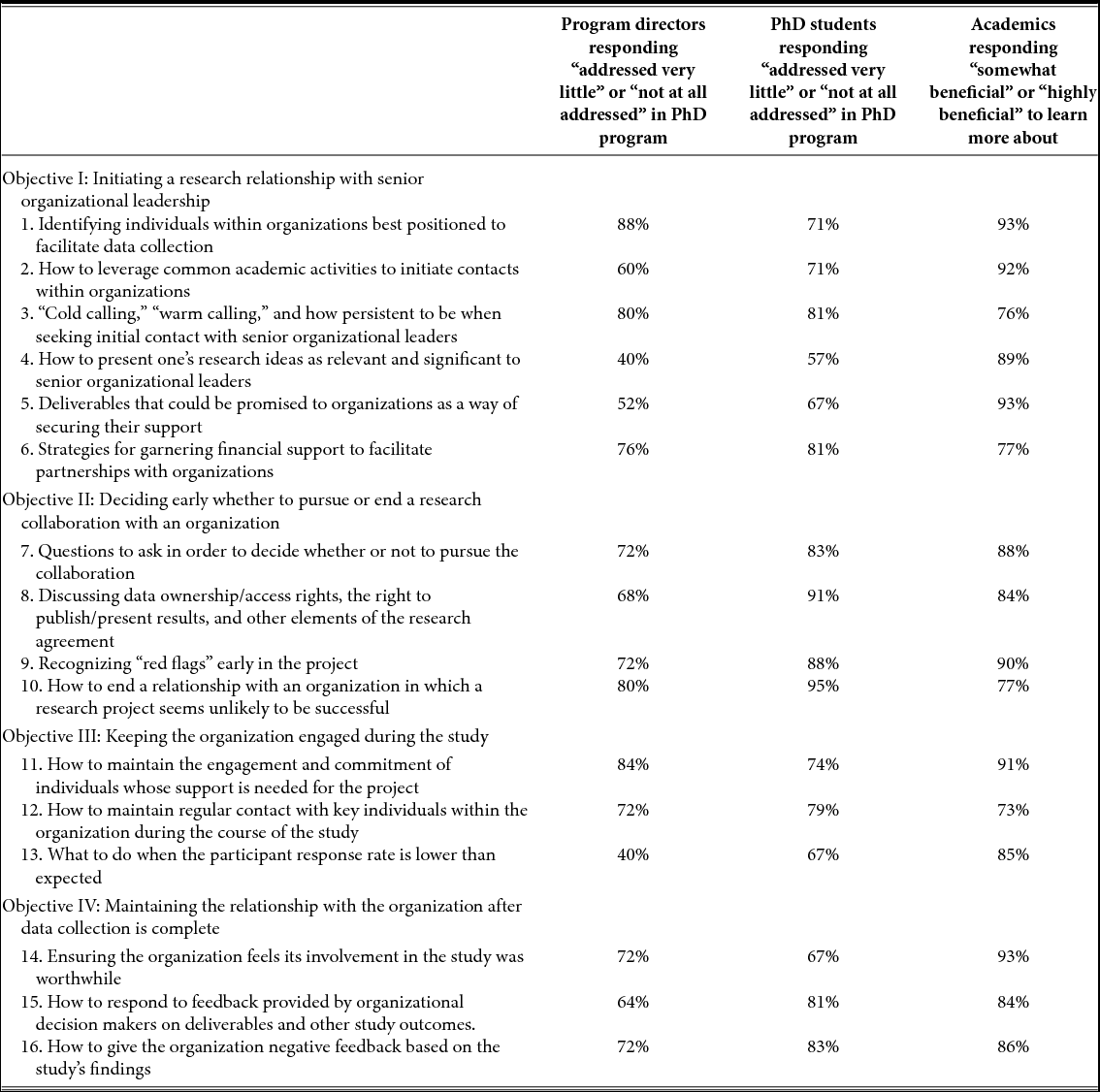
The survey questionnaire for each of these two groups listed 16 specific issues relating to the four broad objectives that we deemed important for collecting employee-related data in organizational contexts (viz., initiating research relationships, deciding early whether to pursue a relationship, maintaining the engagement of the organization during the study, and maintaining the relationship with the organization after data collection is complete). The four objectives and associated issues were generated using an iterative process. The lead author sent a preliminary list to the five coauthors, who each independently provided suggestions for objectives and/or issues to reword, remove, and/or add. The lead author then sent the coauthors a revised list for a second round of feedback. The resulting set of objectives and associated issues is presented in Table 1.
Survey Results

Using a four-point response scale (“not addressed at all,” “addressed very little,” “somewhat addressed,” and “addressed to a great extent”), directors were asked to indicate the degree to which each of the 16 issues is formally addressed in their PhD program. Using the same response scale, PhD students indicated the degree to which each issue has been addressed formally (e.g., in a course or seminar) or informally (e.g., in a collaborative research project with faculty) during their program tenure.
In both questionnaires, we also included an open-ended question for each of the four main objectives to give respondents the opportunity to list other issues that they believe their doctoral program ought to address. None of the directors answered these questions, indicating perhaps that they considered our list of issues sufficiently comprehensive. The handful of students who responded to these questions generally used the space to underscore how important they thought it would be to learn more about the issues already listed in the survey questionnaire.
As shown in Table 1, the majority of program directors believed that 14 of the 16 issues listed were addressed very little or not addressed at all in their PhD program, with 80% or more of them believing this was the case for four issues, and 70% or more of them believing this was the case for 10 issues. A comparatively larger proportion of senior graduate students felt that the issues listed were addressed very little, if at all, in their program, with 80% or more of them believing this was the case for eight issues, and 70% or more of them believing this was the case for 12 issues. Although the differences between program directors and senior graduate students could be indicative of a difference between what program directors think their programs cover and what their programs actually cover, a clear conclusion from these data is that most of the surveyed program directors and students believe that the majority of the issues listed are addressed very little, if at all, in their doctoral programs.
Academics
The questionnaire for those holding academic appointments was identical to the questionnaires described above in terms of the issues presented, although the response options were different. Academics were asked to indicate the degree to which learning more about each issue would benefit their research using a four-point response scale (“Would not benefit me at all,” “Would benefit me very little,” “Would somewhat benefit me,” and “Would benefit me very much”). For each of the four main objectives, respondents were also given the opportunity to list other issues that they would like to learn about in order to further progress their research. The minority of respondents who answered the open-ended questions largely focused on the difficulty they have knowing how to make initial contact with organizations and how to identify common interests, perhaps underscoring the relatively greater difficulty that academics have overcoming the first of the four objectives (initiating a research relationship with senior organizational leadership).
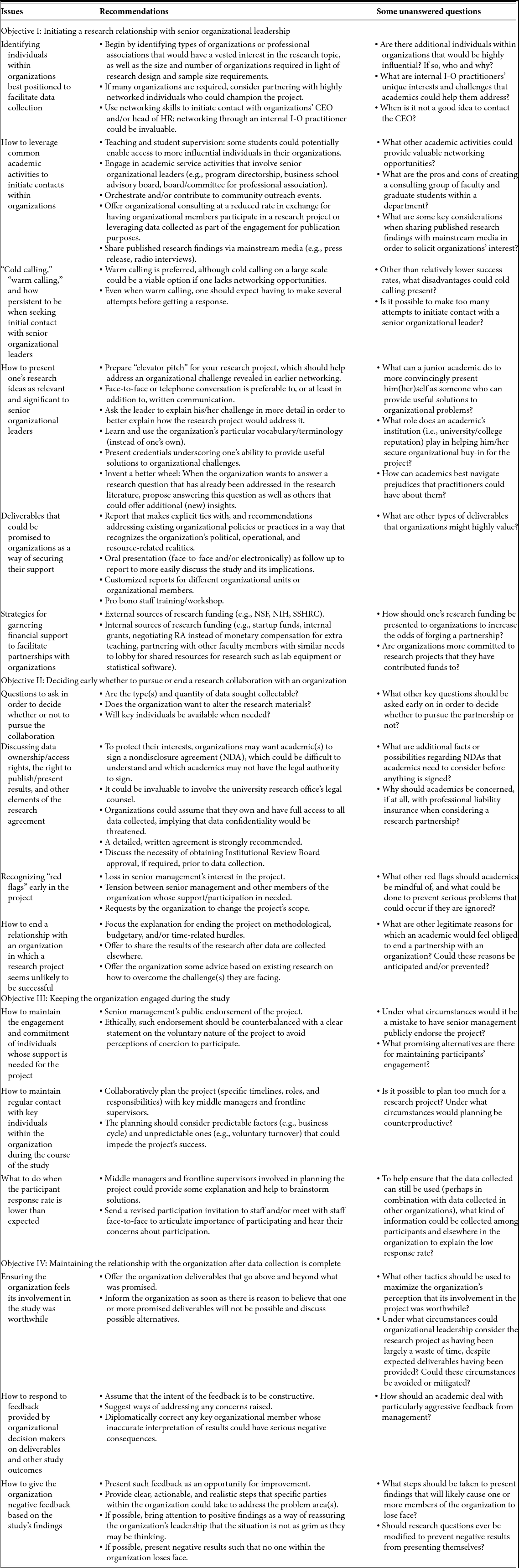
Table 1 shows that the majority of academics surveyed believe that learning more about each of the 16 issues listed would somewhat or very much benefit their research, with 80% or more believing this was the case for 12 of the issues listed, and 70% or more believing so for all 16 issues. Thus, academics reported having developmental needs that are consistent with senior graduate students’ and program directors’ views that the majority of topics listed in our survey receive little to no attention in their graduate programs. There could be various reasons for our relatively low response rates, including “survey fatigue” among some of the individuals solicited, PhD program directors’ relatively limited time, and/or insufficient interest in the survey topic. Lower response rates make it difficult to know whether our findings accurately reflect the views of our three target populations. At the very least, we can say that a proportion of academics involved in organizational research are in need of greater guidance on how to tackle the challenges associated with initiating and managing research relationships with organizations. One of the reasons for this need could be that graduate programs insufficiently address these challenges, which most of the PhD program directors and graduate students involved in our surveys indicated. In the following sections, we recommend specific practices, along with supporting examples, for addressing the issues associated with each of the four main objectives listed earlier.
Objective I: Initiating a Research Relationship With Senior Organizational Leadership
Identifying Individuals Within Organizations Best Positioned to Facilitate Data Collection
Number, type, and size of organizations required
Before targeting specific types of individuals to contact within organizations, it is important to first identify the types of organizations that would likely have an interest in the topic of research. For example, hospitals wish to avoid potentially fatal stress-induced errors made by their medical staff. It could therefore be quite promising for occupational health psychology researchers wishing to study antecedents of stress-induced cognitive failure at work (Wallace & Chen, Reference Wallace and Chen2005) to initiate contact with hospitals, perhaps even those whose practices have been challenged in the press (e.g., Kubinec, Reference Kubinec2014). A key issue here is to think broadly; it is important to identify multiple potential organizations in order to maximize the possibility that a few will agree to participate. Identifying a single research site is risky if the data collection effort with that one organization is unsuccessful.
Organization size should also be considered in light of the project goals. For example, although larger organizations could help reduce the need to involve several organizations because of the large number of research participants each could offer, relying on a select few organizations could reduce if not preclude variation in certain factors salient to the study, particularly organization-level factors (e.g., organizational culture, employee compensation practices). Research questions involving organization-level factors would be better served by partnering with several smaller organizations that vary in terms of those factors. Those that only involve individual or team-level factors that vary considerably within an organization could be well served by partnering with a smaller number of large organizations. To the extent that a large number of organizations are required to properly answer the research questions, it would be advisable to partner first with one or more highly networked individuals who could champion the research project. For example, one of us is currently leading a research project on how managers can best encourage and support their employees’ disclosure of having a mental health problem. A partnership was established with the presidents of two major human resource professionals’ associations. Association members include senior HR leaders from thousands of different organizations in Canada. Because they consider the topic of our research highly important and likely of great interest to their membership, the two partners have committed (in writing) to championing our project and encouraging their HR leader members to get their respective organizations involved in our project.
Identifying individuals with significant influence within the organization
After identifying organizations as potential research sites, academics must initiate contact with leaders who have sufficient influence within the organization to legitimize and gain buy-in for the study among as many potential participants as possible. They must also have the authority to allow employees to take the time needed to participate in the study. The person with the most formal authority in an organization would be the chief executive officer (CEO). When this individual is well liked by employees, his or her endorsement of the study could be instrumental to the recruitment of research participants. For example, one of us recently reached out to the CEO of an insurance company who had already voiced great interest in our topic of research and who is hailed by his employees as an exemplary CEO. His public endorsement of the research project, made explicit in an email message he personally sent to eligible study participants, ensured that employees were aware that they would receive an invitation by the academic and, more importantly, of how their voluntary participation would benefit them and their organization. To prevent institutional (ethical) review boards (IRBs) from associating such an approach with coercion from senior management, we urge researchers to ensure that communications made by the CEO explicitly indicate that participation is voluntary and that there are no adverse consequences for employees who decline to participate.
Although the CEO's public endorsement of the project can be invaluable, getting buy-in from other senior leaders, particularly those whose responsibilities include the organization's human resource (HR) practices and policies (e.g., chief operating officer or COO; vice president of HR), is paramount. The head of HR has access to information that can be invaluable to a research project (e.g., employee contact information, listing of HR practices already in place, confidential ratings of employee job performance, absenteeism and turnover data), assuming employees consent to sharing such information. Moreover, a CEO will sometimes ask the head of HR to decide whether the organization should endorse the research project or not, and will almost certainly delegate the logistics of the project to that individual or his/her team.
Political and networking skills
An academic's political skills (Ferris et al., Reference Ferris, Treadway, Perrewé, Brouer, Douglas and Lux2007) should prove invaluable in identifying and establishing contact with a senior leader having sufficient influence to decide whether the organization will endorse the research project. Networking ability would be particularly helpful in achieving this goal. It would involve identifying and developing relationships with individuals (e.g., line manager, HR manager, internal I-O practitioner) who could identify and facilitate introductions to a particularly influential senior leader within the organization. Developing a relationship with an internal I-O practitioner could be particularly valuable because this person would already understand the academic's work, how it could be of benefit to the organization, and what is required to make it successful.
Networking efforts would be most successful when the academic can identify what another individual wants (e.g., an internal I-O practitioner wanting to coauthor a research paper; a VP of HR wanting to increase the retention or strengthen the engagement of specific talent) and is able to unassumingly, convincingly, and sincerely convey how he or she can helps satisfy those needs (de Janasz & Forret, Reference de Janasz and Forret2007; Ferris, Anthony, Kolodinsky, Gilmore, & Harvey, Reference Ferris, Anthony, Kolodinsky, Gilmore, Harvey, Wankel and DeFillippi2002; Ferris et al., Reference Ferris, Treadway, Perrewé, Brouer, Douglas and Lux2007). This “other-focused” approach should motivate others to reciprocate in kind by identifying and helping to meet a senior organizational leader having the desired level of influence. As a simple example, during a social event unrelated to work, one of us met a middle manager responsible for overseeing one of several production teams in a local manufacturing organization. Our “small talk” (for examples of activities intended to develop small talk skills, see de Janasz & Forret, Reference de Janasz and Forret2007) revealed that he was challenged with ensuring that his production team engage in more effective teamwork in order to reduce production errors and achieve better on-time delivery. We explained that we had expertise that could help identify the best solution to his problem (which visibly drew his interest) and asked whether his superior (the vice president of production) considered the issue important enough that he would be interested in enabling a project involving all production crews within the organization. Our conversation led to a face-to-face meeting with the VP, during which we explored the possibility of a highly promising research project.
In the next section, we provide several examples of commonly pursued academic activities that could be leveraged to make initial organizational contacts, which could then be instrumental in meeting influential organizational leaders. Irrespective of the initial contact made, it is always incumbent upon the academic to ascertain who in the organization would have the greatest influence over the research project's endorsement. Although it could be that initial contact, our experience suggests that in many cases it is not.
How to Leverage Common Academic Activities to Initiate Contacts Within Organizations
Although the activities that academics generally undertake might not always allow them to interact directly with organizational leaders, they often have opportunities to interact with individuals who could introduce them to such people. We offer examples of opportunities stemming from activities that academics tend to engage in, including teaching and supervision of students, academic service activities, community outreach events, consulting, and disseminating research findings in the popular press. Because graduate students are relatively less likely to engage in these activities, we encourage academics (e.g., thesis/dissertation supervisors) to involve them as much as possible in these, as well as all other practices we recommend for initiating and managing relationships with organizations.
Teaching and student supervision
Academics working in business schools often have the opportunity to teach in managerial training programs. Particularly when addressing executive development (e.g., executive MBA), these programs often involve students who are senior managers, thus giving academics a valuable opportunity to make a favorable impression upon influential individuals who could be interested in helping them research a topic of mutual interest. Sometimes a student enrolled in such a program may overtly seek out the professor's help in solving a problem in his or her organization. For example, one of our colleagues was solicited by one of his former MBA students to offer transformational leadership training in his organization. He used this opportunity to conduct a quasi-experimental study on the effectiveness of transformational leadership training (Barling, Weber, & Kelloway, Reference Barling, Weber and Kelloway1996). Although such solicitations seem relatively rare, we encourage academics to express to their students, either in class or in conversations during breaks, a desire to research a topic that would have prompted significant class discussion (e.g., several students commenting on the difficulty they have retaining their best staff when salaries are below market). The success of research projects enabled by students can then be publicized in subsequent courses as a way of highlighting the benefits of researcher–practitioner collaborations. Alternatively, for academics not able to teach courses that enroll these types of students, they can actively seek out faculty who do in order to develop mutually beneficial collaborations.
While teaching an executive MBA course, one of us was particularly successful in recruiting field sites for organizational research. Specifically, following a lecture on organizational justice, several executives lamented the perceptions of unfairness that seemed to pervade in their companies. The professor took this opportunity to share with the students how fair behavior by managers can be successfully trained in field settings (Greenberg, Reference Greenberg2006; Skarlicki & Latham, Reference Skarlicki and Latham1996), which translates into more favorable fairness perceptions among employees. Upon hearing this, multiple executives expressed interest in rolling out a comparable justice intervention in their own companies, thus paving the way for field experiment opportunities. Such opportunities can be made easier by adopting an evidence-based management approach in the classroom and disseminating the findings of field experiments in organizational settings.
Graduate student research supervision (e.g., MSc, MA, PhD) may also lead to useful organizational contacts. Occasionally, graduate students have personal relationships with senior managers or with individuals well positioned to broker a meeting with senior managers. For example, one of our former master's students was working for a municipal government and had previously established close relationships with senior management. Their desire to help her with her master's thesis enabled two waves of employee data collection among employees, some of which were used as a basis for an article that was eventually published. Post-graduation, students may also move into high-level positions within companies and therefore may have the ability to champion data collection. For example, some of our former advisees are now executives at various companies who facilitated the collection of data for a study that required 360-degree ratings of performance, which were subsequently included in a published article.
Academic service activities
Academics may also have the opportunity to develop contacts with senior organizational leaders through service activities within or outside their academic institutions. For example, university/college boards of governors or boards of trustees often involve leaders from the business community, and academics occasionally have the opportunity to serve on such boards as academic representatives. Similarly, some business schools have advisory boards typically including business leaders, on which professors can sometimes serve as well. Alternatively, psychology departments sometimes house grant-supported research institutes that also have advisory boards. These boards help to connect academics with organizational leaders who are well positioned to help secure data collection opportunities for faculty and students engaged in the institutes.
Another service activity that may provide access to influential organizational leaders is to serve as academic program director. Such a role often involves overseeing applied experiences or internships for graduate students as well as attending receptions and other activities designed to maintain close ties with program alumni, some of which can hold senior positions in various types of organizations. For example, one of our recent MBA alumni is now COO for one of the fastest growing high-tech firms in Canada and is keen on giving back to his alma mater. Although alumni of almost any academic program have the potential to be influential leaders in their respective organizations, programs that already have an established track record at maintaining close ties with their alumni and that tend to graduate a critical mass of individuals working in large organizations (e.g., some masters and PhD programs in I-O psychology, MBA programs, bachelor's of commerce programs) would be particularly promising to direct.
Service activities beyond one's academic institution may also provide the opportunity to make useful organizational contacts. Serving on boards and committees of professional associations can be promising, especially when the association includes practitioner members. For example, when one of us was seeking a sample of information technology (IT) workers for a research project, she contacted an HR professional with whom she had previously served on a committee. The HR contact was able to make an introduction to her organization's chief information officer, which resulted in the organization's IT employees participating in the research project from which several papers were published. As examples of possible committees on which one could serve, the Society for Industrial and Organizational Psychology's governing structure includes the “Visibility Committee” and the “Professional Practice Committee,” both of which can include practitioners working as managers or as internal consultants within organizations.
Community outreach events
Academics can occasionally orchestrate or contribute to events (e.g., workshops, seminars) intended to provide value to the local community. For example, one of us used such a speaking event to gain interest in a particular research topic, leading to an ongoing relationship with a government agency interested in safety research. In fact, the agency eventually became part of a major, federally funded research grant supporting the work of several faculty members and doctoral students. As another example, one of us presents research findings of interest to various local community associations (e.g., professional associations, Kiwanis clubs, church groups) a few times per year. These outreach events provide a nice forum for making community leaders aware of the problems that organizational researchers tackle and the value of such research, ultimately leading to potential contacts for future data collection. It is not uncommon to be approached by an audience member who is experiencing a problem in his or her organization that might be redressed by organizational research.
Consulting
Many academics engage in consulting activities, and some translate these activities into opportunities to collect data within client organizations. It is possible to negotiate a reduced consulting rate in exchange for the organization's help in (noncoercively) recruiting employees for a research study. Doing so sends the message that their assistance in involving their staff in a research study is considered compensation in lieu of the standard consulting fee. To the extent possible, making these expectations as clear and as binding as possible (e.g., in contractual form) is highly recommended. Alternatively, as part of the training model used at one of our former academic institutions, the I-O psychology program manages a not-for-profit consulting firm. Consulting projects are used to help train students on some of the issues discussed in this article. An average of four to seven projects are conducted per year, with a mix of existing and new clients. Given the emphasis on graduate student training, many of the organizations allows the firm to incorporate “for-research” modules into data collection efforts. As such, organizations are able to secure cost-effective consulting services, students are able to experience first-hand how to develop and maintain relationships with key organizational leaders, and faculty and students are able to secure publishable organizational data.
Sharing research findings with mainstream media
Most major colleges or universities have media relations departments that publicize the research findings of their faculty, which often lead to television, radio, and newspaper interviews and stories. For example, when a published study may be of interest to employers, some of us contact the media relations group at our university and a press release is issued. When press releases are successful in attracting attention, they can lead to speaking opportunities at companies with high-ranking individuals in the audience who have the ability to sanction field studies that have the potential to contribute to organizational functioning (e.g., boosting sales performance or worker well-being, reducing theft or turnover).
“Cold Calling,” “Warm Calling,” and How Persistent to Be When Seeking Initial Contact With Senior Organizational Leaders
In our experience, it is generally ineffective to “cold call” senior organizational leaders, but it is still a viable option for academics who lack some of the resources and networking opportunities discussed above. Such an approach implies an attempt to contact a person when they know nothing about us and are not expecting us to reach out to them. To some, a more promising avenue is “warm calling” (e.g., Brown, Reference Brown2013; Tyre, Reference Tyre2016), where the call or email is preceded by some sort of contact with the senior leader, such as a referral by a respected third party (see previous section on networking with people who can broker a meeting with senior organizational leadership).
If cold calling is necessary because a referral by a third party is not possible, it is of utmost importance that the initial contact attempt (typically by email) provides a brief description (e.g., three to five lines) of the research project in a way that is clearly targeted toward the organizational leader being solicited. For example, one of us recently led a research team specifically interested in how police officers manage the work–family interface. We developed a list of 167 police chiefs within cities that met our inclusion criteria. Of the 167 police chiefs initially contacted in writing to apprise them of our mutual interest, 35 eventually agreed to allow officers from their departments participate in our research study. A similar approach was used in contacting public school principals in order to examine stress-related issues among teachers over time. Although cold calling may rarely be successful in developing a relationship with a senior leader given its relatively more intrusive nature, the economy of scale can often outweigh the low response rate. For example, within the principal recruitment study, we had emailed over 8,000 principals, of which 16% responded. Among those who responded, over 120 principals eventually agreed to allow us to contact teachers within their schools.
Even when warm calling, it would be unrealistic to expect a senior organizational leader to respond after the first attempt. In our experience, it can take several attempts (email and/or voice-mail messages) to get a response, sometimes as many as five or six. It is important not to take a lack of responsiveness personally. It is understandable given how incredibly busy senior organizational leaders can be, how frequently solicited they are, and how often they travel for work. We typically send out contact requests at 1-week intervals with each follow up message beginning with a brief reference to the previous message (e.g., “Dear _____, I am following up on the message I sent you last week.”). We also strive to be brief and to the point in our communication to avoid overwhelming the other party (e.g., email messages not exceeding three or four lines). We have sometimes included an executive summary of the research project and the benefits it could offer the participating organization as an attachment to the email, which they can open if they wish.
How to Present One's Research Ideas as Relevant and Significant to Senior Organizational Leaders
Once successful contact has been made with a senior organizational leader well positioned to facilitate a study in his or her organization, we recommend that a face-to-face or telephone conversation (rather than continued email exchange) be scheduled in order to help the academic more easily convey his or her enthusiasm for the project and readily address any potential questions or confusion (Daft & Lengel, Reference Daft and Lengel1986). Some describe this process as the “rhetoric of access” (Cunliffe & Alcadipani, Reference Cunliffe and Alcadipani2016). During that conversation, the academic must make the best use of the senior leader's limited time and attention. The goal should be to succinctly and clearly explain how a research project would be of significant practical value to the leader's organization. This is the academic's “sales pitch” or “elevator pitch,” which must be short yet attention grabbing (for suggestions on how to develop and practice a sales pitch, see de Janasz & Forret, Reference de Janasz and Forret2007). A good place to start is to refer to a common acquaintance (see section on initiating organizational contacts above) who had suggested that the academic could be in a position to help the organization address a significant challenge. One could then ask the senior leader to further describe the challenge. The response should provide more detailed information that could help guide an explanation of how a research study could be of particular benefit. For example, in the previously mentioned IT study, data collection occurred at a time when organizations were facing major challenges in retaining IT talent. In exchange for their participation in the research project, companies were offered an analysis of the factors most strongly related to turnover intentions among their IT employees and a benchmarking report comparing their IT employees’ ratings of a number of factors (e.g., facets of satisfaction and commitment) to other participating organizations’ IT employees.
Speaking their language (and not being too picky about your own)
An important consideration when having this conversation (and in subsequent exchanges) is to use language (expressions, jargon) familiar to the senior leader. As academics, we can sometimes be overly concerned with the accurate use of particular terms or expressions. For example, the terms “engaged” or “engagement” get thrown around quite a bit and, depending on the nonacademic using them, can imply anything from being loyal (committed), satisfied, enthusiastic, and/or hard working (Macey & Schneider, Reference Macey and Schneider2008). Adoption of the organization's terminology is important to signal shared interests and to forge a closer relationship (Chao, O'Leary-Kelly, Wolf, Klein, & Gardner, Reference Chao, O'Leary-Kelly, Wolf, Klein and Gardner1994). Clarity on what organizational members specifically imply when using particular terms will be gained as conversations progress, such as those addressing how specific variables could be measured. Several years ago, one of us had the opportunity to collect survey data in a firm interested in its employees’ levels of engagement. Further discussion with the company leaders revealed that what they were particularly interested in was employees’ affective organizational commitment. Although we used the term “engagement” throughout the project, the items we suggested for inclusion in the questionnaire and that were enthusiastically endorsed by the firm's leadership actually captured employees’ affective organizational commitment. At no time did we consider it necessary to correct their use of the term. We suggest that academics proactively learn the jargon used in the organization or industry under consideration. One of us is currently working with a large state agency that has a very particular internal jargon that the research team had to get a very quick handle on in order to be able to communicate with organizational members. Had we not, we would probably not have been able to establish as solid a working relationship. Moreover, we highly recommend that academics avoid using their own jargon or acronyms, such as “I-O,” which can mean “input–output” in some organizations.
Presenting relevant credentials
Credentials that underscore the academic's capacity to provide pragmatic value to the organization are the most valuable one in this context. Having a doctorate, being a professor in a reputable institution, or even holding an endowed position may be of little if any perceived value to those trying to successfully manage an organization. It would be particularly valuable to describe previous or ongoing projects with similar organizations that led to specific changes and improvements. Sharing such experiences would be valuable to the extent that they demonstrate the academic's ability to offer comparisons with other organizations (as an example, see IT study mentioned earlier). Market benchmarking is often of considerable interest to senior managers, particularly on issues that relate to human resource practices (Mathis, Jackson, Valentine, & Meglich, Reference Mathis, Jackson, Valentine and Meglich2016). Short of this, the academic could refer to any previous experience in implementing valuable change (e.g., training) in an organization dealing with a similar issue. An opportune moment to share such experience could be when the conversation addresses the anticipated benefits of involving the organization's staff in a research project (e.g., “The results would provide insights into how to better hire the right people for the job. For example, in a previous project, I used our research findings to develop a customized staffing procedure for . . .”). Another potentially useful credential would be evidence of advanced analytic skills. Some larger organizations have internal staff that collect employee-related data but lack the expertise and/or the time to conduct the statistical analyses necessary to answer important questions. The academic's added value could therefore be to offer methodological expertise. Irrespective of the credentials discussed, an important caveat is to remain humble. From personal experiences, an academic's overstatement of credentials can reinforce the negative “ivory tower” perception that many in applied practice ascribe to academics.
Existing research grant(s) that would help cover part of proposed project's expenses could also potentially be mentioned as a credential. Sharing this information could further legitimize the importance of the research project. For example, one of us has found that some organizational leaders are responsive to the cachet of participating in a project funded by the National Science Foundation. However, such prestigious sources of external funding could also raise alarms for some leaders if it signals greater risk of exposing confidential information. It could also be wise to ask the senior leader whether his/her organization would be in a position to fund a specific part of the proposed project (as a complement to what the grant could cover) because some people are more likely to commit to an endeavor that they have already invested resources in (Arkes & Blumer, Reference Arkes and Blumer1985).
Inventing a better wheel
When discussing a potential research project, the organization's senior management may be interested in answering questions that the existing academic literature has already answered, thus unknowingly trying to reinvent the wheel. This is predictable given the considerable divide between academic research and management practitioners (Rynes, Bartunek, & Daft, Reference Rynes, Bartunek and Daft2001). Rather than dismiss the research question of interest to management, we encourage academics to consider reexamining that question while also exploring the possibility of answering related questions that the academic literature has yet to delve into and that could also serve the organization's interests. For example, much is known about the benefits of distributing fair outcomes to employees, using fair procedures for making decisions (e.g., providing voice to all affected parties), and treating employees with respect and dignity, which cultivates more favorable work attitudes and higher performance among employees (Colquitt, Colon, Wesson, Porter, & Ng, Reference Colquitt, Colon, Wesson, Porter and Ng2001). Thus, a lot can be gained when managers exhibit fairness towards their employees. However, this begs the question of what managers need to do in order to be perceived as fair and whether there are any challenges or difficulties associated with exhibiting fairness. In fact, it is often the case that researchers focus on the effects of various behaviors (e.g., fairness, transformational leadership, feedback provision) on employees yet overlook the antecedents and consequences of those behaviors for the individuals who perform them. Understanding these latter antecedents and consequences (along with developing manager-focused interventions to help promote effective behaviors) would greatly serve the interests of both organizations and managers.
Deliverables That Could Be Promised to Organizations as a Way of Securing Their Support
Assuming there is preliminary agreement with the influential organizational leader on the importance of conducting a particular study in his or her organization, the academic must describe specific deliverables that could be offered. Deliverables can range along a continuum of value. Those with the least value involve simple reports that could possibly be used by the organization to improve one or more of their operations or processes. These often take the form of a report prefaced by an executive summary, detailing the purpose of the study, how it was conducted, and its findings. Quality/pertinence of information should be emphasized over quantity of information (academics can sometimes provide too much information). Use of high-quality graphics clearly summarizing important information that organizational members can easily incorporate into their own presentations would also be welcome.
Deliverables with the most value involve actual improvements made within the organization. At the very least, we recommend that a report be prepared that very obviously ties in the study's results with existing policies or practices used by the organization and provides explicit, step-by-step recommendations on how those practices could be altered for improvements to occur. For recommended changes to be as realistic and implementable as possible, the organizations’ operational, political, and resource-related constraints must be carefully considered. It is therefore important for the academic to learn as much about the organization as possible. Highlighting again the need to speak their language, the report should use terminology with which organizational members are most comfortable.
In addition to providing a detailed, pragmatic, and realistic written report, we strongly encourage academics to follow up with an oral presentation (via videoconferencing or Skype if necessary) to senior management that highlights key insights gained from the study. Such a presentation would provide the opportunity to immediately answer questions they could have and to brainstorm the most effective ways of implementing changes that seem warranted. For example, as part of a large-scale, geographically dispersed project, one of us developed webinars to disseminate the study findings and offer practical improvements for reducing staff turnover. Managers from organizations across the country had the option of attending the webinar in real time and participating actively or logging in to view the archived webinar at their convenience.
The organization may also welcome the preparation of customized reports, such as those prepared for the managers of specific units or departments, which would provide them with insights unique to their respective contexts. A potential concern here would be providing upward feedback from a group of employees that is small enough for their anonymity to be compromised. Individual assessment reports could also be prepared if the project involves psychometric testing and/or behavioral feedback for specific individuals. The central value of such customized reports is that the organization would be spared the time and effort required to communicate the studies’ results to those who would benefit from them the most, thus further helping the organization gain value from its involvement in the research project.
Last, one could inquire into the possibility of training staff members in areas deemed warranted by the research findings. Such an intervention would provide incrementally greater value than limiting deliverables to reports and presentations. Training delivery would not only involve experience that academics could leverage when presenting their credentials to other organizations, but such a deliverable could involve the opportunity to conduct an experimental study of training effectiveness, the likes of which are rarely published in organizational research journals.
Regardless of the specific deliverable, we would specify the type and quantity of data that would need to be collected for those deliverables to be provided. For example, one could explain that it would be of little value, as well as unethical, to provide a customized report to the organization's departments heads using upward feedback provided by fewer than five departmental staff members.
Strategies for Garnering Financial Support to Facilitate Partnerships With Organizations
The organization's lack of resources could make it necessary to secure research funding in order to carry the project out successfully. Doing so could help secure the organization's commitment to the project to the extent that senior leadership clearly sees that external funds would be used for the organization's benefit and that the funding bodies would not impose requirements that could compromise the organization's interests. For example, the organization may lack the personnel to help conduct qualitative interviews or focus groups with some of its staff. Research funding may enable the hiring of dedicated research assistants for such a task. Below are suggestions for potential sources of funding, both outside and within the academic's institution. Irrespective of the source(s) of available funds, it is important that these sources be divulged to all potential study participants to ensure transparency and to reduce or eliminate any fears about the motives underlying the study.
External sources of research funding
Most academics are familiar with the most prestigious sources of external funding provided at the federal level, such as the National Science Foundation (USA), National Institutes of Health (USA), and the Social Sciences and Humanities Research Council (Canada). Other country-wide sources of funding exist but can be more selective in the topics of research they are willing to fund, such as organizations focusing on the creation and dissemination of human resource management knowledge (e.g., Society for Human Resource Management Foundation, Society for Industrial and Organizational Psychology small grant program) and health-focused organizations (e.g., National Institute for Occupational Safety and Health, the Canadian Institute for Health Research). Such external funding opportunities are highly competitive and often require that organizations commit (with letters of support) to partnering with the academics in the conduct of the research and the transfer of knowledge gained to key stakeholders within those organizations and/or the broader society.
Internal sources of research funding
Research funding can also be available within one's academic institution. In addition to summer research funding and seed (“start-up”) funding provided to junior faculty members, there are other avenues through which academics could garner financial research support from their departments. For example, one of us was able to negotiate funding for a research assistant for two academic terms as compensation for taking on additional administrative service responsibility. Similarly, one of us works in a department where additional revenue earned from overload teaching (i.e., teaching more than the normal yearly load) can either be allocated as supplementary income or deposited in a university-administered research account to be used for research (and shielded from income taxation). As another possibility, if the research requires expensive resources (e.g., software licensing, access to specific database), one could partner with colleagues having the same needs and make a case to the department chair or faculty dean to have the academic unit cover the expense so that several faculty members could benefit. Using this approach, one of us was successful in convincing his dean to spend faculty funds on the acquisition of a multiyear and multiuser site licence for the Qualtrics online survey creation tool. This tool was instrumental in designing online surveys for several subsequent research projects.
Objective II: Deciding Early Whether to Pursue or End a Research Collaboration With an Organization
Once contact has been initiated and an organization's senior leadership displays a willingness to collaborate on a particular research project, the academic must seek additional information before entering into an agreement. It is important at this stage to recognize potential threats to the planned project in order to decide whether the relationship should be pursued or not.
Questions to Ask
Are the type(s) and quantity of data sought collectable?
It is critical to know whether the required data would be realistically collectable within the organization. Because of the culture, internal political struggles, operational constraints, or labor relations agreements within certain organizations, it could be very difficult, if not impossible, to collect certain types of data (e.g., performance appraisal or absenteeism data stored in confidential personnel records) or a sufficiently large amount of data to ensure adequate statistical power. It is paramount that the academic specifies up front what the project's specific data requirements would be and to ask knowledgeable organizational members not only whether it will be possible to collect those data but also how they imagine those data will most effectively be collected. Uncertainty or vagueness in the responses provided should be of serious concern (as well as, in some cases, overconfidence in the collection of data that should be difficult to get). One should also ask how many employees would be invited to participate in the study. It is realistic to expect no more than a 35% response rate (Baruch & Holtom, Reference Baruch and Holtom2008). Applying this rate to the total number of employees that would be invited will indicate whether pursuing a research collaboration with the organization would yield a sufficiently large sample size. Efforts to concurrently make inroads with multiple organizations help to mitigate the risk that one organization would yield insufficient data.
Other questions could help clarify the feasibility of collecting the necessary data. For example, one could ask how often the organization's employees get surveyed and when the last survey was conducted. This information may give an indication of whether employees are already suffering from “survey fatigue” (Porter, Whitcomb, & Weitzer, Reference Porter, Whitcomb and Weitzer2004), which would reduce or bias responses to the anticipated study questionnaire(s). Inquiring into whether middle management, frontline supervisors, and/or union representatives will endorse the research project would also be paramount. Their potential objection to such a project could bring it to a grinding halt. Managers could refuse to give their employees the time to participate, or union representatives could threaten management with a grievance if they consider participation in the research project a violation of their negotiated collective agreement.
Does the organization want to alter the research materials?
One should expect that the organization would want to review and/or offer suggestions regarding the research materials. Slight adjustments to the wording of scale items that do not detract from the items’ intended meaning are generally acceptable if they are unlikely to alter reliability and validity. We would simply recommend that academics develop a means of tracking these changes effectively in order to report them accurately in eventual manuscripts. Likewise, minor alterations to the planned timing and follow up of an intervention are probably acceptable if the core feature of the intervention remains intact. However, organizational leaders imposing major changes to research materials could seriously compromise the integrity of the study. For example, one of us recently held discussions with the senior leaders of an organization regarding the possibility of conducting a field experiment with their employees. Our goal was to test the effectiveness of a specific type of leadership training program. By our second meeting, the leadership team indicated that they had specific requirements for the content of the leadership training condition. Unfortunately, the required training content was inconsistent with our research aims. Ultimately, we chose not to pursue collaboration with that organization. When an organization wants to make important changes to research materials, we encourage academics to explore creative strategies that maintain the integrity of the constructs under investigation. For example, it may be feasible to use validated shortened versions of measures (e.g., Fisher, Matthews, & Gibbons, Reference Fisher, Matthews and Gibbons2016) or to add survey items of interest to the organization without necessarily including them in analyses for scholarly publications. We strongly encourage academics to listen to the concerns raised by organizational leaders. It has been our experience that their feedback on study materials can help to improve the overall project, and even highlight unforeseen areas of opportunity for future research and collaboration. However, when the organization wants to make changes that could affect the publishability of a study, it is best to find out early and save the time of the organizational leadership, employees, and researcher.
Will key individuals be available when needed?
In addition to employees participating in the study, the project's success might depend on the actions of specific individuals within the organization. For example, one or more members of the HR department may be needed to provide specific employee contact details or to send research materials to employees on the academic's behalf. Such individuals would also be instrumental to field experiments by providing logistical and administrative support before, during, and after an intervention. Specific managers may also be needed to communicate with their employees in order to apprise them that they will be receiving an invitation to participate in a study and what implications it has for them. If one or more of such key individuals are not available at the right time, then the project may take a great deal longer than planned or may even be a failure if the timing of a particular aspect is an essential requirement of the project (e.g., sequence of training sessions).
To know whether key individuals would be available when required, we highly recommend the use of a Gantt chart (Wilson, Reference Wilson2003) or similar project management tool illustrating the key elements of the project, their projected start and end dates, and the key individuals they would involve. Presenting this overview to the individuals needed for the project would enable them to more accurately gauge whether the project's timeline would interfere with other existing or upcoming commitments.
Discussing Data Ownership/Access Rights, the Right to Publish/Present Results, and Other Elements of the Research Agreement
Academics may falsely assume that they own the data, meaning that there are no restrictions on their access to and use of the data. The organization may be more or less comfortable with such freedom, sometimes out of fear that its competitive advantage or reputation could suffer (e.g., if its name becomes associated with negatively viewed research findings). To protect its interests, some organizations may require the academic to sign a nondisclosure agreement (NDA). An NDA can be challenging to read, making it difficult to see how one-sided it could be. The first action to take when being presented with an NDA is to determine whether the academic can actually sign it or whether it is his or her academic institution that has signatory power. The institution's research office should be able to determine who has signatory power. It is important to determine, perhaps with the assistance of the research office's legal counsel, whether the NDA would preclude the academic from presenting the results at a conference or publishing them in a peer-reviewed journal. Although the involvement of legal counsel can take time, it can help to avoid unpleasant surprises later. In several cases we have engaged in conversation regarding the difference between the organization's right-to-review versus right-to-edit any documents describing the study findings. Once explaining the difference along with our willingness to work with organizations to protect their identity, as well as those of the employees, organizational leaders were often comfortable accepting a right-to-review relationship. Often the issue comes down to assuring the organization that our goal is not to identify them in a negative light but rather highlight the positive aspects.
The organization may assume that it owns and can have full access to the data; yet their access to data could breach any assurance of data confidentiality given to responding employees, thus violating university IRB guidelines by creating unacceptable risks for research participants. Instead of having full access to the raw data, organizations are often quite happy being given aggregated results that preserve the anonymity of individual participant responses. Alternatively, assuming participants provide their informed consent, one could suggest providing them with the raw data once all information that could potentially reveal the identity of individual participants has been removed from the data file.
To prevent any serious problems down the road, we highly recommend that academics sign a written agreement with the organization before the study begins. This agreement could specify (a) who has ownership of raw data, (b) the scope of the work and final deliverables to be submitted by the academic to the organization, (c) who is paying for what, (d) the organization's role in encouraging employees to participate in a noncoercive way, (e) the required use of IRB-approved consent forms, (f) specific guidelines on required sample sizes for reporting aggregated results, (g) no changes to procedures or measures once both parties sign-off and IRB approval is obtained, (h) no dual relationships (romantic or even friendship) between academics and employees or managers, (i) how to deal with the discovery of potentially illegal conduct within the organization (e.g., a research participant describing sexual harassment by his/her current manager), and (j) what can and cannot be presented or published at conferences or in academic journals. It would be valuable to involve the organization's legal team (or equivalent) in reviewing the agreement. To the extent that this discussion reveals immutable conditions limiting intellectual freedom or sacrificing participant interests, academics would be well advised to forego the research partnership. It is also important for academics to realize that such a research agreement implies several issues that the organization would probably not have to deal with if its own internal staff or a consulting firm were to conduct the research instead. This reality underscores the tremendous importance for academics to show how they can provide value (e.g., significantly lower cost than that of hiring a consulting firm, unique expertise, benchmarking capability, etc.) great enough to offset the organization's potential frustration with having to deal with such issues.
Recognizing “Red Flags” at the Beginning of the Project
Red flags constitute warning signs early in the project (before data collection) that the research collaboration with the organization will likely be unsuccessful. We have experienced several red flags that warrant mention so that academics may be spared the frustration of investing significant effort in a project that bears little fruit for their research program.
Loss in senior management's interest
In our view, the most significant red flag is evidence that senior management is losing (or has lost) interest in the research partnership. This can be manifested in different ways. For example, the most influential internal project champion may become increasingly difficult to get in touch with, may express hesitation to publicly endorse the research collaboration, or may even renege on partially funding the project. At the very least, such evidence would imply that the academic could no longer count on his/her support to promote the project. More broadly, it could indicate that the organization simply has much more pressing priorities and has no time for the study.
Tension between senior management and other members of the organization
If senior management clearly endorses the project and is taking steps to communicate its value within the organization, then academics should be on the lookout for signs of tension between project champion(s) and other organizational members that are key to the project's success (e.g., members of middle management, union representatives, front-line managers). Examples of such a sign include having significant difficulty getting in touch with these individuals at the beginning of the project (e.g., at the planning phase) or observing verbal and/or clear nonverbal frustration or lack of interest during initial meetings with them. In our experience, such tension can significantly impact the speed of completion of a project.
Requests to change the project's scope
Another red flag would be a request by the organization's senior leadership to significantly expand or change the scope of the initially agreed upon project. Such requests could be interpreted as a sign that they are less interested in the initial terms of the project, which could imply a decreased commitment to the study's success. Alternatively, such requests could simply be the senior leadership's attempt to get more out of the project than what was originally agreed to. If this occurs, and it is clear that the academic would be unable to meet the requests (either because they imply too much time, too much money, and/or would compromise the main goal of the study), then he or she should take the time to confer with senior leadership, express an understanding of the value of their requests, and explain why they cannot be met. Whether or not senior leadership is still interested in the project is important to clarify.
How to End a Relationship With an Organization in Which a Research Project Seems Unlikely to Be Successful
If the academic decides that it would be best to end the collaboration with the organization, then efforts should still be made to maintain the quality of the relationship. To do so, we recommend that the explanation for ending the project focus on methodological, budgetary, and/or time-related hurdles by underscoring that, although the project could provide great value to the organization, the research goals would not be met, which is our central responsibility. To show goodwill, the academic could offer to share the results of the research after data are collected elsewhere. Another sign of goodwill would be to offer the organization some advice based on existing research on how to overcome the challenge(s) they are facing. This continued contact with the organization might lead to conversations opening the door to more promising future opportunities.
Objective III: Keeping the Organization Engaged During the Study
How to Maintain the Engagement and Commitment of Individuals Whose Support Is Needed for the Project
As noted earlier, senior management's endorsement of the project significantly helps to legitimize it in the eyes of other organizational members. It is important for highly influential senior leadership of the organization to publicly endorse the project by explaining how the organization would specifically benefit from it and by apprising people within the organization that a university/college researcher will be approaching them for their assistance in ensuring the project's success. Otherwise, there could be very little perceived value in devoting time to the research. These other people would include managers and/or members of the human resource department who would contribute logistical assistance and employees who may accept the invitation to participate in the study. Ethically, such senior endorsement needs to be counterbalanced with a clear statement on the voluntary nature of the project—that no individual would be penalized if they chose not to participate in the research.Footnote 2
How to Maintain Regular Contact with Key Individuals Within the Organization During the Course of the Study
Planning the project in collaboration with key organizational members will help the academic achieve two goals: (a) maintaining their engagement and commitment to the project and (b) legitimizing the need for contacting them at specific points during the course of the project. As the research project progresses, many factors may come into play that would reduce if not eliminate organizational members’ attachment to it. Some are predictable, such as a seasonal spike in demands imposed upon them (e.g., accounting staff in the month preceding the end of the fiscal year). Others are unpredictable, such as major internal changes (e.g., departure of key individuals) or major external changes (e.g., significant drop in demand for the organization's products or services; changes in the legal/regulatory environment). It is important to be mindful of predictable factors that would impede the project's success. To that end, we suggest that the timing of the various steps of the project be planned in partnership with organizational members best positioned to comment on the project timeline's feasibility. Such individuals would be those more closely involved with the organization's operations, such as middle managers and front-line supervisors. Having key middle and front-line managers contribute to and sign off on the project plan that specifies their respective roles and contributions will not only prevent predictable organizational demands from interfering with the project's progress but will also increase perceptions of accountability. Such planning will also legitimize the academic's efforts to contact these individuals in order to discuss each of the project's major tasks. Last, considering the possibility that some of key individuals (even the main project champion!) could leave or be absent during the project, we highly recommend that each identify a person who could assume their role (i.e., “project management succession planning”) and that the academic take the time to brief these backup individuals on the project plan. Although a detailed description of specific project planning techniques, couched within the broader practice of project management, is beyond the scope of this article, we encourage academics to consider project management training through a delivery channel upholding internationally endorsed standards, such as those advocated by the Project Management Institute (www.pmi.org).
What to Do When the Participant Response Rate Is Lower Than Expected
When a response rate is lower than expected, we first suggest asking why. The same key individuals involved in planning the project could be legitimately called upon. This may uncover unpredicted internal or external factors that are drawing potential respondents’ attention away from the research project. This would be an opportunity to brainstorm possible solutions with these same individuals, which could include deferring the study until competing demands are no longer present. Alternatively, it may become apparent that the invitation message sent to employees did a poor job of articulating the importance of the study and its value to the organization or to employees, or of specifying how the confidentiality or anonymity of employee responses would be ensured. In such a case, it could be worthwhile to send a new invitation written in a clearer manner or even meeting with groups of potential participants to articulate this information face to face and answer any questions about the research.
Objective IV: Maintaining the Relationship With the Organization After Data Collection Is Complete
Often, academics “forget about” the organization once their data have been collected and subsequent steps in the research process are under way. This can easily make a poor impression upon the organization, which can thwart future attempts to work with its members or with other organizations with which they could share their negative experience. Lack of attention to this issue can also harm the interests of other researchers who may approach the same organization in the future with the hope of developing a research partnership.
Ensuring the Organization Feels Its Involvement in the Study Was Worthwhile
Academics should follow through on the deliverables and timelines that had been agreed upon with senior management. Although this may seem obvious to some, we are aware of many instances where academics have burned bridges with organizations by not providing agreed upon deliverables. If an academic determines that he or she is unable to provide one or more deliverables, senior management should be notified as soon as possible. A clear explanation for the inability to provide one or more deliverable should be provided (e.g., insufficient data collected due to lower than expected response rate; change in middle management that delayed part of the project), and a description of potential alternative deliverables should be outlined.
Whether or not academics are able to fully deliver on what they had committed to, we recommend that they offer the organization something that goes beyond deliverables agreed upon at the outset. For example, instead of just providing general recommendations on how the research findings could be used to implement change in the organization (assuming that was the agreed upon deliverable), one could delve much deeper into the operational or contextual realities of the organization and provide a significantly more tailored set of recommendations that would ensure greater success in the implementation of changes implied by the research findings. The idea is to surprise senior stakeholders with significantly greater value. Such action will only augment the academic's reputation within the organization.
How to Respond to Feedback Provided by Organizational Decision Makers on Deliverables and Other Study Outcomes
One should always respond to criticism as if it were constructive, irrespective of the tone or manner in which it is given. The use of expressions like “good point” or “I hadn't thought of that, but I can see how important that issue is” will go a long way in showing that the academic is highly receptive to management's concerns. We recommend the suggestion of steps to address the concerns that are raised, such as collecting additional data within the organization (which could actually help the academics’ research pursuits) and making changes or additions to the final report. On occasion, one may be faced with organizational leaders offering an erroneous interpretation of the study's findings, such as misinterpreting the key drivers of attrition within the organization—an issue that one of us encountered when presenting results to a board of senior HR representatives from across the organization. It is the academic's ethical responsibility to diplomatically correct any misinterpretations of the data, carefully explaining why this interpretation is not in line with the study results.
How to Give the Organization Negative Feedback Based on the Study's Findings
Academics sometimes have to report study results that reveal serious problems within the organization, such as very low employee satisfaction with the quality of supervision they receive or an alarmingly high frequency of counterproductive work behavior. Efforts should be made to present such results as an opportunity for improvement. To that end, one should provide clear, actionable, and realistic steps that specific parties within the organization could take to address the problem area(s). For example, one of our projects showed that supervision ratings were low among certain employee groups within the organization. Follow up focus groups revealed that although supervisors effectively provided technical support, they were not perceived as socially supportive. We offered specific training recommendations to improve the situation. If possible, we also suggest that attention be brought to positive findings as a way of reassuring the organization's leadership that the situation is not as grim as they may be thinking. Last, it is imperative that negative results be presented in such a way that no one within the organization loses face. It would be quite easy to embarrass the person managing the unit or department where employees are the most dissatisfied within the organization. If circumstances make this unavoidable, we recommend that significant attention be given to any positive results that may have emerged about that person's unit and that useful suggestions are provided on how the challenge could be addressed.
Conclusion
It can be daunting to develop and manage relationships with organizations that can offer conduits to valuable field data instrumental in identifying actionable solutions to important organizational challenges. The time involved can be considerable. In our experience, it would be safe to assume that the period of time between initiating contact with an organization and completing the collection of useable data can take at least one year. Nevertheless, such data are the lifeblood of applied organizational research. With this in mind, our aim was to provide quantitative researchers with specific insights and recommendations that our experience suggests should be considered when trying to initiate potentially useful relationships with influential senior organizational leaders, decide early on whether to pursue a relationship or not, ensure the successful collection of data, and maintain positive ties with the organization once data collection is complete. Although we see value in the insights we have gained when trying to achieve these objectives in our respective academic careers, we do not pretend to know everything there is to know about them nor how to best achieve them. Considering the dearth of published guidance on how to forge and manage academic-organization research partnerships, we invite commentary that would build upon or challenge our suggestions, and/or identify circumstances in which they would be more or less successful. To encourage such commentary, Table 2 provides an overview of our suggestions for addressing each of the issues we have identified as well as a series of unanswered questions that one or more commentaries could address.
Overview of Recommendations and Some Unanswered Questions

We strongly encourage more experienced academics to involve junior faculty members and graduate students as much as possible in achieving the four objectives we have addressed, as this will undoubtedly complement their training in more traditional topics of organizational research methods. The earlier they begin acquiring such experience (even if indirectly at first), the better positioned they will be to initiate and negotiate valuable research partnerships with organizations on their own. Overall, we hope the information provided in this article will augment organizational researchers’ skill in securing valuable organizational research partnerships.