Introduction
Over the course of 2016–2018, New Zealand Māori metal band Alien Weaponry surged from local act to international superstars. When the band departed for their first European and North American tour in 2018, all three band members – brothers Henry and Lewis de Jong, and friend Ethan Trembath – were still in high school.Footnote 1 As an emerging act, they became known primarily for songs involving Māori history and identity, with lyrics in the indigenous Māori language: te reo Māori (the Māori language).
The emergence and sudden success of a band like Alien Weaponry – young, indigenous, bilingual – is inextricably rooted in Aotearoa New Zealand's distinctive postcolonial history, decades of Māori activism and deliberate language preservation efforts.Footnote 2 Alien Weaponry's active participation in Māori language revitalisation through their music allows engagement not only with issues of language and identity in global metal, but also with the use of indigenous frameworks for analysing these issues. Māori principles of kaitiakitanga (protection) and whai wāhi (participation) offer an understanding of the band's contributions to both Māori cultural preservation and global metal, and how these contributions cooperate in the band's success. In addition to unpacking the issues of identity, indigenousness and language revitalisation inherent in understanding Alien Weaponry's output, this article also expands on previous work on nationhood and identity in global metal music.
In the first part of this article, I contextualise Alien Weaponry amidst Māori cultural preservation efforts, previous work on Māori popular music, and contemporary global metal, and summarise Alien Weaponry's domestic and international reception. I then analyse examples from their output to show how the band's multifaceted and intersectional identity is expressed in their music and music videos. I conclude with a discussion of the intersections among language preservation, popular music and citizenship. Together, these discussions shed light on how popular music can shape both cultural preservation and participation.
History
The band members began playing together in 2013, but the music video for ‘Raupatu’, released in February 2017, was one of the first releases to bring the band attention from beyond the shores of their home country. The Māori ‘Raupatu’ translates to ‘confiscated’, and the song's music video depicts contemporary Māori enumerating lands and possessions that they view as having been stolen from their people. Alternating with footage of the band members, the faces of these community members sometimes mouth the words being sung, particularly the word ‘Raupatu’ when it is shouted before the name of each confiscated piece of land:Footnote 3
Nā te Tiriti:
‘Te tino, tino rangatiratanga
O o ratou whenua
[…]
Me o ratou taonga katoa’
Raupatu! Rangiriri
Raupatu! Pukehinahina
Raupatu! Taurangaika
Raupatu! Parihaka
(Accorded by the Treaty:
‘The full possession and chiefly authority
Over their lands
[…]
Over all things of value to them’
Confiscated! Rangiriri
Confiscated! Pukehinahina
Confiscated! Taurangaika
Confiscated! Parihaka)
The treaty quoted in the song is the Treaty of Waitangi (Te Tiriti o Waitangi). The Treaty was signed in 1840 between Māori chiefs and representatives of the British Crown, and officially established New Zealand as a British colony. Importantly, however, it also set the stage for the political significance of te reo Māori. Two versions of the Treaty were drawn up: an English-language original, and a translation into te reo Māori. The English-language original was signed predominantly by the British representatives, and the Māori-language translation was signed predominantly by Māori chiefs; the two versions have irreconcilable differences (Orange Reference Orange2012).Footnote 4 In short: from the Māori-language version, the chiefs understood that they would retain their sovereignty (the quoted lines in the ‘Raupatu’ excerpt above state these lines from the te reo Māori version of the Treaty); the English-language version clearly transfers this sovereignty to the Queen. Both versions promise Māori equal citizenship and all the rights of British subjects (Waitangi Tribunal 2016). Owing to the influence of 20th century Māori activism, the Treaty of Waitangi has re-emerged as a powerful force in Aotearoa New Zealand politics and education, and the process of attempting reconciliation between the two versions of this founding document frames how New Zealanders process ideas of race, indigeneity, cultural identity, power and privilege. The establishment of te reo Māori as an official language of New Zealand in 1987, and the political and educational possibilities that arose because of this are the direct result of Māori activists seeking the sovereignty and equal citizenship promised them by the Treaty.Footnote 5
Such activism was essential to saving te reo Māori from extinction through the education of a new generation of fluent speakers. The Māori Language Act 1987 and the Education Act 1989 led to the establishment of Māori-language immersion schools throughout Aotearoa New Zealand. According to government statistics, as of 2019 about 2.5% of primary and secondary students were enrolled in partial or full immersion programmes; 97% of these students identified as Māori. An additional 22% of students studied te reo Māori as a subject in non-immersion schools (Ministry of Education 2020). Although numbers remain low, they have been steadily increasing for the last 20 years (Ministry of Education 2020). These language revitalisation efforts have resulted in a small but vocal cohort of young people who are empowered to pursue their interests in ways that are integrated with their Māori heritage. The gradual proliferation of Māori language education has also worked to re-normalise the learning and speaking of the language outside of formal Māori cultural rituals, in the wake of generations of language loss as a result of Pāhekā colonisation.Footnote 6 As a result, this interest in language revitalisation has spread beyond Māori communities and has received localised institutional support, such as Wellington City Council's plan – drafted in 2018 – for ‘a te reo capital city by 2040’, the bicentennial of the signing of the Treaty of Waitangi (Wellington City Council 2018, p. 5).Footnote 7
The emergence of a band like Alien Weaponry is in part a direct result of these Māori language revitalisation efforts. Two of the band's founders (brothers Henry and Lewis de Jong) attended a Māori immersion primary school (Westerman Reference Westerman2017). For the de Jong brothers, who are of Ngāti Pikiao and Ngāti Raukawa tribal descent, it was natural to integrate their language and heritage with their interest in playing metal music (Camp Reference Camp2018). Founding bassist Ethan Trembath did not attend a Māori immersion school, but has said, ‘I'm passionate about spreading the same message as Lewis and Henry’ (Daly Reference Daly2018). His commitment to the language is apparent in his performances of backing vocals in te reo Māori. In turn, Alien Weaponry's international success has brought attention to the language and its history, and contributed to and participated in the recent surge of interest in the language among both Māori and non-Māori New Zealanders. Throughout their oeuvre, Alien Weaponry's Māori and post-millennial teenage identities intersect in ways that both preserve heritage and participate in global popular music culture.
Māori frameworks
As an additional result of Māori activism, throughout Aotearoa New Zealand, political and educational institutions have adopted ‘Treaty of Waitangi Principles’ – concepts found within the Treaty that can be adapted to a modern context – as the basis for institutional policy guidelines that support ongoing work towards a more equitable society.Footnote 8 Two of these principles are helpful in contextualising Alien Weaponry's fusion of thrash metal with Māori identity.
The first of these principles is kaitiakitanga (protection, guardianship) and refers to the protection and nurturing of Māori rights, interests and taonga. The Treaty guarantees Māori continued possession of all their taonga, a term that is usually translated as ‘treasures’, and encompasses both physical possessions and intangible cultural traditions and practices, such as language and religion. Alien Weaponry's use of te reo Māori and other emblems of Māori culture in their music and visual presentation practices kaitiakitanga by preserving and nurturing the taonga of language, haka, taonga pūoro (traditional musical instruments) and culturally significant narratives. There is widespread precedent for the use of kaitiakitanga as an intellectual framework within Aotearoa New Zealand and Oceania, particularly in work dealing with ecology, environmental management and preservation of natural resources (see, for example, Kawharu Reference Kawharu2000; Forster Reference Forster2013; and Walker et al. Reference Walker, Wehi, Nelson, Beggs and Whaanga2019). However, it has also been used throughout a wide variety of fields, including business (e.g. Spiller et al. Reference Spiller, Pio, Erakovic and Henare2011) and education (Paul-Burke and Rameka Reference Paul-Burke and Rameka2017). Kaitiakitanga additionally appears in the New Zealand government's Resource Management Act 1991 (sections 2, 7 and 35).
The second Treaty principle I adopt here is whai wāhi (participation), which refers to the full participation of Māori in all sectors of New Zealand society, as derived from the Treaty's guarantee of equal citizenship. Through their band, the members of Alien Weaponry participate in Māori culture and tradition and wider New Zealand culture, as well as global Gen-Z youth culture, in addition to allowing these aspects of their identity to intersect and participate with each other. They also participate in international metal culture and its traditions of incorporating the local. Whai wāhi has a more limited history as an institutionalised intellectual framework, although it is invoked in matters of Māori–Pākehā collaboration (see, for example, Wehi et al. Reference Wehi, Carter, Harawira, Fitzgerald, Lloyd, Whaanga and MacLeod2019). The concept of whai wāhi also appears in Victoria University of Wellington's Tiriti o Waitangi Statute, as a guiding principle mandating the full inclusion and participation of Māori in Aotearoa New Zealand society, and therefore also the University (Victoria University of Wellington 2019).Footnote 9
I expand these precedents towards the analysis of cultural activities such as music. Inasmuch as human culture forms part of the environment that people inhabit, the principle of kaitiakitanga offers a responsive model for dealing with diverse forms of cultural preservation amidst ongoing cultural shifts. Whai wāhi, with its emphasis on full and equal participation, provides a framework for understanding the various levels at which a band like Alien Weaponry participates in Māori, New Zealand and global culture. Beyond what the frameworks themselves have to offer, my decision to incorporate them is also a way of offering a small act of collaboration with Māori language preservation efforts by participating in the normalisation of including relevant Māori terms and concepts in writing, even for diverse international audiences.
Using these frameworks, I endeavour to balance two essential strands of Alien Weaponry's significance. On the one hand, their presence and creative output provide a current snapshot of the political status of Māori identity and language in Aotearoa New Zealand. On the other hand, their rapid ascent to international metal stardom following the release of ‘Raupatu’ reveals an international metal scene that is genuinely interested in cultural and linguistic minorities, but also readily commoditises them and flattens the complexity of their identities.Footnote 10
The frameworks of kaitiakitanga and whai wāhi, however, offer a way to see beyond this simplification and commoditisation; however pervasive it may be, this commoditisation does not preclude other hearings of Alien Weaponry's work. The fact that some listeners do not recognise anything of Māori culture or language beyond the haka does not invalidate the experiences of Māori listeners who witness kaitiakitanga in this music, or who experience it as an expansion of Māori whai wāhi in global popular music. It likewise does not prevent listeners of any background from using Alien Weaponry's music as a pathway to learning more about Māori language, history and culture. Processes of commoditisation are probably unavoidable for artists who desire any level of commercial success amidst global capitalism; however, as this article demonstrates, these realities can exist alongside the work of language and culture preservation. Alien Weaponry's music resists commoditisation and simplification by co-mingling Māori issues with global Gen-Z issues, and treating te reo Māori as a living language that can address any issue and that is not limited to historical Māori concerns and events.
Context: Māori popular music
As the first Māori metal band to gain widespread domestic (or international) traction, Alien Weaponry expand Māori whai wāhi in global popular music. Previous scholarly work on Māori popular music has primarily focused on participation in African-American and Afro-diasporic forms such as reggae, hip-hop and R'n’B. Tony Mitchell has written extensively on Māori hip-hop, examining how artists’ use of te reo Māori and taonga pūoro (traditional musical instruments) in their music constitutes a ‘resistance vernacular’: as he writes, Māori rappers ‘use the rhetoric, idioms, and declamatory styles of hip-hop to express Maori resistance and sovereignty, and in so doing, they indigenize it’ (Mitchell Reference Mitchell2000, p. 51). Mitchell further links rap to Māori orality, citing ‘rap's compatibility with Maori formations of oral discourse’ (Mitchell Reference Mitchell and Mitchell2002, p. 294), and counts Māori rappers among the global rap traditions that act as localised instantiations of the development of a ‘culture of resistance to dominant white culture’ (Mitchell Reference Mitchell and Mitchell2002, p. 284). He further sees in Māori participation in rap and hip-hop ‘an example of both the syncretism of indigenous musical cultures and the indigenisation of rap in seemingly remote ethnic contexts’ (Mitchell Reference Mitchell and Mitchell2002, p. 281). Alvarez (Reference Alvarez2008, pp. 587–9) continues this work, similarly analysing Māori reggae as site for cultural and linguistic resistance. Oli Wilson (Reference Wilson2010) expands these discussions beyond lyrics and visuals to include specific musical signifiers. Wilson's focus on the sounds of traditional instruments and of te reo (rather than lexical meanings) shows how these sounds index indigenousness in ways that are meaningful to insiders and recognisable to outsiders.
April Henderson's (Reference Henderson, Brunt and Stahl2018) work begins to move beyond conventional analysis of the global, local and indigenous in popular music by centring the Māori concept of whakapapa as a framework for understanding intergenerational relationships among hip-hop artists, both within Aotearoa and between Aotearoa and the US/global hip-hop community. Whakapapa is typically translated as ‘genealogy’ or ‘ancestry’, but the concept outstrips ‘Western models of biological descent’ (Henderson Reference Henderson, Brunt and Stahl2018, p. 172), and has the ‘important condition of being stories told in the present – stories that are both an enactment of relationship and preparation for further forms of enactment’ (p. 172). Whakapapa helps Henderson situate how Māori hip-hop artists tell the story of their influences and articulate relationships to the global hip-hop community in the present (p. 173). Henderson's choice of framework is suited to longstanding Māori involvement in local and global hip-hop, and sets an important precedent for using Māori frameworks in the study of popular music. At present, given the relative novelty of a Māori metal band, the band's youth, the early stage of their career and metal's relative de-emphasis of orality, kaitiakitanga and whai wāhi offer greater insight into how Alien Weaponry combine cultural preservation with participation in a global popular music tradition. However, the band's collaborations with indigenous metal bands in North America, discussed later in the article, begin to establish the grounds for a future whakapapa of global indigenous metal.
Within their metal genre, Alien Weaponry inherit this tradition of Māori popular music, and the well-established precedent of te reo as a means of musical decolonisation, in terms of both lyrical meanings and the sounds of the language itself. Indeed, by working within a genre that tends to de-prioritise lyrical clarity in favour of aggressive vocal and instrumental sound, Alien Weaponry offer a site for hearing an indigenous language in a setting in which not understanding the words need not compromise musical enjoyment. Their sudden and intense international popularity validates their work as accessible to diverse international audiences, and their recognition within Aotearoa New Zealand substantiates their participation in the ongoing project of Māori language revitalisation and cultural revival.
Context: global metal
In addition to their significance to the Māori community, Alien Weaponry exists in an era of globalised metal music culture, in which national and cultural identity form significant components of the genre's social roles. Jeremy Wallach, Harris M. Berger and Paul D. Greene's edited collection Metal Rules the Globe: Heavy Metal Music Around the World (Reference Wallach, Berger and Greene2011) deals with metal's explosive globalisation in the 1990s and 2000s, and its chapters consider issues of nation and identity in Western and non-Western metal as co-evolving. Nilsson's (Reference Nilsson, Heesch and Scott2016) work on metal in Botswana takes this precedent further, explicitly arguing that recognising the ‘heterogeneity of globalised metal’ (p. 258) is critical to understanding non-Western metal in ways that move beyond reference to metal's North American and Northern European origins. Karl Spracklen has published extensively on race and identity in metal, from Scottish folk metal (Spracklen Reference Spracklen2017) to throat singing in Kyrgyz and Central Asian metal (Spracklen Reference Spracklen2018). Catherine Hoad's work analyses the significance of whiteness for South African (Hoad Reference Hoad2014) and Australian (Hoad Reference Hoad2016) metal scenes. Collectively, current work on race, ethnicity and nationhood in metal music tends to focus on how these issues play out within individual scenes, and the connections of these scenes to global popular music. My analysis of Alien Weaponry not only contributes an additional case study to these discussions of identity signifiers, but also examines the band's relationship to postcolonial reparation efforts in their home country.
Alien Weaponry's focus on Māori language, history and culture in their music has led to frequent comparisons with Brazilian metal band Sepultura and their 1996 album Roots.Footnote 11 Keith Kahn-Harris links the emerging sense of Brazilian nationhood presented by Roots to a global rise in interest in nationhood in metal music, popularly exhibited by Northern European bands (Kahn-Harris Reference Kahn-Harris2000, p. 20). The emergence of a ‘national’ band from the global South, then, marked an important moment for nationhood in the global metal scene. Kahn-Harris further links the success of Roots to its balance between markers of Brazilianness and markers of 1990s global metal music. As he writes, ‘it is a music for a transglobal oppressed “other”, refracted through Brazil’ (Kahn-Harris Reference Kahn-Harris2000, p. 23). This balance of specificity and accessibility garnered Sepultura a great deal of critical and academic attention. In addition to Kahn-Harris's analysis, Avelar (Reference Avelar2003) examines how Sepultura's music protested narrow conceptions of Brazilian music while simultaneously offering new forms of it, and Williams and Alves da Rocha (Reference Williams and Alves da Rocha2017) discuss Sepultura's gradual accretion of Brazilianness in their music. There are some striking similarities between the origin stories of Sepultura and Alien Weaponry: both were founded by a pair of brothers, and both have made significant efforts to bring to life the histories and sounds of their homelands in their music. One difference, however, is that the members of Sepultura – although they have collaborated with indigenous musicians – are not themselves members of an indigenous group, whereas the de Jong brothers and current bassist Tūranga Porowini Morgan-Edmonds have specified their Māori whakapapa (genealogy, ancestry), and founding bassist Trembath has implied that he also has some amount of Māori ancestry (Daly Reference Daly2018).Footnote 12 There are also similarities in the way that Alien Weaponry's music balances the local and the global, but where Sepultura rebelled against ideas of ‘proper’ Brazilian music (Avelar Reference Avelar2003, pp. 229–30), Alien Weaponry work with and alongside postcolonial efforts to expand possibilities for Māori whai wāhi in contemporary New Zealand society.
Nevertheless, Alien Weaponry's initial reception among Māori partially reflects Sepultura's initial reception in Brazil. According to Avelar, because metal was not seen as a form of Brazilian music, it was only through the international success of their music that Sepultura gained currency as a national band in their home country (Avelar Reference Avelar2003, pp. 342–3). When Revolver interviewed Alien Weaponry in 2018, the band members discussed the typically negative perception of metal among Māori, and associated Māori metal fandom with whakamā, or feelings of social shame and inferiority linked to the inherited trauma of colonisation.Footnote 13 Of the Māori response to their music, Lewis de Jong says, ‘I think there's been so many Māori metal fans coming out of the woodwork after we've done our thing going, “Oh, oh, oh, I listen to Slayer and all that stuff, but I was a bit scared to admit it to everyone” … so I feel like we're making people come out of the metal closet’ (Camp Reference Camp2018). In providing a space for Māori metal fans to shed their whakamā, Alien Weaponry also enables increased whai wāhi for these fans in local and global metal cultures. By explicitly linking metal music with Māori identity, they expand the kinds of music cultures that can be seen as Māori, and as open to Māori participation.
Alien Weaponry's career and reception
In the year that followed the release of ‘Raupatu’, the band signed multi-year international management contracts and record deals, released their debut album Tū and completed a months-long European tour that included multiple major festivals, in addition to receiving copious international press, including in major North American venues such as The Atlantic (O'Regan Reference O'Regan2017), NPR (Westerman Reference Westerman2017), Vice (Moses Reference Moses2017, Williams Reference Williams2018), the New York Times (Graham-McLay Reference Graham-McLay2018) and Noisey (No author 2018). In Aotearoa, they have been nominated for and/or won numerous awards for their music and music videos, including awards specifically for Māori music as well as general ones, such as those sponsored by New Zealand On Air and the Vodafone New Zealand Music Awards. (See Appendices A, B and C for summaries of Alien Weaponry's awards, career highlights and international coverage.) New Zealand has furthermore eagerly embraced the band as a potent cultural export, with TV One Breakfast music correspondent Sarah Gandy concluding that ‘[t]hese guys could be bigger than Lorde in terms of our musical export’. Jeff Newton of NZ On Air added that ‘there's really nothing else like this in the world at the moment’ (New Zealand Music Commission 2020). In short, mainstream New Zealand coverage has focused on the band's export potential – and in particular, the band's potential to export a bicultural New Zealand, while international coverage has broadly focused on the band's New Zealand Māori identity as a signifier of ‘metalness’ and musical innovation.
The band members themselves are aware that such a rapid ascent to international stardom is unusual. I interviewed the band following their 23 September 2019 performance in Baton Rouge, Louisiana (USA), and asked them why they thought their emergence had been so internationally significant. They cited novelty as an important factor – the fact that they were the first band to combine Māori with metal. However, they also acknowledged the work of Tiki Taane and other Māori musicians who had struggled and had limited success, but in many ways had laid the groundwork for an internationally successful Māori music act.Footnote 14 In our discussion, they talked about how the international response has caused them to think more deeply and critically about the personal and political significance of producing Māori music; what began as something that simply felt ‘natural’ to them based on their education and interests has been taken seriously by people around the world, and they have in turn responded by looking for ways to engage with and promote indigenous culture beyond their own performances.
Since their international breakthrough, they have used this recognition to support other indigenous bands. During both of their US tours, they have headlined shows in the Southwest with bands from the Navajo and Zuni nations, using their tour publicity and social media reach to give these relatively unknown bands a platform.Footnote 15 In my discussion with them, the band members indicated that these performances are particularly meaningful to them in terms of making connections with other indigenous groups seeking to balance their own kaitiakitanga of their cultural heritage with whai wāhi in a postcolonial society.
Language, sound, image
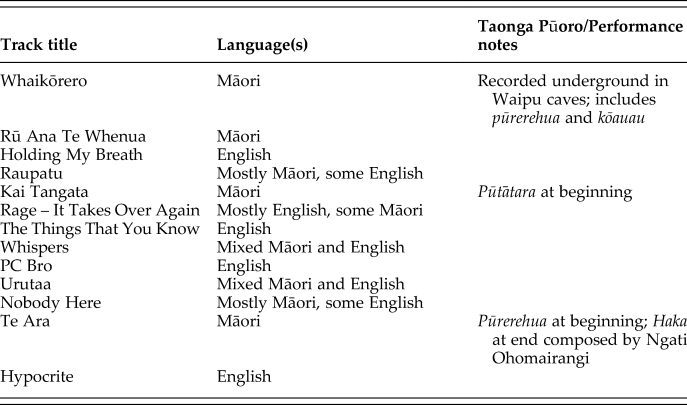
I turn now to a closer look at how Māori language and identity intersect with metal culture in Alien Weaponry's music. Although most press coverage, awards and grants have focused on the band's Māori-language songs, as an album, their debut Tū (2018) freely switches between te reo Māori and English, both within and between songs (see Table 1).
Track list for Alien Weaponry's 2018 debut album Tū, with languages used in each track. Far right column notes use of taonga pūoro (traditional Māori instruments). The album title ‘Tū’ is the shortened form of Tūmatauenga, the Māori god of war.

The music video for track five, ‘Kai Tangata’, depicts some of the most internationally familiar and also most ‘metal’ aspects of Māori culture, and won best video by a Māori artist at the Māori music awards in 2018. The song focuses on the Musket Wars, which took place in the early 1800s, after European contact but prior to official colonisation. The Musket Wars were an inter-tribal affair, as northern Māori tribes armed with muskets attacked tribes to their south, who were armed only with traditional weapons. Although the British were not directly involved in the Musket Wars, their introduction of firearms to Māori society via trade led to an arms race that killed up to 20,000 people and significantly re-arranged tribal boundaries (Keane Reference Keane2012a). ‘Kai Tangata’ is a war song, and its lyrics emphasise preparation for battle, the practice of tā moko (tattooing) and cannibalism of the defeated. The video opens with intertitles briefly explaining the Musket Wars, followed by blood droplets on a silver fern – important botanical iconography of Aotearoa.Footnote 16 Then, Henry de Jong sounds the pūtātara – a traditional conch-shell trumpet used to summon people to battle (Museum of New Zealand Te Papa Tongarewa, no author, no date). The bulk of the video depicts musket-wielding Māori warriors battling a village armed with traditional weapons; visible in the video are the long-handled weapons taiaha and pouwhenua, as well as the short-handled patu and kotiate (Keane Reference Keane2012b). These images are intercut with brief shots of the band playing and repeated closeup shots of a tā moko chisel etching ink into flesh. Close shots of the heavily tattooed faces, legs and buttocks of the warriors offer reminders of the corporeality of combat. Towards the end (beginning at 6:05), a group of warriors are seen performing a haka, a ritual dance that is perhaps one of the most globally recognised aspects of Māori culture.Footnote 17
Choosing to depict the early 19th-century Musket Wars acknowledges the impact that contact with the English had on Māori warrior culture, even before the colonisation process officially began. Given metal's obsession with war, battle and commoditised versions of historical warrior cultures – perhaps best exemplified by the numerous depictions of Viking warrior culture in Nordic metal – the topic of this song and video clearly participates in international metal conventions.Footnote 18 ‘Kai Tangata’ demonstrates how Alien Weaponry's practice of kaitiakitanga dovetails with whai wāhi; here, the visual and lyrical commemoration of a historical turning point for Māori culture becomes embedded in metal tropes. In addition, the music video is simultaneously distinctly Māori, through its language and visual signifiers, and distinctly metal, through its music, and inter-spliced depictions of the band, war, courage, brutality and pain.
Where ‘Kai Tangata’ presents a broad portrait of a moment in Māori history, ‘Rū Ana Te Whenua’ (‘The Earth Trembled’) presents a specific moment in the de Jong brothers’ family history. It tells the story of the battle of Pukehinahina, in which their great great great grandfather Te Aho Aho lost his life fending off British forces in 1864. The song is prefaced by the album's opening introductory track, ‘Whaikōrero’, the title of which refers to a type of formal ceremonial speech. In Alien Weaponry's case, the speech describes the events leading up to the battle at Pukehinahina, and is accompanied by taonga pūoro, or traditional musical instruments; one can clearly hear the pūrerehua – a blade swung on a long string so that it makes a whirring or roaring sound – and the kōauau – one of several traditional flutes. Together, these two tracks present the album as deeply invested in the kaitiakitanga of family and tribal traditions and histories. The sounds of Māori music, history and identity are heard before the sounds of metal on the album, and these traditions are protected amidst their recontextualisation and whai wāhi in global metal culture.
Although the band often use te reo Māori for discussing Māori-specific topics, such as tribal history and the impacts of colonisation, they also use it for discussing issues that impact their generation more broadly. The track ‘Nobody Here’ primarily uses Māori, with some English, and deals with the shallowness and isolation of compulsive internet and social media use – a widely shared area of concern among young people of a variety of backgrounds. The Māori-language verses describe this destructiveness:
Nau mai ki te rua ipurangi au
Ehara i te wāhi whakaruruhau
He karu pōtētē
Ka whakahīhī tonu koe
Te ao mārama ngaro
O rite ki te pō
Te rorohiko
He tāku kāinga pono
(Welcome to the abyss that is the internet
It's not a place of safety
Eyes deliberately closed
Your vanity reigns
The real world lost
Like the darkness
The computer
Is my true home)
In this song, Alien Weaponry's Māori identity intersects with their membership in Gen-Z, addressing a shared area of concern for today's teens and adolescents: the role of social media in a healthy lifestyle. This use of te reo Māori additionally demonstrates the language as living and evolving, and therefore something that can be used for any kind of communication. As they said to me, te reo Māori is ‘first and foremost language. It's for communicating, and it won't stay alive without use’ (interview with author 2019). Exhibiting te reo Māori as a living language further demonstrates both kaitiakitanga and whai wāhi, through using it to participate fully in society and present the shared concerns of New Zealand's youth, both Māori and non-Māori.
In addition, songs like ‘Nobody here’ – and indeed, the album as a whole – exhibit the process of ‘translanguaging’, which involves ‘using one's idiolect, that is, one's repertoire without regard for socially and politically defined language labels or boundaries’ (Otheguy et al., Reference Otheguy, García and Reid2015, p. 297, emphasis in original). Translanguaging moves beyond the related concept of ‘code-switching’ by shifting analytical emphasis from moments of linguistic change to the overall pluralistic experience of multilingual living (Seals and Olsen-Reeder Reference Seals and Olsen-Reeder2019, p. 17). The translanguaging present on Tū shows how kaitiakitanga and whai wāhi are inseparable processes, as preservation promotes participation in all facets of one's identity, and participation in local and global cultures increases recognition of endangered languages and cultural treasures.
Conclusion
Alien Weaponry's ability to engage effectively with Māori language and culture is in many ways a result of deliberate reparations for Treaty violations, reparations that have been achieved (and are still being sought) through decades of indigenous activism in Aotearoa New Zealand.Footnote 19 Given the language's endangered status, however, New Zealand public institutions, with the help of Māori researchers and leaders, continue to search for new ways to promote use of te reo Māori. Māori studies scholar Rawinia Higgins (Tūhoe) argues that if the language revitalisation project is to be successful, the language must be normalised, not restricted to Māori people only, or to certain spaces like the marae (the traditional Māori meeting house). Under the Treaty of Waitangi, te reo Māori is considered a taonga – a treasure to be protected. And although she believes that it is one of the most important taonga, she also believes that this status needs re-framing to ensure the taonga's survival. As she writes:
I have given lectures on this reframing of the notion of taonga and argued that rather than a ‘treasure’ that is coveted and protected, it becomes instead a normal part of our being … we need to shift our focus away from it being sacred and to be only used in contexts like the marae or in classrooms. (Higgins Reference Higgins, Adds, Bönisch-Brednich, Hill and Whimp2016, p. 27)
She further reminds readers that a living language cannot be
confined to the membership of one group, as if they live separately and autonomously from the rest of society … Māori are located in all spheres of New Zealand society, irrespective of their geographic, social, economic or political position. To design strategies that confine Māori to particular domains (whether physical or philosophical) only promotes a ‘traditionalist’ notion of Māori. Modernity has been an essential aspect of Māori evolution since contact, and the development of the language has not been immune to this. (Higgins Reference Higgins, Adds, Bönisch-Brednich, Hill and Whimp2016, p. 29)
Finally, she argues that te reo Māori, both as an indigenous language and in the way that it inflects New Zealand English, is one of few markers that distinguish New Zealand from other postcolonial Commonwealth nations, saying, ‘we cannot avoid the language, it defines our landscape and our identity as a country’ (Higgins Reference Higgins, Adds, Bönisch-Brednich, Hill and Whimp2016, p. 36). For Higgins, the Māori language is not only a Māori taonga, but also a component of equal citizenship for all New Zealanders. Its integration into daily life is not simply about cultural preservation, but also a concrete means of achieving a more equitable society in which Māori culture is valued by all citizens regardless of ancestry, and in which a more inclusive Aotearoa is presented to the world.
Alien Weaponry's simultaneous embrace of te reo Māori and metal music bears out Higgins's thesis. Their band presents an indigenous identity that is not only individually rooted in family history, but also openly engages current issues impacting young Māori as well as young people globally. The use of te reo Māori in their music frames a cultural history in present terms, as well as showing the language as a living language, appropriate for any kind of communication. Simultaneously, Tū's process of translanguaging exhibits two languages as cooperative partners in expression over a wide range of personal and global issues. Alien Weaponry participate in New Zealand's ongoing negotiation of the Treaty of Waitangi and its principles of kaitiakitanga and whai wāhi, and simultaneously take part in an international metal culture interested in narratives of endurance and courage. Given popular music's role in constructing senses of identity and belonging, Alien Weaponry's work contributes a space that is unapologetically Māori and unapologetically post-millennial, and presents these intersecting facets of themselves as equal citizens to the world.
Appendix. Summary of Alien Weaponry's awards, career highlights and sample international coverage in chronological order
A. Awards
2015
• New Zealand On Air $10,000 NZD grant to make music video for ‘Rū Ana Te Whenua’
2016
• win Smokefreerockquest (New Zealand music competition)
• win Smokefree Pacifica Beats (New Zealand music competition; only metal band that has won)
• New Zealand On Air $10,000 NZD grant to make music video for ‘Urutaa’
• New Zealand On Air $10,000 NZD grant to make music video for ‘Raupatu’
2017
• win APRA Maioha award for ‘Raupatu’ at Silver Scroll Awards (Māori-specific award at New Zealand national song writing competition)
• nominated for Vodafone New Zealand Music Awards
2018
• music video for ‘Kai Tangata’ wins best music video by a Māori artist (Ataata Māori Hira o te Tau)
B. Career highlights
2014
• Release of EP Zego Sessions
2017
• ‘Raupatu’ released as single
• ‘Rū Ana Te Whenua’ music video released. It reaches No. 1 on Spotify's ‘Viral NZ’ chart, No. 2 on iTunes ‘Global Metal’ chart
• The band signs a three-year management contract with Das Maschine for international representation (No Author 2017)
• Books performances at European festivals for mid-2018
• first overseas performances in Sydney and Melbourne, Australia
2018
• sign deal with Napalm Records (Rutledge Reference Rutledge2018)
• debut album Tū released on Napalm Records. It debuts at #5 on NZ album charts; it reaches #1 and Spotify adds it to various major metal playlists
• Three-month European tour including stops in Slovenia (Metaldays festival), Germany (including Wacken Open Air), England (Bloodstock Open Air), The Netherlands, Spain, Belgium and Austria
2019
• The band tours almost constantly, mostly in Europe and North America. They return to New Zealand at the end of October.
2020
• Third European tour, including festival appearances, cancelled due to global COVID-19 pandemic
• Band working on material for second album
• Founding bassist Ethan Trembath departs band; replaced by Tūranga Porowini Morgan-Edmonds
C. Sample headlines from international, mainstream English-language coverage 2017–2018
2017
• ‘Meet the teens using te reo and thrash metal to rage against New Zealand's colonial past’ (Vice)
• ‘Can a thrash metal band help save the Māori language?’ (The Atlantic)
• ‘This New Zealand band is trying to save Māori culture one headbanger at a time’ (NPR)
2018
• ‘Alien Weaponry: how teenage band channels Māori heritage into haka thrash metal’ (Revolver)
• ‘Keeping Māori culture alive with thrash metal: Alien Weaponry – Noisey meets’ (Noisey)
• ‘Alien Weaponry: thrash metal and te reo Māori’ (Vice documentary)
• ‘Maori language, once shunned, is having a renaissance in New Zealand’ (New York Times)
The band has additionally been profiled and interviewed by numerous metal-specific publications in Europe and North America.