A number of studies have provided evidence that bilingualism advances executive function in young adults (Costa, Hernández & Sebatián-Gallés, Reference Costa, Hernández and Sebastián-Gallés2008) and even may defer negative aging effects in older adults (Bialysotk, Craik, Klein & Viswanathan, Reference Bialystok, Craik, Klein and Viswanathan2004). However, with regard to potential cognitive benefits of childhood bilingualism in young children, debate persists today as various factors such as socio-cultural demographics are often difficult to dissociate from bilingualism per se. On the one hand, bilingual preschoolers (age 4–6 years) have displayed advanced cognitive performance on a variety of behavioral attention tasks measuring cognitive control (Bialystok, Reference Bialystok1999, Reference Bialystok2001, Reference Bialystok2010; Bialystok & Martin, Reference Bialystok and Martin2004; Carlson & Meltzoff, Reference Carlson and Meltzoff2008). On the other hand, it has been argued that this observed bilingual cognitive advantage may interact with various environmental factors, and even possibly be explained by them (e.g., socio-economic status (SES), ethnic and cultural backgrounds) (Carlson & Choi, Reference Carlson and Choi2008; Mezzacappa, Reference Mezzacappa2004; Morton & Harper, Reference Morton and Harper2007; see Bialystok, Reference Bialystok2009, in response to Morton & Harper). Certain cultural contexts, such as what has been termed a “Confucius East Asian milieu” have been associated with advancement in children's development of regulatory control behavior independently of bilingualism in Korean and Chinese preschoolers (Carlson, Reference Carlson2009; Lewis, Koyasu, Oh, Ogawa, Short & Huang, Reference Lewis, Koyasu, Oh, Ogawa, Short, Huang, Kewis and Carpendale2009; Oh & Lewis, Reference Oh and Lewis2008; Sabbagh, Xu, Carlson, Moses & Lee, Reference Sabbagh, Xu, Carlson, Moses and Lee2006). If culture modulates the development of executive control, it potentially confounds prior developmental findings with children recruited from East Asian families in bilingualism studies (see for example, Bialystok, Reference Bialystok1999; Yang & Lust, Reference Yang and Lust2005).
The concept of culture is necessarily broad and complex, e.g., the classic Tylor (Reference Tylor1871, p. 1)) definition of culture as a “complex whole” consisting of “Knowledge, belief, art, morals, and all those capabilities and habits that man acquires as member of society”. Culture is thus necessarily an elusive concept reflected in multiple dimensions of life, thoughts, beliefs, behaviors and even in the geographical environment in which we operate. For example, a more supervisory and interdependent native culture (i.e., broadly promoted Eastern cultural values) has been contrasted with a more individualistic and autonomous host culture (i.e., broadly promoted Western cultural values) (e.g., Vinden, Reference Vinden2001); cultural differences between East and West have been discerned in many aspects such as parenting attitudes (Ahadi, Rothbart & Ye, Reference Ahadi, Rothbart and Ye1993; Chao & Tseng, Reference Chao, Tseng and Bornstein2002; Chen, Hastings, Rubin, Chen, Cen & Stewart, Reference Chen, Hastings, Rubin, Chen, Cen and Stewart1998; Vinden, Reference Vinden2001), parent–child narratives and autobiographical memories (Wang, Reference Wang2006), children's social and play behavior (Chen et al., Reference Chen, Hastings, Rubin, Chen, Cen and Stewart1998; Farver & Lee-Shin, Reference Farver and Lee-Shin2000), and teachers’ evaluations (Farver & Lee-Shin, Reference Farver and Lee-Shin2000). At the same time, such cultural differences may in fact interact with geographical location. For example, Farver and Lee-Shin (Reference Farver and Lee-Shin2000) provide evidence that Korean American parents assimilating to American culture in the U.S. attenuate the Confucius East Asian milieu. With all these features and values binding together in a variety of ways, the definition and measurement of culture becomes more and more complex and intricate. In the present study, we defined culture effects to be reflected largely on two dimensions – (i) geography (i.e., the Republic of Korea – East vs. the U.S. – West) and (ii) acculturation (i.e., Korean immigrant families vs. American families in the U.S.).
In this study we initiated investigation of the potential cognitive effects of bilingualism on cognitive development by beginning to dissociate bilingualism effects from other possible socio-cultural effects related to geography and general SES. To do this, we recruited four-year-old Korean–English (KE) developing bilinguals in the U.S. and three monolingual control groups – English (E) and Korean (K) monolinguals in the U.S. and Korean monolinguals (ROK) in the Republic of Korea, while attempting to maintain general SES across these. Our selection of Korea and U.S. was determined following the established cultural dichotomy of East and West and choosing a representative country for each as referenced in the literature. Korea is frequently characterized as endorsing Eastern values such as interpersonal harmony, hierarchical relationships, filial piety, and inhibited behavior and the U.S. as valuing self-expressions, independence, individualism, and personal efficacy (Farver & Lee-Shin, Reference Farver and Lee-Shin2000; Vinden, Reference Vinden2001).
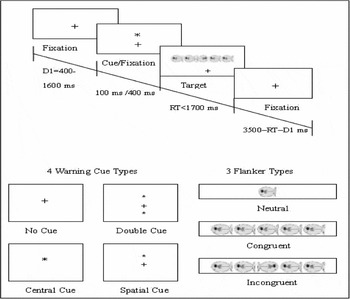
To further focus our investigation of the hypothesized advantage of bilingualism on cognitive development, we evaluate executive attention, a cognitive area which is now well studied, and one where advanced measurement techniques have now been developed, including those which allow correlations with brain mechanisms and genotyping assessments (Posner & Fan, Reference Posner, Fan and Pomerantz2008; Posner, Rothbart & Rueda, Reference Posner, Rothbart, Rueda, Battro, Fisher and Léna2008). To evaluate executive attention, we adopted a child version of an Attention Network Test (ANT; Rueda, Fan, McCandliss, Halparin, Gruber, Lercari & Posner, Reference Rueda, Fan, McCandliss, Halparin, Gruber, Lercari and Posner2004), which enables us to specify global attention performance in terms of accuracy and reaction time and to assess efficiency levels of three attention networks – alerting, orienting, and executive control of conflict resolution as they operate through distinct anatomical brain regions (Fan, McCandliss, Sommer, Raz & Posner, Reference Fan, McCandliss, Sommer, Raz and Posner2002). The ANT task, which was constructed in an integrated ‘cue by flanker’ paradigm for testing of adults (Fan et al., Reference Fan, McCandliss, Sommer, Raz and Posner2002), was first adapted for use with young children by replacing an array of arrow stimuli (← ← → ← ←) with more child-friendly fish stimuli (see Figure 1 below), and sound and animation feedback features were also augmented in accord with children's responses. Using this version, Rueda et al. (Reference Rueda, Fan, McCandliss, Halparin, Gruber, Lercari and Posner2004) tested monolingual children from 6 through 10 years of age, addressing a critical range in life-span development of attention networks. In general, a steady but significant increase of overall attention performance in terms of accuracy and reaction time was observed in developing children whereas executive network efficiency was stable across the four age groups (6–10). Mezzacappa (Reference Mezzacappa2004) also employed the child version of ANT task and found correlations between the development of executive attention in 4–7-year-olds and various ethnic and socio-economic factors.
Schematic representation of the Attention Network Test (ANT).

In the present study, we adopted the Child ANT, previously used to measure executive attention in monolingual children (Mezzacappa, Reference Mezzacappa2004; Rueda et al., Reference Rueda, Fan, McCandliss, Halparin, Gruber, Lercari and Posner2004), to begin to study development of executive attention in a bilingual population and comparable monolingual populations from different culture groups. We hypothesize that:
1. Bilingualism effect (BILINGUALISM). If beneficial effects of childhood bilingualism emerge by age four, even while bilingualism is developing in the child, then significant advances on the Child ANT would characterize our bilingual population compared to the monolinguals, potentially on both overall accuracy and reaction time (RT), as well as in the executive control network that is primarily responsible for conflict resolution. This result would converge with previous research findings with adult bilinguals on the Adult ANT (Costa et al., Reference Costa, Hernández and Sebastián-Gallés2008). It will also converge with recent results suggesting bilingual cognitive control benefits in infants as young as seven months (Kovács & Mehler, Reference Kovács and Mehler2009).
2. Culture effect (CULTURE). If certain Asian socio-cultural environments (e.g., Korea, where there is increased cultural emphasis on behavioral control and inhibition in early childhood (Ahadi et al., Reference Ahadi, Rothbart and Ye1993; Chao & Tseng, Reference Chao, Tseng and Bornstein2002; Chen et al., Reference Chen, Hastings, Rubin, Chen, Cen and Stewart1998)) are linked to significant cognitive benefits in executive attention (Carlson & Choi, Reference Carlson and Choi2008; Lewis et al., Reference Lewis, Koyasu, Oh, Ogawa, Short, Huang, Kewis and Carpendale2009; Oh & Lewis, Reference Oh and Lewis2008; Sabbagh et al., Reference Sabbagh, Xu, Carlson, Moses and Lee2006), then recruited Korean monolinguals in the Republic of Korea may surpass the English monolinguals who receive different cultural nurturing and child rearing practices such as independence, individual orientation and self-expression (Ahadi et al., Reference Ahadi, Rothbart and Ye1993; Chao & Tseng, Reference Chao, Tseng and Bornstein2002;). We also hypothesized that the Korean monolinguals from the Republic of Korea may outperform the Korean immigrant children in the U.S. Although U.S. Koreans share cultural heritage with the native Koreans in the homeland (the Republic of Korea) in ancestral origin, language, the Korean immigrant group would have been to some degree assimilated to the American families in the U.S. in various cultural factors while living under the same North American cultural dynamics.
3. Acculturation effect (ACCULTURATION). Through substantial exposure and alternation to the host culture of a second language, the Korean monolingual children who continuously are in contact with North American culture, e.g., living in the U.S., would begin to integrate the cognitive styles and behaviors that would be reflective of mainstream culture (e.g., Farver & Lee-Shin, Reference Farver and Lee-Shin2000). As far as we know, the impact of acculturation on executive attention has not been studied yet. We take an exploratory approach to this research question by comparing performance between the U.S. Korean and the English monolinguals.
4. Dissociating bilingualism and culture effects (DISSOCIATION). Critically, if bilingualism per se stimulates cognitive advancement over and above any advancement due to culture, then the U.S. Korean–English bilinguals should outperform not only the English monolinguals, but also the Korean monolingual counterparts in the Republic of Korea. Depending on the effects of acculturation, the bilinguals may also outperform monolingual Korean children in the U.S., whom we assume to reflect critical aspects of Korean culture.
In order to examine the effects of BILINGUALISM, CULTURE, and ACCULTURATION on executive attention measured by the ANT task, we designed a set of three planned contrasts in Analysis of Covariance (ANCOVA) models with Age as the covariate; (i) to investigate the BILINGUALISM effect, the KE and the three monolingual groups – K, E, and ROK – were contrasted; (ii) to investigate the CULTURE effect, which was largely defined by the dichotomy of East vs. West, the ROK and the K (U.S.) and E (U.S.) were compared; and (iii) to examine the ACCULTURATION effect, the E and K in the U.S. were contrasted along with a separate analysis comparing the K and ROK. Critically, to dissociate bilingualism and culture (i.e., DISSOCIATION) and to test whether bilingual experience overrules a potential culture effect, we employed a set of separate ANOVAs to directly compare the KE bilingual and ROK monolingual groups in comparison to the KE bilinguals vs. English monolinguals.
Method
Participants
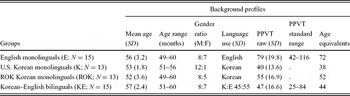
Fifty-six children aged four years (M = 54.6 in months, SD = 3.5) were tested; 15 Korean–English developing bilinguals (KE) (M = 57, SD = 2.4), 15 English monolinguals (E) (M = 56, SD = 3.2), 13 Korean monolinguals (K) (M = 53, SD = 1.8) from the U.S. and 13 Korean monolinguals from the Republic of Korea (ROK) (M = 52, SD = 3.6), (AGE: p < .05) (see Table 1 for participant descriptions).
Participants' descriptions.

Notes: M = Male; F = Female. Age equivalents were computed on the basis of raw scores as indicated in the PPVT norms book (Dunn & Dunn, Reference Dunn and Dunn1997). Language use was based on the parents' reports on the percentile-based frequency.
Socio-economic status was controlled by proxy measures such as middle-class neighborhoods and parental education level. The three groups of children (KE, E, and K) were born in the U.S. and recruited from nursery schools in middle-class urban areas in New York and New Jersey. The ROK group was recruited from a middle-class urban neighborhood in Chonju, Korea. All parents, both in the U.S. and Korea, were college-educated at least. The Virtual Linguistics Lab (VLL) Child Multilingualism Questionnaire (Yang, Blumé & Lust, Reference Yang, Blumé and Lust2007) was used to evaluate the KE group's language backgrounds on the basis of caretaker report. A vocabulary test (either English or Korean), the Peabody Picture Vocabulary Test–III (PPVT) or a Korean adaptation of this (see the “Materials and procedure” section below) was also administered to assess each child's language abilities through vocabulary assessment.
The U.S.-based Korean monolingual (K) and bilingual (KE) children were from the homes of first-generation native Korean parents and were attending either a Korean monolingual or a Korean–English bilingual program in the same preschool in New Jersey. These K and KE groups are similar in many respects (e.g., living in the same neighbourhood (Palisades Park, New Jersey) and attending the same daycare); however, unlike the Korean monolingual group, the KE bilingual group was enrolled in the Korean–English bilingual program for one school year. The Korean and Korean–English bilingual programs in this daycare center differed only in the language of instruction. Parents had chosen the Korean monolingual nursery school experience for their children mainly in order to maintain Korean ethnic identity and to attenuate possible language attrition.The parents of the U.S. Korean monolingual children indicated close cultural affinity to their native Korean and naturalized American cultures alike.
The KE bilingual children had approximately 11 months of formal exposure to English through the bilingual daycare program at the point of testing and thus were acquiring English sequentially after their first language. Their parents reported that they had not found any problems or delays in their children's Korean-L1 abilities. Additionally teachers were asked to eliminate from our sample any children with known linguistic or cognitive disabilities. All the children in the experiment were normally developing and from a family where both parents are Korean native speakers and first-generation immigrants. We assume that by the age of four, children normally have become proficient in their first language and essential first language acquisition is accomplished although some aspects of language continue to develop beyond this time (Lust, Reference Lust2006). Reportedly, the KE group spoke Korean at home and in the Korean community whereas English was the language of communication at school. In answer to a question as to how much time the child spent using each language, we found 45% Korean as opposed to 55% of English on average, which largely corresponds to the child's awake time spent at home vs. at school.
Although the Korean monolingual group in the U.S. had English exposure through the media or by contacting English speakers, none of them had received any formal education in English at the time of testing. Nonetheless, the K group was screened using the set 1 of the PPVT appropriate for English age 2.5 years and all participating children made substantial errors preventing them from passing the first set. The Korean monolingual children may have the ability to identify a few English words but they were unable to comprehend instructions in English. In the community of Palisades Park, New Jersey, children can grow up as Korean monolinguals for the first few years before English schooling begins. This is mainly enabled by the large Korean ethnic composition of the community and the availability of Korean amenities (e.g., schools, shops, and restaurants) and private/public services (e.g., banks, post office, and government offices).
The ROK monolingual children attended a daycare center in Korea which offered a weekly 15-minute-long sing-along time in English. In this short weekly session, children are shown educational DVDs, and a Korean teacher of English leads the session in Korean. Although this may constitute formal English exposure, none of the ROK children obtained good enough proficiency either to pass the first set in the English PPVT or to understand English instructions.
Although systematic comparisons of daycare programs between the participating preschools in the U.S. and Korea were not conducted, Korean preschools’ curriculum for three-to-five years of age is guided by the National Kindergarten Curriculum (NKC), which was formulated under a strong Western influence such as American Developmentally Appropriate Practices (Ministry of Education, 2001). The emphasis of the NKC is mostly given on child-centered and play-centered activities with an integrated teaching model for children's holistic development. We noticed that the Korean daycare center in Korea provided a program quite similar to that of the New York and New Jersey daycare centers, which mostly consisted of a circle time, free play among peers, arts and crafts, singing, story, and playground times. According to our observation, neither of the daycare programs was more enriching than any other in their regular educational programs.
The English monolingual children had no prior formal exposure to languages other than English beyond incidental exposure to foreign languages in various forms such as the media.
Materials and procedure
Peabody Picture Vocabulary Test–III (PPVT)
The PPVT (Dunn & Dunn, Reference Dunn and Dunn1997) has been generally used to measure receptive vocabulary in a wide range of ages, from 2.5 years to 90 years, and was administered in two languages – English for English monolinguals and Korean–English bilinguals, and Korean for Korean monolinguals in the U.S. and Korea.Footnote 1 When a word was given by an experimenter, children were instructed to either point to one of the four drawings or respond by saying the number of the picture of their choice which depicted the word prompt. The number of correct responses for each child between the basal set of zero error and ceiling set of more than eight errors were then computed to output raw scores. The scores of the English PPVT were then converted to standardized scores corrected for age and percentile ranks. The reported population mean is 100 with a standard deviation of 15.
The PPVT primarily functioned to measure vocabulary size. However, in monolinguals the PPVT performance and other non-verbal cognitive abilities such as the Kaufman Brief Intelligence Test (KBIT) (Kaufman & Kaufman, Reference Kaufman and Kaufman2004), have widely demonstrated high correlations, r = .62–.82 (Fantuzzo, McWayne, Perry & Childs, Reference Fantuzzo, McWayne, Perry and Childs2004) and the subtest of matrices of the KBIT was also found to significantly correlate with the PPVT, r = .71 (Levy, Smith & Tager-Flusberg, Reference Levy, Smith and Tager-Flusberg2003).
Attention Network Test (ANT)
Children were visually presented with the child version of the ANT from a distance of approximately 56 cm on a 14.1-inch personal Compaq notebook computer with a Windows 2000 operating system. They were instructed to respond to the two input (right and left) keys on a keyboard in the way that would match the direction of swimming hungry fish as accurately and quickly as they could.
The Child ANT is adapted from the Adult ANT (Fan et al., Reference Fan, McCandliss, Sommer, Raz and Posner2002), which was constructed on the basis of an integrated ‘cue by flanker’ paradigm (Eriksen & Eriksen, Reference Eriksen and Eriksen1974). To make the version more child-friendly, new features (sound and animation feedback) were added and the stimuli were replaced (see Rueda et al., Reference Rueda, Fan, McCandliss, Halparin, Gruber, Lercari and Posner2004, for review). The Child ANT, a game-like non-verbal task, was set in blue background to simulate ocean water, with bright yellow fish swimming leftward or rightward. Children heard ‘woohoo’ for correct responses and ‘huh’ for incorrect responses.
The ANT was composed of four cue (NO CUE, DOUBLE CUE, CENTRAL CUE, and SPATIAL CUE) and three flanker (NEUTRAL, CONGRUENT, and INCONGRUENT) types. The variation of cue and flanker conditions allowed assessment of various components – alerting, orienting, and executive control – in the executive attention system (Fan et al., Reference Fan, McCandliss, Sommer, Raz and Posner2002; Rueda et al., Reference Rueda, Fan, McCandliss, Halparin, Gruber, Lercari and Posner2004). Efficiency in cue and flanker processing is subject to individual differences as the range of executive skills assessed by the ANT is primarily altered by experience and genes (Posner & Rachle, Reference Posner and Rachle1994) (e.g., attentive vigilance for stimuli changes, switching of attention to the location of cues, monitoring for conflict resolution, and inhibition of distraction for correct target detection). Overall ANT performance obtained on the basis of integrative cue and flanker conditions was represented in terms of accuracy in percent and reaction times (RT) in milliseconds on correct trials across the whole task. The RT-based attention network efficiency was computed on the basis of subtraction formulas between three sets of paired conditions: NO CUE and DOUBLE CUE conditions for alerting; CENTRAL CUE and SPATIAL CUE conditions for orienting; CONGRUENT and INCONGRUENT conditions for executive control (see Figure 1).
The task consists of a total of 168 trials over one training block of 24 trials and three experimental blocks of 48 trials each. The three experimental blocks are composed of 12 conditions (4 cues × 3 flankers). Performance feedback in both sound and animation was given on each trial. Children took between 25 and 30 minutes to complete the task.
All groups were tested on the tasks by Korean–English bilingual experimenters in a quiet room. English monolinguals and KE bilinguals were tested in English, and Korean monolinguals (K & ROK) in Korean.Footnote 2 The order of the two tasks – the PPVT and ANT was counterbalanced.
Results
The four groups differed in age (p < .05). The partial correlations between Age and all dependant variables – PPVT raw scores and ANT accuracy, RT, and three network scores, controlling for bilingual experience – showed no significant effects. However, Age was covaried for all analyses using Analysis of Covariance (ANCOVA) except for the English PPVT comparison between the E and KE groups, whose age did not differ.
A one-way ANOVA displayed a significant advantage for English monolinguals on the standardized English PPVT scores when comparing the E and KE groups (Age: ns; KE: M = 87, SD = 13.5; E: M = 114, SD = 14.7), F(1,27) = 31.907, p < .0001, partial η2 = .542. The English monolinguals were placed at 82nd percentile and the bilingual group at 19th percentile. Given the relatively short duration of English exposure for the KE group and recent research that has shown a monolingual–bilingual difference in receptive vocabulary (Bialystok, Luk, Peets & Yang, Reference Bialystok, Luk, Peets and Yang2010), this result was expected.
When comparing the PPVT raw scores from the four groups to get a general index of absolute vocabulary knowledge, the English monolingual group (M = 79) ranked highest, followed by the ROK (M = 55), KE (M = 47), and the K groups (M = 40).Footnote 3 A one-way Analysis of Covariance (ANCOVA) with age as the covariate produced a significant difference in the PPVT raw scores, F(3,51) = 13.656, p < .0001, partial η2 = .445. Post-hoc tests with Bonferroni adjusted p-levels showed that the English monolinguals performed significantly better than the KE (English PPVT) and K groups (Korean PPVT), ps < .0001, whose performance did not differ from each other, ps = ns. The ROK group performed as well on Korean vocabulary as the E group did on English vocabulary, p = ns, and the Korean-speaking groups of K, and ROK did not significantly differ from one another in Korean vocabulary knowledge. These findings suggest that the two monolingual groups (E in the U.S. and ROK in Korea) who live in a country of their L1 possess comparable skills as opposed to the K and KE whose Korean-L1 is a minority language of the host country (U.S.).
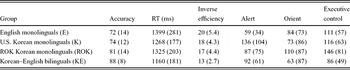
Table 2 summarizes ANT accuracy and RT by groups. A one-way ANCOVA on ANT accuracy and RTs, respectively, controlling for the influence of AGE allowed three comparisons to test the effects of contrast 1 – BILINGUALISM, contrast 2 – CULTURE, and contrast 3 – ACCULTURATION. These were conducted by orthogonal Helmert contrasts in the ANCOVA model. The overall attention measure of accuracy on the Child ANT revealed a significant GROUP difference, F(3,51) = 4.913, p < .004, partial η2 = .224. Planned contrasts revealed that BILINGUALISM significantly increased accuracy performance for the KE group compared to the three monolingual groups taken as a whole, t(51) = –3.492, p (one-tailed) < .0001, partial η2 = .193. To better pinpoint the BILINGUALISM effect, a follow-up test was run with focus on the comparison between the KE bilingual and K monolingual groups recruited in the U.S. This was done because these two groups had both been exposed to two (Korean and U.S.) cultures and differed only in bilingual status, thereby rendering the BILINGUALISM effect more direct and decisive while controlling for a bicultural influence. Consistent with our hypothesis, the follow-up test also showed that the KE bilingual group (M = 88%) outperformed the K (M = 74%) monolingual group (t(26) = –3.51, p = .002) on accuracy and outperformed the E (M = 72%) monolingual group, p < .05. At the same time, it did not differ from the ROK group (M = 81%), suggesting that cultural influence may also be beneficial to accuracy.
Overall ANT performance and RT-based network efficiency (SDs).

Notes: Inverse efficiency was obtained by dividing the correct response times by accuracy and provides a basis for processing efficiency independent of possible speed-accuracy trade-offs (Townsend & Ashby, Reference Townsend, Ashby, Castellan and Restle1978). A higher inverse efficiency score indicates poorer performance. A smaller network value indicates more efficient performance in the given network.
A significant CULTURE effect from contrast 2 was displayed, t(51) = –2.134, p (one-tailed) < .02, partial η2 = .082, which indicates that the ROK group was significantly more accurate than the two other monolingual groups (K and E) in the U.S. The last contrast for ACCULTURATION effect was not significant, t(51) = –.698, p > .05, which suggests that when children acquire only one language, and when acculturation has begun to take place from the native to the host culture, significant culture effects may be attenuated.
To dissociate BILINGUALISM and CULTURE we initially examined the effect of the covariate (Age) in relation to accuracy in the KE and ROK groups by ANCOVA. The result showed that accuracy did not vary systematically with Age, F(1,25) = 1.789, ns. Thus, we conducted a one-way ANOVA comparing the KE and ROK groups. The result failed to show any significant DISSOCIATION effect on accuracy.
The same analysis models were conducted on the overall attention measure of RT of correct trials on the ANT. A significant GROUP difference was found, F(3,51) = 4.122, p < .02, partial η2 = .195. The same set of three planned contrasts used previously yielded only a BILINGUALISM (KE-bilinguals vs. K, E, and ROK-monolinguals) effect, F(3,51) = 2.939, p (one-tailed) < .0001, partial η2 = .145. Further analyses revealed that the largest RT difference was the comparison between the KE (M = 1160 ms) and E (M = 1399 ms) groups, p < .03. Next, we directly compared the KE and ROK using a one-way ANOVA. The result produced a significant DISSOCIATION effect, F(1,26) = 5.157, p < .04, partial η2 = .166. This indicates that the KE bilinguals were significantly faster at speed of processing than were the ROK monolingual counterparts (M = 1325 ms).
Finally, we computed inverse efficiency scores by dividing the mean RTs of the correct trials by the proportion of accurate responses (see Table 2). Inverse efficiency is a standard way to merge RT and accuracy into a single measure to provide a basis for processing efficiency independent of possible speed-accuracy trade-offs (Townsend & Ashby, Reference Townsend, Ashby, Castellan and Restle1978).Footnote 4 A higher inverse efficiency score signifies poorer performance. A one-way ANCOVA with Age as a covariate yielded a significant GROUP effect, F(3,51) = 6.647, p < .001, partial η2 = .281. Planned contrasts displayed a significant effect of BILINGUALISM, t(51) = 4.2, p (one-tailed) < .0001, partial η2 = .257, but no other contrasts were significant. The ANCOVA produced a significant effect of DISSOCATION, F(1,26) = 6.457, p < .02, partial η2 = .199. That is, the U.S. Korean–English bilinguals outperformed the Korean monolingual counterparts from the Republic of Korea.
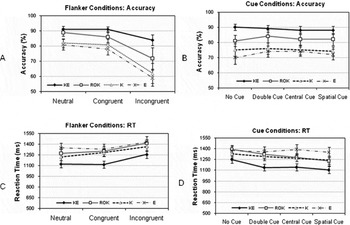
Figure 2 depicts children's accuracy and RT on the ANT as a function of flanker and cue conditions. A 3 (FLANKER conditions: NEUTRAL, CONGRUENT, and INCONGRUENT) × 4 (CUE conditions: NO, DOUBLE, CENTRAL, and SPATIAL) mixed ANCOVA model was conducted with cues and flankers as within-subject factors and GROUP as a between-subject factor. On the measures of both accuracy and RT, no effects were significant except a FLANKER × GROUP interaction on the RT data, F(6,306) = 2.588, p < .03, partial η2 = .132. To further examine bilinguals’ superiority to monolinguals in suppressing flanker distraction in the congruent and incongruent conditions as measured by both accuracy and RT, we modeled a 2 (FLANKER: CONGRUENT and INCONGRUENT conditions) × 4 (GROUP: E, K, ROK, and KE) mixed ANCOVA with FLANKER as a within-subject factor and GROUP as a between-subject factor, with Age as a covariate. No main or interaction effects were found but a planned contrast (BILINGUALISM) on accuracy scores revealed that bilinguals excelled in inhibiting distracting incongruent conditions, t(51) = 1.893, p (one-tailed) < .04, partial η2 = .066 (see Figure 2, quadrant A).
Flanker and cue effects on accuracy and Reaction Time (RT).

In three attention network efficiency scores, the same one-way ANCOVA model was applied to the analysis of each network – alerting, orienting, and executive control (see Table 2). No significant GROUP effects emerged on any of the network of executive control. However, a priori contrasts revealed a significant effect of ACCULTURATION, t(40) = –2.258, p < .03 on alerting in favor of the E group relative to the K group in the U.S.
The DISSOCIATION effect on executive control was further assessed by a follow-up ANOVA by directly comparing the KE group to the ROK group.Footnote 5 The result produced a significant difference in DISSOCATION, F(1,26) = 5.157, p < .04, partial η2 = .166, suggesting that the bilingual advantage is distinct from the culture advantage.
Discussion
Despite the fact that our Korean–English bilinguals were still developing balanced bilingualism and English was their weaker language as shown on the standard PPVT scores, the U.S. KE bilingual group was the most accurate and fastest compared to all three monolingual peer groups (K, E, ROK) in overall executive attention accuracy and RT as measured by the ANT. A sizable culture effect arose in overall accuracy to the advantage of ROK monolinguals; Korean monolinguals in the U.S. behaved similarly to English counterpart monolingual.
These results not only converge with previous research (e.g., Bialystok, Reference Bialystok1999) documenting that bilingualism is advantageous to executive attention development, but they do so through a powerful focused measurement, the Attention Network Test. These results also suggest that a positive bilingualism effect on executive attention may appear quite early in cognitive development and quite early in the process of bilingualism development, even starting only after one-to-two years of second language exposure. Combining these results with recent study of adult bilingualism (Costa et al., Reference Costa, Hernández and Sebastián-Gallés2008) on the ANT, we can conclude that advantageous effects of bilingualism in executive attention may persist over development from early periods of bilingualism to the young adult period in a continuous manner.
Although it is not possible to totally dissociate culture and bilingualism, our design allowed us to begin to dissociate geography (U.S. and Korea) and SES in general (controlled across all groups) as potential cultural factors from bilingualism. It also allowed us to begin to evaluate effects of acculturation with change of geographical location. This design allowed us to discover that the bilingual advantage that is associated with dual language control superseded potential culture benefits that may be built upon the East Asian values of disciplined behavior and behavioral regulation (Chao & Tseng, Reference Chao, Tseng and Bornstein2002; Chen et al., Reference Chen, Hastings, Rubin, Chen, Cen and Stewart1998) at the same time that our results replicated these cultural benefits on development of executive attention. The positive culture effect in accuracy was largely distinguished from the bilingualism effect as each relates differently to RT. The ROK monolingual children's high accuracy (81%) was obtained at the cost of longer RT (M = 1325 ms), whereas the bilingual group was highly accurate (88%) as well as highly efficient in RT (M = 1160 ms) (see Table 2). The significant difference in inverse efficiency between the KE and ROK groups suggests that BILINGUALISM is more conducive to inverse efficiency than CULTURE, and the impact of BILINGUALISM is deeper and more powerful at a cognitive level than that of CULTURE, suggesting the possibility of different mechanisms at work for BILINGUALISM independent of CULTURE. More importantly, the executive control network for conflict resolution between congruent and incongruent flanker conditions clearly set apart the KE bilingual and ROK monolingual groups with a strong implication that a bilingual advantage overrides a potential cultural advantage in the efficiency of conflict processing (Table 2).
The two Korean ethnic groups (native Korean children – ROK vs. U.S. Korean children –K) showed an interesting divergence in executive functioning as represented by the ANT accuracy data (ROK: 81% vs. K: 72% vs. E: 74%), in which the U.S. pair (U.S. Korean children – K vs. U.S. children – E) displayed a substantial similarity. Cross-cultural studies have provided evidence that parents’ cultural affiliation and the extent that they uphold culture-appropriate principles for child rearing change when they immigrate into a new country (e.g., Wang, Reference Wang2006). Immigrant families actively adopt new cultural values of the host country as well as remaining more loyal to the traditional culture of their native country. Although our study did not attempt to answer how the cultural assimilation process and biculturalism (LaFramboise, Coleman & Gerton, Reference LaFramboise, Coleman and Gerton1993) impact the development of executive functioning during early childhood, its results warrant future investigation.
These results raise several questions for future research. In our study, in contrast to overall analyses of accuracy and RT, individual analyses of the three networks on the ANT did not display clear individual distinctions on the basis of bilingual experience. This may be because the executive attention networks remain stable in development from early-to-middle childhood (for further discussion on this issue, see Yang, Yang & Lust, Reference Yang, Yang and Lust2011). Previous developmental findings by Rueda et al. (Reference Rueda, Fan, McCandliss, Halparin, Gruber, Lercari and Posner2004; ages between 6 and 10) and Mezzacappa (Reference Mezzacappa2004; ages between 4 and 7) and our own developmental studies (Yang, et al., Reference Yang, Yang and Lust2011; ages between 4 and 6) of both monolingual and bilingual children also failed to find any significant age effect in the three networks although an adult study has shown significant bilingual advantages in alerting or executive control networks (Costa, et al., Reference Costa, Hernández and Sebastián-Gallés2008).
Our current findings also provoke the question of what comprises East Asia's cultural constructs that scaffold the development of regulatory behavior (e.g., parenting practices on the basis of Confucian values) and how these may relate to bilingualism. The related, yet distinct, contributions of socio-cultural, cognitive-linguistic experiences to potential benefits in executive attention should be further examined to explore individual differences in executive attention from various – demographic, cognitive, temperamental, and biological – perspectives as they integrate with bilingualism (Posner & Rothbart, Reference Posner and Rothbart2007; Rueda, Posner & Rothbart, Reference Rueda, Posner and Rothbart2005).
Given the significance of our effects on relatively small samples, future research should extend our populations controlling for numerous factors. Further intellectual measures can be administered to distinguish the bilingual cognitive advantage from various characteristics of intelligence. The child's bilingualism needs to be more fully and systematically assessed in both languages as it may or may not involve first language attrition at the cost of second language addition; and further studies must attempt to replicate our results with varying first languages (Flynn, Reference Flynn, Gass and Schachter1989; Yang & Lust, Reference Yang and Lust2007). Furthermore, the enhanced executive attention which we have found to be related to childhood bilingualism invites future studies to investigate whether other forms of enrichment such as music or art training (e.g., see Bialystok & DePape, Reference Bialystok and DePape2009) can exert the same effect as bilingualism in advancing an early development of executive capacities.