Co-operation occurs when governments make mutually beneficial, though unilaterally costly, policy adjustments that they would not otherwise have made.Footnote 1 International agreements and institutions often lack independent ways to compel governments to make these policy adjustments; as a result, a large body of research has focused on domestic sources of support for co-operation.Footnote 2 Many of these theories focus on how domestic lobbies, such as special interest groups or non-governmental organizations, can encourage their governments to make co-operative policy adjustments in situations in which the government might otherwise retain the status quo or roll back initial adjustments. The specter of punishment from pro-co-operation (or, more precisely, pro-adjustment) lobbies helps governments credibly commit to costly policy adjustments. Across issue areas, from trade to environmental protection, pro-adjustment domestic lobbies appear to have an important influence on governments’ decisions.
Under what conditions do pro-adjustment domestic lobbies facilitate co-operation, that is, mutual and co-ordinated policy adjustments made by more than one country? We ask not only how pro-adjustment lobbies affect the unilateral political-economic calculus of a government when it is deciding between policy adjustment and the status quo, but also how these lobbies affect the likelihood that both their own government and its partner governments will choose co-operative policy adjustments based on reciprocity. Two observations are key to answering this question. First, lobbies are active participants in the enforcement stage of co-operation. Even after governments have agreed to mutual policy adjustments, lobbies can engage in costly political activities to reward or punish their government for its subsequent decisions over whether to abide by the agreement. Lobbies do so not only with an eye on their own government, but also on how their activities affect the behavior of partner governments.
Secondly, not all pro-adjustment lobbies benefit from their government's co-operative policy adjustments in the same way. Some lobbies support their government's decision to adjust because the lobby has a direct interest in the foreign governments’ policies. That is, these lobbies care about foreign governments’ decisions, and therefore care about their own government's decisions because of the strategic effect these decisions have on partner governments’ behavior. A classic example, which we describe in greater detail below, would be an exporting firm that wants its government to remove import tariffs (adjust) because the firm fears retaliation from the countries that are harmed by the import tariffs. In 2003, US orange producers opposed US tariffs on European steel because the EU threatened to retaliate with tariffs of its own against US oranges. We call these groups internationally benefiting lobbies (IBLs) since they benefit primarily from the adjustment behavior of international partners.
However, some lobbies support their own government's decision to adjust mainly because domestic policy adjustments benefit the lobby directly. An example of such lobbies are domestic firms that oppose import tariffs that raise the prices of input or intermediate goods. In 2003, US auto manufacturers opposed the same US steel tariffs because they raised the price of steel, which hurt the auto companies’ bottom line. We call these domestically benefiting lobbies (DBLs) since they support their own government's decision to adjust regardless of the effect their government's decision has on foreign government behavior. Within each category (IBL and DBL), groups can vary in the intensity of their preferences for co-operation. Some groups may have a lot to gain, and others less so. Moreover, in reality, many lobbies are IBL-DBL hybrids, with interests in both governments’ policy adjustments. In the interest of analytical parsimony, however, we model distinct types of lobbies.
We analyze an infinitely repeated game with two governments attempting to make mutually beneficial policy adjustments (that is, co-operate) in the presence of lobbies with preferences that can vary in type (IBL versus DBL) and intensity.Footnote 3 Our analysis uncovers a contrast between the effects of these two types of lobbies on the possibility of co-operation. On the one hand, IBLs are effective at providing carrots and sticks, which makes them unambiguously helpful for enforcing co-operation. For example, they can reward their own government for adjustments and credibly threaten to remove the adjustment incentives that they offer their own government, should the foreign government be tempted to defect.
On the other hand, while DBLs can perform a similar role, they are less effective at facilitating co-operation when their support for adjustment is too intense. If the DBLs prefer adjustment too strongly, they will reward their government for adjustment regardless of the foreign government's choices, which hinders their government's ability to use the threat of retaliation to induce adjustment by the foreign government. In other words, certain DBLs can undermine reciprocity. Foreign governments have few incentives to adjust when they understand that the domestic government will act unilaterally due to domestic pressure. The adverse effects of DBLs on the prospects of co-operation are most pronounced in ‘asymmetric’ dyads, in which one country's group supports adjustment much more strongly than the other country's group.Footnote 4
The presence of intense DBLs, compared to the presence of IBLs, has important consequences for international issues such as public good provision and the control of negative externalities. While unilateral action by one government may be better than nothing, it is usually worse than co-operation by multiple governments. Co-operation often occurs in situations in which countries working in concert yield greater gains than unilateral changes. For example, reciprocal tariff reductions create greater opportunities for exchange and raise aggregate welfare more than unilateral reductions. In the context of climate change, many scientists emphasize the need to reduce emissions below certain thresholds to avert the worst climate change scenarios, which cannot be achieved by cuts in only one or a few countries’ emissions. Reducing US or Chinese emissions alone will not prevent the world from reaching critical thresholds, but reductions by both could.
Understanding the promises and perils of pro-adjustment lobbies contributes to both international relations scholarship and the design of policies that support co-operation. For the former, the effect of domestic interest groups on co-operation has to be evaluated in the context of enforcement between governments, not only in terms of the effects of those groups on government preferences and unilateral adjustment decisions. From this perspective, pro-adjustment lobbies may not be unambiguously good for the prospects of co-operation. When multiple governments interact at the international level, changes in one government's domestic political context can have indirect effects on foreign governments’ incentives to co-operate. Domestic politics affect not only domestic policy, but the micro-foundations of international reciprocity as well.
Our analysis of lobbies and co-operation also contributes to the growing literature on unilateral action in international co-operation.Footnote 5 According to these studies, major powers can engage in unilateral action to change the preferences and behavior of other actors. While our model is not applicable to these games, as we focus on situations that require reciprocal enforcement in the spirit of Keohane,Footnote 6 it provides another explanation for unilateral action. Even if unilateral action is ineffective, a government may engage in it due to domestic political pressure from a DBL.
The model also sheds light on how best to address pressing international issues where enforcement is a critical issue. We apply the intuition of our model to a prominent recent proposal to solve climate change: contingent promises of reciprocal emissions reductions.Footnote 7 The effectiveness of these proposals depends on the configuration of domestic preferences. If IBLs dominate, with domestic groups worrying about foreign governments’ reciprocal adjustments, the proposals hold considerable promise. But if DBLs dominate, a credibility problem emerges; for example, environmental groups may demand unilateral action and leadership from their own government, which ruins the principle of reciprocity. A properly designed set of contingent promises is more likely to break the ‘global warming gridlock’ if domestic environmental groups allow their own government to retaliate against foreign defections. Regimes and policies with the goal of empowering groups that only care about their own government's abatement efforts (DBLs) will not be as successful as policies that activate groups that are primarily interested in foreign governments’ policies (IBLs). Based on our model, the problem of non-credible promises may be more severe for Europe, where environmental DBLs are strong, than for China or the United States, where environmentalists remain underdogs.
This article is organized as follows: the following section reviews the literature on domestic lobbies and international co-operation. The third section presents the model, and the fourth section analyzes equilibrium behavior across different types of dyads. The fifth section concludes. Throughout, we demonstrate components of each argument with empirical applications drawn from international trade and environmental co-operation.
DOMESTIC LOBBIES AND INTERNATIONAL CO-OPERATION
Co-operation occurs when states agree on mutually beneficial policy adjustments that they would not have otherwise implemented.Footnote 8 Co-operation can be difficult to achieve because these adjustments often, if not always, entail costs. When two governments consider a carbon tax to limit CO2 emissions, this entails costs, namely the economic distortion associated with taxation and backlash from carbon-intensive producers. When two governments consider a trade agreement that limits import tariffs, this costs the governments the political rents they might enjoy from choosing the policies preferred by import-competing interests. These costs create unilateral incentives to defect from co-operation – that is, not implement the policy adjustments under consideration. The last part of Keohane's definition distinguishes co-operation from ‘harmony’, where governments prefer to make certain policy adjustments, regardless of other countries’ actions.
Policy adjustments made by governments in the name of international co-operation often create winners and losers. As a result, lobbies have a stake in decisions over government policy; some support the policy adjustments that co-operation entails and others prefer defection. By lobbies, we mean organized interest groups capable of engaging in collective action to promote their interests through political processes, such as lobbying, making campaign contributions and activating voters.Footnote 9 A large body of existing literature emphasizes the presence and strength of pro-adjustment lobbies as a way to explain a wide range of important international phenomena. Pro-adjustment lobbies can affect whether or not a certain government joins a particular international agreement or institution. For example, Fredriksson and colleaguesFootnote 10 argue that higher corruption facilitates the influence of environmental lobbies, which allows them to convince their governments to ratify the Kyoto Protocol more quickly. EhrlichFootnote 11 argues that the number of institutional ‘access points’ within a democratic political system influences the ability of different lobbies to shape trade policy.
Lobbies also affect bargaining over the terms of international agreements, as argued in many theories that draw on the intuition of ‘two-level games’.Footnote 12 Lobbies are often thought of as domestic political constraints: a government's ability to negotiate and implement treaties is constrained by the domestic constellation of interests and institutions.Footnote 13 Governments negotiate international agreements in the shadow of domestic politics. Lobbies affect the domestic political landscape that, in turn, affects whether countries can agree on an international treaty's terms.Footnote 14
Even after an agreement is reached, lobbies influence a government's decision about whether to abide by an agreement. Studying the case of the 1979 Long-Range Transboundary Air Pollution Convention (LRTAP) in Europe, DaiFootnote 15 argues that having politically powerful pro-compliance lobbies is key to understanding governments’ decisions over whether to comply with the LRTAP regime. MilnerFootnote 16 argues that exporters helped prevent their governments from erecting tariff barriers, which enhanced trade co-operation. SimmonsFootnote 17 shows that human rights agreements can mobilize and co-ordinate the activities of domestic proponents, and that this, in turn, facilitates the implementation and enforcement of these agreements. In virtually every context in which international co-operation is thought to be important for increasing global welfare, there are groups that support or oppose such co-operation at the domestic level.
Unpacking Pro-Adjustment Lobbies
We argue that the effect of pro-adjustment lobbies goes beyond simply the balance of pro- and anti-adjustment lobbies. Within the set of pro-adjustment lobbies, there are important differences in the reasons for their support, which condition how lobbies affect the prospects of mutual adjustment (co-operation). The two ‘types’ of lobbies we consider differ by whether they care about (1) policy adjustments made by their government or (2) adjustments made by foreign governments.
The first type of lobby (DBLs) benefits directly from domestic policy decisions: their support for adjustment derives from the policy choices made by their government. The distinguishing feature of these lobbies is their support for their government's adjustment decision in isolation of its effects on other governments’ decisions.
Consider the context of international co-operation regarding CO2 emissions abatement. DBLs support their government's decision to implement and abide by CO2 abatement agreements, such as the Kyoto Protocol, because they represent firms that will receive subsidies to develop low-pollution technology. Solar technology firms support CO2 reduction efforts because subsidies for renewable energy technology are often a prominent part of governments’ abatement plans. They support CO2 abatement efforts because they benefit directly from domestic policy choices, such as subsidies. Their support for international co-operation to reduce pollution is often not based on altruistic values or an intrinsic desire for lower CO2 emissions. In the United States, solar firms do not support CO2 reduction writ large. They have lobbied extensively for import tariffs against Chinese solar technology, because competition from Chinese producers lowers the price of solar cells.Footnote 18 Such tariffs are contrary to the goal of CO2 emissions abatement because they raise solar technology prices in the United States, which likely decreases the overall use of the technology.
DBLs are also commonplace in the context of co-operation over lowering trade barriers. In March 2002, the George W. Bush administration took a significant step away from its overall support of free trade and placed heavy tariffs on steel imports from major producers such as the European Union. The move was largely political, designed to increase support from politically important domestic steel producers in the 2002 elections that November. In November 2003, the World Trade Organization (WTO) ruled against the legality of the tariffs, and the Bush administration had to choose whether to re-adjust its policy back toward free trade or keep the tariffs in place. While the administration could abide by the WTO ruling and remove the tariffs, it could also ignore the ruling and leave them in place, since the tariffs had not yet reached their predetermined expiration date. Despite the WTO ruling, US steel producers urged the administration to leave the tariffs in place.
Many lobbies, however, advocated compliance with the WTO ruling, and the steel tariffs were lifted in December 2002. Many of these anti-tariff groups can be thought of as DBLs: they opposed the tariffs because they benefitted directly from adjustment. The steel tariffs had a larger-than-expected effect on domestic prices, and the price of steel increased substantially. Producers that used steel as an intermediate good suffered; thus politically powerful interest groups, such as those representing American automobile manufacturers, strongly supported removing the steel tariffs.Footnote 19 These lobbies supported compliance because they benefitted directly from lower prices for production inputs.
In contrast to DBLs, which benefit from their own government's policies, the second type of lobby (IBLs) benefits from how their government's adjustment decision affects the actions of other governments. Firms and other actors in one country can often benefit from, or be harmed by, the policy adjustments made in another country. In today's globalized world, the policy decisions of foreign governments can have significant impacts on the welfare of domestic firms. IBLs support their government's decision to adjust because they know that the decisions of their government and its foreign partners are related. Under reciprocity, where a foreign government adjusts if and only if the other government adjusts, lobbies that care about foreign governments’ decisions also care about their own government's decisions.
Again consider the context of CO2 abatement. While firms installing solar panels at home are DBLs, solar technology firms that expect to export their products to other countries are IBLs; they benefit when those other countries implement policies that encourage demand for solar cells, like rebates or tax breaks for consumers who choose this technology. A domestic solar producer might expect to benefit from a foreign trading partner's decision to engage in CO2 abatement efforts. Such firms might support their own government's pollution abatement efforts, since the policy adjustments of foreign countries might be contingent on their government's decisions.
These types of lobbies have also been emphasized in explanations of international trade co-operation. Groups representing the interests of exporting firms often oppose tariff barriers on goods in unrelated sectors or industries, because those tariffs can provoke harmful retaliation from the governments of trade partners.Footnote 20 Returning again to the steel tariffs example, many relevant interest groups were IBLs: they opposed the tariffs because they feared retaliation from the United States’ trading partners. In response to the steel tariffs, the European Union promised retaliatory tariffs on imports of US products that were produced by exporting firms located in politically sensitive states.Footnote 21 Textile producers in the Carolinas and orange growers in California strongly supported compliance with the WTO ruling because they feared the consequences of this retaliation.
In practice, lobbies’ preferences can have both domestic and international elements: a lobby's welfare can be affected by both domestic and foreign policy decisions. Some lobbies care about what their government does and what foreign governments do, so the domestic-international difference is not black and white. We could also imagine lobbies that care about both domestic and international actions, but that care more about one or the other.Footnote 22 We describe two ‘types’ in order to highlight this important dimension of variation in lobby preferences.
Variation in pro-adjustment lobbies is important because international co-operation often resembles a repeated prisoner's dilemma. Governments would like to mutually choose adjustment, but have incentives to defect from co-operation unilaterally. The shadow of the future, and the possibility that unilateral defections would be met with punishment, help sustain co-operation. As the model below demonstrates, the type of pro-adjustment lobby under consideration and the intensity of its preferences can affect the credibility of punishment strategies, and in turn, the sustainability of co-operation.
MODEL AND SOLUTION CONCEPT
The model presented here reflects a wide range of international co-operation problems. Two governments, indexed by i and j, consider policy adjustments such as pollution abatement or the removal of tariff barriers. Governments benefit when their partner government makes these adjustments, but the adjustments entail unilateral costs. As a result, neither government has an intrinsic incentive to act without either reciprocity from the other government or domestic political pressure. For generality, we assume that a domestic interest group can condition a reward to the government for its decisions, and we leave unspecified the channels and domestic political institutions within which interest groups and government politicians interact.Footnote 23
Since our goal is to analyze reciprocal enforcement,Footnote 24 the basic game we analyze is a simple version of the prisoners’ dilemma. The main assumption underlying this game is that two parties can reach a better outcome by making mutual policy adjustments, but each has unilateral incentives to refrain from making costly adjustments. As a result, without reciprocity or enforcement, both countries ‘defect’ and co-operation fails. As discussed in the introduction, not all mutually profitable policies require reciprocal enforcement, and we do not claim that our model is applicable to all instances of international negotiations between countries, for example pure co-ordination games.Footnote 25 Our interest is in the relationship between domestic lobbies and reciprocal enforcement, and this interest guides our analytical assumptions.
We first examine a simple baseline model of governments that are deciding whether to make adjustments without any lobbies. We establish conditions under which co-operation can occur in the absence of lobbies. We then consider three types of dyads: (1) when the two governments have IBLs, (2) when the two governments have DBLs and (3) mixed dyads (one government has an IBL and the other has a DBL). We analyze whether the addition of lobbies makes co-operation easier or harder, and compare the effects of each type of lobby. This allows us to isolate the effects of different lobbies and their preferences on the possibility of co-operation.
The Folk Theorem implies that many equilibrium outcomes are possible given sufficiently large discount factors. Throughout, we consider a conventional ‘grim trigger’ punishment strategy to enforce co-operation. Governments i and j (potentially) begin play by both making costly policy adjustments. If either government or lobby defects at time t, then both governments stop co-operating beginning at time t + 1. This punishment strategy is the harshest among conventional ‘reversionary’ strategies that underpin international reciprocity.Footnote 26
To prevent variation in punishment strategies from affecting the analysis, we isolate the effects of lobbies on co-operation by keeping these strategies consistent. Because of its harshness, grim trigger helps stack the deck in favor of co-operation by making initial defections as unappealing as possible. If lobby preferences made co-operation more difficult under grim trigger strategies, they would do the same for less harsh punishment strategies.Footnote 27 Moreover, KeohaneFootnote 28 has shown that, in practice, reciprocal strategies (which are often less ruthless variants of the grim trigger) are common in international relations. In this regard, our equilibrium concept reflects the empirical reality of international co-operation. At the end of the equilibrium section, we also consider other punishment strategies. We show that in restrictive circumstances which require almost infinite patience among the governments complex strategies can achieve more co-operation than grim trigger.
The Game Without Lobbies
In each period of an infinitely repeated game, governments i and j simultaneously choose between adjustment and defection; that is, the choice not to make a particular policy adjustment. If government i adjusts, then government j receives a benefit, bj > 0, and if government j adjusts, then government i receives the benefit bi > 0. A government choosing to adjust pays a cost, c > 0.Footnote 29 This cost can be thought of as a combination of the economic, administrative and political costs of the policy adjustments required for co-operation. Notably, the cost term also represents the political cost to the government of imposing costs on anti-co-operation lobbies, such as import competitors in the case of trade. In the interest of simplicity, we do not endogenize the behavior of these lobbies. However, their effects on outcomes can be evaluated by varying the cost c.
Mutual adjustment is assumed to be optimal for global welfare:
 $$$ {{b}_i},{{b}_j}\, \gt \,c $$$
. All players discount future pay-offs by some common factor
 $$$\delta \in ({\rm{0,1}}) $$$
. We assume that the governments are identical to one another, aside from their benefits to adjustment, so that we can isolate the effects of variation in their domestic lobbies.
The Game With Lobbies
In games with lobbies, governments play the same game described above, but each also interacts with a lobbying group within its country, lobby i and lobby j. Lobbies also differ from one another in two additional ways. First, they can differ by whether they gain benefits when their government adjusts (DBLs) or when the foreign government adjusts (IBLs). An IBL in country i gains a benefit Vi > 0 when the foreign government chooses to adjust. In other words, when government j adjusts, lobby i gains Vi , and when government i adjusts, lobby j gains Vj (and vice versa for an IBL in country j). A DBL in country i gains a benefit Vi > 0 when its government chooses to adjust: when government i adjusts, lobby i gains Vi , and when government j adjusts, lobby j gains Vj (and vice versa for a DBL in country j).
Secondly, lobbies can vary in the intensity of their preferences. We do not assume that Vi = Vj for any of the lobby-type permutations considered below. This allows us to consider situations in which one lobby might value adjustment more or less intensely than its foreign counterpart. Also note that we do not assume that the lobbies’ pay-offs for adjustment are identical to their governments’ pay-offs. Allowing lobby and government preferences to diverge, and allowing lobby preferences to diverge from one another, lets us consider a rich variety of preference constellations.
In the game with lobbies, each of the two lobbies, i and j, can influence its own government's decision by offering a reward to its government when it chooses to adjust. The rewards, denoted ri and rj , can be thought of as conventional campaign contributions or other direct lobby influence, as in Grossman and Helpman.Footnote 30 Within each period of the repeated game with lobbies, the sequence of the game is as follows: first, the lobbies simultaneously select the reward to offer their government for its choice to adjust, with each reward greater than or equal to zero.Footnote 31 Secondly, the governments observe the rewards offered by the two lobbies and simultaneously choose to adjust or defect. If government i adjusts, the reward, ri is added to its pay-off and subtracted from lobby i's payoff. Similarly, if government j adjusts, the reward, rj , is added to its pay-off and subtracted from lobby j's pay-off.Footnote 32
Our interest is in the range of parameter values that allows governments to co-operate in a subgame perfect Nash equilibrium using grim trigger punishment. However, we must also specify equilibrium strategies for the lobbies. We assume the lobbies play their one-shot optimal actions in each period. That is, a lobby's action in each period must be a best response to other players’ actions during that period. In other words, lobbies are not allowed to use contingent strategies. For example, lobby i cannot agree to reward government i as long as lobby j rewards government j.
An advantage of this approach is that each lobby's punishment strategy is individually rational by definition. This means that the credibility of the grim trigger punishment, from a lobby's perspective, can be easily characterized. The limitation is that we cannot analyze lobbies’ ability to improve their pay-offs through contractual arrangements akin to international treaties. This simplifies the analysis and allows us to focus on the incentives of governments. Moreover, it could be difficult for lobbies to write binding contracts with foreign governments or lobbies. Therefore, our simple approach is a logical starting point. In the conclusion, we expand on lobbies’ strategic incentives to change their behavior due to the possibility that they will spoil co-operation.
EQUILIBRIUM ANALYSIS
This section presents the equilibrium analysis for each game described above. Proofs can be found in the Appendix.
Without Lobbies
In the absence of lobbies, it is clearly not possible to sustain co-operation without repeated play, since neither government obtains a benefit from unilateral adjustment. The unique Nash equilibrium in any single period is for both governments to defect. We first establish the conditions under which a grim trigger punishment strategy can sustain co-operation on equilibrium path in repeated play.
Claim 1 (No lobbies: co-operation): The following is a subgame perfect Nash equilibrium if and only if δbi ≥ c and δbj ≥ c:
-
1. Both governments adjust in the first period.
-
2. If both governments adjust in period t, then they also adjust in period t + 1.
-
3. If either government defects in period t, both governments defect forever beginning in period t + 1.
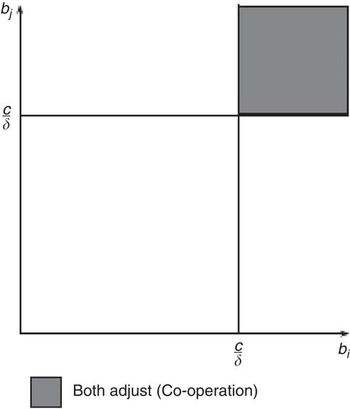
In the repeated game without lobbies, co-operation is sustainable under familiar reciprocity conditions: (1) when the governments’ discounted benefits from co-operation are high enough relative to their costs and (2) when the governments have a high enough discount factor. If the condition established in Claim 1 is met, so that δbi , δbj ≥ c, the threat of grim trigger is sufficient to ensure that both governments want to adjust. This punishment threat is credible, because in subgames in which either government has previously defected, neither has any incentive to adjust, knowing that the other government will defect. Without lobbies, co-operation is possible when the discounted value of co-operation exceeds the cost. Figure 1 shows the range of benefits for the governments in which co-operation is sustainable. Each government must ascribe a sufficiently high value, relative to the cost and adjusted for time preferences, to the other government's adjustment.
Regions of co-operation: no lobbies

Equilibrium Analysis: IBLs
In the sections that follow, we investigate how lobbies can enhance the possibility of co-operation even when governments are unable to sustain co-operation on their own. Specifically, for analyzing the games with lobbies, we assume that the conditions established in Claim 1 are not met. In other words, co-operation is impossible under the specified punishment strategies without lobby influence. This allows us to demonstrate the conditions under which lobbies that care about adjustment (and can condition rewards for their government based on its choices) are able to facilitate co-operation where it would otherwise have been impossible based on the two governments’ preferences alone.
We now consider conditions for co-operation when both countries have IBLs that value adjustment by the foreign government. We consider an equilibrium in which (1) lobbies can offer non-negative rewards to their government when it chooses to adjust and (2) lobbies and governments punish each other for defections with lowered contributions and future defections, as in the grim trigger punishment strategy above. We use superscripts to denote the reward offered in a particular period (for example, the reward offered by lobby i during period t is
 $$$r_{i}^{t} $$$
).
Claim 2 (IBLs: co-operation): The following is a subgame perfect Nash equilibrium if and only if
 $$${{V}_i}\,\geq \,\frac{c}{\delta }\,{\rm{ - }}\,{{b}_i} $$$
and
 $$${{V}_j}\,\geq \,\frac{c}{\delta }\,{\rm{ - }}\,{{b}_j} $$$
:
-
1. In period 1, the lobbies offer
 $$$ r_{i}^{1} \, = \,r_{i}^{\ast} \, = \,c\,{\rm{ - }}\,\delta \,{{b}_i} $$$
and
$$$r_{j}^{1} \, = \,r_{j}^{\ast} \, = \,c\,{\rm{ - }}\,\delta \,{{b}_j}$$$
. Government i adjusts if
$$$r_{i}^{1} \geq r_{i}^{\ast} $$$
and government j adjusts if
$$$ r_{j}^{1} \geq r_{j}^{\ast} $$$
.
-
2. If both governments adjusted in period t, then government i adjusts in period t + 1 whenever
$$$ r_{i}^{{t + 1}} \geq r_{i}^{\ast} $$$
and government j adjusts in period t + 1 whenever
$$$ r_{j}^{{t + 1}} \geq r_{j}^{\ast} $$$
. -
3. If both governments adjusted in period t, then lobby i offers
$$$r_{i}^{{t + 1}} \, = \,r_{i}^{\ast} $$$
and lobby j offers
$$$r_{i}^{{t + 1}} \, = \,r_{j}^{\ast} $$$
in period t + 1. -
4. If either government defects in period t, then for every period k > t, lobbies offer
$$$ {{r}^k} \, = \,0 $$$
and government i adjusts if and only if
$$$ r_{i}^{k} \geq c $$$
and government j adjusts if and only if
$$$r_{j}^{k} \geq c$$$
.


Claim 2 holds that the presence of IBLs can facilitate co-operation even where it would otherwise have been impossible in the absence of lobbies. The condition in Claim 2 says that lobbies must value adjustment enough to want to offer (and pay for) these rewards in each period. In this equilibrium, the lobbies offer their governments positive rewards,
 $$$ {{r}^\ast} $$$
, which induce their government to adjust. This equilibrium exists when the lobbies’ values for adjustment, V, are higher than the smallest possible reward they must offer their government to induce adjustment.Footnote
33
The smallest possible reward needed to induce adjustment is determined by the difference between their government's pay-off stream with co-operation and their temptation to defect. The present value of the government's net-of-rewards utility stream to adjustment is
 $$$\frac{{b\,{\rm{ - }}\,c}}{{1\,{\rm{ - }}\,\delta }}$$$
and the government would get a pay-off of b if it unilaterally defected. The lobbies offer just enough of a reward to ensure that their government's pay-off for continuing to adjust, which is
 $$$ \frac{{b\,{\rm{ - }}\,c\, + \,r}}{{1\,{\rm{ - }}\,\delta }} $$$
, is equal to their government's pay-off for defecting. In other words, the lobby offers just enough to keep their government from defecting, and no more, since any additional reward is more costly for the lobby yet gains them no additional benefit.
If a government defects, either of its own volition or because its lobby offered it an insufficiently high reward, then the lobbies will withdraw their future rewards and the governments will defect in the future. As before, a government's threats to withdraw from co-operation are credible because it gains nothing from adjustment, knowing that the other government's defection will deny it any benefit to adjustment and that its lobby is no longer offering rewards for adjustment.
IBLs’ threats to withdraw their rewards are also credible. IBLs only care about the foreign government's decision to adjust or defect. After a government has defected, the lobby in country i cannot influence the decision of government j, and vice versa. The lobby can do no better by offering a positive reward, because the reward to the home government will not change the foreign government's decision and would be costly if their government accepts the reward and adjusts.
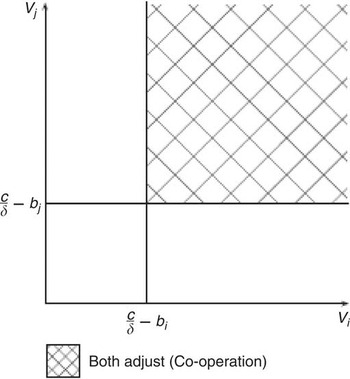
Proposition 1 (IBLs and co-operation): If the lobbies in both countries value adjustment highly enough, then co-operation is possible with internationalist lobbies, even when the governments would not be able to co-operate in the absence of the lobbies. Ceteris paribus, co-operation is easier with, than without, internationalist lobbies.
Since the lobbies are willing to compensate their governments for adjustment, in order to avoid the grim trigger, they enable additional co-operation. Figure 2 illustrates the regions in which the presence of IBLs can facilitate co-operation. In the cross-hatched regions, both lobbies value adjustment enough to make their optimal (positive) reward offers to their government. In these regions, their governments co-operate on sn equilibrium path, even though co-operation would be impossible without the lobbies.
Regions of Co-operation: Internationalist Lobbies

Some of the well-known examples from the context of international trade described above demonstrate this concept. MilnerFootnote 34 has argued that exporters were able to pressure their governments to resist otherwise tempting protectionist pressures because the exporters wanted to avoid retaliatory tariffs by partner governments. More recently, IBLs have influenced the economic relations between the United States and the rapidly growing China. In the United States, Congress has repeatedly threatened to impose sanctions against China unless the Chinese government reduces the extent of its alleged undervaluation of the yuan. While such legislation may appease domestic import competitors, it scores few points among exporting interests. On 18 October 2011, Thomas Donohue, the president of the US Chamber of Commerce, America's premier business lobby, warned Congress of the negative consequences of punishing China through protectionist legislation: ‘They [China] want to keep all those people working and if [currency appreciation] was forced on them somehow … they would simply just drop the prices as low as they have to to keep those folks working’.Footnote 35
In the vocabulary of our model, the US Chamber of Commerce is an IBL because it worries about foreign retaliation against domestic economic policies. It fears that China would respond to unilateral economic sanctions by adopting policies that induce further harmful economic distortions. Groups such as the Chamber of Commerce can potentially increase the United States’ ability to engage in economic co-operation with other countries. When lobbies are as influential as the Chamber of Commerce, there is little doubt that legislators in Washington will respond to their concerns.
Equilibrium Analysis: Domestically Benefiting Lobbies
We now consider conditions for co-operation in a dyad in which both countries have DBLs that value adjustment by their own government. To maintain comparability with the previous games, we consider an equilibrium in which (1) lobbies can offer non-negative rewards to their government when it chooses to adjust and (2) lobbies and governments punish each other for defections with lowered contributions and future defections, as in the grim trigger punishment strategy above. This equilibrium is characterized by co-operation with the threat of punishment.
Claim 3 (DBLs: co-operation with punishment): The following is a subgame perfect Nash equilibrium if and only if
 $$${{V}_i}\, \in \,[\frac{c}{\delta }\,{\rm{ - }}\,{{b}_i},c)$$$
and
 $$$ {{V}_j}\, \in \,[\frac{c}{\delta }\,{\rm{ - }}\,{{b}_j},c) $$$
:
-
1. In period 1, the lobbies offer
$$$r_{i}^{1} \, = \,r_{i}^{\ast} \, = \,c\,{\rm{ - }}\,\delta \,{{b}_i}$$$
and
$$$ r_{j}^{1} \, = \,r_{j}^{\ast} \, = \,c\,{\rm{ - }}\,\delta \,{{b}_j} $$$
. Government i adjusts if
$$$r_{i}^{1} \geq r_{i}^{\ast} $$$
and government j adjusts if
$$$r_{j}^{1} \geq r_{j}^{\ast} $$$
. -
2. If both governments adjusted in period t, then government i adjusts in period t + 1 whenever
$$$r_{i}^{{t + 1}} \geq r_{i}^{\ast} $$$
and government j adjusts in period t + 1 whenever
$$$r_{j}^{{t + 1}} \geq r_{j}^{\ast} $$$
. -
3. If both governments adjusted in period t, then lobby i offers
$$$r_{i}^{{t + 1}} \, = \,r_{i}^{\ast} $$$
and lobby j offers
$$$r_{i}^{{t + 1}} \, = \,r_{j}^{\ast} $$$
in period t + 1. -
4. If either government defects in period t, then for every period k > t, lobbies offer
$$$ {{r}^k} \, = \,0 $$$
and government i adjusts if and only if
$$$r_{i}^{k} \geq c$$$
and government j adjusts if and only if
$$$r_{j}^{k} \geq c$$$
.


Note that the behavior specified in this equilibrium is identical to that analyzed in Claim 2, except for the conditions under which these strategies constitute an equilibrium. DBLs present an additional complexity, due to the possibility that a lobby would want to unilaterally induce its government to adjust, regardless of the adjustment decision of the other country. Given this problem, we also characterize a second equilibrium of this game, which results in policy adjustments by both governments without conditional punishments (that is, harmony).
Claim 4 (DBLs: harmony): The following is a subgame perfect Nash equilibrium if and only if
 $$$ {{V}_i}\geq c $$$
and
 $$$ {{V}_j}\geq c $$$
:
-
1. In every period t, the lobbies offer
$$$r_{i}^{t} \, = \,r_{j}^{t} \, = \,r_{i}^{\ast} \, = \,r_{j}^{\ast} \, = \,c$$$
. -
2. Government i adjusts if and only if
$$$r_{i}^{t} \geq c$$$
and government j adjusts if and only if
$$$r_{j}^{t} \geq c$$$
.


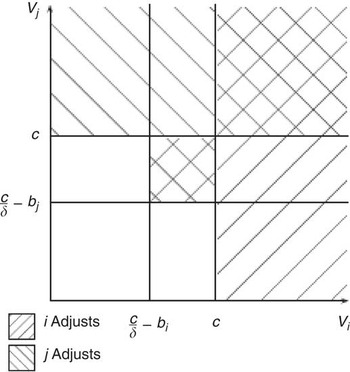
Figure 3 shows the two regions in which mutual adjustment occurs, which correspond to these two equilibria. Claim 3 describes the co-operation that occurs in the smaller, middle box. Claim 4 describes the harmony that occurs in the larger box in the top right-hand corner. Like IBLs, DBLs can help facilitate co-operation relative to the game without lobbies. However, the figure shows a key difference between the prospects of co-operation for IBLs and DBLs. With DBLs, the range of parameter values that supports unilateral adjustment, in which at least one government adjusts, is larger. But the range of parameter values that supports mutual adjustment is smaller.
Regions of co-operation: domestic lobbies Note: The middle cross-hatched box corresponds to co-operation with punishment (Claim 3). The upper-right cross-hatched box corresponds to adjustments without punishment (Claim 4).

This key difference arises because DBLs that value adjustment more strongly than their foreign counterparts suffer from an inability to commit to punishing their own governments. As a result, they make it harder for the foreign lobby to induce its own government to adjust. Consider what happens when lobby i's value to adjustment by government i is greater than the costs to adjustment:
 $$${{V}_i}\geq c$$$
. In any period, lobby i is willing to offer a reward that completely offsets the government's costs of adjustment:
 $$$ {{r}_i}\, = \,c\, + \,{\epsilon} $$$
, regardless of the strategies of lobby j and government j.Footnote
36
Government i is willing to accept this offer and choose to adjust. If lobby i values adjustment enough, then it cannot credibly commit to withholding rewards from government i, even when government j defects.
The intensity of lobby i's preferences, in turn, has a subtle but important effect on lobby j's strategy. Lobby i's inability to commit to withholding rewards as punishment increases the reward that lobby j must offer government j for adjustment. Recall that lobbies want to offer the smallest possible reward that offsets the difference between their government's costs and the benefits of adjustment. When lobby i cannot commit to withholding rewards as punishment, the costs of defection by government j
decrease. When government j defects, this no longer causes lobby i to withhold rewards and government i to defect, which makes defection relatively more attractive for government j. Defection by j no longer entails reciprocal defections by i. Lobby j must now offer a higher reward to government j in order to offset this increased difference between j's pay-offs from defection versus adjustment. Specifically, lobby j must also offer a reward that completely offsets government j's costs of adjustment,
 $$$ {{r}_j}\, = \,c $$$
, since government j bears no additional ‘punishment costs’ for defecting. If government i adjusts regardless of government j's decision, then it becomes more expensive for lobby j to induce its government to adjust.
If one lobby values adjustment strongly enough to offer adjustment-guaranteeing rewards, but the other lobby does not, then the types of strategies considered above do not facilitate co-operation in equilibrium. The asymmetry between the lobbies undermines reciprocity by removing an important cost to free riding: punishment by co-operative partners. Proposition 2 summarizes the relationships between domestic lobbies and the prospects for co-operation.
Proposition 2 (DBLs and international co-operation): If the condition in Claim 4 is met, then both countries adjust in all periods, regardless of past moves (harmony). If the condition in Claim 3 is met, then both countries adjust under the threat of punishment (co-operation). Ceteris paribus, DBLs expand the set of parameter values that allows harmony, but make co-operation more difficult in the absence of harmony, compared to IBLs.
A comparison of Propositions 1 and 2 is illustrative. With IBLs, co-operation is easier compared to a world without lobbies. IBLs value adjustment, so they are willing to help defray their government's costs and make adjustment relatively cheaper. However, they do not compromise the credibility of punishment. Since they have no incentive to influence their own government once reciprocity has failed, these lobbies do not undermine the credibility of contingent adjustment. To sustain co-operation through reciprocity, as KeohaneFootnote 37 has proposed, IBLs are ideal.
DBLs can also make co-operation easier than a world without lobbies, but they are less effective when their preferences are too intense. While they give governments additional incentives to adjust, they also have a downside, compared to the world without lobbies. Since DBLs want their government to adjust even unilaterally, these lobbies can also undermine reciprocity. A government with DBLs that are willing to pay a lot for unilateral action cannot threaten foreign governments with suspending adjustment, for this threat would not be credible, making defecting a more attractive option.
While there are several obstacles to credible climate co-operation, the fact that many environmental groups want their own government to act unilaterally is one of them. Especially in Europe, environmental groups have been successful in inducing the European Union to mitigate climate change regardless of what other major emitters do. Given this interest in unilateral action, these groups’ political clout means that Europe's commitment to climate mitigation is not conditional on reciprocal mitigation by other major emitters, like China or the United States. Our model suggests that these groups’ activities could cause the replacement of contingent co-operation with a pattern of unilateral action on the part of a self-proclaimed ‘climate leader’, such as the European Union. If Europe could threaten other major emitters with suspension of climate policy if there is no progress in international negotiations, other major emitters would understand that any progress in climate mitigation also depends on their policies. In other words, the other major emitters could not free ride on Europe's efforts to mitigate climate change and promote clean energy.
Testing this claim empiricallyis difficult, because rational governments generally would not negotiate a treaty that is expected to fail.Footnote 38 This is probably one of the reasons why extant climate treaties, including the Kyoto Protocol, are not very ambitious and do not contain credible enforcement mechanisms.Footnote 39 However, one may examine the validity of the theoretical result by examining lobbies’ activities in climate negotiations. If lobbies’ activities focus on their own government's policy, calling for unilateral action, and if the negotiations fail because major emitters do not trust each other's promises to co-operate, then the empirical record is consistent with the model's predictions.Footnote 40
This problem with the environmentalists’ strategies has complicated multilateral climate negotiations. During the year preceding the infamous Copenhagen climate summit in December 2009, which was expected to lay the foundation for a global climate treaty, many environmental groups lobbied the European Union for unilateral leadership. On 27 January 2009, Joris Den Blanken and Sebastien Risso of Greenpeace's European Union Unit (GPEUU) called on the EU ‘to reduce emissions by at least 40 per cent in 2020, compared to 1990 levels’ without any mention of conditionality.Footnote 41 On 28 January 2010, when Copenhagen failed to produce a global treaty following dramatic turns in the negotiations, GPEUU criticized the European Union for failure to show more unilateral leadership. As Den Blanken then explained:
The EU is starting to sound like a broken record. Its back-seat tactics did not work in Copenhagen and they continue to fail today. The only way the EU can exert any international leverage is if it increases its domestic emissions target to 30 per cent.
Again, Greenpeace argued that the European Union should increase the ambitions of its climate policy regardless of how China, the United States and other major emitters behave. According to our model, which provides firm microfoundations for Victor'sFootnote 42 conjecture, this strategy is counterproductive for sustaining reciprocal climate co-operation: ‘Doing better will require that climate diplomats push countries to make contingent offers and realize that the form of contingency will vary with the interests and abilities of governments.’Footnote 43
The model suggests that the domestic power balance between IBLs and DBLs is important for the credibility of reciprocal adjustment. In the climate case, the validity of this conjecture could be scrutinized by evaluating governments’ credibility in different political-economic contexts. If environmental groups that call for unilateral action receive support from industries that prefer unilateral action, such as solar panel installers, we expect the government's credibility to be limited. However, if industries with a strong preference for the foreign government's action (such as exporters of clean energy technologies) are powerful, then the government's credibility should be bolstered. Based on the history of climate co-operation, one would expect non-credible promises to be a more severe problem for Europe, where environmental groups insist on unilateral action and have considerable political clout, than for China and the United States, where these interests are politically less powerful relative to the heavy industry and fossil fuel producers.
Equilibrium Analysis: Mixed Dyads
Finally, we consider the conditions for co-operation in a ‘mixed’ dyad in which lobby i is an IBL and lobby j is a DBL. In other words, both lobbies gain value from the adjustment decision of government j. We again consider the types of trigger strategies described above in which lobbies can (potentially) condition rewards and governments can condition co-operation on past adjustment.
Claim 5 (Co-operation with Mixed Dyad): The following is a subgame perfect Nash equilibrium if and only if
 $$$ {{V}_i}\geq \frac{c}{\delta }\,{\rm{ - }}\,{{b}_i} $$$
and
 $$$ {{V}_j}\leq c $$$
:
-
1. In period 1, the lobbies offer
$$$r_{i}^{1} \, = \,r_{i}^{\ast} \, = \,c - \delta {{b}_i}$$$
and
$$$r_{j}^{1} \, = \,r_{j}^{\ast} \, = \,c - \delta {{b}_j}$$$
. -
2. If both governments adjusted in period t, then government i adjusts in t + 1 if
$$$r_{i}^{{t + 1}} \geq r_{i}^{\ast} $$$
and government j adjusts in t + 1 if
$$$r_{j}^{{t + 1}} \geq r_{j}^{\ast} $$$
. -
3. If both governments adjusted in period t, then lobby i offers
$$$r_{i}^{{t + 1}} \, = \,r_{i}^{\ast} $$$
and lobby j offers
$$$r_{j}^{{t + 1}} \, = \,r_{j}^{\ast} $$$
. -
4. If either government defects in period t, thenfor every period k > t, lobbies offer
$$$ {{r}^k} \, = \,0 $$$
and government i adjusts if and only if
$$$ r_{i}^{k} \geq c $$$
and government j adjusts if and only if
$$$ r_{j}^{k} \geq c $$$
.


In a mixed dyad, co-operation is again not sustained in equilibrium with grim trigger-type punishment strategies when lobby j values government j's adjustment strongly enough to unilaterally fund adjustment, regardless of government i's decision. Since government i and lobby i's benefits come from adjustment by government j, they have no incentive to adjust when lobby j unilaterally funds adjustment by government j. Lobby j sufficiently rewards government j to induce adjustment, while lobby i avoids paying any rewards and government i avoids paying any costs for its own adjustment. Lobby j's inability to commit to refraining from rewarding adjustment by government j leaves lobby i with no incentive to offer a reward for government i to adjust.
It is important to note that in this case, both the IBL and its government obtain their maximal pay-offs. They need not contribute or co-operate, and yet the DBL induces its government to adjust. Thus co-operation fails because the game's outcome is actually in the collective interest of one of the countries.
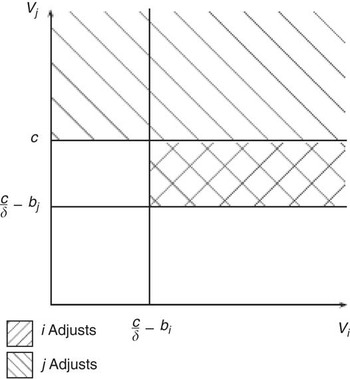
Co-operation is still possible in the region where lobby j has an ‘intermediate’ value to government j's co-operation. Having these intermediate preferences means that lobby j can still credibly commit to withdraw its rewards if government i no longer adjusts. Lobby j likes adjustment enough to offer a reward on an equilibrium path, but not enough to offer a sufficiently strong reward to induce adjustment off the equilibrium path. Figure 4 shows the region in which co-operation is possible: it is identical to that of a dyad with two internationalist lobbies, except for the removal of the region where
 $$${{V}_j}\, \gt \,c$$$
.
Regions of co-operation: mixed dyad

Feasible Equilibria with Alternative Punishment Strategies
So far, we have examined the conditions under which different types of lobbies facilitated or hindered co-operation under grim trigger-type punishment strategies. A natural question is how these findings are affected by the consideration of alternate punishment schemes. Specifically, if one DBL valued adjustment much more strongly than its foreign counterpart, and co-operation failed, is there a punishment scheme that sustains mutual adjustment? In general, the answer is yes. The punishment schemes described in Folk Theorem arguments can sustain co-operation if the players are sufficiently patient – that is, for a high enough discount factor.
Consider the possibility that the common discount factor δ has a very high value, δ → 1. In this case, it is possible to construct a punishment strategy that sustains co-operation.
Proposition 3 (Folk Theorem): There exists some threshold
 $$$ \underline{\delta } $$$
such that if
 $$$\delta \in [\underline{\delta }, 1)$$$
, an SPNE exists such that both governments adjust in every period on the equilibrium path of play.
The details of the punishment strategies that sustain co-operation in Proposition 3 are are adapted from Fudenberg and Maskin and are provided in the Appendix.Footnote 44 Intuitively, the punishment strategy is based on the idea that even small punishments can have large pay-off effects. Since even slight changes in the rules of co-operation can deter governments and lobbies from defecting, the severe grim trigger punishment is not needed.
Unfortunately for proponents of co-operation, these punishment schemes require that governments discount future pay-offs only a little. Their success depends on the imposition of slight costs on deviating governments over long periods of time. If governments are interested in their short- and medium-term pay-offs, the elaborate strategies detailed in the Appendix do not sustain co-operation. This means that the practical relevance of these strategies is probably limited.
CONCLUSION
International co-operation often proves difficult because countries’ governments renege on their commitments to make costly policy adjustments when past promises prove inconvenient. Recognizing this pattern, scholars of international relations have recently paid close attention to the role of domestic lobbies in the enforcement of international commitments. This article presented a game-theoretic model of the role of pro-adjustment lobbies in the enforcement of international co-operation that applies to a broad variety of issue areas.
Is good news about lobbies that support co-operative policy adjustment good news for co-operation? Yes, but the exact nature of the lobbies’ incentives is central to understanding their ability to promote co-operation. If lobbies are primarily interested in foreign governments’ policy adjustments, then the presence of lobbies has an unambiguously positive effect on co-operation. The lobbies compensate their government for its adjustments in an effort to avoid the foreign government's suspension of co-operation in the future. Moreover, these lobbies can credibly threaten to remove this compensation should the other government defect.
This logic is more complicated if lobbies are primarily interested in their own government's adjustments. The problem is that such a lobby might compensate its own government for adjustment regardless of the other government's decisions. Thus the foreign government does not have much incentive to adjust: retaliation is not credible, because there is lobbying pressure on the domestic government to continue unilateral action even in the absence of reciprocity.
While producing this result, our analysis also raises new questions for future research. One such question pertains to the strategic incentives of lobbies. If a DBL understands that its strong interest in domestic action ruins reciprocity, it may prefer to tie its own hands in order to enable reciprocal co-operation without costly payments to the government. The DBL could publicly commit to withhold campaign contributions to the government, so as to raise the cost of government inaction, or misrepresent its preferences in order to encourage the government to negotiate a reciprocal treaty.
Our results are potentially relevant for addressing the problem of developing an agreement to curtail climate change. In a recent book, VictorFootnote 45 argues that countries need to make ‘contingent promises’ to one another as a way to break the current ‘global warming gridlock’. Under this solution, ‘Governments would outline what they are willing and able to implement as well as extra efforts that are contingent on what other nations offer and implement.’Footnote 46 We agree with his theory but modify it to capture consistency with two dimensions. Just as important as ‘I will do X if you do Y’ is the implicit promise that ‘I will not do X (or will do worse) if you do not do Y’.
Contingent promises need to be geared toward building domestic coalitions that will help enforcement. The context of climate change is almost certainly one of highly asymmetric preferences. The desire for emissions reductions and the toleration of the costs involved are substantially higher in Europe and Japan than in the United States and China. Victor estimates that the ‘level of effort in the EU… is perhaps ten times higher than what the US has been willing to adopt when measured by the economic cost EU and US policy makers have been willing to impose on their economies for the purposes of mitigation’.Footnote 47 Indeed, the European Union is far ahead of other countries in its unilateral abatement efforts.
The analysis above argues that when countries are characterized by highly asymmetric preferences, IBLs can help facilitate co-operation better than DBLs because IBLs do not undermine the credibility of enforcement. In Victor's description of border tariff adjustments, in which countries levy tariffs against imports from countries not engaged in sufficient mitigation efforts, he hints at the importance of punishment credibility, writing that ‘It is hard to see how reluctant countries will face the right long-term incentives to control emissions unless there is a cost – one that will appear reliably … for countries that drag their feet’.Footnote 48
In practice, contingent promises need to be geared toward rewarding lobbies that care about the effects of their government's behavior on partner governments, not toward constructing ever more powerful lobbies that support unilateral policy adjustments without reciprocal punishment strategies. Consider two examples. In one contingent promise, Country A promises to lower its emissions to a certain level by subsidizing renewable energy technologies at home if Country B also offers a domestic subsidy. These types of subsidies often propel powerful lobbies into action that have the goal of retaining the benefits of the subsidy, regardless of whether the goal of the subsidy (in this case, abatement) is being efficiently achieved. One need only look to the strength of the sugar lobby in the United States for an example of a lobby that is effective at retaining its preferential treatment.Footnote 49 These are DBLs, for they support their government's abatement efforts because they benefit from them directly. A country making this type of promise may achieve abatement unilaterally, but it is less able to compel its partner government to co-operate with this promise. Once these types of lobbies have taken root, they are difficult to remove. The threat of retaliation by Country A, which may be crucial to compelling Country B to co-operate, is no longer credible.
A second, similar contingent promise might have Country A promise to subsidize abatement efforts in Country B, and B could do the same for A. Such an arrangement builds IBLs. Groups in B benefit from A's transfers, and therefore support their government's decision to continue with the types of policies that ensure A's continued support, and vice versa. Those groups know that if B defects, then A will cease its transfers. Reciprocity is much stronger in this arrangement because the threat to punish is inherently credible. Neither country wants to make transfers to the other country, aside from the fact that such actions ensure that the other country will do the same. Neither country would have any qualms about ceasing its transfers in the event that the other country chooses to defect.
Contingent promises could also be made more credible through issue linkage. If governments worry that environmental DBLs reject reciprocal punishments based on non-co-operative pollution levels, they could create an issue linkage that brings a different type of lobby to the forefront. For example, a trade sanction could be domestically popular among import competitors. In this sense, our model also contributes to the issue linkage literatureFootnote 50 by providing a new justification for it as a strategy of reciprocal enforcement.
In short, reciprocity implies a carrot and a stick. The stick is crucial to enforcing international co-operation. Since domestic interest groups have a stake in co-operation policy and actively influence their government's decisions, agreements need to focus on activating the interest groups that are best able to foster reciprocity. By paying more attention to domestic groups’ specific interests, architects of international agreements can improve the effectiveness of reciprocity in an international system characterized by anarchy and self-help. Ignoring these interests may generate dysfunctional agreements if governments’ strategic incentives to co-operate are undermined by domestic lobbies.