When did the separation of ownership from control arise in American corporations? Was there an early period in the development of the American economy in which ownership and control were unified, and if so, how did the governance of these early corporations function? Such questions are difficult to answer given the fragmentary nature of the records that survive from early businesses. The most influential history of corporate ownership in the United States is presented in Adolf Berle and Gardiner Means's The Modern Corporation and Private Property. They argue that legal, organizational, and technological developments in the late-nineteenth and early-twentieth centuries eroded the power and influence of stockholders, and led to the emergence of large, diffusely held enterprises controlled by professional managers, or by minority interests. In particular, Berle and Means claim that in the early nineteenth century, ownership and control were indeed unified, and they distinguish the corporations of their time from those of a hundred years earlier, in which “the number of shareholders was few; they could and did attend meetings; they were businessmen; and their vote meant something.”Footnote 2 Most of the subsequent literature on corporate governance has accepted Berle and Means's characterization of the history of American corporations, and its emphasis on developments in the late-nineteenth century leading to the separation of ownership from control.Footnote 3
But the early history of American corporations is not well understood. By the end of the first quarter of the nineteenth century, thousands of businesses in all manner of industries had been granted corporate charters by American states. Moreover, especially beginning in the 1820s, a small but growing number of these firms had publicly traded equity shares.Footnote 4 This era is sometimes regarded as a “statistical dark age,” however, and although these firms were certainly much smaller than the large industrial enterprises that appeared in the late-nineteenth century, relatively little is known about their ownership or governance.Footnote 5 With the noteworthy exception of Walter Werner's 1981 article, which argues that control by management occurred even in the early nineteenth century, the governance of America's early corporations has been the focus of little research.Footnote 6 In view of the importance often ascribed to the historical legal origins of contemporary investor protections, this gap in our understanding of early corporate governance is striking.Footnote 7
This article analyzes the ownership and governance of a relatively large sample of early-nineteenth-century firms, using a newly collected dataset of all of the business corporations created in New York State through 1825. The main elements of the dataset were collected from the surviving records generated by New York's capital tax of 1823–1828. This law required all operating business corporations to submit a list of their stockholders to the state's comptroller. Many of these ownership lists survive in the New York State Archives, and have been matched to the charters of the corporations; to lists of corporate directors obtained from contemporary newspapers and city directories, and from surviving directors' minute books; and to price data of securities traded on the New York Stock and Exchange Board (NYS&EB), collected by Richard Sylla, Jack Wilson, and Robert Wright.Footnote 8 The data obtained from these sources present a detailed portrait of early-nineteenth-century corporate governance.
As with modern firms, the stockholders' elective franchise was the principal mechanism by which the corporations were governed. In the early nineteenth century, many firms configured the voting rights of their stockholders in a way that enhanced the relative influence of small investors: they used what might be termed “graduated voting rights,” wherein the votes per share to which an investor was entitled was a decreasing function of the number of shares held.Footnote 9 Such rules for allocating votes originated in seventeenth-century English business corporations, and were sometimes quite complex.Footnote 10 This article develops an index by which the voting rights of investors in corporations employing these schemes can be quantified. The index is computed as the average fraction of a vote per share to which an investor is entitled, across all potential levels of shareholdings, from one share to all of the shares. The index ranges from zero to one and is increasing in the voting power of large investors; a value of one implies that one vote is granted to every share, irrespective of the number of shares held (“one share-one vote”). For lower values of the index, large investors received less than a full vote for their shares.
Early-nineteenth-century corporation law offered relatively few rights or protections to investors: there were no financial reporting requirements or accounting standards, and the legal rights of stockholders to sue malfeasant directors were somewhat uncertain.Footnote 11 In order to attract the participation of small investors, many corporations specified graduated voting rights schemes in their charters, and the average value of the index across all businesses incorporated in New York in 1825 or earlier was 0.63. Although the charters of some firms offered other forms of rights for investors (a few of the charters included guarantees that annual financial statements would be produced, for example), the voting rights of stockholders were the most important protection offered to early-nineteenth-century small investors.
These protections for small investors were of paramount importance because many of the firms were quite clearly dominated by large shareholders. Although the data indicate the presence of substantial numbers of small investors in many of the corporations, in general ownership was highly concentrated. As most large investors were represented on the firms' boards, the extent of managerial voting power was extremely high with on average about 40 percent of the votes in the hands of the directors. The oppression of minority investors by large shareholders was therefore a central concern in the governance of these firms, as with the firms of the mid-nineteenth century.Footnote 12 In general, firms in the industries with the greatest ownership concentration specified voting rights with the lowest values of the index, whereas firms in industries where share ownership was most equally distributed specified one vote per share, which corresponds to the highest value of the index. This suggests that graduated voting rights were chosen at least in part in order to attract small investors by limiting the voting power of large shareholders.
Were these measures effective? Did firms with different configurations of voting rights actually have a different balance of power between large and small shareholders? And were these differences reflected in firm values? This article analyzes these questions empirically in careful detail. Cross-sectional regressions of firm ownership concentration on governance institutions show that firms with a lower value of the voting index had a much lower degree of concentration of voting rights in the hands of large investors, and in the hands of management. Although securities price data from the period are perhaps less informative than those of modern stock markets, as the trading volume was relatively light, results of market value regressions indicate a positive correlation between firm values and the voting power of minority shareholders; firms with one vote per share had lower market values. Moreover, the results indicate a negative correlation between firm values and the voting power of management.
In general the results indicate that even in the early decades of the nineteenth century, before the development of large industrial enterprises and even before the emergence of railroads, there was significant separation between ownership and control. Moreover, this separation was harmful for investors and for the performance of the firms. Berle and Means's typology of control structures is useful in characterizing the results: they distinguish between “(1) control through almost complete ownership, (2) majority control, (3) control through legal device without majority ownership, (4) minority control, and (5) management control,” where each type represents successively greater degrees of separation between ownership and control.Footnote 13 Although few if any of the firms in the 1820s could be characterized as subject to management control, where ownership is so diffuse that no individual or group dominates the corporation through stock ownership, most of the firms in the dataset would have been characterized by Berle and Means as under minority control—a group of investors held sufficient numbers of shares to dominate the firm because the rest of the shares were diffusely held. The problems associated with this form of control were much more acute in the 1820s than in later periods, however, because at the time there was little if any distinction between control and management. Early corporations were in general run by their directors—there were few hierarchical levels within management.Footnote 14 As there were few if any legal constraints on self-dealing by directors at the time, an investor who controlled the management of a firm could easily harness its operations for his own benefit. Conflicts between large shareholders and small shareholders were therefore the central concern in early corporate governance and the protections offered to investors at the time were often designed to address this problem. Overall, the picture of corporate governance in the early-nineteenth century that develops is one of weak investor protections, and strong ownership concentration—a relationship entirely consistent with that found in modern economies.Footnote 15
The sample of corporations analyzed in this article encompasses a relatively large number of enterprises in a broad range of industries. But it comes from only one state. American corporation law falls mostly within the purview of state law, and the statutes and case law pertaining to corporations, along with the content of corporate charters, differed somewhat across states.Footnote 16 Nonetheless New York's central role in the development of the American economy and Wall Street's central role in America's financial markets makes New York's corporations an appropriate focus for a study of corporate governance during this period. The early-nineteenth century was a period of rapid growth and dynamism for New York's economy: the population of the state increased approximately fourfold between 1790 and 1825, becoming the nation's most populous; the city of New York developed into the preeminent center of business and finance in the United States, surpassing Philadelphia; and the completion of the Erie canal in 1825 further invigorated commerce in and across the state.Footnote 17 Perhaps more importantly, New York was a great innovator in the area of corporation law. New York enacted one of the earliest general incorporation acts of any significance for businesses, the 1811 act for manufacturing companies; the first limited partnership law (1822) and one of the first free banking laws (1838) in the United States; and several influential regulatory statues, such as the safety fund law for banks (1829). Many of these statutes influenced the subsequent development of corporation law in other states; in some cases entire New York statutes were copied wholesale.Footnote 18
THE GOVERNANCE OF NEW YORK'S CORPORATIONS, 1790–1825
In the early-nineteenth century, the privileges of corporate status for businesses could only be secured by petitioning a state government for a charter which would be granted by legislative act. Although New York began to liberalize its incorporation process with its 1811 general incorporation act for manufacturing companies, entrepreneurs in other industries still needed to obtain a special act of the legislature in order to incorporate.Footnote 19 The process of obtaining a charter was often costly and time consuming, and the use of the corporate form was therefore confined to industries where incorporation was a legal requirement, as with banks, or where special corporate powers were crucial, as with insurance firms, some manufacturing firms, and public utilities such as turnpike roads, bridge companies, and gas light companies. Banks were among the most politically contentious enterprises at the time and banking charters were particularly difficult to obtain.Footnote 20
If granted, a charter would specify the powers available to the firm, the size of the capital stock and the par value of the shares, and the duration of the corporation's existence. The charters also included provisions that regulated the operations of the businesses, which varied by industry—bank charters, for example, often included provisions that restricted the interest rates that could be charged on loans, and limited their indebtedness; bridge and turnpike road company charters dictated the rates of toll that could be charged; and manufacturing charters (or certificates of incorporation filed in accordance with the general act) specified the types of products the corporation was permitted to produce.Footnote 21 In general, early corporations did not have the power to merge with other corporations or in any way amend their charters without seeking an additional legislative act. And in the years through 1825, none of New York's corporations were granted the power to issue any securities other than common stock, and the right to invest in the stock of other corporations was usually forbidden, except with insurance firms.
The governance institutions of corporations were specified in their charters.Footnote 22 Most corporations were to be managed by an elected board of directors, who would, in turn, elect a president, and also possibly appoint a secretary or treasurer, from among their members.Footnote 23 The board would usually have the authority, by majority rule, to write the corporation's bylaws, and generally run the firm.Footnote 24 The charters sometimes also referred to salaried agents, cashiers, clerks, secretaries, tellers, and others who would be hired by the directors and might have assumed some managerial responsibilities. In general, however, most of the firms in industries such as banking, insurance, and bridges and turnpikes had very few employeesFootnote 25, and although some of the manufacturing firms did have as many as 300 employees, the management of these enterprises probably had very few hierarchical levels, and in many cases the directors supervised even the day-to-day operations of the firms.Footnote 26
For nearly all of the corporations in the sample, the charters required elections of the entire board—there were no “classified” or staggered boards—to be held annually.Footnote 27 However, stockholders in early corporations enjoyed few other legal protections, and were usually not even guaranteed the right to see annual financial statements.Footnote 28 In the absence of other safeguards, the election of directors assumed preeminent importance for the stockholders in defending their interests. Consequently the conduct of the elections, including the voting rights of stockholders, was often specified in great detail in the charters.
Voting Rights of Stockholders: An Index
Consider the charter for the Bank of New York, written by Alexander Hamilton. For the election of directors, it states the following:
each stockholder shall be entitled to a number of votes proportioned to the number of shares which he or she shall have held in his or her own name…according to the following ratio's [sic] that is to say, at the rate of one vote for each share not exceeding four, five votes for six shares, six votes for eight shares, seven votes for ten shares, and one vote for every five shares above ten.Footnote 29
Such configurations of voting rights, which might be termed “graduated voting rights,” granted one vote per share when small numbers of shares were held, but then after some threshold, a shareholder was entitled to less than one vote per share. With the Bank of New York, a stockholder with four shares received four votes, but a stockholder with 20 shares received nine votes (0.45 votes per share), and a stockholder with 100 shares received 25 votes (0.25 votes per share). For holdings above the threshold of four shares, the greater the number of shares a stockholder held, the lower the number of votes per share to which she or he was entitled.
Many of the graduated voting rights schemes employed were different from that of the Bank of New York. Most turnpike corporations, for example, allowed one vote per share for up to ten shares, and then one vote for every five additional shares held. Other versions added a maximum number of votes for any stockholder. But in every case one vote per share was granted up to some threshold—usually some number near ten—and above that threshold, less than one vote per share was granted. These thresholds did not vary much across firms, because most firms granting votes in this way adopted one of a handful of standard formulas assigning votes to shareholdings. However, the total number of shares varied widely across firms, and the same voting rights specification adopted by a small turnpike with 100 total shares, and a large financial institution with thousands of shares, had quite different effects on the votes granted to shareholders with a given percentage of the stock. Consider again the voting rights scheme of the Bank of New York, which had 2,000 total shares. A stockholder with 30 percent or 600 shares was entitled to 125 votes, or 0.21 votes per share. However, if there had been only 100 total shares, a stockholder with 30 percent would have been entitled to 11 votes or 0.37 votes per share.
The effects of the graduated voting rights schemes adopted by New York's corporations were quite complex.Footnote 30 The relative voting power, in the sense of the percentage of the total votes, an investor received depended on the entire distribution of the shares: only in the presence of small investors, who received one full vote per share, would large investors' relative voting power be curtailed.Footnote 31 This implies that impact of a graduated voting rights scheme can only be assessed once the distribution of share ownership is known.
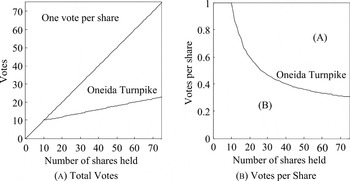
It is possible, however, to construct an index that quantifies the potential of a given voting rights configuration to reduce the power of large shareholders. We can think of the charters as specifying a function, v(n), which determines the number of votes to which an investor holding n shares would be entitled. For charters that specified one vote per share, v(n) = n, but when graduated voting rights were chosen, for values of n above some threshold, v(n) < n. Panel (a) of Figure 1 plots the v(n) specified in the charter of the Oneida Turnpike Road Company, incorporated in 1801, which granted one vote per share up to ten shares, and then one vote for every five additional shares. The firm had a total of 75 shares.Footnote 32 As illustrated in the figure, after the threshold of 10 shares, a stockholder with additional shares would receive only 1/5 of a vote for each additional share, and the slope of the line representing its v(n) falls from one to 1/5 once ten shares are held.
GRADUATED VOTING RIGHTS: AN EXAMPLE

Panel (b) in the figure plots the votes per share, or v(n)/n, for different levels of shareholdings in this firm. For any amount up to ten shares, an investor would be entitled to one vote per share. But for amounts in excess of ten shares, the number of votes per share that the investor would receive falls as the number of shares held increases. An investor holding 20 shares would receive 12/20 = 0.6 votes per share, and at 50 shares the investor would receive 18/50 = 0.4 votes per share. In contrast, voting rights of one vote per share would, of course, never reduce the number of votes per share to which a stockholder was entitled, and in the figure this would be represented by a horizontal line where votes per share always equal one.
The plot presented in panel (b) suggests a simple approach to quantifying the extent to which a given voting rights scheme reduces the votes granted to large shareholders. If plotted on the same figure, a voting rights scheme that reduced the voting power of large investors to a greater extent would lie below the line for the Oneida Turnpike (granting fewer votes per share for large shareholdings), and one that granted more votes per share for large shareholdings would lie above it. Therefore, the area below the line, denoted (B), will be increasing in the number of votes per share to which holders of large stakes are entitled. This suggests that the relative fraction of the total area in the figure taken up by (B), or (B) / ((A) + (B)), could serve as an index of the voting power of large shareholders. For firm i, with voting rights formula vi(n), and N total shares, this is calculated as
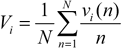
The index can assume any value between zero and one, and measures the average number of votes per share to which an investor is entitled, across all levels of shareholdings from one share to all the shares. The higher the value of the index, the greater the fraction of a vote per share granted to large investors.Footnote 33 The index is thus a measure of the voting power of large investors, and takes on a value of one when a firm offers one vote per share.
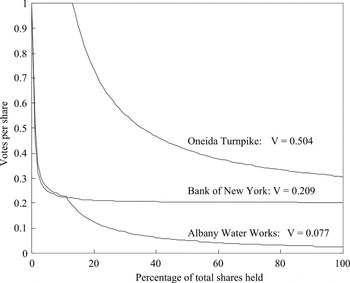
The value of the voting rights index varied widely across firms. Figure 2 plots votes per share as a function of the percentage of shares held for the Bank of New York, the Oneida Turnpike, and the Albany Water Works Company, and includes the value of the voting rights index for each firm.Footnote 34 The voting rights specified in the Oneida Turnpike's charter are more accommodating of large shareholders relative to those of the other firms; the value of the index is more than twice as large as that of the Bank of New York.Footnote 35 Like many water companies, the voting rights specified in the charter of the Albany Water Works includes a provision that no shareholder would be entitled to more than 40 votes, irrespective of the number of shares held. The votes per share offered to investors in that firm are nearly identical to those of the Bank of New York until 11 percent of the shares are held, at which point no additional votes could be obtained.Footnote 36
VOTING RIGHTS INDEX VALUES: THREE EXAMPLES

A corporation that chose a voting rights scheme with a low value of the index created an obvious incentive for investors to hold their shares in many names other than their own, in order to wield a larger number of votes. Although such behavior was documented among the shareholders of the Second Bank of the United StatesFootnote 37, the extent to which large investors circumvented the voting rights configurations of other business corporations in this way is not known, and will be investigated in the empirical analysis below.
Governance Provisions in the Charters
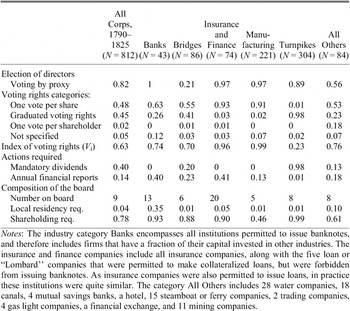
From 1790 to 1825, 812 businesses were incorporated in New York State, including 153 manufacturing companies created by the 1811 general act. The specifications of voting rights, along with other governance provisions, are summarized in Table 1. As indicated in the table, in about 80 percent of the charters, the right to vote by proxy in the election of directors was guaranteed.Footnote 38 At the time, proxy votes (like all votes) were cast in person, so a shareholder wishing to vote by proxy would send another individual in his or her stead.
GOVERNANCE PROVISIONS: INDUSTRY MEANS, 1790–1825

Notes:
The industry category Banks encompasses all institutions permitted to issue banknotes, and therefore includes firms that have a fraction of their capital invested in other industries. The insurance and finance companies include all insurance companies, along with the five loan or “Lombard” companies that were permitted to make collateralized loans, but were forbidden from issuing banknotes. As insurance companies were also permitted to issue loans, in practice these institutions were quite similar. The category All Others includes 28 water companies, 18 canals, 4 mutual savings banks, a hotel, 15 steamboat or ferry companies, 2 trading companies, 4 gas light companies, a financial exchange, and 11 mining companies.
The charters sometimes also contained other provisions regulating the composition or the actions of the board. For example, the directors were usually (78 percent of the time) required to own stock in the firm, and more rarely (4 percent of the time) a specific local residency requirement for some or all of the directors was imposed. About 40 percent of the firms' boards were required to pay out all profits out as dividends, leaving no discretion over retaining earnings.Footnote 39 And finally, 14 percent of the charters required the management of the firm to produce annual financial statements, either at the shareholders' annual meeting, or in a filing to the state government.Footnote 40
The voting rights of the shareholders were generally specified in precise detail. In 48 percent of them, each share was entitled to one vote, irrespective of the number of shares held. For 46 percent of the charters, a “graduated” voting rights system was specified. For 2 percent of the firms, each shareholder was granted one vote, and, finally for 4.7 percent of the firms, the votes of shares were not specified at all. In the latter case, with no guarantee of voting rights for the shares in the charter, most corporations likely specified the voting rules for shareholders in their bylaws; indeed, at least one charter from the era specified parameters within which the voting rights chosen in the bylaws must fall.Footnote 41 For all the firms in the sample where the voting rights of stockholders were specified, the average value of the voting rights index Vi is 0.63.
We can begin to understand the intentions behind the governance provisions in the charters by comparing those selected in different industries, as in the further columns of Table 1, where summary statistics are presented for six broad industry categories. The columns in the table indicate that there was substantial variation across industries in the style of governance institutions chosen. Manufacturing corporations, for example, almost always granted their investors one vote per share, only rarely required annual financial statements, and never mandated that all profits had to be paid out as dividends. Manufacturing firms also had the smallest boards, and imposed the requirement of share ownership by directors with the lowest frequency. As we will see, these governance provisions reflected an ownership structure that was quite different than that commonly found in other industries.
In contrast, banks and insurance companies, whose financial powers created ample opportunities to defraud investors and creditors and to disrupt the payments system, were the only firms whose charters mandated annual financial statements with any regularity, and even in these industries the requirement was imposed only 40 percent of the time. Firms in these two industries had very large boards, and the directors were never required to pay out all profits as dividends. The one important difference between the charters in banking and insurance is in their voting rights: whereas the average value of the index of voting rights for insurance firms is 0.96, in banking it is 0.74, reflecting the use of some graduated voting rights schemes.
In turnpike road companies, and to a lesser extent in bridge companies, graduated voting rights were heavily used, as was the requirement of mandatory dividend payments of all profits.Footnote 42 Overall the lowest values of the voting index (reflecting voting rights configurations with the greatest potential to reduce the power or large shareholders) were found in turnpikes, bridges, and banks. One might imagine that the charters of firms in these industries were designed to attract the participation of small shareholders by offering them some measure of protection from dominance by large shareholders. Alternatively, the legislature may have regarded the control of these enterprises, and in particular the potential for large shareholders to abuse that control, as a matter of public concern: the route of a turnpike road, the placement of a bridge, and of course the notes or loans issued by a bank all might have created opportunities for private gain by a dominant shareholder at the expense of small investors, or the community, in a way that was far less likely to be true of firms in industries such as manufacturing.
Other Governance Statutes
The rights of shareholders specified in the charters were (to a limited extent) supplemented by statute laws enacted during the period. But in general, the rapid proliferation and increasing sophistication of corporations outpaced the efforts of the legislature and the courts to protect the interests of investors. There were, for example, still relatively few statutes governing the behavior of corporate directors. Moreover, the notion that a corporate charter was a contract between the state and the firm that could not be impaired, as held by the U.S. Supreme Court in its 1819 Dartmouth College decision, made it difficult for the state to impose measures such as a financial reporting or inspection requirement on institutions whose charter did not already include such a provision, or a clause reserving the right of the legislature to modify its terms.Footnote 43
The ability of the state to enforce its statutes was also limited, as the state government had only skeletal administrative offices. For example, many insurance companies, in violation of the state's restraining statutes and also in violation of their charters, issued bonds or notes designed to circulate as bank notes, offered discount loans, and generally assumed the powers of banks.Footnote 44 Even after the restraining statutes were strengthened and subsequent court decisions removed any doubt regarding the legality of these actions, the New York Senate's finance committee found in 1825 that these practices remained fairly widespread.Footnote 45 Even on matters that were simpler to monitor, such as the use of the general incorporation statute, the limits of the law with respect to the industries within which the firms had to operate were violated, with little apparent consequence.Footnote 46 And in other cases, safeguards or regulations were circumvented. Most charters of financial companies, for example, included a requirement that a minimum amount of capital was to be paid in before the business could commence operations. These regulations seemed to presume that the payments would be made in specie, but instead such payments were nearly always made notes of various kinds, or pledged securities.Footnote 47
Notwithstanding these limitations, the state did enact a highly significant piece of legislation in 1825 to protect the rights of shareholders and creditors. The act required that dividends could only be paid out of firms' profits; limited the indebtedness (relative to paid-in capital) that any firm could take on, and made directors personally liable for any indebtedness in excess of this amount; and imposed rules on the conduct of the election of directors, such as the requirement that the stock transfer books (which list the shareholders eligible to vote in elections of directors) be open to inspection.Footnote 48 In response, a substantial body of case law relating to the election of directors began to develop, as the courts interpreted this law in the context of different practices employed by insiders seeking to disenfranchise other shareholders.Footnote 49
In many respects, the rights of shareholders in early-nineteenth-century New York were relatively weak: many fraudulent practices in the elections of directors were not made illegal until the statute of 1825 and even then, the impact of the law took time to evolve. Most corporations were not obligated to present their investors with financial statements, and the state struggled to rein in corporations that violated even the most politically sensitive laws, such as those regulating entry into banking. Directors of financial corporations routinely “hypothecated” their shares, meaning that they used their shares as collateral to borrow from the company and were often its debtors, rather than investors.Footnote 50 The shares of many banks and insurance companies were traded on the New York Stock and Exchange Board, but the exchange itself had no listing requirements at the time and did not provide meaningful safeguards for investors. Nonetheless, many corporations created during the period successfully attracted investments from large numbers of shareholders.
NEW YORK'S CORPORATIONS IN 1826–1827 AND THEIR OWNERSHIP
In 1823 the New York legislature passed a law that exempted individuals' stock holdings from taxation and instead levied a tax on the paid-in capital of incorporated companies, payable by the corporations themselves. The comptroller's ledgers of corporations, shareholdings, and tax payments, along with the stockholder lists submitted by many corporations, survive in the New York State Archives.
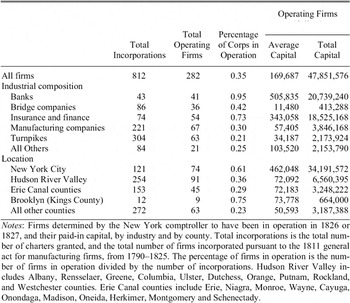
Of the 812 companies incorporated in New York in 1825 or before, the comptroller's office found that only 282 were in operation in 1826 or 1827.Footnote 51Table 2 presents the industries, reported paid-in capital, and location of the operating firms. In total, the capital of all operating corporations was about $48 million, and the state's 95 banks and insurance companies accounted for about $39 million or 81 percent of that total. There were 67 manufacturing firms, 63 turnpikes, 36 bridges, and small numbers of firms in other industries such as gas lighting, steamboats, and water works. The data in the table indicate that there was significant variation in the average sizes of the corporations across industries, with the largest companies in banking and finance, and the manufacturing corporations and turnpikes and bridges much smaller.
NEW YORK BUSINESS INCORPORATIONS IN OPERATION IN 1826 OR 1827: INDUSTRIAL COMPOSITION, LOCATION, AND PAID-IN CAPITAL

Notes:
Firms determined by the New York comptroller to have been in operation in 1826 or 1827, and their paid-in capital, by industry and by county. Total incorporations is the total number of charters granted, and the total number of firms incorporated pursuant to the 1811 general act for manufacturing firms, from 1790–1825. The percentage of firms in operation is the number of firms in operation divided by the number of incorporations. Hudson River Valley includes Albany, Rensselaer, Greene, Columbia, Ulster, Dutchess, Orange, Putnam, Rockland, and Westchester counties. Erie Canal counties include Erie, Niagra, Monroe, Wayne, Cayuga, Onondaga, Madison, Oneida, Herkimer, Montgomery and Schenectady.
Turning to the lower panel of the table, of these 282 corporations, 74 (26 percent) were located in New York City. These firms had a total capital of $34 million, or about 71 percent of all corporations' capital—a consequence of the fact that most of New York City's firms were large banks and insurance companies. In general, the remaining counties with significant numbers of corporations were located either along the Hudson River, or in the counties in the central part of the state touched by the Erie Canal, such as Oneida.
Ownership
The complete list of shareholders was found for 132 of the 282 operating corporations for at least one year, and for 246, the geographical distribution of their shares aggregated by county was found. Most of the stockholder lists are for the year 1826, although a small handful are from other years. In that year, the equity of 67 firms was traded on the New York Stock and Exchange Board. All but one of these publicly traded firms operated in New York City (with one in Brooklyn), and all but four were banks and insurance companies.Footnote 52 This market almost certainly facilitated substantially greater diffusion of the shares of the listed companies.
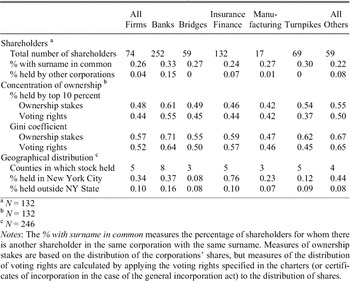
Some summary statistics of these data are presented in Table 3. There was an enormous degree of variation in ownership structures across firms. The number of owners ranged from 560 (Bank of America, capital $2 million) to just three (Athens Turnpike Company, capital $8,000). On average, the corporations had about 74 shareholders, which implies that at least some small stakes were commonly held. The surnames of the shareholders reveal that kinship ties may have been important in the allocation of shares; for 26 percent of investors in each corporation, there was another investor in that corporation with the same surname. The average firm's equity was owned in five counties, with 34 percent owned in New York City, and 10 percent owned outside of New York State. Certainly a fair number of shareholders lived far away from the businesses in which they invested, and very likely had no contact with or involvement in their day-to-day operations.
OWNERSHIP STRUCTURE, INDUSTRY MEANS

a N = 132
b N = 132
c N = 246
Notes:
The % with surname in common measures the percentage of shareholders for whom there is another shareholder in the same corporation with the same surname. Measures of ownership stakes are based on the distribution of the corporations' shares, but measures of the distribution of voting rights are calculated by applying the voting rights specified in the charters (or certificates of incorporation in the case of the general incorporation act) to the distribution of shares.
Looking across the different industries, those with the largest firms, such as banks and insurance, had the largest numbers of shareholders and their ownership was also the most geographically dispersed. The wide ownership of banks and insurance companies was probably also due in part to the appeal of the equity of these often consistently profitable firms to a broad range of investors, who could trade shares in these companies through brokers on the stock exchange in New York City. Moreover, firm size clearly was not the only determinant of ownership diffusion: manufacturing firms, which were on average much larger than either turnpike companies or bridge companies, had by far the smallest numbers of shareholders. Almost all of the manufacturing enterprises in the dataset could be considered “close corporations,” with very illiquid shares that traded only rarely, and which were held in large blocks by local investors.Footnote 53
The table also includes two measures of the degree of concentration of ownership: the total fraction held by the top 10 percent of investors, and also the Gini coefficient of shareholdings. These measures are presented both for ownership stakes (percentage of the shares held) and voting rights, calculated from the entire distribution of shareholdings according to the voting configuration specified in the charter or certificate of incorporation. On average, most firms had a few very large shareholders, with the top 10 percent holding 48 percent of the shares. The firms with the most equally distributed shares were in manufacturing, and the most unequally distributed were in banking, turnpikes, and some of the firms included in the “other” category. The effect of the voting rights configurations chosen in the different industries on the power of large shareholders can be seen by comparing the measures of inequality in ownership stakes with those of voting rights. In most industries except manufacturing, where one vote per share was nearly always chosen, the voting rights of large shareholders were curtailed at least somewhat. In particular, in banks and turnpikes, the voting rights configurations chosen reduced the power of large shareholders substantially. This finding implies that many investors were willing to hold stakes in firms well in excess of the voting rights they would be granted. Even if they did circumvent the effects of the firms' voting rights by holding shares in more than one name, they apparently did not do so enough to ensure that their voting power was undiminished.
Managerial Ownership and Corporate Control
A crucial element in understanding the ownership structure of these firms, and the extent of separation between ownership and control, is the degree of managerial ownership. Unfortunately, the lists of shareholders submitted pursuant to New York's capital tax did not identify the directors of the firms, and were simply signed by the corporate secretary or president. An extensive search of contemporary newspapers and city directories was therefore undertaken, and eventually the lists of directors for 51 of the corporations were obtained, and matched to a shareholder list.Footnote 54 The corporations for which a directors list could be found through this approach were overwhelmingly located in New York City (43 of 51 firms), and tended to be institutions of a “public” character, such as insurance companies, banks, and large manufacturing companies.
Moreover, unlike the proxy statements of modern public firms, where the shares “beneficially owned” or controlled by management are precisely enumerated, the shareholder lists from the 1820s do not identify shares that a director might have controlled or voted, but that he did not own directly. For example, some contemporary accounts mention the practice of shareholders “giving their proxies to officers of banks,” or essentially delegating their votes to the management itself.Footnote 55 There is no way to know how common such voting agreements were, as no such agreements were identified on the shareholder lists. Similarly, some corporations, particularly insurance firms, held relatively large stakes in other corporations and it was often the case that a director of the insurance firm was also a director of the corporation in which the insurance firm held a stake. In compiling the directors' shareholdings, I assumed that the shares owned by any corporations in which a shareholder was a director would be voted by that shareholder.
Often the lists of stockholders included trusts, where one or more of the directors were trustees. Consistent with the treatment of shares owned by corporations, and with contemporary accounts, I assumed that the directors would vote those shares. However, in many cases these shares were actually treasury shares or shares forfeited by investors who never paid in the amounts for which they subscribed. In principle, these shares should not have entitled their trustees to any votes. And yet the contemporary case law indicates that the shares in such trusts (which often constituted large or even majority blocks of shares) were voted by the directors of the firm.Footnote 56 Consider the example of the Tradesmen's Insurance Company. At its founding in 1825, a group of seven investors, one of whom was the president of a New Jersey bank, subscribed to a majority of the shares. This acquisition was financed through a “stock note” issued by the bank: the bank took the shares as collateral and the company was given deposit credit at the bank equal to that amount. When some of the other bank directors objected to the transaction and refused to accept checks drawn by Tradesmen's Insurance on its account, the transaction was eventually reversed and the shares were returned to the company. But rather than acknowledging that the shares had effectively never been paid in, the directors placed the shares in a trust, with the president of the company and two other directors as trustees. As the nominal owners of the stock, they voted the shares.Footnote 57 And because the shares in the trust accounted for 1,582 of the company's 4,000 total shares, the votes of these shares, when added to those of the shares owned directly by the members of the board (511), gave them 52 percent of the votes of the firm (the firm's charter specified that each share was entitled to one vote). In most cases, however, it is not possible to observe whether the directors actually voted those shares, so there is a danger that the managerial ownership data presented below may overstate the stake held by the directors somewhat, if they in fact did not vote shares held in this way.
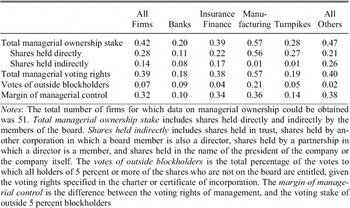
With these caveats in mind, the data for managerial ownership are presented in Table 4. The data indicate that on average, ownership by the directors was extremely high, with 28 percent of the shares held directly, and 14 percent held indirectly, either through corporations, partnerships or trusts, for a total ownership stake of 42 percent. Given the firms' voting rights configurations, these stakes entitled the directors on average to 39 percent of the total votes of their firms. Compared to mean ownership of about 13 percent and 21 percent for American public corporations in 1935 and 1995, respectivelyFootnote 58, the extent of managerial shareholding in the 1820s was much higher. The levels of management ownership during the period are similar to those of modern firms in the first year after their IPO, which is about 38 percentFootnote 59.
MANAGERIAL VOTING RIGHTS, INDUSTRY MEANS

Notes:
The total number of firms for which data on managerial ownership could be obtained was 51. Total managerial ownership stake includes shares held directly and indirectly by the members of the board. Shares held indirectly includes shares held in trust, shares held by another corporation in which a board member is also a director, shares held by a partnership in which a director is a member, and shares held in the name of the president of the company or the company itself. The votes of outside blockholders is the total percentage of the votes to which all holders of 5 percent or more of the shares who are not on the board are entitled, given the voting rights specified in the charter or certificate of incorporation. The margin of managerial control is the difference between the voting rights of management, and the voting stake of outside 5 percent blockholders
In order to assess the relative power of management's voting stake, the percentage of all of the votes controlled by holders of 5 percent or more of the stock who were not on the board was also calculated. As these large blockholders had the greatest incentive to monitor the performance of management, and to vote their shares, they were the mostly likely to check on management's power. On average, these blockholders controlled 7 percent of the firms' votes, meaning that the margin of managerial control was 32 percent. Many of the firms might have been characterized by Berle and Means as under minority control, as the stake held by insiders was large enough to be unchecked by any outside investors.
The data presented in Table 4 also indicate that there was substantial variation across industries in the degree of managerial ownership in the firms. The directors of manufacturing firms held enormous stakes, with 64 percent of the shares in total, but as the ownership of the shares was evenly distributed among a small number of shareholders, many of the investors not on the board also held large stakes, and the total votes of outside blockholders was 21 percent. In these firms, many of which could be characterized as “controlled by almost complete ownership,” there was barely any separation of ownership from control. In contrast, the management of turnpikes and banks held much smaller stakes and were entitled to around 20 percent of their firms' votes. The directors of insurance firms held 39 percent of their firm's shares, nearly half of which was due to shares held indirectly.
Although one might be tempted to interpret the high degree of insider ownership as consistent with strong managerial incentives and, perhaps, good governance, it is likely that the opposite was true. Directors in early-nineteenth-century corporations held sweeping powers to utilize their firms' resources for their own benefit and engage in self-dealing; bank directors, for example, were commonly the largest borrowers from their own firms.Footnote 60 The comfortable margin control over the firms' votes held by insiders implies that these firms were operated by managers who were not accountable to outside shareholders, and also had the authority to utilize their firms' resources for their own benefit.
OWNERSHIP AND GOVERNANCE: EMPIRICAL ANALYSIS
What was the effect of different voting rights on the extent of control of the corporations by large shareholders or directors? By examining the variation in the ownership structures and voting rights configurations both between and within industries, the nature of the relationship between the two can be better understood. It is likely that the ownership structure and governance institutions of the firms were jointly endogenous, so the results presented below should be interpreted as a descriptive analysis of the correlations in the data, rather than identification of a causal relationship. But the correlations nonetheless shed important light on the nature of the relationship between ownership structures and governance institutions.
The contrasts across industries in ownership structures and governance institutions, as noted above, suggest that industries with unequally distributed shares tended to configure their voting rights in a way that diminished the power of large investors. Manufacturing firms, for example, had relatively few shareholders, the most equally distributed ownership, and the greatest degree of managerial ownership. They essentially had no small investors and did not bother with the requirements of producing accounting statements or mandatory dividend payments, or with graduated voting rights schemes. In contrast, banks and turnpike companies had much larger numbers of shareholders, the most unequally distributed ownership, and the lowest degree of managerial ownership. Firms in these industries often utilized graduated voting rights schemes, probably in an effort to offer small shareholders some protection from the power of large shareholders. They also had larger boards, perhaps as a means to increase the representation of different interests in the governance of the firm.
Such differences across industries are illuminating, but they are somewhat difficult to interpret, because these industries were so different: in terms of firm size, profitability, perceived risks, capital structure, and no doubt many other characteristics, banks, turnpikes, and manufacturing firms were often radically different. And these other industry characteristics might ultimately be responsible for both their ownership structures and their governance institutions.
A clearer indication of the effects of differences in governance institutions would focus instead on within-industry comparisons. In this context, firms in the same industry with different governance institutions would be compared to one another. Although the governance institutions were chosen endogenously by the incorporators, and therefore any correlations found would not have a causal interpretation, such within-industry comparisons examine the effects of these measures when adopted by relatively similar firms, and are somewhat easier to interpret.
Therefore, the relationships between ownership structures and governance institutions are analyzed in the context of a regression framework that includes firm characteristics as controls, as well as industry fixed effects. Specifically, for firm i, the determinants of ownership measure si are estimated as

where Vi is the voting rights index; xi is a vector of firm characteristics, including other governance provisions; and the industry ik terms are a series of six indicator variables for each industry in the sample. The firm characteristics employed in the regression include the age of the firm, which would likely influence both the degree of diffusion of the shares, which likely increased over time, and might also reflect political conditions at the time the firm was incorporated, and therefore the governance provisions included in the charter. Certainly the size of firms might affect their ownership structures as well, so the log of the firms' capital is included. A table of summary statistics for all the variables included in the regressions is included in the appendix.
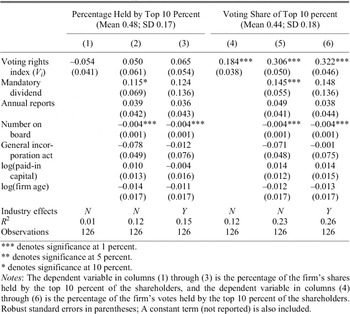
The results for the ownership stakes and voting power of large shareholders are presented in Table 5. In columns (1) through (3), the degree of concentration of ownership, measured by the percentage of the shares held by the top 10 percent of the investors, is the dependent variable. Irrespective of whether additional controls are added into the regression, or whether industry effects are added (limiting the analysis to within-industry variation) the results of these regressions indicate that there was no relationship between voting rights and ownership concentration. This suggests that graduated voting rights schemes did not cause the distribution of shares to become dramatically more equal, and also that they did not cause widespread efforts by large shareholders to circumvent these schemes by holding shares in multiple names. Evidently, investors were willing to hold stakes that were large enough to be penalized by graduated voting rights schemes.
REGRESSIONS, FIRM OWNERSHIP STRUCTURES

*** denotes significance at 1 percent.
** denotes significance at 5 percent.
* denotes significance at 10 percent.
Notes:
The dependent variable in columns (1) through (3) is the percentage of the firm's shares held by the top 10 percent of the shareholders, and the dependent variable in columns (4) through (6) is the percentage of the firm's votes held by the top 10 percent of the shareholders. Robust standard errors in parentheses; A constant term (not reported) is also included.
The results in columns (4) through (6), where the voting rights (as opposed to ownership stakes) of the top 10 percent of shareholders is the dependent variable, therefore follow immediately: firms that selected voting rights schemes that limited the power of large investors imposed them on essentially the same distribution of ownership, resulting in a lower degree of control by the largest shareholders. The within-industry correlation is slightly stronger than the one calculated using both between-and within-industry variation, as in columns (4) and (5), but the results are generally quite similar. Again, the interpretation of the positive coefficient on the voting index is that firms with a high value of the index (or one vote per share) were controlled to a much greater extent by large investors. And conversely, the influence of the largest 10 percent of investors was reduced when firms adopted voting rights corresponding to a lower value of the index.Footnote 61
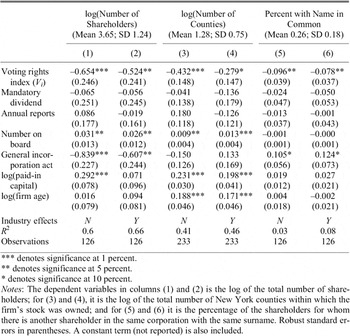
The regressions in Table 6 investigate whether lower values of the voting rights index were associated with more diffuse ownership, either in the form of a larger number of owners or in a wider geographical distribution of the shares. In both cases, a lower value of the voting rights index does seem to be associated with somewhat greater diffusion of ownership; the estimated coefficients in columns (2) and (4) imply that a one-standard-deviation decrease in the voting rights index was associated with an increase equivalent to about 15 percent of a standard deviation in both the log of the number of owners, and the log of the number of counties in which the shares were held. This is consistent with small, potentially more distant shareholders expressing a preference for investments in firms with lower values of the voting rights index but it is also consistent with shareholders holding their stakes in multiple names when graduated voting rights were chosen. Somewhat clearer evidence of the latter is found in column (6), where the dependent variable is the percentage of the shareholders whose surname is the same as that of another shareholder. If investors tried to circumvent graduated voting rights schemes by holding their stakes in the names of others, it would have been convenient to hold them in the names of relatives. And indeed this seems to have been the case, although the effect is extremely small: the parameter estimate indicates that a one-standard-deviation decrease in the voting rights index was associated with an increase equal to 3 percent of a standard deviation of the degree of commonality of the shareholders' surnames.
REGRESSIONS, FIRM OWNERSHIP STRUCTURES

*** denotes significance at 1 percent.
** denotes significance at 5 percent.
* denotes significance at 10 percent.
Notes:
The dependent variables in columns (1) and (2) is the log of the total number of shareholders; for (3) and (4), it is the log of the total number of New York counties within which the firm's stock was owned; and for (5) and (6) it is the percentage of the shareholders for whom there is another shareholder in the same corporation with the same surname. Robust standard errors in parentheses. A constant term (not reported) is also included.
Many of the other governance institutions of the firms, and firm characteristics such as the size of the capital stock, have large and statistically significant effects in the regressions without industry fixed effects (columns (1), (3), and (5)). However, these relationships appear to be due to the strong correlations of those characteristics with particular industries. Once the industry effects are included, most of the estimates become much smaller, implying that there was no within-industry effect. But interestingly, in each of the regressions, there is a robust association between the number of members of the board, and the degree of diffusion. Evidently larger boards were specified for firms with greater numbers of investors, and less concentrated ownership. In a related finding, manufacturing firms that were incorporated by the 1811 general act, rather than by obtaining a charter by special legislative act, had fewer owners, and had owners that were more likely to have surnames in common.
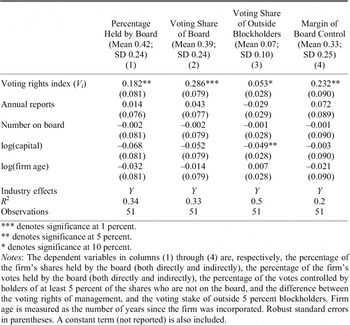
Results for regressions estimating the relationship between governance provisions and managerial ownership are presented in Table 7.Footnote 62 The estimates tell a slightly different story than those in Table 5: higher values of the voting rights index were associated with greater degrees of managerial ownership, and amplified the voting power of their larger stakes. Although outside 5 percent blockholders also had a larger share of the votes, the margin of managerial control was much higher for firms with higher levels of the index. Thus, even though the overall degree of ownership concentration did not vary with the voting rights chosen, the degree of managerial ownership and control did, and strongly: a one-standard-deviation increase in the voting rights index was associated with an increase in managerial voting power of about 45 percent of a standard deviation.
REGRESSIONS: MANAGERIAL OWNERSHIP AND CONTROL

*** denotes significance at 1 percent.
** denotes significance at 5 percent.
* denotes significance at 10 percent.
Notes:
The dependent variables in columns (1) through (4) are, respectively, the percentage of the firm's shares held by the board (both directly and indirectly), the percentage of the firm's votes held by the board (both directly and indirectly), the percentage of the votes controlled by holders of at least 5 percent of the shares who are not on the board, and the difference between the voting rights of management, and the voting stake of outside 5 percent blockholders. Firm age is measured as the number of years since the firm was incorporated. Robust standard errors in parentheses. A constant term (not reported) is also included.
EMPIRICAL ANALYSIS: FIRM VALUES
Assessing the impact of the ownership and governance data presented above on small investors or for the performance of the firms is difficult. It is likely that the management or large blockholders of some of the corporations in the dataset were essentially unaccountable to the other investors, and the governance institutions specified in the charters of these enterprises played some part in determining the extent of the balance of power between insiders and outsiders. But ultimately the question of interest is how did this balance of power affect the performance of the firms? The absence of any financial reports or accounting data for most of the firms certainly presents challenges for any attempt to address this question.
One avenue for investigation that is available is to analyze the market values of the publicly traded corporations within the sample. In 1826, the year of most of the shareholder lists in the dataset, the shares of 67 New York corporations were traded with some regularity on the New York Stock and Exchange Board (NYS&EB).Footnote 63 These were all shares of common stock, and although newspapers did not report trading volumes until around 1828, contemporary accounts suggest that the market for many corporate securities was quite liquid.Footnote 64 Thus the reported price data of these markets might reasonably be interpreted as informative of the market's assessments of the firms. Weekly prices of all equities that traded regularly on the NYS&EB were recorded from contemporary newspapers by Sylla, Wilson, and Wright, and these data were matched to the companies in the dataset.
The NYS&EB price data present at least two challenges for the researcher attempting to use them in this way. First, although most modern research on firm value uses measures of Tobin's Q as the focus of the analysis,Footnote 65 the NYS&EB data cannot be used to construct a measure of Q, as there is no data available on the value of the firms' liabilities. The prices quoted in transactions and reported in the press are expressed as a percentage of par value, or what would have been considered the book value of the shares.Footnote 66 Thus the data can be interpreted as an approximate measure of the ratio of the market value of equity to the book value of equity.
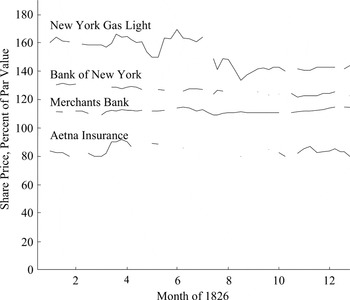
Second, many shares traded infrequently. Figure 3 presents a time series plot of the prices of four stocks of varying degrees of liquidity. Whereas for Merchants Bank and the New York Gas Light Company, transactions are recorded in most weeks, for the Bank of New York, and to a much greater extent for Aetna Insurance, there are many weeks or even entire months when the shares did not trade. Nevertheless, there are distinct differences in the average value of these firms over the course of the year, and the empirical analysis that follows will use the annual average values calculated from the weeks where transactions were recorded.Footnote 67 That is, rather than focusing on the small month-to-month variation in each firm's price, the average value over the entire year will be computed, and analyzed in a regression framework. But to address the problem that for some firms, transactions were recorded only in particular months, perhaps of more buoyant (or more depressed) conditions in the market, the analysis will include indicator variables for the months of the year in which transactions occurred.
SHARE PRICE DATA, FOUR STOCKS

The relationship between the firms' values, and their governance provisions, is analyzed in a simple framework of the following form

where MBi is firm i's average market-to-book ratio for 1826; Vi is the index of the firm's voting rights; xi includes firm characteristics such as the size of its capital stock, and its age; the monthij terms are a series of 12 indicator variables equal to one for each month of the year in which there was at least one transaction recorded for the firm's stock; and the industryik terms are a series of six indicators for the firms' industries. In subsequent specifications measures of ownership will be substituted for the voting rights index in the regression.
It should be noted that the effect of different voting rights configurations on the performance or value of the firm is potentially ambiguous. On the one hand, they clearly limit the power of large shareholders, and if the expropriation of small investors by insiders who held large stakes was a common problem, then voting rights that tipped the balance of power toward small shareholders might have raised the value of the firm to new investors, which should be reflected in market prices. On the other hand, such measures would insulate the firm from the forces generated by the market for corporate control, and in particular would make it quite difficult for a large investor to purchase a controlling stake in the firm.
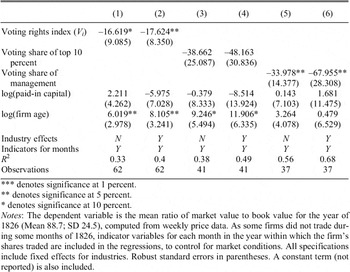
The results are presented in Table 8. Although the sample size is small, and becomes smaller when the ownership variables are included in the regression, some clear patterns emerge. First, as shown in columns (1) and (2), firms that offered voting rights that limited the voting power of large shareholders had higher values. The size of the coefficient in column (2) indicates that a one-standard-deviation increase in the voting rights index would reduce the firm's market-to-book value by 25 percent of a standard deviation. The reason for this simple reduced form relationship is suggested in columns (3) through (6), where ownership data are included in the regression. Both of the measures are negatively related to firm value, and in particular the ownership stake of management has a strongly negative relationship with firm value. This is consistent with insiders wielding control of their corporations for their own purposes and expropriating outsiders, and reducing the value of their firms. However, it may also be due to the market's perceptions of the quality of firms' capital: if investors knew that the capital stock was paid in using stock notes or other illiquid or risky financial instruments, this would have been reflected in the firms' valuations. If high levels of insider ownership or high levels of the voting index were negatively correlated with the quality of contributed capital, then this could also produce the same correlations.
REGRESSIONS: OWNERSHIP, GOVERNANCE AND FIRM VALUE

*** denotes significance at 1 percent.
** denotes significance at 5 percent.
* denotes significance at 10 percent.
Notes:
The dependent variable is the mean ratio of market value to book value for the year of 1826 (Mean 88.7; SD 24.5), computed from weekly price data. As some firms did not trade during some months of 1826, indicator variables for each month in the year within which the firm's shares traded are included in the regressions, to control for market conditions. All specifications include fixed effects for industries. Robust standard errors in parentheses. A constant term (not reported) is also included.
Finally, it should be emphasized that these results were obtained from the market values of a relatively small number of firms during a single year. Any firm conclusions regarding the generality of these findings await the outcome of efforts to replicate them in other contexts.
CONCLUSION
The corporate form found widespread adoption in a wide range of industries during the first three decades of the nineteenth century. This article has used data from New York's capital tax of the 1820s to analyze the ownership and governance of many of these early firms.
One immediate conclusion that can be drawn from the results of this article is that well before the emergence of the large industrial enterprises with tens of thousands of shareholders described by Berle and Means, ownership and control were quite commonly separated. In the 1820s, corporations were much smaller, and had far fewer shareholders, than the firms of the late nineteenth century, but they suffered from this problem nonetheless. The extent of separation of ownership from control varied significantly across industries, and moreover what Berle and Means would call “managerial control,” where ownership is so diffuse that professional, salaried managers effectively hold unchecked power, was probably quite uncommon. But “minority control,” where firms were operated by managers holding stakes that were large enough to make them unaccountable to the other shareholders, was quite common. And many of the governance institutions of the firms at the time were configured to help mitigate this problem.
Early-nineteenth-century firms utilized a variety of means to offer protections to their investors and make their stock more attractive to small shareholders. Some specified graduated voting rights in their charters—configurations of voting rights where the number of votes a stockholder was entitled to decreased with the number of shares he owned. In response to voting rights structures which reduced the voting power of large blocks of stock, large investors did not, apparently, reduce their shareholdings to a large extent, but held stakes with severely diminished voting power. Evidently the gains attained from the protections offered to small shareholders outweighed the costs. Such voting rights schemes were associated with lower managerial ownership, and higher firm values.
Another conclusion that follows from the results of this article is that the early evolution of the corporation was not a single process, but several processes occurring in parallel. Banks and insurance companies, for example, attracted large amounts of capital from a broad and diffuse base of investors, and their governance institutions were configured to facilitate this arrangement. Manufacturing firms, on the other hand, were quite closely held, with a few local investors holding large stakes, and effectively had no “small investors” at all. Over the course of the nineteenth century, with the rise of mass production, more integrated national markets, and other developments, manufacturing firms grew considerably in scale and their ownership and governance evolved as well, whereas banks and other financial corporations continued to be subject to strict limits on their size and on the scope of their activities.Footnote 68
Finally, the results of this article suggest some important questions to be investigated in later periods, as the corporation continued to evolve. For example, the extent of managerial ownership of 1820s corporations was extremely high by modern standards. At what point did managerial ownership begin to fall, and what developments were responsible for this change? Similarly, the United States is often described as having some of the best investor protections of any country in the world, and the least concentrated corporate ownership as a result. Certainly the level of investor protections offered in the early nineteenth century were much weaker—but how these protections evolved across states and over time is far from clear. Answers to such questions will help place the findings of this article in their historical context.
Appendix
THE CHARTERS
In New York 812 charters of incorporation were granted to businesses prior to 1826. The 659 charters granted via special act of the legislature were found and coded from New York's session laws (New York Laws, 1790–1825.) A substantial fraction of these charters were subsequently amended, often to increase the capital stock. The dataset includes the terms of the charters as amended as of 1825. For the 153 firms incorporated under New York's 1811 general incorporation act for manufacturing firms, the certificates of incorporation were found in the records of the New York State Comptroller in the New York State Archives, Albany NY (record group A1859).
NEW YORK'S 1823 CAPITAL TAX AND THE SHAREHOLDER LISTS
In 1823 New York levied a tax on the paid-in capital of incorporated companies, payable by the corporations themselves (New York Laws, 1823, chapter 262). The law was revised in 1824 and again in 1825 in response to difficulties encountered in its implementation (New York Laws, 1824, chapter 22; 1825, chapter 254.) The evolution of these laws, and the difficulties encountered in their implementation, are discussed in the report of the comptroller on the taxation of incorporated companies (Journal of the Assembly of the State of New York, 1827, pp. 538–49). The law required that all incorporated companies submit a list of the names, places of residence, and numbers of shares owned, for all stockholders, to the state comptroller, so that revenues could be distributed to county governments in proportion to the amount of stock owned in each county. The law remained in effect until 1828, when it was replaced with a simpler capital tax on corporations that did not provide for revenue distribution on the basis of local shareholdings (New York Revised Statutes, 1828, chapter 13, title 4).
The lists of stockholders submitted by the corporations pursuant to the tax law were found in various different record groups in the New York State Archives associated with the comptroller's office, including A0833, A0829, and A0847. The comptroller's ledgers of taxes paid by incorporated companies pursuant to the law, and amounts allocated to the different counties on the basis of the residences of their shareholders, were found within record group A1301; the ledgers recording the results of the comptroller's attempts to determine whether chartered corporations were in operation were found in record group A1204. The comptroller's records indicate that compliance with the law was initially low, but by 1826 most of the corporations believed to be in operation were submitting the required stockholder lists. As a stockholder list could be found for at least one year for less than half of the 282 operating corporations; this implies that most of these lists have not survived. Although the staff at the New York State Archives cannot be certain about the reason for these losses, they have indicated that the fire at the state library in 1911, coupled with the destruction of many historical records by the state archivist in the 1950s, are the likely causes. In an effort to expand the scope of the dataset, an extensive search of various archives in New York State was undertaken to try to find duplicate copies of the stockholder lists that may have been retained by the corporations themselves in their correspondence files. A small number of these shareholder lists were found in the New York State Historical Association, Cooperstown, NY, and the Citigroup Archives, New York, NY.
SUMMARY STATISTICS
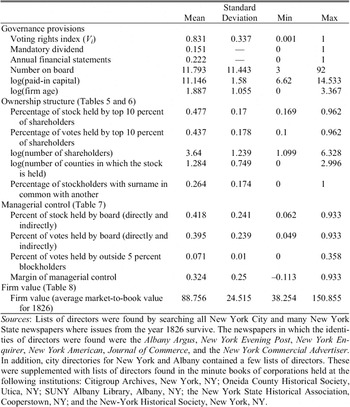
Summary statistics for the variables used in the analysis in the article are presented in Appendix Table 1. Note that the statistics for the governance provisions are those pertaining to the 132 observations where ownership lists could be found.
SUMMARY STATISTICS

Sources:
Lists of directors were found by searching all New York City and many New York State newspapers where issues from the year 1826 survive. The newspapers in which the identities of directors were found were the Albany Argus, New York Evening Post, New York Enquirer, New York American, Journal of Commerce, and the New York Commercial Advertiser. In addition, city directories for New York and Albany contained a few lists of directors. These were supplemented with lists of directors found in the minute books of corporations held at the following institutions: Citigroup Archives, New York, NY; Oneida County Historical Society, Utica, NY; SUNY Albany Library, Albany, NY; the New York State Historical Association, Cooperstown, NY; and the New-York Historical Society, New York, NY.