Implications
For dairy cattle on pasture in temperate regions, it is largely unknown to what degree hot summer conditions impact energy metabolism, milk yield and milk composition and how effective shade is in preventing this. In this study, the effect of Belgian summer weather on dairy cows with and without access to shade was investigated. Hot summer conditions affected body temperature, metabolism and milk yield and composition. Some effects (the increase in body temperature and the decrease in milk yield, among others) were reduced by access to shade, provided by trees combined with shade cloth.
Introduction
During summer, in most temperate regions, dairy cattle are kept on pasture for at least few hours a day. Pasturing has some important benefits for animal health and welfare, and improves the public perception of the dairy sector (van den Pol-van Dasselaar, Reference van den Pol-van Dasselaar2005). On the other hand, cattle on pasture may be exposed to aversive climatic conditions – for example, when high temperatures occur in combination with intense solar radiation. Such conditions can have substantial detrimental effects on the cows’ comfort level, feed intake, metabolism and productivity, as illustrated by ample studies in hot climates. Especially highly productive dairy cows are highly susceptible to heat stress, due to their high metabolic rate, which results in the production of considerable metabolic heat (Kadzere et al., Reference Kadzere, Murphy, Silanikove and Maltz2002). In addition, their high energy expenditure increases the possibility that the decreased energy (feed) intake and increased energy requirements during heat stress triggers a state of ‘negative energy balance’. Under such conditions, cows must mobilise reserves from adipose tissue and skeletal muscles (Bernabucci et al., Reference Bernabucci, Lacetera, Baumgard, Rhoads, Ronchi and Nardone2010). This altered metabolic state may be reflected by changes in blood plasma concentrations of several ‘metabolic heat stress’ indicators. Plasma cholesterol concentration has been shown to decrease in response to heat stress, presumably due to increased lipolysis in peripheral tissues (Abeni et al., Reference Abeni, Calamari and Stefanini2007). Enhanced breakdown of amino acids (mobilised from skeletal muscle tissue) and consequently an increased plasma urea or plasma urea nitrogen concentration has been reported in several heat stress studies (Shwartz et al., Reference Shwartz, Rhoads, VanBaale, Rhoads and Baumgard2009; Baumgard and Rhoads, 2012). Plasma creatinine, another indicator of skeletal muscle breakdown, has been shown to increase due to heat stress as well (Schneider et al., Reference Schneider, Beede and Wilcox1988; Abeni et al., Reference Abeni, Calamari and Stefanini2007). A more general indicator of alterations in energy metabolism in the liver is the blood plasma concentration of ALP (alkaline phosphatase). This enzyme is involved in the regulation of energy metabolism by the liver, and is known to decrease in response to heat stress (Toharmat and Kume, Reference Toharmat and Kume1997; Abeni et al., Reference Abeni, Calamari and Stefanini2007). Hyperventilation due to heat stress can cause hyperchloraemia – that is, an increase in blood plasma chlorine (Cl−), through increased elimination of bicarbonate from the blood in exchange for Cl−. This exchange takes place in the lung tissue as a direct consequence of increased removal of carbon dioxide via respiration (Afzaal et al., Reference Afzaal, Nisa, Khan and Sarwar2004). Bicarbonate can also be eliminated in exchange for Cl− in the renal tissue as a consequence of respiratory alkalosis – a secondary effect of hyperventilation (Afzaal et al., Reference Afzaal, Nisa, Khan and Sarwar2004; Calamari et al., Reference Calamari, Abeni, Calegari and Stefanini2007; Smith, Reference Smith2009).
Ultimately, a negative energy balance due to heat stress can reduce milk yield and alter milk composition (Collier et al., Reference Collier, Doelger, Head, Thatcher and Wilcox1982; West, Reference West2003). Hot summer conditions may, therefore, not only affect cattle comfort and welfare but also dairy producers’ income by reducing the milk yield quantitatively and also by reducing the milk quality. In the United States (Bailey et al., 2005) as well as the EU, multiple component pricing systems are used to calculate milk payments on the basis of milk fat and protein contents. In the EU, the basic milk price is adjusted according to the actual fat and protein contents (i.e. whether the milk meets fat and protein content standards or not; LEI, 2012).
Provision of shade is regarded as one of the most cost-efficient heat stress mitigation strategies on pasture (Blackshaw and Blackshaw, Reference Blackshaw and Blackshaw1994). Many studies have illustrated the beneficial effects of providing shade to heat-stressed cattle in hot climates, in terms of physiology (Ingraham, Reference Ingraham1979; Valtorta et al., Reference Valtorta, Leva and Gallardo1997) as well as performance. For example, milk yield and milk fat and lactose yields are known to increase when shade is provided (e.g. Davison et al., Reference Davison, Silver, Lisle and Orr1988). For cattle on pasture in temperate regions, however, it is largely unknown what the capital investment would be to provide shade on pasture and whether the benefits would outweigh the cost.
First, in temperate climate, it is uncertain how severely milk yield and milk are impacted by summer conditions. Traditionally, negative effects on production have been assumed to start at a Temperature Humidity Index (THI; as defined by Thom, Reference Thom1959) value of 72 or even 74 (Hahn et al., Reference Hahn, Mader and Eigenberg2003), but these threshold values are outdated (Van laer et al., Reference Van laer, CPH, Sonck and Tuyttens2014). These validation studies were carried out primarily in (sub)tropical and arid regions, and they were carried out on less-productive dairy cows rather than those generally reared nowadays (Zimbelman et al., Reference Zimbelman, Rhoads, Rhoads, Duff, Baumgard and Collier2009), especially in temperate regions. On the other hand, Brügemann et al. (Reference Brügemann, Gernand, von Borstel and König2011) identified a lower daily average THI value of 60 as the threshold for declining milk protein content in German Holstein cows. Hammami et al. (Reference Hammami, Bormann, M’hamdi, Montaldo and Gengler2013) proposed a daily average THI value of 62 as a new threshold for Western European Holstein cows, above which milk yield was found to decline with 0.164 kg/day per cow. However, the studies on which these thresholds were based were performed in undefined housing systems. Indoor-housed cows were most likely included (especially during hot conditions). Specifically for cattle on pasture in temperate climate, no such thresholds are available.
Second, it is not very clear how great the benefits of shade on pasture are in temperate climatic conditions. The benefits depend predominantly on how effective shade is in reducing the negative heat stress effects. Only limited research on this topic is available for temperate regions (Van laer et al., Reference Van laer, CPH, Sonck and Tuyttens2014). In New Zealand (temperate) summer conditions, milk production was 0.5 l/day higher in cows that had access to shade compared with those without, but milk composition was not affected by shade treatment (Kendall et al., Reference Kendall, Nielsen, Webster, Verkerk, Littlejohn and Matthews2006).
The aim of this study was to assess whether and to what extent rectal temperature (RT), hyperchloraemia, metabolic parameters (cholesterol, urea, creatinine and ALP), milk yield and milk composition are affected by hot climatic conditions, specifically for dairy cows on pasture in temperate summers. In addition, the effectiveness of shade was evaluated by investigating the degree to which shade reduced or prevented these negative effects.
Material and methods
Experimental setup
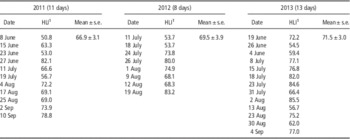
This study was carried out during three subsequent summers (2011, 2012 and 2013; Table 1), and was approved by the Animal Ethics Committee of the Institute for Agricultural and Fisheries Research (ILVO; application no. 2011/151 and 2011/151bis). The experiment was carried out on the pastures of the institute’s experimental farm (latitude 50°59'1"N, longitude 3°46"49"E). The Holstein dairy cows were rotated between four (in 2011) or two (in 2012 and 2013) pastures. Each pasture was adjacent to a shaded area surrounded by an electric fence. This shaded area could be accessed from either of the two adjacent pastures through a 3- to 5-m wide passage. Shade was provided by young trees and shade cloths (shading percentage=80%, Duranet bvba, Ostend, Belgium) that were spanned between the trees (see Supplementary Figure S1). The two shaded areas (625 m2 each) for dairy cattle were used by a maximum 60 dairy cows on adjacent pastures, thus providing at least 10.5 m2 of shade per cow.
Overview of the daily average Heat Load Index (HLI) on the days of blood sampling and measurement of rectal temperatures (RT)

1 Daily average HLI on this day.
Animals, management and experimental treatments
The number of lactating Holstein–Friesian dairy cows used in this experiment varied between 60 and 125, as dry cows left the herd and cows and heifers nearing parturition were regularly included. In 2011, the study included 125 dairy cows. At the beginning of the experiment (10 June 2011), they were of an average parity of 2.0±1.6 (mean±s.d.), were 169.1±132.4 days in milk (DIM; mean±s.d.) and yielded 26.9±11.7 l of milk per day (mean±s.d.). In 2012, 66 dairy cows were included. This group had an average parity of 2.9±1.1, an average DIM of 180.9±123.4 and milk yield of 30.9±7.3 l/day at the beginning of the experiment (1 June 2012). In 2013, 96 dairy cows were included, with an average parity of 2.0±1.2, an average DIM of 178.9±117.5 and milk yield of 26.3±7.2 l/day at the beginning of the experiment (7 June 2013). All the cows were milked twice daily (starting around 0530 and around 1530 h). During each milking session, they received half of the daily portion of concentrates. After milking, they were fed the daily mixed ration of mainly corn silage (49% to 76%, 60% on average) and pre-wilted grass silage (9% to 29%, 21% on average), supplemented with a protein source (soyabean meal or protected soyabean meal) and wheat or corn cob mix. In addition, during some periods, the ration was completed with pressed beet pulp (0% to 25%, 9% on average) and/or by-products from the bio-ethanol or starch industry. During the entire study period, the dairy cows were kept on pasture where they could graze ad libitum, except for during milking.
During the summers of 2011 and 2013, the dairy herd was divided into two groups of equal size, which were as comparable as possible with regard to traits known to affect susceptibility to heat stress (productivity, parity, age and percentage of black coat). During the summers of 2011 and 2013, one group (the S treatment) was always granted access to the shaded area, whereas the other group (the NS treatment) never had access to shade when on pasture. In order to exclude potential confounding effects (e.g. from pasture productivity or composition, location of drinking troughs) on the cows’ behaviour or productivity due to pasture allotment, NS and S groups were switched daily between allotments. During the summer of 2012, the cows were kept on the same pastures as those used in 2013, but none of the animals had access to shade (NS treatment). The same animal observations were made and samples were taken as in 2011 and 2013, and these data were pooled with those from the NS treatment in 2011 and 2013 in order to investigate the effect of climatic conditions.
Climatic data
A custom-built Campbell Scientific BWS200 weather station (Campbell Scientific Inc., Logan, UT, USA) located in open pasture, within 500 m of all pastures used in the trial, registered the average air temperature (Ta, in °C), air humidity (RH, in %), solar radiation (Rad, in W/m2) and wind speed (WS, in m/s) every 15 min. Based on these measurements, 15-min values of the Heat Load Index (HLI; Gaughan et al., Reference Gaughan, Mader, Holt and Lisle2008) were calculated. When Tbg>25, HLI=8.62+0.38×RH+1.55×Tbg–0.5×WS+e (2.4−WS). When Tbg<25, HLI=10.66+0.28×RH+1.3×Tbg–WS. Tbg stands for black globe temperature (in °C) and is calculated as Tbg=1.33×Ta−2.65×Ta0.5+3.21×log (Rad+1)+3.5 (Hahn et al., Reference Hahn, Mader and Eigenberg2003).
The HLI was used to quantify hot conditions, as this climatic heat stress index incorporates all the relevant climatic variables contributing to thermal (dis)comfort on pasture – that is, air temperature, air humidity, solar radiation and wind speed. In addition, it was already proven to be the best predictor (out of six climatic heat stress indices) for increasing shade use by Holstein dairy cattle on pasture (Van laer et al., 2015).
In order to evaluate the effect of shade on microclimate, additional measurements of Tbg were carried out, with Testo 400’s Wet Bulb Globe Temperature probe (Testo AG Inc., Lenzkirch, Germany), under shade and without shade. During the nine measurement sessions, performed on 8 days of medium to high heat load (weather forecast predictions of daily maximum temperatures ⩾25°C), for each of the shaded areas, Tbg was measured at 1.5 m height under shade and in an open area nearby (i.e. on three locations 20 to 50 m away from each shaded area). Three measurement sessions took place between 1000 and 1230 h, two sessions between 1200 and 1430 h and four sessions between 1330 and 1600 h. During each measurement session, three instantaneous measurements were taken inside and outside of each shaded area.
Physiological measurements
Physiological measurements took place on 11 days (Table 1). The daily average air humidity ranged between 46.9% and 84.9%, the daily average wind speed was between 0.8 and 6.8 m/s, solar radiation intensity was between 28.2 and 74.3 W/m2, the daily average air temperature was between 16.0°C and 30.2°C, the daily average Tbg was between 19.7°C and 34.4°C and the daily average HLI value was between 50.8 and 85.5. At the end of these 11 observation days, 20 ‘focal animals’ were separated from the herd before entering the milking parlour for the evening milking session (around 1500 h). In 2011 and 2013, always the same 10 ‘matched’ pairs (as comparable as possible in terms of productivity, parity, age and percentage of black coat) with one pair member in each experimental group (NS or S) were sampled. From these 20 focal cows, RT were determined with a digital thermometer (with an accuracy of 0.1°C), and blood samples were obtained; 9 ml blood samples were collected (in lithium–heparin-coated tubes) by punction of the tail vein. The samples were cooled immediately, plasma was centrifuged and frozen at −20°C until analysis. An automatic clinical chemistry analyser (Cobas 8000 Modular Analyser; Roche Diagnostics, Indianapolis, IN, USA) was used to determine the concentrations of several blood plasma indicators of metabolic changes that are known to be related to heat stress (i.e. the concentrations of cholesterol, urea, creatinine and ALP) and the concentration of Cl− (a sign of hyperventilation) in the blood plasma.
Milk yield and milk composition
Within each trial period (each summer), milk yields from each cow were saved by an automated registration system, except for a period between 26 July 2013 and 22 August 2013 due to a defect in the registration system. The automated system summed the milk yield from each morning with that of the evening before to obtain individual daily milk yield (MY X ) data. MY X was coupled with climatic data from 1, 2 and 3 days before. Thus, the milk yield data set contained milk yields from 98 days in 2011 (10 June 2011 to 15 September 2011), 117 days in 2012 (1 June 2012 to 25 September 2012) and 105 days in 2013 (7 June 2013 to 19 September 2013). These data were coupled with the daily average HLIs, which ranged between 46.1 and 86.7 (mean±s.e.=61.6±0.5) on the day before, between 46.1 and 86.7 (mean±s.e.=61.6±0.5) 2 days before and between 46.7 and 86.7 (mean±s.e.=61.7±0.5) 3 days before.
In addition, data from monthly determinations of milk composition, with a mid-IR spectrophotometer, by the Flemish milk monitoring service (Melk Controle Centrum Vlaanderen, http://www.mcc-vlaanderen.be) were obtained. These determinations were carried out every 5 weeks, unrelated to weather conditions. Contents of fat, protein, lactose and urea were also coupled with climatic data from 1, 2 and 3 days before. Thus, the milk composition data set contained data from 3 days in 2011, 3 days in 2012 and 4 days in 2013, and coupled to it daily average HLIs that ranged between 50.6 and 76.3 (mean±s.e.=59.4±2.5) on the day before, between 46.1 and 75.7 (mean±s.e.=57.6±2.5) 2 days before and between 48.6 and 67.8 (mean±s.e.=56.2±1.7) 3 days before.
Data analysis
Effect of shade on microclimate
The difference in Ta and Tbg measured in open area and under shade was modelled using a linear mixed model ANOVA (proc mixed, in SAS 9.3). Measurement session and shade area were included as random factors.
Physiological measurements
The effect of HLI and treatment on RT and blood plasma concentrations of ALP, cholesterol, creatinine, urea and Cl− were investigated using mixed linear regressions (proc mixed, in SAS 9.4), which also took the productivity of the cow into account (as a fixed effect). Both linear and quadratic models were tested to determine the effect of HLI on several dependent variables. In the linear models, the fixed effects were as follows: (1) the effect of the productivity of the cow – that is, the summed milk yield of the morning of the same day and the evening before, centred over the data set (the overall average daily milk yield was subtracted from the individual value), (2) the effect of treatment (NS or S) and (3) the interaction of (2) with the daily average HLI. In the quadratic models, the fixed effects were (1), (2) and (3), as well as the interaction of (2) with the square of the daily average HLI (for model equations, refer Supplementary Material S1). Generally, the strictly linear models yielded the best fit – that is, the lowest AICC value (Corrected Akaike Information Criterion). Therefore, only results from the strictly linear models are reported.
Milk yield
In order to investigate the effect of HLI and access to shade on milk yield, the daily milk yield data (the number of litres/day) from each cow in the herd, over the entire experimental period, were used. Mixed linear regressions (proc mixed in SAS 9.4) were carried out, which also took the lactation stage of the cow into account (as a fixed effect). Irrespective of the potential effect of HLI, the milk yield can be assumed to decrease linearly between peak lactation and late lactation – that is, between 42 and 305 DIM (Adediran et al., Reference Adediran, Ratkowsky, Donaghy and Malau-Aduli2012). Data from <42 and >305 DIM were omitted from the data set. The effect of HLI was included in the models as a linear factor as well as a quadratic factor to detect non-linear effects. The daily milk yield was, thus, modelled as a function of (1) the effect of the lactation stage (DIM), (2) the effect of treatment (NS or S), (3) the interaction of (2) with the daily average HLI 1, 3 or 3 days before sampling and (4) the interaction of (3) with the square of the daily average HLI (for model equations, refer Supplementary Material S1).
Milk composition
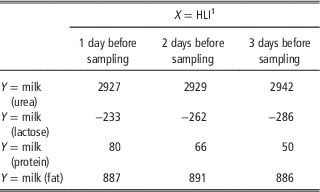
The effects of HLI and treatment (S or NS) on the milk contents of fat, protein, lactose and urea were investigated using linear mixed regressions (proc mixed in SAS 9.4), which also took the milk yield (quantity) into account as a fixed effect. Milk protein content and fat content, for example, are known to co-vary greatly with milk yield (Welper and Freeman, Reference Welper and Freeman1992). For the milk composition, again, both models with and without a squared HLI factor were tested. In the linear models, the fixed effects were as follows: (1) the effect of the milk quantity – that is, the milk yield on the day of sampling, centred over the data set (the overall average milk yield, 26.9 kg/day, was subtracted from the individual value), (2) the effect of treatment (NS or S), (3) the daily average HLI and (4) the interaction between (2) and (3). In the quadratic models, the fixed effects were (1), (2), (3) and (4), and, additionally, the interaction of (3) with the square of the daily average HLI and the interaction of (4) with the square of the daily average HLI (for model equations, refer Supplementary Material S1). The models without the quadratic HLI factor always yielded the best fit (the lowest AICC value). Consequently, only results from these strictly linear models are reported here. For each composition variable, the model that yielded the lowest AICC value (Table 2) – that is, the model with the HLI of either 1, 2 or 3 days before sampling – was considered to be the best fitting model. Only the results of these models are discussed.
AICC values of models for milk composition variables in function treatment (NS or S) and their interaction with the Heat Load Index (HLI)Footnote 1

AICC=Corrected Akaike Information Criterion.
1 Daily average of 1, 2 and 3 days before sampling.
All mixed linear regressions included a random factor to correct for repeated measurements per cow and a random factor to correct for potential year effects.
Results
Effect of shade on microclimate
In comparison with a nearby open area, shade lowered Tbg by 4.5°C (P<0.0001); the mean Tbg (±s.e.) was 30.3±2.0°C outside shade and 25.8±2.0°C under shade.
Physiological measurements
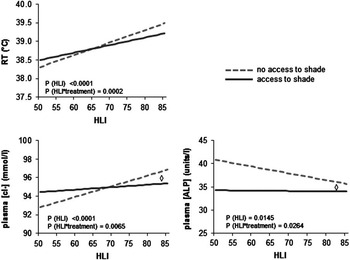
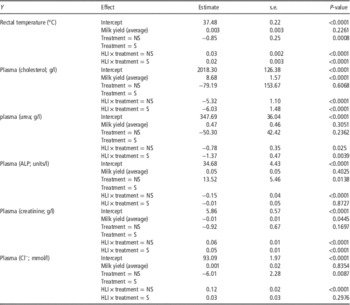
The RT and all blood plasma variables were significantly affected by HLI (P<0.0001 for RT, Cl−, cholesterol and creatinine, P=0.0003 for urea, P=0.015 for ALP). The RT and the blood plasma concentrations of Cl− and ALP were also significantly influenced by the interaction between HLI and treatment (P=0.0002 for RT, P=0.0065 for Cl− and P=0.026 for ALP, whereas P=0.700 for cholesterol, P=0.313 for urea and P=0.293 for creatinine). RT increased with increasing HLI for both treatments; however, the response was less pronounced in cows with access to shade (Figure 1 and Table 3). The mean RT was 39.5±0.1°C for cows without access to shade and 39.2±0.1°C for cows with access to shade (difference: P=0.0011) at the highest observed daily average HLI (i.e. 85).
Effect of the daily average Heat Load Index (HLI) and treatment (NS or S) on rectal temperature (RT) and blood plasma (Cl−) and alkaline phosphatase (ALP). ◊ Blood plasma (Cl−) and (ALP) are not significantly influenced by HLI for animals with access to shade (Table 3).

Effects of the daily average Heat Load Index (HLI) and treatment (NS or S)Footnote 1 on the rectal temperature and blood plasma indicators of metabolic alterations

ALP=alkaline phosphatase.
1 NS=no access to shade; S=access to shade.
The plasma concentration of Cl− increased along with increasing HLI for cows without access to shade. However, for cows with access to shade, plasma Cl− was not significantly affected by HLI (Figure 1, Table 3). The plasma concentration of ALP decreased with increasing HLI for cows without access to shade only. For cows with access to shade, ALP was unaffected by HLI (Figure 1, Table 3). The plasma concentration of cholesterol and urea decreased, whereas that of creatinine increased with increasing HLI, irrespective of access to shade (Table 3).
Milk yield
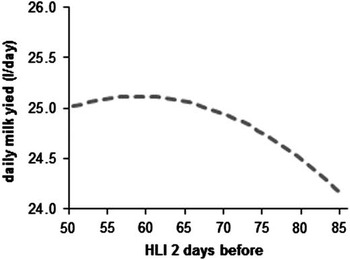
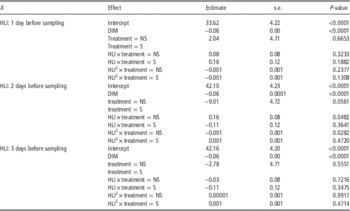
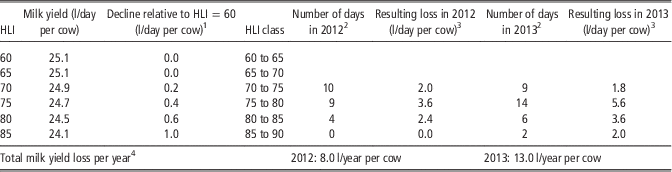
For cows with access to shade, the milk yield was not significantly affected by the HLI (or its quadratic factor) on 1, 2 and 3 days before (Table 4).The milk yield for animals without access to shade, however, was affected by the HLI (and its quadratic factor) 2 days before. For example, when the daily average HLI value increased from 65 to 85, the milk yield (for cows with an average number of DIM) decreased from 25.1 to 24.1 l/day (Figure 2, Table 4). For the cows with access to shade, the daily milk yield did not significantly decrease with increasing HLI (Figure 2, Table 4). The model for cows without access to shade was used to assess the annual decrease in milk yield (in litres per cow) due to the lack of shade for the years 2012 and 2013. This assessment was based on the modelled decrease in milk yield per 5 unit increase in HLI and the occurrence of the corresponding HLI levels in 2012 and 2013 (Table 5). This assessment was not made for 2011, because no climatic measurements were available before 8 May 2011. The results of the assessment indicate that, in 2012, the milk yield for cows without access to shade declined by 8.0 l/year per cow due to daily average HLI values above 70 (total n=23; Table 5). In 2013, there were 31 days with daily average HLI above 70. Consequently, the milk yield for cows without access to shade declined by 13.0 l/year per cow (Table 5).
Daily average milk yield for cows without access to shade (NS) (and with an average number of days in milk (DIM), i.e. 202) in function of the daily average Heat Load Index (HLI) 2 days before.

Effects of lactation stageFootnote 1 , treatment (NS or S)Footnote 2 and its interaction with the daily average Heat Load Index (HLI)Footnote 3 and its quadrat (HLI2)Footnote 3 on the daily milk yield

1 DIM=days in milk (lactation stage).
2 NS=no access to shade; S=access to shade.
3 Daily average of 1, 2 and 3 days before sampling.
Assessment of the potential loss in yearly milk yield per cow due to lack of shade in the Belgian summers of 2012 and 2013

1 The degree of decline in milk yield with every 5 unit increase in HLI above the HLI that gave the maximum milk yield (HLI=60).
2 The occurrence of the number of days with these HLI levels in 2012 and 2013, based on data from the weather station on our experimental pastures.
3 The resulting milk yield loss per HLI level, for both years.
4 The total milk yield loss is the sum of milk yield loss per HLI level, for both years.
Milk composition
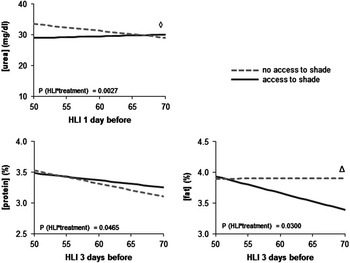
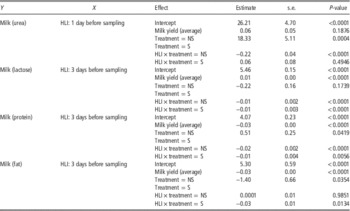
The milk urea content was best explained by the HLI 1 day before sampling (Table 2). For cows with access to shade, the milk urea content was unaffected by HLI. For cows without access to shade, the milk urea content decreased with increasing HLI (Figure 3, Table 6; P(HLI×treatment)=0.0027). The milk contents of lactose, protein and fat were best explained by the HLI 3 days before sampling (Table 2). The milk lactose content decreased with increasing HLI, irrespective of access to shade (Table 6; P(HLI×treatment)=0.1248). The milk protein content decreased with increasing HLI, but the decline was less marked for cows with v. without access to shade (Figure 3, Table 6; P(HLI×treatment)=0.0465). The milk fat content was unaffected for animals without access to shade, but decreased with increasing HLI for cows with access to shade (Figure 3, Table 6; P(HLI×treatment)=0.0300).
Effect of the daily average Heat Load Index (HLI) – 1 day before or 3 days before, depending on what day gave the best fit (lowest AICC (Corrected Akaike Information Criterion), see Table 4) – and treatment on milk urea, protein and fat content. P-values for the interaction between HLI and treatment are given, ◊ the milk composition variable is not significantly influenced by HLI for animals with access to shade, Δ the milk composition variable is not significantly influenced by HLI for animals without access to shade (Table 6).

Effects of treatment (NS or S)Footnote 1 and their interaction with the Heat Load Index (HLI)Footnote 2 on the milk composition variables

AICC=Corrected Akaike Information Criterion.
1 NS=no access to shade; S=access to shade.
2 Daily average HLI of 1, 2 and 3 days before sampling, depending on which day provided the best fitting model (model with the lowest AICC value, Table 2).
Discussion
Hot summer conditions affected RT, hyperchloraemia and energy metabolism
The RT and the energy metabolism of cows without access to shade were substantially affected by hot summer conditions. At HLI=85 (±the highest observed daily average value in the RT data set), the RT of cows without access to shade was on average 39.5°C. This result is comparable with the RTs around 39.5°C that Muller et al. (Reference Muller, Botha, Coetzer and Smith1994a) observed at air temperatures around 35°C for unshaded Holstein cows in South Africa. Moreover, daily maximum body temperatures (as measured vaginally) were comparable for Holstein cows in New Zealand summers (Kendall et al., Reference Kendall, Nielsen, Webster, Verkerk, Littlejohn and Matthews2006; Tucker et al., Reference Tucker, Rogers and Schütz2008). The increase of RT was tempered by having access to shade. This is in line with the results of Kendall et al. (Reference Kendall, Nielsen, Webster, Verkerk, Littlejohn and Matthews2006). In line with previous research, the plasma concentration of Cl− increased with increasing degree of heat (Calamari et al., Reference Calamari, Abeni, Calegari and Stefanini2007) for cows without access to shade. This hyperchloraemia is likely a sign of hyperventilation (Afzaal et al., Reference Afzaal, Nisa, Khan and Sarwar2004; Smith Reference Smith2009). In our research, parallel to the present study, respiration rates indeed regularly exceeded 120 breaths per minute (>20% of the observations of dairy cows outside shade; Van laer et al., 2015). Access to shade, however, seemed to prevent hyperventilation, given that the Cl− concentration did not increase for animals with access to shade. This is consistent with the finding that the prevalence of respiration rates ⩾120 breaths per minute was reduced by the use of shade (Van laer et al., 2015). Increasing HLI was associated with a decrease in plasma ALP, indicating a general alteration in energy metabolism, but this was prevented by access to shade. Increasing HLI was also associated with a decrease in the plasma concentration of cholesterol. A similar finding was reported by Toharmat and Kume (Reference Toharmat and Kume1997). The change may be due to decreased liver activity and increased lipolysis in peripheral tissues (Abeni et al., Reference Abeni, Calamari and Stefanini2007). Increased skeletal muscle breakdown was established, as indicated by the increase in plasma creatinine concentration, and was also reported by Abeni et al. (Reference Abeni, Calamari and Stefanini2007) and Schneider et al. (Reference Schneider, Beede and Wilcox1988). The effect of hot summer conditions on lipolysis and amino acid breakdown was not reduced by access to shade, however. Our findings on urea concentrations in blood as well as in the milk were unexpected. An increased breakdown of amino acids in response to hot summer conditions was expected to increase blood plasma urea concentrations (Shwartz et al., Reference Shwartz, Rhoads, VanBaale, Rhoads and Baumgard2009) and milk urea content (Gallardo et al., Reference Gallardo, Valtorta, Leva, Gaggiotti, Conti and Gregoret2005). On the other hand, Abeni et al. (Reference Abeni, Calamari and Stefanini2007) also found a decrease in blood plasma urea concentrations during two hot periods under Italian summer conditions. In cattle, plasma and milk urea concentrations are very much determined by the rumen degradable protein balance: a largely positive balance leads to higher NH3 production in the rumen, which results in higher urea concentrations in blood and milk. In the present study, the observed decrease in the urea concentration might, therefore, be due to a shift in feeding behaviour. From previous research, it is known that during hot days cows reduce their feed intake during the hottest part of the day (Silanikove Reference Silanikove2000). Although data on individual feed intake are unavailable for this study, hot summer conditions may have reduced the intake of grass on pasture, which is an important source of degradable protein. This possibly reduced the availability of NH3 in the rumen, and thus the urea levels in blood and milk. For cows with access to shade, hot summer conditions did not reduce milk urea content, which suggests that changes in rumen degradable protein balance were less pronounced in this treatment group. However, completely unravelling the effects of hot conditions (in temperate summers) on feed intake, energy intake and protein intake was well beyond the scope of this study.
Nevertheless, our findings with respect to the various blood plasma indicators of metabolic changes indicate that the absence of shade, even in a temperate region such as Belgium, under hot summer conditions, is able to trigger at least some degree of ‘negative energy balance’ in Holstein dairy cows kept on pasture. In addition, the observed hyperchloraemia suggests that cows without access to shade can suffer from hyperventilation under hot summer conditions. This can be assumed to reflect substantial thermal discomfort as well (see Van laer et al., 2015). Furthermore, this study indicates that, even in a temperate climate, the negative energy balance due to heat stress ultimately reduces milk yield and alters milk composition.
Hot summer conditions decreased the milk yield of cows without access to shade
Increasing HLI was associated with decreasing milk yield for unshaded cows. After a lag-effect of 2 days, their milk yield declined, starting at a daily average HLI around 65. The higher the HLI increased, the steeper the milk yield decline became. At HLI=85, the milk yield was 4.2% lower than at HLI=65 (24.1 l/day per cow v. 25.1 l/day per cow). Another study that related the milk yield of Holstein dairy cattle in temperate climate to HLI (Hammami et al., Reference Hammami, Bormann, M’hamdi, Montaldo and Gengler2013) found a reduction in milk yield with 0.1% per unit increase of the HLI, but above the threshold of 80 only (decline of 0.12 kg/day per cow v. yield of 23.8 kg/day per cow under thermoneutral conditions). The data for that study were obtained from cows in unspecified housing systems, however. Indoor-housed cows were probably included (especially during hot summer conditions), which might explain the higher threshold for milk yield decline. In contrast, a study on cows on pasture in New Zealand found no relationship between the daily maximum HLI and daily total milk production (Kendall et al., Reference Kendall, Nielsen, Webster, Verkerk, Littlejohn and Matthews2006). Furthermore, no studies relating milk yield to the HLI are known, at present.
The decline in milk yield in our study under temperate climatic conditions was less marked than the declines reported in (sub)tropical or arid climates. For example, a large-scale study in Arizona, which was characterized by a desert climate, reported a significant decline in milk yield (about 6.8%) when the daily minimum THI increased from 65 to 73 (decline of 2.2 kg/day per cow v. yield of 32.2 kg/day per cow at THI=65; Zimbelman et al., Reference Zimbelman, Rhoads, Rhoads, Duff, Baumgard and Collier2009). In the present study, the decrease in milk yield coupled with increasing HLI did not occur when cows had access to shade. The milk yield also benefited from access to shade in New Zealand summers – with a difference of 0.5 l/day per cow (Kendall et al., Reference Kendall, Nielsen, Webster, Verkerk, Littlejohn and Matthews2006) – and in South-African summers – with a 5.5% difference (Muller et al., Reference Muller, Botha and Smith1994b).
Hot summer conditions altered milk composition
The milk contents of lactose, protein and fat were significantly affected by hot summer conditions. As HLI increased, after a lag-time of 3 days, the milk lactose production decreased by about 0.02% and the protein content decreased by about 0.01% per unit increase of HLI. This decline in protein content is less than the 0.06% decline reported by Gantner et al. (Reference Gantner, Mijiç, Jovanovac, Raguz, Bobiç and Kuterovac2012) for cows in free-stall barns in Croatia. We demonstrated no unambiguous effect of shade on the relationship between HLI and milk composition. Contrary to expectations, the milk fat content was unaffected for cows without access to shade, but did decrease by about 0.03% per unit increase of HLI for cows with access to shade. For a cow with access to shade, the daily fat yield would, thus, decrease by 8 g/day per unit increase of HLI. This decline is comparable with the decline of 10 g/day per unit increase of the HLI above 80 that Hammami et al. (Reference Hammami, Bormann, M’hamdi, Montaldo and Gengler2013) found, but not as steep as the decline of 0.07% found by Gantner et al. (Reference Gantner, Mijiç, Jovanovac, Raguz, Bobiç and Kuterovac2012) at daily THI⩾72. On the other hand, cows with access to shade showed a less marked decrease of the milk protein content.
In conclusion, hot summer conditions may affect dairy producers’ income, due to reduced quantity as well as quality of the milk produced. However, the heat stress remediating effect of shade on milk composition remains unclear. This might be due to the relatively low number of milk composition samples from periods of high HLI. The milk composition data set contained data from only 10 days in total, with daily average HLIs up to only 76.3 (mean±s.e.=59.4±2.5) on the day before and only 67.8 (mean±s.e.=56.2±1.7) 3 days before. Therefore, further research would be useful to determine to what degree shade can reduce the negative effect of heat stress on milk composition, specifically for dairy cows on pasture in temperate summers.
Other aspects of provision of shade on pasture
The present study showed that the absence of shade on pasture during hot summer conditions can reduce dairy producers’ income. In a study parallel to the present study, we also demonstrated that shade improves thermal comfort for cows (Van laer et al., 2015). However, potential effects of hot summer conditions and shade on veterinary costs, feed intake, pasture productivity, etc., remain unknown.
In addition, the cost for provision of shade on pasture depends greatly on the design and size of the shading structure. As a minimum, generally 3.5 to 6.5 m2 shade per cow is recommended (Armstrong, Reference Armstrong1994). However, Schütz et al. (Reference Schutz, Clark, Cox, Matthews and Tucker2010) demonstrated that 9.6 m2 of shade per cow elicited twice as much shade use and more simultaneous shade use by several cows, fewer aggressive interactions and lower respiration rates compared with 2.4 m2 of shade per cow. In a field study on commercial farms, the same authors found the prevalence of high Panting Scores (⩾2) to decrease by 0.3% with every additional 1 m2 of shade per cow (Schütz et al., Reference Schutz, Cox and Tucker2014).
Trampling and manure deposition in shaded resting areas may also be reduced by high individual space allowance or by using movable structures (Armstrong, Reference Armstrong1994). Movable structures are also suitable for rotational grazing systems. Shade cloth is ideal for the construction of lightweight movable structures, which are being commercialised in, for example, the United States (Dr T. Brown-Brandl, personal communication). On the other hand, shade provision by trees on pasture creates a more natural landscape, greater biodiversity and landscape connectivity. Other points of attention regarding natural or artificial shade on pasture are discussed in the study by Van laer et al. (Reference Van laer, CPH, Sonck and Tuyttens2014).
Conclusions
The first aim of our study was to assess the degree of negative impact of hot summer conditions, occurring in temperate summers, on RT, metabolic parameters, milk yield and milk composition. Increasing HLI increased RT, a sign of hyperventilation, signs of lipolysis and skeletal muscle amino acid catabolism, whereas it decreased the milk contents of lactose, protein and fat. In cows without access to shade, the milk yield, after a lag-period of two days, also decreased notably with increasing HLI. The higher the HLI increased, the steeper the milk yield decline became. At daily average HLI=85, the milk yield 2 days later was 1.0 l/day per cow lower than at daily average HLI=65. The second aim was to evaluate the effectiveness of shade in preventing the above-mentioned negative effects. The effect of hot summer conditions on lipolysis and amino acid breakdown (as assessed by blood plasma concentrations of cholesterol and creatinine) was not tempered by having access to shade. The effects of hot summer conditions on milk composition were not unambiguously ameliorated by shade either. However, the increase of RT, hyperchloraemia (a sign of hyperventilation) and the decrease of ALP (a regulator of metabolism in the liver) in the blood plasma were ameliorated by shade. Access to shade prevented the decrease in milk yield that was observed in cows without access to shade. Additional research would be useful to investigate other potential benefits of shade, aspects of optimal shade area design and size (e.g. to prevent excessive trampling of the grass and excessive manure deposition) and the cost of an adequate shade area, in order to allow a cost–benefit analysis for provision of shade on pasture in temperate climate.
Acknowledgements
This study was funded by the Federal Public Service of Health, Food Chain Safety and Environment (contract RT 10/13 Pastress). The experiment was approved by ILVO’s Ethics Committee (EC 2011/151 and EC 2011/151bis). The authors thank all the people who helped to accomplish this study, including the animal caretakers and technicians (especially Seppe Holemans, Sara Van Lembergen and Thijs Decroos) from ILVO Animal Sciences Unit and Master student Evelien Van de Keere. They also thank Miriam Levenson for English language editing.
Supplementary material
To view supplementary material for this article, please visit http://dx.doi.org/10.1017/S1751731115000816