Introduction
Scullin and Murray monoliths are thought to hold the largest concentration of breeding seabirds in East Antarctica (Harris & Woehler Reference Harris and Woehler2004, ATCM 2010). The seabird assemblage at these large outcrops of ice-free rock on the Mac. Robertson Land coast includes five petrel species (Antarctic petrel Thalassoica antarctica (Gmelin), Cape petrel Daption capense (L.), southern fulmar Fulmarus glacialoides (Smith), snow petrel Pagodroma nivea (Forster) and Wilson's storm petrel Oceanites oceanicus (Kühl)), one larid species (south polar skua Catharacta maccormicki (Saunders)) and one penguin species (Adélie penguin Pygoscelis adeliae (Hombron & Jacquinot)) (Alonso et al. Reference Alonso, Johnstone, Hindell, Osborne and Guard1987). The Antarctic petrel population at Scullin Monolith is second in size only to the colony at Svarthameren in Dronning Maud Land (van Franeker et al. Reference Van Franeker, Gavrilo, Mehlum, Veit and Woehler1999). The monoliths were designated as an Antarctic Specially Protected Area (ASPA No. 164) in 2005 by the Antarctic Treaty Consultative Parties in recognition of the global importance of the seabird assemblages and to protect their outstanding ecological and scientific values.
It is a requirement under Annex 5 of the Protocol on Environmental Protection to the Antarctic Treaty that a management plan is developed for each ASPA to ensure the goals of protecting the ecological and scientific values are achieved, and that each plan is reviewed at regular intervals. A management plan for the Scullin and Murray Monoliths ASPA was developed by the Australian Antarctic Division and approved at the Antarctic Treaty Consultative Meeting (ATCM 2005), and subsequently revised in 2010.
One of the activities listed in the management plan is ‘where practical, the Area shall be visited as necessary, and preferably no less than once every five years, to conduct censuses of seabird breeding populations’ (ATCM 2010). Further, one of the measures in the management plan to ensure its aims and objectives continue to be met is that ‘ornithological surveys, including aerial photographs for the purposes of population census, shall have a high priority’. While these words clearly encourage regular seabird population monitoring, the complex logistics of accessing this remote site has until now limited quantitative assessment of the seabird populations to a single survey by a ground-based team in 1986/87 (Alonso et al. Reference Alonso, Johnstone, Hindell, Osborne and Guard1987). That study provided population estimates for Adélie penguins at both Scullin and Murray monoliths, for five petrel species at Scullin Monolith, and for two petrel species at Murray Monolith. In 2010/11 we took the opportunity of using a scheduled flight by a CASA-212 aircraft from Davis to Mawson stations to fly past the monoliths and photograph the Adélie penguin population with a view to: 1) estimating its current abundance, 2) providing updated data on Adélie penguin abundance for the management plan, and 3) providing a basis for assessing whether any change has occurred in the population since 1986/87. We present here results of this work and discuss potential biases and uncertainties in both the recent and earlier Adélie penguin population data. As the recent work was conducted from an aircraft flying at a distance from the ASPA we were unable to collect any useful population data on the flying seabirds because they are smaller in size and more cryptic than Adélie penguins.
Methods
This survey
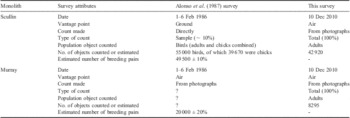
Counts of Adélie penguins were made from photographs taken from a CASA 212 fixed wing aircraft flying along the seaward side of the monoliths at ≥ 750 m horizontal distance from the ASPA boundary and 750 m altitude on 10 December 2010 (Table I). The flight path did not enter the ASPA and was in accordance with the minimum approach distance permitted by the management plan. The photographs were taken with a hand-held Nikon D200 digital SLR camera fitted with 75–300 mm zoom lens. Overlapping colour photographs of all penguin sub-colonies were taken on both low- and high-zoom settings. Although photographs were taken at an oblique angle to the horizontal, the effective obliqueness relative to penguin sub-colonies was reduced because the moderate to steeply sloping ground occupied by penguins faced toward the aircraft. The photographs were converted to a lossy compressed format (JPG). It was not possible to stitch the overlapping photographs together using appropriate software because the photographs were taken on different zoom settings from the moving aircraft. Instead, we used features in the low-zoom photographs such as guano, snow and rock patterns to delineate adjoining sections of penguin colonies on the high-zoom photographs, and then made counts from the high-zoom photographs. The extent and overlap of photographic coverage was sufficient to include all penguin sub-colonies at each monolith. We were unable to distinguish between breeding and non-breeding penguins in the images, and consequently made counts of all Adélie penguins (i.e. breeding and non-breeding penguins combined). The counts were partitioned into penguins visible on ground covered by guano and penguins visible on ground that was free of guano.
Details of Adélie penguin population surveys at Scullin and Murray monoliths.

Alonso et al. (Reference Alonso, Johnstone, Hindell, Osborne and Guard1987) survey
Population data for Scullin Monolith were obtained by a team working from the ground on 1–6 February 1986. Our interpretation of the methods, after translating from Spanish to English, is that: 1) 5324 birds (adults and chicks combined) were counted in a sample area of c. 10% of the total occupied area, 2) from this sample count, a total of 55 000 birds were estimated to be present, of which 39 670 were estimated to be chicks, 3) this number of chicks was adjusted (divided) by a ‘productivity factor’ of 0.8 (obtained from Ainley et al. Reference Ainley, LeResche and Sladen1983) to derive an estimate of 49 500 breeding pairs at the beginning of the season, and 4) an error of ±10% was associated with the estimate (we could find no explanation of how this was derived) (Table I).
Population data for Murray Monolith were described as being made from a helicopter with the aid of aerial photographs. It is difficult to assess whether the estimate of 20 000 ± 20% (Table I) was derived from a sample count or total count, or whether the estimate is based on actual counts or is a ‘guestimate’.
Results
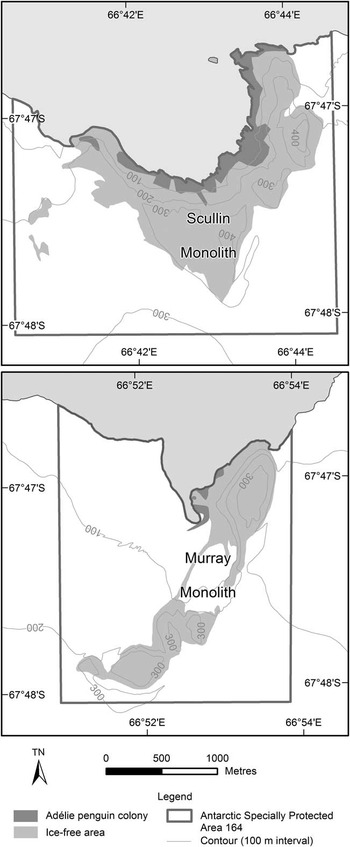
We counted a total of 42 920 adult Adélie penguins at Scullin Monolith (Table I). The number of penguins on guano-free ground was trivial (< 0.2% of the total). In general the sub-colonies at Scullin Monolith had a similar distribution to that shown in the current management plan (Map D, ATCM 2010). However, we observed some small to moderate-sized sub-colonies at the western end of the monolith that are not shown in the current management plan (Fig. 1). A total of 8295 penguins were counted at Murray Monolith (the number on guano-free ground was again trivial). The current management plan has no information on sub-colony distribution at Murray Monolith (Map C, ATCM 2010). We observed most of the penguins (c. 75% of the total) along the western base of rock adjoining the ocean, and were surprised to see a substantial number of penguins (c. 25% of the total) further west again on glacial ice, covered by moraine debris (Fig. 1).
Approximate distribution of Adélie penguins at Scullin Monolith (upper) and Murray Monolith (lower).

Discussion
We would expect both of these counts to be negatively biased to some extent due to some penguins being obscured by boulders, but without simultaneous ground counts in sample areas for comparison it is not possible to rigorously quantify detection bias. At Scullin Monolith, smooth rock features and dense guano created a simple background with good contrast for counting, and we expect that any bias here would be minor (perhaps no more than 5%). Visibility conditions were similar on the main rock features of Murray Monolith where most of the penguins occurred, but detectability bias may have been considerably higher (possibly up to 20%) where penguins occupied moraine debris because numerous large boulders and rocks created a complex background to identify penguins against. In early December the number of adult Adélie penguins present at breeding sites in East Antarctica is similar to the number of incubating nests (Taylor et al. Reference Taylor, Wilson and Thomas1990, Watanuki & Naito Reference Watanuki and Naito1992, Southwell et al. Reference Southwell, McKinlay, Emmerson, Trebilco and Newbery2010), so the unadjusted counts, at least at Scullin Monolith, are probably a reasonable approximation of the number of breeding pairs during incubation.
The ground count of chicks at Scullin Monolith in 1986/87 is less likely to be biased than the aerial counts of this study because of the closer proximity of observers to the penguins, but the estimate of 49 500 breeding pairs that Alonso et al. (Reference Alonso, Johnstone, Hindell, Osborne and Guard1987) derived from the chick count may have considerably more uncertainty associated with it than the proposed value of ±10%. There would be some sampling error associated with scaling the sample count up from sampled areas to the entire area, as well as some uncertainty in adjusting counts of chicks to an estimate of breeding pairs at the beginning of the breeding season because Adélie penguin chick productivity varies considerably from year to year (Whitehead et al. Reference Whitehead, Johnstone and Burton1990, Jenouvrier et al. Reference Jenouvrier, Barbraud and Weimerskirch2006, Emmerson & Southwell Reference Emmerson and Southwell2008) and the specific value for Scullin Monolith in 1986/87 is unknown. In addition, the productivity value applied by Alonso et al. (Reference Alonso, Johnstone, Hindell, Osborne and Guard1987) was derived from Adélie penguin populations in the Ross Sea (Ainley et al. Reference Ainley, LeResche and Sladen1983) and may not be representative of productivity at the monoliths. It is difficult to assess the accuracy and precision of the estimate of Alonso et al. (Reference Alonso, Johnstone, Hindell, Osborne and Guard1987) of 20 000 ± 20% breeding pairs for Murray Monolith because the methodological basis for the estimate is unclear, and we recommend caution when interpreting this result.
The new population data presented here meets the expectations of the Scullin and Murray Monoliths management plan for up-to-date information on seabird population status for one of the seven species. A ground-based effort would be needed to obtain up-to-date data for the six flying seabird species. The new data may also provide a basis for assessing whether Adélie penguin breeding populations at the monoliths have changed in the 25 years since the first survey effort in 1986/87. However, the raw counts themselves cannot be reliably compared because they were obtained on different dates within the breeding season. We recommend that rigorous estimation and adjustment methods such as those described in McKinlay et al. (Reference McKinlay, Southwell and Trebilco2010) and Southwell et al. (Reference Southwell, McKinlay, Emmerson, Trebilco and Newbery2010) are applied to the raw count data from each survey effort before any assessment of change is made so that the biases and uncertainties are fully accounted for and the estimation procedures are standardized. This requires auxiliary phenological data for adjusting and standardizing counts of different population objects undertaken at different times within the breeding season, as outlined in Southwell et al. (Reference Southwell, McKinlay, Emmerson, Trebilco and Newbery2010), in addition to the raw count data presented here. Phenological data currently being collected in the Mac. Robertson Land region to the west of Scullin and Murray monoliths (authors’ unpublished data) using remotely operating cameras (Newbery & Southwell Reference Newbery and Southwell2009) will allow the counts to be standardized and compared.
Acknowledgements
We thank John Lee-Steere, Troy Fleet, James Timmons, Al Wallach and Rod Robertson from SkyTraders for piloting the aircraft and taking photographs, and Anthony Hull and Alison Dean for logistical support and organization. Deb Bourke provided helpful comments on a draft of the manuscript. The constructive comments of the reviewers are gratefully acknowledged.