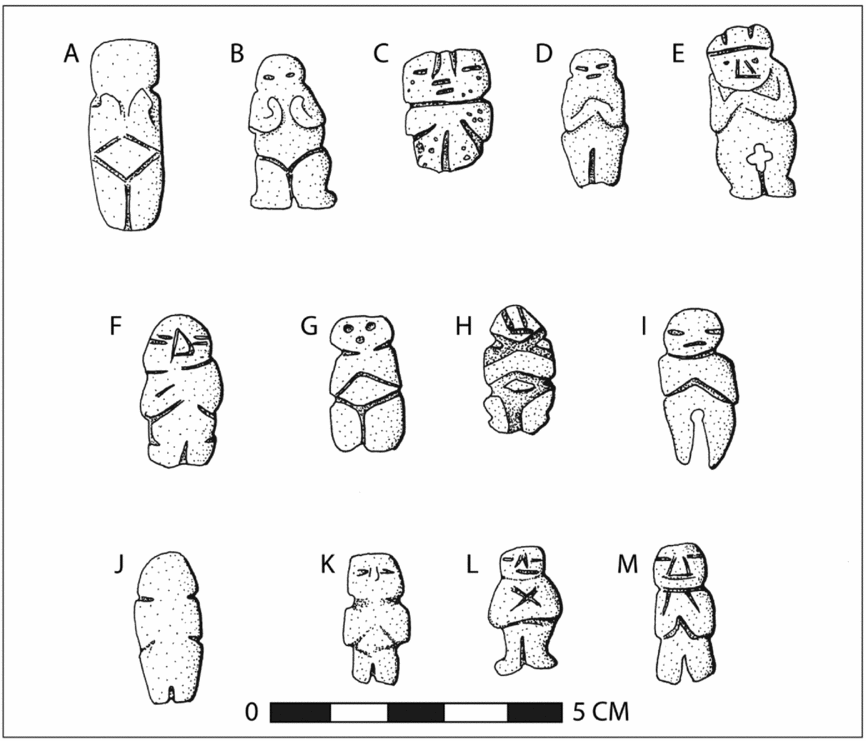
In this report, I propose interpreting certain miniature anthropomorphic figures commonly encountered archaeologically throughout the Maya lowlands as materialized intermediaries, or vehicles for souls of the dead. Anthropomorphic miniatures typically have minimal features, usually incised, with arms positioned over the chest (Figure 1). They are commonly made of shell, bone, and stone, including slate, jade, and obsidian; this differentiates them from ceramic figurines. Some of these anthropomorphic miniatures have arms completely crossed across the chest, while others have arms brought up with in-curved hands, palms facing outward. Legs are often together, separated by a single incised line, although some are crafted with legs drawn up into the chest, ankles crossed. Their sizes range from 2–7 cm in length. Some examples at Tikal, Guatemala have painted features (Moholy-Nagy and Coe Reference Moholy-Nagy and Coe2008). Their form, style of representation, and miniature size relate them to anthropomorphic miniatures in ritualized contexts elsewhere in Mesoamerica (Supplemental Figure 1). The interpretation proposed here may help in understanding a shared practice among this wider group.
Anthropomorphic Miniatures, often called “Charlie Chaplins”: A) Uaxactun (after Ricketson and Ricketson Reference Ricketson and Ricketson1937:plate 67); B) Tikal (after Moholy-Nagy and Coe Reference Moholy-Nagy and Coe2008:Figure 162b3); C) Piedras Negras (after Coe Reference Coe1959:Figure 5.1g); D) Copan (after Maudslay Reference Maudslay1889:plate 27); E) Chichen Itza (after Coggins and Shane Reference Coggins and Shane1984:Figure 134) F) Cahal Pichik (after Thompson Reference Thompson1931:177); G) Hatzcap Ceel (after Thompson Reference Thompson1931:Figure 17); H) Caracol (Lomitola Reference Lomitola2012:Figure 54 used with permission); I) Camp 6 (after Thompson Reference Thompson1931:plate XXXIX); J) Pacbitun (after Healy et al. Reference Healy, Awe, Iannone and Bill1995:5e); K) K'axob (after Harrison-Buck Reference Harrison-Buck and McAnany2004:Figure 4.3); L) San Jose (after Thompson Reference Thompson1939:plate 29); M) Las Ruinas de Arenal (Taschek and Ball Reference Taschek and Ball1999:Figure 11a).

Archaeological Context
Most Maya anthropomorphic miniatures were found in temple caches (see Lomitola Reference Lomitola2012 for detailed distributions). In Belize, most date from AD 15–200 or the Late Preclassic Period. Early Classic (AD 250–600) examples come from Copan (Maudslay Reference Maudslay1889), Tikal, and Uaxactun, and Late Classic (AD 600–800) examples appear at Piedras Negras (Coe Reference Coe1959). Rarely are they found in burials, but a few examples do exist. A cached collection in one burial at Tikal, another at Yaxuná (Stanton et al. Reference Stanton, Freidel, Suhler, Ardren, Ambrosino, Shaw and Bennett2005), two burials at Caracol (Chase and Chase Reference Chase and Chase2014), and one at Las Ruinas de Arenal (Taschek and Ball Reference Taschek and Ball1999) all date to the Early Classic Period. The Late Classic Period “High Priest's Grave” of Chichen Itza also includes an example (Thompson Reference Thompson1938). These burials all held remains of adults, with sex determination inconsistently reported. A few anthropomorphic miniatures were found in caches with stelae at Uaxactun (Ricketson and Ricketson Reference Ricketson and Ricketson1937), Tikal, and Piedras Negras. In one example at Pacbitun, anthropomorphic miniatures were included in an Early Classic ballcourt cache (Healy et al. Reference Healy, Awe, Iannone and Bill1995).
Of the more than 700 reported Maya anthropomorphic miniatures, over 550 were found throughout the temples of Tikal (Moholy-Nagy and Coe Reference Moholy-Nagy and Coe2008). The second largest reported group, 85, comes from Caracol (Lomitola Reference Lomitola2012). Unsurprisingly, anthropomorphic miniatures from Tikal display the widest variation. Often different styles were included in the same cache. They do not appear to form localized style groups.
Anthropomorphic miniatures are often part of patterned collections of materials layered and color coded, argued to index the Maya cosmos (Chase Reference Chase, Lackey and Kolb1988). For example, an offering in the core of a temple at Caracol included anthropomorphic miniatures in a bundle with marine shells, shark's teeth, and stingray spines; terrestrial elements including pumpkin seeds, pine needles, and a jade earflare; and carved animals and sky elements such as a honeycomb. This collection was encircled by four marine shell bivalves situated at the cardinal directions (Chase and Chase Reference Chase and Chase2006). Patterns of directionality and color are seen in other Late Preclassic offerings containing anthropomorphic miniatures in Belize, for example at K'axob and Las Ruinas de Arenal (Harrison-Buck Reference Harrison-Buck and McAnany2004; Taschek and Ball Reference Taschek and Ball1999). In burial contexts, miniatures are typically part of larger collections including marine materials, cinnabar, and jade inside ceramic vessels, similar to temple caches.
Bodies and Souls
In anthropomorphic representations, what is not represented is as meaningful as what is represented (Joyce Reference Joyce, Renfrew and Morley2007:8). Unlike Maya ceramic figurines that depict various ages, dress and activity, these anthropomorphic miniatures were crafted with minimal features. Clothing, hair, and genitalia are absent; even facial features may not appear. They just barely qualify as identifiably “human,” with many features lacking beyond the head and four limbs. Maya ethnographies describe outer appearance, including dress, language, and customs as attributed to the self, divisible from multiple “souls” that inhabit the body (Guiteras-Holmes Reference Guiteras-Holmes1961; Pitarch Reference Pitarch2013). A variety of stages and forms of the lived body were represented in figurines, painted scenes on pottery, and carved stone monuments. What we encounter in anthropomorphic miniatures is the other side of the self, the immaterial side, the “soul” or spiritual substance, devoid of detail and individual traits that distinguish one body from the next.
Ethnographically, souls are free flowing, inhabiting mountains and caves. They can be called into material bodies. This does not imply bringing a dead object to life, but rather, furnishing a body such that it allows a relationship with the sacred during rituals under human control (Pitarch Reference Pitarch2013). Unlike ceramic figurines, anthropomorphic miniatures were intentionally made generic, providing material vehicles for mobile souls.
Bodies to Recall the Dead
Anthropomorphic miniatures were, I argue, material links to ancestors who had moved on to other worlds. Ancestors were powerful agents in Classic Maya society, holding influence over the living. Descendants sought out material links to ancestors in order to engage them. In some cases, bones, particularly skulls and long bones, were curated as physical links to ancestors. The bones themselves were not considered to be the ancestor, as the soul had already moved on. Rather, the bones provided a material connection to the ancestor (Sherer Reference Sherer2015:96).
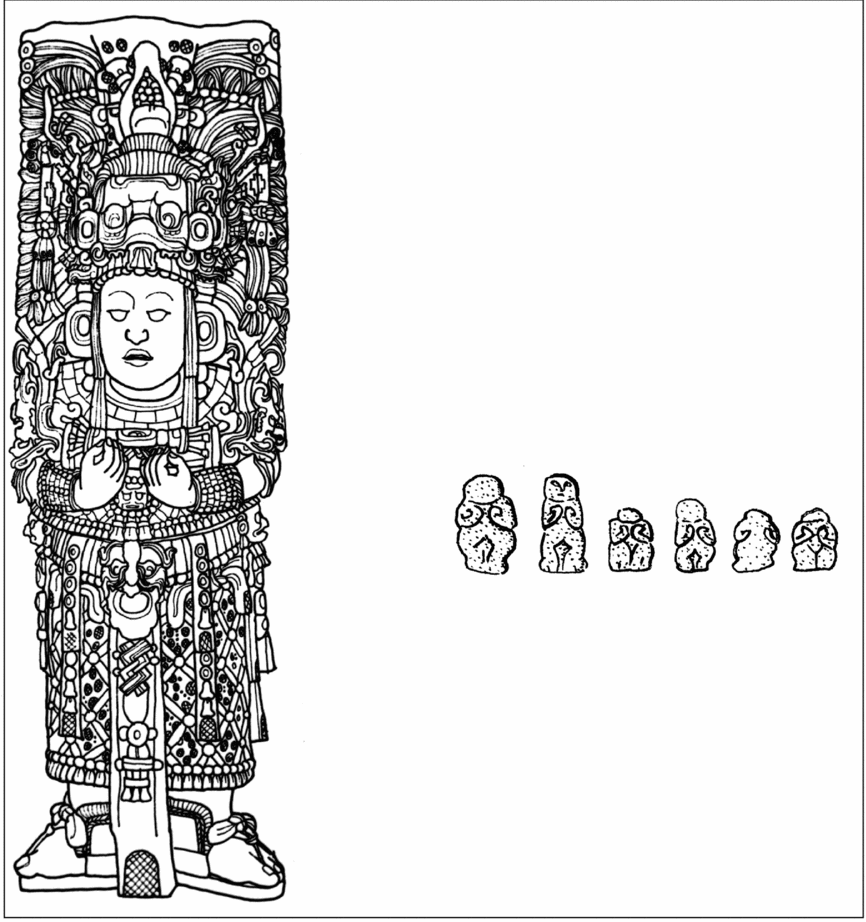
By crafting anthropomorphic miniatures in poses similar to those adopted by rulers, they are shown as intermediaries between earthly and supernatural realms. A ubiquitous feature of anthropomorphic miniatures is the position of the arms across the chest. This position is a common feature of Mesoamerican figural representations, on stone monuments as well as small carved stones (Urcid Reference Urcid1993; Zeitlin Reference Zeitlin1993). Many Maya monuments depict rulers with arms across the chest, hands inward, palms facing out, often with arms wrapped around a “ceremonial bar.” The ruler's costume and held objects “represented the totality of the cosmos, indicating the king's positioning at the cosmic center” (Gillespie Reference Gillespie, Boric and Robb2008:126). The ruler in this pose was an intermediary between the earthly domain and his subjects, and other worlds in which supernatural beings dwell (Figure 2).
Copan stela H (illustration by Schele used with permission) and miniature figures from Tikal with incurved hands, not to scale (Moholy-Nagy and Coe Reference Moholy-Nagy and Coe2008: Figures 80h1,2,3,4,5,7).

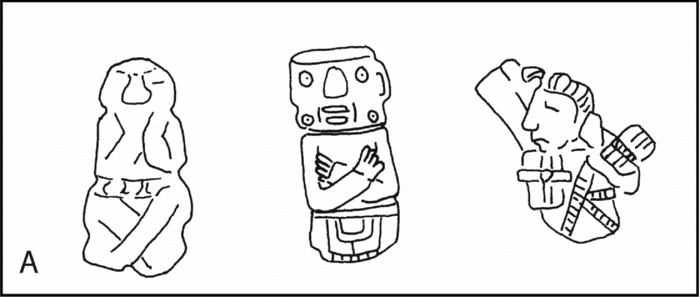
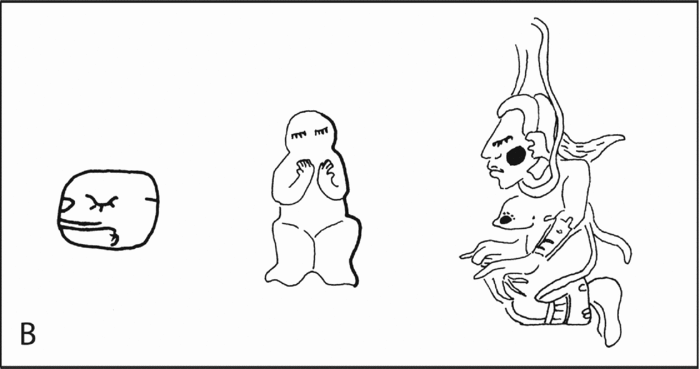
Anthropomorphic miniatures with arms across the chest found outside the Maya area have been described as recalling bundled bodies (Paddock Reference Paddock1966; Urcid Reference Urcid1993; Zeitlin Reference Zeitlin1993). Bundling the deceased in tightly bound cloth wrapping is noted across Mesoamerica (Guernsey and Reilly Reference Guernsey and Reilly2006). The dead were bundled either in sitting positions, more typical in West Mexico, or extended, more common in the Maya region (Figure 3a). Maya iconography of death includes closed eyes, bundled skull and long bones, death spots, and skeletal features (Coe Reference Coe and Benson1975; Quirarte Reference Quirarte, Hammond and Willey1979). Among anthropomorphic miniatures found at Tikal, some have eyelashes extending downward, suggesting the eyes are closed. The eyes of a dead goddess in the Dresden Codex, in addition to the eyes of a head glyph for “death or dying,” are also depicted with downcast eyes (Figure 3b). At Tikal, where roughly 53% of burials were in a flexed position with legs drawn up, there are anthropomorphic miniatures that show legs drawn up (Sherer Reference Sherer2015:83). This is not common outside of Tikal, suggesting a correlation of practice and representation.
From left to right: Anthropomorphic miniature from Tikal, with legs drawn up and arms across the chest, resembling a bundled body (after Moholy-Nagy Reference Moholy-Nagy and Pohl1985:Figure 10.8); Penate figure from Monte Alban with arms across the chest and legs up (after Caso Reference Caso and Wiley1965:Figure 31); Mixtec codex drawing of bundled body with eyes closed (after Nuttall Reference Nuttall1975).

From left to right: One version of the Cham glyph (T736v) translated as “to die” or “death” with eyes closed (after Montgomery Reference Montgomery2002:55); a “Charlie Chaplin” figure from Tikal with eyes closed and incurved hands (after Moholy-Nagy Reference Moholy-Nagy and Pohl1985:Figure 10.8); a dead goddess from the Dresden Codex with eyes closed and death mark on her cheek (after the Dresden Codex:53).

Camahuiles in Highland Guatemala
One resource for understanding anthropomorphic miniatures comes from the Guatemala Highlands, where similar objects are used by contemporary Maya. Bowls with small stone figures stacked inside were found as offerings at the Quiche Maya site of Zacualpa (Wauchope Reference Wauchope1975). Contemporary Maya healers have adopted them in their work, calling them “little helpers,” and describing them as general ancestors of the community (Frühsorge Reference Frühsorge2015). Today, these objects are called camahuiles. This word has been related to the Quiche c'abawil, often used for “deity” (Orellana Reference Orellana1981), but Tedlock explains that “k'ab'awil or ‘god’ refers to the patron deities of the ruling Quiche lineages and to the sacred stones that were the material embodiments of these deities” (Tedlock Reference Tedlock1996:222). While caba uil is a Quiche term for images of deities, the word kame is literally “death” (Edmonson Reference Edmonson1965:55). These figures may be images of death or representations of the dead.
Conclusions
In this report, I have suggested that certain anthropomorphic miniatures are materialized representations of dead bodies, serving as receptacles for ancestors and ritual companions. Intentionally crafted with minimal features, these generic human forms of jade, shell, bone, and slate are very different from ceramic figurines. Through their lack of human features, the immaterial side of the self or the soul is materialized. The archaeological contexts in which they are found suggest that they were important in ritual, primarily during the Late Preclassic and Early Classic Periods, with a few examples dating to the Late Classic Period at Piedras Negras and Chichen Itza. Through a consideration of their context and iconography, drawing on ethnohistorical and ethnographic information, I have shown that these anthropomorphic miniatures could recall the dead in their represented form and thus were active.
Miniature anthropomorphic figures, often made of jade, of varied styles and levels of abstraction, are found throughout Mesoamerica. Anthropomorphic miniatures at sites such as Monte Alban (Caso Reference Caso and Wiley1965), and from the temples of Teotihuacan (Cabrera Cortés Reference Cabrera Cortés and Ruiz Gallut2002) are similar in their represented form and ritual contexts. A shared role for more generic anthropomorphic miniatures in ancient Mesoamerican ceremonial life, as containers for spirits of the dead, may explain the occurrence of these features in widely separated cultural traditions.
Acknowledgments
Initial work on this research was carried out with support from Arlen and Diane Chase. Lucas Johnson and James Crandall provided feedback.
Data Availability Statement
No original data were presented in this paper.
Supplementary material
To view supplementary material for this article, please visit https://doi.org/10.1017/laq.2018.29
Supplemental Figure 1. Map of sites mentioned in text.
Supplemental Figure 2. Camahuile figure of greenstone from Zacualpa in Highland Guatemala (after Wauchope Reference Wauchope1975:Figure 24).