




No CrossRef data available.
How Stable are Morphological Doublets? A Case Study of /[schwa]/ ∼ Ø Variants in Dutch and German
Published online by Cambridge University Press: 01 December 2004
Abstract
This paper examines the diachronic development and synchronic status of morphological doublets in Dutch derivation (adjectives in -(e)lijk) and German inflection (genitives in -(e)s) in the light of the commonly held view that functionally equivalent doublets are rare in morphology and, where they do exist, tend to be small in number and diachronically unstable (see, for example, Kroch 1994). It is shown here that large numbers of doublets can thrive for centuries, despite the fact that they require a high degree of arbitrary lexical information, while others tend to be eliminated systematically by organizing words into lexical “gangs” defined by phonological and morphological properties. It is also argued that the lexically conditioned nature of the inflectional doublets provides evidence for the wholesale lexical listing of German genitives.I am very grateful to Martin Durrell, and to Roel Vismans and other Dutch speakers present at the Association for Low Countries Studies Conference in Sheffield (January 2004), at which the Dutch section of this paper was presented, for their very helpful comments. I would also like to thank the two anonymous referees for their invaluable feedback.
Information
- Type
- ARTICLES
- Information
- Copyright
- © 2004 Society for Germanic Linguistics
Introduction
From neogrammarian linguistics through to present-day generative theories, it has always been assumed that doublet forms are rare in morphology, in much the same way as absolute synonyms are in semantics (Bloomfield 1933:145). This is assumed to be due to a general economy constraint on the storage of linguistic items (Kroch 1994:180) that prevents speakers from having multiple variants of a word or a word form with no functional distinction between them.1
The same argument is also used for rule-based approaches, where one rule blocks the application of another that would generate a doublet form (see, for example, Kiparsky 1973, 1982).
In generative theory, various mechanisms have been established in order to account for the lack of functionally equivalent doublets in language; for example, the Elsewhere Condition (Kiparsky 1973), lexical blocking (Aronoff 1976), disjunctive ordering (Anderson 1981), level ordering (Kiparsky 1982), and more recent versions of these (Kroch 1994, Giegerich 2001). Here the general consensus is that blocking occurs automatically; that is, the use of one variant (usually an irregular form that has to be lexically specified, such as sang) blocks the occurrence of the other (usually the one that would be derived by a regular rule, *singed) unless, of course, the doublets reflect some sort of functional distinction and are therefore exempt from blocking. For example, in the pigeon flew out, flew blocks *flied, but not in the specific use of fly out in baseball as in the batter flied out to center field (Kroch 1994). The main difficulty with these approaches, however, is that the observation upon which they are based, namely that doublets rarely occur, is itself flawed. Morphological doublets that are functionally equivalent do occur in language, indeed sometimes in large numbers (see section 6 below), and this does not appear to pose a problem to native speakers.2
See also Eddington 2002 for diminutive doublets in Spanish, although it must be pointed out that many of his examples may reflect regional distinctions.
In the following sections, two Germanic suffixes are examined, each of which is realized by two allomorphs. The words containing these suffixes are considered to be doublets under this account, as the allomorphs are not systematically conditioned by phonological, morphological, or semantic factors. That is to say, each word has two variant forms, and both can be used interchangeably. The doublets in question are Dutch derivational forms in -(e)lijk and German genitives in -(e)s. Although, superficially, both types appear to be similar (having a variant with and without schwa), they are in actual fact very different in terms of their diachronic development: the Dutch doublets are gradually eliminated (or, at least, reduced in number) systematically, while the German ones behave quite randomly, thriving for centuries despite their lexical arbitrariness.
Doublets in Dutch derivation
In Dutch, -elijk /[schwa]l[schwa]k/ and its variant -lijk /l[schwa]k/ are derivational affixes marking adjectives that have nouns, verbs and other adjectives as their base, and are often equivalent to the English suffixes -able/ible, when associated with verbs (e.g., begrijp ‘understand’, begrijpelijk ‘understandable’) or -ly when associated with nouns and adjectives (for example, vriend ‘friend’, vriendelijk ‘friendly’; bang ‘afraid’, bangelijk ‘fearful(ly)’). Adjectives in -(e)lijk are very common (that is, they have a high type frequency) but are largely unproductive (Geerts et al. 1984:353, Kooij 1982:322).3
Such examples show that one cannot always equate high type-frequency with productivity (see Bauer 2001:48 for discussion).
See Fehringer 2003b for a full treatment of the distribution of schwa before the suffixes -lijk, -ling, -nis, and -loos.

When the stem preceding the suffix ends in a fricative, however, the occurrence of schwa appears to be more sporadic, and often doublets occur; for example, ongelofelijk and ongelooflijk ‘unbelievable’ (see the verb stem geloof ‘believe’).5
The doubling of the vowel is a spelling convention in Dutch and does not reflect a change in pronunciation. Long vowels are written as two vowels in closed syllables and as one vowel in open syllables. Conversely, short vowels in open syllables are indicated by doubling the following consonant.

By contrast, the following fricatives alternate with a voiced fricative when a vowel follows, but appear voiceless in syllable-final position due to the general phonological rule of final obstruent devoicing in Dutch (see Booij 1995:33, 55).

The velar fricative is somewhat different from /v/ and /z/ in that many speakers neutralize the voice distinction in certain phonological environments (Booij 1995:8). The fact that it is an alternating fricative is reflected in the choice of past tense suffix for verb stems ending in 〈g〉; for example, legde ‘laid’, where -de attaches to voiced sounds and alternating fricatives (which Booij regards as “underlyingly voiced”) while -te attaches to voiceless consonants as in lachte ‘laughed’.
It is interesting to note that /v/ and /z/ remain voiceless in these examples despite the presence of a following vowel, and hence no longer being in syllable-final position. This seems to be a lexical peculiarity of all stems ending in /v/ [f] and /z/ [s] before -elijk. Booij (1995:92–93) accounts for this by positing a “morpholexical rule” that states that these consonants do not voice before -elijk.
As we can see from the examples above, it is within this group of words with stem-final alternating fricatives that the doublets occur.8
Unless, of course, the stem final syllable is unstressed, in which case schwa is always absent; for example, vúriglijk ‘fierily’.
According to the most recent edition of the Van Dale Groot Woordenboek der Nederlandse Taal (otherwise known as the Grote Van Dale), the words in 4 appear as doublets.9
The list includes not only words with stems ending in an alternating fricative but also those ending in /n/ preceded by a short vowel, as in mannelijk, although it will be argued here that this latter group does not allow doublets (or, at least, no longer does).

Note that it is not possible to make the generalization that all words in -(e)lijk whose stems end in an alternating fricative (or in a short vowel plus /n/) have doublet forms, as there is an equally numerous group of such words that the Grote Van Dale lists as having one variant only, as shown in 5.

This is listed as lijfelijk and lijflijk in Geerts et al. (1984:356).
If these dictionary data reflect actual modern usage, the implication is that native speakers of Dutch must simply learn which words allow doublets and which do not, as it appears to be a purely lexical matter.
Methodology
In order to determine whether the forms listed in the Grote Van Dale as doublets do indeed reflect modern usage, an online corpus covering a variety of Dutch texts dating from 1970 to 1995 was consulted. This is a sub-corpus of the Institute for Dutch Lexicology's 38 million-word corpus (INL 1996) containing 31,843,116 words. The main motivation for concentrating on written rather than spoken data was the greater accessibility of the former. This was also coupled with the fact that in the spoken language the occurrence of schwa before -lijk can be quite unsystematic, with idiolect and pragmatic factors playing a role (for example, schwa being inserted for emphasis, as in ongelófélijk! ‘unbelievable’, where the acute accents indicate stress [Taaladvies Online]). Thus, it must be borne in mind when discussing the Dutch doublets that we are dealing with forms that have been internalized by speakers after having been taught them formally, since it is when they are learning to write that native speakers of Dutch learn which -lijk forms permit doublets and which do not.
The token frequency of each doublet listed in the Grote Van Dale with -elijk and -lijk was examined (see 4 above), and, for the purpose of comparison, the token frequency of similar words with stems ending in an alternating fricative (or in a short vowel plus /n/), which the Grote Van Dale lists as having only one alternative (see 5 above). The results are given in tables 1–7 in the next section. The texts examined are written in standard Dutch and are mainly nonfiction (a large proportion of them are newspaper and magazine articles). They were chosen in order to rule out dialectal influence, although it is recognized that this is not always possible. General Internet searches (for example, using Google) were generally not carried out, since the results of these can be unreliable: they often include misspellings, dialectal forms, and there are often multiple entries for the same text on different Web sites, which makes the word under investigation appear to be used more frequently than it actually is.11
Having said that, the Internet was consulted in one case where the word did not occur in any text or in the corpus, and again at the end in order to compare the frequency ratios of established doublets with the results from the INL corpus (see note 32).
This also falls into the category “verb and noun base”: gerief can be a verb stem or a noun (see note 26).
Note that /v/ is voiced in respectievelijk (compare respectief) and successievelijk (compare succesief).
In many cases, the doublet forms listed in the Grote Van Dale reflect earlier usage. Therefore, the historical development of these forms was investigated using texts from the seventeenth century in which there was a clear distinction between those forms that occurred as doublets on the one hand (broadly speaking, those listed in 4 above and some from 5) and forms that were consistently spelled with either -elijk or -lijk on the other hand (that is, words of the type given in 1 and 2 above).12
Despite the fact that spelling had not yet been standardized in the seventeenth century, the distinction made between forms in -(e)lijk (17th-century -(e)lijck) that allowed doublets and those that did not was surprisingly systematic (apart from a few cases where words with stems ending in 〈d〉 sometimes showed variation, as in godlijck/goddelijck (Coornhert, about 644).
The token frequency of the seventeenth-century doublets involving -(e)lijk is given in the tables below under Statenvertaling. Examples from Vondel and Coornhert are presented in brackets preceded by the abbreviations Vdl. and Cht. respectively. A cell that is left blank indicates that the word was not attested in either of its doublet forms in the texts. Finally, a comparison was made between the Statenvertaling and a later well-known Dutch translation of the Bible, the Leidse Vertaling of 1899–1911, in order to examine the development of the -(e)lijk doublets within a uniform context. By the time that the Leidse Vertaling was complete, written Dutch had, to a great extent, become standardized.
Results
These can be divided into subgroups based on phonological criteria: (i) stems with a short vowel followed by a final /n/, and (ii) stems ending in an alternating fricative, which can be further subdivided according to the sound preceding the fricative and the latter's place of articulation.
Stems with V/n/
This first group is extremely clear-cut. If we examine the token frequencies of words whose stems have a short vowel (abbreviated to V) followed by /n/, it becomes clear that, despite some of them having occurred at earlier stages of the language, the forms without schwa are simply not used in modern Dutch, at least for the most part, despite being listed as doublets in the Grote Van Dale.13
Token frequency results include the occurrence of different word-forms (for example, inflected adjectives and comparatives such as mannelijke, mannelijker, etc.).

Even in the two cases where the schwa-less form does occur, that is, kenlijk and manlijk, its token frequency is minimal in relation to that of the corresponding form with schwa, which means that we can also disregard these as valid alternatives.14
It should also be noted that the corpus may well contain some spelling errors.
The preference for schwa in the above forms is not accidental, but has a sound phonological basis (it is prosodically motivated)15
Fehringer (2003b) argues that it is motivated by foot structure: schwa is inserted to create a branching foot before -lijk.
Stems Ending in an Alternating Fricative
The situation with words ending in an alternating fricative, however, is much more complex, and here we see that the interaction of a number of different factors (phonological, morphological, and frequency-related) leads to the creation of subsets, often referred to as “gangs” in the psycholinguistic literature, which are defined by family resemblances.16
See Alegre and Gordon 1999, Bybee 2001, and also Eddington 2002 and Fehringer 2003a.
(a) Stems ending in C + fricative. The most consistent gang is based on phonological criteria: if the stem-final fricative is preceded by another consonant (abbreviated to C), it is regularly followed by -elijk. Some of these forms are listed in the Grote Van Dale as having only one alternative (that is, with schwa), while others are listed as having two. It is interesting to note, however, that the variants without schwa do not occur in the modern Dutch corpora, which suggests that they are not used (or, in some cases, no longer used). Table 2 illustrates the fact that doublets do not occur in words of this phonological type.

Note that derivatives of the adjectives, for example, sterfelijkheid ‘immortality’, follow the same pattern as the adjectives with regard to the occurrence of schwa.
As with the V/n/ stems above, there is a good phonological motivation for the preference of schwa in these forms, albeit of a different nature; namely, the desire to break up clusters of more than two consonants for ease of pronunciation (see the insertion of schwa between consonants in words such as film, melk, berg, etc. [Booij 1995:127–128]).18
For example, this statement is valid for -(e)lijk but not for -(e)loos ‘without’, as in werkloos ‘unemployed’, which has a cluster of three consonants. This suffix, however, has a different prosodic status to -lijk; that is, -loos forms a prosodic word of its own while -lijk does not (Booij 1995:86).
(b) Stems ending in V(V)/x/. Another readily identifiable subset or gang of words, albeit not as consistent as the ones outlined above, consists of forms whose stems end in a vowel (either long, short or a diphthong) plus /x/. Here the pattern is relatively clear. Speakers show a definite preference for the schwa-less -lijk, except when the base is an adjective. Indeed, it is interesting to note that many of the forms that occurred regularly with -elijk in the seventeenth century (or that varied between -elijk and -lijk) have clearly moved toward -lijk in the modern texts. Consider the examples in tables 3 and 4 on the following pages:

Some of the -(e)lijk adjectives occur quite often in the negative form (with the prefix on-). As there appears to be no difference between the positive and the negative adjective with regard to the occurrence of schwa, both are treated together.
By contrast, gezeglijk ‘biddable’, from the same base, is listed as having only the schwa-less alternative, but the word does not occur in the older texts or in the modern corpora.

The noun gevoeg does exist, yet its meaning is unrelated to the adjective synchronically.
It is evident from the forms also attested in the older texts that there is a definite progression from -elijk to -lijk in these words, and that we are not dealing with a case of random variation. Moreover, the fact that these words can be found in exactly the same context, which is the case when comparing the 1637 Bible with the 1899–1911 version, suggests that this change is not context-dependent. Some examples are provided in 6.

See King James: but let not Pharaoh deal deceitfully any more, be ye stedfast, unmoveable
In contrast to the abovementioned words with stems in V/n/ and those with a consonant preceding the final fricative, there is no obvious phonological motivation for stems ending in V(V)/x/ to disfavor schwa.23
It is possible that consonantal strength might play a role here. As the velar fricative /x/ is a relatively weak consonant (Ernestus and Baayen 2003:7), and weak consonants form good syllable contacts with a following suffix-initial sonorant (Shannon 1991), there is no need to insert schwa.
See also vergeeflijk and toegeeflijk below.
With regard to the exceptions, ontegenzeggelijk cannot easily be explained. Yet the occurrence of mogelijk and hertogelijk are less surprising. It is highly likely that the resistance of mogelijk to join the rest of the gang in moving toward the schwa-less form has to do with the fact that it is an extremely frequent word (see table 3 for its token frequency relative to that of the other words in the gang), and it is well known that the frequent use of a word serves to reinforce its form in the mind of the speaker and therefore make it more resistant to change (see, for example, Bybee 1985, 2001). Moreover, its meaning is not completely predictable with regard to that of its associated verb (mogen ‘to be allowed’; mogelijk ‘possible’), which also contributes to its idiosyncratic status. The occurrence of hertogelijk is also unsurprising, albeit for a different reason. This form is different from the other members of its gang in that it is irregular with respect to its base: hertog ‘duke’ has a short vowel before the final consonant, whereas hertogelijk has a long vowel. This means that hertogelijk must be marked in the speaker's mind as “special” in some way, which could also protect it against change.
The fact that the occurrence of -elijk or -lijk after V(V)/x/ stems is also morphologically motivated can be seen in the behavior of the deadjectival forms, which regularly occur with schwa in modern Dutch.

This observation is not just based on these two items, but, as is shown on examination of stems ending in /s/ and /f/, it is a salient pattern with all deadjectival forms in -(e)lijk, many of which are also used as adverbs.
Returning to the question of doublets, the only words that regularly appear as having two alternatives in the modern corpora are klagelijk/klaaglijk and gevoegelijk/gevoeglijk, which, interestingly, are not those that the Grote Van Dale lists as doublets. As their stems end in VV/x/ and they are not adjectival we would expect the schwa-less form to dominate, and it does appear from the historical development of these words that they are moving in that direction, albeit more slowly than the other members of the gang. It is interesting that these two words have one thing in common: the joint token frequency of their modern Dutch forms is quite low in comparison to that of the other members of the gang, except hertogelijk, which is irregular in any case (see table 4). This may account for the lack of definite preference for one form over the other.25
The link between frequency and preference for one variant over the other is also evident in the German data (see section 8.3).
(c) Stems ending in VV/s/. Another gang thay can be readily identified consists of stems in /s/ preceded by a long vowel or diphthong. This gang contrasts sharply with the V(V)/x/ gang in that schwa is favored in most cases, and indeed has been since the seventeenth century, as shown in table 6:

This refers to words such as ijselijk and vreselijk which, although they are historically derived from verbs, are also associated with nouns that have the same form as the verb stem (ijs and vrees) and appear to behave in the same way as words with noun bases, unlike, for example, verkies and genees, which cannot be interpreted as nouns.
Neither forms of this word were attested in the older texts or the modern corpus. Slafelijk is listed in the Groene Boekje (Woordenlijst 1995) as the only alternative, and an Internet search produced results of 6:1 in favor of -elijk.
This is an older word that is no longer used.
Again, morphological criteria appear to play a role here, as words with a verbal base prefer the schwa-less form, while words with a nominal or adjectival base occur regularly with schwa. These morphological preferences can be found in other gangs as well. We have already seen that words with an adjectival base prefer schwa (see table 5), and it is demonstrated below that the preference for schwa-less forms with verbal bases is prevalent with words in /f/ (table 7).

As far as doublets are concerned, there are none whatsoever to be found in this group. Indeed, it appears that most words in VV/s/ were lexicalized at quite an early stage and there was little change after that.
(d) Stems ending in VV/f/. This gang, consisting of stems ending in /f/ after long vowels and diphthongs, is similar to the VV/s/ gang in that deverbal stems tend to occur without schwa while the majority of other gang members prefer schwa. However, the pattern here is less salient than in the VV/s/ gang, and there are more doublets present.
Once again, we see a preference for schwa in the deadjectival forms, except with lief(e)lijk which has two alternatives, and again in the denominal forms, except with gerief(e)lijk which also has doublets. By contrast, the verbal forms tend to occur without schwa, unless doublets are permitted.
Thus, according to the token frequency results in modern Dutch, four of the words in this gang have doublet forms, albeit at slightly different ratios, as shown in 7.

Unlike klagelijk/klaaglijk and gevoegelijk/gevoeglijk mentioned above (see tables 3 and 4), the persistence of the doublets with VV/f/ cannot be explained in terms of relative frequency. While klagelijk/klaaglijk and gevoegelijk/gevoeglijk are relatively infrequent members of their gang, which means that there is not one particular form that is being reinforced by regular use, the doublets in VV/f/ are all fairly (and some very) frequent in their occurrence when compared to other gang members. Thus, we would expect one form to have ousted the other by now.
The fact that these doublets are recognized as such by native speakers of Dutch is evident from the “Online Language Advice” Web site of the Nederlandse Taalunie (Taaladvies Online) which states that both spelling variants are “official” (although the Web site lists a few more pairs of doublets than our results produced).31
The fact that there is no semantic difference between the doublets distinguishes them from near-doublet forms in -(e)loos ‘-less’ that often have a figurative meaning where schwa is present, but a more literal meaning when it is absent; for example, zouteloos ‘insipid’ versus zoutloos ‘without salt’ (compare zout ‘salt’). For more examples, see Fehringer 2003b.
Summary
The twenty-seven words listed in the Grote Van Dale as having doublet forms may well have had them at some stage of their development (and an investigation of older texts shows that this was often the case), but there has been a gradual tendency for speakers through the generations to favor one form over the other, so that modern Dutch is left with merely a handful of examples.

It is interesting to note that if we do a general internet search (e.g., using Google), the resulting ratios are as follows: onbeschrijf(e)lijk and ongelofelijk/ongelooflijk remain at about 1.5:1 and 1:2 respectively; gerief(e)lijk has slightly less differentiation at about 1:2; gevoeg(e)lijk and klagelijk/klaaglijk favor the schwa-less forms by about 1:2.5; and lief(e)lijk favors schwa by almost 1:6.
In the majority of cases where one form is preferred over another, so that doublets no longer exist, the choice of alternative is not simply a matter of lexical idiosyncrasy, but is governed by a number of general factors (phonological, morphological, and frequency-related) that lead to the creation of subsets, or gangs, of words identifiable by salient patterns. These can be expressed using the schemas in 9 (see Bybee 2001).

It is interesting to note that within the group of words whose stems end in an alternating fricative, there is a correlation between the use of schwa and the strength of the preceding fricative (see 10 below), which also ties in with Shannon's (1991) observation that weak consonants make good syllable contacts with following sonorants (in this case /l/) while stronger ones do not, and therefore schwa is inserted after strong consonants to break up the “poor” contact.

Thus, alveolar fricatives tend to be followed by schwa, while velars do not, and the labiodentals show hesitation between the two tendencies, hence the occurrence of doublets. However, it should be taken into account that these phonological factors interact with morphological ones, so that there is some degree of overlap between the gangs. For instance, most words with verb bases have -lijk, while those with adjective bases have -elijk, irrespective of the final consonant. As far as the V/n/ and VC + fricative gangs are concerned, -elijk occurs with all types of base, which indicates that these gangs are determined by phonological factors alone.
As words in -(e)lijk are not always semantically transparent, 33
For instance, words in -(e)lijk with verb bases often have a more figurative meaning than their corresponding forms in -baar, which also denotes ‘-able’ but is more productive; for example, dragen ‘to carry’, draagbaar ‘portable’, draaglijk ‘bearable’; bewegen ‘to move’, beweegbaar ‘movable’, beweeglijk‘lively, mobile’ (Geerts et al. 1984:354).
This type of lexical organization has been represented using formal mechanisms based on the Analogical Modelling of Language (AML, see Skousen 1989, 1992), which has been shown not only to account for existing patterns but also to predict the behavior of new words (see, for example, Eddington 2002 and Ernestus and Baayen 2003).
Doublets in German Inflection
Since the Early New High German period, the occurrence of doublets in written German texts has been a common phenomenon; namely in the genitive singular forms of strong masculine and neuter nouns, which can end in either -s or -es /[schwa]s/. Generally speaking, -es always occurs in indigenous words after the sibilants written <s, ß, x, z> (Glases ‘glass’, Reflexes ‘reflex’), and predominantly after 〈sch, tsch, st〉 as in Busches ‘bush’. By contrast, -s is always used after -en, -em, -el, -er, -ling, mostly after vowels, diphthongs and unstressed syllables, and with loanwords and proper nouns such as Wagens ‘car’, Fotos ‘photo’, Abends ‘evening’, Friseurs ‘hair-dresser’, Schmitts ‘Smith’ (see Drosdowski et al. 1995:221–222, Durrell 2002:22–23). For the most part, this was also the case in Early New High German (Moser, Stopp, and Besch 1987:61–64).35
For a more detailed account of the distribution of modern German -es and -s based on phonological criteria, see Pfeffer and Morrison 1979.
In his generative account of the phenomenon, Becker argues for a morphological solution, in contrast to the more phonologically based approaches to the /[schwa]/ ∼ Ø alternation in German such as those of Strauss (1982), Giegerich (1985), and Wiese (1986).
Methodology
In order to establish the extent to which these genitive doublets are used and, if so, whether their use is determined by context-based factors such as sentence prosody, priming from preceding genitives, or register, it is necessary to find an electronic corpus that not only gives token frequency results but also shows the context in which the words to be investigated appear. One such corpus is the Wortschatz Deutsch project of the University of Leipzig, which contains 35 million sentences with 500 million running words. The corpus includes material from the eighteenth century up to the present day, incorporating both literary and journalistic writing. As the genitive is a feature of written rather than spoken German (see Durrell 1992a:18), a corpus such as Wortschatz Deutsch, which focuses on the written language, is highly appropriate for the present investigation. Indeed, some spoken varieties of German do not use these genitive forms at all, and where they are used in speech they tend to signal a more formal register. Thus, the German data have in common with the Dutch forms outlined above the fact that they are learned by native speakers when they learn to write, which indicates that both the Dutch and the German data have been internalized late.
In addition to the modern German corpus, a corpus of Early New High German from the University of Bonn was also examined in order to compare the relative token frequencies of the variants in earlier stages of the language with those of the modern German examples. This corpus, which is as yet unpublished, includes data from a variety of regions, ranging from 1350 to 1700 (see http://www.ikp.uni-bonn.de/dt/forsch/fnhd/ for further information).37
Many thanks to my colleague Jonathan West for allowing me to borrow his hardcopy of the corpus, and for alerting me to the problem of genitive doublets in German.
Results
This section investigates the relative token frequencies of genitive doublets in a selection of words from the (very large) subset of forms that do not fulfill the abovementioned phonological or morphological criteria for the definite preference of -s or -es.
Phonological Factors
First, the words are organized into groups determined by their phonological shape in order to establish any connection between word-final sounds and choice of genitive allomorph. For the sake of uniformity, the words chosen are all monosyllabic. The token frequencies given refer to the word standing alone and not as part of a compound. If a related compound exists whose first element appears to be a genitive, this information is given in a separate column in table 8 below.38
The careful wording “appears to be a genitive” is due to the fact that linguists often disagree as to whether the -(e)s-between the two nouns of a compound is a case of inflection or simply a derivational “linking element” that has the same form as the genitive. For a detailed discussion of this issue, see Isensee-Montgomery 2001.

If we examine the genitives standing alone, there is a general preference for the suffix with schwa, which tends to be the case with monosyllabic words (Durrell 2002), yet it is interesting that it is much greater with some words than with others, and it does not appear to be a phonological matter but depends on individual lexemes. Thus, Leib shows a marked preference for -es, while Staub shows no definite preference. (This does not mean, however, that Leibes and Leibs are not doublets, as even at a ratio of 18:1 there are still enough examples of the less common form to establish its validity).
Indeed, the nature of the final consonant does not appear to play much of a role in the choice of suffix allomorph in modern German. For instance, Hugo, Stopp, and Moser (1987:44) claim that in Early New High German there was a preference for -es after dentals. However, evidence from the Bonn corpus shows that this depended on individual lexemes (see table 8), and in modern German the preference for -es is more general. The only evidence of phonological conditioning can be seen in nouns with a short vowel ending in /k/, which appear to prefer -s in modern German. In contrast to the Dutch developments outlined above, there appear to be no instances of gang effects causing speakers to choose one variant over the other. Indeed, doublets thrive in the modern language, with only a slight preference for -es in many of the examples contrasting with a more definite preference in others.
On further examination of nouns ending in a plosive (see table 9), it becomes apparent that phonological considerations are far outweighed by lexical conditioning, and that a more important factor in the preference for one form over the other is frequency of use. That is to say, it is often the case that very commonly used nouns, as evident from the high numbers produced after adding the token frequencies of the two variants together, show the highest ratios in favor of one variant (in these cases, -es), even allowing for the fact that some of these may occur in set phrases and therefore produce more difference in ratio, as in um Gottes willen ‘for God's sake’.39
Pfeffer and Morrison (1979:304) note that the preference of -es with words ending in two or more consonants is motivated by the desire to avoid consonant clusters. This is a natural phonotactic constraint, yet it is interesting that its application is heavily influenced by arbitrary lexical factors.

See Feindeshand ‘hands of the enemy’ and Feindesland ‘enemy territory’, which are now archaic.
Lands-is also used but much less commonly.
If we examine words ending in a fricative and words ending in a sonorant consonant, we find that they behave very similarly to those ending in a plosive. For example, there is generally a preference at differing ratios as shown in table 10.

Again, the most frequent word, Jahr, shows a definite preference for -es, though it must be noted that the correlation between frequency and high ratios is merely a tendency and not systematic; for example, the token frequency of Buch(e)s is higher than that of Dorf(e)s, yet the ratio of the former is lower than that of the latter.
Unlike words ending in an obstruent, the sonorant-final forms are less uniform in their general preference for -es, and they are also less uniform than their Early New High German counterparts (table 11).

Most forms in Manns-are either colloquial or archaic; for example, Mannsperson ‘male personage’.
In most of the Early New High German examples, -s appears to be preferred after sonorants. However, in modern German many of these words have changed in favor of -es while others have stayed as they were, which has led to a rather “messy” situation. The only area of relative systematicity is with words ending in -/l/, which regularly prefer -s in Early New High German and in the modern language.43
These examples violate Pfeffer and Morrison's (1979:303, 305) claim that words with a long vowel or diphthong followed by a single consonant tend to prefer -es (see also Ruhm, Strom, and Traum in table 11). Conversely, words with a short vowel followed by a single consonant do not necessarily prefer -s (for example, Schiff, Mann in tables 10 and 11, respectively), which suggests that there is no systematic correlation between vowel length and choice of genitive allomorph.
Up to this point, the genitive doublets have been examined as isolated words with no reference to their wider context. However, it could be the case that the token frequencies listed above are directly related to contextual factors, and that looking for a word-based phonological motivation is barking up the wrong tree. Indeed, it could be argued that the reason why these doublets have thrived for so long and continue to do so, unlike the Dutch variants in -(e)lijk, is that they are functionally distinct (for example, in terms of register) or are motivated by factors such as sentence prosody. With regard to register, native speakers often say that the form with schwa is more formal (see, for example, Becker 1990:176). However, the same speakers then go on to use both forms apparently indiscriminately. Consider the examples in 11 from Becker 1990.

Here we see that both variants Wortes and Worts ‘word’ appear in contexts where the register is identical (the text deals with theoretical linguistics; one sentence discusses reduplication and the other word-stress). One may wonder whether sentence prosody plays a role here. However, an investigation of further examples shows no conclusive correlation between sentence prosody and choice of variant. Consider, for instance, the examples in 12 from an article on Yiddish syntax (Reershemius to appear).

In these cases, the variants Verb and Verbes ‘verb’ are preceded and followed by the same phrases (the whole string means “the final position of the finite verb in the subordinate clause”), and there is no suggestion that the prosodic pattern of that part of the sentence is different in the two examples.
Indeed, a close examination of the Wortschatz corpus reveals that there is no systematic correlation between the use of -s/-es and degree of formality.

Here, both texts are taken from the Spiegel ONLINE and are written in the same register. The variants occur within exactly the same phrase ‘the author OF THE BOOK …’ followed by the name of the book. There is no reason to suppose that the variant in -es is the more formal one.
If we examine the Wortschatz corpus with regard to sentence prosody, we find that forms with -s and -es regularly appear in the same prosodic positions within a sentence, as in 14.

In these examples, the variants Krieges and Kriegs ‘war’ both appear in sentence final position and are stressed. Literally translated, the first sentence ends with ‘to the continuation of the war’ and the second with ‘as a result of the war’. Both are preceded by the (unstressed) definite article. Such examples suggest that the choice of variant cannot be systematically correlated with a particular prosodic structure.44
The fact that considerations of sentence prosody, register, and, indeed, regional variation may be contributing factors in the choice of variant is not being entirely ruled out here, but it is clear that they are not systematic conditions.
It could be that syntactic priming plays a minor role in the choice of variant (that is, an -s genitive preceding the word in question primes the speaker to produce another -s genitive, or vice versa), but again there is no conclusive evidence of this in the corpus. For instance, the use of the less common variant Sohns ‘son’ in 15a could be seen as being influenced by the preceding -s genitives Schwiegervaters and Wagners. However, Sohns also appears where no priming is evident (15b).

The only case of contextual factors clearly influencing the choice of variant is apparent in set phrases containing the genitive; for example, des Heiligen Geistes ‘of the Holy Ghost’, im Laufe des Tages ‘in the course of the day’. Yet not even this is consistent, as seen in 16.

Here, we see that the set phrase im wahrsten Sinne des Wort(e)s (literally ‘in the truest sense of the word’) admits both variants.
It appears then that we are dealing with “problematic” doublets that cannot be accounted for by appealing either to phonological or to contextual factors. Speakers have been using these doublets for centuries and there is no evidence that they are on the decline.45
Even when the ratio of the variants is quite high, for example, 10:1, the less common form may still show a high number of occurrences, which proves that it is a valid alternative.
Compare also Giegerich's (2001) argument that synonymy blocking does not occur within the stratum-2 morphology of English because this stratum contains no listed forms.
Morphological Factors
As there appears to be little phonological motivation for the preference of one doublet form over another in the words examined in section 8.1 above, the next step is to investigate the possibility of morphological factors influencing the choice of variant. For instance, it might be that gender or the choice of noun plural marker may have an effect on the genitive form. If we consider words ending in a dental plosive, for example, it appears that masculines with a plural in -e tend to favor genitive -es at a relatively high ratio (see the entries for Tod, Freund, and Hund in tables 8 and 9). However, the same cannot be said of Eid and Schritt, where the preference for -es is very weak. Similarly, neuters with a plural in -er also show considerable variation with regard to the preference of -es. For example, Geld, Kind, and Land come out very strongly in favor of -es, while Glied, End, and Wort show a weaker preference. Thus, one can conclude that there is no systematic correlation between gender (or the form of the plural) and the choice of genitive variant.
Although morphological factors do not appear to be relevant to the behavior of genitive doublets in the monosyllabic words examined in section 8.1 above, an examination of the same words within compounds (either as the first or last element) reveals an interesting pattern. Words that show a marked preference for one variant over the other usually appear in that form when they are the first element of a compound that contains a genitive. For example, if we consider tables 8 to 11 above, Leib, Gott, Tod, Sieg, Geist, Feind, Freund, Kind, Land, Stand, Wald, Jahr, and Mann strongly prefer -es and appear with -es in compounds, while Dreck prefers -s both on its own and in compounds. By contrast, words with a lower ratio of preference can go either way when occurring within a compound, usually opting for a default -s, as in Blut, Rat, Amt, Volk, Schiff, and Reich. This is a tendency rather than an absolute rule, however, as the exceptions Hund and Staat show.47
And possibly Krieg, although its ratio of preference (8:1) is not as high as that of the other examples.
Similar developments can be seen when the word in question appears as the last element of a compound. That is to say, high preference ratios in the non-derived forms directly correlate with the choice of suffix variant at the end of the compound (table 12 on next page). Conversely, as seen in table 13 (p. 320 below), if the non-derived forms show no strong preference for either -es or -s (that is, if the ratio is below 5:1), the compounds randomly choose one or the other.


The fact that some (non-derived) lexical items show a definite preference for one genitive doublet over another must be learned and internalized by native speakers of modern German. This suggests that, when setting up a formal grammar of German, genitive forms must be listed in the mental lexicon, a claim that is further supported by the behavior of genitives within compounds (either as the first or the last element). In other words, the speaker must know which variant of the genitive is preferred for a particular item before he/she produces a compound with that genitive form, which strongly suggests that the genitive markers within compounds are, in fact, felt by speakers to be genitives rather than being a derivational linking element. We have then a case of inflection “inside” derivation but, as in many other cases of this phenomenon (see Perlmutter 1988, Chapman 1996), the inflection is lexically conditioned.
The notion that genitives, a case of prototypical inflection, or to use Booij's (1996) terminology, “contextual inflection” (that is, inflection that is motivated by syntactic, rather than lexical, conditions), should be listed in the lexicon may not be widely accepted, but it is clear that -(e)s genitives in German are heavily influenced by arbitrary lexical factors. One could argue that only those genitives showing a strong preference for one variant over the other should be stored as words, while the others could be actively produced by some sort of morpholexical rule. Yet the problem then arises as to where the cutoff point lies. Would a 20:1 ratio qualify the item for storage but not a 19:1 ratio? And to what extent do these ratios correspond to the native speaker's intuition? It is difficult to ascertain how a grammar should cope with these facts since the borderline between grammatical and ungrammatical seems to be completely wiped out.
It is clear that the preference for one variant over the other is a matter of degree, with some items clearly preferring -es, some clearly preferring -s, and others (the majority) situated somewhere in between. The only adequate way to account for this fact is to list these genitives as having doublet forms that are lexically stored as wholes, some of which are marked for a specific preference. The organization of the lexicon advocated here is akin to that of Bybee 2001, in which the lexicon is not represented as merely a list of words but as a network of connections to related items that makes storage more efficient. It is not necessary to list the affixes separately, as these are understood by the speaker on the basis of the words in which they occur. Moreover, a model such as this, which is usage-based rather than structure-based, allows for the storage of multiple variants (Bybee 2001:23), which means that doublets are not treated as something problematic and “uneconomical.” In the case of compounds, they will be listed with connections to their constituent nouns, which accounts for the fact that the preference for one genitive doublet over another in a compound will be automatically determined by the preference of the relevant genitive noun.
With regard to bisyllabic nouns, words ending in an unstressed syllable mostly occur with -s in the genitive; for example, des Abends ‘evening’ (Drosdowski et al. 1995:221). If we look at morphologically complex stems (such as deverbal nouns with prefixes, see table 14) this also appears to be the case, yet the difference is that, here, the preference is minimal, and both doublets thrive.

As was shown to be the case with simple genitives whose preference ratios for one variant were relatively low, these morphologically complex stems with low preference ratios uniformly take the default -s when acting as the first element of a compound.
By contrast, complex stems with inseparable (that is, unstressed) prefixes show a slight preference for -es.50
See also Pfeffer and Morrison 1979:305.

Particularly interesting is the last example Verstandes, whose high preference ratio in favor of -es is mirrored by its occurrence as the first element in compounds. Indeed, it is striking that Stand, which has a preference ratio of 13:1 in favor of -es, has exerted some influence on Verstand and on compounds (for example, Wasserstand ‘water level’ at 2.1:1, Familienstand ‘marital status’ at 3:1, and Marktstand ‘market stall’ at 9:1 in favor of -es), but very little on the complex stems with initial stress (see table 14). Thus, it is clear that morphological influence from the simple genitive may be overruled by considerations of stress in the morphologically complex form.
Frequency
It was observed in section 8.1 above that words showing a strong preference for one genitive variant over the other tend to be those that are used very frequently. The assertion that frequent use of a form serves to reinforce its shape in the mind of the speaker and therefore makes it resistant to change (Bybee 1985, 2001) or, in language acquisition, makes it more likely to block the production of other forms than low-frequency items do (Clahsen et al. 1992) has been widely attested in the linguistic literature. If we take some examples of genitives that are used very frequently (that is, those having a token frequency of over 6000 in the Wortschatz corpus) and compare them with phonologically similar but much less frequently used forms (that is, with a token frequency of around 200 or lower), the results clearly show that there is a strong correlation between frequency and preference for one doublet over the other (table 16).

It is clear from these examples that frequently used words show a clear preference for one variant over the other (albeit at different ratios), while such a preference is not apparent, or much less marked, in infrequently used words.
Summary
The -(e)s genitive in standard written German provides one area in which doublets are thriving, in huge numbers, and have been since Early New High German times. In many cases, the use of -es or -s appears to be a matter of purely random variation, as both forms are regularly used by native speakers of German with no systematic functional distinction. This does not mean, however, that all genitives can be derived by an overarching rule of the type “add either -s or -es,” since some lexical items show a definite preference for one variant over another, and this is a fact that native speakers have to learn and internalize. This fact is also reflected in the behavior of morphologically related forms, many of which are heavily influenced by the genitive form of their corresponding simple noun. Consequently, it is necessary to regard all -(e)s genitives as being lexically listed as whole words within a network of connections, with information on the preference of doublet signaled in some way. Only this approach can account for the fact that the preference of one variant over another is a matter of degree, and its motivation is not purely phonological but also based on arbitrary lexical factors. Moreover, the fact that token frequency plays a very important role in the preference of doublet is naturally accounted for in this model, as the frequent access of a particular word gives it greater lexical strength (Bybee 2001:28). If genitives were derived by an over-arching rule rather than being stored individually in the lexicon, token frequency would be irrelevant.
Conclusion
Since we have argued that German genitives in -(e)s are lexically listed, and therefore have much in common with the derivational -(e)lijk adjectives in Dutch, one might wonder why the gang effects observed in the Dutch adjectives have not appeared to be present in the German genitives. In other words, why has the Dutch situation “sorted itself out” in terms of eliminating “problematic” doublets, or at least by minimizing their number, while German is showing no signs of taking the same route? It could be that the difference between the German and Dutch cases derives from the simple fact that the Dutch doublets were, from their earliest stages, much fewer in number than the German ones. It only took a few items to develop in a similar way for some salient patterns to emerge, which then attracted increasingly more gang members (for example, the move towards schwa-less -lijk after /x/). By contrast, the parallel behavior of certain groups of words in German (for example, the tendency for words ending in /l/ to prefer -s) was not salient enough to be recognized as a pattern, as there were so many other words that were occurring with both doublets randomly. Indeed, as Lass (1990:99–100) points out, a lot of apparently senseless variation continues to exist over the centuries due to historical inertia, and sometimes it can cost more “effort” to eliminate the distinctions rather than to just carry on as before (rather like the effort involved in dismantling a house when one is still living in it). Furthermore, the fact that the German genitives are, like the Dutch examples, characteristic of the written rather than the spoken language might also play a role, as it is well known that the written language is much slower to change than its spoken counterpart.51
For instance, Pfeffer and Morrison (1979) observe that some tendencies for the preference of -es or -s following certain sounds are more consistent in the spoken language than in the written language, yet it is unclear from their data to what extent regional variation was taken into account. Clearly this needs further investigation.
On the basis of these developments, it has been argued here that morphologically complex forms are stored as whole words in the lexicon, embedded in networks of connections. This indeed involves a lot of redundancy, but generalizations can be captured by the use of schemas (see 9 above), which describe the behavior of lexical subsets or gangs. In this way, storage is made more efficient. The fact that the preference for alternative variants is often a matter of degree argues against a “rule-versus-list” dichotomy in which some forms are lexically listed and others generated by rule (see, for example, Pinker 1991). Moreover, the substantial influence of token frequency on this preference is strong evidence for a model that takes full account of the concept of lexical strength.
References
Alegre Maria, and Peter Gordon.
1999.
Rule-based versus associative processes in derivational morphology.
Brain and Language
68.
347–354.Google Scholar
Aronoff Mark.
1976.
Word formation in generative grammar.
Cambridge, Mass.:
MIT Press.
Bauer Laurie.
2001.
Morphological productivity.
Cambridge:
Cambridge University Press.
Becker Thomas.
1990.
Analogie und morphologische Theorie.
Munich:
Wilhelm Fink.
Bloomfield Leonard.
1933.
Language.
New York:
Holt.
Bonn corpus of Early New High German (unpublished).
Information available at http://www.ikp.uni-bonn.de/dt/forsch/fnhd/.
Booij Geert E.
1995.
The phonology of Dutch.
Oxford:
Clarendon Press.
Booij Geert E.
1996.
Inherent versus contextual inflection and the split morphology hypothesis. In Booij and van Marle 1996,
1–16.
Dordrecht:
Kluwer Academic.
Booij Geert E., and Jaap van Marle (eds.).
1996.
Yearbook of Morphology
1995.
Dordrecht:
Kluwer Academic.
Bybee Joan L.
1985.
Morphology. A study of the relation between meaning and form.
Amsterdam:
John Benjamins.
Bybee Joan L.
2001.
Phonology and language use.
Cambridge:
Cambridge University Press.
Chapman Carol.
1996.
Perceptual salience and affix order: Noun plurals as input to word formation. In Booij and van Marle 1996, 175–184.
Dordrecht:
Kluwer Academic.
Clahsen Harald,
Monika Rothweiler,
Andreas Woest, and
Gary F. Marcus.
1992.
Regular and irregular inflection in the acquisition of German noun plurals.
Cognition
45.
225–245.Google Scholar
Coornhert, D.V. circa 1644. Vijftigh lustighe historien oft nieuwigheden Joannis Boccatij.
Available at http://www.dbnl.org/tekst/coor001vijf01/.
Cruse Alan.
1987.
Lexical semantics.
Cambridge:
Cambridge University Press.
Drosdowski Günther et al.
1995.
Duden Grammatik der deutschen Gegenwartssprache.
5th edition.
Mannheim:
Bibliographisches Institut.
Deutsches Universalwörterbuch
(Duden).
2003.
5th edition.
Mannheim:
Bibliographisches Institut.
Durrell Martin.
1992a.
Using German.
Cambridge:
Cambridge University Press.
Durrell Martin.
2002.
Hammer's German grammar and usage.
London:
Arnold.
Eddington David.
2002.
Spanish diminutive formation without rules or constraints.
Linguistics
40.
395–419.Google Scholar
Ernestus Mirjam, and
R. Harald Baayen.
2003.
Predicting the unpredictable: Interpreting neutralized segments in Dutch.
Language
79.
5–38.Google Scholar
Fehringer Carol.
2003a.
Morphological “gangs”: Constraints on paradigmatic relations in analogical change.
Yearbook of Morphology, ed. by
Geert E. Booij and
Jaap van Marle,
249–
272.
Dordrecht:
Kluwer Academic.
Fehringer Carol.
2003b.
Prosodic conditions on allomorph selection in Dutch derivational morphology.
Journal of Germanic Linguistics
15.
297–324.Google Scholar
Geerts G.,
W. Haseryn,
J. de Rooij, and
M. C. van den Toorn (eds.).
1984.
Algemene nederlandse spraakkunst.
Groningen:
Wolters-Noordhoff.
Giegerich Heinz.
1985.
Metrical phonology and phonological structure.
Cambridge:
Cambridge University Press.
Giegerich Heinz.
2001.
Synonymy blocking and the Elsewhere Condition: Lexical morphology and the speaker.
Transactions of the Philological Society
99.
65–98.Google Scholar
INL.
1996.
Instituut voor Nederlandse Lexicologie. 38 miljoen woorden corpus.
Available at http://www.inl.nl/corp/corp.htm/.
Isensee-Montgomery, Bettina.
2001.
Studies in German and English morphology with special reference to “linking elements.” Doctoral dissertation, University of Edinburgh.
Janda Richard D., and
Maria Sandoval.
1984.
“Elsewhere” in morphology.
Bloomington:
Indiana University Linguistics Club.
Kiparsky Paul.
1973.
“Elsewhere” in phonology.
A Festschrift for Morris Halle,
ed. by Stephen R. Anderson and Paul Kiparsky, 93–106.
New York:
Holt, Rinehart, and Winston.
Kiparsky Paul.
1982.
From cyclic phonology to lexical phonology.
The structure of phonological representations
(Part 1), ed. by Harry van der Hulst and Norval Smith, 131–175.
Dordrecht:
Foris.
Kooij Jan G.
1982.
Epenthetische schwa: Processen, regels, domeinen.
Spektator
11.
315–25.Google Scholar
Kroch Anthony.
1994.
Morphosyntactic variation.
Papers from the 30th regional meeting of the Chicago Linguistics Society: Parasession on variation and linguistic theory,
ed. by Katharine Beals et al. 80–201,.
Chicago:
Chicago Linguistics Society.
Lass Roger.
1990.
How to do things with junk: Exaptation in language evolution.
Journal of Linguistics
26.
79–102.Google Scholar
Leidse Vertaling. 1899–1911.
Available at http://www.hispage.nl/bijbel/.
Moser Hugo,
Hugo Stopp, and
Werner Besch (eds.).
1987.
Grammatik des Frühneuhochdeutschen,
3rd volume:
Flexion der Substantive
by Klaus-Peter Wegera
Heidelberg:
Carl Winter.
Paul Hermann.
1880
[1975, 9th edition].
Prinzipien der Sprachgeschichte.
Tübingen:
Niemeyer.
Perlmutter David M.
1988.
The Split Morphology Hypothesis, evidence from Yiddish.
Theoretical Morphology, ed. by
Michael Hammond and
Michael Noonan,
79–100.
San Diego:
Academic Press.
Pfeffer J.
Alan, and
Scott Morrison.
1979.
The genitive singular with -s and/or -es in spoken and written German.
IRAL
17.
303–311.Google Scholar
Reershemius Gertrud.
To appear. Einige Bemerkungen zur Bewahrung von Merkmalen des älteren Deutsch im Jiddischen.
Field studies: German language, media and culture,
ed. by Holger Briel and Carol Fehringer.
Bern:
Peter Lang.
Shannon Thomas F.
1991.
On the relation between morphology and syllable structure: Universal preference laws in Dutch.
The Berkeley conference on Dutch linguistics 1989, ed. by
Thomas F. Shannon and
Johan P. Snapper,
173–205.
Lanham, MD:
University Press of America.
Skousen Royal.
1989.
Analogical modeling of language.
Dordrecht:
Kluwer Academic.
Skousen Royal.
1992.
Analogy and structure.
Dordrecht:
Kluwer Academic.
Strauss Steven L.
1982.
Lexicalist phonology of English and German.
Dordrecht:
Foris.
Taaladvies Online. http://taalunieversum.org/taal/advies/vraag/614/.
Toorn M. C. van den,
J. A. van Pijnenburg,
W. J. J. Leuvensteijn,
J. M. van der Horst.
1997.
Geschiedenis van de Nederlandse taal.
Amsterdam:
Amsterdam University Press.
1999.
Van Dale Groot Woordenboek der Nederlandse Taal.
13th edition. Utrecht: van Dale Lexicografie.
Van den Vondel Joost.
1612.
Het Pascha.
Available online at http://cf.hum.uva.nl/dsp/ljc/vondel/pascha/pascha.html/.
West Jonathan.
1989.
Lexical innovation in Dasypodius' dictionary.
Berlin and New York:
Mouton de Gruyter.
Wiese Richard.
1986.
Schwa and the structure of words in German.
Linguistics
24.
607–724.Google Scholar
1995.
Woordenlijst Nederlandse taal (“Het Groene Boekje”).
The Hague, Antwerp: SdU Uitgevers.
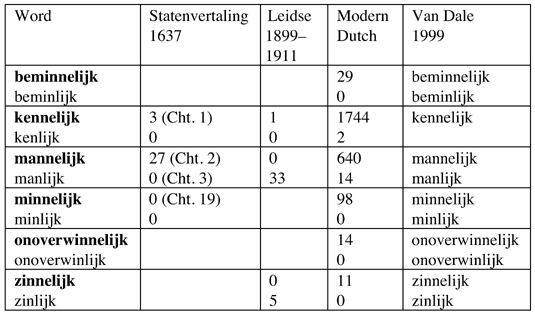
Table 1. Stems with V/n/.
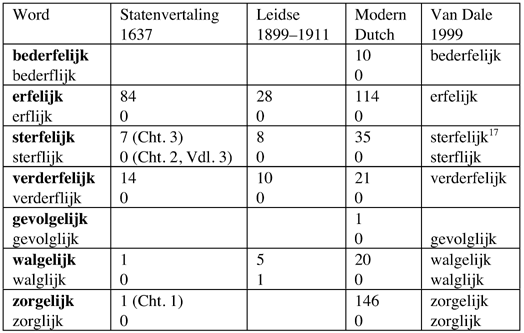
Table 2. Stems ending in an alternating fricative preceded by C.
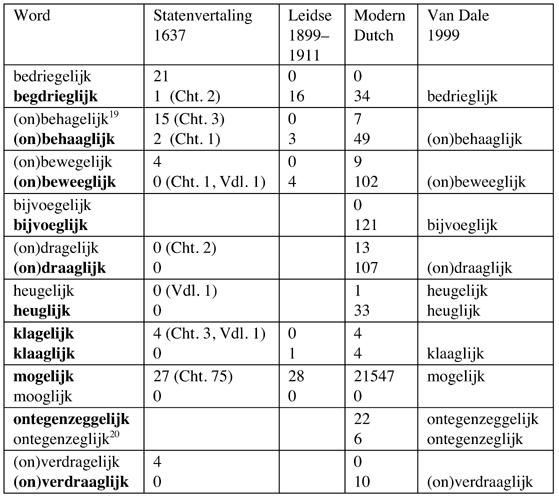
Table 3. Stems ending in V(V)/x/ (verb base).
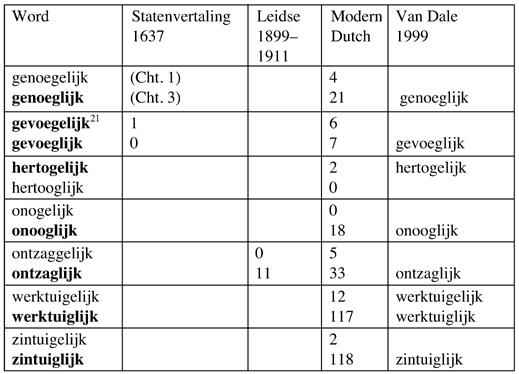
Table 4. Stems ending in V(V)/x/ (noun base).
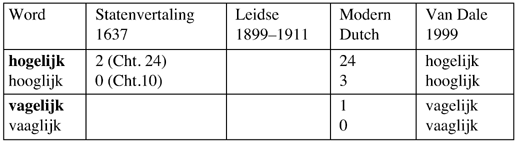
Table 5. Stems ending in V(V) /x/ (adjective base).
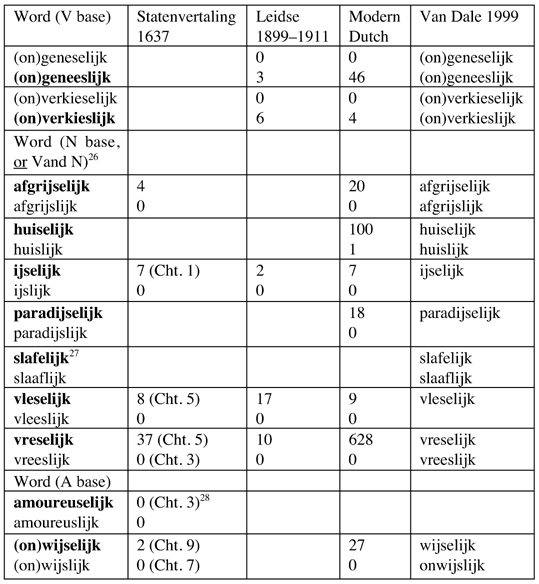
Table 6. Stems ending in VV/s/.
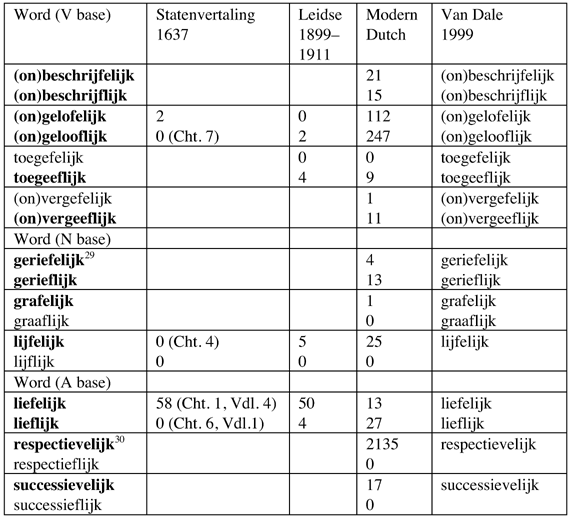
Table 7. Stems ending in VV/f/.
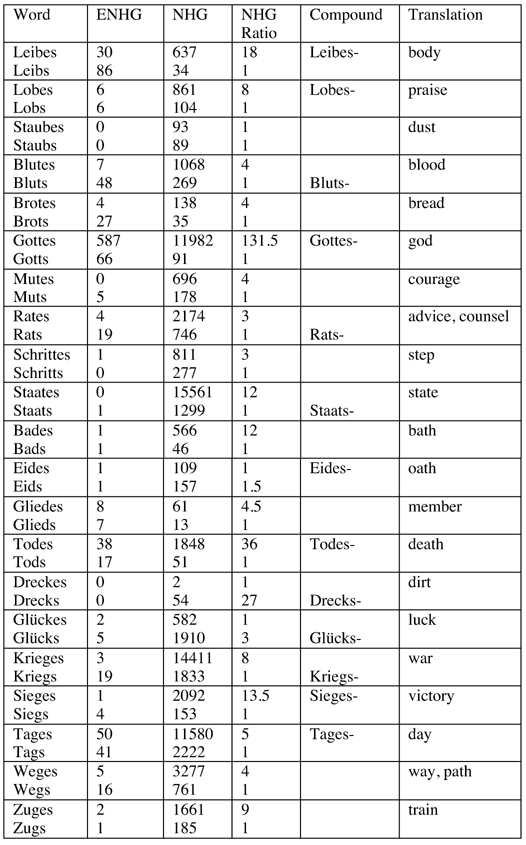
Table 8. Words ending in V(V) + plosive.
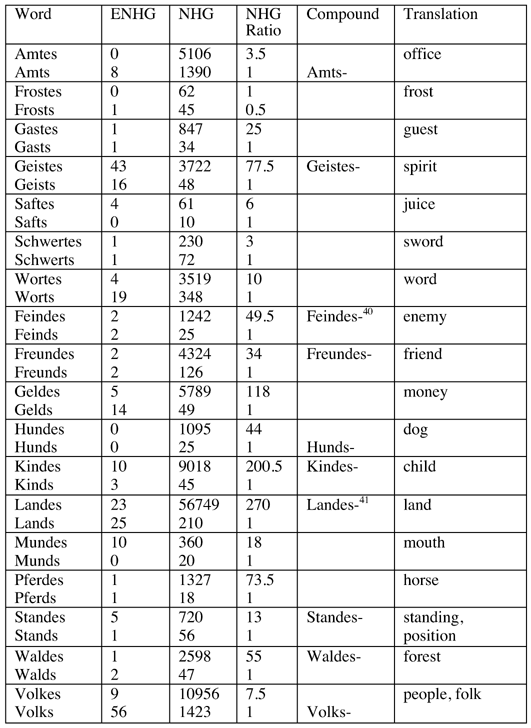
Table 9. Words ending in C + plosive.
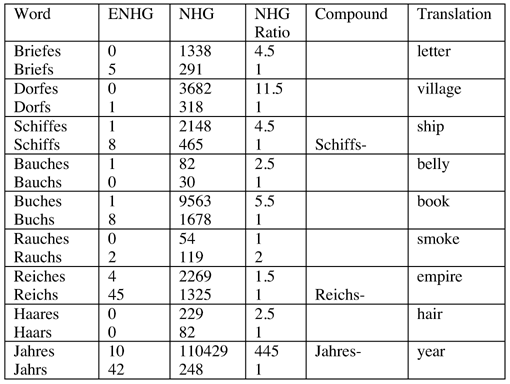
Table 10. Words ending in a fricative.
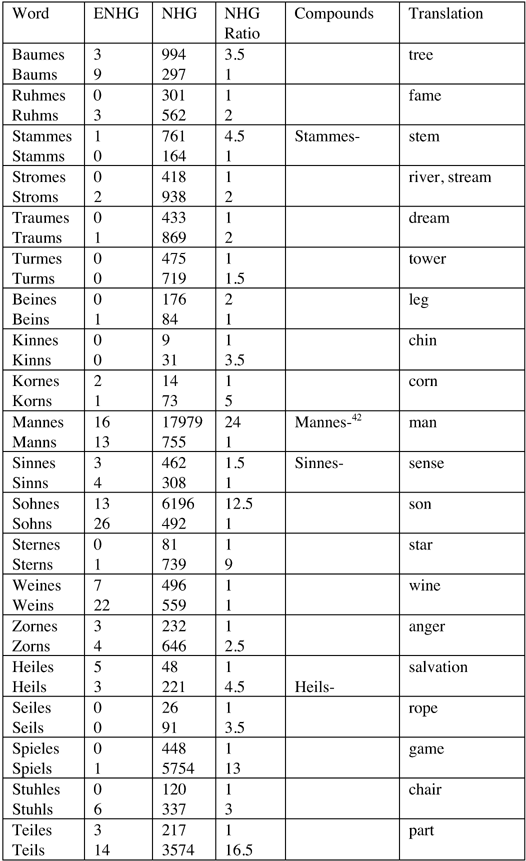
Table 11. Words ending in a sonorant consonant.
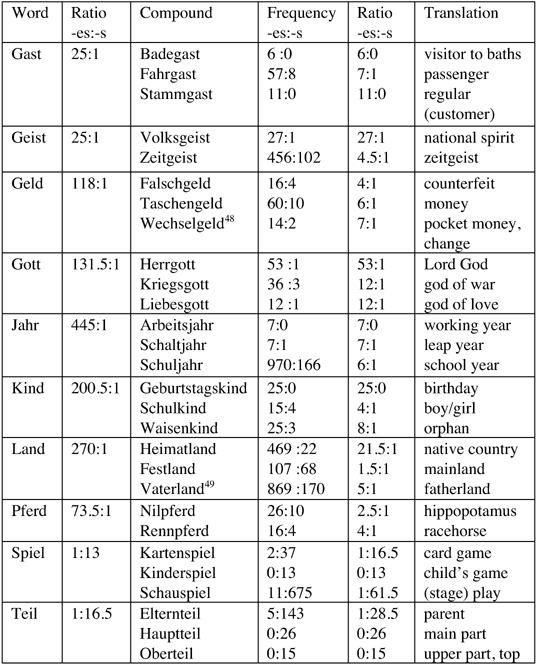
Table 12. Compounds in the genitive.
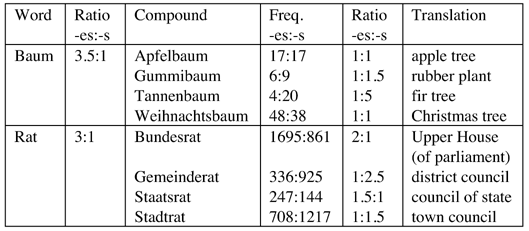
Table 13. Compounds with lower -es:-s ratios.
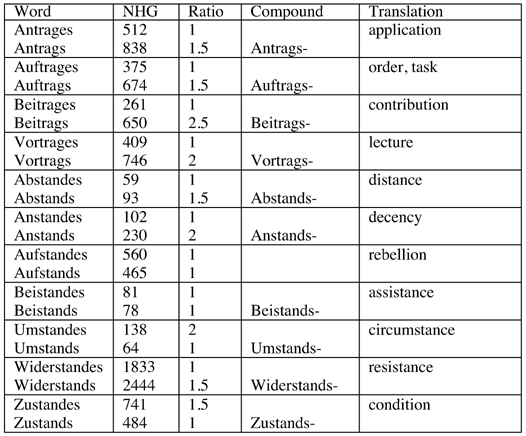
Table 14. Deverbal nouns with stressed prefixes.
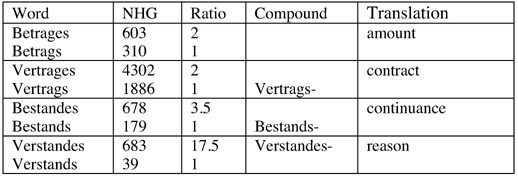
Table 15. Deverbal nouns with unstressed prefixes.
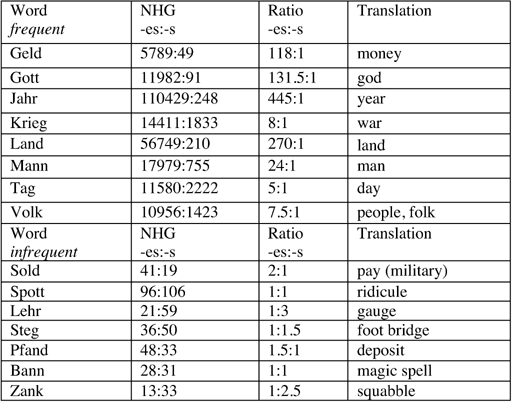
Table 16. Frequent versus infrequent words.
 You have
Access
- 13
- Cited by