Borderline personality disorder (BPD) is a serious mental health disorder characterized by pronounced affective instability, chaotic interpersonal relationships, impulsivity, self-harm, and disturbances in identity (American Psychiatric Association, 2013). Adolescents with a BPD diagnosis comprise approximately 30% of clinical populations (Glenn & Klonsky, Reference Glenn and Klonsky2013), often meet criteria for additional disorders (Ha, Balderas, Zanarini, Oldham, & Sharp, Reference Ha, Balderas, Zanarini, Oldham and Sharp2014), and engage in high rates of suicidal behaviors (Crowell & Yaptangco, Reference Crowell and Yaptangco2013), all of which make adolescent BPD a serious public health concern. Furthermore, the presence of BPD symptoms in adolescence, even below diagnostic thresholds, predicts poorer social and peer functioning in adolescence (Wright, Zalewski, Hallquist, Hipwell, & Stepp, Reference Wright, Zalewski, Hallquist, Hipwell and Stepp2015) as well as severe functional impairment across critical domains in adulthood (Miller, Muehlenkamp, & Jacobson, Reference Miller, Muehlenkamp and Jacobson2008). Given the clinical prognosis associated with adolescent and adult BPD, it is imperative to learn more about what individual and environmental factors contribute to the development and maintenance of BPD symptoms during adolescence.
Theoretical Models of the Development of BPD
Etiological models of BPD emphasize transactions between biologically based emotional vulnerabilities and environmental risk factors, especially in the parent–child relationship (Bradley, Jenei, & Westen, Reference Bradley, Jenei and Westen2005; Fonagy, Target, & Gergely, Reference Fonagy, Target and Gergely2000; Gunderson & Lyons-Ruth, Reference Gunderson and Lyons-Ruth2008; Kernberg, Reference Kernberg1984; Linehan, Reference Linehan1993). Linehan's biosocial theory (Crowell, Beauchaine, & Linehan, Reference Crowell, Beauchaine and Linehan2009; Linehan, Reference Linehan1993) is one such model, which focuses on the interplay between an individual's biological or temperamental propensity toward high emotional reactivity and an “invalidating environment.” Emotions are dynamic and unfolding processes; thus, high emotional reactivity refers to greater sensitivity to the environment, heightened intensity of emotional response, and a slower return to baseline. Caregivers may create an invalidating environment though invalidating emotional displays, criticism, harsh parenting, and/or other means (Fruzzetti, Shenk, & Hoffman, Reference Fruzzetti, Shenk and Hoffman2005). Within an invalidating environment, child and caregiver are likely to reciprocally influence one another: a child high in emotional reactivity may evoke more invalidating reactions, and invalidation may exacerbate emotion reactivity in the child. Thus, transactions between an individual's biological vulnerability to emotional reactivity and an invalidating environment are thought to exacerbate both systems, thereby conferring risk for a higher likelihood of emerging BPD symptoms over time (Stepp et al., Reference Stepp, Whalen, Scott, Zalewski, Loeber and Hipwell2014). In a similar theoretical model, Gunderson and Lyons-Ruth (Reference Gunderson and Lyons-Ruth2008) have proposed that a biologically based vulnerability to heightened reactivity, particularly in relational contexts, plays an important role in the development of BPD. One manifestation of this vulnerability is enhanced emotional reactivity to maternal affective communications, such as criticism or other forms of invalidation.
Although not intended to be specific to the emergence of BPD, two additional developmental psychopathology models that may hold relevance for explaining the complex associations between physiological reactivity and environment in the development of BPD are the biological sensitivity to context (BSC; Boyce & Ellis, Reference Boyce and Ellis2005) and the adaptive calibration model (ACM; Del Giudice, Ellis, & Shirtcliff, Reference Del Giudice, Ellis and Shirtcliff2011). Both models posit that children who are more physiologically reactive are more susceptible to the effects of their environmental conditions, and are therefore either at increased risk (if exposed to a stressful environment) or at decreased risk (if exposed to a supportive and less stressful environment) as compared to children with low physiological reactivity. Parental feedback, including criticism or praise of the child, can be seen as one component that contributes to the stressfulness of the child's environment (Ellis, Del Giudice, & Shirtcliff, Reference Ellis, Del Giudice and Shirtcliff2013). Specifically, more critical parental feedback may signal a harsher environment, whereas more parental praise of the child may signal a more supportive, nurturing, and less stressful environment. Although these models were not intended to predict the emergence of discrete forms of psychopathology, integrating these evolutionary theories with the biosocial model may further elucidate the development of BPD. In particular, adolescents may be at either higher or lower risk for emerging BPD, conditional on their own physiological reactivity to critical or praising parental feedback. For example, adolescents with high physiological reactivity to criticism may be more vulnerable and reactive to various types of environmental stressors, and may therefore be at heightened risk for BPD. At the same time, adolescents with greater physiological reactivity to praise may be more susceptible to various forms of environmental support, and this susceptibility may serve as a buffer against the risk of developing BPD. However, environmental conditions may not dramatically affect adolescents with lower levels of physiological reactivity.
Empirical Support for Etiological Models of BPD
Biosocial theory (Linehan, Reference Linehan1993) and other etiological models (e.g., Fonagy et al., Reference Fonagy, Target and Gergely2000; Gunderson & Lyons-Ruth, Reference Gunderson and Lyons-Ruth2008; Kernberg, Reference Kernberg1984) serve as the theoretical basis for several specialized treatments for BPD. Nonetheless, empirical evidence supporting these formulations is still in its infancy. In particular, there is a paucity of research on biomarkers and phenomenological (subjective) aspects of emotional reactivity as predictors of the development and maintenance of BPD symptoms over time (Chanen & Kaess, Reference Chanen and Kaess2012). Though many studies suggest subjective experiences of intense negative emotions and enhanced and prolonged stress responses among adults with BPD (Rosenthal et al., Reference Rosenthal, Gratz, Kosson, Cheavens, Lejuez and Lynch2008), few studies have examined these indices as predictors of the development of BPD symptoms in adolescence. Neuroimaging studies suggest abnormalities in frontolimbic circuitry in both adolescents and adults with BPD that are consistent with difficulties in processing emotional stimuli, inhibiting emotional responses, and modulating emotional arousal (Chanen & Kaess, Reference Chanen and Kaess2012; Lis, Greenfield, Henry, Guilé, & Dougherty, Reference Lis, Greenfield, Henry, Guilé and Dougherty2007). However, studies of peripheral psychophysiological responding to stressful stimuli in adults with BPD have yielded mixed and often contradictory results (for reviews, see Cavazzi & Becerra, Reference Cavazzi and Becerra2014; Rosenthal et al., Reference Rosenthal, Gratz, Kosson, Cheavens, Lejuez and Lynch2008), and only limited research assesses psychophysiological reactivity in adolescents with BPD symptoms (Chanen & Kaess, Reference Chanen and Kaess2012). In adults with BPD, some studies suggest BPD is characterized by psychophysiological hyporeactivity, as opposed to the hyperreactivity described by biosocial theory (for reviews, see Cavazzi & Becerra, Reference Cavazzi and Becerra2014; Rosenthal et al., Reference Rosenthal, Gratz, Kosson, Cheavens, Lejuez and Lynch2008). Other evidence supports impaired recovery to baseline, greater psychophysiological arousal in response to negative emotional stimuli, and lower arousal in response to pleasant stimuli. In terms of emotional processing, a recent review of evidence concluded that adults with BPD or elevated BPD symptoms tend to show a greater attentional bias toward negative emotional stimuli (Baer, Peters, Eisenlohr-Moul, Geiger, & Sauer, Reference Baer, Peters, Eisenlohr-Moul, Geiger and Sauer2012). Processing of positive affective stimuli among those with BPD is less clear, but one study suggests hypervigilance to both positive and negative emotion words (Sieswerda, Arntz, Mertens, & Vertommen, Reference Sieswerda, Arntz, Mertens and Vertommen2007). Another study (Vitale & Newman, Reference Vitale and Newman2012) found that adult female offenders with BPD demonstrated suppressed eye-blink startle response to pleasant pictures. The authors suggested these results might reflect biased attentional allocation to positive emotional content, perhaps because those with BPD, who typically focus on negative content, found positive stimuli more novel. Given the variability in findings from studies with adults and the paucity of studies with adolescents, the precise physiological, cognitive, and phenomenological markers of emotional vulnerability involved in the development of BPD have not yet been clearly identified. Defining these vulnerabilities would provide crucial data to help identify adolescents who are at risk for developing BPD.
Relational contexts may be most likely to spark emotional dysregulation among those with BPD (Gunderson & Lyons-Ruth, Reference Gunderson and Lyons-Ruth2008; Lazarus, Cheavens, Festa, & Zachary Rosenthal, Reference Lazarus, Cheavens, Festa and Zachary Rosenthal2014), yet little research has examined responses to interpersonal stressors among adolescents with elevated BPD symptoms. In some studies, adolescents or young adults with BPD symptoms evidenced greater orienting to negative social stimuli and an inability to disengage from threatening social stimuli in the midst of negative mood states (Jovev et al., Reference Jovev, Green, Chanen, Cotton, Coltheart and Jackson2012; von Ceumern-Lindenstjerna et al., Reference von Ceumern-Lindenstjerna, Brunner, Parzer, Mundt, Fiedler and Resch2010a, Reference von Ceumern-Lindenstjerna, Brunner, Parzer, Mundt, Fiedler and Resch2010b). Other studies with these age groups provide more equivocal evidence of physiological or subjective emotional reactivity to interpersonal stressors (Matusiewicz, Weaverling, & Lejuez, Reference Matusiewicz, Weaverling, Lejuez, Sharp and Tackett2014). Our own work with the current study sample suggests that a latent variable of negative emotional reactivity prospectively predicts greater BPD symptoms in adolescent girls, particularly those exposed to high levels of environmental adversity (e.g., family stress and poverty; Stepp, Scott, Jones, Whalen, & Hipwell, Reference Stepp, Scott, Jones, Whalen and Hipwellin press). Other studies with the same sample suggest that positive maternal behaviors, such as support and validation, and positive interactions in the mother–daughter dyad predict decreasing trajectories of BPD symptoms over time (Whalen et al., Reference Whalen, Scott, Jakubowski, McMakin, Hipwell, Silk and Stepp2014). Given the emphasis in theoretical accounts on relational dynamics in the parent–child relationship as an exacerbating influence on emotional reactivity and the development of BPD, it is imperative to elucidate how adolescents at risk for BPD respond both phenomenologically and physiologically to stressful interpersonal situations, especially with parents, and how these responses predict the course of BPD symptoms over time. Considering evidence of rejection sensitivity in those with BPD (Berenson, Downey, Rafiaeli, Coifman, & Paquin, Reference Berenson, Downey, Rafiaeli, Coifman and Paquin2011; Chapman, Walters, & Dixon Gordon, Reference Chapman, Walters and Dixon Gordon2014; Gratz, Rosenthal, Tull, Lejuez, & Gunderson, Reference Gratz, Rosenthal, Tull, Lejuez and Gunderson2010; Sadikaj, Moskowitz, Russell, Zuroff, & Paris, Reference Sadikaj, Moskowitz, Russell, Zuroff and Paris2013), maternal evaluative feedback (i.e., praise and criticism) may be particularly relevant as an interpersonally and affectively arousing stimulus that can evoke strong emotional reactions in adolescents at risk for BPD.
Pupillometry as an Index of Biological Reactivity
Pupillometry, which refers to the measurement of pupil dilation in response to a task, is a potentially informative physiological index of emotional processing and responding that has yet to be examined in relation to BPD in either adolescents or adults. The locus coeruleus (LC), found on each side of the pons in the brainstem, is the brain's major source for norepinephrine (NE). LC and NE system activation is highly correlated with pupil dilation (Aston-Jones & Cohen, Reference Aston-Jones and Cohen2005). Both the LC and NE contribute to focusing and disengaging attention (Bouret & Sara, Reference Bouret and Sara2005), and cause the pupil to dilate in response to task difficulty, increased arousal, or vigilance (Raizada & Poldrack, Reference Raizada and Poldrack2007). The amygdala shares functional connections with the LC, and pupil dilation is linked to amygdala activation in response to emotional reactions (Koikegami & Yoshida, Reference Koikegami and Yoshida1953). Pupillometry is also a noninvasive measure of cognitive and emotional changes that participants are unable to detect or verbalize, leading some to suggest that it is a window into the preconscious (Laeng, Sirois, & Gredebäck, Reference Laeng, Sirois and Gredebäck2012). The use of pupillometry is relatively new in the field of child and adolescent clinical psychology, but initial findings suggest that individual differences in pupillary responses to emotionally evocative tasks can be demonstrated in children and adolescents (Silk et al., Reference Silk, Dahl, Ryan, Forbes, Axelson, Birmaher and Siegle2007, Reference Silk, Stroud, Siegle, Dahl, Lee and Nelson2012). One study demonstrated that adolescents had greater pupil dilation when being rejected than when being accepted by peers in a simulated chatroom task, and greater pupil dilation in response to rejection was associated with lower perceptions of social connectedness with peers in daily life (Silk et al., Reference Silk, Stroud, Siegle, Dahl, Lee and Nelson2012). These findings suggest that interpersonal stressors, such as those that evoke feelings of rejection, map onto interpretable changes in pupil dilation.
Aims and Hypotheses of the Current Study
The present study will examine the course of girls’ BPD symptoms across 18 months in adolescence (between the ages of 16 and 17) as predicted by their subjective experience of emotion (negative and positive affective responses) and pupil dilation reactivity and recovery when listening to maternal criticism, praise, and neutral statements. This prospective design, which uses a multimethod approach to examine emotional reactivity and recovery in the context of maternal feedback, will inform our understanding of the development of BPD in middle to late adolescence, a developmental period in which evidence suggests that BPD symptoms tend to peak and then show a normative decline, on average, in adolescent populations (Bornovalova, Hicks, Iacono, & McGue, Reference Bornovalova, Hicks, Iacono and McGue2009). Sampling BPD symptoms at age 16 and across 18 months of follow-up assessments therefore allows us to examine pupillary and affective responses to maternal feedback as predictors of remittance, maintenance, or increases in symptoms during this critical developmental window in which change in symptoms would be expected. Although BPD is equally prevalent in population samples of men and women, we focus in this study on adolescent girls, given evidence of higher rates of BPD among adolescent girls and young women in clinical and forensic settings, and greater distress and impairment in females with BPD as compared to males (American Psychiatric Association, 2013; Grant et al., Reference Grant, Chou, Goldstein, Huang, Stinson, Saha and Ruan2008; Rosler, Retz, Yaqoobi, Burg, & Retz-Junginger, Reference Rosler, Retz, Yaqoobi, Burg and Retz-Junginger2009; Trull, Jahng, Tomko, Wood, & Sher, Reference Trull, Jahng, Tomko, Wood and Sher2010).
Based on theoretical and empirical work reviewed above, we hypothesized that greater increases in pupil dilation, higher negative affective responses, and lower positive affective responses to hearing maternal criticism would predict higher levels and increases in BPD symptoms over time in adolescence. Furthermore, consistent with the BSC (Boyce & Ellis, Reference Boyce and Ellis2005) and ACM (Del Giudice et al., Reference Del Giudice, Ellis and Shirtcliff2011), we sought to examine whether adolescent girls who are more reactive to praise are at lower risk for the development of BPD. Because neutral statements were devoid of interpersonal or emotional content, we did not expect an association between reactivity to neutral maternal statements and BPD symptoms. However, in accordance with biosocial theory (Linehan, Reference Linehan1993) and empirical evidence suggesting prolonged stress responses in individuals with BPD (for reviews, see Cavazzi & Becerra, Reference Cavazzi and Becerra2014; Rosenthal et al., Reference Rosenthal, Gratz, Kosson, Cheavens, Lejuez and Lynch2008), we hypothesized that sustained pupillary dilation during rest conditions (after hearing maternal feedback, suggesting sustained affective processing after stimulus offset) would predict higher levels and increases in BPD symptoms over time.
Method
Participants and recruitment procedures
Sixteen-year-old girls and their biological mothers were recruited from the Pittsburgh Girls Study (PGS) for a longitudinal substudy on girls’ personality development. The ongoing PGS follows an urban community sample, oversampling low-income participants (see Keenan et al., Reference Keenan, Hipwell, Chung, Stepp, Stouthamer-Loeber, Loeber and McTigue2010, for further details on PGS study design). One hundred and thirteen girls were selected at age 16 from the larger PGS for participation in the current substudy. Girls were recruited based on their self-reports on the affective instability subscale of the Personality Assessment Inventory (PAI-AI; Morey, Reference Morey1991), which was administered as part of the PGS annual assessment battery. The sampling strategy was designed to produce a sample with a high degree of variability in this core symptom of BPD, and thus, a sample representing a wide range of risk for BPD, so that increases or decreases in BPD symptom expression could be examined as an outcome. Unlike measures of general negative emotionality, the PAI-AI assesses mood intensity and variability (e.g., “My mood can shift quite suddenly”). The PAI-AI contains six items scored on a 4-point scale (0 = false, not at all true, 3 = very true). These items were summed to create an AI index. Raw scores of >11 on the PAI-AI (2 SD above the mean score for community participants) suggest clinical significance (Morey, Reference Morey1991; Trull, Reference Trull1995; Trull, Useda, Conforti, & Doan, Reference Trull, Useda, Conforti and Doan1997). To ensure representation of girls with high levels of affective instability (and thus greater risk for other BPD symptoms as well), participants with PAI-AI scores in the clinically significant range were oversampled. Approximately one-third of girls who were recruited for the current study screened high on affective instability (scores > 11 on the PAI-AI), and the remainder of the sample was randomly selected from girls endorsing low to medium levels of affective instability (scores ≤ 11).
Out of the 113 girls who were recruited for this substudy, 77 completed both the diagnostic interviews and the pupillometry assessment at baseline, and 57 had no missing pupil data in any of the task conditions (e.g., missing due to excessive eye blinks, as further described below). Thus, 57 girls are included in the current analyses. The 57 girls who were included did not significantly differ from the 56 who were excluded due to missing data in terms of race, socioeconomic status, PAI-AI scores, or number of BPD symptoms. Further, the 57 girls with complete pupil data who were included did not significantly differ from the 20 who participated in the pupillometry assessment but were excluded due to missing pupil data in race, socioeconomic status, PAI-AI scores, number of BPD symptoms, self-reported affects prior to the pupillometry assessment, or nonmissing raw pupil dilation indices. Reflecting the demographic characteristics of the PGS, this sample was racially and socioeconomically diverse (65% African American, 35% Caucasian; 53% of families reported receiving some form of public assistance in the last year, e.g., Women, Infants, and Children, food stamps, welfare, and Temporary Assistance for Needy Families).
Assessment procedures and measures
Participants completed a semistructured interview for personality disorders followed by a pupillometry assessment in the laboratory at the initial assessment (i.e., Wave 1 of the personality substudy, which occurred at age 16). At three follow-up assessments (Waves 2–4, occurring at 6 months, 12 months, and 18 months postinitial assessment), the semistructured interviews for personality disorders were repeated in the laboratory to assess symptoms in the past 6 months. All study procedures were approved by the university institutional review board. Participants were compensated for their participation.
Assessment of BPD symptoms
BPD symptoms were assessed dimensionally at each wave using the Structured Clinical Interview for DSM-IV Personality Disorders (Pfohl, Blum, & Zimmerman, Reference Pfohl, Blum and Zimmerman1997), a semistructured interview with established reliability and validity for assessing the presence and severity of personality disorders in adolescents. Questions were modified slightly, where necessary, to be more developmentally appropriate for adolescents (e.g., asking about school in addition to work). Interviewers were postbaccalaureate-, masters-, or doctoral-level clinicians who were trained to reliability by the senior author (S.D.S.). The nine items corresponding to individual DSM-5 (American Psychiatric Association, 2013) diagnostic criteria for BPD were rated on a 0–3 scale (0 = not present, 1 = subthreshold, 2 = present, and 3 = strongly present). Symptoms at the initial assessment were rated according to DSM-5 guidelines for personality disorder in adolescence (e.g., symptoms were rated as present if they persisted for at least a year). At follow-up, symptoms were rated as present if they persisted for the last 6 months. The nine BPD items at each wave were summed to yield dimensional scores for BPD symptoms, which were used as continuous measures of BPD symptoms over time. Video recordings of 12 participants’ initial Structured Clinical Interview for DSM-IV Personality Disorders interviews (21% of the analyzed sample) were rated by at least one additional independent rater for calculation of interrater reliability. The number of raters per case ranged from two to six (seven cases had two raters, three had three raters, and two had four raters). The intraclass correlation (ICC) was calculated based on one-way random effect models for the unequal number of raters per case, and demonstrated good interdiagnostician agreement for BPD dimensional scores (ICC = 0.84). Two participants (3.5%) in the analyzed sample met full diagnostic criteria for BPD at the initial Wave 1 assessment, and 13 participants (22.8%) had clinically significant BPD symptoms (i.e., three or more symptoms). The prevalence of diagnosable BPD in this sample was within the range (e.g., 3%–6%) found in other community adolescent samples (Chabrol et al., Reference Chabrol, Montovany, Ducongé, Kallmeyer, Mullet and Leichsenring2004; Zanarini, Frankenburg, Hennen, & Silk, Reference Zanarini, Frankenburg, Hennen and Silk2003). Consistent with previous studies with adolescents (Becker, Grilo, Edell, & McGlashan, Reference Becker, Grilo, Edell and McGlashan2002; Zanarini et al., Reference Zanarini, Horwood, Wolke, Waylen, Fitzmaurice and Grant2011), intense anger (35.1%) and affective instability (24.6%) were the most frequently met BPD criteria in this sample, followed by transient stress-related dissociation or paranoid ideation (12.3%), unstable and intense interpersonal relationships (12.3%), impulsivity (10.5%), chronic emptiness (10.5%), identity disturbance (7%), frantic efforts to avoid abandonment (1.8%), and suicidal or self-harming behavior (1.8%).
Maternal feedback task
On a subsequent visit to the laboratory shortly after the Wave 1 interviews, participants completed a maternal feedback task used by Hooley, Gruber, Scott, Hiller, and Yurgelun-Todd (Reference Hooley, Gruber, Scott, Hiller and Yurgelun-Todd2005) in which participants listened to audio-recorded clips of their own mothers making three types of comments (criticizing or praising their daughter, or making neutral comments devoid of interpersonal/relational content or any information about their daughter). Researchers collected two 30-s clips on different topics from mothers in the neutral and criticism conditions, and three 30-s clips on different topics in the praise condition. The extra praise clip was used for debriefing purposes, as described further below. Audio clips were recorded while the adolescents were interviewed in a separate room. In the criticism condition, each mother discussed aspects of her daughter's behavior that bothered the parent. In the praise condition, each mother discussed aspects of her daughter's behavior that the parent liked. Mothers were asked to only discuss topics of praise or criticism that they had previously verbalized to their daughters. This was done both to guard against novelty effects (which could affect physiological data) and to protect participants from new criticism. For the neutral condition, mothers were asked to discuss topics in which their daughter would be uninterested, such as the weather, what they do at work, or household chores. As a manipulation check, each audio clip used in the pupillometry assessment was rated on a 7-point scale (1 = most criticizing/least praising, 7 = least criticizing/most praising) by four independent raters who were unaware of the intended condition of the clips and to participants’ BPD symptom scores. Raters reached excellent agreement as evidenced by a two-way mixed model reliability analysis with absolute agreement (single measures ICC = 0.91, average measures ICC = 0.98). One-sample t tests comparing the clip ratings in each condition to neutral (rating = 4) confirmed criticism clips were rated as more critical than neutral (M = 2.57, SD = 0.40); one sample, t (56) = –27.15, μ = 4, p < .001; the praise clips were rated as more praising than neutral (M = 6.01, SD = 0.56; one sample, t (56) = 26.99, μ = 4, p < .001; and the neutral clips did not significantly differ from a rating of 4 (M = 4.06, SD = 0.39); one sample, t (56) = 1.20, μ = 4, p = .23.
Pupillometry assessment
Pupil dilation was recorded while each girl heard two clips of her own mother making critical statements about her, two clips of her own mother praising her, and two clips of her mother making neutral statements. Clips were separated by a 30-s intertrial interval of silence. Pupil dilation was recorded throughout the task. For debriefing purposes, participants always heard a third, untested, praise clip (randomly selected from among the three praise clips) following completion of the task. At baseline (30 s prior to stimulus presentation) and during rest periods after each audio clip, participants rated their subjective affective experiences (i.e., sad, anxious, angry, frustrated, and happy) using a 5-point visual analogue scale (VAS) presented on a monitor 65 cm from the participant.
Apparatus, data selection, cleaning, and reduction
Pupillary data were collected at 60 Hz (every 16.7 ms) in a moderately lit room (0.56-fc illuminance) using a table-mounted ISCAN, Inc., RK464 video-based infrared pupillometer. Lighting was held constant across participants. Video digitization and pupil diameter calculation were completed by the equipment. Pupillary data were cleaned using standard procedures (Siegle, Ichikawa, & Steinhauer, Reference Siegle, Ichikawa and Steinhauer2008), including interpolation through blinks, removal of trials with over 50% blinks, and smoothing. Data was smoothed using a low-pass first-order Butterworth filter that preserved all frequencies below 0.003 Hz to remove high-frequency noise from the pupillary signal. The average pupil diameter over the 100 ms (6 samples) preceding the onset of the stimulus was subtracted from pupil diameter after stimulus onset to produce stimulus-related pupil dilation waveforms. We then identified the maximum (i.e., peak) pupil dilation after stimulus onset within each condition, which occurred within 9 s after stimulus presentation. Thus, pupil indices used in these analyses can be interpreted as the peak change in pupil dilation after stimulus presentation within each condition (i.e., praise, criticism, neutral, and rest). Peak dilation during rest was aggregated across all rest periods (i.e., after stimulus offset in each condition).
Negatively valenced VAS ratings (sad, anxious, angry, and frustrated) were averaged to yield an overall negative affect (NA) score at baseline and within each condition (i.e., praise, criticism, and neutral). VAS “happy” ratings within each condition were used as a single-item measure of positive affect (PA). Change in NA and PA with each condition was calculated by subtracting NA and PA baseline ratings from NA and PA ratings after stimulus offset within each condition. Thus, NA and PA indices used in these analyses can be interpreted as change (from baseline) in subjective NA and PA after hearing praise, criticism, or neutral clips.
Data analytic plan
Analyses were conducted using SPSS version 21 (SPSS Inc., Chicago). Change in BPD symptoms over 18-month follow-up in adolescence was analyzed using multilevel linear mixed (MLM) models (Raudenbush & Bryk, Reference Raudenbush and Bryk2002), which included an autoregressive error structure to account for dependencies due to repeated measurements (i.e., autocorrelation). Restricted maximum likelihood estimation was used to assess the significance of random effects. Three MLM models were conducted to predict initial level and change in BPD symptoms over time from three sets of predictors: (a) changes (from baseline) in pupil indices within each condition, (b) changes (from baseline) in NA after each condition, and (c) changes (from baseline) in PA after each condition. Fixed effects were included in each MLM model for time (i.e., within-individual change over time in BPD symptoms from Wave 1 [age 16] through Wave 4, covering an 18-month time span), grand mean centered predictors, and the interactions between time and mean centered predictors to examine the influence of these factors on changes in BPD symptoms over time. Because the pupillary assessment was completed at the initial assessment (Wave 1, at age 16), the intercept was placed at the initial assessment point. Therefore, the intercept can be interpreted as the initial mean level of BPD symptoms, and the linear slope for time can be interpreted as the average within-individual rate of change in BPD symptoms across 18 months of follow-up.
Initial MLM models included minority race (coded 0 = White or Caucasian, 1 = Black or African American), family poverty (coded 1 = family received public assistance, 0 = family did not receive public assistance), and overall clip rating averaged across all conditions as covariates. Those variables that reached statistical significance as predictors of intercept or slope were retained as covariates in subsequent models. Random effects for the BPD symptom intercept were included in all models to account for individual variability in mean levels of BPD symptoms. The inclusion of random slopes for time (i.e., BPD symptom linear slope) led to model nonconvergence, most likely due to the relatively small sample size and complexity of the models. We therefore included only the random intercept in all models, and used a simple variance components covariance matrix for random effects. We probed significant effects by testing the significance of simple slopes at selected values of the predictors (±1 SD) and examining regions of significance in accordance with methods described by Preacher, Curran, and Bauer (Reference Preacher, Curran and Bauer2006).
Results
Preliminary analyses
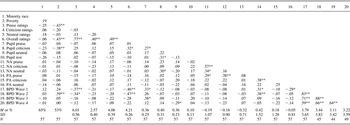
Descriptive statistics and bivariate correlations are presented in Table 1. Prior to conducting primary analyses, associations between average clip ratings (both across and within conditions) and BPD symptoms were explored using bivariate correlations. Participant BPD dimensional scores at initial and follow-up assessments were related to observer ratings of audio clips as less praising (ps ≤ .001). Examination of correlations with clip ratings within each condition revealed that BPD symptoms at each assessment were only associated with lower ratings for praise clips (ps < .05), meaning girls with greater BPD symptoms heard maternal clips during the praise condition that tended to be rated as less praising according to the team of independent raters. Given the association between overall clip ratings and BPD symptoms, overall clip rating was explored as a potential covariate and moderator of effects in the primary analyses. In addition, given the significant association between BPD symptoms and clip ratings specifically within the praise condition, the main and moderating effects of praise clip ratings were explored in supplemental analyses of data for the praise condition only.
Descriptive statistics and bivariate correlations

Note: Minority race was coded 0 = White/Caucasion, 1 = African American. Poverty was coded 0 = no public assistance, 1 = receiving public assistance. Maternal audio clip “ratings” were calculated as the average ratings across the two clips in each condition by the four independent raters. Clips were rated on a 7-point scale (1 = most criticizing/least praising, 7 = least criticizing/most praising). NA, Negative affect; PA, positive affect; BPD, borderline personality disorder dimensional scores, calculated based on the sum of the nine BPD item scores from the Structured Interview for DSM-IV Personality (Pfohl, Blum, & Zimmerman, Reference Pfohl, Blum and Zimmerman1997). The total number of participants for BPD symptoms at Waves 2–4 differ from Wave 1 due to participant attrition.
*p < .05. **p < .01.
Before examining full conditional models that included predictors, we examined an MLM model of average change in BPD symptoms over the 18-month period. The results showed that the initial average level of BPD symptoms (intercept) differed from zero (B = 3.74, SE = 0.47, t = 7.95, p < .001), but there was no significant change in BPD symptoms across 18 months in the sample overall (B = –0.20, SE = 0.15, t = –1.34, p = .19). The intercept was negatively correlated with the slope (r = –.45, p < .001), indicating that individuals with higher initial levels of BPD symptoms tended to show greater decreases in symptoms over time. The random effect for intercept indicated that there was significant individual variability in initial average levels of BPD symptoms (σ2 = 7.16, SE = 2.50, Wald Z = 2.87, p = .004).
Next, we examined minority race, poverty (i.e., receipt of public assistance), and the mean-centered overall clip rating as potential covariates. The fixed effects of poverty and minority race on initial levels or rate of change in BPD symptoms were not significant. Substantive interpretations of subsequent model results did not differ whether or not race or poverty were included as covariates in the models. Thus, these variables were excluded from final models. Higher overall clip ratings were significantly associated with lower initial BPD symptoms (B = –6.16, SE = 1.91, t = –3.23, p = .002), indicating an association between observer ratings of clips as more praising and lower BPD symptoms at age 16. There was no significant effect of overall clip rating on rate of change in BPD symptoms over time. Thus, overall clip rating was retained in subsequent models as a covariate to adjust for the influence of this variable on the initial level of BPD symptoms. Overall clip rating was also explored as a moderator of effects of the predictors on the initial level and rate of change of BPD symptoms; however, in models where none of these interactions reached significance, they were dropped from the final models for parsimony.
Primary analyses
Pupillary responses
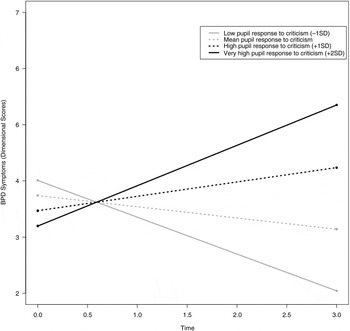
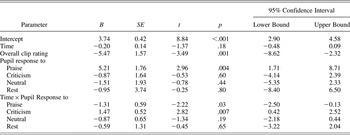
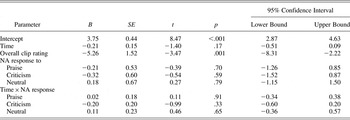
The results for the MLM model predicting level and change in BPD symptoms from pupil indices within each condition are presented in Table 2. After controlling for the influence of overall clip rating on initial BPD symptom levels, there was a significant association between greater pupillary response to maternal praise and higher initial BPD symptoms. Pupillary response within the criticism, neutral, or rest conditions was not associated with the initial level of BPD symptoms. In addition, greater pupillary response to maternal praise was associated with decreases in BPD symptoms over time, whereas greater pupillary response to maternal criticism was associated with increases in BPD symptoms over time. Simple slope analyses revealed that only girls with high (+1 SD) pupil responses to maternal praise showed significant decreases in BPD symptoms (B = –0.53, SE = 0.20, t = –2.59, p = .01), whereas those with low (–1 SD) or average levels of pupil response to praise did not show significant changes in BPD symptoms over time. Further, as demonstrated in Figure 1, only girls with low (–1 SD) pupil response to maternal criticism showed significant decreases in BPD symptoms (B = –0.66, SE = 0.21, t = –3.07, p = .004), whereas those with high (+1 SD) or average levels of pupil response to criticism did not show significant changes in BPD symptoms over time. However, examination of regions of significance for this effect revealed that girls with very high levels of pupil response to criticism (+2 SD; 7% of the sample) demonstrated significant increases in BPD symptoms over the course of the study (B = 0.72, SE = 0.36, t = 2.02, p = .05). There were no significant effects of pupillary response during neutral or rest conditions on rate of change in BPD symptoms.
Plot of two-way interaction between time and pupil response to criticism at low (–1 SD), medium (at the mean), and high (+1 and +2 SD) levels. BPD, Borderline personality disorder. Time coded as 0, 1, 2, and 3, corresponding to Waves 1–4 and representing 18 months of follow-up from the initial (age 16) assessment.

Multilevel linear model examining the effects of pupillary response within each condition on borderline personality disorder symptoms

Note: Time coded as 0, 1, 2, and 3, corresponding to Waves 1–4 and representing 18 months of follow-up from the initial (age 16) assessment. Overall clip rating is the average of independent ratings for maternal audio clips (1 = most criticizing/least praising, 7 = least criticizing/most praising) across praise, criticism, and neutral conditions. Pupil response is the peak change in pupil dilation during the first 9 s of stimulus presentation within each condition after subtraction of pupil dilation at baseline.
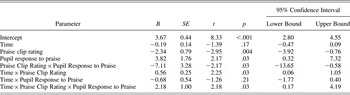
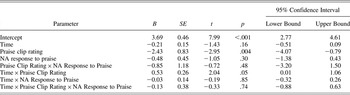
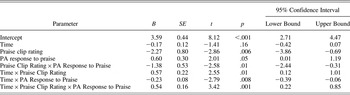
Due to the significant association between BPD symptoms and the independent ratings of praise clips in particular (which did not emerge in the neutral or criticism conditions), we also planned to examine the main and interactive effects of praise clip ratings and pupillary response to praise (see Table 3). The results revealed a significant interaction between praise clip ratings and pupillary response to praise for predicting the BPD intercept, as well as a significant three-way interaction between time, praise clip ratings, and pupillary response to praise. Simple intercepts and slopes tests demonstrated that girls who heard praise clips that were rated as more negative/less praising (–1 SD for praise clip ratings) and who had greater pupillary responses to the praise clips (+1 SD for pupil response to praise) had the highest initial level of BPD symptoms (simple intercept B = 6.93, SE = 0.84, t = 8.23, p < .001, as compared to simple intercepts ranging from 2.32 to 3.03 in the other three groups), and were the only group to show significant decreases in symptoms over time (simple slope B = –0.98, SE = 0.27, t = –3.62, p = .007).
Multilevel linear model examining the main and interactive effects of pupillary response to praise and praise clip ratings on borderline personality disorder symptoms
Note: Time coded as 0, 1, 2, and 3, corresponding to Waves 1–4 and representing 18 months of follow-up from the initial (age 16) assessment. Praise clip rating is the average of independent ratings for maternal audio clips (1 = most criticizing/least praising, 7 = least criticizing/most praising) in the praise condition only. Pupil response to praise is the peak change in pupil dilation during the first 9 s of stimulus presentation within the praise condition after subtraction of pupil dilation at baseline.
NA responses
The results for the MLM model predicting level and change in BPD symptoms from NA responses within each condition are presented in Table 4. After controlling for the influence of overall clip rating on initial BPD symptom levels, there were no significant effects of NA response within each condition on the level or rate of change in BPD symptoms. In the analysis for the praise condition only (see Table 5), results demonstrated that girls who heard praise clips that were rated as more praising had significantly lower initial BPD symptoms. Girls who heard praise clips that were rated as more praising also showed small but significant increases in BPD symptoms over time (p = .047), which may be explained by the negative association between intercept and slope (i.e., those who start lower have more room to increase). There was neither a main effect of NA response to praise nor an interactive effect of NA response to praise and praise clip ratings, for predicting level or rate of change in BPD symptoms.
Multilevel linear model examining the effects of NA response within each condition on borderline personality disorder symptoms
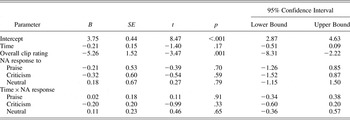
Note: Time coded as 0, 1, 2, and 3, corresponding to Waves 1–4 and representing 18 months of follow-up from the initial (age 16) assessment. Overall clip rating is the average of independent ratings for maternal audio clips (1 = most criticizing/least praising, 7 = least criticizing/most praising) across praise, criticism, and neutral conditions. Negative affect (NA) response is the change in subjective NA within each condition after subtraction of NA at baseline.
Multilevel linear model examining the main and interactive effects of NA response to praise and praise clip ratings on borderline personality disorder symptoms
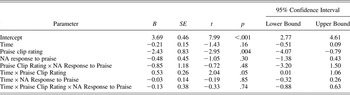
Note: Time coded as 0, 1, 2, and 3, corresponding to Waves 1–4 and representing 18 months of follow-up from the initial (age 16) assessment. Praise clip rating is the average of independent ratings for maternal audio clips (1 = most criticizing/least praising, 7 = least criticizing/most praising) in the praise condition only. Negative affect (NA) response to praise is the change in subjective NA within the praise condition after subtraction of NA at baseline.
PA responses
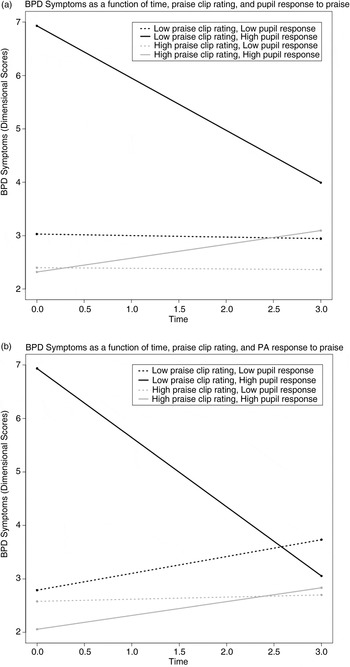
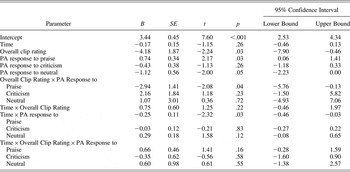
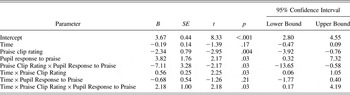
The results for the MLM model predicting level and change in BPD symptoms from PA responses within each condition are presented in Table 6. In this case, overall clip rating moderated some of the effects of PA responses on BPD symptoms, and therefore, these interactions were retained in the final model. There was a small but significant (p = .049) main effect of PA response to neutral maternal comments, indicating that girls who had greater increases in PA after hearing their mothers making neutral comments had lower initial BPD symptoms. There was a significant main effect of PA response to praise predicting higher initial BPD symptoms, but this was moderated by overall clip rating. Further probing of this effect revealed that greater PA response to praise was only associated with greater BPD symptoms among girls who heard more negatively rated/less praising maternal clips (i.e., at –1 SD and at the mean of overall clip ratings, Bs = 1.50 and 0.74, SEs = 0.39 and 0.33, ts = 3.83 and 2.23, ps = .0003 and .03, respectively). Finally, there was a significant interaction between time and PA response to praise, with simple slopes tests indicating that only girls who reported more increases in PA in response to praise (+1 SD) demonstrated decreases in BPD symptoms over time (B = –0.55, SE = 0.22, t = –2.45, p = .02). To further examine this finding, we next examined the main and interactive effects of observer ratings for praise clips only and PA response to praise (see Table 7). The results of this analysis and subsequent simple intercepts and slopes tests revealed that girls who heard praise clips that were rated as more negative/less praising (–1 SD for praise clip ratings) and who had greater PA response to the praise clips (+1 SD for PA response to praise) had the highest initial level of BPD symptoms (simple intercept B = 6.93, SE = 0.81, t = 8.55, p < .001, as compared to simple intercepts ranging from 2.05 to 2.79 in the other three groups), and were the only group to show significant decreases in symptoms over time (simple slope B = –1.29, SE = 0.26, t = –4.89, p < .001). These findings for PA response to praise parallel those reported above for pupillary response to praise. Together, these results show that girls whose mothers had fewer positive things to say about them during the praise condition but who had greater pupillary and PA response to hearing these praise clips had the highest initial BPD symptoms and showed the most rapid decline in BPD symptoms over time. These effects are plotted side-by-side in Figure 2 for ease of comparison.
(a) Plot of three-way interaction between time, praise clip rating, and pupil response to praise, and (b) plot of three-way interaction between time, praise clip rating, and positive affect response to praise. Predictors are plotted at low (–1 SD) and high (+1 SD) levels. BPD, Borderline personality disorder; PA, positive affect; praise clip rating, average of independent ratings for maternal audio clips (1 = most criticizing/least praising, 7 = least criticizing/most praising) in the praise condition only; time coded as 0, 1, 2, and 3, corresponding to Waves 1–4 and representing 18 months of follow-up from the initial (age 16) assessment.

Multilevel linear model examining the main and interactive effects of PA response within each condition and overall clip ratings on borderline personality disorder symptoms
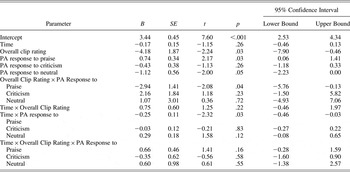
Note: Time coded as 0, 1, 2, and 3, corresponding to Waves 1–4 and representing 18 months of follow-up from the initial (age 16) assessment. Overall clip rating is the average of independent ratings for maternal audio clips (1 = most criticizing/least praising, 7 = least criticizing/most praising) across praise, criticism, and neutral conditions. Positive affect (PA) response is the change in subjective PA within each condition after subtraction of PA at baseline.
Multilevel linear model examining the main and interactive effects of PA response to praise and praise clip ratings on borderline personality disorder symptoms

Note: Time coded as 0, 1, 2, and 3, corresponding to Waves 1–4 and representing 18 months of follow-up from the initial (age 16) assessment. Praise clip rating is the average of independent ratings for maternal audio clips (1 = most criticizing/least praising, 7 = least criticizing/most praising) in the praise condition only. Positive affect (PA) response to praise is the change in subjective PA within the praise condition after subtraction of PA at baseline.
Discussion
We examined pupillary and subjective affective responses to maternal feedback as predictors of the course of BPD symptoms across 18 months in adolescence in an at-risk community sample of girls. The results were partially consistent with our hypotheses and with existing etiological theories (e.g., Gunderson & Lyons-Ruth, Reference Gunderson and Lyons-Ruth2008; Linehan, Reference Linehan1993) that emphasize a biological vulnerability to emotional reactivity, particularly in response to interpersonal situations such as maternal feedback, as a risk factor for the development of BPD. However, some findings were inconsistent with our hypotheses and with existing theoretical models that are specific to BPD, but may be interpreted within the framework of other developmental psychopathology models (e.g., BSC; Boyce & Ellis, Reference Boyce and Ellis2005). Each of our findings is discussed below in the context of theory and prior research.
As hypothesized and consistent with existing theories suggesting that enhanced biological reactivity (Linehan, Reference Linehan1993), especially within interpersonal contexts (e.g., Gunderson & Lyons-Ruth, Reference Gunderson and Lyons-Ruth2008), is a risk factor for the development of BPD, our results suggest that greater pupillary reactivity to maternal criticism predicts a worsening course of BPD symptoms over time. Specifically, low pupil reactivity to maternal criticism predicted faster decreases in symptoms, whereas medium and high levels of reactivity to criticism predicted no change in symptoms, and very high reactivity (at +2 SD from the mean) to criticism predicted increases in symptoms over time. This finding extends prior research demonstrating sensitivity to critical evaluation in those with BPD (Berenson et al., Reference Berenson, Downey, Rafiaeli, Coifman and Paquin2011; Chapman et al., Reference Chapman, Walters and Dixon Gordon2014; Gratz et al., Reference Gratz, Rosenthal, Tull, Lejuez and Gunderson2010; Sadikaj et al., Reference Sadikaj, Moskowitz, Russell, Zuroff and Paris2013) by showing that this sensitivity to criticism predicts the maintenance, or even increases, in BPD symptoms longitudinally during this important developmental phase. However, contrary to hypotheses, pupillary response to criticism was not associated with initial levels of BPD. Furthermore, subjective affective responses to criticism did not predict initial levels or rates of change in BPD symptoms. Differing effects of pupillary response to criticism predicting concurrent symptoms versus rate of change over time may help explain prior mixed findings in cross-sectional studies of BPD and reactivity to negative social stimuli in adolescents (Matusiewicz et al., Reference Matusiewicz, Weaverling, Lejuez, Sharp and Tackett2014). Our results suggest that physiological measures of reactivity to negative social stimuli may not be associated with concurrent BPD symptoms in adolescents, but may predict a worsening course of symptoms over time. Greater pupillary responses to maternal criticism may reflect greater attentional allocation, cognitive processing, or activation of brain structures related to emotional reactivity in response to negative social cues (Aston-Jones & Cohen, Reference Aston-Jones and Cohen2005; Koikegami & Yoshida, Reference Koikegami and Yoshida1953). Alternatively, a combination of these cognitive and emotional processes in response to maternal criticism may be operating, which over time, may culminate in a worsening course of BPD symptoms. The lack of effect of subjective affective responses to criticism suggests that participants may not be able to report on the greater processing and/or reactivity to criticism sparked by stimuli. Pupillary response to criticism may be a useful biomarker for this sensitivity to negative social feedback (Laeng et al., Reference Laeng, Sirois and Gredebäck2012).
The results for the praise condition were partially consistent with our hypotheses and with BSC and ACM theories (Boyce & Ellis, Reference Boyce and Ellis2005; Del Giudice et al., Reference Del Giudice, Ellis and Shirtcliff2011) in suggesting that high reactivity may be either adaptive or maladaptive depending on environmental context. Specifically, girls who were more reactive to maternal praise clips in terms of their pupillary and positive affective responses had greater initial BPD symptoms (contrary to our hypotheses), but only when praise clips were rated by observers as less praising (i.e., more criticizing). Given that these girls heard praise clips that were independently rated as less praising, it is likely that their mothers were generally more critical, which was supported by the bivariate correlations and multilevel models showing that initial BPD symptoms were associated with less positively rated maternal feedback. This finding might suggest that these particular girls are less likely to hear praise from their mothers and may therefore be simultaneously at greater risk for concurrent symptoms and also more sensitive to maternal praise, so much so that it takes less praise to get their attention and make them feel happy in the moment. This interpretation is consistent with prior studies suggesting hypervigilence to positive emotion words (Sieswerda et al., Reference Sieswerda, Arntz, Mertens and Vertommen2007) and suppressed eye-blink startle response to pleasant pictures (Vitale & Newman, Reference Vitale and Newman2012) among those with BPD, which could reflect biased attentional allocation to novel stimuli. However, consistent with our hypotheses and with both BSC and ACM theories (Boyce & Ellis, Reference Boyce and Ellis2005; Del Giudice et al., Reference Del Giudice, Ellis and Shirtcliff2011), the same girls with greater pupillary and positive affective responses to low levels of maternal praise also showed steeper decreases in BPD symptoms over time. Hence, these girls may be at greater risk for showing initial symptoms due to exposure to a harsh environment (i.e., more critical or less praising parental feedback), but their susceptibility and receptivity to positive feedback may allow them greater flexibility and resilience over time. To the degree that they are able to attend to and absorb maternal praise, as indicated by pupillary and positive affective responsivity to this type of feedback (even at relatively low levels of praise), they appear to be at reduced risk for maintaining symptoms over time. However, these interpretations are tentative and should be taken with caution, especially because we did not examine the larger environmental milieu (harsh parenting, traumatic experiences, exposure to violence, etc.) in which these girls are living.
Contrary to our hypotheses and to biosocial theory's (Linehan, Reference Linehan1993) proposal of delayed return to baseline, there was no association between sustained pupil dilation during rest (i.e., after stimulus offset) and BPD symptoms. Although a few studies have found evidence of sustained processing or reactivity to emotional stimuli in those with BPD, many have failed to find support for this aspect of biosocial theory (for reviews, see Cavazzi & Becerra, Reference Cavazzi and Becerra2014; Rosenthal et al., Reference Rosenthal, Gratz, Kosson, Cheavens, Lejuez and Lynch2008). It is possible, however, that collapsing pupil dilation during rest after all conditions (praise, criticism, and neutral) may conceal effects that could be context specific, as BPD might only be associated with sustained processing of negative social stimuli, but perhaps not positive or neutral stimuli. We collapsed pupillary response to rest across conditions because doing otherwise would have increased the complexity of our statistical models beyond what our limited sample size could realistically handle with adequate power. It is also possible that the failure to find sustained reactivity may be related to the physiology of the pupil, and that other methods (e.g., fMRI) may be better suited to detecting sustained emotional reactivity. For this reason, future studies of this nature would benefit from the use of multiple physiological measures.
As hypothesized for the neutral condition, there were no remarkable effects of pupillary or affective responses to neutral maternal comments, other than a small association between positive affective responses to neutral comments and lower initial BPD symptoms. This result suggests that girls who react more positively to hearing their mothers talk about neutral topics that do not concern them are slightly less likely to demonstrate concurrent BPD symptoms. It is possible that these girls are generally closer and more positively connected with their mothers emotionally and, thus, have more positive emotional reactions to their mothers’ comments, even when those comments do not pertain to them personally.
The lack of effects for negative affective responses across conditions for predicting BPD symptom levels or rates of change over time were somewhat surprising. In addition, although some research suggests that those with BPD show reactivity only in specific subjective emotions and not across general negative emotions (e.g., Gratz et al., Reference Gratz, Rosenthal, Tull, Lejuez and Gunderson2010), we found no difference in results if we examined each negative emotion separately (analyses not presented but are available from first author upon request). However, examination of correlations between BPD symptoms and raw negative affect scores at baseline and after each stimulus condition suggests that girls with greater BPD symptoms had higher negative affect ratings at baseline and at each subsequent assessment. Because they reported high negative affect to begin with, there was little room for these girls to show any increases in negative affect with the presentation of maternal feedback. This finding is consistent with prior studies suggesting generally high subjective negative affectivity (i.e., intense baseline negative affect) in those with BPD, but not necessarily high subjective negative emotional reactivity as reflected in change from baseline (Herpertz, Kunert, Schwenger, & Sass, Reference Herpertz, Kunert, Schwenger and Sass1999; Jacob et al., Reference Jacob, Hellstern, Ower, Pillmann, Scheel, Rusch and Lieb2009; Kuo & Linehan, Reference Kuo and Linehan2009; Scott, Levy, & Granger, Reference Scott, Levy and Granger2013).
This study has several strengths that fill important gaps in prior research on emotional reactivity and the development of BPD symptoms. One notable strength is that the stimuli used were personally relevant, interpersonal in nature, and ecologically valid. Each adolescent participant heard maternal praise and criticism specifically tailored to the adolescent, increasing the personal relevance of the stimuli. Another strength is the use of multimodal assessments, which included phenomenological (self-reports and interviews), physiological, and observer-rated measures, allowing for comparison across levels of analysis. The use of pupillometry, in particular, provides several advantages, including the opportunity for noninvasive measurement of emotional reactivity, which can assess covert processes (Laeng et al., Reference Laeng, Sirois and Gredebäck2012). In addition, pupillometry has not previously been used to assess physiological differences in BPD, and these results suggest that it may be a useful biomarker of risk for the development of BPD. Finally, the study of these processes in an at-risk sample of girls during a critical developmental period represents another strength of the current research.
These results should also be considered within the context of a number of limitations. Though the current sample size was comparable to other studies using pupillometry with adolescents (Silk et al., Reference Silk, Dahl, Ryan, Forbes, Axelson, Birmaher and Siegle2007, Reference Silk, Stroud, Siegle, Dahl, Lee and Nelson2012), the sample is relatively small for more traditional studies. The smaller sample size was, however, mitigated by the use of multiple time points, which increases statistical power (Raudenbush & Xiao-Feng, Reference Raudenbush and Xiao-Feng2001). In addition, although the rates of diagnosable BPD were on par with other community studies (Chabrol et al., Reference Chabrol, Montovany, Ducongé, Kallmeyer, Mullet and Leichsenring2004; Zanarini et al., Reference Zanarini, Frankenburg, Hennen and Silk2003), few participants in the study sample met full diagnostic criteria for BPD. Though there was a full range of subthreshold BPD symptoms represented in the current sample, these results may not generalize to clinical populations with greater severity of BPD pathology, or to those with the full disorder. Further, because only female adolescents were sampled, the current results may not be relevant to male adolescents with BPD symptoms. In addition, in terms of sampling, BPD symptoms were assessed in a limited developmental window (18 months) starting at age 16, when BPD symptoms have typically already begun to manifest. Future research could evaluate a wider developmental window beginning earlier in order to capture the onset of symptoms as well as the developmental course across adolescence. We also only assessed a few subjective emotions, but a more comprehensive assessment of specific emotions, such as shame, may be more relevant for examining negative emotional responses to criticism in those with BPD (e.g., Gratz et al., Reference Gratz, Rosenthal, Tull, Lejuez and Gunderson2010). Finally, because subjective emotional responses to stimuli had to be obtained during the rest conditions rather than during stimulus presentation, we were unable to obtain measures of subjective emotion during actual criticism or praise, or to assess sustained subjective emotional responding after stimulus offset.
The current study integrates clinical theory with developmental psychopathology frameworks for understanding how girls’ pupillary and subjective affective responses to maternal feedback predict initial levels and trajectories of BPD symptoms. The findings may also have more general implications beyond the BPD diagnosis as conceptualized in the DSM to suggest potential mechanisms for the development of emotion dysregulation within certain interpersonal contexts. The complexity of these findings serve as an important reminder that the development of BPD-related phenomena is far from straightforward, and high reactivity is not necessarily maladaptive in all contexts. Whereas girls who are less reactive to maternal criticism show decreasing BPD symptom trajectories, those who are highly physiologically reactive to maternal criticism show worsening trajectories of symptoms over time. These results are consistent with Gunderson and Lyons-Ruth's (Reference Gunderson and Lyons-Ruth2008) theory of interpersonal hypersensitivity as a risk factor for BPD. By contrast, girls who are more sensitive to maternal praise may simultaneously be at greater risk for concurrent symptoms while also at decreased risk for the development of BPD over time, suggesting that high physiological reactivity can actually be adaptive in a supportive context. These findings are consistent with BSC and ACM theories (Boyce & Ellis, Reference Boyce and Ellis2005; Del Giudice et al., Reference Del Giudice, Ellis and Shirtcliff2011) as well as Belsky's model of differential susceptibility (Belsky, Reference Belsky, Ellis and Bjorklund2005), which theorizes that heightened emotionality may make individuals more sensitive to environmental inputs. These results, combined with evidence for heritability of BPD symptoms (e.g., Bornovalova et al., Reference Bornovalova, Hicks, Iacono and McGue2009), suggest that those with a high susceptibility to BPD may require a more responsive and sensitive environment to offset this inherited burden. As one of the few evidenced-based treatments for adolescent BPD emphasizes teaching parents to validate their child's emotions (Miller, Rathus, & Linehan, Reference Miller, Rathus and Linehan2007), the current study would suggest that when clinicians are introducing these skills, they carefully observe how parents provide evaluative feedback and how adolescents respond to it. Not only could parents be taught to provide stronger praise statements and less criticism, but also adolescents who are less responsive to parental praise may be coached to attend more to this type of feedback, which may help reduce their risk for continued symptoms. In sum, these findings add to a developing literature on the etiology of BPD symptoms during adolescence, and extend our present knowledge by incorporating a multimethod assessment of emotional responding during a series of interpersonal situations.