Introduction
Attention deficit hyperactivity disorder (ADHD) in adults is a highly prevalent mental health disorder in the USA (4.4%) (Kessler et al. Reference Kessler, Adler, Barkley, Biederman, Conners, Demler, Faraone, Greenhill, Howes, Secnik, Spencer, Ustun, Walters and Zaslavsky2006) and worldwide (2.8–5.3%) (Polanczyk et al. Reference Polanczyk, de Lima, Horta, Biederman and Rohde2007; Simon et al. Reference Simon, Czobor, Balint, Meszaros and Bitter2009). Clinically significant symptoms of inattentiveness, hyperactivity and impulsivity usually start in childhood (APA, 2013). ADHD is also associated with problems related to executive functioning, including the ability to self-regulate (Velez-Pastrana et al. Reference Velez-Pastrana, Gonzalez, Rodriguez Cardona, Purcell Baerga, Alicea Rodriguez and Levin2015). Approximately 65% of those diagnosed in childhood persist in the disorder into adulthood (Faraone et al. Reference Faraone, Biederman and Mick2006). Long-term adverse outcomes for ADHD have been documented in a wide range of areas, including school and occupational performance (Shaw et al. Reference Shaw, Hodgkins, Caci, Young, Kahle, Woods and Arnold2012), interpersonal relationships (Moya et al. Reference Moya, Stringaris, Asherson, Sandberg and Taylor2014) and co-morbidity, including conduct disorder, antisocial personality, and substance use (Levin et al. Reference Levin, Evans, Vosburg, Horton, Brooks and Ng2004; van Emmerik-van Oortmerssen et al. Reference van Emmerik-van Oortmerssen, van de Glind, van den Brink, Smit, Crunelle, Swets and Schoevers2012). Its burden of disease is evidenced by an increased likelihood for serious accidents (Barkley et al. Reference Barkley, Guevremont, Anastopoulos, DuPaul and Shelton1993; Chang et al. Reference Chang, Lichtenstein, D'onofrio and Larsson2014), earlier mortality rates (Dalsgaard et al. Reference Dalsgaard, Ostergaard, Leckman, Mortensen and Pedersen2015), delinquency and criminality (Gonzalez et al. Reference Gonzalez, Gudjonsson, Wells and Youngin press; Young et al. Reference Young, Moss, Sedgwick, Fridman and Hodgkins2015a ).
Considerable evidence supports an over-representation of youths and adults with ADHD in correctional services. Meta-analytical prevalence estimates reported from 42 prison studies indicate that 30% of adults in prison were classified as ADHD cases (Young et al. Reference Young, Moss, Sedgwick, Fridman and Hodgkins2015a ). ADHD is increasingly recognized as a significant factor in prisoners’ health; studies among prison inmates with ADHD have found them at risk of increased psychiatric co-morbidity and poorer psychosocial adjustment to the prison environment (Gudjonsson et al. Reference Gudjonsson, Sigurdsson, Young, Newton and Peersen2009; Young et al. Reference Young, Wells and Gudjonsson2011b , Reference Young, Sedgwick, Fridman, Gudjonsson, Hodgkins, Lantigua and Gonzalez2015b ; Gonzalez et al. Reference Gonzalez, Velez-Pastrana, Ruiz Varcarcel, Levin and Albizu-Garcia2015). Yet despite this high prevalence among inmates, ADHD is rarely diagnosed and treated by offender mental health teams (Young et al. Reference Young, Adamou, Bolea, Gudjonsson, Muller, Pitts, Thome and Asherson2011a ). This may be explained by the exclusion of ADHD in routine prison screening protocols in the criminal justice system. Unless healthcare screens include the condition, there is a risk that ADHD will be missed or misdiagnosed and, in turn, individuals with ADHD in the criminal justice system will not receive appropriate treatment and support. Given the evidence that interventions are effective in this population at both individual (Ginsberg et al. Reference Ginsberg, Hirvikoski, Grann and Lindefors2012) and a wider population level (Lichtenstein et al. Reference Lichtenstein, Halldner, Zetterqvist, Sjolander, Serlachius, Fazel, Langstrom and Larsson2012), it is imperative that these individuals are identified.
As a neurodevelopmental disorder, the diagnostic process for ADHD in adulthood is complicated by the necessity to determine whether symptoms were present in childhood, thereby often relying on retrospective recall that is usually self-reported. Moreover, the diagnostic criteria include a wide range of symptoms that may overlap with other mental health disorders. For instance, attentional symptoms are present in anxiety, depression and substance use disorders, and impulsivity is present in bipolar disorder and borderline and antisocial personality disorders (APA, 2013). ADHD is also highly co-morbid with other disorders and it is not uncommon for co-existing affective and anxiety disorders to be the reason for seeking and receiving services.
Screening tools are most commonly applied to indicate the likelihood of a subsequent ADHD diagnosis upon further clinical evaluation. They can provide a cost-effective way to identify individuals with sufficient ADHD symptoms to warrant a comprehensive psychiatric diagnostic interview, which includes an assessment of the presence of symptoms, their onset, associated impairment, differential diagnosis and/or co-morbidity. However, there are various problems with existing rating scales, many of which have simply mirror the diagnostic criteria and so add considerably to the duration of an already lengthy prison healthcare screen. The briefest screening tool available is the 6-item Adult Self-Report Scale (ASRS; Kessler et al. Reference Kessler, Adler, Ames, Demler, Faraone, Hiripi, Howes, Jin, Secnik, Spencer, Ustun and Walters2005, Reference Kessler, Adler, Gruber, Sarawate, Spencer and Van Brunt2007). This has been frequently used for community epidemiological research as it has strong concordance with clinical diagnoses, with a reported area under the curve (AUC) of 0.90. A major drawback with the brief ASRS is that it solely provides information on current symptoms, requiring researchers to administer a different measure for retrospective assessment (Ginsberg et al. Reference Ginsberg, Hirvikoski, Grann and Lindefors2012; Daigre et al. Reference Daigre, Roncero, Rodriguez-Cintas, Ortega, Lligona, Fuentes, Perez-Pazos, Martinez-Luna and Casas2015), such as the Wender Utah Rating Scale (Ward et al. Reference Ward, Wender and Reimherr1993). Furthermore, screening tools might differ in their predictive validity among different patient samples. Alternative cut-off scores have been reported for the ASRS depending on the population, for example for screening ADHD among alcohol-dependent patients (Daigre et al. Reference Daigre, Roncero, Rodriguez-Cintas, Ortega, Lligona, Fuentes, Perez-Pazos, Martinez-Luna and Casas2015) and for substance-dependent patients seeking treatment (van Emmerik-van Oortmerssen et al. Reference van Emmerik-van Oortmerssen, van de Glind, van den Brink, Smit, Crunelle, Swets and Schoevers2012).
Given the very high rates of ADHD in prison samples, it is a priority to identify a screening tool that can be quickly and easily applied, and that accurately predicts the presence or absence of the disorder. A meta-analysis of rates of ADHD reported in youth and adult prisoners found that rates based on a screening methodology were significantly higher than when rates were obtained using a clinical diagnostic interview (43.3% v. 25.5%, respectively; Young et al. Reference Young, Moss, Sedgwick, Fridman and Hodgkins2015a ). This suggests that the current screening process in this population is identifying a high false-positive rate. The development of a screen that is more concise yet accurate in predicting presence or absence of an ADHD diagnosis would be advantageous within the justice system.
This study therefore aimed to address these limitations by developing an empirically derived ADHD screen tested against a clinical diagnostic interview in a large sample of male adult offenders. First, we explored the discriminative ability of a widely used ADHD screen, the Barkley Adult ADHD Rating Scale (BAARS-IV; Barkley, Reference Barkley2011) against a clinical diagnostic interview that is in international use, the Diagnostic Interview for ADHD in Adults (DIVA-2; Kooij, Reference Kooij2012). Second, we developed a brief version of the screen in order to simplify its use for greater efficiency and cost-effectiveness while maximizing its psychometric properties. Third, we provide internal validation and cross-validation on our derived brief scale.
Method
Participants
Participants were 392 males who were either serving sentences or were on remand at HMP Inverness (Porterfield). Two cases were excluded from analysis for missing essential information in the ADHD diagnostic interview. Table 1 presents demographic data, ADHD screening results and clinical diagnosis frequencies.
Screening rates and prevalence of BAARS-IV and DIVA-2 (n = 390)

BAARS, Barkley Adult ADHD Rating Scale; DIVA-2, Diagnostic Interview for ADHD in Adults 2.0; NOS, not otherwise specified; I/A, Inattention; H/I, Hyperactivity/Impulsivity.
a Percentage out of those classified by DIVA-2.
b Six cases did not meet age of onset ⩽12 nor the impairment criterion.
Instruments
BAARS-IV
The BAARS-IV is an empirically developed self-rating scale, based on DSM diagnostic criteria, that evaluates the most reliable underlying dimensions of the symptom list for adults aged 18–81 years (Barkley, Reference Barkley2011). The BAARS-IV assesses the 18 current and 18 childhood symptoms of ADHD along with age of onset and several domains of impairment, with reported alphas of 0.92 and 0.95, respectively. To simplify the use of the BAARS-IV as a screening instrument, ordinal scale items (0–4) were recorded into presence/absence of symptoms (0, 1) provided the item was answered as 3 or 4 (often or very often). For the present study and consistent with DSM-5 criteria, a symptom count of ⩾6 for inattention (I/A) or hyperactivity/impulsivity (H/I) lists were required for retrospective childhood self-report, and ⩾5 in the last 6 months for current self-report.
Structured diagnostic interview
All participants were interviewed using the DIVA-2 (Kooij, Reference Kooij2012), regardless of their previous ADHD BAARS-IV screening results. The DIVA-2 is a validated structured interview for ADHD in adulthood that allows assessing symptoms retrospectively as well as currently. The DIVA-2 is divided into categories of I/A, H/I and a section for impairment. For each of these areas, questions address current symptom presentation, and those present as a child (ages 5–12). Akin to the gold standard in clinical practice – the CAADID – the DIVA-2 uses the symptoms of ADHD as described in DSM-IV. Adaptation to the current DSM-5 only required changing the age of symptom onset criterion. Participants are subsequently asked if problems with I/A and H/I have interfered with five different areas of their lives: work or education, relationships and family, social contacts, free time and hobbies, and self-confidence/self-image. The DIVA-2 is very frequently used, particularly in Europe, and has been recently employed in clinical settings (Deberdt et al. Reference Deberdt, Thome, Lebrec, Kraemer, Fregenal, Ramos-Quiroga and Arif2015), among older adults (Semeijn et al. Reference Semeijn, Korten, Comijs, Michielsen, Deeg, Beekman and Kooij2015), and in police custody (Young et al. Reference Young, Goodwin, Sedgwick and Gudjonsson2013). The DIVA-2 has also been used as the criterion for validation of an ADHD screening tool for older adults (Semeijn et al. Reference Semeijn, Michielsen, Comijs, Deeg, Beekman and Kooij2013).
When applying DSM-5 criteria, ⩾6 symptoms of I/A or H/I are required to have been present often in childhood, by the age of 12 years; for older adolescents and adults (age ⩾17 years) at least five symptoms on either dimension must be present. In addition symptoms must have persisted for at least 6 months, to a degree that is inconsistent with developmental level, and that negatively impacts social and academic/occupational activities. Subgroup classifications can be made for those meeting only I/A criteria (predominantly inattentive presentation), those meeting only H/I criteria (predominantly hyperactive/impulsive presentation) or combined presentation for those meeting both I/A and H/I criteria.
We also recorded cases that did not meet the impairment or the age of onset criteria [i.e. ADHD not otherwise specified (NOS)]. Specifically, age of symptom onset was set at <18 years for the ADHD NOS group.
Diagnosis history
A question addressed whether a doctor or mental health professional had ever diagnosed participants with ADHD. Two additional questions queried whether they had received medication treatment for ADHD, or for a general psychiatric illness.
Procedures
Following approval from the Scottish Prison Service (reference: 7/13/10/10), an all-male sample was recruited by opportunity sampling from Porterfield Inverness Prison (UK) over a period of 18 months. Participants were informed about the study by flyers placed on noticeboards by a member of the prison staff, and from individual letters. Those who indicated interest attended an appointment with the researcher when they were given detailed written information about the study and the consent procedures. The researcher ensured that all participants understood the information handed to them and answered questions. The information and consent sheets were read out to participants of poor literacy. Participants were informed that their participation was voluntary and of their right to withdraw at any time. After providing informed consent, participants met with the researcher in an individual booth within an area of the prison dedicated to support therapeutic services. A comprehensive battery of measures was administered, taking approximately 4 h in total, and the vast majority of participants took up the option to split data collection across 2 or 3 sessions (depending on fatigue and ability). The battery of assessments included the two measures reported in the present study: the BAARS-IV and the DIVA-2 diagnostic interview. Two researchers had previously attended individual and comprehensive training sessions at the Maudsley Hospital Adult ADHD Service to administer these measures, which included watching and scoring video recordings of patients attending that service to ensure reliability. £20 was paid into the Prison Common Good Fund for the participation of each prisoner. This fund is managed by a group of prisoners and the funds can be used to purchase items for the common good of all prisoners and enhance prison life.
Analytical strategy
Scores from the BAARS-IV were dichotomized into ‘ADHD’ or ‘no ADHD’ depending on whether they exceeded the symptom count thresholds from the manual. Similarly, DIVA-2 assessments were made binary into ‘ADHD’ and ‘no ADHD’ based on their classification, including categories of predominantly inattentive, predominantly impulsive and combined into the ‘ADHD’ group. Using the DIVA-2-derived diagnosis as the reference, sensitivity, specificity, positive predictive value (PPV) and negative predictive value (NPV) of different cut-offs were calculated. The cut-off scores for the BAARS-IV child symptoms and adult symptoms were those that optimized all of the above-mentioned parameters. The AUC was used as the statistical measure to compare the final diagnostic models of the screening instruments. An increase in AUC represents higher specificity (i.e. correct identification of non-cases) for each level of sensitivity (i.e. cases correctly identified). Therefore, a higher AUC represents better screening and diagnostic performance (Singh, Reference Singh2013).
After examining the original full BAARS-IV predictive accuracy, we developed the brief screening tool from the best subset of its items in this prison sample. In order to select the best and most predictive items, we first randomly split the sample by half (50:50). For the screen development, the ADHD DIVA-2 diagnosis was regressed on all BAARS-IV items using logistic regression with stepwise selection of significant predictors. We then created a symptom additive scale to derive a simple cut-off score for practical use, and obtained the above-mentioned parameters to select the optimal value. Furthermore, a more precise form of the screen was obtained by calculating each item weighted based on their regression coefficients from the model. This weighted probability score was used to derive the AUC of our screening tool and receiver-operating characteristic (ROC) curve.
For the brief screening tool we identified the optimal cut-off point based on having an acceptable level in the internal validation sample (50%) for the trade-off between sensitivity and specificity. This selection was aided by using Youden's index (Schisterman et al. Reference Schisterman, Perkins, Liu and Bondell2005): J = ([sensitivity + specificity] – 1). Youden's index places equal importance on values of sensitivity and specificity, therefore on false-positive and false-negative cases. In addition to these statistical measures of screening performance, we also report PPV, NPV and percentage correctly classified (i.e. % accuracy) for the brief scale.
For validation, the selected items additive scale and the weighted probability scores were tested in the other half-sample. To provide further evidence for validation of the brief diagnostic tool, we used Leave One Out cross-validation (LOOCV), a form of resampling type of cross-validation. LOOCV allows employing the total sample as a new sample by combining the results using the sample n times, each time with one observation left out (n − 1) (Bautista et al. Reference Bautista, Arana, Marti-Bonmati and Paredes1999). The parameter estimates in each n − 1 sample are used to generate predicted values only for the one left-out observation. Both the internal validation and cross-validation (LOOCV) procedures were repeated on cases classified as ADHD NOS. The latter analysis allows estimation of how our prediction models fare in cases that are likely to present clinically significant symptoms, which may also require treatment, but fail to meet standard criteria based on age of onset. Thus, this will provide further ecological validation of the screening instrument. All analyses were performed using Stata v. 13 (StataCorp, 2013).
Results
Demographics, screening and diagnosis prevalence of ADHD
The sample was essentially white British (99.0%). The average age was
 $\bar x = 30.3$
years, with the ADHD group having significantly lower mean age (
 $\bar x = 28.2$
, s.d. = 7.5 years) than those without ADHD [
 $\bar x = 31.0$
, s.d. = 8.5 years; t (df) = −2.91 (388), p < 0.01]. Effect size for this age contrast was moderate at 0.343 (95% confidence interval 0.111–0.574).
Only 18 participants (18.8%) out of 96 who were diagnosed with ADHD in the present study reported having been diagnosed with the disorder prior to the study, and 15 (15.6%) reported having received pharmacological treatment for ADHD. About half (53.1%) of those diagnosed with ADHD in the study reported having taken general psychiatric medication.
Using the BAARS-IV, the retrospective scale produced 151 (38.8%) of the total sample that screened positive for likely having ADHD in childhood. For current symptoms, 70 (18.0%) were so classified. The prevalence rate was 12.1% as 47 inmates screened positive for both childhood and current symptoms. The data, including classification frequencies by ADHD subtypes, are included in Table 1.
Using the DIVA-2, both the retrospective symptom and the current symptom count (based on interview) produced the same result, with 177 (45.4%) of the total sample surpassing the symptom cut-offs, respectively. The prevalence rate was 31.8% as 124 inmates met symptom criteria for both childhood and current symptoms. We next applied the impairment (i.e. impairment in two or more areas) and age of onset criteria. While DSM-5 criteria requires onset by age 12 years, we also included those participants reporting onset at age 12 years due to the unreliability of retrospective recall of symptom onset (Barkley et al. Reference Barkley, Murphy and Fischer2008) and the high frequency of this value and sharp decline thereafter. After excluding seven participants from the classified group for having an age of symptom onset after 12 years, 15 participants for not meeting the impairment criterion, and six that failed to meet both, the ADHD group consisted of 96 individuals. This yielded a lower prevalence of 24.6%. To provide further validity on our derived brief screening tool, we estimated its diagnostic utility on the DIVA-2-classified cases that did not meet the impairment or the age-of-onset criteria. Specifically, age of symptom onset was set at <18 years for this ADHD NOS group.
Diagnostic accuracy of the BAARS-IV screen
The BAARS-IV original scale had sensitivity, specificity, PPV, NPV and total percentage of correctly classified as 37.9, 96.3, 76.6, 82.8 and 82.0, respectively. In clinical terms this is not adequate, due to the high number of false positives. To address this, we examined the diagnostic accuracy of the symptom scales by fitting the total symptoms of childhood and current symptoms independently. Fig. 1 includes these results for each of the 18-symptom scales with optimized cut-off scores. Clinically, 9 out of 18 items warrant diagnosis, but the optimized cut-off value for the childhood BAARS-IV symptom scale was ⩾11, whereas for the current BAARS-IV symptom scale this was only ⩾4. Both symptoms scales notably improve on the sensitivity indices compared with the full BAARS-IV classification, but lose specificity and accuracy.
Diagnostic properties of the Barkley Adult ADHD Rating Scale (BAARS) ADHD screening by manual, the BAARS childhood symptoms and the BAARS current symptoms scales.

Development and diagnostic accuracy of the BAARS-IV brief screen
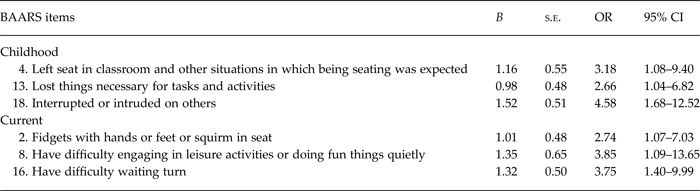
The ADHD DIVA-2 diagnosis was regressed on all BAARS-IV items using logistic regression with stepwise selection of significant predictors. The final model produced a solution with six items, three from childhood and three from adulthood, which had significant risk associations with the diagnostic interview results, with odds ratios ranging from 2.66 to 4.58. The specific items, beta coefficients and 95% confidence intervals are all included in Table 2. The single item that was most predictive of ADHD classification was (children retrospective scale 18) Interrupted or intruded on others, based on an AUC of 0.78 (sensitivity 67.7%, specificity 81.3%, accuracy 78.0%).
Logistic regression model results for child and current BAARS-IV items directly associated with DIVA-2 interview-derived ADHD diagnosis (n = 195)
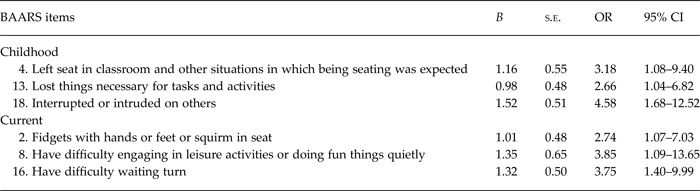
BAARS, Barkley Adult ADHD Rating Scale; DIVA-2, Diagnostic Interview for ADHD in Adults 2.0; OR, odds ratio; CI, confidence interval.
Items selected previously from stepwise model, forward selection from the pool of all BAARS items.
Scoring each item on a simple yes/no basis provides an additive scale ranging from 0 to 6. Splitting the sample randomly in half to give a ‘development’ and a ‘validation’ sample, and using Youden's J index indicates that in both samples a cut-off of ⩾3 gives optimal performance (see Table 3). Using a more complex scoring system for each item, namely calculating the weighted probability, based on each item's regression coefficient, and then plotting the ROC curve (see Fig. 2) for development split-half (50%), validation split-half (50%), and LOOCV, reveal AUCs of 0.89, 0.81 and 0.82, respectively.
Receiver-operating characteristic (ROC) curves and area under the curve for the diagnostic accuracy of the brief Barkley Adult ADHD Rating Scale for Diagnostic Interview for ADHD in Adults interview-derived ADHD diagnosis.

Diagnostic accuracy of the Brief BAARS
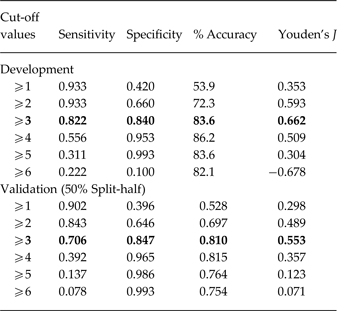
BAARS, Barkley Adult ADHD Rating Scale; AUC, area under the curve; CI, confidence interval.
Development: AUC 0.885 (95% CI 0.823–0.947), n = 195; Validation: AUC 0.822 (95% CI 0.750–0.894). n = 195.
Finally, we explored the diagnostic utility of our derived brief BAARS-IV scale on cases classified as ADHD NOS. The internal validation (50%) and LOOCV methods both produced AUC values of 0.78.
Discussion
In this study we set out to evaluate the BAARS-IV (Barkley, Reference Barkley2011) as a diagnostic screening measure for detecting ADHD cases in a UK prison sample. We did so utilizing a valid and frequently used clinical interview for diagnosis. We then proceeded to develop a briefer scale that maximized diagnostic accuracy and efficiency. To our knowledge, this is the first study to examine both false-positive and false-negative rates when screening for ADHD in a prison sample. High rates for both were found. The original BAARS-IV performed poorly at identifying prison inmates with ADHD (0.38), but had high ability to identify non-cases (0.96) and an overall AUC of 0.67. However, the briefer scale substantially improved the diagnostic parameters of sensitivity (84.0), accuracy (83.6) and overall AUC (0.89), with robust specificity (82.2). Internal validation (AUC 0.81) and cross-validation (AUC 0.82) findings confirmed its potential usefulness to screen for ADHD in different samples of prison inmates. Screening for ADHD NOS cases was satisfactory in this sample, which provides further evidence of diagnostic validity.
A clear strength of the brief diagnostic screening tool is that it includes both childhood and current ADHD indicators. Our modelling approach allowed examination of the potential contribution of all 36 items and produced a solution that equally represented childhood and current symptoms (i.e. three items in each). In the context of clinical practice, this finding is consistent with the chronic nature of ADHD symptom domains of I/A and H/I. Childhood symptoms on the brief screen were seemingly more predictive of ADHD status than adult symptoms, when contrasting their individual diagnostic screening capacities using total number of symptoms. The symptom average was higher in childhood than in current self-reports of prisoners, and the screened prevalence was also higher retrospectively (39.8% v. 17.9%), which is consistent with symptom decline with age (Faraone et al. Reference Faraone, Biederman and Mick2006).
The three childhood items empirically selected by our model all queried ADHD indicators that are relevant to the domain of school and school performance, and one specifically referred to behaviour in the classroom. One of these items was the single most predictive item of the BAARS-IV, Interrupted or intruded on others. School problems, including behavioural and academic difficulties, and resultant school drop-out are all established risk factors for delinquency and incarceration (Murray & Farrington, Reference Murray and Farrington2010). School-based detection of ADHD symptoms of inattention, hyperactivity and impulsivity can be explored in combination with other known risk factors for delinquency and imprisonment such as conduct problems (Koegl et al. Reference Koegl, Farrington and Augimeri2009), peer antisocial activity (Loeber & Farrington, Reference Loeber and Farrington2000) and history of bullying or having being bullied (Farrington et al. Reference Farrington, Ttofi and Losel2011; Ttofi & Farrington, Reference Ttofi and Farrington2012). For instance, in our sample, only 18.8% of individuals who were diagnosed in this study with ADHD had been previously detected by a physician or mental health professional, and only 15.6% had received targeted pharmacological treatment for their symptoms. This is consistent with earlier community-wide studies such as the National Comorbidity Survey (Kessler et al. Reference Kessler, Adler, Barkley, Biederman, Conners, Demler, Faraone, Greenhill, Howes, Secnik, Spencer, Ustun, Walters and Zaslavsky2006) that found only 10% of adults with ADHD had ever been diagnosed with it previously. Such results emphasize that ADHD is being substantially missed in at-risk individuals or being misdiagnosed. Early detection of cases affords the opportunity for early intervention and interruption to the antisocial trajectory (Lichtenstein et al. Reference Lichtenstein, Halldner, Zetterqvist, Sjolander, Serlachius, Fazel, Langstrom and Larsson2012).
Notwithstanding the age-of-onset criterion having been recently modified to include those with onset up to 12 years, we also included those who reported onset of symptoms at 12 years. Notably, the frequency for onset at age 12 years was markedly high, and followed an upward trend from all previous age categories, whereas onset on and after age 13 years sharply declined. Requesting individuals to think and recall back to this time may be difficult and they may find it easier to distinguish between the move from junior and senior school around this age.
The BAARS-IV full scale based on the DSM algorithm performed poorly in terms of detection of cases, and also produced a much lower prevalence rate than expected (12.1%). Nevertheless, this is consistent with our previous prison study using a DSM-IV-based rating scale that assessed symptoms retrospectively and currently, producing a screening rate of 14% (Young et al. Reference Young, Gudjonsson, Wells, Asherson, Theobald, Oliver, Scott and Mooney2009). This may suggest that at least in prison inmates, assessing full standard criteria as self-report of symptoms are not advised.
A key strength of the study is its large sample size and a methodology in which every participant in the sample was screened and interviewed using the DIVA-2 – a diagnostic clinical interview of ADHD in international use. This methodology allowed us to investigate both false-positive and false-negative rates in this population for the first time. Findings are thus generalizable to other male offender populations. This is exemplified by the ADHD prevalence rate of 24.6% obtained in the present study, which is markedly consistent with a recent meta-analytical rate based on 42 studies at 26–30% (Young et al. Reference Young, Moss, Sedgwick, Fridman and Hodgkins2015a ). However, our sample was restricted to males and that is a limitation. Future research should extend this protocol to female offenders with ADHD who may present as clinically distinct from community females with ADHD, in terms of co-morbidity, severity and impairment (Young et al. Reference Young, Moss, Sedgwick, Fridman and Hodgkins2015a ; Gonzalez et al. Reference Gonzalez, Velez-Pastrana, Ruiz Varcarcel, Levin and Albizu-Garcia2015; Konstenius et al. Reference Konstenius, Larsson, Lundholm, Philips, van de Glind, Jayaram-Lindstrom and Franck2015). We performed internal validation and provided confirmation by using LOOCV. Because performance on the LOOCV model was similar to the half-sample trial it may be expected that the test performance in another sample would be equally adequate. Nevertheless, administering the screening tool in an entirely new sample would represent an ideal validation group, which was not available for the present study. Therefore, a next step in validation is to perform the protocol in an external, independent sample of offenders. Our objective was to generate and to provide the first line of validation for a screening tool that would be particularly suited for ADHD in a criminal justice sample. Replication studies should provide definitive proof of its diagnostic qualities further in subsequent studies. We also advice examining the brief screen's external validity as applied in clinical settings.
The findings are clear that this brief screening tool has considerable promise as an accurate and resource-effective tool for adult males in the criminal justice system who are likely to have ADHD. It also has the potential to be of value in other populations, both clinical and educational/occupational, and future research should aim to establish the utility of the screen more widely.
The proportion of inmates in prisons is increasing worldwide (Walmsley, Reference Walmsley2013), but particularly in the USA is estimated at more than 1% (Pew Charitable Trusts, 2008). Many of these inmates will likely meet diagnostic criteria for ADHD (Young et al. Reference Young, Moss, Sedgwick, Fridman and Hodgkins2015a ), and in turn will be released from prison and will require community mental health services. Efficient identification in prison may lead to adequate interventions that could prevent adverse functional outcomes for the individual and for society.
Acknowledgements
We are grateful to the Scottish Prison Service and staff at Porterfield Inverness Prison for their support of the study. We are also grateful to Russell A. Barkley, Ph.D., for his comments on an earlier draft of this paper, and to Dr Constantinos Kallis, for his valuable advice on the statistical methods. This study was funded by Shire Pharmaceutical Development Limited. Shire Pharmaceutical Development Ltd. had no role in the design and conduct of the study; collection, management, analysis, and interpretation of the data; or on the preparation, review, or approval of the manuscript, and the decision to submit the manuscript for publication.
Declaration of Interest
Susan Young, Gisli H. Gudjonsson and Philip Asherson have received honoraria for consultancy, travel, educational talks and/or research from Janssen, Eli Lilly, Shire, Novartis, HB Pharma, Flynn Pharma and/or Shire. The remaining authors have no conflict of interest to declare.