Why are certain practices adopted and others rejected in colonial encounters? How did the acceptance or rejection of nonnative material culture and practices manifest across the colonial landscape? Answering these questions demands analysis of the ways particular materials were used, both spatially and temporally (Dietler Reference Dietler2010:8–14). Colonial encounters involved sociopolitical and economic negotiations on a variety of scales through time and across space, with far-reaching effects on the local region, macroregion, and globe (see Stein Reference Stein2005). Archaeologists investigating colonial situations have turned away from models that stress the asymmetrical assimilation of a passive culture into a dominant partner toward an understanding that both the colonizers and the colonized have significant inputs into structures of domination, power, and resistance (Ferris, Harrison, and Wilcox Reference Ferris, Harrison and Wilcox2015; Gosden Reference Gosden and Hodder2001; Jordan Reference Jordan, Majewski and Gaimster2009; Liebmann and Murphy Reference Liebmann and Murphy2011; Lightfoot Reference Lightfoot2005; Panich Reference Panich2013; Silliman Reference Silliman2005; Stein Reference Stein2005; Voss Reference Voss2005). These entanglements produce conditions under which new identities emerge—inadvertently or intentionally—from multiple active agents taking part in the transformation of culture (Deagan Reference Deagan and Cusick1998; Ortiz Reference Ortiz and de Onís1995; van Dommelen Reference van Dommelen1998; Voss Reference Voss2005, Reference Voss2008).
In the eighteenth and nineteenth centuries, the establishment of the mission system in Alta California represented one colonial enterprise that sparked a series of negotiations across the landscape (Panich and Schneider Reference Panich and Schneider2014, Reference Panich and Schneider2015). Specifically, these colonial operations were articulated through a regional system composed of key political and economic institutions whose primary goal was to enculturate native peoples and make them into loyal Spanish subjects through relocation programs, intensive labor regimes, and strict religious indoctrination (Haas Reference Haas2014; Hackel Reference Hackel2005; Lightfoot Reference Lightfoot2005; Milliken Reference Milliken1995). Settler communities maintained two primary social categories to distinguish themselves (españols or gente de razón [people with reason]) from Indians (indios or gente sin razón [people without reason] [Haas Reference Haas1995, Reference Haas2014; Lightfoot Reference Lightfoot2005; Voss Reference Voss2008]). This system supplanted the Spanish castas system, or sistema de castas, which was based upon the idea that individuals of primarily Spanish ancestry were of higher status, while persons of mixed heritage were of lower status (Haas Reference Haas1995:29–32, Reference Haas2014:54–56; Voss Reference Voss2008:101). Yet the distinctions between gente de razón and gente sin razón were not static; these boundaries were fluid and negotiable, allowing Indians who accepted colonial lifeways to elevate their social identities (Lightfoot Reference Lightfoot2005:68; Haas Reference Haas1995:30; Voss Reference Voss2008:101–102). Gente de razón status was especially important for indigenous peoples because they could gain higher-status occupations, receive more rights and responsibilities such as land ownership, have greater access to prestige goods, or even occupy specialized adobe apartments set aside for the most “tried and true” mission residents (Farris and Johnson Reference Farris and Johnson1999; Haas Reference Haas2014; Hackel Reference Hackel2005; Lightfoot Reference Lightfoot2005; Voss Reference Voss2008). Indigenous peoples who rejected these colonial expectations remained lower-ranked within the colonial order and were thus classified as gente sin razón.
However, not all indigenous peoples responded to this system in the same way; nor were colonial ideas and practices accepted passively or homogeneously across the landscape (Castillo Reference Castillo and Hurst Thomas1989; Lightfoot Reference Lightfoot2005; Panich and Schneider Reference Panich and Schneider2014). In fact, these institutions were established in regions where native California groups were socially situated in small, linguistically diverse, autonomous territories that had developed their own histories for thousands of years before the Spanish arrived (Bettinger Reference Bettinger2015; Heizer Reference Heizer and Sturtevant1978). For at least the last 9,000 years, people speaking Chumashan languages made up several of these sociopolitical groups occupying the coastal region of south-central California. From the founding of Mission San Buenaventura (AD 1782) to the end of the mission system (AD 1833), the Chumash experienced everyday life under colonialism differently, depending upon where they were spatially and socially situated. Left behind in the archaeological record are the material signatures of these sociohistorical circumstances, the study of which can provide insight into the operation of colonialism.
In this study, I focus upon one type of material culture used by the Chumash for thousands of years—soapstone. This type of stone tolerates direct heat and can be modified into various forms, making it an ideal medium to cook, prepare, and store foods. Previous research has identified the importance of soapstone in Chumash foodways, but there is no serious investigation of these cooking vessels through time and across space, even though they are available to study in museum collections. To advance understanding of this artifact class, I identify procurement sources and develop a functional typology to determine how the objects were used. I then conduct diachronic and spatial analyses to show how practices changed or remained the same across the landscape. I conclude that the Chumash acquired, produced, consumed, and recycled soapstone in recombinant ways during the Mission period. Although some Spanish practices were integrated into local traditions, the Chumash rejected or transformed others. The contexts of these objects provide critical elements in understanding the dynamic nature of indigenous social identity in Alta California.
Situating Identity
Over the course of the last decade, identity issues have become a predominant topic of study in anthropology; however, their widespread use can lead to ambiguous meanings and interpretations (see Insoll Reference Insoll2007). Indeed, the paradoxical nature of identity makes it difficult to define, for identity is both fixed and fluid; it incorporates the individual and society; it can be ascribed or cast out of free will; moreover, it is not only rooted in the past but also linked to expectations of the future (Díaz-Andreu and Lucy Reference Díaz-Andreu, Lucy, Díaz-Andreu, Lucy, Babić and Edwards2005; Gardner Reference Gardner, Amundsen-Meyer, Engel and Pickering2011; Hodos Reference Hodos, Hales and Hodos2010; Smith Reference Smith, Gardner, Lake and Sommer2014; Voss Reference Voss2008). In this article, I refer to identity as “individuals’ identification with broader groups on the basis of differences socially sanctioned as significant” (Díaz-Andreu and Lucy Reference Díaz-Andreu, Lucy, Díaz-Andreu, Lucy, Babić and Edwards2005:1; emphasis added). Status, race, ethnicity, gender, and age are elements that crosscut each other in identity studies; one category of social difference can prevail over the other or be deemed more significant in certain contexts.
A problem faced by archaeologists, however, is how to study identity issues without essentializing people in the past. Engagement with postcolonial frameworks calls into question the assignment of categories based upon specific attributes or styles and illustrates the difficulties in classifying artifacts into dichotomies, such as indigenous/colonial, traditional/innovative, and Spanish/native, or as merely “hybrid” things (e.g., Law Pezzarossi Reference Law Pezzarossi2014; Liebmann Reference Liebmann2015; Silliman Reference Silliman2015). One way to avoid such rigid categorical distinctions is to bring together change and continuity while recognizing the important roles of practice, memory, and material discourse (e.g., Liebmann Reference Liebmann2012:135–188; Silliman Reference Silliman2009). This framework is especially useful when investigating identity issues and indigenous craft industries at the local level. For instance, archaeologists can horizontally and vertically trace both change and continuity in localized craft production to see what practices were adopted during colonial encounters, the contexts in which these practices were performed, and the shifting, dynamic ways indigenous identities manifested across the colonial landscape. These data can illuminate the ways local groups constructed, reconstructed, negotiated, and expressed their identities in different social circumstances.
Here, I investigate the acquisition, production, use, and recycling of soapstone vessels employed in food preparation and storage to evaluate how the Chumash negotiated their social identities across the landscape during the Mission period (AD 1782–1833). Rather than simply reflecting changes, the dataset demonstrates that the production and use of particular vessel classes were important in the creation and maintenance of indigenous social identity. I find a shift in the soapstone industry inside the mission space and thus a change in foodways. Specifically, the Chumash acquired raw materials from new sources, changed from ollas to bowls, and emphasized the production of comales. However, the primary use of ollas at the outlying ranchería illustrates that traditional soapstone use remained relatively similar throughout the Protohistoric and Mission periods. I argue that these differences in practice articulate specific means of understanding new ways that the Chumash negotiated their identities under colonialism at different points across the landscape.
The Chumash of South-Central California
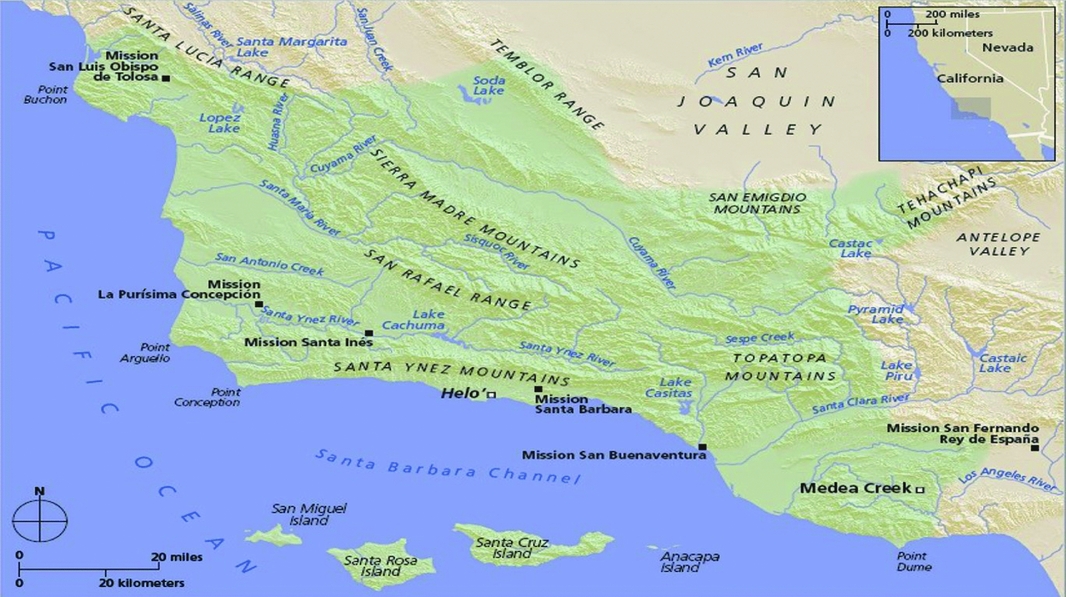
People speaking Chumashan languages occupied the area between Paso Robles in the north and Malibu in the south, the Northern Channel Islands (i.e., Santa Rosa, San Miguel, Santa Cruz, and Anacapa), and as far inland as the western edge of the San Joaquin Valley (Figure 1). They were a complex, nonagricultural, hunter-gatherer-fisher society characterized by high population density, sedentism, hereditary leadership, craft specialization, and a large-scale regional trade network (Arnold Reference Arnold2001; Gamble Reference Gamble2008:276–300; Johnson Reference Johnson, McIntosh, Tainter and Keech McIntosh2000; King Reference King1990). The Gabrieliño (Tongva), who spoke a Takic language of the Uto-Aztecan linguistic stock, occupied the south coast and interior regions immediately south of the Chumash. Historically, their territory extended south to Newport Bay and eastward to encompass the San Gabriel and Santa Ana Mountains; it also included the Southern Channel Islands—Santa Catalina, San Clemente, Santa Barbara, and San Nicolas (McCawley Reference McCawley1996).
Map depicting the extent of Chumash territory in the Santa Barbara Channel region.

Historical documents suggest that the Chumash first encountered peoples from overseas with the arrival of Juan Rodriguez Cabrillo in AD 1542, thus marking the beginning of culture contact (see Silliman Reference Silliman2005). In the Santa Barbara Channel region, this period is known as the Protohistoric period, or the Late period 2 a/b (Johnson Reference Johnson1982). The colonial era, however, with long-standing, daily interaction between the Chumash and European colonists, began with the founding of Mission San Buenaventura in AD 1782. This era is referred to here as the Mission period.
The mission system was established not only to prevent the advance of Russian fur traders from the north but also to convert indigenous peoples into gente de razón. The latter included teaching them characteristics of “rational” peoples (i.e., urban, agricultural, Christian, and Spanish-speaking; Hoover Reference Hoover and Hurst Thomas1989:397). Under the Franciscan policy of reducción, Chumash peoples from multiple surrounding villages were resettled into mission establishments in an effort to form Christian communities (Farris Reference Farris, Panich and Schneider2014; Haas Reference Haas2014). Once baptized, indigenous peoples could not leave the mission without permission; if they ran away, they were persuaded to return through negotiation or were brought back by force (Milliken Reference Milliken1995). When neophytes abided by mission rules and remained disciplined in their daily responsibilities, they gained stature within the mission community and were given increased rights and enhanced status or occupations (Hackel Reference Hackel2005:272–320).
Although there was much change in the Santa Barbara Channel region during the Mission period, even as late as AD 1813, evidence of continuity in practice is present with the use of traditional shell beads, local lithic production detritus, and ground stone fashioned from nearby soapstone sources. The analysis of these local craft industries within colonial establishments provides insight into the social position of the Chumash who relocated to the mission setting and the new identities that were forged there.
Previous Research on Soapstone Use among the Chumash
The use of soapstone among the Chumash has long interested scholars working in the Santa Barbara Channel region. Archaeological and ethnographic evidence suggests that Santa Catalina Island was the primary source for soapstone acquisition for thousands of years (Gamble Reference Gamble2008, Reference Gamble2015; Heizer and Treganza Reference Heizer and Treganza1944; Howard Reference Howard, Browne, Mitchell and Chaney2000; King Reference King1982; Romani Reference Romani1982; Rosenthal and Williams Reference Rosenthal and Williams1992; Schumacher Reference Schumacher1878, Reference Schumacher and Putnam1879; Wlodarski Reference Wlodarski1979). To date, archaeologists have identified 76 quarries on the island near Airport in the Sky, Potts Valley (or Valley of the Ollas), Empire Landing, Eagle's Nest, and Little Springs Drainage (Howard Reference Howard, Browne, Mitchell and Chaney2000:601). Soapstone sources occur in a variety of outcropping types, ranging from talc schists to short-fibered tremolite-asbestos-talc; colors vary from light gray and pink to dark green and black; and formation types include globular outcrops, lenticular veins, and foliated aggregates. However, archaeological evidence shows that people acquired raw material to make ollas, bowls, and comales from coarse-grained soapstone sources that occur as large surface mounds (Wlodarski Reference Wlodarski1979). Due to the rarity of these largest soapstone artifacts in the Tongva (Gabrieliño) area, King (Reference King1982:435–436) posits that these objects were made on Santa Catalina Island and largely traded to the Chumash area.
While there is clear evidence of soapstone vessel production on Santa Catalina Island, archaeologists have identified other quarries throughout Southern California, including at least 18 on the mainland and other islands (Romani Reference Romani1982:164–171; Table 1). While analytic techniques such as X-ray fluorescence and laser ablation inductively coupled plasma mass spectrometry aid in the discovery of soapstone sources (e.g., Basgall and True Reference Basgall and True1985; Eddy Reference Eddy2013), visual identification also documents mineralogical subtypes, granular inclusions, and fine- and coarse-grained materials to identify acquisition locations (Romani Reference Romani1982; Rosenthal and Williams Reference Rosenthal and Williams1992; Weide Reference Weide1973; Wlodarski Reference Wlodarski1979). For instance, Romani (Reference Romani1982:28–31) explains that micaceous soapstone with abundant content of anthophyllite (a mineral characterized by radiating bundles of needlelike crystals) occurs in a unique locality on Santa Catalina Island (see also Weide Reference Weide1973).

Hollowware soapstone vessels (ollas and bowls) were documented by some of the region's earliest antiquarians (e.g., Abbott Reference Abbott and Putnam1879), who even noted distinct differences in soapstone vessel shapes, including ollas of “globular form, with a narrow opening on the top” and bowls of “Mexican form, with a wide opening” (Schumacher Reference Schumacher and Putnam1879:117). Others called attention to soapstone griddles (“frying pans” or comales)—flat pieces of soapstone used for heating food directly over a fire (Hudson and Blackburn Reference Hudson, Blackburn and Blackburn1983:196). These objects have a range of stylistic attributes, such as rounded edges, an incised line near the edge of the cooking surface, a protruding lip around the rim, and handles on one or both sides. Many of these griddles exhibit a straight, conical, or biconical hole or holes drilled at one end for the insertion of a stick to remove it from the fire.
Romani's (Reference Romani1982) pioneering study defined ollas, bowls, and comales and synthesized research on the role of soapstone cooking wares in the Chumash socioeconomic sphere. However, she conducted no diachronic analysis to show whether or how these artifact types changed over time. In a later study, King (Reference King2011:300) illustrated that soapstone ollas recovered from Chumash mortuary contexts remained relatively consistent from the Protohistoric period onward. Nonetheless, his typological classification does not show the appearance of the 24 different kinds of soapstone bowls identified by Wlodarski and Larson (Reference Wlodarski, Larson and Greenwood1976:43) at Mission San Buenaventura. Furthermore, we do not know when or how soapstone griddles were introduced. Hudson and Blackburn (Reference Hudson, Blackburn and Blackburn1983:196) suggest that these objects were probably not used until after Spanish contact; however, I have identified soapstone griddles in sites as early as the Middle period in the Malibu Prehistoric Cemetery (CA-LAN-264).
Diachronic analyses of soapstone vessels in Chumash mortuary contexts have identified a sudden increase in their use in the Protohistoric period (Late period 2a, AD 1500–1650), following a lack of use that lasted nearly 400 years (King Reference King1990:90). This boom is also evidenced by the intensified Late period 2a/b quarrying of micaceous soapstone outcrops on Santa Catalina Island (Howard Reference Howard, Browne, Mitchell and Chaney2000; Schumacher Reference Schumacher and Putnam1879; Wlodarski Reference Wlodarski1979; Wlodarski et al. Reference Wlodarski, Romani, Romani and Larson1984). Some of these quarries show evidence of the use of metal tools—a technology introduced by the Spanish. Some even reveal how bowls and ollas were manufactured: by cutting the object out of the source rock and detaching the chipped form of a pot, with its bottom facing up. Gamble (Reference Gamble2015) notes that soapstone vessel manufacture increased after the introduction of metal tools and suggests that ollas, especially large, decorated ones, were associated with feasting events, both before and during the Mission period.
Previous archaeological investigations have laid the groundwork for the study of soapstone cooking vessel production, use, and recycling over time and across space in California. This study investigates soapstone ollas, bowls, and griddles from numerous archaeological sites and tracks vertical and horizontal change and continuity in Mission period soapstone vessel use.
Materials and Methods
Preliminary analysis started with a systematic examination of soapstone artifacts from four archaeological assemblages: Medea Creek (CA-LAN-243), Mission San Buenaventura (CA-VEN-87), Mission La Purísima (CA-SBA-520), and Cemetery D of Helo’ (CA-SBA-46). To identify the source of soapstone acquisition, the raw material was visually inspected for granular inclusions, mineralogical components, and color variability with the aid of a 3-inch magnifying glass with 5× magnification. After these initial visual inspections, a Dino-Lite Premier (AM4113ZT4) 400× polarizing digital microscope enhanced the mineralogical composition of these objects, which aided with the identification of specific minerals. The granular structure, mineralogical characteristics, and color variability within each assemblage were then compared between assemblages. Previous reports describing the mineralogical characteristics of soapstone sources were used to identify acquisition locations.
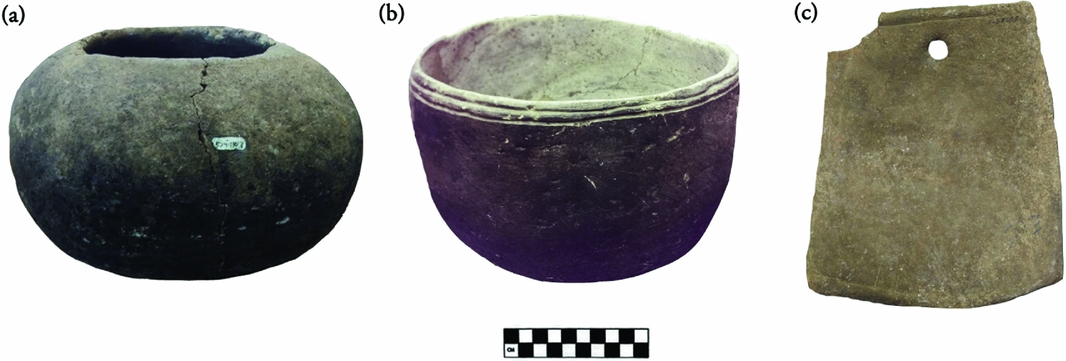
Each artifact was examined for use-wear and style (i.e., etching, buffed edges, and rim type). Particular attention was dedicated to analyzing the object's primary use (how it was originally designed) and secondary use (a later addition to its primary function), following Adams (Reference Adams2002:21–24). After these initial descriptions, each soapstone object was classified as an olla, bowl, or griddle. Ollas have restricted orifices that taper in at the shoulder, while bowls feature wide, unrestricted orifices, and griddles have flat or curved bodies with at least four angled edges (Figure 2). Unfortunately, the minimum number of vessels for griddles was indeterminable because these objects break into uneven fragments that do not allow for an accurate count of individual specimens. Consequently, the ratio of griddles to ollas and bowls could not be determined; therefore, I only focus on the stylistic attributes of griddles over time and across space.
(a) Olla (Cat. No. 524–1107, Fowler Museum at the University of California, Los Angeles, Archaeological Collections Facility); (b) bowl (Santa Barbara Museum of Natural History, Phelan Collection); (c) comal (Cat. No. 1–32195; Phoebe Hearst Museum of Anthropology, Berkeley, California).

Late Period 2a/b (AD 1542–1782)
Data from the Late period 2a/b assemblage were collected from Medea Creek (CA-LAN-243) in the Santa Monica Mountains, which is the largest and best-documented Late/Protohistoric inland Chumash cemetery (King Reference King1982). Bone samples from two different burials yielded radiocarbon dates of 345 ± 50 BP and 530 ± 60 BP (King Reference King1982:34). These data, along with shell bead seriation and obsidian hydration dating, suggest that the Medea Creek cemetery was used for about 200–300 years, from AD 1450 to no later than AD 1785 (King Reference King1982:32–35).
Mission Period (AD 1782–1833) Mission Assemblages
The first mission assemblage comes from Mission San Buenaventura (CA-VEN-87), which was founded in AD 1782 and is in Ventura, California. This mission played a chief role in the conversion of Channel Islanders, especially the Chumash living on Santa Cruz Island, due to its proximity to some of the island's largest villages (Johnson Reference Johnson1982:97). The mission grounds were extensively investigated under the direction of Roberta Greenwood, and many major structures were uncovered, including Indian family housing (Loci 1–4) and a segment of the first established church (Locus 5).
The second mission soapstone assemblage comes from Mission La Purísima (CA-SBA-519 and CA-SBA-520; Deetz Reference Deetz1963), which was founded in 1813 in Lompoc, California. Of the entire neophyte population at the mission, only about 50 individuals lived inside a designated area referred to as the Indian family apartments. These residents likely represented baptized Indians who fully accepted Christianity and other colonial customs, thereby achieving a degree of stature in the mission community (Farris and Johnson Reference Farris and Johnson1999:8). Deetz (Reference Deetz1963) exposed seven rooms in the apartments, with hearth features and in situ artifacts associated with domestic activities.
Mission Period (AD 1782–1833) Ranchería Assemblage
The last historic site used in this study, CA-SBA-46, is located in what is today Goleta, California. The historic village, referred to as Helo’, and its associated cemetery are approximately 56 km southeast of Mission La Purísima and 51.5 km west-northwest from Mission San Buenaventura. The site is only about 11 km from the presidio of Santa Bárbara (established in AD 1782) and Mission Santa Bárbara (established in AD 1786). The soapstone assemblage studied here was excavated from a section of the historic village denoted Cemetery D, which was only used during the mission era (AD 1782–1833; Gamble Reference Gamble2008; Glassow, Johnson, and Erlandson Reference Glassow, Johnson, Erlandson and Riddell1986; Orr Reference Orr1943:10). In 1875, Henry C. Yarrow and his party excavated one portion of the cemetery, and in 1930, Ronald Olson excavated another portion, recording hundreds of burials and associated artifacts (Olson Reference Olson1930:11; Putnam et al. Reference Putnam, Abbott, Haldeman, Yarrow, Henshaw and Putnam1879).
Comparing Assemblages
These assemblages represent both mortuary and domestic contexts. A study based solely on mortuary goods was not possible, as Indian burials inside Mission La Purísima—the most extensively excavated mission cemetery in the Santa Barbara Channel region—lacked grave goods (Humphrey Reference Humphrey1965:189). Additionally, existing soapstone collections from domestic sites outside the mission derive from mixed Late period occupations, representing both the Protohistoric and Mission periods; therefore, a horizontal and vertical analysis to compare with Mission assemblages was not possible. Although there is a risk in comparing domestic and mortuary assemblages, vessels from both contexts show evidence of multiple cooking events (i.e., thick food residue on the interior, oxidation on the exterior, heavy soot buildup on the base) and thus still inform us about foodways and the use of soapstone in everyday life.
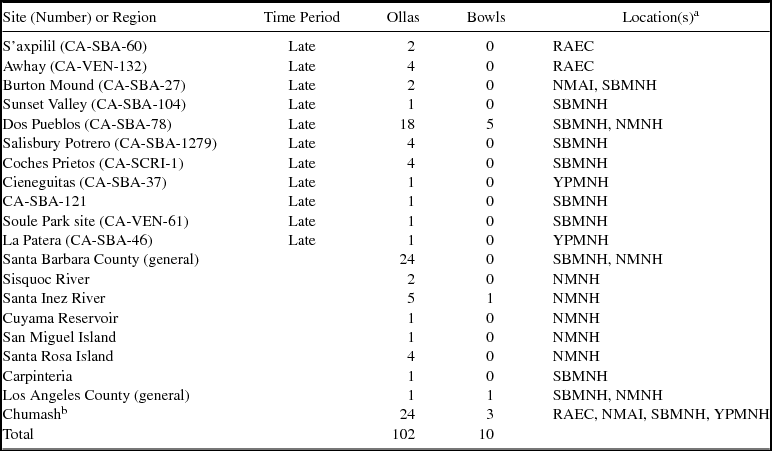
Due to the nature of the two distinct contexts studied here, I have also incorporated data gathered from six different repositories across North America that house a total of 112 hollowware soapstone vessels (Table 2). These artifacts were recovered from numerous archaeological excavations over the course of the last century and were unearthed from mixed Late period archaeological sites within the Santa Barbara Channel area and some unknown contexts within the Chumash region. Together, these data provide the most comprehensive sample available for documenting traditional Chumash patterns outside the mission during the Protohistoric and Mission periods.
Frequency of Ollas and Bowls in Repositories with Chumash Collections.

a RAEC = University of California, Santa Barbara, Repository for Archaeological and Ethnographic Collections; NMAI = National Museum of the American Indian; SBMNH = Santa Barbara Museum of Natural History; NMNH = National Museum of Natural History; YPMNH = Yale Peabody Museum of Natural History.
b Items labeled as Chumash in collections but with no specific provenience.
Results
Acquisition
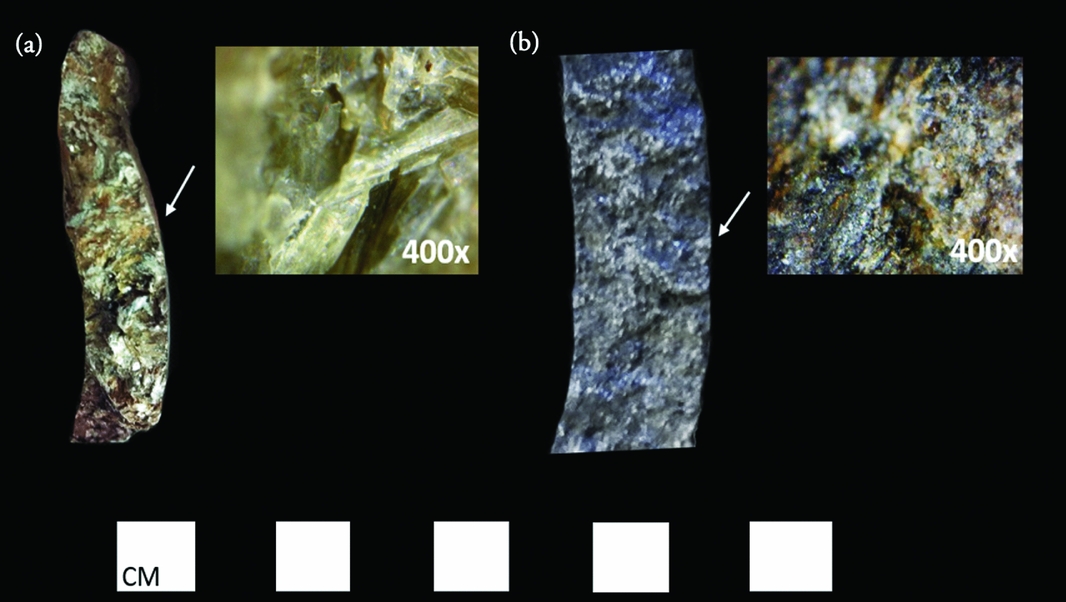
All the objects studied here consist of coarse-grained (grain size >1 mm, after Rosenthal and Williams Reference Rosenthal and Williams1992:221), silicate-rich rocks (e.g., talc-schist, chlorite-schist, chlorite-talc-schist); however, there are differences in the quality of the raw material among the sites in terms of mineralogical components and other distinctive features. Among the objects studied from the Protohistoric period and the historic ranchería, for instance, the Dino-Lite microscope showed evidence of crystal-like minerals that were densely compact (Figure 3). To the naked eye, the aggregation of these minerals gives the object a distinct silvery, crystalline appearance, resembling sources originating from Santa Catalina Island rather than those identified in the interior Yokuts area (Tulare County) or Sierra Pelona schists (King Reference King1982:127). These crystals resemble an abundance of anthophyllite that is known to exist in unique localities on Santa Catalina Island (Romani Reference Romani1982:31). The color of the soapstone within one artifact can range from pale red (10R6/2), to pinkish gray (7.5YR7/2), to dark gray (2.5Y4/1). Finally, the fractured areas of these soapstone pieces were smooth and rounded.
(a) Medea Creek olla showing possible evidence of the mineral anthophyllite and (b) Mission La Purísima bowl with no crystals present. Photos taken at the Fowler Museum at the University of California, Los Angeles, Archaeological Collections Facility and La Purísima Mission State Historic Park Curation Facility, Lompoc, California.

The raw material used to fashion cooking vessels in the mission displayed more densely concentrated, medium, sheetlike minerals, which suggests a source that has more schist in its granular composition. These objects also lack the aggregation and abundance of fine crystals. Thus, the distinct crystalline appearance and presence of needlelike crystals under the Dino-Lite microscope were absent within all the artifacts sampled from the Mission assemblages. While the raw material was interleaved with what appears to be quartz, these inclusions were more dispersed rather than aggregated. The primary colors noted on these artifacts were a gray (2.5Y5/1) and very dark gray (2.5Y3/1). Along the fractured surfaces, which broke in blocky structures rather than smoothed ones, isolated pieces of bronze-colored mica inclusions as big as 6 mm were present, suggesting that this material also came from a source rich with mica.
These preliminary results suggest that during the Protohistoric period the soapstone was procured from Santa Catalina Island; however, a shift in soapstone acquisition likely occurred inside the missions as new quarries were accessed. Romani (Reference Romani1982:163–171) documented at least three “chlorite-schist,” “steatite,” and “talc-schist” sources near Mission La Purísima and Mission San Buenaventura. These include Santa Cruz Island near the vicinity of Valley Anchorage, near Mt. Piños in Santa Barbara County, and even in the southern San Joaquin Valley in Lindsay, Tulare County. Alternatively, there may have been different localities on Santa Catalina Island that were used to produce mission cooking vessels. Further analytic testing is necessary to determine the exact location of these materials; however, some of these sources may no longer be visible or available for study due to recent construction and mine and quarry operations.
Olla, Bowl, and Griddle Descriptions
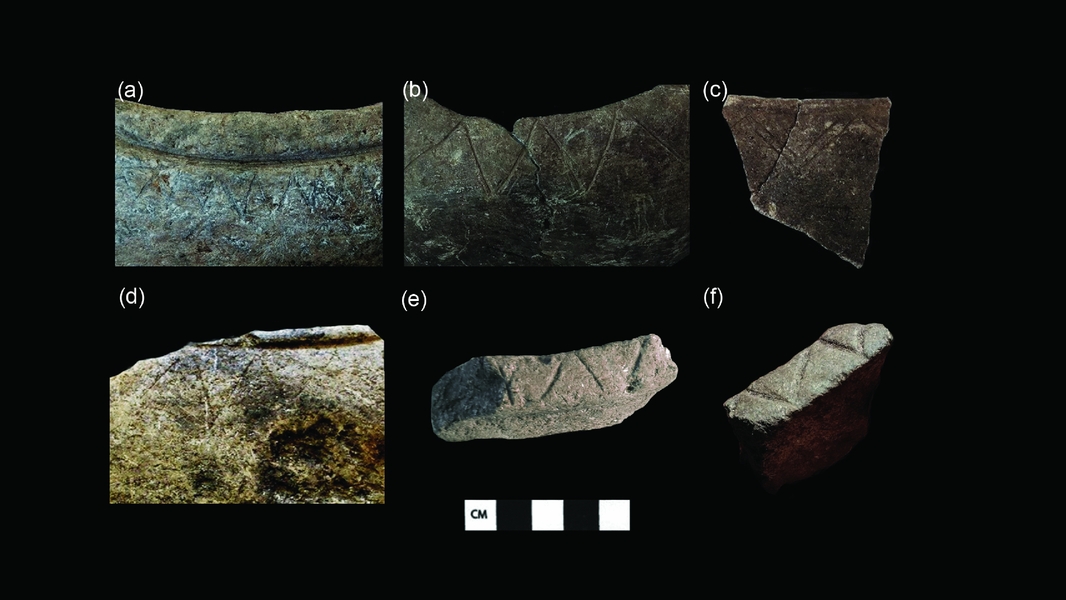
All the ollas from the four soapstone assemblages feature orifice diameters ranging from 10 to 18 cm and display full, globular bodies. This vessel shape has long been recognized as ideal for boiling foods for long periods, as excess water could not boil over the top of the small opening and food could therefore remain hydrated (Rice Reference Rice1987:240–241). Each vessel also displayed a thin rim that gradually increased in thickness toward a bulbous base, which suggests that the ollas were positioned over the cooking fire with some form of support (Rice Reference Rice1987:242). The principal use-wear evident on all the ollas was made up of heavy soot buildup on the lower and middle portions of the vessel body, suggesting that their primary use and function was cooking. Thick, well-preserved food residue also adhered to most of the ollas’ basal interiors, further attesting to their use for long-term cooking. Regarding style, the ollas exhibit characteristics such as an upward-protruding lip, an incised line around the orifice to distinguish a rim, and incised lines in the shape of Vs and Xs along the shoulder (Figure 4).
Examples of different etching styles on soapstone ollas and bowls: (a) Medea Creek olla (Cat. No. 524–1102); (b) Medea Creek olla (Cat. No. 524–1103); (c) Medea Creek olla (Cat. No. 534-316); (d) Mission La Purísima olla (Cat. No. 147–1714; photo by Shyra Liguori); (e) Mission San Buenaventura bowl (Cat. No. v-87-5501); (f) Mission La Purísima bowl (found during a 2017 archaeological survey; photo by Barbara Tejeda). All other photos taken by the author at the Fowler Museum at the University of California, Los Angeles, Archaeological Collections Facility and the Albinger Museum, Ventura, California.

The bowl rims are much thicker than the rims of the ollas, and the orifices are much wider. Indeed, box plots reveal a statistically significant difference in the rims and orifices of these two artifact classes (Figure 5). The bowl vessels gradually increase in thickness toward a flat base that joins the vessel wall at an angle; the function of this design suggests that cooking was done on a flat, stable surface (Adams Reference Adams2002:218). The shape of these vessels suggests that the foods cooked were not boiled for long periods but, rather, simmered at lower temperatures (Linton Reference Linton1944). The open form of these bowls would have facilitated stirring and the frequent addition and removal of contents (Rice Reference Rice1987:241). In fact, the primary use-wear evident on the bowls is carbon sooting, as identified on the vessel exterior near the bottom and middle portions of the base, suggesting that they functioned primarily for cooking food. However, the lack of residue in these bowls reveals that they were not used for long-term boiling, as was the case with ollas. Regarding decoration, most bowls are plain, while others display incising in the form of Vs or Xs on the rim or horizontally protruding lips. One bowl even displayed a handle on the shoulder.
Box plots showing statistical differences in (a) rim thickness and (b) orifice size of ollas and bowls.

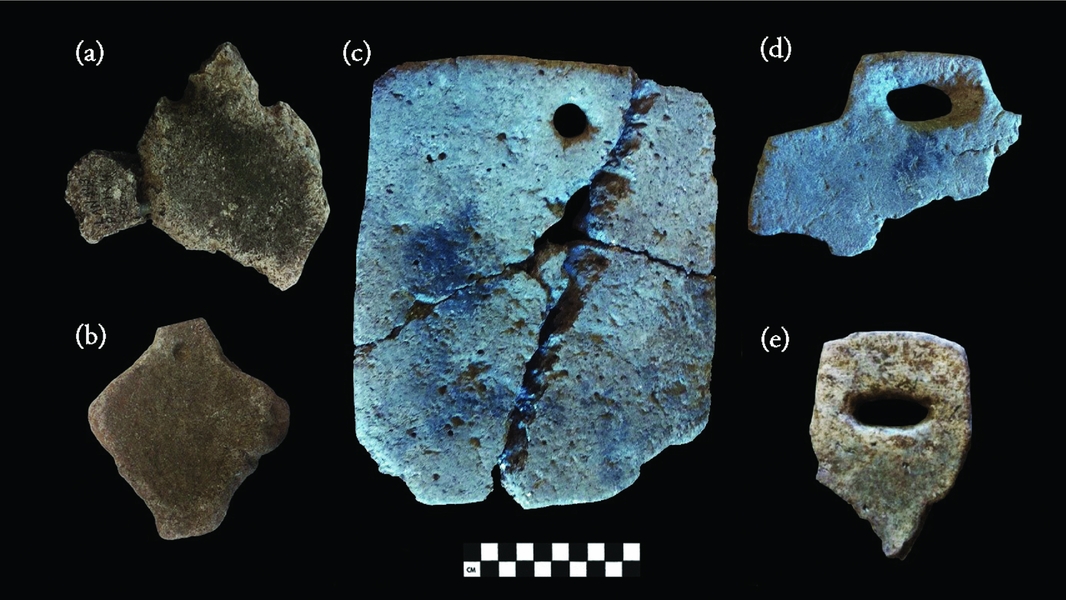
The griddles come in a variety of shapes, ranging from triangular to diamond and ovular to rectangular. Some griddles were made in a rather crude fashion, while others display stylistic attributes such as rounded edges and a protruding lip or handle(s). The principal use-wear among them is sooting along the outer edges and on one side of the griddle; some food residue and grease stains are occasionally present on the other side. These attributes suggest that their primary function was for heating solid foods over a hearth—the hole at the top allowed for the insertion of a stick or metal rod to move the comal on, off, and around the fire. However, some griddles, including the four whole specimens identified from the historic ranchería of Helo’, lack evidence of sooting and food residue.
Diachronic Change
The Late period 2a/b soapstone assemblage is primarily composed of ollas (n = 14); only one bowl was identified in the collection. A similar pattern exists at Helo’, located some distance from the mission, where there continues to be a higher number of ollas (n = 24) than bowls (n = 7). In fact, the use of ollas in mixed Late period sites occupied outside the mission is striking: 39 ollas and only five bowls were identified in extant museum collections within Chumash territory. Moreover, ollas figure prominently in collections across the Santa Barbara County area, and they even dominate soapstone assemblages that lack specific locations in the Chumash region. In stark contrast to this pattern is the higher frequency of bowls inside the missions. At Mission La Purísima, 13 bowls and only five ollas are present in the assemblage, and at Mission San Buenaventura, 16 bowls and only six ollas were identified (Figure 6). There is a statistically significant difference (Fisher's exact test, p < 0.0001) between the number of bowls and the number of ollas inside the missions compared with the native villages of Helo’ and Medea Creek.
Frequency of bowls and ollas among four sites.

Concerning griddles, two prominent patterns are discernible in the Protohistoric and Mission period assemblages. First, griddles that display a high degree of body curvature and remodification occur more often in the Mission period assemblages than in the Protohistoric period ones. In the precolonial assemblage, for instance, only one griddle was altered from a bowl or olla, but at Mission La Purísima, at least eight griddles appear to have been shaped from hollowware vessels—some even display a portion of the rim from the olla or bowl from which they were refashioned. At Mission San Buenaventura, as many as 53 soapstone fragments were described as displaying secondary modifications (Wlodarski and Larson Reference Wlodarski, Larson and Greenwood1976:51). The refashioned griddles have a heavy schist content and are much thicker, resembling mission bowls rather than Santa Catalina Island soapstone ollas, which suggests that they were recycled from bowls produced in the mission. Finally, the griddles have traits that show greater elaboration and more stylized features later in time. At the Mission period sites studied here, griddles are primarily composed of large, rectangular slabs with a distinct rim etched into a well-defined edge or slightly upward-facing rim. Projecting handles were also present in the mission assemblages (Figure 7). However, in the Protohistoric period a variety of shapes (i.e., triangular, diamond, subrectangular, ovular) were noted, and some of these objects feature rough, unfinished edges.
Different styles of soapstone griddles: (a–b) Medea Creek; (c–d) Mission La Purísima; (e) Mission San Buenaventura. Photos taken at the Fowler Museum at the University of California, Los Angeles, Archaeological Collections Facility; La Purísima Mission State Historic Park Curation Facility, Lompoc, California; and the Albinger Museum, Ventura, California.

Discussion
Acquisition, Production, and Recycling
The patterns identified in the raw materials inside the missions may have occurred as a result of changing procurement practices that emerged due to destabilized trade networks extending from the Channel Islands to the mainland. By 1803, many islanders had left their native villages to join the missions, and between AD 1814 and 1817, the Northern Channel Islands were nearly devoid of native peoples (Johnson Reference Johnson1982:67–68). The Southern Channel Islands went through similar disturbances: by 1819, Santa Catalina Island's native population was gone (Strudwick Reference Strudwick, Jazwa and Perry2013). This suggests that the mission system exerted a major impact upon Channel Island trade routes and that island peoples were experiencing drastic change by the time the second Mission La Purísima was established in 1813. Soapstone sources identified by Romani (Reference Romani1982), such as the area near Mt. Piños in Santa Barbara County and the southern San Joaquin Valley in Lindsay, Tulare County, would have provided alternative procurement places. The source identified near Mt. Piños is certainly much closer. For instance, a straight linear path from Mission La Purísima to the northwestern point on Santa Catalina Island near Airport in the Sky stretches about 220 km; from Mission San Buenaventura, this same point is about 112 km away. However, Mt. Piños is only about 112 km away from Mission La Purísima and about 64 km away from Mission San Buenaventura. Alternatively, the soapstone source from Lindsay in Tulare County may have been exploited. King (Reference King1982:127) specifically distinguished this source in the Yokuts area as a quarry site that was distinctly different from soapstone sources on Santa Catalina Island due to its heavy schist-like content. The differences identified here may be a result of indigenous procurement from these two distinct locations.
While previous archaeological investigations found that soapstone vessels were made near procurement places on Santa Catalina Island, more soapstone artifacts displaying sequential secondary modifications, miscellaneous soapstone pieces, and unidentifiable vessel fragments are found inside mission spaces compared with Late period 2a/b assemblages and outlying rancherías. For instance, at Mission San Buenaventura, Wlodarski and Larson (Reference Wlodarski, Larson and Greenwood1976:57–58) show that recycled soapstone objects and vessels associated with food preparation (i.e., bowls, comales, and ollas) increased over time, based on raw counts from 0 to 180 cm. The authors (1976:59) also found twice as much soapstone as mission pottery, as represented by percentages compared with the total number of artifacts from 0 to 100 cm. At Mission La Purísima, Deetz (Reference Deetz1963) also found that the use of soapstone increased inside the mission. When comparing the mission Indian family apartments with Alamo Pintado—a historic Chumash village located 40 km from the mission—Deetz (Reference Deetz1963:187) found more than twice the frequency of soapstone artifacts, illustrating that this material type was used more intensively in the mission than in surrounding villages.
The shift in soapstone acquisition, production, and recycling represents a reconfiguration of social, economic, and political activities, as well as new practices that emerged inside the mission space. The imposed colonial structure operated such that indigenous peoples could not leave Franciscan lands without permission, and they had limited freedom to choose their occupation (Lightfoot Reference Lightfoot2005:66–68). However, mission residents could have elevated their social status and been promoted to jobs with greater responsibility by accepting colonial lifeways. Soapstone bowl producers may have been indigenous peoples who worked their way up the hierarchical mission social system and were thus guided by social customs related to status and identity. The decision to produce bowls instead of ollas not only catered to Spanish-influenced cuisine and culinary practices but also fostered the construction of new indigenous identities by creating distinctions in practice across space. Yet these soapstone artifacts were not made using ceramic or metal resources; nor were they imported from colonial seaports such as San Blas. These bowls were fashioned from materials used by indigenous peoples in the Santa Barbara Channel region for thousands of years, illustrating that these changes in practice mapped onto preexisting forms of knowledge and cultural values. Some of the bowls even display etching on the rims, such as the series of Vs and Xs, recognized on ollas in the Protohistoric period and at the outlying ranchería. The symbolic importance of these historically situated materials and styles inside the mission suggests that indigenous identities were transformed and redeployed in ways that allowed the Chumash to adapt to and negotiate new colonial situations on their own terms.
Consumption and Foodways
The change identified in the soapstone industry inside the mission also demonstrates a shift in culinary practices. Bowls were used to simmer different types of foods frequently; their open form could facilitate the serving of foods for the mission community, and their flat bases suggest that they were cooked on level surfaces in specialized cooking areas. Thick-pasted stews and soups influenced by early Spanish cuisine would also have been ideal meals to cook in these vessels. For instance, at El Presidio de San Francisco, Voss (Reference Voss2008:248) has found that two of the most prominent hollowware cooking vessels were bowl-shaped. The first type had a slightly restricted orifice and a low, flared collar, while the other bowl was shallow, with flaring rims. The former may have been used to simmer cereals, beans, and meats, and the latter could have been used to thicken rice and bean dishes. Ethnographic records in the Santa Barbara Channel area support these archaeological interpretations and provide insight into the types of foods that would have been cooked in soapstone bowls. One informant told the ethnographer John P. Harrington that early Hispanic families would use soapstone vessels to cook beans; in a supplementary illustration, the vessels are depicted as being placed upon beams built above a hearth in an outdoor cooking area (Hudson and Blackburn Reference Hudson, Blackburn and Blackburn1983:Figure 138-1).
The diachronic study of griddles before and during the Mission period offers additional insight into the shift in foodways inside the mission. In the Protohistoric assemblage, the griddles are small, irregularly shaped (i.e., diamond, triangular, subrectangular, or ovular), and crudely made, often displaying rough, unfinished edges. This variability in size and design may suggest that these objects served multiple purposes. On the one hand, Chartkoff (Reference Chartkoff1998:174) suggests that griddles may have been used to cook flat cakes made from leached acorn meal or to mill hard seeds. On the other hand, King (Reference King1982:439) notes that these objects were used as lids to keep out dirt; they were used as rock cairns that could have served as markers for family burial plots; and some of these objects may have even been ritually “killed.” Inside the mission space, however, griddles with food residue become more formalized, exhibiting “comfort features” (sensu Adams Reference Adams2002:19) such as projecting rims and handles with well-burnished sides and upward-lifted edges, making the tools more comfortable to hold. These changes may also suggest a functional shift regarding the foods they were used to cook. For instance, numerous ethnographic accounts describe the primary use of comales as reserved for the cooking of tortillas (Hudson and Blackburn Reference Hudson, Blackburn and Blackburn1983:196–197; King Reference King1982:440; Romani Reference Romani1982). The stylistic attributes of soapstone griddles identified inside the missions (i.e., opposing rim handles and thick, burnished edges with elevated rims) may have been influenced by Mexican comales, suggesting that the griddles’ primary function was to cook tortillas.
Though this change in soapstone vessel class may have been related to a shift in diet, these practices also suggest the creation of new social identities and status hierarchies shaped inside the mission space. As has been demonstrated, food and its associated activities (i.e., preparation, processing, and storing) can be a highly visible act, and they often play a prominent role in identity politics (Mintz and Du Bois Reference Mintz and Du Bois2002). In historical documents, Franciscans were clear about the distinctions between categories of food considered acceptable for eating, remarking upon the “pagan” ways of indigenous Californians, who lived off the land and ate what Mother Nature provided (Geiger and Meighan Reference Geiger and Meighan1976). A typical Spanish diet considered acceptable for human consumption consisted of meats from domesticated animals and cultivated crops, and it was these foods that the colonial community used to support itself. Mission Indians who followed these foodway practices may have been rewarded with social mobility inside the mission. However, traditional food gathering practices were not altogether eliminated. Popper (Reference Popper2016) reports on a range of plants gathered by native Californians and colonists in colonial institutions throughout the state. In fact, at Mission Vieja de la Purísima, which operated between AD 1787 and 1812, the majority (at least 80%) of fruits and seeds were from nondomesticated plants (Popper Reference Popper2016:18). Traditional gathering practices likely continued to some extent at the missions studied here as well; nevertheless, the consumption of wild foods in distinct ways clearly distinguished the foodways of mission residents from traditional culinary practices, suggesting that these new cooking strategies symbolized indigenous ideological affiliations associated with the mission community.
Teasing Apart the Nuances
Though a change in the soapstone industry did occur during the Mission period, some practices also illustrate continuity by way of reconnection with traditional practices and social memories. For instance, throughout the Mission period and inside the mission space, the olla continued to display traditional elements first recognized at the Protohistoric site of Medea Creek. The most prominent style of etching included a series of Xs and Vs along the shoulder or rim and an incised line to distinguish a lip. Inside La Purísima Mission, this design style was identified on one olla in Room 3 of the Indian family housing, and the other was found in the apartment's associated trash pit. These cooking vessels may represent heirlooms imbued with social and symbolic significance. Indeed, one of Harrington's (Reference Harrington1928:178) Chumash informants noted that soapstone vessels were handed down in a family for generations. The continued use of these ollas throughout the Mission period may have facilitated social discourses reconnecting Chumash peoples to their deep ancestral past.
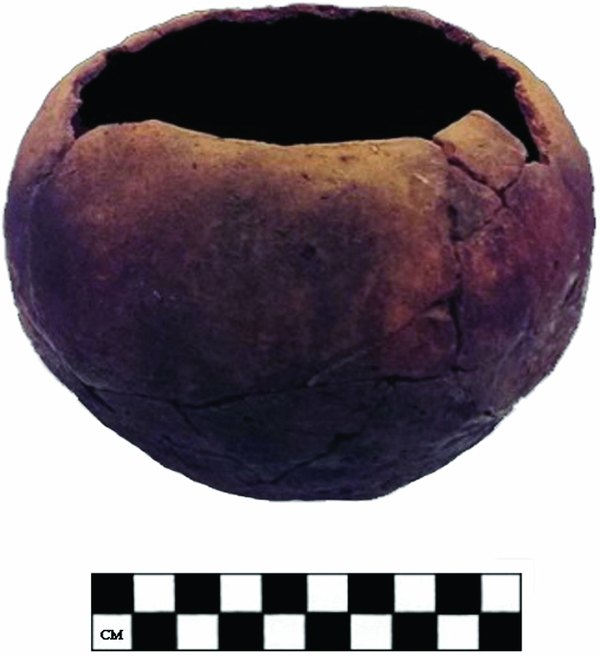
Further evidence demonstrating the importance of the olla to the Chumash can be found in its form, which was created in a variety of materials including clay, wooden bowls, and baskets produced throughout the Mission period. Nowhere is this phenomenon more apparent than in an olla-shaped ceramic vessel excavated from Burial 53 (U8) in the historically occupied village of S'axpilil (CA-SBA-60; Figure 8; Crabtree and Warren Reference Crabtree and Warren1977). The earthenware vessel was hand-molded in globular form and displays a restricted, plain-rimmed mouth. The study of diagnostic pottery in colonial outposts throughout California, such as San Antonio de Padua, illustrates that most earthenware vessels in these colonial establishments were not ollas but, rather, bowls, jars, and cooking pots. Many of the latter display everted rims and opposing strap handles (Costello Reference Costello, Skowronek, Blackman and Bishop2014:72–73). This, however, is not the case with the Chumash pottery vessel from CA-SBA-60, which features a restricted orifice and a plain design. Because ceramic materials were not a primary medium with which to fashion vessels in the Santa Barbara Channel region until the Spanish arrived, this pottery jar may provide a glimpse into the individual negotiation of Chumash identity between the past and the present and the ways in which ollas took on new social symbolism shared through collective memory.
Chumash earthenware olla from the historic Chumash village of S'axpilil (CA-SBA-60). Photo taken at the University of California, Santa Barbara, Repository for Archaeological and Ethnographic Collections.

Griddles, too, changed during the Mission period, both inside and outside the mission space. At Helo’, griddles display characteristics resembling mission assemblages, including incised lines around the edges, distinctly thick rims, and a much larger size than what was recognized in the Protohistoric assemblage. This pattern was identified not only at the ranchería of Helo’ but also in Mission period sites throughout the Santa Barbara Channel area. One example comes from the historic village of Sailimihi, CA-SRI-40, on Santa Rosa Island. It was excavated by Philip Mills Jones, who, in 1901, noted the presence of glass beads in the historic cemetery (see Kennett Reference Kennett2005:99–100). Among at least 13 griddles, all displayed characteristics of formal, burnished rims and large sizes or elements that suggest they were modified from ollas or bowls. While it may be that the people occupying this historic village emphasized the cooking of tortillas, there is no evidence to support such a claim. Food residue from historic-period sites on the Northern Channel Islands suggests that dietary patterns were relatively consistent throughout the late Holocene and mainly involved locally available flora and fauna, especially maritime foodstuffs (see Arnold Reference Arnold2001; Kennett Reference Kennett2005; Rick et al. Reference Rick, Erlandson, Vellanoweth and Braje2005). Alternatively, Koerper and colleagues (Reference Koerper, Peterson, Vargas, Grenda and Stanton2011) have found that many remodified comales were incorporated into the mortuary/mourning area in the Gabrieliño (Tongva) historic village of CA-LAN-62 and were used as funerary and ritual offerings. These Mission period comales, not being associated with the consumption of tortillas, may have taken on a different meaning among the Chumash, as they were incorporated into ceremonial spheres and used for ritual purposes.
Conclusion
In following the soapstone industry diachronically and across the colonial landscape, this study identified an abrupt and significant shift in the production, recycling, and use of bowls and comales inside the mission space. These data suggest that there existed a combination of changes in menu and production specialization in the mission related to the creation of new social identities and the enhanced status of mission Indians. Outside the mission, however, while the continued use of ollas demonstrates that traditional culinary practices endured, the Chumash inscribed Mexican-influenced comales with new meaning by incorporating them into ceremonial spheres. The artifacts studied here illustrate that whether inside or outside the mission, local peoples adapted to new colonial circumstances using their own system of meanings and values, which allowed them to survive and persevere in new and different ways throughout the Mission period. It is only by examining actual practices and by addressing the ways in which these objects were used, over time and across space, that one can reveal the complex ways indigenous peoples creatively negotiated their identity in new social environments using deeply rooted historical and cultural values.
Acknowledgments
I would like to express my thanks to Gregory Wilson for his insightful discussions, which significantly contributed to this article, and Bob Kelly for his help, as well as the thoughtful comments of six anonymous reviewers of an earlier draft of this manuscript. I am also grateful to Lynn Gamble, John Johnson, Stuart Smith, Brian Barbier, and Mikael Fauvelle for their contributions to earlier versions of this manuscript. Numerous people assisted me with accessing soapstone vessels, including Freddie Romero, Natasha Johnson, Shyra Liguori, Barbara Tejada, Wendy Teeter, Torben Rick, Roger Colten, and Sarah Kerchusky. Also, thanks go to Don Van Dorn for help with the Chumash map and Albert Thomas for help with the Spanish abstract.
Data Availability Statement
The Medea Creek (CA-LAN-243) soapstone assemblage was located at the Fowler Museum at the University of California, Los Angeles, under ACC 524 but has since been repatriated. The Mission San Buenaventura (CA-VEN-87) collection is stored at the Albinger Museum, the Ventura County Museum, an off-site storage facility in Ventura, and a storage unit on the property of Moorpark Community College operated by the Ventura County Archaeological Society. The accession number assigned for this collection is v-87. The artifacts studied from the Mission La Purísima (CA-SBA-520) collections are stored on the grounds of Mission La Purísima under ACC 155 and 147. Finally, the soapstone assemblage from Helo’ (CA-SBA-46) can be found at the Smithsonian Institution's National Museum of Natural History's Museum Support Center under ACC 6283 and the Phoebe A. Hearst Museum of Anthropology at the University of California, Berkeley, under ACC 633.