Introduction
The (US) State of New Jersey's response to Superstorm Sandy was unprecedented in that this storm affected the entire state and Emergency Medical Services (EMS) community. Since 2008, New Jersey (NJ) planned and prepared EMS to respond to tropical storms and hurricanes by establishing the Tropical Storm/Hurricane Management Plan for EMS. Despite the state's planning and preparedness efforts, the damages were so significant that NJ's EMS infrastructure, including the ability to respond adequately to 911 emergencies, was affected. Many EMS agencies lost buildings, equipment, and apparatus, reducing their ability to respond.
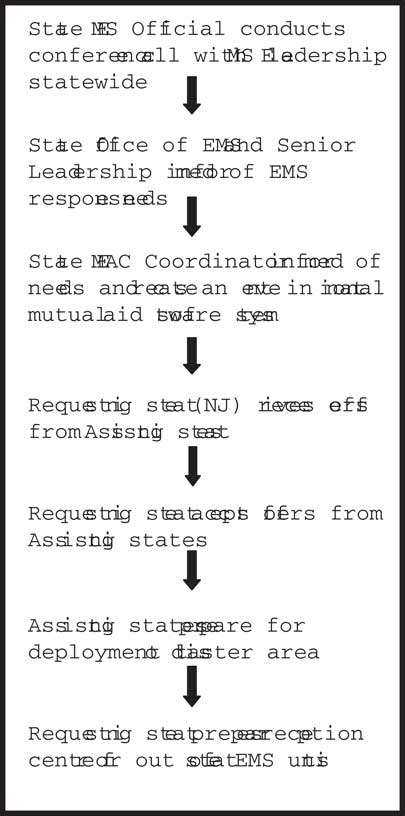
To augment NJ's EMS infrastructure, the state relied on the Emergency Management Assistance Compact (EMAC) for its operational response. The EMAC is a national disaster relief compact established in 1996 via United States Public Law 104-321. 1 The EMAC is implemented when a state's governor declares a state of emergency for a disaster. The compact enables other states to send personnel, equipment, and commodities to the state affected by the disaster situation. The compact is a legally-binding contract once it is signed by both the sending and requesting states. New Jersey's EMAC process is detailed in Figure 1. This was the second time in the state's history that an EMS EMAC request was submitted. The first EMAC request was for Tropical Storm Irene in 2011.
New Jersey Emergency Management Assistance Compact Process
Abbreviations: EMAC, Emergency Management Assistance Compact; EMS, Emergency Medical Services; NJ, New Jersey.

The purpose of this report is to discuss the activation, response, knowledge, and practical application of NJ's response to Superstorm Sandy as it correlates to the EMAC process. There is very little published literature regarding the EMAC process. A literature review also revealed a lack of publications on EMAC practical implementation and practices during a disaster situation, and on EMAC's relationship to the Emergency Medical Services system. State officials and emergency medical service agencies can examine the NJ response, considering the external validity, generalizability and representativeness of the case as it pertains to their current plans and policies within local/state jurisdictions across the country.
Report and Discussion
EMAC Activation
In order to activate the EMAC process, NJ Governor Chris Christie declared a State of Emergency for NJ on October 27, 2012 at 11:30 am due to the anticipated devastation based on weather predictions. The New Jersey Department of Health (NJDOH) and the New Jersey Office of Emergency Management (NJOEM) officials then activated the EMAC mutual aid notification system for additional ambulances to assist the NJ EMS response to Superstorm Sandy. Member states of the EMAC mutual aid network (which includes all 50 states, the District of Columbia, Puerto Rico, Guam, and the US Virgin Islands) were notified of NJ's request. 1
Request and Offer
Interested states then contacted NJ OEM and completed a Requisition A form (REQ A). The REQ A is a legally-binding contract signed by both the requesting and assisting state in support of the interstate EMAC resource request. The form consists of three sections which must be completed by the requesting and assisting state in order to approve state assets for deployment. The requesting state completes Section 1, which details the mission and needed assets to support the response efforts. In Section 2, the assisting state provides information about the assets that are available for deployment and the estimated costs to support the mission. Once the requesting state accepts the offer, the designated State OEM official must sign Section 3. The requesting state is responsible for the expenses related to the mission.
Response
In preparation for the additional resources, a regional EMS staging area and camp were established by the NJ EMS Task Force (NJEMSTF) in Atlantic County, NJ. Post storm, a second location was established at MetLife Stadium in East Rutherford, NJ. Emergency Medical Services assets were organized into strike teams, task forces, and single resources, which were deployed to various locations around the state for missions.
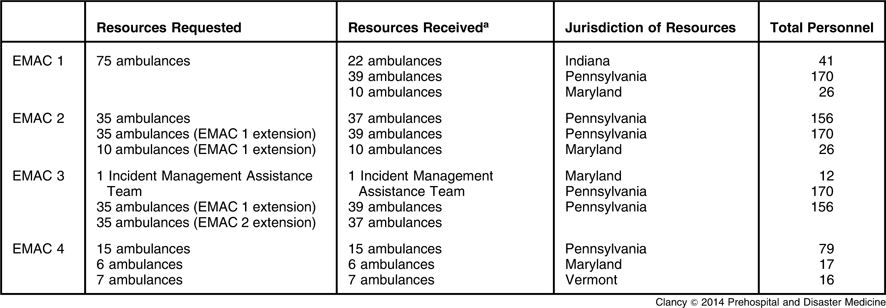
In total, four states (Indiana, Pennsylvania, Maryland, and Vermont) assisted NJ during Superstorm Sandy. Multiple extensions of the EMAC were employed as well as an additional request for an Incident Management Team (IMT) from Maryland. The extensions (EMAC 1, EMAC 2, EMAC 3, and EMAC 4) of the EMAC allowed the personnel already operating in NJ to continue to stay in NJ and be assigned additional missions. If an extension is not agreed upon by the requesting and assisting state, the EMAC agencies must return to their home state. The additional resources assisted with 911 response, continuity of operations/staff relief, shelter support, and search and rescue missions. A summary of EMAC resources and personnel can be viewed in Table 1.
Summary of Emergency Management Assistance Compact Resources

Abbreviation: EMAC, Emergency Management Assistance Compact.
aResources requested differed from resources received due to the negotiations between the requesting and the assisting states.
Reimbursement
One of the most important phases of the EMAC process is the reimbursement phase. As of this writing, NJ continues in the recovery phase of this disaster. It is important that assisting states track all expenses and provide documentation to their respective Emergency Management Coordinator. This documentation is then forwarded to the requesting state for review and payment.
Practical Application and Identified Reflections of EMAC for Requesting State
An after action report following the implementation of the EMAC produced the following reflections for the requesting state:
-
• The requesting states should invite out-of-state EMS unit Team Leaders to conference calls early on. This ensures immediate collaboration and communication.
-
• Currently, the EMAC operating system in NJ has limited online access for viewing. Each State EMAC Coordinator should consider granting access to the view-only feature in the EMAC operating system, at a minimum, to the State EMS Coordinator.
-
• Mission descriptions must be stated clearly in the EMAC request.
-
• Any change to a mission by the requesting state must be reflected in an amendment to the REQ A. Currently, EMAC affords limited flexibility in the REQ A form once signed by both entities.
-
• When requesting staffing via EMAC, requesting states should request staffing for a 24-hour period per ambulance unit. Operationally this means four staff per ambulance (two staff for each 12-hour period).
-
• In the absence of the State EMAC Coordinator, communication on who is handling the EMAC requests/issues should be clear to all agencies.
-
• Assisting agencies received automatic, electronic toll violations when they entered NJ while crossing the bridge tolls into the state. Requesting agencies should ensure there is a plan in place with the appropriate agency or commission in said jurisdiction so that electronic toll system violations are not an issue during a response and do not become a burden post event.
-
• Requesting states should ensure assisting states do not bill for services rendered when deployed. This is in accordance with the EMAC rules and should be reiterated by the assisting state personnel to all agencies prior to assisting state personnel arrival in the requesting state territory.
-
• Although an IMT was received into NJ to assist with incident management, states should consider requesting and utilizing an IMT with EMS-based operational experience earlier in the event; possibly prior to being impacted.
-
• Due to the incorrect usage of generators and damaged utilities, a large amount of carbon monoxide illnesses and fatalities took place after Sandy struck. Emergency Medical Services responders should be equipped with personal carbon monoxide detectors when providing 911 services to areas that do not have power. This was evidenced by several cases reported to NJ officials.
-
• A number of EMS responders fell ill after eating “donated food.” It is best to utilize Meals Ready to Eat (MREs) or food supplied from contracted sources.
Practical Application and Identified Reflections of EMAC for Assisting States
An after action report following the implementation of the EMAC produced the following reflections for the assisting state:
-
• Treatment protocols are typically different from state to state in the US. When assisting states respond to an EMAC request, assisting state agencies should continue to utilize their existing patient care treatment protocols. This is vitally important when the requesting state examines patient care reports detailing the medical treatment provided by the assisting state agencies to the patient. Monitoring patient care during and after a disaster is important to ensure that the patient has received the most appropriate care for the patient condition.
-
• Assisting state agencies should ensure that they possess credit cards for fuel for the duration of the mission.
-
• Assisting states should ensure they have enough medical supplies and medications during the contract period.
-
• A predeployment briefing is essential by the assisting state to its respective agencies prior to deployment.
-
• A code of conduct policy should be established by the assisting state agencies prior to deployment.
-
• Prior to making an EMAC request, assisting agencies should plan for events and create mission-ready packages based on established templates. A mission ready “package” is a template that states and agencies can utilize to ensure all aspects of a mission are considered.
Best Practices
Best practices should be established:
-
• State EMS officials should meet with their respective State Emergency Management Officials to discuss the operationalization of an EMAC to include planning, training, and exercising respective plans prior to invocation.
-
• Establish relationships and integrate planning and training across all disciplines before the disaster to ensure an effective activation of EMAC.
-
• State health and emergency management officials should educate executive leadership about the EMAC process before a disaster strikes to expedite the approval process.
-
• The State EMS Director of the requesting state should communicate with other State EMS Directors from assisting states during the request phase of the process.
-
• Responding states should communicate early with the point of contact outlined on the REQ A Form. This contact ensured communication and coordination prior to resources arriving in New Jersey.
-
• A daily briefing to update EMS stakeholders and EMAC agencies statewide on the situational awareness of statewide activities should be held to determine additional resource needs throughout an event. This practice ensured the availability of resources during Superstorm Sandy.
-
• Base camps should be predefined and established early for assisting agencies. These agencies can then arrive, set up camp, and be ready for deployment for assigned missions.
-
• Advance teams should be sent by assisting states to receive a briefing on the current situation and to determine logistical or operational issues that may need to be mitigated prior to their arrival on site.
Overall, the EMS response to Superstorm Sandy showcased a high level of cooperation and teamwork among the NJDOH, NJOEM, interstate partners, and local/county agency officials. Although challenges and issues arose during this event, the leaders of the NJ agencies and the out-of-state partners were able to overcome these obstacles and provide needed emergency services in a timely manner. State, county, and local EMS agencies will continue to review this response and adopt revisions to existing emergency plans based on the knowledge, experience, and analysis documented during this event.
It is imperative that EMS agencies in the United States have a baseline understanding of the EMAC process and know the key personnel in their jurisdiction who are responsible for the EMAC process, should it need to be activated. Fortunately for NJ, the state was able to benefit from its experience in implementing the EMAC process on a smaller scale during Tropical Storm Irene in 2011. There were some obstacles during that process in 2011. An after action report with key stakeholders of that event made it clear that NJ needed to improve the EMAC process. Hence, following Tropical Storm Irene in 2011, state EMS officials met with state emergency management officials in NJ to discuss how to improve the process. The after action review of Tropical Storm Irene was the impetus to a successful EMAC process during Superstorm Sandy. Emergency management and EMS officials together ensured that when the out-of-state resources were requested, the request was expedited. Although NJ was very timely in requesting out-of-state resources during Superstorm Sandy, receipt of assets into NJ was delayed for approximately two days due to the EMAC approval process. Agencies should be cognizant of this approval process when planning for a disaster so that the EMAC process is not prolonged.
Conclusion
Planning for a disaster is essential for states and territories. It is recognized that when a disaster strikes, there will be health and medical consequences for those affected. Emergency Medical Services, in cooperation with emergency management officials, should understand the EMAC process to ensure that when resources are needed in a disaster area, the process for requesting and assisting is accomplished in an expedious manner. Emergency preparedness efforts should focus on planning, training and exercising this process. Failing to understand this process can delay resources for a disaster area; therefore, proper emergency preparedness efforts should be completed with EMS and emergency management officials alike.