1. INTRODUCTION
The guide star catalogue is taken as the only standard to judge whether a star sensor system achieves the purpose of star pattern identification and attitude determination, and it is closely related to the star sensor's storage capacity, the execution speed of the star pattern identification algorithm and the design of the internal optical system (Kosik, Reference Kosik1991; Liebe, Reference Liebe1995; Reference Liebe2002). The catalogue mainly functions to provide a matching template for star pattern identification and reference vectors for the attitude determination algorithm. Making a reasonable simplification of the guide star catalogue can effectively improve the success rate and speed of star pattern identification.
The original star catalogue contains a large number of fixed stars, but not all these fixed stars can be used for celestial navigation or satellite attitude determination. The traditional method of simplifying the guide star catalogue is the visual magnitude threshold filtering method (Kim and Junkins, Reference Hye-Young and Junkins2002) that takes the stars whose brightness is higher or equivalent to a certain star in the original star catalogue as the guide stars. The fixed stars are unevenly distributed on the celestial sphere. In this case, if the magnitude threshold is set too low, the star catalogue will be incomplete (a large number of holes will appear) and the success rate of star pattern identification as well as its attitude determination accuracy will decline. However, if the magnitude threshold is too high, the number of fixed stars will increase correspondingly, which will lead to the redundancy of the guide star catalogue caused by too large capacity and lower accuracy rate of star pattern identification.
In view of the defects of the visual magnitude threshold filtering method, previous researchers have put forward the orthogonal grid method (Padgett and Kreutz-Delgado, Reference Padgett and Kreutz-Delgado1997; Padgett et al., Reference Padgett, Kreutz-Delgado and Udomkesmalee1997) based on the idea of geometrically dividing the celestial sphere in order to establish the guide star catalogue with fewer guide stars in number, better distribution uniformity and high completeness. In this method, the equal-area mapping method is adopted to allow the guide stars to be projected onto the plane from the unit sphere. The plane is then divided without overlapping. However, if considered from the uniformity of the local celestial sphere, this method will result in poorer distribution uniformity of guide stars, that is, the number of guide stars obtained in a field of the star sensor is not even; its maximum value is bigger or its minimum value is smaller. When it comes to geometrically dividing the celestial sphere, the inscribed cube method (Zhang et al., Reference Zhang, Wei and Jiang2006) is the most representative one.
The inscribed cube method uses the inscribed cube of the celestial sphere to evenly divide the spherical surface into six parts, each of which is subdivided into smaller parts of N×N. Although this method divides the celestial sphere evenly without overlapping, it is the surface areas of the inscribed cube that are divided evenly without overlapping. However, after the division, for each sub-block, the corresponding space solid angles are still different in size. In particular, when the optical axis of the star sensor points around the celestial pole and the eight apexes of the inscribed cube, the space solid angles vary greatly, with a difference of a factor of nearly 5·2 times. Therefore, this method also has its defect, because it has poorer uniformity of dividing the whole celestial sphere.
According to the advantages and disadvantages of the above methods, a new method which takes “quasi-uniform distribution” of space solid angles as the principle and the size of space solid angle correspondent to 4°×4° on the equator as the reference and divides the whole celestial sphere into 2664 sub-blocks in sequence and selects guide stars uniformly as per the block, is proposed in this paper. According to the ergodic statistical analysis of the whole celestial sphere, this method is superior to the inscribed cube method in completeness, uniformity and storage capacity.
2. DIVISION OF THE CELESTIAL SPHERE BASED ON SPACE SOLID ANGLES
The traditional geometrical division of the celestial sphere runs as follows. First, the surface of the celestial sphere is expanded into a rectangular plane, and then its right ascension and declination are divided according to the fixed value, or the celestial sphere is projected onto a plane and then this plane is divided without overlapping. However, in practical engineering, the rotation of the optical axis pointing of the star sensor in space will be unstable. In this case, the projections of the celestial sphere onto the selected plane have unfixed sizes. In addition, the right ascension and declination coordinates themselves are not uniform in space. So, if this traditional method is used to geometrically divide the celestial sphere, the uniformity of the guide star catalogue is poorer. However, if the space solid angle method is used to divide the celestial sphere, the corresponding space solid angles of the spherical sub-blocks will be approximately equal and the guide star catalogue will have better distribution uniformity.
2.1. Calculation of Space Solid Angles
The solid angle Ω subtended by a surface S is defined as the surface area Ω of a unit sphere covered by the surface's projection onto the sphere (Zhang et al., Reference Zhang2008; Mathworld, 2014). On the basis of taking the apex of a solid angle as the centre, a sphere with the radius “r” is drawn. The cross-sectional area (ds) of the boundaries of this solid angle on this sphere is divided by the radius squared to mark the size of solid angle, i.e.
 $$d\Omega = dS/r^2 $$
The unit of solid angle is “steradian”, the symbol of which is “sr”.
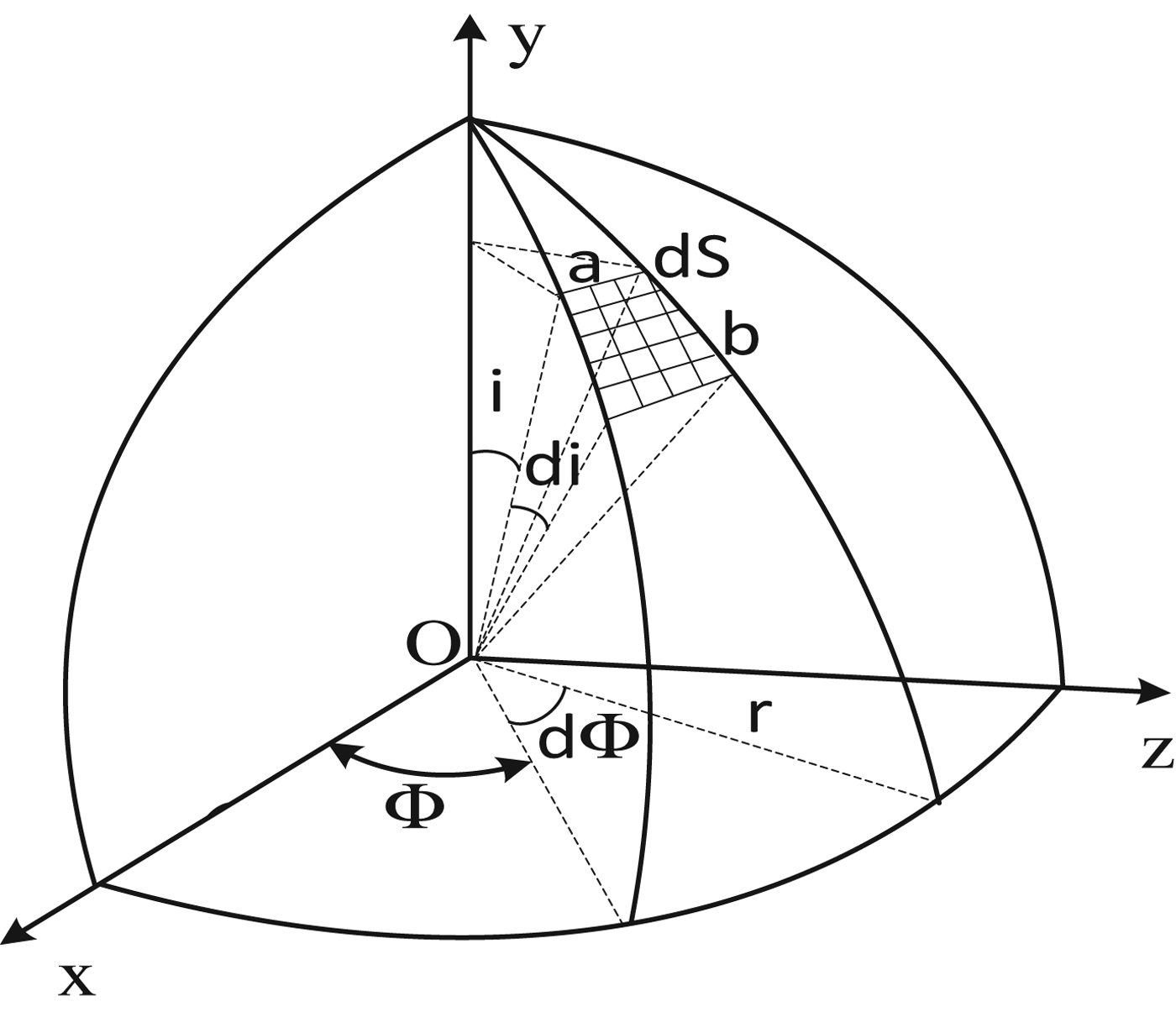
In Figure 1, a sphere is drawn on the basis of taking O as the centre and r as the radius. The shaded area on the sphere (dS) to the point O constitutes a solid angle “dΩ”. The position of the shaded area depends on the space polar (sphere) coordinates “r”, “Φ” and “i”. “r” is the radius vector. “Φ” is the angle in the sagittal plane, and “i” is the angle in the meridional plane. “dr”, “dΦ” and “di” are the micro-variables of r, Φ and i. The area depends on the length of sides: “a” and “b”, which can be seen from Figure 1:
 $$a = r\sin id\varphi $$
 $$ b = rdi$$
 $$ dS = r^2 \sin idid\varphi$$
The corresponding solid angle of the shaded area is:
 $$ d\Omega = dS/r^2 = \sin idid\varphi$$
 $$ \Omega = \int\int {\sin idid\varphi = \int_\phi ^{} {d\varphi \int_i^{} {\sin idi} } }$$
Equations (5) and (6) are the general formulae of space solid angles.
Solid Angles.

2.2. Dividing the Celestial Sphere Based on Space Solid Angles
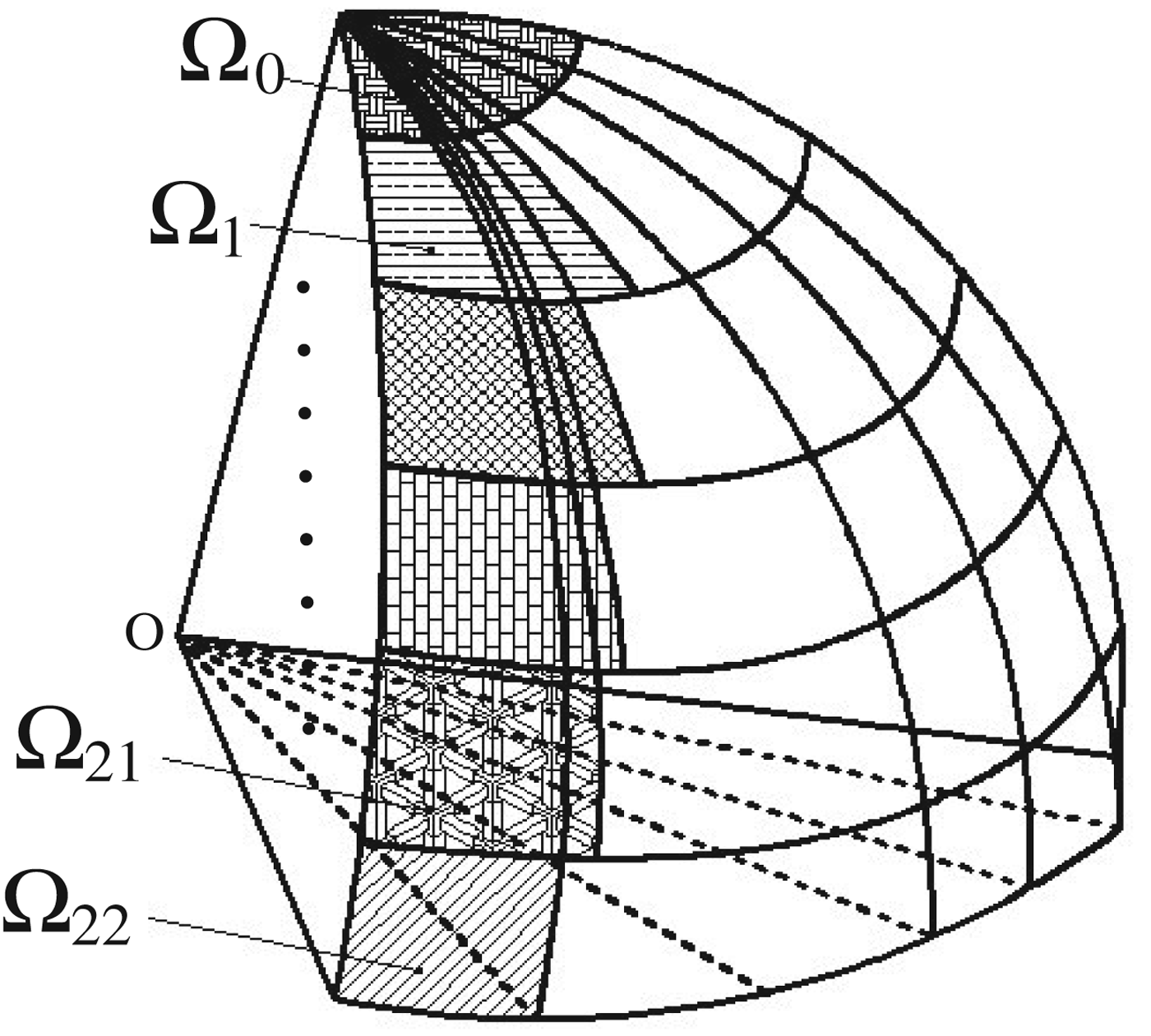
The whole celestial sphere is divided into 2664 sub-blocks in sequence based on the sizes of corresponding space solid angles of 4°×4° on the equator, as shown in Figure 2. Among them, the latitude band of 2° at the spherical crowns of south and north poles is taken as a sub-block as a whole.
Division of the Celestial Sphere Based on Space Solid Angles.
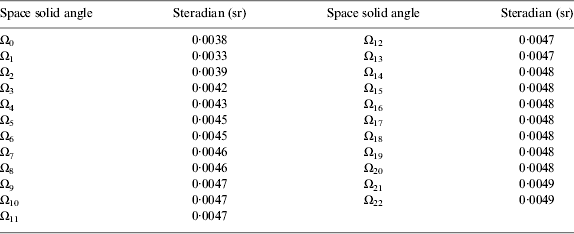
The sizes of space solid angles of sub-blocks between the North Pole and equator are shown in Table 1.
Sizes of Space Solid Angles of Sub-blocks between the North Pole and Equator.
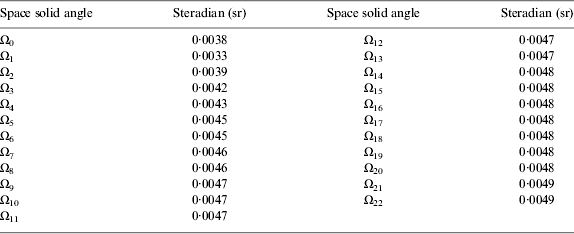
It can be seen from Table 1 and Figure 3 that the difference between the space solid angle of the maximum sub-block and that of the minimal sub-block is 32·7%. Moreover, for each sub-block, the latitude is equal, and the RMS value is 0·0046. All these show that the sub-blocks obtained through dividing the celestial sphere based on space solid angles have better distribution uniformity, suitable for the selection of the star catalogue.
Trend of Space Solid Angles between Sub-blocks at the North Pole and those on the Equator.
3. SIMPLIFICATION OF GUIDE STAR CATALOGUE
The selection of guide star is an important content of modern star sensor design (Kim and Junkins, Reference Hye-Young and Junkins2002) because it has a direct impact on the performance and reliability of star pattern identification and attitude determination of the star sensor. The minimum number of observable stars in the field of view (FOV) and the minimum number of matched star pairs in the star pattern identification process are considerably important parameters at the design stage of the star sensor, which directly affects the size of field of view, sensitivity of starlight, memory and size of guide star catalogue.
The inscribed cube method means that the celestial sphere is evenly divided into 486 sub-blocks (6×9×9=486) in the rectangular coordinate system. Similarly, 60,000 (6×100×100=60000) evenly distributed visual axis pointings are generated on the whole celestial sphere. In this method, it is actually the surface area of the inscribed cube that is evenly divided, and the corresponding space solid angle of each sub-block is not equal after the division. On this basis, 60,000 visual axis pointings are scanned in sequence to find six guide stars with the brightest light in the field of view each visual axis pointing corresponds to. When the guide stars in the field of view are less than or equal to six in number, they are not handled at all. Therefore, if this method is used to divide the celestial sphere, the uniformity is relatively poor.
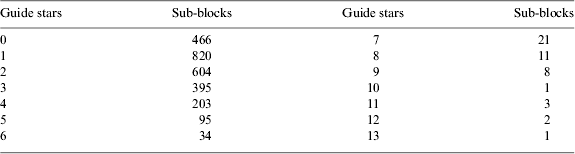
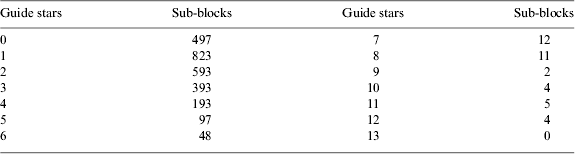
In this paper, the star catalogue from the Smithsonian Astrophysical Observatory (SAO) is used as the original star catalogue and 5103 stars with the brightness higher than (or equal to) 6Mv are selected as guide stars. Table 2 shows the distribution of guide stars in the sub-blocks after the celestial sphere is divided using the space solid angle method.
Distribution of Guide Stars from SAO in the Sub-blocks.
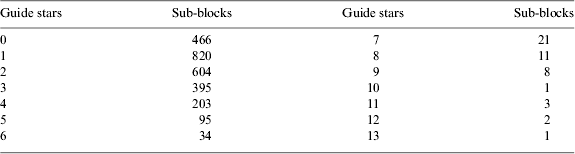
It can be seen from Table 2 that there are 466 sub-blocks without a guide star. After gathering statistics about the number of guide stars contained in the eight sub-blocks adjacent to these 466 sub-blocks and taking these sub-blocks as the centre, it can be found that there is a no “holes phenomenon” in the sub-block of 3×3. There are four zones that contain three guide stars; there are 17 zones which contain four guide stars; at worst, there are at least three guide stars involved in star pattern identification. Obviously, this division method enables the guide star catalogue to have better completeness.
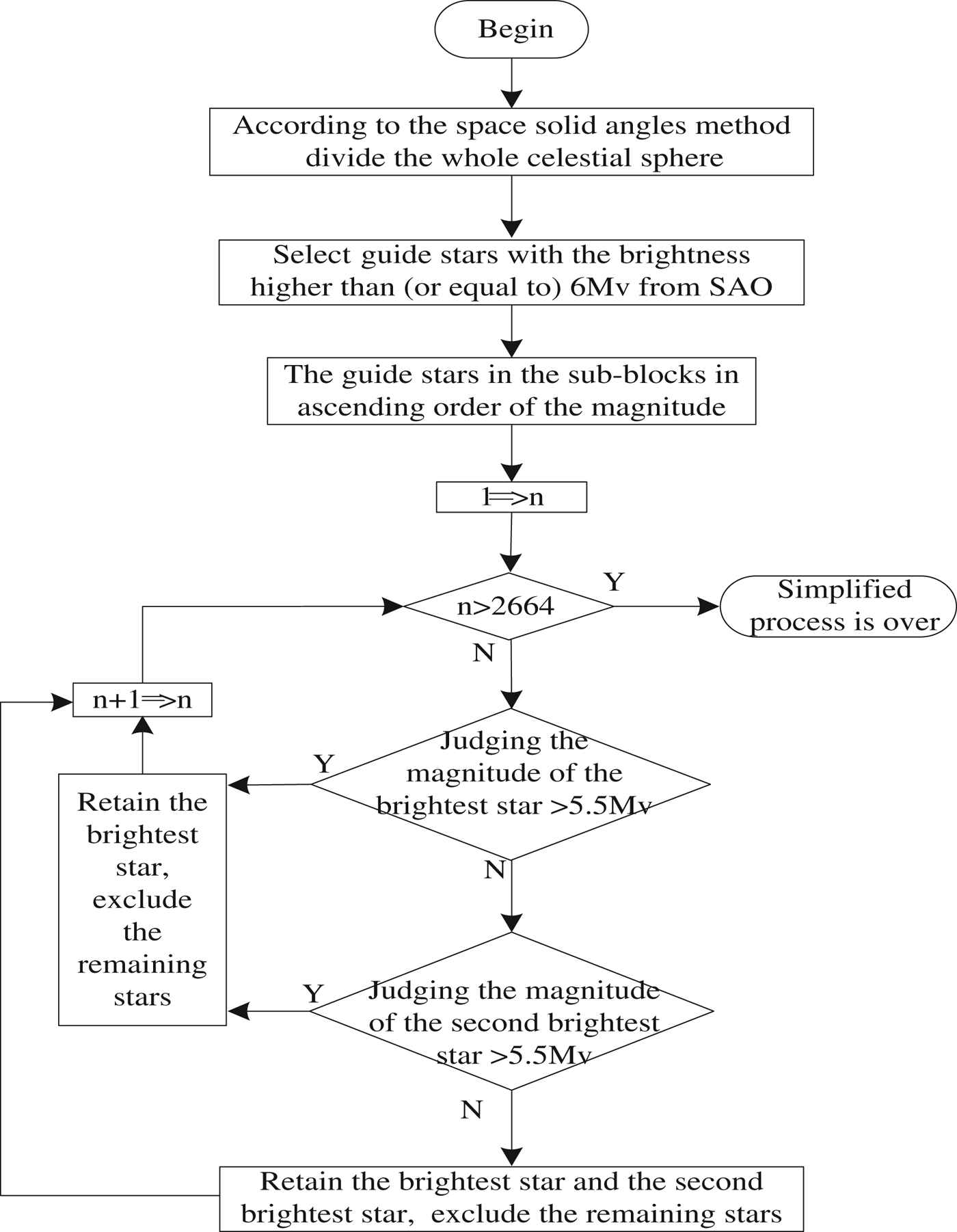
On this basis, the sub-blocks containing two stars or more are filtered under the following conditions. If the magnitude of the brightest star in the sub-block is more than 5·5Mv, this star will be retained and the remaining stars will be excluded; if the magnitude of the brightest star in the sub-block is less than (or equal to) 5·5Mv, the magnitude of the second brightest star will be judged; if the magnitude of the second brightest star is more than 5·5Mv, this second brightest star will be retained and the remaining stars will be excluded. If the magnitude of the second brightest star is less than (or equal to) 5·5Mv, the brightest star and the second brightest star will be retained and the remaining stars will be excluded. The simplifying process is shown in Figure 4. After being filtered under these conditions (although 5·5Mv is taken as the magnitude threshold, the guide star still has the completeness of 6 Mv stars), the guide stars reduce to 2937 from 5103 in total number, or reduce by 12·6% compared to 3360 guide stars retained after being filtered using the inscribed cube method. Hence, it decreases the storage size of the guide star catalogue and accelerates star pattern identification. Otherwise, the time of reading the guide star catalogue will be extended and the speed of program running will be slow. Consequently, the hardware design becomes complex and the reliability of the system is reduced (Vedder, Reference Vedder1993).
Simplifying process flow chart.
4. PERFORMANCE VERIFICATION OF GUIDE STAR CATALOGUE
The traditional method for simplifying the guide star catalogue is the visual magnitude threshold filtering method. The stars in the original star catalogue whose brightness are no less than the threshold are taken as the guide stars. This method is easy to implement and able to provide a guide star catalogue that well matches the observation stars. However, the stars are unevenly distributed on the celestial sphere. Hence, to ensure the guide stars that appear in the star sensor FOV are sufficient to identify star patterns, we need to increase the magnitude thresholds. As a result, the number of guide stars rises exponentially and the storage overheads and search time increase dramatically as well. We use SAO as the original star catalogue and extract 5103 stars from SAO whose brightness is no less than 6Mv as the guide stars.
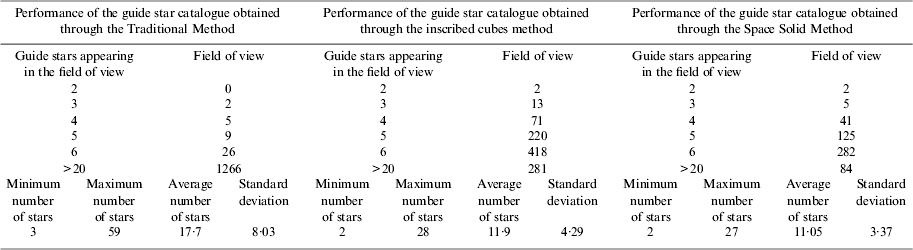
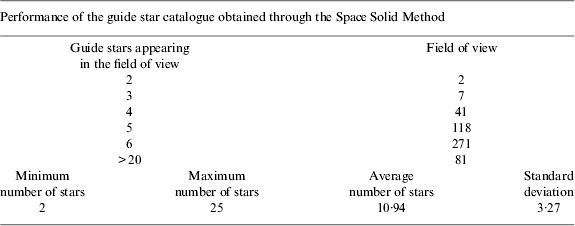
In order to test the performance of the generated guide star catalogue, 7200 evenly distributed visual axis pointings are generated on the whole celestial sphere on the basis of taking 3° in the right ascension and declination as the interval respectively. Through sequential scanning, the guide stars in the corresponding field of view of each visual axis pointing can be found in the 12°×12° field of view. Their statistical data are shown in Table 3.
Comparison of three types of Guide Star Catalogue performance.
The analysis of the data of Table 3 shows that in the 12°×12° field of view, the probability of having over four stars appear is 99·97% with the traditional method. If the guide stars are selected using our proposed method, the number of guide stars fall by 42·4%, but the probability of having over four stars appear in the field of view is 99·92%. Hence, compared with the traditional method, the proposed approach in this paper provides almost the same completeness but a higher degree of uniformity. After the guide star catalogue is divided respectively using the space solid angle method and inscribed cube method, the emergence probabilities of less than six stars are 5·9% and 9·1% respectively and the emergence probabilities of more than 20 stars are 2·86% and 8·36% respectively. Under the premise that the minimum number of stars, the maximum number of stars and the average number of stars are basically the same, the standard deviation gained through using the space solid angle method to divide the star catalogue is 78·6% of that gained through using the inscribed cube method, which shows that the uniformity of guide star catalogue obtained using the space solid angles further improves.
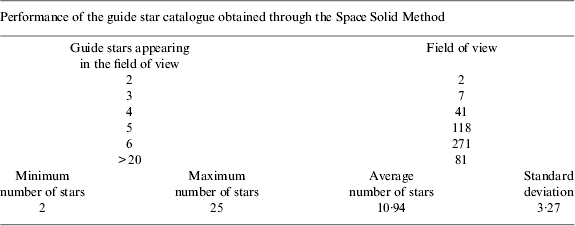
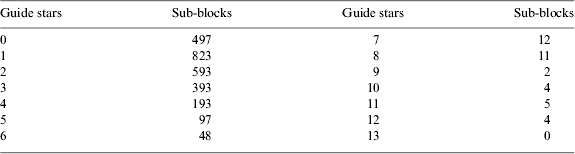
In fact, the selection method developed in this paper is not sensitive to the original star catalogue. That is to say, almost the same results can be obtained when different original star catalogues are utilised. For example, we tried to adopt SKY2000 as the original star catalogue to extract 5066 stars whose brightness is no less than 6Mv as the guide stars. After the celestial sphere is divided into 2664 sub-blocks in sequence according to the space solid angles, the distribution of guide stars is shown in Table 4. It can be found that the total number of guide stars is reduced from 5066 to 2916 using our proposed approach. The performance of the guide star catalogue is shown in Table 5. From Tables 4 and 5, we can see that these data are basically consistent with those in Tables 2 and 3.
Distribution of Guide Stars from SKY2000 in the sub-blocks.
Guide Star Catalogues from SKY2000 used as the original Star Catalogue for performance.
Through further analysis of the guide star catalogue divided according to the space solid angle method, the author makes statistics of the distribution of central axis pointing when two to four stars appear in the field of view. The statistical results are shown in Figure 5.
Distribution of Central Axis Pointing when two to four Stars Appear in the Field of View.
According to the previous research (Liebe, Reference Liebe1992; Zhang, Reference Zhang2005; Tian et al., Reference Tian, Lin, Hao, Lu, Chen and Zhuang2010; Zhang, Reference Zhang2011), the stars near the celestial poles are distributed relatively sparsely and the stars near the equator are distributed relatively densely. It can be seen from Figure 5 that most of the sparse celestial regions are near the equator and mid-latitudes of southern and northern hemispheres. From the perspective of actual practice, the optical axis pointing of star sensors stays away from the celestial equator and mid-latitudes of southern and northern hemispheres.
5. CONCLUSIONS
The establishment of the guide star catalogue is the basis of star pattern identification, which is the premise of improving the reliability of a star sensor. Actually, the completeness and uniformity of the guide star catalogue are the key factors influencing the success rate and time of identification. In this paper, the process of dividing the whole celestial sphere using the space solid angle method is described. After this division process, the brightest one or two guide stars in the sub-block is or are retained to meet the requirements of star catalogue completeness. Meanwhile, under the premise of ensuring the success rate of star pattern identification, the guide stars are simplified and selected through the space solid angle method. Compared to the number of guide stars selected through the inscribed cube method (3360), the number of guide stars selected through the space solid angle is reduced by 12·6%, thus greatly simplifying the computation of star pattern identification, meeting the requirements of uniformity and minimizing storage capacity. Most of the sparse celestial zones are near the celestial equator and the mid-latitudes of southern and northern hemispheres. The actual star observation test at night in the external field shows that the guide star catalogue for star sensor established using the method proposed in this paper fully meets the requirements of a star sensor in terms of both functionality and performance.
ACKNOWLEDGEMENT
The work described in this paper was supported by the National Natural Science Foundation of China (Grant No. 61008046 and 61273051).