IntroductionFootnote 1
Due to rising unemployment and social troubles caused by the economic downturn, European states confront a growing threat of mounting social inequalities. At the same time, falling tax revenues and increasing public debt result in tightening public expenditure and the need for increasingly efficient and effective delivery of social services. Consequently, since the late 1990s, the ‘activation paradigm’ has started to become a dominant reference point for the modernisation of the European social model, by putting its emphasis on the promotion of employability and labour-market participation as a way to overcome mere ‘passive’ employment policies based on income replacement (van Berkeland and Møller, 2002; van Berkel and Borghi, 2007; van Berkel et al., 2011). The ‘activation paradigm’ thus makes an integrated approach towards social cohesion even more indispensable, creating new demands for inter-organisational co-ordination between social and employment policies for fostering equal opportunities in the labour market and promoting social cohesion. Therefore, local governments, which are increasingly responsible for the implementation of social and employment policies, become crucial actors vested with the new challenge of making the delivery of localised and integrated services possible (Heidenreich and Graziano, Reference Heidenreich and Graziano2014).
This article tries to investigate whether, and the extent to which, Italian local governments respond to the overarching challenge of overcoming inter-organisational and institutional barriers between policy fields. With this aim, we will analyse the multi-dimensional (horizontal) integration between employment and social policies at the Italian local level, by focusing especially on the organisation and management of policy implementation and service delivery.
With the aim of making Italy more ‘modern’ by placing it in line with European standards (Graziano, Reference Graziano2007, Reference Graziano2009, Reference Graziano2011) and thus reducing budgetary difficulties and countering its highly centralised and hierarchical Weberian governance model, Italy went through a wave of New Public Management (NPM) reforms in the 1990s (Pollitt and Bouckaert, Reference Pollitt and Bouckaert2004). As far as the local tiers of government are concerned, these reforms have brought about a devolution which has deeply redefined local administrative structures and powers. Therefore, it becomes an interesting scholarly task to analyse the consequences of devolution on the co-ordination of employment and social policies at the local level, especially considering that, in the Italian case, only a few contributions have dealt specifically with this issue so far (Kazepov, Reference Kazepov2008; Genova, Reference Genova2008; Minas, Reference Minas2009).
As we will show below, devolution has implied that different layers of local government were involved in different policy fields, thus bringing about a multi-level fragmentation between social and employment policies. Nevertheless, in this paper we argue that the main barrier to co-ordination has to be found in a strong specialisation ethos which dominates at the Italian local level (and, possibly, also at the national level – but this is not at the heart of our contribution). The latter is linked to the resilience of some specific features of the Weberian bureaucratic governance model (Weber, Reference Weber, Henderson and Parsons1947), and particularly the rigid division of labour that it shields with the consequence that functional specialisation and expertise are the basis for action.
The article is organised as follows. First, we will propose a theoretical framework to explore the determinants of the co-ordination of social cohesion policies at the Italian local level. Second, the key Italian reforms related to devolution and their impact on social cohesion policies will be sketched out. Third, we will discuss and provide evidence on the implementation of social cohesion policies at the Italian local level. Then, we will analyse the relevance of the specialisation ethos and how it flows into a model of governance via ‘organ pipes’, and, finally, we will show the main differences among the cases analysed in terms of the theoretical framework presented.
Theoretical framework and research design
Neo-institutionalism (March and Olsen, Reference March and Olsen1984, Reference March and Olsen1989; Goetz and Hix, Reference Goetz and Hix2000) has strongly emphasised the extent to which institutions – conceived of as having formal rules, standard operating procedures and governmental structures – ‘matter’ in that they deeply impact on the way in which ‘things are done’, thus also shaping the range of possibilities that policy change might eventually follow. With specific reference to NPM reforms, several scholars have stressed the role that national ‘historical legacies’ and institutional contexts have maintained in determining the direction of policy change, its outcomes and the policy implementation gaps (Peters and Pierre, Reference Peters and Pierre1998; Christensen and Lægreid, Reference Christensen and Lægreid1999, Reference Christensen and Lægreid2011; Barzeley, Reference Barzeley2003; Capano, Reference Capano2003; Pollitt and Bouckaert, Reference Pollitt and Bouckaert2004; Borghi and van Berkel, Reference Borghi and van Berkel2007; Gualmini, Reference Gualmini2008; Ongaro and Valotti, Reference Ongaro and Valotti2008; Genova, Reference Genova2008; Ongaro, Reference Ongaro2006, Reference Ongaro2009: 247–76, 2011; Kuhlmann, Reference Kuhlmann2010; Champion and Bonoli, Reference Champion and Bonoli2011; Graziano and Winkler, Reference Graziano and Winkler2012). Therefore, in line with this literature, we expect that path dependency is also likely to be at work when the outcomes of the NPM reforms, in terms of the co-ordination of social cohesion policies, are analysed.
More specifically, Italian administrative culture is deeply rooted in a Rechtsstaat model (Pollitt and Bouckaert, Reference Pollitt and Bouckaert2004), which incorporates the rational-legalistic bureaucratic tradition theorised by Weber (Reference Weber, Henderson and Parsons1947). This model is characterised by a high formalism based on the primacy of law, and the administrative process must rigorously be pursued within the limits laid down by abstract rules and legal precepts. As a result, in the exercise of authority, each person occupies an office that has a defined sphere of competence and, in the action associated with his status, he is subject to the ‘impersonal order’ of law. It follows that, even if bureaucrats acknowledged the adverse effects that policy fragmentation would eventually bring about, they would have little room for manoeuvre in overcoming them due to the process of ‘juridification’ (Capano, Reference Capano2003: 786), that is, the institutionalisation of a hegemonic paradigm in Italy based on administrative law. The tasks of the organisation are divided into clearly specified and distinct functions given to separate and hierarchically organised offices; the corporate group subject to a given authority has ‘an obligation to obedience only within the sphere of the rationally delimited authority’ (Weber, Reference Weber, Henderson and Parsons1947: 303). It follows that one of the most fundamental traits of rational legal authority is the high specialisation ethos implied, in which functional specialisation and expertise are the basis for action. Indeed, not only are the official functions of each office strictly defined and bound by rules, thus requiring specialised training to be performed, but they also must be realised within a specified area of competence involving ‘a sphere of obligations to perform functions which has been marked off as part of a systemic division of labour’ (Weber, Reference Weber, Henderson and Parsons1947: 303).
Such a specialisation ethos obviously contrasts with the principle of integration embedded in the ‘activation approach’, and is likely to impact negatively on the possibility for co-ordination between different policy fields. What is more, politicians have little freedom in overcoming specialisation. Indeed, Italian multi-partism and polarised pluralism implies that politicians, after their elections, have to create coalition governments and distribute delegations and mandates to their political allies. Therefore, political fragmentation results in a proliferation of mandates and councillorships. It follows that, even if politicians virtually recognise the relevance of co-ordination, the Italian party system structure (at both the national and local levels) prevents them from exerting an agency to become ‘entrepreneurs’ of co-ordination. In this sense, in Italy co-ordination is exclusively an ‘extrapolitical’ objective which is set at the European level.
Before sketching out our research hypothesis in more depth, it is worth recalling that the Italian public sector is divided into four levels of government − national, regional, provincial (provincia) and municipal (comune). This article is based on a comparison among three cases, that is, Milan (Lombardy Region), Rome (Lazio Region) and Naples (Campania Region) by focusing specifically on the provincial and municipal levels. To select these cases, the NUTS (Nomenclature of Territorial Units for Statistics) classification was used, which is a hierarchical system for dividing up the economic territory of the EU. Three NUTS 3 regions, corresponding to the Italian level of the provincia, were chosen based on the regions’ economic output: strong (Milan), average (Rome) and underperforming (Naples).
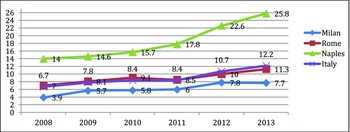
Therefore, this ‘most different case’ research design (Przeworski and Teune, Reference Przeworski and Teune1970) singles out three regions − located in the northern, central and southern parts of Italy, respectively − which are not only marked by significant differences in terms of unemployment (see Figure 1) but are also very diverse in terms of social capital, thus enabling us to identify other potential contextual variables which might eventually affect the impact that Italian devolution has on the multi-dimensional co-ordination of social and employment policies at the local level.
Unemployment rate (%) in Milan, Rome, Naples (NUTS3 – Province) and Italy (2008–2013)

In particular, we might expect that the higher the unemployment, the stronger the perception of fragmentation-induced problem pressure (Champion and Bonoli, Reference Champion and Bonoli2011). Indeed, when unemployment is high, local services are more overcrowded and, due to the fact that the total amount of beneficiaries increases, the total amount of per capita resources allotted to beneficiaries is lower than it would be if unemployment was low. Consequently local actors, in order to rationalise resources, are also likely to have more incentives to spur co-ordination between social and employment services in order to decongest them by promoting labour-market integration.
As with unemployment, social capital could also be positively correlated with the perception of fragmentation-induced problem pressure. Indeed, higher social capital contributes to increasing institutional quality (Putnam, Reference Putnam1993). The social capital variable is particularly important in a country like Italy, which is cut by a profound North‒South territorial cleavage with deep historical, cultural and socio-economic roots. In his seminal work, Putnam showed that it was precisely the deficit of ‘civicness’ in Southern Italy that undermined its political, institutional and economic development when compared with that achieved in the North. It follows that the North‒South divide might also explain the differences in the local supply of services, and devolution might end up worsening the territorial cleavage (Bifulco and Vitale, Reference Bifulco and Vitale2006; Graziano and Winkler, Reference Graziano and Winkler2012). So far, on the one side, social capital, by increasing mutual trust, also entails a major propensity towards voluntary co-operation, not only between citizens and institutions but also within the institutions themselves; on the other side, social capital improves the institutional quality and is thus likely to make politicians and bureaucrats more prone to recognise policy fragmentation as a problem and to look for co-ordination measures. By contrast, we expect the institutional quality and the propensity for co-ordination to be weakened in contexts which are marked by a low (institutional) social capital.
In our theoretical framework, we consider that the legacy of the Weberian tradition, by implying a strong specialisation ethos (independent variable), jeopardises the deepening of co-ordination between different policy fields at the local level. Nevertheless, as just pointed out, unemployment and social capital might also affect the final outcome in terms of co-ordination. In this paper, we do not intend to investigate the different mechanisms underlying co-ordination but, rather, we aim to detect whether co-ordination, as an organisational outcome, arises or does not arise at the policy implementation stage; thus trying to provide some explanations for its eventual existence (or non-existence). Coherently with this research question we will scrutinise three different aspects of multi-dimensional co-ordination between labour and social policies, that is, inter-services co-ordination, intra-social services co-ordination (whether some forms of co-ordination between labour and social policies exist within social services) and intra-employment services co-ordination (whether some forms of co-ordination between labour and social policies exist within employment services). Investigating whether or not co-ordination exists along these three dimensions will allow us to analyse the extent to which the specialisation ethos is determinant and cuts across (and/or within) services. If the specialisation ethos is high, it is likely that co-ordination is absent along all the three dimensions, while if the specialisation ethos is low, then co-ordination might arise in one or more dimensions.
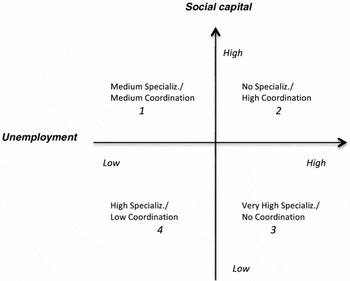
More specifically, we assume that social capital is likely to have a direct impact on co-ordination (see Figure 2). Social capital could act as an antecedent variable that influences the independent variable. Indeed, high social capital – by increasing trust, mutuality and institutional quality – is also likely to reduce the specialisation ethos, thus impacting positively on co-ordination. By contrast, the rate of unemployment could work as a contextual variable and its effect on co-ordination is likely to be strongly related to the social capital variable. Indeed, it is plausible to think that only when social capital is high and institutional quality stronger, are managers able to think about more creative solutions, transforming high unemployment into an opportunity to boost multi-dimensional co-ordination. On the other hand, when institutional quality is low, high unemployment is likely to be even more detrimental to co-ordination than low employment would be, because it imposes further budgetary constraints, political and/or managerial complications for policy-makers and bureaucrats. When co-ordination is taken into account, unemployment, rather than having an effect by itself, operates to reinforce or diminish the impact that the social capital may have on the specialisation ethos and, consequently, on co-ordination.
Contextual variables and impact on co-ordination

The cases of Milan, Naples and Rome score differently with respect to both the social capital (Cartocci, Reference Cartocci2007)Footnote 2 and unemployment variables. In terms of Figure 2, we would expect Milan to be in the upper quadrants (comparatively high social capital and relatively low unemployment), while Rome and Naples should be located in the bottom of the figure, with Naples being in the third quadrant (very low social capital and very high unemployment) and Rome likely to be in the fourth quadrant. Consequently, on the basis of the theoretical model presented so far, we expect devolution to have brought about comparatively more multi-dimensional co-ordination in Milan than it has in Naples and Rome, and that Naples would be the least co-ordinated. In the next sections, we will try to test this hypothesis and to scrutinise the impact of social capital, unemployment and the specialisation ethos in the three cases.
The article is based on three main sources: policy documents, legislative documents and sixty-five semi-structured interviews. The interviewees were selected following both the positional method and the ‘snowball’ technique (Denzin and Lincoln, Reference Denzin and Lincoln2005), and the interviews were carried out between May 2011 and April 2012. A wide range of actors were interviewed from both the governmental and the administrative levels, as well as the third sector and trade unions, mainly from both the provincial and municipal levels. Furthermore, these actors were selected so as to give a balanced picture between social and labour policies.
Italian devolution and social cohesion policies
During the 1990s, Italy experienced a significant wave of reforms strongly inspired by NPM principles, aiming at modernising Public Administration by re-organising the central government, simplifying the administrative procedures, injecting marketisation and accountability principles, introducing management control, strategic planning and performance evaluation tools, and privatising labour relations within the public sector. Due to the variety and wide-ranging extent of the norms which have been introduced, in this short review we will mainly focus on the very relevant reforms introduced with regard to social and labour policies at the local level.
In particular, Law 59/1997, the so-called Bassanini, named after the Minister of Public Function of the time, expanded the process of devolution of national competences to the regioni, province and the comuni.
The Bassanini law, and successive implementing laws, aimed at developing ‘administrative federalism’ and the pursuit of the maximum decentralisation achievable through ordinary law, that is, without constitutional amendments. The reform was designed around the principle of subsidiarity, according to which decision making should occur as close as possible to citizens, and central government should have only a subsidiary function, limited to those services which cannot be provided at a more local level. Indeed, devolution and subsidiarity, in line with the NPM principles, also aimed at improving the identification of needs and customising services to local requirements. The reforms were also intended to promote the simplification of the administrative procedures and lead to major involvement of local actors so as to assure their integration in local development through the implementation of integrated programmes of action.
Thus the relationships between the State, the regions, the provinces and the municipalities were reshaped. Indeed, before the wave of reforms inaugurated by the Bassanini law, the Italian governance of employment and social policies was highly hierarchical, based on state-centric control, with local institutions having a residual role (Graziano, Reference Graziano2008; Graziano, Reference Graziano2009; Graziano and Raué, Reference Graziano2011).
The legislative decrees 469/1997 and 112/1998 and successive laws, which implemented the Bassanini law, enhanced the role of the local levels of government in many policy fields, including labour and social policies. In particular, the provinces were vested with the function of managing labour-related services, thus becoming the most important institutions to implement active labour policies. Through the Centri per l’impiego (CPIs–Employment Centres), provinces have begun to exercise the functions and tasks assigned to them in relation to employment, pre-selection and matching of labour supply and demand. Along with devolution, the reforms also promoted marketisation. Indeed, the 1997 law allowed for the opening of private temporary work agencies for matching labour demand with supply. Therefore, the reforms resulted in an expansion of employment services (ISFOL, 2008) as opposed to the highly inefficient and limited provision that existed (Gualmini, Reference Gualmini1998).
By contrast, the comuni (municipalities) did not receive any legal competence in labour policies, while becoming the main providers of social services. Nonetheless, big municipalities continue to run some employment services, as they have traditionally done, but there is no regular pattern in this respect.
In particular, with regards to social assistance policies, a national framework law was issued in 2000 (Law 328/2000) which, in order to regulate the principle of subsidiarity and take into account the specificities of people and places, vested the municipalities with the task of service and social benefits delivery, as well as with the design and implementation of the overall network of social services. The provinces, by contrast, were assigned very few competences in that they remained responsible for the provision of social services to a very limited number of socially disadvantaged target groups. However, the provincia, as an intermediate level of government between the comune and the regione, was recognised as having a role in the co-ordination of integrated systems of social interventions. Indeed, attention was also paid to integrating planning, both vertically and horizontally, by involving different actors (public, private and the third sector).
More specifically, the Piani di zona (PdZs – Area Plans) have become the most important policy tool for integrated planning and the provision of social services at a local level. They are issued by the municipalities falling within the same territorial ‘domain’ (an area covering roughly 90,000 inhabitants), thus implying co-ordination between more local entities (Bifulco and Centemeri, Reference Bifulco and Centemeri2008), in the form of local network governance arrangements (Bassoli, Reference Bassoli2010). Furthermore, the law overtly calls for the inclusion of local communities as well as non-institutional actors in the policy formulation and implementation (through contracting-out, accreditation and partnerships) so as to achieve a ‘municipal welfare’ that integrates social services with education, health, training and employment policies.
It is worth emphasising that Law 328/2000 conferred to the state the role of determining the principles and objectives of social policy while all the functions and administrative tasks related to this policy field were given to regions and local authorities. Nevertheless, the Constitutional Law 3/2001 introduced a series of innovations in social assistance policies and abolished the institutional arrangements provided by Law 328/2000. Indeed, with the reform, the regions were given the sole responsibility for the selection of social assistance objectives, principles and planning, and only the establishment of national minimum standards (‘essential levels’) was left to the central government so as to guarantee homogeneity across the entire national territory.
Summing up, social and employment policy reforms during the 1990s were marked by a clear decentralisation (and some marketisation) which inaugurated a multi-level and non-hierarchical model of governance for social cohesion policies (Graziano and Raué, Reference Graziano2011). As a result of these reforms, the provincial and municipal levels gained a crucial role in service delivery and the implementation of employment and social policies.
Multi-dimensional co-ordination between employment and labour policies at the Italian local level
In this section, we will briefly describe the implementation of labour and social policies, in the cases of Milan, Rome and Naples, by specifically focusing on their multi-dimensional co-ordination, both inter-services and within services. As was discussed in the previous section, due to Italian devolution the bulk of the implementation of social and labour policies was assigned to two different levels of government, comune and provincia, respectively. Therefore, to fully investigate the effects of devolution we will also explore the multi-dimensional co-ordination of social and labour policies both within the same level of government and between different levels of government (provincial and municipal).
Inter-services co-ordination between labour and social policies at the Italian local level
The case of Milan is particularly interesting because, although municipalities do not have proper competencies as regards labour policies, the comune of Milan has a long tradition of providing employment-related services. Indeed, at the municipal level the labour policy department offers services for job search and job orientation through the Sportello Lavoro (Labour front-office) and also runs a sophisticated training activity system that mainly addresses individuals characterised as having low competencies.
Furthermore, the social policy department at the municipal level commands its own labour services, that is, the Centre for Job Mediation (CELAV), launched in 2001. More specifically, CELAV has as its main purpose the facilitation of social integration and promotion of the employability of disadvantaged groups who, being in a situation of personal, mental, physical, family or social distress, are unlikely to be employed.
In order to realise its core mission, CELAV has established very strong synergies with several actors (e.g., firms, service providers – both public and private – third sectors actors, etc.); however, it does not co-ordinate its activities with the labour policy department and the related employment services at either the municipal level or the provincial level. It is worth emphasising that the lack of co-ordination between the social policy (and CELAV) and the labour policy department has been justified as being a consequence of the fact that the former is mainly devoted to emergency needs while the latter also addresses those situations which do not fall within the perimeter of the emergency. The latter might thus be considered as being related more generally to the notion of ‘development’. In this sense, the division between the two policy fields is upheld at both the political and administrative levels since they are considered as having different objectives, addressing diverse targets and thus pursuing different goals.
The main providers of employment, training and career guidance services at the provincial level are the Agenzie per la Formazione, l’Orientamento e il Lavoro (AFOLs – Agencies for Training and Work Orientation). The AFOLs network consists of seven public agencies in which the province and the municipalities co-participate, and they embrace the employment and training centres run by the province and those run by the municipalities. Nevertheless, Milan City-AFOL (MCA) is entirely run by the province in that the municipal administration has not entered the AFOLs system up till now (Monticelli and Catalano, Reference Monticelli and Catalano2014). Interviewees have underscored the extent to which political unwillingness and inter-institutional competition between the comune and the provincia are probably the main reasons why the municipality of Milan does not participate in the AFOL network. Indeed, the fact that the comune of Milan has its own well-organised employment services and does not want to see them overshadowed by those of the province has probably contributed to reducing communication flows between the province and the municipality with respect to labour matters. As already mentioned, MCA does not co-ordinate at all with CELAV, and some bureaucrats and case-workers operating in these structures are not even aware of the existence of the other centre.
Also, in the case of Rome, inter-services co-ordination between labour and social policies is quite limited both between different levels and within the same level of government. At the municipal level, the social department works largely in isolation and appears extremely self-centred in that there is no perception that any sort of synergy could be developed with other departments, and a fortiori, with other levels. Similarly, in the implementation of social services, the municipality of Rome runs its own projects without involving or acknowledging the presence of similar services by the province. Likewise, the labour department does not perceive as valuable the relationship with the social department.
At the provincial level, the division between social policies and labour policies mirrors the one found at the municipal level. Indeed, although different departments within the same administration are somehow informed about what is going on in the other, there is no co-ordination in policy implementation because each department follows its own guidelines (issued by the councillor). Resource asymmetry – the social department manages little money as compared to the bulk of resources of the labour department − is perceived as a factor hindering co-operation because the labour department has no interest in developing any sort of co-operation with a social department which is much smaller and does a limited number of things.
Also, in the case of Naples, both at the municipal level and at the provincial level, the social and labour departments do not co-ordinate at all. In addition, as will be explained in the next section, it also emerged that there is dramatic fragmentation within the social policy field itself. Multi-dimensional co-ordination in social and labour policies is also non-existent between the provincial and the municipal levels. Indeed, all the actors interviewed have underscored the extent to which comune and provincia ‘do not talk each other’ at all. In this case, the severe economic constraints existing at the local level emerge as a crucial barrier to integration. Indeed, on the one hand, if it is true that the comune manages very limited resources for labour policies, on the other hand, the province has so many financial constraints of its own that it has become marginal even with respect to this policy field over which it formally has relevant competencies. Shortage of economic resources amplifies inter-institutional competition and blame-avoidance mechanisms. The municipal level is often blamed by the provincial level for not having thought about policies or tools to promote the development of the city (e.g., lack of projects on infrastructure and on peripheral neighbourhoods). The province, however, is repeatedly depicted by actors at the municipal level with words which are both vivid and meaningful: ‘non-existent’, ‘unreachable’, ‘Provincia: what is that!?’.
Summing up, as will be further discussed below, the three cases analysed are marked by several differences in terms of the provision of employment and social services. Despite this, stark variations between them have not emerged with respect to the inter-services multi-dimensional co-ordination between labour and social policies which appears to be quite shallow at the Italian local level.
Co-ordination within social services at the Italian local level
As we pointed out above, in the case of Milan, the social policy department at the municipal level commands the CELAV, a labour centre which promotes the employability of disadvantaged groups. In order to reach this aim, CELAV operates by following an activation principle: the goal is to make self-sufficient and independent the beneficiaries who are assisted through an individualised path towards work insertion with the offer of several supporting tools (e.g., internships, working training, paid training and monetary benefits). CELAV thus works as a meeting point between the individual and the firm. The match between a person's competencies and a company's requirements is made through a tutor from CELAV who becomes the reference point both for the user and for the company.
Another important institution worth mentioning operating in Milan is the Fondazione Welfare Ambrosiano (FWA) which was launched in 2009 through a co-funding of the provincia, the Chamber of Commerce and trade unions. The recipients of the services of the FWA are all workers and their families, who are in a situation of temporary financial difficulty at the personal and/or family level and work regularly in Milan or are considering starting an entrepreneurial project in Milan, regardless of current place of residence. One of the most important financial tools offered by the FWA is microcredit. More specifically, the FWA operates through the provision of a bank guarantee (bond bail) for facilitating access to credit for ‘not bankable subjects’. The microcredit provided might be either social credit (e.g., medical care, training, mortgages, extinction of debts) or entrepreneurial credit (e.g., start up of entrepreneurial activity). Therefore, through this policy tool, the FWA integrates labour and social policies and also individuates ‘new poverty’ phenomena, thus also operating a cultural shift from the classic notion of social assistance.
In the case of Rome, more fragmentation in the social field emerged than in Milan. At the municipal level, three different departments could be involved in the process of integration: Economic and Productive Activities – Training and Employment; Policy for the Redevelopment of the Suburbs; and Promotion of Social Services and Health. However, they work in absolute autonomy, each of them following its own routines and meeting its own goals. An attempt to create some synergy within the social field has to be traced back to the institutional arrangement at the municipal level itself. Indeed, the comune of Rome, following the idea of proximity and subsidiarity created some sub-entities, that is, the municipi (boroughs ranging from 55,000 to 208,000 inhabitants) with whom it shares social service delivery competences, while the budget of the boroughs is decided at the municipal level. However, the boroughs develop and implement only social services in a constant dialogue with the other levels and the relevant stakeholders without crossing labour policies. Issues are framed according to specific vulnerable targets without fully considering the relevance of labour issues.
The lack of co-ordination within the social policy field appears quite significant in the case of Naples. Indeed, in this case at the municipal level, the social department interfaces with two main political entities, that is, the Councillorship for Equal Opportunities and Young People (CEOY) and the Councillorship for Welfare (CW). The CEOY issues the strategic objectives related to women and youth policies. Those targets are mostly treated as social categories and dealt with through passive policies. As a result, the mission of CEOY de facto fully overlaps with that of the CW, and the CEOY issues policy guidelines that could be left to the CW. In addition, neither the CEOY nor the CW and, consequently, the social department (which implements both the CEOY and the CW guidelines) have relationships with the labour department. In the case of Naples, local actors often referred to the high unemployment rate as a crucial reason why it is difficult to think about women and youth as ‘assets’, rather than as ‘emergencies’, and why there is a lack of co-ordination between the labour and social department. In the words of an interviewee: ‘If there is no work, all that can be done is trying to protect people's life.’ On the other side, many also pointed out the extent to which the lack of co-ordination is also a consequence of political and institutional responsibilities.
As in the case of Rome, a somewhat relevant attempt at integration at the municipal level occurs within the social policy field between the comune and the municipalità (the seven sub-entities into which the comune of Naples is divided). Indeed, the interaction with the municipalità has been thought of as a way for the central level (the comune) to get closer to its citizens, but also as a tool to overcome the absence of a monitoring system, thus transforming the local territory into a resource which could contribute to better understanding and interpreting of local needs. Despite the attempts made to give the municipalità more voice in both the social policy development and implementation phases, the results have been quite unsatisfactory. This is mainly the consequence of a pseudo-decentralisation operated by the central level, for which the municipalità are said to be crucial actors but for which they are not given their own resources to manage. In turn, this further triggers a confrontational and antagonistic attitude by the municipalità towards the comune since the former often uses its interactions with the central level in an instrumental way just to claim economic resources rather than to establish co-operative relations. Furthermore, in many cases, the political level of the municipalità is constituted by unskilled politicians who use their role for pursuing clientelist politics.
Summing up, in the case of Milan, the social services delivered at local level appear to be more sophisticated than those in the other two cases. Furthermore, as the CELAV and the FWA demonstrate, co-ordination between employment and social policies is realised within social services and institutions that also follow an ‘activation approach’. By contrast, a major fragmentation emerged in the case of Rome and an even more major one in the case of Naples, where several duplications and inefficiencies arose.
Co-ordination within employment services at the Italian local level
As we pointed out before, in the case of Milan, the AFOLs are the main providers of employment, training and career-guidance services. The AFOLs network consists of seven public agencies, each of them operating in a territory of the provincia of Milan with different socio-economic characteristics and working on a pool of reference of 400,000 inhabitants. AFOLs were created with the purpose of strengthening the supply of services and overcoming previous fragmentation, thus unifying all the structures and functions which were, up to that time, divided between the province and the municipalities into a ‘one-stop shop’.
Also in the case of Rome, as in the case of Milan, there is some integration with respect to employment-related services. This is mostly the consequence of the strong autonomous investment that the province made in its employment centres network. This network is the widest in Italy with twenty-five centres and a workforce of over 300 people. This network consists of the COLs (Centri Orientamento Lavoro – Labour orientation centres), scattered throughout the provincial territory and run by local municipalities, which offer general information and guidance for entering the labour market, and the CPIs, which are managed by the province. Even though the COLs’ and the CPIs’ missions do not fully overlap, beneficiaries are not redirected since electronic information flows allow sensitive data to be shared by the two levels of government. Despite that, contacts between levels are still not fully structured and much inefficiency arises. For example, training and vocational programmes are duplicated many times since the provincial and the municipal levels invest in their own courses and trainings.
The most interesting example related to employment services is constituted by Porta Futuro (PT), launched in 2011 and co-financed by the European Social Fund, which is an innovative ‘one-stop shop’, owned and managed by the provincia and supported by a COL run by the comune. PT gathers together in one place employment, guidance and training services to be offered to all citizens and all companies in the province. It also features a Sportello Unico Attività Produttive (Enterprise one-stop shop) for those citizens wishing to find work or those companies recruiting personnel or willing to benefit from specific employment public services. PT was launched to facilitate the matching of labour supply and demand in a particularly critical economic moment ‘when it became clear that new approaches were necessary to meet the needs of the growing number of unemployed’.
As opposed to the case of Rome and Milan, Naples is characterised by a strong fragmentation of employment-related services at the provincial level. In the provincia of Naples, there are seventeen CPIs (three of them are located in the territory of the municipality) currently employing roughly 350 people, and the services offered are very poor compared to that of the AFOLs and the CPIs in Rome. Furthermore, beyond the CPIs, under the Department for Equal Opportunities, a Sportello Donna (SD: desk for women) has been established, whose function overlaps with that of the CPIs. The SD offers counselling for women seeking work placement. In addition, there is also a desk offering counselling specifically to young people (Informagiovani) which is placed under the social policy department. These desks, though, do not co-ordinate their activities in a synergic way. This not only fragments service delivery, augmenting the confusion of the final user who does not know who is offering what, but also constitutes a barrier to the merging of human and economic resources which could make CPIs more effective.
Summing up, in the cases of Milan and Rome, as the AFOLs’ ‘one-stop shop’ and the CPIs–COLs network and the PT show respectively, there exists a certain co-ordination within the employment services. By contrast, in the case of Naples beyond the inter-services lack of multi-dimensional co-ordination also emerged a lack of integration within both social and employment services.
The specialisation ethos at the Italian local level
The previous section has shown the extent to which inter-services multi-dimensional integration between labour and social policy is weak both within the same, and between different, levels of government in each of the cases considered. In this section, we will discuss the impact that the specialisation ethos has in determining fragmentation in the three cases analysed. By contrast, in the next section, the main variations among the three cases in terms of the theoretical model presented above will be discussed.
From an organisational point of view in the three cases, each policy field is managed by a department that tends to work autonomously, treasures its own autonomy and avoids interfering with the other departments’ competencies. Departments follow a very rigid functional specialisation, keep very loose connections, if any, with other departments and operate as ‘organ pipes’, in terms of respecting a strict division of their tasks and competences.
It clearly appeared that the main reason behind the specialisation ethos, and the consequent willingness and/or necessity to respect functional specialisation is the need to abide by the division of competences so as to avoid interfering in other departments’ spheres of competence. So far, political and bureaucratic actors, even in cases where they are aware of the potential advantages that integration would bring to social cohesion policies, are very cautious in looking for co-ordination in order to avoid intruding on another departmental or institutional ‘sphere of influence’. Therefore, as a bureaucrat of the social department in Naples pointed out, even if ‘it would be desirable to have a kind of Welfare Department under which all policies are placed . . . there is de facto a normative and institutional policy organisation that divides policies’. Indeed, politicians and bureaucrats have often stressed the extent to which the boundary between co-ordination and ‘invasion’ of the another department's institutional space might become quite blurred. What is more, team work and co-ordination might bring about indecisiveness due to the rigidity of the bureaucracy. As said in the words of a bureaucrat in Rome: ‘co-ordination is alien to Italian culture because we have a too hierarchical and rigid bureaucratic structure. As a result, commissions in Italy are organs which have many stomachs and no brain!’
Therefore, work division is respected in order to escape the risk of encroaching on the other departments’ tasks and triggering political competition or exacerbating existing competition. As a result, there is little co-ordination in policy implementation since each department ‘cultivates her own garden’. As a bureaucrat in the municipality of Rome put it: ‘If the department of social services wants to develop a project on schooling, the target is to be framed as “parents-kids” to avoid criticisms from the school department.’
The administrative division between departments is also endorsed at the political level since each department pertains to a different councillorship, and has to follow the policy lines and objectives issued by the political councillor who runs the related councillorship. In this sense, if collaboration does not occur at the political level it is very unlikely for it to arise at the administrative level because ‘the organisational separation also implies that policy objectives and, consequently administrative routines and goals, are different between policy fields’. It follows that collaboration is far from being structured because it is not embedded in a routine by formal co-ordination mechanisms but rather depends on the convergence of the political vision, and the personal and ‘empathic’ proximity existing between politicians. Indeed, the Weberian model implies a primacy of the legal culture (Capano, Reference Capano2003), so that legislation is the primary source of rationality. Consequently, co-ordination mostly occurs as an effect of the formal mechanisms defined by law (e.g., Piani di Zona). In this sense, due to the quite negligible institutionalisation of these co-ordination mechanisms by law, at the municipal and local levels, co-ordination is left to the initiative of policy-makers or bureaucrats and it stems from the individual willingness, background and personal history of the political and/or administrative actors working in the departments.
In some cases, co-ordination might emerge as a consequence of the development and/or implementation of specific projects and the related political and/or bureaucratic relationships arising as a result of the realisation of these projects. However, these examples of co-operation are mostly ad hoc phenomena rather than praxis, and very few in number and size compared to the overall size of social and labour services.
The division of competences along different layers of local government brought about by Italian devolution, that is, the fact that social and labour policies mostly pertain to the municipal and provincial levels respectively, certainly plays a key role in further exacerbating the separation between these policy fields. In this sense, devolution has contributed to policy fragmentation both between different layers and within the same level of government. Indeed, in some cases, the asymmetry of competencies and resources that one policy field holds compared to the other at one layer of government has been listed as a justification for the fact that the ‘minor’ policy field, that is, the one which manages little resources at that layer of government, turns out to be a negligible ‘interlocutor’ for the other policy field. Consequently, there would be little to gain from co-operation, which would rather entail a waste of time, energy and autonomy.
Nevertheless, even in cases, such as those of Rome and Milan, where the comune has a long tradition in providing employment-related services, and avenues for virtuous co-ordination with the social policy field could be opened during both policy development and service delivery, labour and social policy multi-dimensional integration is far from occurring. It is not by chance that, not only in the case of Rome and Naples, but also in the case of Milan, where CELAV works by clearly following an activation approach, the departmental separation between social and labour policies is upheld as having its rationale in the fact that these two pillars respond to different policy objectives and principles.
In addition, even between different tiers of government the lack of co-ordination is often legitimised by the interviewees as being necessary so as to ‘respect the other actor's institutional space’. In this sense, the specialisation ethos does not only imply inter-departmental but also inter-institutional separation. Even within the same policy field, the specialisation ethos often results in resistance to co-ordination between the municipal and provincial co-ordination. For example, despite the province participating in the formulation of social policies, as prescribed by law, in the Piani di Zona (the main social policies programming tool at the local level for social policy development), in all three cases this participation appears to be purely formal and the hegemonic actor in developing social policies remains the comune. With respect to labour policies, the comune and the provincia rarely interact with one another, while they have quite stable and constant relations with the region.
Therefore, at both the political and the administrative levels, the specialisation ethos appears to be highly detrimental to multi-dimensional co-ordination between the policy fields which is neither structured, nor constant nor regular.
Discussion and conclusion
In the previous section, we argued that the specialisation ethos is the main barrier to social and labour policy multi-dimensional co-ordination at the Italian local level. Indeed, despite the different economic context and the diverse endowment of social capital, the three cases analysed show a lack of multi-dimensional co-ordination between labour and social policies inter-departmentally, inter-services and inter-institutionally.
In this section, a further step needs to be made to explain the differences that emerged between the three cases. In the theoretical framework, we discussed the potential effect that unemployment and social capital might eventually have on the specialisation ethos and, consequently, on co-ordination. Therefore, it becomes crucial to scrutinise whether these variables might be effectively linked to the differences in terms of co-ordination displayed in the three cases. Indeed, we showed that, in the case of Milan, and to a minor extent in Rome, the specialisation ethos reduces its within services impact.
Therefore, it is worth summarising the main differences displayed between the three cases:
• First, Milan is the only case in which the integration of social and labour policies, along with an activation approach, permeates institutions and services devoted to both social policy implementation (most notably CELAV and FWA) and labour policy implementation (AFOLs). Milan displays integration within social and employment services.
• Second, Rome displays integration within employment services, as witnessed by the COLs-CPIs network, as well as the PF ‘one-stop shop’, but not within social assistance services.
• Third, the case of Naples lags behind and displays a full lack of integration within both social and employment policies and services.
The existence in Milan of a more advanced integration within services than in the other cases seems to confirm that other contextual variables might be crucial in explaining this peculiarity. In particular, the wealthier socio-economic context and the traditional lower rate of unemployment, which have made more economic resources available, along with a higher social capital, have certainly contributed to innovative ‘institutional creations’ through which the offer of social services has been upgraded so as to make possible the launching of an activation approach since the early 2000s.
In Milan, the economic crisis is neither associated with a strong awareness on behalf of the local actors of the fragmentation-induced problem pressure nor with a high willingness to overcome it,Footnote 3 so as to ‘grasp “new poverty phenomena” that would otherwise remain untargeted, thus untying social assistance policies from their mere emergency approach’. A higher institutional quality contributes to capitalising on the economic crisis, transforming it into an opportunity for overcoming the specialisation ethos itself. Indeed, in Milan, most interviewees referred to recession as an ‘opportunity’ and/or a ‘challenge’ while, in other cases, and especially in Naples, the negative side of the economic crisis and its constraining impact were stressed.
The case of Rome, by displaying a quite rich offer of employment services along with a kind of integration within employment services, shows the extent to which a high unemployment rate can represent a stimulus for local actors who are able to correctly read the socio-economic context: ‘The economic situation was terrible and we decided that we had to change our approach to labour problems and that the very first crucial step to accomplish was integrating orientation, training, labour demand and supply into a one-stop shop. To this aim, we also looked at all the best practices scattered abroad.’ Also, ‘through the PF we want to realise the goal of not dividing the person along its different needs, but taking care of her in its unity . . . It is not just a labour but also a social project.’
The case of Naples fully shows the extent to which a dramatic socio-economic context, along with a very low institutional quality, imply high fragmentation in policy implementation and service delivery coupled by a lack of within services integration. As we mentioned before, most local actors do not mention the economic situation as the main barrier to integration: ‘We are exploding! How can we talk of active labour policies when there is no labour at all?! We should talk of job defence for those few people who still have a job!’ Also, ‘collaboration can arise if people can take the initiative to do things together. When there is no money also the initiative dies!’. Nevertheless, most local actors, even recognising the dramatic repercussions of the economic crisis, have pointed out the extent to which ‘unemployment and lack of resources have become a scapegoat, a too easy way out! Local actors and institutions often pretend to be the victims. But the truth is that they have the main responsibility for that!’ Indeed, interviewees frequently show their frustration at operating in a social context rigged by patronage, low institutional quality and absence of ‘civicness’: ‘here everyone does what she wants! Co-ordination implies vision, and a glance to the future . . .Vision cannot exist when self-interest dominates! And we are all guilty.’
Summing up, the Italian case shows that the specialisation ethos may be the main barrier to labour and social policy multi-dimensional integration. Nevertheless, variables linked to the socio-economic context, such as the rate of unemployment and social capital, seem to play a relevant role in impacting on the specialisation ethos so as to reduce its effect and create a stronger perception of the fragmentation-induced problem pressure. However, this effect seems to operate more within than between services. In particular, on the one side, there appears to be a positive relationship between the level of social capital and within services integration; on the other side, unemployment seems to contribute to within service integration only when the level of social capital is not too low and the employment rate itself is not too high.
In more general terms, this paper contributes to the existing welfare state literature, first by focusing in a comparative fashion on the local dimensions of social-cohesion policies and their co-ordination; second, by developing and testing an original analytical framework which investigates the determinants of the co-ordination of social cohesion policies. In particular, we tried to show that co-ordination is linked to a mix of various variables which are not often discussed in the literature, so as to investigate whether, after more than a decade of NPM, the Weberian tradition still dominates. As we argue in this final section, we specify and better qualify the general argument that co-ordination is limited by the specialisation ethos but such limitation varies according to different sets of social capital and employment conditions. This, we believe, is a finding which could be further tested via other pieces of research devoted to other countries belonging to a Weberian tradition. Therefore, the extension of this framework to other cases would enrich our understanding of the barriers and enablers of efficient and effective active and integrated social cohesion policies.