Introduction
Canola (Brassica Linnaeus; Brassicacea), also known as oilseed rape, is a widely planted, temperate oilseed crop that often requires insect pest management. The main crop species with the most cultivars is Brassica napus Linnaeus, but a few cultivars of B. rapa Linnaeus, and B. juncea Linnaeus, are planted as well (Canola Council of Canada 2017). The suite of insect pests of canola crops in Canada and its management were reviewed by Lamb (Reference Lamb1989), Lafond and Harker (Reference Lafond and Harker2011), Gavloski et al. (Reference Gavloski, Cárcamo and Dosdall2011), and worldwide by Reddy (Reference Reddy2017). Despite the economic significance of insect pests to canola production, there are still only a few validated thresholds for the major pests. For pests with established economic thresholds (or economic injury levels) such as Lygus Hahn (Hemiptera: Miridae) species (Wise and Lamb Reference Wise and Lamb1998), there is a need to validate them in relevant ecoregions where the crop is grown. Furthermore, the thresholds need to be tested with modern cultivars that differ in terms of yield and genetics compared to the original cultivars used to develop them.
Cabbage seedpod weevil (Ceutorhynchus obstrictus Marsham; Coleoptera: Curculionidae) has become a chronic exotic pest of canola in southern Alberta and Saskatchewan, Canada where it continues to expand eastward toward Manitoba, Canada (Cárcamo et al. Reference Cárcamo, Dosdall, Dolinski, Olfert and Byers2001; Dosdall et al. Reference Dosdall, Cárcamo, Olfert, Meers, Hartley and Gavloski2011). A recent review of its natural history and management can be found in Cárcamo and Brandt (Reference Cárcamo and Brandt2017) and Dosdall and Cárcamo (Reference Dosdall and Cárcamo2011). Fields planted early are at greatest risk of cabbage seedpod weevil damage by the larvae (H.C., unpublished data) and a nominal threshold of 3–4 cabbage seedpod weevils per sweep at the early flower stage has been recommended (Dosdall et al. Reference Dosdall, Moisey, Cárcamo and Dunn2001). In Europe, the threshold for winter canola is 1–2 per plant or one per four plants when the pod midge is present (Sylven and Svenson Reference Sylven and Svenson1975; Tulisalo et al. Reference Tulisalo, Korpela and Pohto1976; Free et al. Reference Free, Ferguson and Winfield1983).
Lygus are native pests that attack many crops including canola throughout Canada. Economic thresholds have been developed for Lygus with conventional open-pollinated cultivars that are no longer planted (Wise and Lamb Reference Wise and Lamb1998; Otani and Cárcamo Reference Otani and Cárcamo2011; Cárcamo Reference Cárcamo2012), and are being validated using a combination of cages and commercial farm level sites (H.C., unpublished data).
Lygus and cabbage seedpod weevils are late season pests and growers often ask about the effects of seeding period on their damage and the possibility of managing them jointly. In most jurisdictions, it is clear that the cabbage seedpod weevils are a more serious pests in fields planted earlier than later (H.C., 2001–2004, unpublished data) and in fact this pattern allows for successful trap cropping in field borders that flower earlier than main crops (Cárcamo et al. Reference Cárcamo, Dunn, Dosdall and Olfert2007). For Lygus, the effects of seeding date have not been determined and given the variation in species composition depending on ecoregion (Cárcamo et al. Reference Cárcamo, Otani, Herle, Dolinski, Dosdall and Mason2002) and multivoltine life histories (Gerber and Wise Reference Gerber and Wise1995), it is likely that the effects of seeding date will vary from region to region. Seeding date and the resulting timing of crop stage may also influence the efficiency of managing Lygus in canola fields by spraying insecticide against the cabbage seedpod weevil. Anecdotal field observations suggest that fields sprayed with insecticide for cabbage seedpod weevils do not require Lygus management. However, from plot studies (H.C., 2001–2004, unpublished data) it seems that early-planted fields are already at low risk of Lygus damage, particularly in southern areas where they have two or three generations.
The objectives of this study were to validate an action threshold for cabbage seedpod weevil, determine the impact of spraying insecticide for cabbage seedpod weevil at the early flower stage on abundance of Lygus at the early pod stage in commercial farms, and determine the effect of seeding period on this pest complex.
Materials and methods
Study sites and experimental design
From 2010 to 2013, 15–20 different canola fields (73 total, >32 ha) were sampled each year in southern Alberta within 200 km from Lethbridge (49°37′N, 112°39′W) where the cabbage seedpod weevil is considered a chronic pest. The fields were divided into three groups based on seeding period: early (17 fields seeded in April before Julian Day 118), intermediate (40 fields seeded in the first half of May, Julian Days 119–133); late (16 fields seeded after mid-May, Julian Days 134–154). The region falls within the moist mixed grassland and mixed grassland ecoregions of the Prairies Ecozone of western Canada (Ecological Stratification Working Group 1995). These regions are characterised by low-annual precipitation (<450 mm) with soils predominantly of the brown or dark brown chernozemic types. The predominant canola species was B. napus and only three of the 73 sites were planted to Brassica rapa (Reward – a conventional open-pollinated cultivar). For B. napus, the cultivars were highly diverse and variable from year to year and site to site, but the vast majority (∼90%) belonged to Round Up Ready and Liberty Link herbicide tolerant (genetically modified) cultivars in similar proportion. A few fields were planted to specialty cultivars such as Nexera or Clearfield.
At each field along the perimeter, four to eight large strips (50–100 m long and 25–35 m wide) were designated as unsprayed control areas and flagged with large orange plastic garbage bags as soon as the crop started to flower. The areas were selected to avoid obvious heterogeneity such as bare patches, or sloughs. The farmer was asked to spray the entire field if cabbage seedpod weevils were high (at least two per sweep) or only the field border if cabbage seedpod weevils were under this threshold. In either case, they were asked to turn off the nozzles to avoid spraying the flagged strips. A sprayed area (same size and similar topography as the control) between control strips along the field border was selected as the sprayed treatment strip to be sampled for insects and yield. This design was considered the most practical for the operator to successfully leave unsprayed control areas in each field and reduce drift by using large strips.
Sampling
Cabbage seedpod weevils and Lygus were sampled with a standard sweep net (38 cm diameter with a 92 cm handle). Two samples were taken near the middle of each strip. A sample consisted of 10 walking sweeps with each swing of the net aimed to cover a 180° arc. Weekly sampling began once the crop started to flower and continued until the mature pod stage. The contents of each sample were emptied onto a plastic bag and stored in a freezer (−20°C) until the cabbage seedpod weevils and Lygus (adults and nymphs) could be counted in the laboratory.
The possibility of simplifying sampling for cabbage seedpod weevils was studied in farms with at least one cabbage seedpod weevil per sweep at the early flower stage. Estimates of cabbage seedpod weevil abundance in each field at the early flower stage were estimated using all 16 samples from 28 fields. These means were compared to a smaller sample of four sweeping samples collected by taking two sets in each of the two most distant strips in each field. The distance among the two closer samples was about 25 m and between the distant strips over 500 m.
Yield, seed quality, and pod damage assessment
Yield and seed quality parameters were estimated from four, 0.25 m2 quadrats collected at crop maturity near the same spot (near the centre) where insect samples were obtained for strips that were 50 m long; for strips that were 100 m long, insect and yield sampling was done in two spots in each strip near the middle. At each quadrat, plants were counted, and placed in a harvest sac. Each sac was then hung in an open shelter to dry before threshing the plants to measure seed dry weight, oil content, and chlorophyll concentration (a measure of green seed).
Cabbage seedpod weevil larval damage to canola pods was estimated from each strip near the sweep sampling area. The main racemes from each of 10 plants were collected and placed in paper bags. All the pods from these racemes were examined for exit holes at a later date in the laboratory.
Statistical analysis
To determine seeding period and spray treatment effects on insect pest abundance or pod damage, data from the four to eight strips in each treatment (sprayed or unsprayed control) were averaged because variability within a farm was not of interest. Data were tested for normality and variance heterogeneity using the Wilkinson–Shapiro and Levene tests, respectively, in Systat (2009) (version 13). Insect abundance and damage data did not meet the assumptions for parametric analysis and were transformed to ranks as recommended by Conover and Iman (Reference Conover and Iman1981). A linear mixed model effect was used in R (R Core Team 2015; package “lmerTest,” R version 3.4.4, Kuznetsova et al. Reference Kuznetsova, Brockhoff and Christensen2016). Seeding period groups (early, intermediate, late), spray treatment, and their interaction were fixed factors in the model. Site was identified as a random factor where the spray treatments were nested. Year was considered another random factor containing the seeding period and spray treatments. This analysis is equivalent to a standard analysis of variance for split plots and similar results were obtained for comparison using the R function “aov” with a split-plot model. Statistical differences among seeding period insect means were determined in R using “TukeyHSD.” To determine insecticide effects on canola yield and seed quality parameters, the analysis was done by seeding period because of the well-known effect of date of seeding on temperate crops such as canola (e.g., Kirkland and Johnson Reference Kirkland and Johnson2000). For yield analysis (mixed analysis of variance in Systat), farm sites nested in year were treated as random factors and spray treatment was the fixed factor. Impact of insect pests or damage on yield was further studied using linear regression with yield as the dependent variable and abundance of cabbage seedpod weevils or Lygus per 10 sweeps in each strip as the predictor. Outliers with high-leverage values outside the confidence intervals (95%) were identified using Systat and were removed. For the sub-sampling study to simplify cabbage seedpod weevil sweeping effort, the Kruskall–Wallis test was used to compare the estimated means of the two methods. For all analysis, effects were considered significant at a P-value of 0.05 or less and marginally significant for P-values above 0.05, but less than 0.10.
Results
Insect abundance
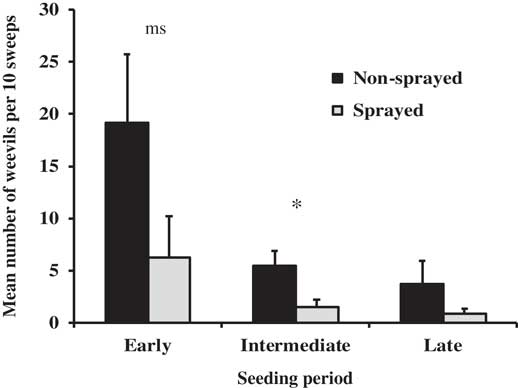
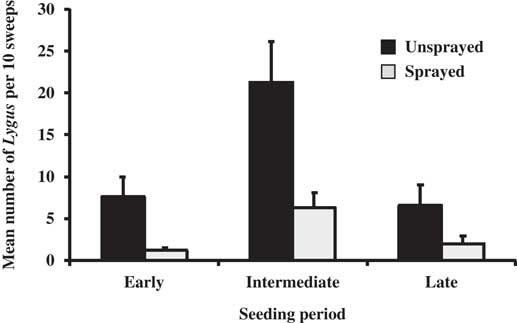
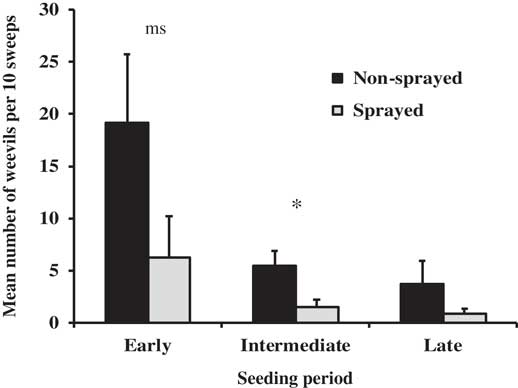
Seeding period (early, intermediate, or late) clearly affected the abundance of cabbage seedpod weevils (Fig. 1). Fields planted in April had about twice the number of cabbage seedpod weevils at the early flower stage (20 per 10 sweeps) as those planted in the first or second half of May (Fig. 1, lmer analysis of variance on ranked data F 2,69 = 7.61, P = 0.001; Tukey’s test, P < 0.002). For Lygus sampled at the early pod stage, an opposite and marginally significant trend was observed (Fig. 2, F 2,62 = 2.7, P = 0.07). Early-planted fields had about one-third the number of Lygus (seven per sample of 10 sweeps) as those found in fields planted in the first half of May. Fields planted late and early had similar Lygus abundances (Fig. 2).
Effect of canola seeding period (early = April, intermediate = first half of May, late = second half of May) and insecticide spray treatment on cabbage seedpod weevils at the early flower stage in a commercial farm study in southern Alberta (n = 73 fields, 2010–2013). Entries are arithmetic means plus one standard error. Asterisks denote marginally significant differences between spray treatments for early seeded fields (P = 0.09 (ms) and highly significant difference for fields seeded during intermediate dates (P < 0.001*), Tukey’s honestly significant difference test applied to ranked data.
Effect of seeding period and insecticide spraying on Lygus in canola at early pod in southern Alberta (n = 73 farms pooled from 2010 to 2013). Insecticide spraying had a significant effect (F 2,70 = 24.7, P≤0.01), but there was no interaction with seeding period, which only had a marginally significant effect (F 2,62 = 2.7, P = 0.07). Entries are arithmetic means plus one standard error.
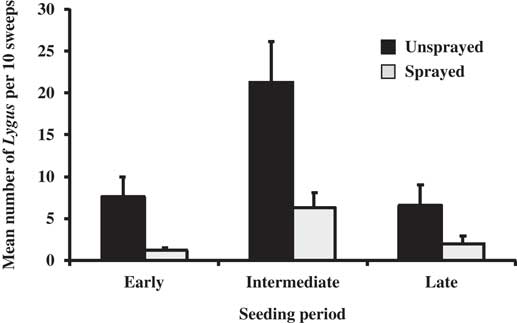
Spraying insecticide significantly reduced the abundance of cabbage seedpod weevils (Fig. 1, F 1,70 = 44.9, P < 0.01) and Lygus (Fig. 2, F 1,70 = 24.7, P < 0.01). Furthermore, there was a marginally significant interaction of spraying insecticide and seeding period for cabbage seedpod weevils only (F 2,70 = 2.8, P = 0.07). Spraying fields planted early or during the normal period reduced number of cabbage seedpod weevils (P = 0.09, and P < 0.01, respectively), but this was not the case for fields planted late (P = 0.22).
Sampling
Means and standard errors of cabbage seedpod weevils for individual fields obtained from the complete set of 16 sweep samples at the early flower stage were 44.9 ± 7.6 cabbage seedpod weevils and 46.6 ± 8.7 cabbage seedpod weevils for the set of four sweep samples (each 10 sweeps). There was no significant statistical difference between the two estimates of cabbage seedpod weevil abundance (Kruskall–Wallis test, P = 0.98).
Yield, seed quality, damage, and thresholds
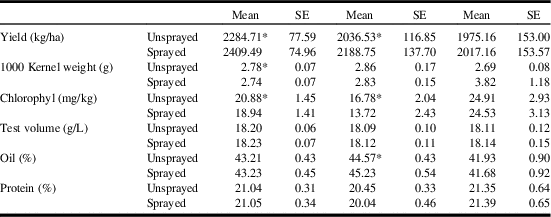
Insecticide spraying for cabbage seedpod weevils affected yield and seed quality, particularly in fields planted in April (Table 1). Sprayed strips in early-planted fields had around 152 kg/ha more yield than strips not sprayed (mixed analysis of variance, F 1,15 = 7.64, P = 0.01 and F 1,38 = 7.87, P = 0.01, for early and intermediate seeding periods, respectively). The yield increase in response to insecticide spraying was lower (125 kg/ha) and nonsignificant in fields planted after mid-May (F 1,12 = 0.57, P = 0.46). Yields from the combine monitor were not significantly different between treatments or seeding periods, although there was a similar increase of about 100 kg/ha in strips sprayed compared to the controls (data not shown). One thousand seed weights and chlorophyll content (a measure of green seed) although, higher for plants harvested from the sprayed strips than from controls, were not significantly different (Table 2, Kruskal–Wallis test, P >0.05). Oil content was significantly higher in plants from sprayed strips than in control strips only for fields planted in April (Table 2, mixed analysis of variance, F 1,15 = 6.65, P = 0.02).
Yield and other seed quality parameters from canola test strips sprayed with insecticide or unsprayed controls.

Notes: Insecticide was sprayed at the early flower stage in commercial farms around southern Alberta, Canada. Asterisk denotes significant difference between sprayed and unsprayed treatments within columns (P < 0.05). SE, standard error.
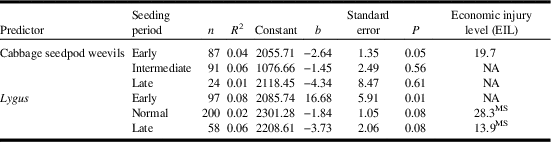
Regression of canola yield on cabbage seedpod weevils at the early flower stage or Lygus at early pod in commercial canola fields.
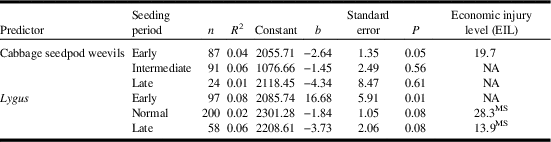
Notes: Yields were estimated from quadrat samples collected from 2010 to 2013 in southern Alberta, Canada. b, slope coefficient of the regression of yield on the insect pest abundance; NA, not applicable because regression coefficient b was not significantly different from zero, P >0.05 or was positive; MS, regression coefficient was only marginally significantly different from zero, P = 0.08. EIL, number of insects per 10 sweeps.
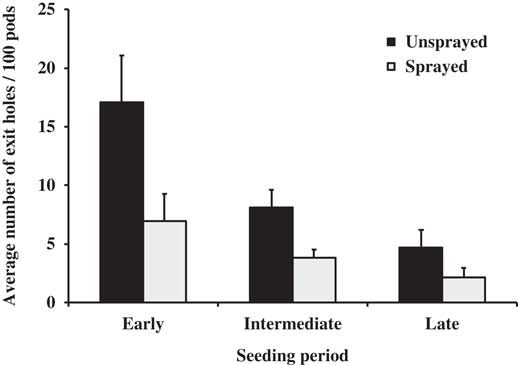
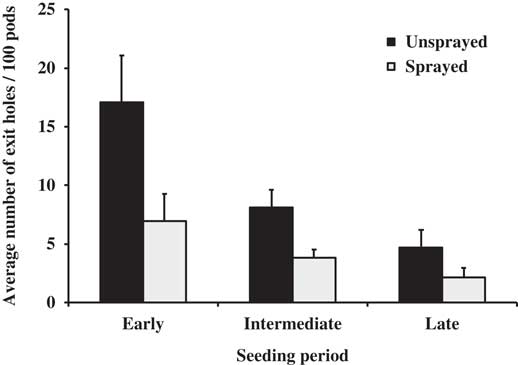
Pod damage, expressed as number of cabbage seedpod weevil larval exit holes per 100 pods, was lower in sprayed than in control strips (Fig. 3). For this measurement, the differences were consistent and significant for the early (F 1,16 = 44.06, P < 0.01), intermediate (F 1,38 = 33.04, P < 0.01), and late (F 1,14 = 44.06, P < 0.01) seeding periods (mixed analysis of variance on ranked data). However, the damage levels (approximately 20 holes/100 pods) were two to four times higher in the early seeded fields than in those planted later (Fig. 3).
Effect of insecticide spraying at the early flower stage on number of cabbage seedpod weevil exit holes per 100 canola pods in fields planted early (April), or during the intermediate period (first half of May) or late (second half of May) in southern Alberta from 2010 to 2013. Entries are averages of 4–8 samples of 10 main racemes in each of 15, 40, and 16 fields planted early, intermediate, or late, respectively. Asterisks denote significant differences between spray treatments (Tukey’s honestly significant difference test, P < 0.05 for early and intermediate seeding periods.
Economic injury levels were calculated (Table 2) for cabbage seedpod weevils and Lygus for each seeding period using the formula “economic injury level = g/b” (Stone and Pedigo Reference Stone and Pedigo1972). Economic injury level equals the gain threshold (g) divided by the slope coefficient (b) of the regression of yield on the insect pest abundance (cabbage seedpod weevils or Lygus/10 sweeps), which quantifies the yield losses per insect sampled. The gain threshold was calculated using a recent canola price of $427.71/ton (Canadian dollars used for all calculations) and a cost of aerial insecticide spraying of $22.24 per ha (22.24/427.71 = 0.05199). Therefore, 52 kg/ha needed to be saved by spraying for these pests to cover the cost of the action.
Regression coefficients (R 2 ) of yield and insect abundance for either pest were low for all seeding periods (Table 2). The slope coefficient (b) was only significantly different from zero for cabbage seedpod weevils and yield for plants seeded early during the month of April (P = 0.05); therefore the economic injury level would be 19.7 cabbage seedpod weevils per 10 sweeps. For Lygus, the slopes were marginally significant for Lygus at early pod in fields planted in early or late May (intermediate and late seeding periods: P = 0.08, economic injury level = 28.3, and 13.9 Lygus/10 sweeps, respectively). For Lygus from fields planted in April (early seeding), the slope was positive and significant (P = 0.01).
Discussion
In temperate regions with short growing seasons, seeding date manipulation generally has limited application as a pest management strategy because most crops such as canola need to be seeded early to maximise yield potential. However, our study suggests that for cabbage seedpod weevil, delays in seeding may have significant impacts on pest densities and yield loss. Cabbage seedpod weevils are strongly attracted to the earliest flowering fields planted in late April even relative to fields planted during the recommended period of early May. This pattern has been observed in a wide geographic range, including northern Idaho, United States of America (Brown et al. Reference Brown, McCaffrey, Harmon, Davis, Brown and Erickson1999), United Kingdom (Free and Williams Reference Free and Williams1978), and has been exploited to develop trap-cropping systems in Alberta (Cárcamo et al. Reference Cárcamo, Dunn, Dosdall and Olfert2007). Our study suggested that seeding during the early part of May resulted in similar yields compared to seeding in April, therefore, it should be possible for growers to reduce risk of cabbage seedpod weevil damage by delaying seeding of some of their fields to this time and concentrate cabbage seedpod weevils in those early-planted fields, reducing the crop area that benefits from cabbage seedpod weevil control. Minimum distances among fields for this technique to be effective remain to be determined. Growers could also plant trap crop borders earlier to control them there (Cárcamo et al. Reference Cárcamo, Dunn, Dosdall and Olfert2007). Fields seeded in April generally had fewer Lygus than those planted later during the first half of May when most canola is planted in the prairies. This suggests that fields planted in early May are better synchronised with the life cycle of Lygus in the southern prairies. Fields planted in April may receive fewer overwintered adults because of the potentially lower population of Lygus in the spring (from overwintering mortality) compared to the summer. Also, other plants such as brassicaceous winter annual weeds (e.g., hoary cress (Cardaria draba Linnaeus), flixweed (Descurainia sophia (Linnaeus) Webb ex Prantl; Brassicaceae) would be at a more advanced attractive flowering stage than canola (vegetative) in the spring. On the other hand, canola fields planted in May flower in July making them more attractive relative to senesced uncultivated habitats or cut forage crops and potentially better synchronised with the larger generation of summer Lygus adults.
Only fields planted early required cabbage seedpod weevil management, and insecticide spraying effectively reduced cabbage seedpod weevils below potentially damaging abundances (two per sweep). Although insecticide spraying also reduced cabbage seedpod weevils significantly relative to control strips in field planted during the normal seeding period in early May (intermediate), such control action was unwarranted because their impact on yield was low according to our regression analysis. Cabbage seedpod weevils appear to be at the northern edge of their distribution range in the southern prairies of Canada (Dosdall et al. Reference Dosdall, Cárcamo, Olfert, Meers, Hartley and Gavloski2011) and spring planted canola is poorly synchronised with their life cycle. Cabbage seedpod weevils are active early in the spring and those that invade canola fields are near the end of their life cycle (Ulmer and Dosdall Reference Ulmer and Dosdall2006). Therefore, even a small difference in planting date can result in low densities that do not require management. Development of winter canola or spring conditions that fostered early seeding would favour the cabbage seedpod weevil and increase its pest status.
A popular hope among canola producers is to reduce Lygus pests at the pod stage by spraying at the early flower stage for cabbage seedpod weevil or other pests. In past plot studies, Lygus abundances were not reduced by spraying before the early pod stage (Butts and Lamb Reference Butts and Lamb1991; Wise and Lamb Reference Wise and Lamb1998; H.C., unpublished). However, Lygus are highly mobile (Stern and Mueller Reference Stern and Mueller1968) and they may have moved from unsprayed to sprayed plots in the above studies. Our study was more realistic because it used large commercial fields and large study strips that minimised the confounding effect of within site dispersal by Lygus or insecticide drift. Contrary to the past small plot research, we showed a consistent reduction of Lygus abundance in large strips that were sprayed relative to those not sprayed at the early flower stage. It is of interest that this effect was detectable even a few weeks later during the early to mid-pod stage when Lygus can be damaging. The differences were more pronounced and statistically significant in fields planted during the intermediate seeding period in early May. In fact for fields planted early, which are the only ones that should be sprayed for cabbage seedpod weevils, the number of Lygus was clearly below the recommended economic thresholds during the pod stage in unsprayed strips. The five-fold reduction by spraying could likely become significant with more sites but would be of no economic significance. The lower number of Lygus in fields planted late was unexpected; in general, Lygus appear to reach high abundances in many canola fields near harvest time (H.C., field observation) when the crop is no longer vulnerable and past the legal preharvest interval for most pesticides. It is likely that Lygus populations are highly variable and dependent not just on temperature but also on the intensity of precipitation events that can increase nymphal mortality (Day Reference Day2006).
This study is the first one to validate action thresholds for cabbage seedpod weevil in commercial fields of spring canola. According to our analysis by seeding period, only those fields planted early require an action threshold. Our results suggest an economic injury level of two cabbage seedpod weevils per sweep. This value confirms the current suggested nominal action threshold of 2–3 per sweep currently used in Alberta and Saskatchewan, but is lower than the nominal value of four cabbage seedpod weevils per sweep based on cage studies (Cárcamo Reference Cárcamo2012; 2010–2013 unpublished data). Comparing our results to other regions is difficult. Most European studies have focused on winter oilseed rape (B. napus) (Free and Williams Reference Free and Williams1978) or spring turnip rape (B. rapa) (Sylven and Svenson Reference Sylven and Svenson1975; Tulisalo et al. Reference Tulisalo, Korpela and Pohto1976). Brown et al. (Reference Brown, McCaffrey, Harmon, Davis, Brown and Erickson1999) in the Pacific Northwest of the United States of America found high-yield losses (30%) from late season insect pests that included cabbage seedpod weevils; however, similar to European studies, they did not use a sweep net to sample cabbage seedpod weevils, but relied on shaking plants to estimate densities per plant. Other studies such as those by Lerin (Reference Lerin1984) in France or Buntin (Reference Buntin1999) in the United States of America have determined the thresholds based on pod damage levels and yield, which cannot be used to prevent yield loss.
In conclusion, a number of recommendations can be made from this study. The economic injury level we calculated from the early seeded fields of two cabbage seedpod weevils per sweep supports the nominal action threshold of three to four per sweep currently in use. We recommend using the higher end of this threshold because most growers or agronomists prefer to sweep the borders of the fields where cabbage seedpod weevils are twice as abundant as in field interiors. A reasonable estimate of cabbage seedpod weevil abundance can be obtained with as few as four samples per field. The operator should collect one sample along the border and a second one at least 50 m inside the field and repeat this process at a location 500 m away. Our study suggested that only early-planted fields (April) require cabbage seedpod weevil management so that an action threshold was not needed for late seeded fields (after mid-May). Fields with intermediate seeding dates (early May), may still reach threshold densities, and require protection, if neighbours did not plant earlier or under cool spring conditions that delay cabbage seedpod weevil spring activity.
Acknowledgements
This study was funded through the Canola Agronomic Research Program of the Canola Council of Canada, Agriculture and Agri-Food Canada and Alberta Agriculture and Forestry. The technical support from S. Daniels, I. Oseen, and the numerous summer students is gratefully acknowledged. The senior author gratefully acknowledges H. Catton and R. Laird for statistical advice. Equally important were the contributions of all the agronomists and growers that enthusiastically participated by allowing us to work with them to implement the study on their farms or with their clients and provided yield data from their combine yield monitors.