Procrastination is defined as ‘to voluntarily delay an intended course of action despite expecting to be worse off for the delay’ (Steel, Reference Steel2007, p. 66). Procrastination is a universal behaviour problem in both adults and students. Hammer and Ferrari (Reference Hammer and Ferrari2002) found that 20% of adults reported procrastination in everyday tasks, and 52% of the students delayed their academic tasks (Özer et al., Reference Özer, Demir and Ferrari2009). Procrastination behaviours that are restricted to students’ studies related to tasks comprise academic procrastination, which is ‘an irrational tendency to delay at the beginning or completion of an academic task’ (Yong, Reference Yong2010, p. 63). Indeed, many students lack motivation to start or complete academic assignments in a timely manner, despite their best intentions. Students frequently postpone academic tasks, including preparation for writing papers during the semester, preparation for taking exams, completing official tasks related to school, and attending classes regularly (Solomon & Rothblum, Reference Solomon and Rothblum1984). Academic procrastination is considered a maladaptive behavioural habit that not only has a negative impact on students’ academic achievement, but also has a close correlation with students’ anxiety and depression (Akpur, Reference Akpur2017; Constantin et al., Reference Constantin, English and Mazmanian2017; Kim & Seo, Reference Kim and Seo2015). Milgram and Toubiana (Reference Milgram and Toubiana1999) found that test anxiety was positively correlated with dispositional procrastination on schoolwork, such as preparing for an examination or writing papers. Custer (Reference Custer2018) also found significant correlations between test anxiety and academic procrastination. More generally, numerous studies have found a positive correlation between anxiety over academic events (e.g., tests) and procrastination (Park & Sperling, Reference Park and Sperling2012; Rodarte-Luna & Sherry, Reference Rodarte-Luna and Sherry2008; Solomon & Rothblum, Reference Solomon and Rothblum1984; Spada et al., Reference Spada, Hiou and Nikcevic2006). Numerous studies have demonstrated a close correlation between academic procrastination and anxiety, most of which adopted a cross-sectional design and did not focus on causal relationships (Onwuegbuzie & Jiao, Reference Onwuegbuzie and Jiao2000). Indeed, there are different perspectives on the causal relationship between anxiety and procrastination (Lay & Silverman, Reference Lay and Silverman1996; McCown & Johnson, Reference McCown and Johnson1991; Solomon & Rothblum, Reference Solomon and Rothblum1984; Steel, Reference Steel2007).
In one respect, anxiety is seen as similar to neuroticism, in that those who are anxious procrastinate because they feel stressed, which creates task aversion (Burka & Yuen, Reference Burka and Yuen2008). It has even been suggested that highly anxious people tend to have irrational thought patterns, such as catastrophising small situations and fear of failure, which causes them to put off tasks as a way of escaping temporary emotion and alleviate anxiety (Hobfoll, Reference Hobfoll1989; Sirois & Pychyl, Reference Sirois and Pychyl2013). Hobfoll (Reference Hobfoll1989) proposed the appraisal-anxiety-avoidance model to explain the link between anxiety and the tendency to procrastinate. According to this model, if individuals consider a situation as a challenge that they are incompetent to deal with, they are prone to seeking to escape from the situation. Tice and Bratslavsky (2000) suggested that procrastination usually takes place when people consider a task aversive and find it causes unpleasant feelings like stress or anxiety. McCown and Johnson (Reference McCown and Johnson1991) found that people were more likely to put off an anxiety-provoking activity than a less anxiety-provoking one. Using structural equation modelling, Ariani and Susilo (Reference Ariani and Susilo2018) demonstrated that test anxiety significantly positively affected procrastination. It is likely that people who feel upset or anxious about their current workload can turn to doing something else as a way of short-term mood repair, thus helping themselves feel a release from stress in the present.
On the other hand, procrastination is usually considered a maladaptive behaviour that often results in a feeling of discomfort when people put tasks off until near the deadline and realise that their time is about to run out, resulting in anxiety and stress in trying to perform an important task on time. Beswick et al. (Reference Beswick, Rothblum and Mann1988) found that students who procrastinated by putting off studying for an exam experienced greater anxiety during the exam. Steel (Reference Steel2007) indicated that procrastination not only stems from negative affect and poor mood but also leads to them. Although procrastination initially gives temporary comfort, as the deadline approaches the procrastinator experiences negative feelings and thoughts, which causes anxiety, stress and regret (Deniz et al., Reference Deniz, Traş and Aydoğan2009, p. 610). Some studies have demonstrated that procrastinators are prone to feel more stress and illness only at the end of a semester (Tice & Baumeister, Reference Tice and Baumeister1997). By spending less time on tasks, procrastinators may feel less stress than others at the beginning of the school year, but they experience much greater stress when their tests approach at the end of a semester. The complex relationship between procrastination and anxiety must consider the bidirectional relationship between both factors.
In sum, previous theories and studies have demonstrated that the correlation between procrastination and anxiety may be reciprocal. However, the correlation of procrastination with anxiety has for the most part been based on cross-sectional studies, which do not permit causal conclusions. Indeed, a recent repeated-measure study demonstrated that students’ rate of change in anxiety and procrastination varied significantly over the semester, and anxiety and procrastination were not predictable from the initial levels (Yerdelen et al., Reference Yerdelen, McCaffrey and Klassen2016). This suggests that there is a relationship between anxiety and procrastination across a semester. However, its extent and direction remain unexamined. On the other hand, an experimental design could allow us to draw a conclusion regarding a causal relationship, but it can only concentrate on one direction (i.e., procrastination results in test anxiety or the converse). Therefore, to fill this gap, we adopted a longitudinal design to explore the mutual prediction effects between test anxiety and academic procrastination, which can contribute usefully to better understanding of the relationship between academic procrastination and test anxiety over time. The hypotheses of the present study are as follows:
Hypothesis 1(H1): There is a significant relationship between academic procrastination and test anxiety.
Hypothesis 2(H2): Academic procrastination at Time 1 (T1) will have cross-lagged effects on test anxiety at Time 2 (T2).
Hypothesis 3(H3): Test anxiety at T1 will also have cross-lagged effects on academic procrastination at T2.
Method
Study Design
This study used a longitudinal design, and the data used in this research were collected in two waves during a semester. The academic procrastination and test anxiety of students were measured at the middle of a winter semester, and were measured again two months later at the end of the semester. Our hypotheses were tested using a fully cross-lagged panel analysis.
Participants and Procedure
A total of 264 students enrolled in six classes of a psychological health course (three classes each in Grades 10 and 11) at a high school in Changsha City, Hunan Province, China were invited to take part in this study. Students completed a survey at T1 in the middle of the 2018 winter semester, and at T2, two months later at the end of the semester. After excluding 37 students who submitted incomplete forms (at T1, T2 or both), the final sample comprised 227 students, including 123 boys (54.2%) and 104 (45.8%) girls, with an average age of 16.7 years (SD = 0.62, range 15–18 years). The participants completed the questionnaire in their classes and returned them on the spot. The researcher provided the necessary instructions in person, and information on confidentiality and anonymity was also provided. Informed consent was obtained from students and their parents. Before the survey, permissions were also obtained from the school managers. The research protocol was approved by the Ethics Committee of the Ethics Committee of Hunan Normal University.
Measures
Academic procrastination was measured using the Aitken Procrastination Inventory (API; Aitken, Reference Aitken1982). The API is a self-report inventory measuring trait procrastination. The original scale contains 19 items that use a 5-point scale ranging from 1 (false) to 5 (true). This study used the Chinese version translated by Liu and Lu (Reference Liu and Lu2011). Their study demonstrated that the Chinese version of the API is reliable and valid for Chinese high school students to assess their academic procrastination behaviour. The Chinese version consists of two factors assessed by 13 items in total. The two factors include: Task aversiveness (e.g., ‘When the exam is approaching, I often waste my time doing other things rather than reviewing’) and a feeling of failure (e.g., ‘If I had an important project to do, I’d get started on it as quickly as possible’). The internal consistency of the whole inventory was .80. High scores indicate students who have a high level of procrastination behavior. In the current study the internal consistency reliability of the scale was .81 at T1, and .82 at T2.
The Test Anxiety Scale (TAS; Sarason, Reference Sarason, Spielberger and Sarason1978) was developed to measure participants’ degree of test-taking anxiety. The TAS consists of 37 items in total. These items relate to tension, worry, test-irrelevant thinking, and bodily symptoms. Typical statements in the questionnaire include: ‘While taking an important exam, I find myself thinking of how much brighter the other students are than I am.’ Respondents are asked to choose true or false according to whether the statements of the questionnaire in line with themselves. Items are scored with 1 (if true) or 0 (if false). The summary score for the TAS questionnaire ranges from 0 to 37. Test-retest reliabilities of between .80 and .87 have been reported (Sarason, Reference Sarason, Spielberger and Sarason1978). The Chinese version of TAS was originally translated by C. Wang (Reference Wang2001), and a recent research demonstrated that the internal consistency of Chinese version TAS was .87 and test-retest reliability was .59 in Chinese high school students (Song & Zhang, Reference Song and Zhang2008). In the current study the internal consistency reliability of the scale was .85 at T1, and .86 at T2.
Results
Descriptive Statistics
Table 1 shows the means, standard deviations, and correlations of all study variables. As expected, the cross-correlations between academic procrastination and test anxiety were both positive and significant at T1 (r = .314, p < .01) and T2 (r = .175, p < .01). The T1 academic procrastination was positively correlated with T2 test anxiety (r = .477, p < .01), and the correlation between T1 test anxiety and T2 academic procrastination was relatively weak (r = .165, p < .05). To determine whether T2 test anxiety and T2 academic procrastination could be predicted by T1 academic procrastination and T1 test anxiety separately, a full cross-lagged panel analysis was conducted.
Descriptive Statistics and Correlations Among the Study Variables

Note: AP, academic procrastination; TA, test anxiety.
**p < .01, *p < .05.
Cross-Lagged Panel Analyses
Confirmatory factor analysis (CFA) was used in both phases to measure academic procrastination and test anxiety as latent factors (Anderson & Gerbing, Reference Anderson and Gerbing1988). The scores of the two dimensions (task aversiveness and feeling of failure) served as indicators of the latent variable of academic procrastination. Indicators for the latent variable of test anxiety were created using item parcelling as follows: We first conducted a preliminary exploratory factor analysis separately for the items of test anxiety for both phases. Screen plots indicated that a single factor was sufficient to identify the unidimensional structure of the TAS. Items 29 and 33 of the TAS were deleted, as their factor pattern coefficients were negative. Following the ‘item-to-construct balance’ method (e.g., Little et al., Reference Little, Cunningham, Shahar and Widaman2002), we created five parcels of seven items each for the TAS. CFA demonstrated that the four-factor structural model (academic procrastination, test anxiety, T1, and T2) fit the observed data well, χ2 = 96.01, p < .001, df = 64, comparative fit index (CFI) = .97, root mean square error of approximation (RMSEA) = .045. Second, structural equation modelling (SEM) with Mplus (J. Wang & Wang, Reference Wang and Wang2012) was used to test the cross-lagged relationships between academic procrastination and test anxiety. Age and gender were controlled as predictors of academic procrastination and test anxiety. As is usual in SEM for longitudinal models, the error terms of each indicator at T1 with the corresponding indicator at T2 were allowed to vary. We used the CFI and the RMSEA as indicators of model fit. CFI ≥ .90 and .95 reflect adequate and good fits respectively, while RMSEAs ≤ .08 and .05 reflect adequate and good fits respectively (McDonald & Marsh, Reference McDonald and Marsh1990). The robust maximum likelihood (MLR) method (J. Wang & Wang, Reference Wang and Wang2012) was used to estimate our statistical models.
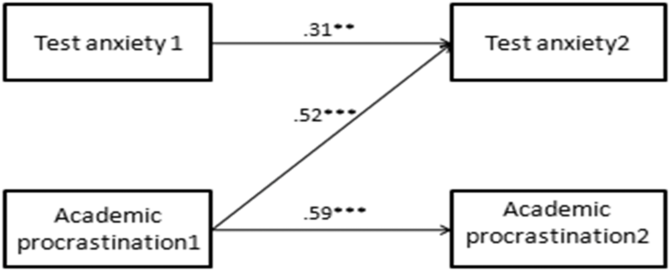
Full cross-lagged panel analyses demonstrated that the data fit the model well, χ2 = 122.506, df = 75, p < .001; CFI = 0.96, RMSEA = 0.05. The standardised regression coefficients are shown in Figure 1. After controlling for the variance explained by T1 test anxiety and sex, T1 academic procrastination significantly predicted T2 test anxiety (B = .52, p < .001). The correlation between T1 and T2 test anxiety was significant (B = .31, p < .01). T1 and T2 academic procrastination were also significantly correlated (B = .59, p < .001). Notably, there were no statistically significant cross-lagged relationships between T1 test anxiety and T2 academic procrastination.
Cross-lagged relationships between academic procrastination and test anxiety. Parameter estimates are standardised. Only significant coefficients are presents.
Note: **p < .01, ***p < .001.

Discussion
Within the limits of the present study, a causal relationship was revealed primarily between academic procrastination and test anxiety in a sample of Chinese high school students. In general, the findings partially support our hypotheses. Our findings supported the cross-lagged path from T1 academic procrastination to T2 test anxiety, whereas the path from T1 test anxiety to T2 academic procrastination was not significant. This means that academic procrastination may be the cause of test anxiety rather than the result.
Our basic correlational analyses revealed that academic procrastination and test anxiety were positive at both T1 and T2. It appears that students who frequently engaged in academic procrastination behaviours were more likely to feel anxious about their tests, which is consistent with prior studies (e.g., Ariani & Susilo, Reference Ariani and Susilo2018; Toubiana, 1999). In the cross-lagged panel analysis, after controlling for sex and T1 test anxiety, T1 academic procrastination predicted T2 test anxiety well. In other words, the initial level of academic procrastination could predict students’ future test anxiety. This supports the maladaptive dysfunction of procrastination, which suggests that procrastination usually leads to task-related anxiety and depression. As Steel (Reference Steel2007) suggested, as a form of short-term mood repair, procrastination initially makes people feel relaxed, but as the deadline approaches, it leads to more stress and work-related anxiety. For example, Rothblum et al. (Reference Rothblum, Solomon and Murakami1986) found that students who procrastinated frequently tended to be more anxious across the whole semester, and also tended to have lower stress levels in the early parts of the semester. Tice and Baumeister (Reference Tice and Baumeister1997) demonstrated that student procrastinators tend to experience less stress early on, but more stress at the end of the semester and more stress overall. Another study found similar results in that the relationship between procrastination and anxiety was observed as an increase at the semester end (Lay & Schouwenburg, Reference Lay and Schouwenburg1993). The present study supports the causal relationship between academic procrastination and anxiety across time. This means that students who delay their schoolwork at the beginning of the semester are more prone to judge themselves as not having prepared well as their test approaches and consequently feel greater worry about future test failure, consistent with previous cross-sectional studies (Haycock et al., Reference Haycock, McCarthy and Skay2011; Schouwenburg, Reference Schouwenburg1992).
Our findings did not support the reciprocal causation effect of test anxiety on academic procrastination. This result is inconsistent with other cross-sectional studies and the proposed model, where anxiety tends to increase procrastination (Steel, Reference Steel2007). However, there tends to be a small effect of anxiety on procrastination at one point in time. The claim that anxiety increases procrastination is mainly based on clinical observations (Burka & Yuen, Reference Burka and Yuen2008). However, we note that Schouwenburg (Reference Schouwenburg1992) found that overall procrastination was unrelated to fear of failure. Lay and Silverman (Reference Lay and Silverman1996) concluded that anxiety plays a minor role, if any, in inducing dilatory behaviour and should not be viewed as a strong correlate of procrastination, although it is possible that anxiety may induce procrastination behaviours in some individuals. However, other researchers have proposed that the relationship between anxiety and procrastination depends in general on other variables of coping and competence (Haghbin et al., Reference Haghbin, McCaffrey and Pychyl2012; Klassen et al., Reference Klassen, Krawchuk and Rajani2008). Another issue to consider in the relationship between anxiety and procrastination is the adaptive function that anxiety can play in helping individuals engage in work. According to self-regulatory theory, anxiety may motivate people to devote greater effort toward a goal and thereby reduce procrastination so as to avoid failure to achieve a goal (Wright et al., Reference Wright, Carver and Scheier1998). For example, Xu et al. (Reference Xu, González Vallejo and Xiong2016) demonstrated that anxiety felt right before a mathematics test resulted in less dilatory behaviour. The present study further found that the level of anxiety could not predict future academic procrastination behaviours across time; that is to say, anxiety may not lead to an increase in dilatory academic behaviour. Similarly, the recent longitudinal study of Yerdelen et al. (Reference Yerdelen, McCaffrey and Klassen2016) suggested that a certain level of anxiety may help students to make better progress in their schoolwork, while too much anxiety may result in avoidance.
Practical Implications
Overall, the present study provided basic evidence for understanding the causal relationship between test anxiety and academic procrastination. It also has important practical implications for intervention and counselling for test anxiety and academic procrastination in schools. Academic procrastination is usually considered to be related to students’ bad academic performance, depression and anxiety, while the present study further demonstrated that academic procrastination causes test anxiety. School counsellors should thus pay more attention to it and provide early intervention suggestions for academic procrastinator students. A straightforward way to decrease academic procrastination is to improve students’ motivation and engagement in study activities. There are several strategies suggested by Martin (Reference Martin, Street and Porter2014) to improve students’ motivation and engagement, which include increasing student’s self-belief through ‘chunking’ important tasks and expanding the students’ views about success; helping students develop more positive beliefs about school; increasing students’ learning focus by recognising the journey as much as the destination during study; and planning strategies to help students plan better for short-term tasks, such as how to get it clear in their minds what the task is asking and to spend time thinking about how to do the task.
As for test anxiety, although a high level of anxiety may impair students’ test performance, we did not find it to led to academic procrastination. Although conclusions cannot be drawn from the present study, the possibility of the motivational effect of anxiety to promote studying should also be considered. This means that maintaining a reasonable level of academic anxiety may not be bad for students. It is not necessary for school counsellors to eliminate students’ worries about exams completely. For extremely anxiety students, except for the development of some relaxation strategies, such as breathing techniques to physical activity, sport and exercise, it is also important to help them better prepare for tests and decrease daily academic procrastination behaviours.
Conclusion and Recommendations
Overall, the findings of the present study suggest that academic procrastination may lead to an increase in test anxiety, but test anxiety did not predict the future level of academic procrastination. As the definition and measurement of the associated variables may confuse the relationship between anxiety and procrastination, future research may examine the correlation between state anxiety and actual academic procrastination behavior longitudinally.
There were several limitations to the current study. First, the participants were all high school students. Thus, the results should not be generalised to other groups. Second, the relationship between anxiety and procrastination is complicated; our study could not take into account the related factors that might have affected this relationship. For example, future longitudinal research should consider personality traits (e.g., perfectionism and impulsiveness may mediate or moderate the relationship between anxiety and procrastination). Third, we tested our hypothesis in a complete two-wave panel. A multiwave measurement throughout the semester might yield more comprehensive results regarding the cross-lagged relations between anxiety and procrastination.
Acknowledgement
This work was supported by a PhD early development program of Hunan Normal University.