I. Introduction
Much of the social and political attention surrounding the nationwide opioid epidemic has been centered on the dramatic increase in overdose deaths among white, middle-class, suburban and rural users. Media coverage of the epidemic routinely describes it as “The New Face of Drug Addiction,” insinuating that this demographic is experiencing addiction at rates never seen before.Reference Streitfeld1 Dozens of news stories mention that 90% of the 33,091 people who died from opioids in 2015 were white.Reference Rudd2 Doctor prescribing practices have been a focus as well, given that the increased misuse of prescription opioids among whites has led to addiction in some cases, and that overdose deaths involving prescription opioids have quadrupled since 1999.3 The trend of opioid initiation type may be changing however, with a current study reporting a marked increase in heroin as the modal substance of initiation.Reference Cicero, Ellis and Kasper4
Though it's true that the most dramatic increase in opioid-related deaths has occurred in white Americans, the opioid epidemic has also profoundly affected communities of color. Opioid deaths, in particular heroin overdoses, have nearly doubled among Black Americans since 2000.5 These deaths have been largely overlooked by the media, and non-white victims of the opioid epidemic are conspicuously absent from political discourse. To attribute this lack of discussion entirely to the low relative frequency of non-white deaths offers an incomplete explanation at best and a wholly inaccurate one at worst. Rather, the marginalization of Black people is highly consistent with a pattern of framing addiction affecting people of color as a pathological shortcoming to be answered by militarized policing and involvement of the criminal justice system, in lieu of treatment.
This is especially and historically true of Black Americans, who were severely affected by an “opioid epidemic” in the 1960s and 1970s. At the time, heroin addiction ravaged communities and resulted in overdose deaths as it does today, “except that the face of the heroin addict in the media was Black, destitute and engaged in repetitive petty crimes to feed his or her habit.”Reference Hart6 Then, little compassion was expressed for those with heroin addiction, and what was genuinely an opioid crisis was rarely labeled as such. Instead, New York implemented harsh Rockefeller Drug Laws that criminalized drug possession, which were later instituted in other states.Reference Drucker7
To say, therefore, that today's opioid crisis is the likes of which we've never seen before, is only a half-truth. While opioid abuse has undeniably skyrocketed to never-before-seen levels, creating the largest drug epidemic in recorded history, the current crisis is not unprecedented. Declaring as much suggests that the increase in opioid abuse is primarily worth our attention because of the predominantly white population affected. Neglecting to acknowledge Black people in the current epidemic, while simultaneously describing the current surge in opioid use as a novel crisis, erases both the past and present experiences of Black people. This article will therefore seek to discuss the opioid epidemic in Black communities in historical context, and to suggest why targeted evidence-based interventions are appropriate.
II. Opioid Usage in the Black Community
A. Rates of Use
The current opioid epidemic is the largest drug epidemic in recorded U.S. history, for all racial groups. Since 2000, the rate of overdose deaths involving opioids has nearly quadrupled, resulting in more than 500,000 deaths in under two decades.8 In 2016, more than 64,000 Americans died from drug overdoses, of which more than 33,000 were opioid-related.9 By comparison, there were 7,100 recorded overdose deaths from drugs of any type in 1975, at the height of the heroin epidemic.10 The magnitude of this particular epidemic is partly due to increased prescriptions of opioid analgesics that started in the 1990s.Reference Modarai11 As pain treatment moved from the area of specialty care to primary care and the pharmaceutical industry began advertising the safety of a new class of painkillers, the rate of long-term opioid prescriptions rose steeply.Reference Schottenfeld, Waldman, Gluck and Tobin12 At the same time, there has been a profound improvement in heroin distribution in recent decades: an increase in the availability of heroin and a decrease in its price in some parts of the country have made it easier to access than in past years.
No racial group has escaped the effects of this opioid epidemic, including Blacks, despite the fact that Black and white people differ in the types of illicit drugs they tend to use. Though research has consistently shown that Black and white people generally use drugs at similar rates,13 there are notable racial disparities for certain drug formulations. For example, whites are more likely to report lifetime cocaine use than Blacks, though Blacks are more likely to use crack than powder cocaine compared to whites.14 This pattern of drug use corresponds directly to sentencing disparities, where sentences for crack possession are eighteen times longer than those for possession of powder cocaine.15
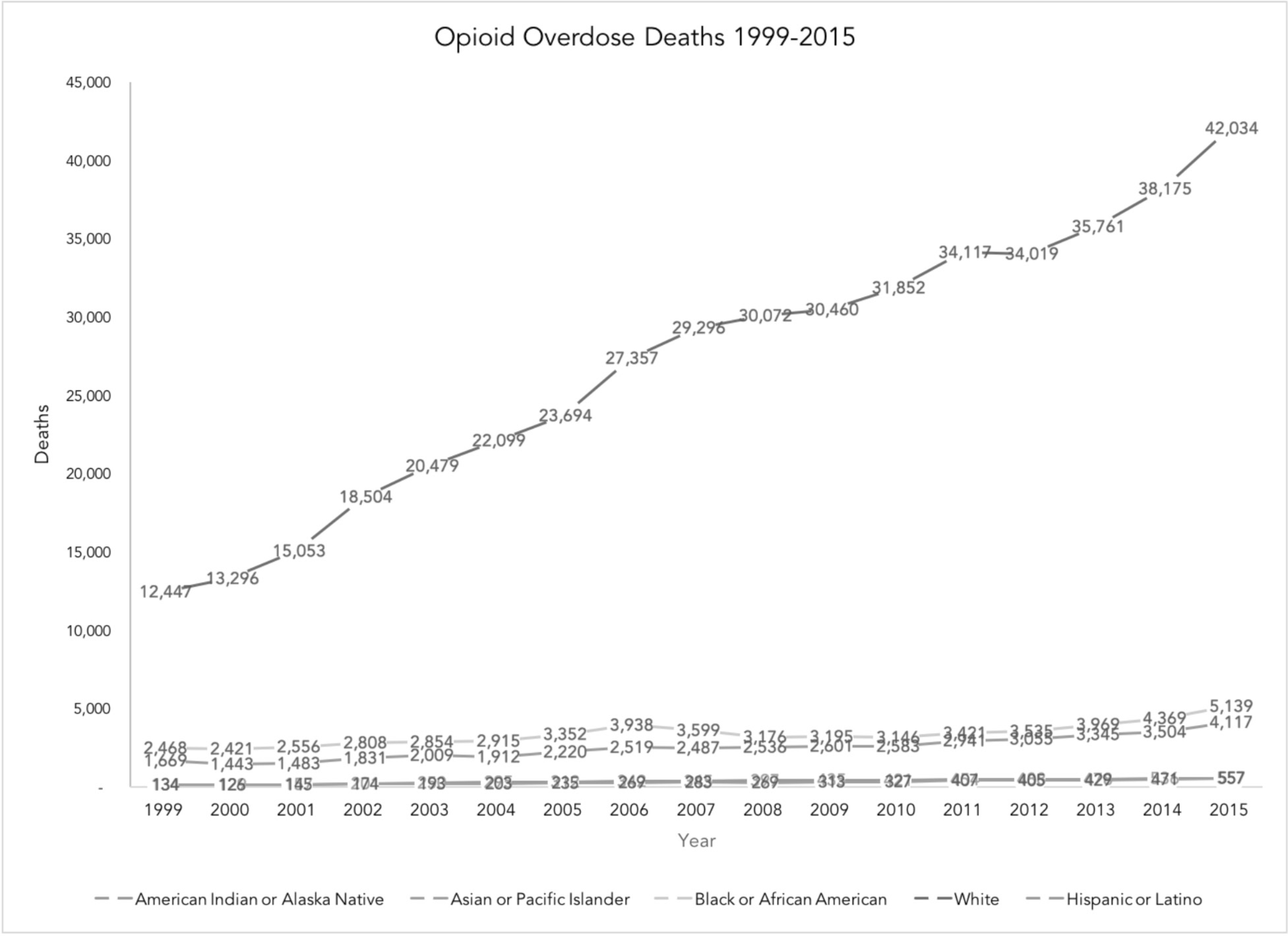
These racial disparities extend to rates of opioid use. In 2016, 4.6% of whites misused opioids, compared to 4% of Blacks.16 As of 2014, the rate of white American deaths (shown in dark grey in Figure 1) from opioid overdose was more than twice that of Black Americans (shown in light grey in Figure 1). Drug use overall is increasing at a faster pace among whites: since 2001, drug overdose deaths in the U.S. have increased 7% annually for white Americans (shown in dark grey in Figure 2), compared with an average 2% increase for Black Americans (shown in light grey in Figure 2). Significantly, however, the rate of increase in opioid deaths has been comparable across races for the last five years (Figure 1).Reference Childress17
Rates of opioid overdose deaths from 1999 to 2015. Over a sixteen-year time period, the rate of opioid overdose deaths increased by a factor of 3.3 among white Americans and by a factor of 1.7 among Black Americans.18

Deaths by opioid overdose from 1999 to 2015.

B. Jurisdictions in Which Black Opioid Usage Exceeds that of Whites
Despite the increase in opioid overdose deaths for Blacks, the narrative around the opioid epidemic has emphasized the high numbers of white casualties across the nation. Though the rates of opioid use disorder are indeed lower for Blacks than they are for whites in most states,19 several states show patterns of usage that are entirely different from national trends. In a recent paper, the Chicago Urban League calls attention to the fact that in five states — West Virginia, Wisconsin, Missouri, Illinois, and Minnesota — and the District of Columbia, rates of opioid overdose deaths among Black Americans exceed those of the general population, even though fewer Black people died overall than white people (Table 1).Reference Bechteler and Kane-Willis20
Jurisdictions with the Highest Rates of Opioid Overdose Deaths (per 100,000 Residents) Among Black Americans in 201521

In some cases, this state-level reversal of the national trend is explained at the city level. In Chicago, the number of fatal opioid overdoses has increased significantly over a relatively short period of time: from 2015 to 2016, opioid-related deaths increased nearly 75%.23 The overdose rate of Black Americans, however, was 56% higher than the overdose rate of whites. Given the perception of opioid use disorder as being a disproportionately white problem, it is noteable that Black people make up approximately 32% of the population in Chicago, but account for 48.4% of all opioid deaths.24 In Washington D.C., where 47.7% of the population is Black, both the rate and the total number of opioid-related deaths is higher in the Black population than in the white population. In 2016, 79% of all opioid-related deaths in the District were Black-Americans, 81% of whom were between the ages of 40 and 69.25
In Cuyahoga County, Ohio, which includes Cleveland and surrounding areas, the rate of overdose deaths in Black users is also increasing rapidly.Reference Scruggs26 This is, in part, due to the rise of fentanyl, a synthetic opioid now responsible for almost two-thirds of the county's overall deadly overdoses.27 Aside from fentanyl's general dangerousness — it's a drug 50 to 100 times more potent than heroin28 — county officials believe fentanyl has been so deadly for Black residents because drug dealers have been lacing their cocaine products with opioids.Reference Adams29 The Cuyahoga County medical examiner's 2016 report on overdose deaths found that the number of cocaine overdose deaths remained relatively steady for ten years until 2015, at which point cocaine overdose deaths and fentanyl overdose deaths increased dramatically and simultaneously.30 Given that Black Americans generally use cocaine more than heroin or other prescription opioids,31 the covert introduction of fentanyl into the cocaine supply likely contributed to this sharp rise in Black overdose deaths. In 2016, fentanyl and its analogues contributed to the deaths of 58 Black Cuyahoga residents, and to 399 total fatal overdoses in the county that year.32 There were 25 fentanyl-involved overdose deaths of Black residents in 2015, and only five in 2014, marking a nearly 900% increase over two years.
The rise of fentanyl may be playing an important role in the rapidly climbing overdose rates in minority communities across the nation.Reference Katz and Goodnough33 Similar to Cleveland's struggle with fentanyl-laced cocaine, heroin cut with fentanyl is suspected to be a primary driver of opioid-related deaths in the District of Columbia.34 In 2016, 64% of overdose deaths involved fentanyl or a fentanyl analog.35 Fentanyl-adulterated heroin is a key factor in the growing crisis in Chicago as well: fentanyl-related deaths represented nearly 58% of opioid deaths in 2016, more than three times fentanyl's share of deaths in 2015.36 The Chicago Urban League notes that the neighborhoods with the highest fentanyl overdose death rates are all racially concentrated areas of poverty on the South and West sides of Chicago, where the majority of the residents are Black.37
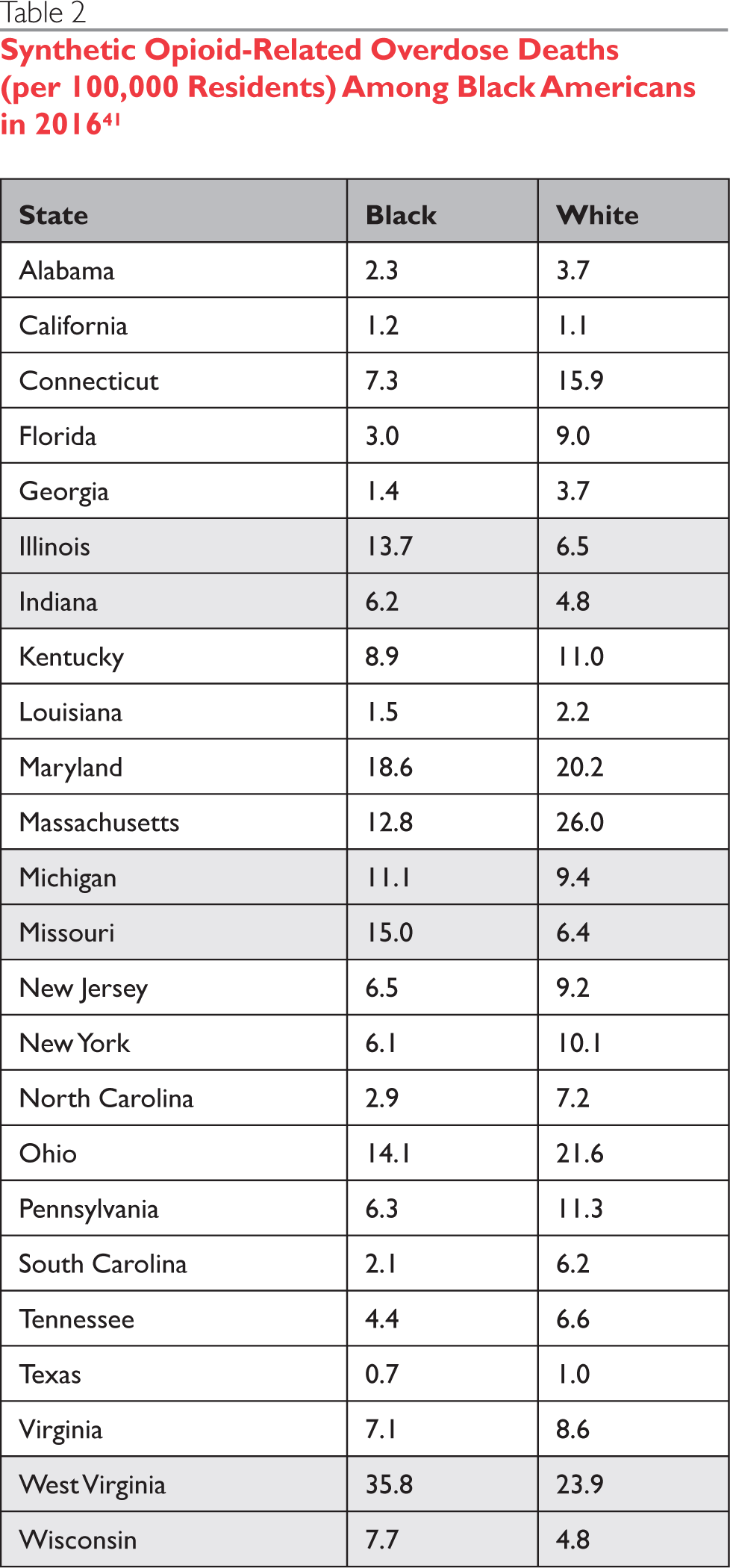
Though fentanyl is a significant contributor to overdose deaths in Black communities, it is difficult to determine whether Black Americans are disproportionately dying from fentanyl-adulterated drugs relative to whites. Nationally, the rate of overdose deaths related to synthetic opioids, including fentanyl, is higher for whites than it is for Blacks (Figure 3).38 This is not necessarily surprising, as any disparity in fentanyl-related overdoses would most likely be found at the state or local levels. However, of the 24 states for which synthetic opioid-related overdose data were not considered suppressed or unreliable,39 only six had higher rates of synthetic opioid overdose deaths for Blacks than for Whites (Table 2).
Deaths by synthetic opioid overdose from 1999 to 2016.40

Synthetic Opioid-Related Overdose Deaths (per 100,000 Residents) Among Black Americans in 201641

Rather than dying disproportionately from fentanyl relative to whites, it's more likely that Blacks are dying more frequently from fentanyl-laced cocaine, whereas whites are dying more often from fentanyl-laced heroin and other opioids diverted from prescriptions. However, this information is also not nationally available, and is instead collected at local levels.42 Given the recent surge in fentanyl-laced cocaine and heroin, any national trends in fentanyl-related deaths based on racial preferences for illicit substances will become more apparent in the future.
C. Accounting for Differences Between Blacks and Whites in Opioid Usage: Modes of Initiation
Some experts have hypothesized that minority patients have been perversely shielded from the worst of the opioid crisis because they lack access to prescription opioids.43 White Americans, on the other hand, presumably have more access to prescription opioids and therefore a greater chance of developing an opioid use disorder. The lack of access to prescription opioids that minority patients face is rooted in institutional and personally-mediated racist practicesReference Jones44: general bias against people of color in the medical system (institutional racism), the under-valuing of Black people's pain during evaluation (personally-mediated racism), and stereotypes that Black patients are more likely to sell or become addicted to painkillers result in discriminatory prescribing practices.Reference Hoffman45 Indeed, numerous studies have documented the systematic under-treatment of pain in some racial and ethnic minorities,Reference Green46 and one meta-analysis found that Black Americans were 29% less likely than their white counterparts to be prescribed opioids.Reference Meghani47 However, this does not account entirely for the differences seen in rates of opioid use between races: other contributors, such as drug price, drug preference, and cultural norms, likely influence modes of drug initiation.
While the reality of discriminatory prescribing practices is certainly not to be dismissed, it is a dangerous oversimplification. Framing racial stereotyping as having a “protective effect” on Black people is problematic: to focus just on the lesser frequency of opioid prescriptions is to run the risk of minimizing the problem of opioid use and abuse among Black people. Moreover, several studies have shown that Black Americans are not insulated from the crisis because of the under-prescription of opioids. The frequency of overdose deaths from fentanyl-laced drugs, as well as the fact that Blacks are more likely to initiate use with non-prescription opioids, especially evidence this.
In fact, many people — regardless of race — do not develop an opioid use disorder starting with prescription drug use at all, despite media coverage and analysis that suggests otherwise. Illicit opioids, particularly heroin and synthetic non-methadone opioids, have been and are increasingly used to initiate drug use.48 Heroin is now a more common initiating opioid of abuse than each of the most popular prescription opioid analgesics.49 In 2005, only 8.7% of opioid initiators started with heroin, but this sharply increased to 33.3% in 2015, with no evidence suggesting future stabilization.50 In contrast, the most commonly prescribed opioids, oxycodone and hydro-codone, dropped from 42.4% and 42.3% of opioid initiators respectively, to 24.1% and 27.8% in 2015. Since 2010, overdose deaths involving predominantly illicit opioids (heroin, synthetic non-methadone opioids, or both) have increased by more than 200%.Reference Dowell51 Black people have always been more likely to initiate opioid use through heroin (and cocaine) than prescription opioids. Nonetheless, a demographic shift has occurred over the past fifty years, such that over 90% of heroin users are now white.Reference Cicero52 This is probably, at least in part, because heroin has become more accessible and far less expensive than prescription opioids.Reference Mars53
III. The Criminalization of Black Substance Use Disorders: Comparing the Opioid Epidemic to Drug Epidemics of the Past
Now that whites are using opioids at much higher rates than Blacks, more emphasis is placed on the disease model of substance use disorders, whereby people who misuse opioids deserve medical treatment. This differs greatly from the historical approach to a heroin use disorder, when opioid use — predominantly by Black Americans — was heavily criminalized. Despite the new approach, however, the legacy of this differential treatment remains: Blacks are still more likely to be arrested as a result of their opioid use and are disproportionately criminally sanctioned.54 For example, 80% of those who are convicted for heroin trafficking are either Black or Latino, even though whites use opioids at higher rates than other groups and tend to buy drugs from individuals within their racial group.55
Even outside of opioid use, Black people are criminalized more often for drug use than their white counterparts, at every stage of the criminal justice system. Blacks represent 12% of drug users, but 38% of those arrested for drug offenses, and 59% of those in state prison for drug offenses.56 Drug enforcement occurs disproportionately in Black communities,57 and Black people are incarcerated on drug charges at a rate 10 times greater than whites.Reference Bigg58 Beyond incarceration rates, there are clear racial disparities in sentencing and plea-bargaining, and in certain policies such as mandatory minimums and “three-strikes” laws which disproportionately affect people of color.59 Given these disparities, it's productive to ask why Black people are more likely to end up in the criminal justice system for opioid use, while white people are identified more often for treatment. This disparity is largely the effect of two past drug epidemics, the responses to which were both shaped by racism: the heroin epidemic of the late 1960s and 1970s, and the crack-cocaine epidemic of the 1980s and 1990s.
A. The Heroin Epidemic of the 1960s and 1970s
In response to the heroin epidemic that began in the 1960s, in 1973 New York passed legislation mandating extremely severe prison terms for possession or sale of relatively small amounts of drugs.Reference Tsimbinos60 The Rockefeller Laws, as they became known, called for mandatory life sentences for selling or conspiring to sell any quantity of hard drugs; the elimination of plea-bargaining and suspended sentences; and the elimination of treatment under “youthful offender” laws for those between the ages of sixteen and nineteen.Reference Underwood and Daniels61 The laws also called for mandatory life sentences for those found to have committed serious crimes after taking drugs and mandatory life sentences for those possessing or conspiring to possess more than an ounce of heroin, cocaine, opium, or morphine.62 An accompanying law, known as the “Second Felony Offender Law,” required long prison terms for individuals who committed a second felony within ten years of a prior felony conviction.63
Governor Nelson Rockefeller advocated for these laws in order to battle what he called a “reign of terror” that developed in the wake of increasing drug usage.64 Rockefeller described it as the “toughest anti-drug program in the country” and urged the police and the judicial system to enforce the law.Reference Connery and Benjamin65 Although intended to target “kingpins,” most people incarcerated under the laws were convicted of low-level, non-violent, first-time offenses, and the laws adversely and disproportionately affected Black people with a heroin use disorder.Reference Drucker66 The effects have been lasting: in 2001, Blacks and Hispanics accounted for 94% of those in prison for drug offenses while whites made up only 5.3% of those incarcerated for drug crimes in New York.Reference Nakdai67 Despite the $76 million the state spent on enforcing the Rockefeller laws, heroin use and crimes related to heroin were as widespread in the late 1970s as they were before the laws went into effect.Reference Maggio68
B. The Crack-Cocaine Epidemic of the 1980s and 1990s
The inefficacy of the Rockefeller laws seemed ultimately irrelevant, as they set the standard for most of the punitive drug legislation enacted over the last forty years and contributed fundamentally to the War on Drugs. The harsh drug laws of the 1980s are infamous for their establishment of mandatory sentences and high penalties for drug convictions. One of the most infamous drug laws is the Anti-Drug Abuse Act of 1986, which set penalties that were 100 times harsher for crack (the cocaine formulation more commonly used among Black Americans) than they were for powder cocaine (more commonly used among whites) convictions.69 Lawmakers justified this disparity by reference to claims that crack cocaine was more addictive and caused more violence in its users.Reference Hart70 In reality, crack is pharmacologically almost identical to powder cocaine;71 the purported reasons for the differential treatment of crack cocaine and powder cocaine offenses were actually pretext for creation of sentencing regimes that would target poor, Black communities.Reference Baum72 We now know that an astonishing 85% of those sentenced for crack cocaine offenses were Black, even though the majority of users of the drug were, and are, white.Reference Hart73 Law enforcement resources were concentrated in communities of color, executing policies like “stop and frisk” and resulting in increased arrests of Black people.74 At the peak of the crack epidemic in Los Angeles, for instance, not a single white person was arrested on federal crack cocaine charges in a city of nearly 4 million people — even though whites in the city used and sold crack.75
Media and political discourse during the 1980s reinforced the criminalization of drug use by connecting crack and its associated problems with Black people.76 The rhetoric was coded, but only thinly veiled: problems related to crack were described as being prevalent in “poor,” “urban” or “troubled” neighborhoods, “inner cities” and “ghettos.” Negative coverage of Black people with substance use disorders was rampant: a 1987 New York Times article entitled “New Violence Seen in Users of Cocaine” described increasing incidents of violent, erratic and paranoid behavior among heavy cocaine users, particularly in cities like Harlem.Reference Kerr77 It referred to “crack houses,” and falsely stated that “cocaine psychosis” was more likely to develop in users of crack than users of powder cocaine.Reference Vaughn78 A 1995 photo story by award-winning documentary photographer Eugene Richards, entitled “Cocaine True, Cocaine Blue,” depicted images alleged to represent life in communities where cocaine addiction was prevalent. The story featured a photo of a Black man proudly brandishing two guns for the camera, next to a photo of a brown man injecting himself with drugs in a dingy apartment, along with photos of brown men handcuffed in the rear seat of a police car, next to a photo of a Black woman exchanging sex for drugs, despite the presence of her child in the room.Reference Richards79 Michel Du Cille's 1988 Pulitzer Prize winning photo series documenting cocaine (crack) use disorder in Miami featured similarly distressing images, highlighting Black and brown men and women in varying states of deterioration, drug use, and imprisonment.Reference du Cille80 Neither Richards' nor Du Cille's photo stories depicted white cocaine use in such a negative light. In fact, they hardly included any white subjects at all.
The “militarized policing” and heavy criminalization of drug use in the 1980s and ‘90s contributed substantially to Black people's ongoing disproportionate involvement in the criminal justice system. As of 2010, 40% of those incarcerated in U.S. prisons were classified as Black, while Black people make up just 13% of the national population. In 2015, 38% of adults on parole and 30% of adults on probation were Black.
These overwhelmingly skewed media portrayals were successful in their campaigns to link Black people to drug use: one 1995 study found that 95% of those asked to picture a drug user envisioned a Black person.Reference Burston81 As Cardozo law professor Ekow Yankah stated:
“African-Americans were cast as pathological. Their plight was evidence of collective moral failure, of welfare mothers and rock-slinging thugs and a reason to cut off all help. Blacks would just have to pull themselves out of the crack epidemic. Until then, the only answer lay in cordoning off the wreckage with militarized policing.”82
There was no talk of medical treatment, or of seeing addiction as a disease; in stark contrast with today's approach.
C. Black Americans' Ongoing Involvement in the Criminal Justice System
The “militarized policing” and heavy criminalization of drug use in the 1980s and ‘90s contributed substantially to Black people's ongoing disproportionate involvement in the criminal justice system. As of 2010, 40% of those incarcerated in U.S. prisons were classified as Black, while Black people make up just 13% of the national population.83 In 2015, 38% of adults on parole and 30% of adults on probation were Black.84
Black Americans' involvement in the criminal justice system is disproportionately drug-related compared to their white counterparts. In the federal prison system, where the majority of drug offenders are held, Black Americans make up 38% of the prison population and 39% of the drug offender population.85 Whites, on the other hand, make up 58% of the prison population but account for just 22% of drug offenders.86 The racial disparities are especially glaring once drug type is considered: more than 53% of drug offenders in the federal prison system were convicted for cocaine (powder or crack) offenses, and Blacks represented 88% of crack cocaine offenders.87 Further, despite the fact that white people are more likely to use heroin than are Black people, 39% of heroin offenders in the federal prison system in 2015 were Black, and only 13% were white.Reference Werle and Zedillo88
IV. Framing the Opioid Epidemic as a Public Health Crisis
The overrepresentation of Blacks in the criminal justice system for cocaine and opioid offenses is a clear reminder of America's history of responding to large-scale drug use — especially when perpetrated by Blacks — with criminalization. It is therefore difficult to dispute the claim that the current opioid epidemic has been framed as a public health crisis and national emergency largely because its primary victims are not Black.Reference Gostin89 There is strong historical precedent for concluding that the different approach is due in no small part to race; the concept of reframing the problem of drug use as a medical epidemic, instead of a crime epidemic, when primary usage shifts from non-white to white users is not novel.Reference Cohen90
Perhaps the clearest historical examples are the cyclical “epidemics” of marijuana-smoking by white middle-class youth between the 1950s and the 1980s. During the 1950s, political culture demanded severe penalties for “urban pushers” and “foreign traffickers” of marijuana; but the same groups made repeal of felony possession laws a bipartisan imperative in the late 1960s when marijuana use by white youth on college campuses and in affluent suburbs increased dramatically.Reference Lassiter91 A decade later, after the Rockefeller Drug Laws instituted harsh mandatory minimums, parents of white suburban youth banded together to create policy changes that exempted marijuana from the laws.92 In fact, the marijuana decriminalization movement of the 1970s explicitly revolved around the view that white middle-class Americans should not have their futures ruined by policies designed to protect them from international trafficking and urban drug markets.93 In the 1980s, the “Just Say No” campaign further promoted the racial dichotomy by helping institutionalize public health campaigns in white middle-class neighborhoods, but militarized interdiction in urban minority areas.94
This practice of employing a public health strategy for white middle-class groups, but a crime-control agenda in urban minority neighborhoods is deeply entrenched in American political culture. Consequently, the public health approach of seeing an opioid use disorder as a medical problem has now been embraced in nearly every public forum and institution, largely due to the representation of white people with opioid use disorders in the media, social and political conversation, and in a robust government response.
A. The Role of Media
In stark contrast to the portrayal of Black Americans with opioid use disorders in the past, media coverage surrounding the current opioid epidemic has helped frame opioid use as a public health problem, rather than a moral problem or “disease of the poor.” Headlines over the past decade, while expressing an almost morbid fascination with the apparent novelty of the white middle-class drug user, simultaneously emphasize the sympathy with which the crisis should be approached. In the New York Times: “In Heroin Crisis, White Families Seek Gentler War on Drugs.”Reference Seelye95 In Time magazine: a photo story entitled “A caring lens on the opioid crisis.”Reference Stockbridge and Rothman96 In the New Yorker: “The Addicts Next Door.”Reference Talbot97 The language in news stories themselves is just as illuminating: the crisis is characterized as a threat from outside, with drug users facing an “illness” or a “disease” rather than a moral shortcoming.Reference Shaw98 The usage of health and medical terminology is increasingly nuanced, and highlights the absence of such terms in previous crises. Contrast, for instance, the references to children with Neonatal Abstinence Syndrome as “opiate-dependent babies” with the mythical and pejorative “crack babies” of the 1980s and ‘90s.Reference Holloway99
Essential to the media's characterization of the opioid epidemic as a public health crisis is the focus on white users. Even when race is not explicitly mentioned, headlines frequently imply that noteworthy users are white. Fox News has described “The New Face of Drug Addiction.”Reference Lee100 NBC News announced that “Painkiller Use Breeds New Face of Heroin Addiction.”Reference Schwartz101 ABC News touted “Heroin in Suburbia: the New Face of Addiction.”Reference Michels102 By contrast, drug use in Black communities is not considered newsworthy: few accounts exist of prescription drug use or the emerging heroin problem in urban, non-white communities.Reference Netherland and Hansen103 When those accounts do exist, the stories are extremely short, and omit the consideration, details, and exposition accompanying profiles of white drug users.104 Much of the “urban” coverage still looks the way it did during the 1980s and 1990s, with a focus on Black people in the midst of using, or in dirty public spaces, or interacting with police.105
When an epidemic is coded as a middle-class white, largely suburban problem, different representational strategies and interventions are invoked. Individual white drug users are portrayed as largely blameless victims of their own biology, and deserving of help, such as treatment and prevention of overdose or infection.106 Their stories are depicted as particularly tragic because they are seen to have wasted their tremendous potential — more was hoped of them and for them.107 The news often explores the etiology of a person's drug use, providing the background and context necessary for drawing parallels among white users. Noting that an opioid use disorder often develops among white users in a limited number of ways — young people start using the prescription medications of their parents or grandparents, a person “falls in with a bad crowd,” or a person is prescribed painkillers and subsequently becomes dependent on them — allows for the generalization that external forces are at play.108 Through this lens, remarkably different from that of the past, a substance use disorder is no single individual's fault, but rather a disease process that warrants a public health response.
B. Social and Political Discourse
The media's framing of the epidemic as a public health crisis is reflective of a shift in public sentiment about how people with substance use disorders should be treated. The majority of Americans (67%) believe that the government should focus more on providing treatment for those who use illegal drugs, such as heroin and cocaine, while only 26% think the government's focus should be on prosecuting users of such hard drugs.109 This emphasis on treatment corresponds to an ongoing increase in the number of people who view the opioid epidemic as a public health problem: in 2017, 76% of the public said that prescription drug abuse is an extremely or very serious public health problem in America, compared to 63% who said the same in 2013.Reference Oliphant110 Just 22% regarded prescription drug abuse as a somewhat serious or less serious problem in 2017, down from 34% in 2013.111
Because this crisis has affected so many white, middle-class Americans, the public's concern has been reflected in political discourse, as well. Most politicians have publicly acknowledged that an opioid use disorder is the basis of a crisis, worthy of sympathy, rather than a moral failure deserving punishment or incarceration. During the 2016 presidential race, for example, most of the candidates addressed the issue on numerous occasions. Several even told personal anecdotes of how an experience with a close friend or family member drove them to understand substance use disorders and the opioid crisis in a much more compassionate way, or cited similar stories told to them by constituents.Reference Lopez112
This increased visibility provides those who suffer from an opioid use disorder more political clout than those who had opioid use disorders during previous epidemics, and importantly, gives white opioid users more political influence than Black users. Since the majority of people with opioid use disorders are white and middle class, their family members are more likely to advocate on their behalves, are more likely to engage directly with their representatives, and have been instrumental in changing the political conversation from one of legal sanctions to one of medical treatment.113 As a result, lawmakers tend to support more compassionate drug policies than they did during the heroin epidemic of the 1970s or the crack cocaine epidemic of the 1980s and 1990s. Instead of placing people with substance use disorders behind bars, law-makers fund treatment centers, promote counseling for substance use disorders, and work to provide safe places for people with opioid use disorders to receive drugs under medical supervision.114
C. Governmental Action
In accordance with the social and political framing of the opioid epidemic as a great public health concern, the President of the United States also declared the opioid epidemic a public health emergency in October of 2017. This declaration followed an August 2017 report by the President's bipartisan Commission on Combating Drug Addiction and the Opioid Crisis that urged the President to declare a national emergency.115 The Commission's final report, released in November 2017, offered detailed recommendations that address a wide range of problems that contribute to the epidemic, and suggested actions to be taken by federal health and law enforcement agencies and health research programs.116 A top proposal would create a nationwide multimedia public education campaign stressing the dangers of substance use disorders, although multiple agencies have shown that Drug Abuse Resistance Education is not effective in preventing drug use or abuse.117 Another proposal would establish “drug courts” in every one of the 93 federal court districts, and each would offer medication-assisted treatment and recovery services.118 Additionally, every U.S. law enforcement officer would be provided naloxone, a medication that quickly reverses an opioid overdose (although the commission did not address its skyrocketing cost).119
D. The Need for Specialized Treatment in Black Communities
Unfortunately, even in this response to the current opioid crisis, Black people remain marginalized. For instance, in the Commission's 138-page report, less than a page was dedicated to a discussion of the epidemic's effects in communities of color, despite evidence that the lack of access to substance abuse treatment is more pronounced in minority communities than it is in the general population.Reference Daley120 Instead, mention of race was entirely subsumed in a section labeled “Special Populations,” which acknowledged that “although many of the recommendations included in this report are generic for the population as a whole, subpopulations exist within our nation that conceivably require increased outreach, access to services, and more tailored or intensive services.”121 The report, however, didn't mention any specific types of outreach or services that would be beneficial to these subpopulations. Instead, it simply noted that the majority of people of color with opioid use disorders fall in the lowest income bracket, reside in large metropolitan areas, and are more likely to use public insurance programs instead of private.122
While accessing treatment for opioid use disorders is generally difficult for everyone, regardless of race — only one in ten people with a substance use disorder nationwide are able to get the treatment they need,123 and only 13% of individuals in need of treatment for substance use disorders receive any specialty services124 — several studies have indicated that the shortage of treatment is even more pronounced in Black communities. Among those with perceived need, Blacks are more than twice as likely as whites to have no access to treatment for alcohol use disorders, for other forms of substance use disorders, or to general mental health care services.Reference Wells125 The criminal justice system is perhaps the only setting in which Blacks are actually more likely than whites to receive specialty substance use treatment when in need of it,Reference Lipari and Hager126 as Blacks are more frequently referred to mandatory substance abuse treatment.Reference Cook and Alegría127
Outside of the criminal justice system, however, Blacks experience several barriers to substance use treatment. Difficulties in geographic access to treatment, compounded with lower rates of insurance and higher utilization of public health insurance relative to whites, may partially explain lower rates of treatment for Blacks who are not referred by the criminal justice system. In 2015, 44.1% of Blacks relied on Medicaid in comparison to 35.3% of whites, but only 60% of U.S. counties have one or more outpatient substance use disorder treatment facilities that accept Medicaid.Reference Barnett and Vornovitsky128 Counties with higher percentages of Black, rural, and/or uninsured residents are less likely to have even one of these facilities.129 These lack of resources in rural, low-income, and predominantly nonwhite areas is consistent with findings that state policies adopted to fight the opioid crisis, such as mandatory prescription drug monitoring programs (PDMPs), are not effective in counties that are below the national median in terms of average wage and proportion of white population.Reference Ayres and Jalal130 Black people's access to certain treatments for opioids, such as Suboxone, a relatively new medication shown to decrease opioid use with fewer stigmas than methadone,Reference Netherland and Hansen131 is further limited by the fact that public health insurance is not accepted by many private substance abuse treatment programs. In 2015, 11.1% of Blacks were uninsured compared to 6.7% of whites.132 Insufficient access to substance use disorder treatment facilities for Blacks is unfortunately unsurprising, considering inequity in access to other elements of the healthcare infrastructure — including physicians, hospitals, trauma centers, and specialty mental health facilities.Reference Cummings133
Given the increasing rate of Black opioid use and overdose deaths, and that Blacks are less likely than whites to be identified for substance use treatment, but more likely to be criminalized for their substance use, it's clear that Blacks are being underserved in the current crisis.
In addition to having less financial access to conventional substance use treatment, Blacks are less likely to seek help, due to historical mistreatment by and consequent mistrust of the medical community and healthcare system.Reference Cooper134 Research has shown that Blacks, who are often in ethnic-discordant relationships with health professionals, rate the quality of interpersonal care by physicians and the health care system more negatively than whites.Reference Sorkin, Ngo-Metzger and De Alba135 Stigma related to mental illness and mental health treatment also prevents many Blacks from seeking treatment. In a 2008 study of Black mental health consumers, 76% said that stigma played some role in initially preventing them from seeking voluntary mental health treatment, either by keeping them from recognizing they had problems requiring professional help, or as a deterrent from seeking services when they realized they did have a problem.Reference Alvidrez, Snowden and Kaiser136 62% expressed fear of social judgment, and 21% expressed fear of social rejection or discrimination; and often, upon entering treatment, they found that at least one of these fears was justified.137
V. Rectifying the Under-treatment of Blacks With Opioid Use Disorders
Given the increasing rate of Black opioid use and overdose deaths, and that Blacks are less likely than whites to be identified for substance use treatment, but more likely to be criminalized for their substance use, it's clear that Blacks are being underserved in the current crisis. Coupled with the fact that Blacks encounter substantial barriers in accessing substance use treatment and healthcare more generally, it's crucial that specific, targeted and evidence-basedinterventions, such as the use of racial impact assessments, are provided for Black communities to alleviate the impact of the opioid epidemic. There have been few targeted interventions for minority racial communities thus far. However, given the importance of culturally relevant treatment options, the Substance Abuse and Mental Health Services Administration (SAMHSA) has been a leader in developing such services for Black people with opioid use disorders.
A. SAMHSA and Faith-Based Community Initiatives
SAMHSA has developed a task force to determine how best to engage the Black population in treatment. As part of this initiative, SAMHSA provides grants specifically for “faith-based community initiatives” (FBCIs), programs in which medical professionals work with faith-based organizations to deliver substance use prevention, treatment for substance use disorders, and mental health services to underserved communities and culturally diverse populations.138 Given the importance of religious institutions within the Black community, where churches have traditionally served as an anchor of culture, social support, and mutual assistance,Reference Molock139 FBCIs that are specially designed for Black Americans are ideal vehicles through which to provide culturally sensitive treatment for opioid use disorder.
The significance of religion and spirituality in substance use patterns and treatment outcomes is well documented in the general population — research suggests that spiritual or religious involvement is associated with decreased risk of drug use, and more effective recovery from substance use disorders.Reference Walton-Moss, Ray and Woodruff140 Faith-based treatments created specifically for Black people with substance use disorder appear promising as well. In a study of cocaine-dependent Black women in residential treatment, women that were provided with culturally-relevant group activities and individual mentoring from Black church volunteers were 55% more likely to remain in the residential treatment program than their counterparts who received no special treatment.Reference Stahler141 In another study of heroin-dependent individuals receiving narcotic replacement therapy, individuals with consistently high or increasing religiosity and spirituality scores self-reported significantly fewer days of heroin use than those with scores that were consistently low or decreased over the course of treatment.Reference Conner142
FBCIs are well-positioned to help deliver substance use treatment. In addition to providing social and psychological support for substance use recovery, many churches and faith-based organizations have already launched their own syringe exchange programs.Reference Sisk143 It is important to note, however, that though FBCIs can be important sources of substance use treatment programs for Black communities, there will likely be differences in program effectiveness even within this racial group. Although Black Americans have higher levels of public and private religiousness than whites,Reference Taylor144 the importance of religion varies among regional groups within the Black population. Black Americans in the South exhibit higher rates of participation in organized and non-organized religious activities compared to Blacks in other regions of the U.S.,Reference Chatters, Taylor and Lincoln145 and Blacks in rural settings tend to be more involved in organized religious activities and attend church services more frequently than Blacks in urban areas.Reference Levin, Taylor and Chatters146
B. Other Culturally Sensitive Interventions
Beyond recognition of the importance of the role of religion and spirituality in many Black communities, other considerations need to be more comprehensively integrated into the development and evaluation of empirically supported treatments. For instance, specific interventions are required to counterbalance the effects of racial and ethnic inequalities on drug policy and to encourage Black people to seek treatment. These inequalities are embedded in American popular and political cultures, as well as in medicine, and are reliably and imperceptibly reproduced in institutional practices unless they are actively addressed.147 Racial or ethnic impact assessments are one way to anticipate the effects of health policies and clinical practices on racial and ethnic minorities.Reference Fiscella and Sanders148 Such statements require policymakers to conduct a formal assessment of how a specific policy proposal is likely to ameliorate or exacerbate racial disparities, particularly in the criminal justice system. Importantly, they're meant to avoid policies that purport to be colorblind or race-neutral but, in fact, result in differential treatment. A few states, including Iowa and Connecticut, have already implemented racial impact assessments; others, such as New York, have proposed them.Reference London149
Consideration of Black people's interaction with the criminal justice system, especially related to substance use, is crucial when designing treatment options. Explicitly framing treatment of a substance use disorder as a health problem, rather than a racially bifurcated law enforcement issue, signals to Black people that clinicians and health advocates are aware of the disproportionate legal repercussions that people of color face, and will take this into consideration when helping them. One organization based in New York City, called “Punishment to Public Health,” is a collaboration of clinical practitioners, public health researchers, and disenchanted criminal justice officials that lobby against incarceration for illicit drug possession and advocate for diversion of arrestees into mental health and substance use treatment services.150 The organization has made alliances with the New York Police Department to provide mental health assessments and diversion from courts for arrestees, and has worked with a range of non-governmental organizations to develop community reintegration and recidivism prevention programs for released inmates. They've also worked with the New York Police Department to conduct community participatory research documenting the racially discriminatory impact of neighborhood-based, racially stratified stop and frisk police practices, and to implement educational advancement programs for low income youth with a criminal justice history. The community-based interventions of From Punishment to Public Health and their NGO partners have helped to redress the effects of unequal drug law enforcement, and their direct testimony to policy makers has supported reform of drug laws themselves as a central to racial justice, civil rights, and health itself.151
VI. Conclusion
Opioid use disorder is more widespread ethnically and geographically than many Americans realize and is becoming even more so over time. While most of the national and local media attention has focused on the increase in overdose deaths among suburban, white, middle-class users, the epidemic is increasingly affecting more Black people, for whom overdose death rates have more than doubled.152 The issue is not that white people aren't affect by the crisis — they are, and in record numbers — but rather that Black Americans, often left out of the greater discussion, have been and continue to be adversely affected by the same epidemic. In some states Black Americans are dying at rates exceeding any other racial group, but are unfortunately excluded from the conversation.153
The recent shift to the framing of drugs more broadly and the opioid crisis in particular, as a public health problem highlights the blatant mistreatment of people of color during the “War on Drugs.” As Ekow Yankah puts it:
It is hard to describe the bittersweet sting that many African Americans feel witnessing this national embrace of addicts. It is heartening to see the eclipse of the generations-long failed war on drugs. But Black Americans are also knowingly weary and embittered by the absence of such enlightened thinking when those in our own families were similarly wounded. When the face of addiction had dark skin, this nation's police did not see sons and daughters, sister and brothers. They saw “brothas,” young thugs to be locked up, rather than “people with a purpose in life.”
The heroin epidemic shows that how we respond to the crimes accompanying addiction depends on how much we care about the victims of crime and those in the grip of addiction. White heroin addicts get overdose treatment, rehabilitation and reincorporation, a system that will be there for them again and again and again. Black drug users got jail cells and “Just Say No.”154
Despite the shift to a public health framework, not enough has changed for Black people, in terms of treatment. Poor treatment disproportionately burdens Black people. Solely dedicating additional resources to treatment is insufficient: treatment solutions must be tailored to target communities of color. If racial exclusions are not explicitly acknowledged, they run the risk of being reproduced in all areas where opioids play a role, and people of color will continue to suffer in an epidemic that excludes their experiences.
Acknowledgements
The authors thank Ian Ayres, Abbe Gluck, and Kate Stith at Yale Law School for helpful comments.