


1. Introduction
This paper analyzes the fair division of a common property resource when agents also possess private resources (such as money), which they can use for compensatory payments. A pertinent example is the problem of climate change, where the environment's limited absorptive capacity for greenhouse gases (GHG) can be considered as a common resource that has to be divided across countries. By searching for a ‘fair’ way of doing so, I am taking up Article 3 of the Framework Convention on Climate Change, which mentions equity as one of its general principles on which to base climate protection strategies.Footnote 1 The analysis is based on normative equity axioms, but I also discuss the ‘political acceptability’ of the proposed solution.
Much of the literature on burden sharing in the climate change regime has focused on the ‘fair initial allocation’ of property rights to greenhouse gas emissions. One prominent candidate is the equal per capita allocation of CO2 emission entitlements, but there is no shortage of alternative proposals (see Rose et al., Reference Rose, Stevens, Edmonds and Wise1998, for a survey). However, determining a fair initial allocation of emission entitlements is only a first step towards fair burden sharing. It is the final allocation of emissions and associated abatement costs that countries ultimately care about. The burden sharing literature usually assumes that emission entitlements are traded on competitive (or Walrasian) markets so that their initial allocation determines the final outcome – at least if one abstracts from uncertainties such as those concerning the development of economic and emissions growth rates and permit prices (Edmonds et al., Reference Edmonds, Wise and Barns1995). This neglects, however, that Walrasian markets allocate the gains from exchanging emission entitlements in a very specific way; a priori it is not clear why this way should be considered fair.
For example, competitive trading of equal per capita emission rights would lead to huge welfare transfers across countries. For some countries, these transfers might substantially exceed their emission abatement cost (e.g. Rose et al., Reference Rose, Stevens, Edmonds and Wise1998; Böhringer and Helm, Reference Böhringer and Helm2008). Hence they would actually gain from international efforts to reduce greenhouse gas emissions, while other countries face substantial cost. Not only is such an outcome unlikely to be accepted politically, but it may also be regarded as ‘unfair’.
Accordingly, in this paper I will focus on the fair division of the efficiency gains that arise from exchanging the initial allocation of emission entitlements. The initial allocation itself, and therefore also the global emission target, is taken as given and will be discussed only briefly in the section on the political feasibility of the proposed solution. The analysis is based on four axiomatic equity criteria, which have received wide support in the fair division literature.Footnote 2 The first, Pareto efficiency, requires that agents support each other at least if this does not reduce one's own utility. The second, individual rationality, says that if there are efficiency gains from reallocating entitlements to the common resource, then every agent should get a non-negative share of these gains. According to the third, the stand-alone upper bound, no agent should be better off than if she could consume the whole common resource on her own. Finally, with equal entitlements to the common resource, envy-freeness requires that each agent prefers her share of it to the share of any other agent.
Based on those criteria, I will argue that developing countries should participate in greenhouse gas abatement measures, but should be fully compensated for their incremental abatement costs. This is compatible with the idea of imposing ‘no harm’ on developing countries, which has been repeatedly mentioned as a central ingredient of any ‘acceptable’ treaty (Edmonds et al., Reference Edmonds, Wise and Barns1995; Bohm, Reference Bohm1997). Interestingly, the result appears to hold for many initial entitlement allocations that are currently under discussion. Accordingly, once exchanges of entitlements to greenhouse gas emissions are subjected to the above fair division criteria, the initial entitlement allocation itself turns out to be much less important than it is generally thought of.
The paper is organized as follows. Section 2 introduces the basic model and the first three fair division criteria. Section 3 discusses envy-freeness and adapts it to problems where monetary compensations can be used to facilitate the fair division of a common property resource. Section 4 proposes a specific solution for this kind of problem, which satisfies the stipulated fairness criteria. Implementation and political acceptability of this solution are discussed in section 5. Finally, section 6 concludes with some cautious remarks regarding the limitations of the suggested solution.
2. Model and fair division criteria
I consider the problem of fairly dividing a common property resource ω ∈ R L+ of L goods among a set of I ≡ {1, . . ., n} agents, with generic elements denoted alternatively i, j, or k. Each agent is entitled to a nonnegative share ωi ∈ R L+ of the common resource such that Σi∈Iωi = ω. Furthermore, agents are characterized by continuous and monotonic quasilinear utility functions, u i(x i, t i)=v i(x i)+t i, where x i ∈ R L+ is the final allocation of the common property resource and t i are transfer payments. Accordingly, I abstract from wealth effects. I assume free disposal of x i.
Thus, one can summarize a fair division problem by E ≡ ({u i}i∈I, {ωi}i∈I). A solution is a correspondence F that associates to every fair division problem a subset of feasible allocations

For the example of climate change, the problem is to find an allocation of GHG emissions, x i, and monetary transfers, t i, that constitutes a fair division of the global emission target ω, given entitlements ωi. Note that there are no externalities in the model, i.e. I completely abstract from damage effects. The reason is that climate change damages depend on overall emissions ω, which are given exogenously in this model, but not on their regional distribution. Nevertheless, countries are affected differently by climate change (Mendelsohn et al., Reference Mendelsohn, Dinar and Williams2006), which raises important equity concerns. Implicitly, I assume that the resulting question of fair compensations for climate change damages is dealt with separately from fairly dividing the costs of achieving a given global emission target. In further work, it would be good to relax this assumption and to investigate the fair division of mitigation and damage costs in a common framework.
In the following, I introduce three fair division criteria on which the proposal for the allocation of abatement costs will be based. The first one is Pareto efficiency. It says that if an agent could be made better off without making any other agent worse off, this should be done. Put differently, one should support others at least if this does not involve any sacrifices for oneself. Sometimes, Pareto efficiency has been termed the criterion of unanimity, which shows that it is not more than a lowest common denominator. Given the assumption that lump-sum transfers are feasible, Pareto efficiency is equivalent to maximizing the sum of utility across agents.
Definition 1.An allocation (x*i, t*i)i∈Iis Pareto-efficient for E if there exists no other feasible allocation (x i, t i)i∈Isuch that

The second fair division criterion is individual rationality (Steinhaus, Reference Steinhaus1948). It says that each agent should be guaranteed at least the utility from consuming her entitlement ωi to the common resource. If there are overall gains from a reallocation of the initial shares, it follows that everyone should benefit from such a reallocation. Accordingly, individual rationality implies a minimum degree of solidarity in sharing the gains from cooperation. Thereby, it puts a lower bound on each agent's utility.
Definition 2.An allocation (x i, t i)i∈Iis individual rational for E if

The third fair division criterion is the stand-alone upper bound. It says that no agent shall be better off from the fair division of a common resource than if she could consume the whole common resource on her own (Moulin, Reference Moulin1991, Reference Moulin1992).
Definition 3.An allocation (x i, t i)i∈Isatisfies the stand-alone upper bound for E if

This criterion may easily be violated by Walrasian markets. For example, suppose that the common resource were divided such that each country received equal per capita tradable emission rights. Then, countries with low emissions could yield substantial welfare gains from selling emission rights to countries with high emissions (see Böhringer and Helm, Reference Böhringer and Helm2008, for empirical estimates).
In the context of private goods, such gains are rarely objected to. However, here we are concerned with the fair division of a resource that is the common property of several agents. It has been widely argued that common ownership implies a duty to share the benefits of the resources with the co-owners. In particular, Moulin (Reference Moulin1992: 1333) wrote that ‘fair division conveys the idea of no subsidization: the presence of other agents who are willing to pay higher monetary transfers than me for consuming the resources should not turn to my advantage’.
This idea can be traced back at least to John Locke (1632–1704). Locke argued that the maximum utility one may obtain from a common resource should be that arising from the own usage of the resource, but not from selling shares of it. Starting from the idea that nature in its original state is common property that was given equally by God to all men to be worked and appropriated by them, he writes:
‘God has given us all things richly’, is the voice of reason confirmed by inspiration. But how far has he given it to us? To enjoy. As much as any one can make use of to any advantage of life before it spoils, so much he may by his labour fix a property in; whatever is beyond this is more than his share, and belongs to others. (Locke, Reference Locke1963)
Accordingly, also the stand-alone criterion expresses a minimum degree of solidarity. Thereby, it establishes an upper bound on each agent's utility.
These three criteria impose only minimum requirements on the fair division of a common property resource. Hence, one cannot expect that they determine a unique solution. Nevertheless, they do so for one particular group of agents, namely those that are entitled to a larger share ωi than they actually need for themselves. For climate change, these are countries that receive emission entitlements in excess of their emissions in the ‘business-as-usual’ scenario, i.e. without any abatement measures. For many entitlement rules that are currently under discussion, this group would basically comprise the developing countries.
In particular, let there be agents who are satiated in the usage of the common resource at their entitlement level, i.e. for which the marginal utility of any x iωi is zero.Footnote 3 As ω ≥ ωi, this implies v i(ωi) = v i(ω). Hence, the lower bound of individual rationality coincides with the stand-alone upper bound. Accordingly, compensations for this group of agents should be such that their utility at an efficient allocation of the common resource equals their stand-alone utility.
Proposition 1.Let F be a solution to the fair division problem E that satisfies Pareto efficiency, individual rationality, and the stand-alone upper bound. Then, all agents who are satiated in the usage of the common resource at their entitlement level receive an allocation (x*i, t i), where t i = v i(ω) − v i(x*i) and superscripts * denote Pareto-efficient levels.
For climate change it roughly follows that developing countries should participate in emission abatement (by efficiency), but should be fully compensated for their incremental abatement cost (by the individual rationality and stand-alone criteria). In a dynamic framework, economic growth in developing countries would raise the level of emissions at which they are satiated. Accordingly, their stand-alone utility v i(ω) would rise, leading to a higher allocation of emissions x*i and/or higher compensation payments t i for abatement costs.
It remains to determine an allocation for the other agents. The criterion of envy-freeness, which is discussed in the following section, will offer further guidance on this question.
3. Envy-freeness and monetary compensations
Let agents have equal entitlements to a common resource. An allocation of that resource is called envy-free if no agent prefers another agent's allocation to her own, i.e. if u i(x i) ≥ u i(x j) for all pairs of agents i, j ∈ I (Foley, Reference Foley1967; Varian, Reference Varian1974; Schmeidler and Vind, Reference Schmeidler and Vind1972). Note that the assumption of equal entitlements is crucial. For example, suppose that the wife of a deceased husband receives a share of the inheritance that is unambiguously more valuable than the share of a remote relative. Then the above specification of envy-freeness is not applicable because the two are unequally entitled to the inheritance.
The criterion of envy-freeness has been widely used by economists, and Arnsperger (Reference Arnsperger1994: 155) even states that it ‘has become the first and foremost “distributive companion” to the aggregative requirement of Pareto efficiency in the literature on normative economics’. Nevertheless, it has rarely been formulated for the specific case of exchange economies in which agents are characterized by quasilinear utility functions. This is not surprising because the general formulation of envy-freeness from equal entitlements is independent of whether utility is linear in one good or not. Yet, if one wants to make the linearity of utility in one of the goods (say money) explicit, this could be easily done. In slight abuse of notation, let me assume that the common resource consists of a goods bundle ω plus a certain amount of money t. Then envy-freeness would require that

where Σi∈It i = t.
Things are more complicated if the money is not part of the common resource. For example, consider the case of two countries, i, j, which are both satiated in the usage of the common resource at their entitlement level. Pareto efficiency, individual rationality, and the stand-alone upper bound uniquely determine the transfers for those countries as t i = v i(ω) − v i(x*i) (see proposition 1). Upon substitution into (5), envy-freeness would require that

which may easily be violated.
However, using (5) as the criterion for envy-freeness with money means that compensations are treated in exactly the same way as if they were part of the common resource that has to be divided fairly.Footnote 4 Thereby, it is implicitly assumed that all agents have equal entitlements not only to the common resource, but also to monetary compensations; since the above formulation of envy-freeness presupposes equal entitlements.
This assumption appears questionable. In the above example of satiated countries, transfers are fixed such that the two countries can secure their utility levels of the reference situation. Both of them are fully compensated for their emission abatement efforts, which they contribute so as to make abatement efficient. In this sense, the countries are treated equally and may not envy each other, even if (6) is violated.
These considerations suggest that envy-freeness should be based on equal entitlements to the common resource, while entitlements to compensations have to be prescribed by a separate compensation rule. For this purpose, I introduce the criterion of envy-freeness with respect to a compensation rule. It says that no agent should prefer the bundle consisting of another agent's share of (i) the common resource and (ii) the compensation she would receive or pay if she had the share of this other agent. Adding a feasibility constraint for compensations in the two allocations that are compared with each other, this leads to the following definition.
Definition 4.Let ≡ (x 1, . . ., x i, . . ., x j, . . ., x n) be an allocation vector of the common resource, and denote by  the same vector with transposed entries for agents i and j. A compensation rule is a function ti(x) that associates for every agent i ∈ I to every x a level of compensation to be paid or received. An allocation (x i, t i(x))i∈Ifrom equal entitlements to the common resource is envy-free with respect to compensation rule t i(x) for E if

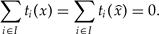
Accordingly, envy-freeness with respect to compensation rule t i(x) means that no agent envies any other agent's share of the common resource, given that associated with this share are compensations t i(x). Of course, to meaningfully apply this criterion, the compensation rule itself has to be regarded as ‘fair’, but this is a separate issue.Footnote 5
Let us return to the above example of satiated countries with compensations t i = v i(ω) − v i(x*i), i.e. the rule that is dictated by Pareto efficiency, individual rationality, and the stand-alone upper bound. Envy freeness with respect to this compensation rule requires that

which is always satisfied.
Observe the difference to the ‘standard’ formulation as given in (6). There, country i bases its evaluation of envy on the other country's transfer t j = v j(ω) − v j(x*j). By contrast, in the alternative formulation (9) country i bases its evaluation on the transfers that it would get if it received the other's share x j of the common resource, which are given by v i(ω) − v i(x*j).
4. The bounded Walrasian solution
Often, the Walrasian mechanism – i.e. an assignment of property rights in proportion to each agent's entitlements and a subsequent allocation via competitive markets – has been advocated for fair division problems (see Young, Reference Young1994). Indeed, for a large number of agents with sufficiently diverse preferences, the set of envy-free and efficient allocations is approximately the same as the set of Walrasian allocations from equal endowments (Varian, Reference Varian1976). Taking into account that the Walrasian allocation is also individually rational, this makes it a very prominent solution candidate for any fair division problem.
However, the Walrasian solution has been criticized because it may violate the stand-alone upper bound.Footnote 6 For the example of climate change, this would be the case for countries that receive an income from selling emission entitlements that exceeds their abatement costs. Therefore, I propose a solution to the fair division of common property resources that is based on the Walrasian equilibrium, but supplements it by the stand-alone utility as an upper bound.
Definition 5.Let the allocation (x*i)i∈Iand the price vector p* ∈ R L+constitute a Walrasian equilibrium. The bounded Walrasian solution (BWS) associates to every fair division problem E an allocation (x*i, t i(x*))i∈Isuch that compensations for agents i ∈ I are determined by
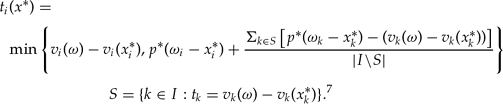
Accordingly, the bounded Walrasian solution divides the common resource efficiently, and with respect to monetary transfers it distinguishes between two types of agents. Members of set S receive transfers such that they are exactly as well off as with their stand-alone utility. Members of set I\S receive (or pay) transfers p*(ωi − x*i) as in the Walrasian equilibrium. In addition, they get an equal per capita share of the difference between the transfers that members of set S would receive in the Walrasian equilibrium, and the transfers they actually receive to reach their stand-alone utility level.
This reallocation of excess compensations on an equal per capita basis has not been derived from generic equity criteria, and one may imagine other rules. However, the equal per capita rule can be justified by arguing that the funds to be reallocated arise from a free service of members of S, from which the other agents should benefit equally.
Furthermore, an unequal redistribution of excess compensations may easily lead to envy. For example, suppose that there is a country i ∈ I\S, which is nearly indifferent between x*i and x*j, i.e. for which

where ϵ is a small number. Using a compensation rule where country j 's share of excess compensations exceeds that of i, country i would envy j with respect to that compensation rule.Footnote 8
Note that the bounded Walrasian solution corresponds with the Walrasian solution if the latter does not violate the stand-alone upper bound. Furthermore, in this case envy-freeness with respect to the BWS compensation rule is equivalent to the formulation of envy-freeness in equation (5). This accords with the above argument that deviations from the assumption of equal entitlements to compensations should be founded in fairness considerations. Of the fairness criteria that have been discussed in this paper, the Walrasian solution always satisfies Pareto efficiency and individual rationality. Accordingly, such deviations have to be justified by violations of the remaining fair division criterion, the stand-alone upper bound. This is exactly the idea that underlies the bounded Walrasian solution.
Proposition 2.The bounded Walrasian solution is Pareto efficient. Furthermore, it satisfies the fair division criteria of individual rationality, stand-alone upper bound and, for equal entitlements to the common resource, envy-freeness with respect to a compensation rule.
Proof. Pareto efficiency follows from the fact that the bounded Walrasian solution implements the Walrasian allocation with respect to the commodities in which utility is non-linear. Given the assumption of quasilinear utility functions, the complementing monetary transfers have no effect on efficiency. The stand-alone upper bound is satisfied because it is an integral part of the compensation rule. Individual rationality is well-known to be satisfied by the Walrasian solution. Intuitively, retaining the initial entitlement is a feasible decision for the individual agents (Foley, Reference Foley1967). It is also satisfied by the bounded Walrasian solution because all agents are either (weakly) better off than in the Walrasian equilibrium or get their stand-alone utility. It remains to analyze envy-freeness. As this part of the proof is less straightforward, it has been relegated to the appendix.
The statement in Proposition 2 about envy-freeness is limited to ‘equal entitlements’ to the common resource because the criterion has only been defined for this case. At first view, this seems quite restrictive since even with equal per capita emission entitlements, countries – which are the relevant actors in climate change – would differ in their entitlements simply because they have different population size.
A straightforward way to include such cases is to ‘redefine’ agents such that they have equal entitlements (see Brams and Taylor, Reference Brams and Taylor1996: 152). For example, suppose that country A has n times as many entitlements as country B. Then one could treat country A as n countries, each of which having equal entitlements and equal welfare functions whose aggregate is the original welfare function of this country.Footnote 9
5. Implementation and political feasibility
The International Energy Agency projects that without new government measures, CO2 emissions will increase by more than 50 per cent until 2030, and over 70 per cent of this increase will come from developing countries (International Energy Agency, 2006). This contrasts sharply with the strengthened evidence as presented in the IPCC's fourth assessment report that most of the observed increase in globally averaged temperatures since the mid-twentieth century is caused by anthropogenic greenhouse gas emissions, that climate change is happening faster than previously believed, and that it has substantial detrimental impacts. The conclusion is straightforward: GHG emissions have to be reduced drastically relative to the business-as-usual scenario, and this will not be feasible without substantial reductions in developing countries.
In the preceding section, I have suggested a general rule – the bounded Walrasian solution – with a view to achieving this agenda. The rule was derived solely from fairness considerations. Hence, two questions need to be addressed in order to assess its policy relevance: How can the proposal be implemented in practice, and what are the prospects for its political feasibility?
BWS has been defined as an efficient allocation of emissions and a vector of transfer payments. However, this should not be understood as an implementation procedure, but rather as a target that can be achieved in different ways. One possibility would be to allocate emission permits with the target that their unconstrained trading leads to BWS. For the sake of concreteness, consider an allocation of emission entitlements according to the equal per capita rule. Then, the permit share of developing countries with low emissions would be determined such that their revenues from selling permits equals their mitigation cost.
Obviously, given uncertainty about energy demand, abatement costs and permit prices, such a solution can never be implemented perfectly. However, this critique applies to any proposal which takes into account the costs of emission abatement. Numerical simulation models may provide some guidance, but the specific permit allocation will certainly remain an issue of intensive negotiations. Nevertheless, if countries committed themselves to the general idea behind the bounded Walrasian solution, this would substantially structure the negotiation process. Furthermore, the permit allocation could be adjusted in regular intervals to allow for new information. Moreover, deviations from estimated business-as-usual emissions would have an anti-cyclical effect for developing countries. Specifically, suppose permits have been allocated on the basis of countries' emission projections. If a country's economy and emissions grow stronger than anticipated, then ex post it should have received more permits to fully compensate it for the (higher) abatement costs. Accordingly, a country bears higher costs only if it is more able to do so.
This brings me to the issue of political acceptability. Under the Kyoto Protocol, North–South cooperation on emission abatement takes place via the clean development mechanism (CDM). Its main principle is strikingly similar to BWS: Industrialized countries undertake part of their emission abatement obligations in developing countries, thereby improving efficiency; and they have to pay the full costs of the emission abatement projects. However, since CDM is project based, it is faced with substantial transaction costs such as the costs for baseline determination, project approval, and verification (Michaelowa et al., Reference Michaelowa, Stronzik, Eckermann and Hunt2003). Therefore, its anticipated scope of 1.8 billion tonnes of CO2 until 2012 is relatively limited.Footnote 10 Under BWS, a baseline would have to be determined only at the country level in order to allocate permit endowments. Transaction costs of international permit trading can be expected to be reasonably low (Michaelowa et al., Reference Michaelowa, Stronzik, Eckermann and Hunt2003).
The principle of fully compensating developing countries for their incremental abatement costs has also been agreed to in other international agreements. Most notably, it resembles the arrangements in place in the international regime for the protection of the ozone layer (Montreal Protocol), which has generally been praised for its fairness; countries with low CFC emissions have been fully compensated for their additional abatement costs (Biermann, Reference Biermann1997).
A further attractive feature of the bounded Walrasian solution is that it alleviates the effects of the controversial initial allocation of entitlements to GHG emissions. Remember that entitlements have been taken as exogenous and only their subsequent exchange has been subjected to fairness criteria. The main implication of BWS for GHG abatement, the full participation and full compensation of developing countries, roughly holds for all initial entitlement allocations that give developing countries not substantially less emission entitlements than they need in the business-as-usual path. Obviously, this also includes entitlement rules that take into account historic emissions, as many developing countries have argued for. Nevertheless, the initial entitlement allocation is relevant in the long run as it determines the point when developing countries exceed their entitlements so that they would have to start bearing some of the mitigation costs.
Concluding remarks
The necessity of substantial GHG emission reductions is acknowledged by a growing number of countries, including such central actors as the USA and China. For example, several US states – particularly California – have adopted ambitious targets for CO2 emission reductions. Similarly, in a widely discussed public letter to the US president the Senators Boxer, Bingaman, and Lieberman – the then incoming chairs of three important Senate Committees on global warming – have demanded ‘an effective system of mandatory limits on greenhouse gases’. There are also some encouraging signs from China, which has announced ambitious plans to increase energy efficiency and to promote renewable energies (Aunan et al., Reference Aunan, Berntsen, O'Connor, Persson, Vennemo and Zhai2007).
Proceeding on four prominent equity criteria, the present paper has developed a proposal for the sharing of GHG mitigation costs in a comprehensive climate change regime. The thrust of the bounded Walrasian solution is that developing countries should initially be fully compensated for the greenhouse gas abatement measures that they are obliged to undertake out of efficiency considerations.
Fairness is a highly controversial issue, and I am well aware that many readers will not consent to the proposed solution. In particular, fair division theory is only one possible approach to analyze the fair sharing of the costs of climate protection. Naturally, I believe that it is a very valuable one, particularly since it clearly lays out the ethical principals from which the ‘fair’ proposal is derived. In the remaining, I will briefly discuss some objections to the bounded Walrasian solution and its derivation.
Most obviously, one might dispute the claimed fairness of the bounded Walrasian solution as such. First, its underlying fair division criteria are derived from normative arguments, which are open to disagreement. Second, it is a common problem of fair division theory that several equity principles, each of which appears to be quite reasonable, are incompatible with each other. As we expand the set of criteria beyond those considered in this paper, this may well happen. For example, it is well known that the criteria of individual rationality and resource monotonicity (see footnote 6) are incompatible for any Pareto efficient mechanism (Moulin and Thomson, Reference Moulin and Thomson1988).
Third, one might question the whole approach of fair division theory because its focus on isolated problems disregards superordinate equity aspects such as countries’ ‘differentiated responsibilities and respective capabilities’, which are explicitly mentioned in Article 3(1) of the Framework Convention on Climate Change (see footnote 1). However, the bounded Walrasian solution for international climate policy is not really affected by this proviso. According to it, it will initially be the rich industrialized countries that are required to assume the costs of reducing GHG emissions. This is in accordance with countries’ different responsibilities and capabilities. Differences in the historic responsibility for the accumulation of greenhouse gases in the atmosphere could also be accounted for by specifying compensations for climate change damages. As stated in section 2, this issue is not analyzed in the current paper, but I would certainly agree that adversely affected developing countries have a legitimate claim to such compensations.
Similarly, it would be a misinterpretation of the foregoing to conclude that the allocation of tradable emission rights should not be used as an instrument to transfer wealth from ‘rich’ to ‘poor’ countries. However, one has to distinguish whether the motivation of transfers is the fair division of a common resource, or the rectification of injustices that exist regardless of the climate change problem. This paper has analyzed only the former issue.
A different objection concerns the assumption of quasilinear preferences and the implied absence of wealth effects. However, even for a problem like climate change which involves potentially large emission abatement costs, empirical studies suggest that wealth effects and international spillovers are likely to be small (typically less than 1 per cent of GDP, e.g. Böhringer and Rutherford, Reference Böhringer and Rutherford2002). Furthermore, Pareto efficiency, individual rationality, and the stand-alone upper bound can be reformulated easily for the case of more general preference profiles. The main policy implication – the full compensation of developing countries – is not affected by this.Footnote 11 Finally, from a policy perspective the main virtue of the bounded Walrasian solution is not the precise allocation that it determines, but rather the broad direction that it indicates. To obtain the latter, a partial equilibrium approach seems justifiable.
Appendix
Proof of Proposition 2 (envy-freeness of the bounded Walrasian solution)
By construction of the bounded Walrasian solution, an agent can never be better off than with her stand-alone utility – no matter what share of the common resource she consumes and sells. Therefore, envy-freeness with respect to the BWS compensation rule is obviously satisfied for agents i ∈ S who receive their stand-alone utility.
Turning to agents i ∈ I\S, denote by

i‘s share of reallocations from agents k ∈ S in the bounded Walrasian solution. Similarly,  denotes i ‘s share if her allocation x*i is transposed with that of agent j, while the allocations of all other agents remain unchanged. I first show that ≤ λi.
With equal entitlements, all agents can choose from the same budget set. Since agent i has chosen x*i rather than x*j, we have

Exchanging the indices i and j, subtracting v j(ω) on both sides, and rearranging yields

First, suppose that agent i compares herself with an agent j ∈ I\S, i.e. with an agent for whom the left-hand side of (13) is negative. Since the right-hand side of (13) is even smaller, agent j remains a member of set ∈ I\S if she receives x*i rather than x*j. Accordingly, the transposition of x*i and x*j has no effect on members of set S so that  .
Next, suppose that agent i compares herself with an agent j ∈ S. Noting the definition of λi in (11) and using (13), the contribution of this agent to transfers λi falls if she receives x*i rather than x*j. Accordingly,  . Intuitively, in an inefficient solution there is less to be redistributed.
EFC requires that

Accordingly, an agent i ∈ I\S compares her current utility with the utility she would attain if she consumed the bundle of any other agent and received the compensations that are associated to this consumption bundle. For such agents

The first inequality follows from the fact that we consider an agent i ∈ I\S, and noting that . The second inequality follows from (12). Accordingly, for agents i ∈ I\S

so that EFC simplifies to

This expression holds by (12) and  .
 , for the case of two agents




