INTRODUCTION
Deep-sea macroinvertebrates communities are characterized by high diversity values (Grassle, Reference Grassle1989; Smith et al., Reference Smith, Levin and Mullineaux1998). In areas where the oxygen-minimum zone (OMZ) intercepts the continental slope, anoxic and severely hypoxic benthic fringes are species-poor, but not so hypoxic zone extending in even deeper water which is species-rich. In the OMZ, depth and dissolved oxygen concentration are the most important factors affecting deep-water communities' composition (Levin & Gage, Reference Levin and Gage1998; Rogers, Reference Rogers2000; Hendrickx, Reference Hendrickx2001; Levin et al., Reference Levin, Etter, Rex, Gooday, Smith, Pineda, Stuart, Hessler and Pawson2001; McClain, Reference McClain2004; Zamorano et al., Reference Zamorano, Hendrickx and Toledano-Granados2007a; Hendrickx & Serrano, Reference Hendrickx and Serrano2010) and species size (see Olabarria & Thurston, Reference Olabarria and Thurston2003, Reference Olabarria and Thurston2004).
Environmental conditions occurring at bottom level in deep sea (i.e. muddy sediments, abundant detritus as food source, stable values of salinity and temperature) optimize settlement and dominance of endofauna and epifauna communities which are often highly diverse (Rex et al., Reference Rex, Stuart and Coyne2000; Levin et al., Reference Levin, Etter, Rex, Gooday, Smith, Pineda, Stuart, Hessler and Pawson2001; Kröncke & Türkay, Reference Kröncke and Türkay2003; Méndez, Reference Méndez2007). Deep-water crustaceans, echinoderms and fish are generally better represented in benthic samples obtained from sledges or beam-trawls than in box cores. Due to difficulties in operating such equipment in deep water, there is a general lack of information related to their distribution, abundance and community composition.
On average, the continental slope descends 20 m each 1000 m (2%). Although its upper bathymetric limit varies considerably and depends essentially on the slope of the continental shelf, on average it extends from 200 to 2000–3000 m. Worldwide, the continental slope represents about 5% of the total oceanic surface, but in the exclusive economic zone (EEZ) of Pacific Mexico it corresponds to 12.2% or 288,900 km2, regardless of the Gulf of Tehuantepec (Longwell & Flint, Reference Longwell and Flint1981; Seibold & Berger, Reference Seibold and Berger1982; Hendrickx, Reference Hendrickx, Salazar-Vallejo and Gonzalez1993).
In the eastern Pacific, the upper section of the continental slope (roughly between 100 and 1000 m) is oxygen-poor (≤0.5 ml l−1) and an OMZ has long been recognized in the region. Worldwide, the OMZ covers an estimated area of 1,148,000.00 km2 of the ocean bottom, but nowhere is it as extended as in the eastern Pacific. The entire Pacific coast of Mexico, except the upper Gulf of California, is included in the region where vertical hypoxic conditions are the most extensive (see Díaz & Rosenberg, Reference Díaz and Rosenberg1995; Helly & Levin, Reference Helly and Levin2004; Hendrickx & Serrano, Reference Hendrickx and Serrano2010).
Among the factors responsible for these phenomena, are the reduced vertical diffusion of oxygen, the presence of oxygen-depleted deep-water mass originating from the North Atlantic, and the excessive consumption of oxygen in upwelling and highly productive areas (Levin, Reference Levin2002; Helly & Levin, Reference Helly and Levin2004; Hendrickx & Serrano, Reference Hendrickx and Serrano2010). Along the coast of western Mexico, these effects have been documented for the Gulf of California, south-west Mexico and the Gulf of Tehuantepec (Lavin et al., Reference Lavin, Robles, Argote, Barton, Smith, Brown, Kosro, Trasviña, Velez and Garca1992; Lluch-Cota et al., Reference Lluch-Cota, Alvarez-Borrego, Santamaria del Angel, Müller-Karger and Hernandez-Vazquez1997; Hendrickx & Serrano, Reference Hendrickx and Serrano2010).
The OMZ is responsible for a sharp reduction of abundance and diversity in natural communities, and represents a physiological barrier for most species of macro-invertebrates. Consequently, there are little or no exchange between the communities living above and below the OMZ and their composition is generally distinct (Rosenberg et al., Reference Rosenberg, Arntz, Chuman de Flores, Flores, Carvajal, Finger and Tarazona1983; Levin & Gage, Reference Levin and Gage1998; Hendrickx, Reference Hendrickx2001; Levin et al., Reference Levin, Etter, Rex, Gooday, Smith, Pineda, Stuart, Hessler and Pawson2001; Hendrickx & Serrano, Reference Hendrickx and Serrano2010; Zamorano & Hendrickx, Reference Zamorano and Hendrickx2011). Laboratory experiments have shown a low tolerance of species of bivalves and echinoderms to oxygen concentrations inferior to 1 ml−1 and a correlation between oxygen concentration and maximum size of organisms (Rosenberg et al., Reference Rosenberg, Hellman and Johansson1991; McClain & Rex, Reference McClain and Rex2001).
Previous studies on deep-water molluscs communities in the Gulf of California indicate that species composition and bathymetric distribution is also highly dependent on the OMZ effect which limits colonization and affects distribution patterns (Hendrickx et al., Reference Hendrickx, Van Der Heiden and Toledano-Granados1984; Rogers, Reference Rogers2000; Zamorano & Hendrickx, Reference Zamorano and Hendrickx2009). In some cases, however, species are highly adapted to adverse oxygenation conditions (i.e. moderate to severe hypoxia) and dominate in habitats that would otherwise be devoid of life (Hendrickx, Reference Hendrickx2001; Méndez, Reference Méndez2007; Zamorano et al., Reference Zamorano, Hendrickx and Toledano-Granados2007a). Common adaptations include an increase of the branchial surface, of the respiratory rhythm and of the capacity to remove oxygen from the environment, a better affinity of haemocyanine for oxygen coupled with a reduction of oxygen needs, and a higher dependence on anaerobic metabolism (see Childress, Reference Childress1995; Childress & Seibel, Reference Childress and Seibel1998; Lamont & Gage, Reference Lamont and Gage2000; Levin, Reference Levin2002). Lack of strong competition for food and reduction of predator numbers also represent a significant advantage for species able to adapt to these critical conditions (Rogers, Reference Rogers2000; Levin, Reference Levin2002).
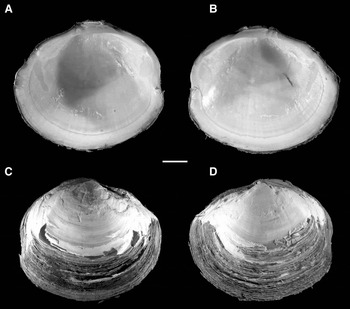
Species of the deep-water genus Lucinoma have developed a strong affinity for hypoxic environment via the acquisition of bacterial chemosymbiosis that allows for oxidation of sulphur and a reduction of oxygen-dependence (Williams et al., Reference Williams, Taylor and Glover2004). Among the approximately 26 species recognized in this genus (BSF, 2010), Lucinoma heroica (Dall, Reference Dall1901) occurs in deep water from off Santa Rosalía, Baja California Sur, Mexico (Dall, Reference Dall1901), to Peru (Ramirez et al., Reference Ramirez, Paredes and Arenas2003; Coan & Valentich-Scott, Reference Coan and Valentich-Scott2012), in depths of 730–1838 m (Zamorano et al., Reference Zamorano, Hendrickx and Toledano-Granados2007b). Little is known, however, about its bathymetric and geographical distribution in the area and its specific tolerance to oxygen-poor environment. Lucinoma heroica (Figure 1) was found as abundant and frequent during a series of cruises aimed at collecting deep-water invertebrates communities along the Pacific coast of Mexico (TALUD project) and this material is used to complete our information on this species.
Lucinoma heroica (Dall, Reference Dall1901) (EMU-6934): (A, B) right and left valves, inner view; (C, D) right and left valves, outer view. Scale bar = 1 cm.

MATERIALS AND METHODS
As part of the TALUD Project (‘Bioscenosis of deep-water fauna of the Mexican Pacific’), a total of nine cruises aboard the RV ‘El Puma’ of the Universidad Nacional Autónoma de México were organized in the Gulf of California, between 22o–28°N and 112o–110°W, from 2000 to 2007. Samples of the benthic macrofauna were collected in a depth-range of 460–2309 m during the following cruises: TALUD IV, 23–27 August 2000; TALUD V, 13–18 December 2000; TALUD VI, 13–17 March 2001; TALUD VII, 5–9 June 2001; TALUD VIII, 16–19 April 2005; TALUD IX, 10–15 November 2005; and TALUD X, 9–15 February 2007. Three types of sampling gear were used: a benthic sledge (2.4 m width, 0.9 m high) equipped with a modified shrimp net (~5.5 cm stretched mesh size) and an inner net of ~2.0 cm (3/4") stretched mesh size; a modified Karling dredge with a blind back-end with capacity of 80 l of sediment; and a standard Reineck box core (42 cm by 41 cm by 59.5 cm height) with a maximum capacity of 102 l. Volume of sediments collected with the Karling dredge and the box core were measured and filtered through a 0.5 mm grid in order to separate the specimens of the macrofauna. The swept area method was used to estimate the density of shells collected with the benthic sledge, using the duration of each haul (30 minutes) and the average hauling speed (1.75 knots). All cruises considered a total of 288 samples were taken in 127 localities using the three sampling devices: 75 with the box core; 97 with the Karling dredge; and 116 with the benthic sledge. Positional coordinates for each sampling station were plotted using a GPS navigation system. Depth was measured with an EdoWestern, analogic recorder (TALUD III–VIII) or a SIMRAD digital recorder (TALUD IX–X). Epibenthic water temperature and salinity were measured with a Seabird SBE 19 conductivity–temperature–depth probe (CTD). Dissolved oxygen content was estimated with the Winkler method (all cruises) and with a probe attached to the CTD (TALUD VIII–X).
The specimens of L. heroica were separated from all benthic samples, fixed on-board with a 4% formaldehyde seawater solution, subsequently washed with tap water and preserved in 70% ethanol. Measurements (shell height (SH) in mm; shell length (SL) in mm) were taken with a caliper (precision, ± 0.005 mm) using only specimens with soft parts. A simple linear regression analysis was used to determine the height/length relationship. Size of each specimen was incorporated in a frequency histogram and related to environmental conditions. Based on previous results obtained by Zamorano et al. (Reference Zamorano, Hendrickx and Toledano-Granados2007a), depth and dissolved oxygen concentration were selected as the most significant factors in the multiple linear regression analysis. Results of this analysis were used to establish the model in which shell size (y) is related to the selected environmental factors (x1 and x2 corresponding to oxygen concentration and depth, respectively). Parameters of model and the model itself are described in the Results section.
The material collected during this survey is deposited in the Regional Collection of Marine Invertebrates (EMU) of the Instituto de Ciencias del Mar y Limnologia, UNAM, in Mazatlan, Sinaloa, Mexico (see catalogue number in Table 1).
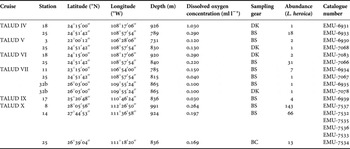
Geographical location, environmental parameters and sampling gears used in the stations where specimens of Lucinoma heroica (Dall, Reference Dall1901) were collected during the oceanographic cruises ‘TALUD IV–XI’. Abundance refers to number of specimens per sample. DK, Karling dredge; BS, benthic sledge; BC, standard box core. Catalogue number (EMU) is indicated for each lot.

RESULTS
Samples of L. heroica (Dall, Reference Dall1901) totalling 291 specimens were collected in a depth-range of 731 and 991 m (Table 1). No specimens of this species were obtained during the TALUD VIII cruise and L. heroica was captured in 13 of the 127 localities (10.5%) where samples were obtained. Considering all species of molluscs collected during the survey, L. heroica was the dominant (Dm) and one of the most frequent (F) species according to the criteria of Glémarec (Reference Glémarec1964) and Picard (Reference Picard1965) in both the benthic sledge (Dm = 3.15% of individuals, F = 25% of stations) and in the sediment samples (Dm = 5.4% of individuals, F = 24% of stations).
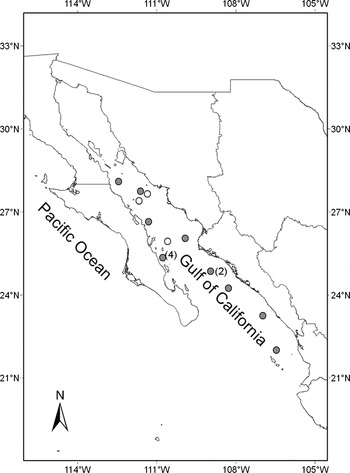
For the Gulf of California there are three previous records of the species. The first corresponds to the type locality (Dall, Reference Dall1901), off Santa Rosalia (27°24′N 111°40′W), at 1829 m; the second (Skoglund, Reference Skoglund2001) is located on the east side of Isla del Carmen (25°56′N 110°35′W), between 1321 and 1334 m depth; and the third by Skoglund (Reference Skoglund2001), near Isla San Pedro Nolasco (27°39′N 111°21′W), between 931 and 952 m depth. These earlier records are located in the southern-central Gulf of California (Figure 2). Unfortunately, no data related to epibenthic temperature or oxygen concentration are available for these previous records. In the present work, the species was collected in the south-eastern Gulf (Figure 2), off the coast of Sinaloa and Nayarit, and values are available for these two parameters.
Distribution of Lucinoma heroica (Dall, Reference Dall1901) in the Gulf of California including the material collected during TALUD cruises (solid circles) and in previous cruises (open circles). The number in parentheses indicates that the same station was sampled more than once in different cruises.

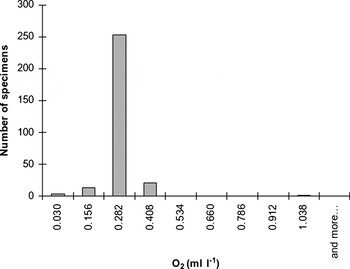
All samples examined during this study were obtained in depth <1000 m, in an oxygen concentration range of 0.03 ml l−1 to 1.03 ml l−1, in moderate (>0.1–0.3 ml l−1; 97.94% of total abundance) to severe (0.03–0.04 ml l−1; 1.72% of total abundance) hypoxia. Only one sample (a single specimen) was collected in 926 m depth (the deepest sampling station for the species in this survey), with an oxygen concentration of ~1.03 ml l−1 (Figure 3).
Number of specimens of Lucinoma heroica (Dall, Reference Dall1901) obtained during the TALUD cruises in relation to oxygen concentration (histogram obtained by the method of Sturges, Reference Sturges1926).

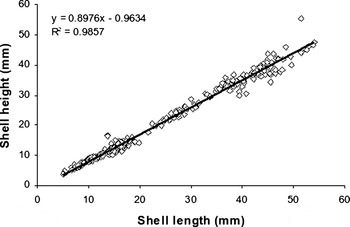
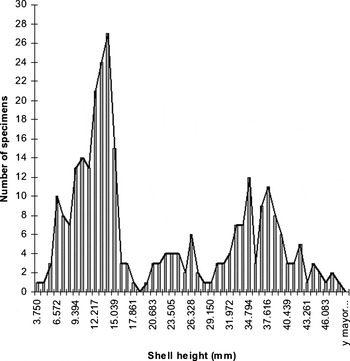
The smallest and largest specimens collected measured SH 3.75 mm, SL 4.96 mm, and SH 55.4 mm, SL 51.38 mm, respectively. A highly significant isometric relationship (y = 0.9x–0.96; R 2 = 0.990, F1, 289 = 7402.62, P < 0.0000) (Figure 4) was obtained between SH and SL for L. heroica, thus allowing the use of any of these two parameters for further analysis. Consequently, height was selected as the size parameter. When samples were pooled, a trimodal size–frequency distribution (Figure 5) was observed and indicates the predominance of individuals with a height between 12 and 15 mm (30% of the material collected). No clear size distribution pattern was observed, thus indicating that size distribution of L. heroica in the area is heterogeneous.
Linear relationship between height and length of Lucinoma heroica (Dall, Reference Dall1901) based on the specimens collected during the TALUD cruises (N = 291).

Size–frequency distribution for Lucinoma heroica (Dall, Reference Dall1901) based on the specimens collected during the TALUD cruises (N = 291).

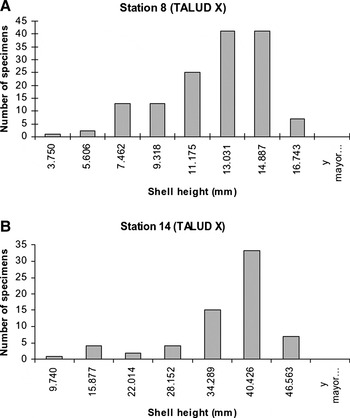
Of the 13 stations in which samples of L. heroica were taken, station 8 of TALUD X cruise features the largest number of specimens of the species (143) representing 49.3% of all specimens collected during the study. Individuals of this sample were smaller than 17 mm in height and present a unimodal size distribution, with 57% of specimens between 13 and 15 mm height (Figure 6A), and correspond to the first mode of the trimodal distribution observed for pooled samples (Figure 5).
Frequency histogram of size (shell height) for Lucinoma heroica (Dall, Reference Dall1901) harvested at station 8 (N = 143) and station 14 (N = 66) during the TALUD X cruise in the southern Gulf of California.

Station 14 of TALUD X cruise provided the second most abundant sample, totalling 66 specimens (22.7% of the total). However, unlike station 8 of TALUD X, the sample is dominated by large individuals, with a mode between 34 and 46 mm, and also includes individuals as small as 9 mm height (Figure 6B). Specimens of this sample correspond to the third mode observed for pooled samples (Figure 5).
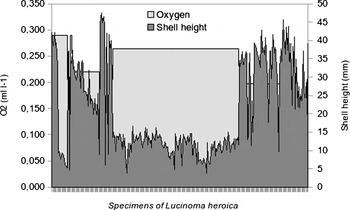
The analysis of a hypothetical relationship between size distribution and oxygen concentration indicates that small specimens (SH ≤ 20 mm) generally occur in moderate hypoxic conditions (>0.1ml l−1), while larger specimens (SH > 35mm) are apparently able to tolerate almost anoxic conditions (<0.1ml l−1). Intermediate-size specimens (SH 20–35 mm) were found in oxygen concentration values of ~0.2 ml l−1 (Figure 7).
Classification of Lucinoma heroica specimens according to their size (shell height) and the dissolved oxygen concentration (ml ls−1) associated with each capture (N = 291).

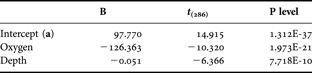
The multivariable analysis using both environmental factors and shell size indicates a significant value of correlation (R = 0.652) when size and oxygen concentration are compared, explaining a variance of R2 = 0.425 (F1,287 = 211.948; P = 0.000). When depth is also considered, correlation increases up to R = 0.704, explaining 50% of total variance (R2 = 0.496), and depth remains as a significant factor (F2,286 = 140.827; P = 0.000). A regression analysis between oxygen and depth was used to test whether there is co-linearity among parameters or not. Results showed that oxygen concentration is not a function of depth (R2 = 0.172), due to the fact that at depths greater than 700–800 m oxygen values increase steadily, corresponding to the deepest edge of the OMZ (see Hendrickx & Serrano, Reference Hendrickx and Serrano2010).
Based on the results obtained with the multivariable analysis (Table 2), the model predicting shell size (i.e. shell height) of L. heroica as a function of depth and oxygen concentration is defined as: y = 97.770 – 126.363 oxygen – 0.051 depth. In this model the lower the oxygen concentration the higher the size of the specimens.
Values obtained from multiple linear regression analysis for Lucinoma heroica (Dall, Reference Dall1901) in the south-central Gulf of California.

All samples considered, number of individuals of L. heroica obtained with the Karling dredge and the box core were compared with the total volume of sediment filtered, providing an average density of 1.532 ind. l−1. Average density of L. heroica collected with the benthic sledge and estimated with the swept area method is 0.002 ind m−2.
DISCUSSION
During the TALUD cruises L. heroica was found in samples obtained with equipments designed to collect both epifauna (benthic sledge) and endofauna (Karling dredge and box core). Our data and the statistical analysis indicate that L. heroica is a relatively common and dominant resident in the OMZ, as noted by Zamorano et al. (Reference Zamorano, Hendrickx and Toledano-Granados2007a), and occurs under severe (<0.1 ml l−1O2) and moderate hypoxia (0.1–0.5ml l−1O2). The majority of the specimens collected (97.93%), however, were associated with oxygen concentrations values comprised between 0.1 and 0.5 ml l−1, which correspond to moderately hypoxic conditions according to the criteria of Zamorano et al. (Reference Zamorano, Hendrickx and Toledano-Granados2007a) and Hendrickx & Serrano (Reference Hendrickx and Serrano2010).
The maximum size of L. heroica recorded in the literature is 71 mm (Keen, Reference Keen1971) and the size-range observed in this study (3.75–55.4 mm) is considerably lower. The species was found to be recurrent in the samples taken in the southern Gulf of California and a new upper bathymetric limit was set at 700 m, while the lower known limit of bathymetric distribution of this species is close to 1850 m (Zamorano et al., Reference Zamorano, Hendrickx and Toledano-Granados2007b). Its geographical distribution is restricted to the central and southern Gulf of California (Dall, Reference Dall1901; Keen, Reference Keen1971; Scott et al., Reference Scott, Hochberg and Roth1990) with a single report off the coast of Peru (Skoglund, Reference Skoglund2001). Based on our data, the number of localities within the Gulf of California increased from three to 16 and it can be considered as a widespread species south of the large islands separating the northern Gulf from the central and southern Gulf.
Another species of the genus has been reported off the Mexican Pacific. Lucinoma annulatum (Reeve, 1850) is distributed from Alaska to the Gulf of California, from the intertidal to 665 m (Coan & Valentich-Scott, Reference Coan and Valentich-Scott2012), and has been recorded by Ríos-Jara et al. (Reference Ríos-Jara, López-Uriarte and Galván-Villa2008) in the continental shelf of Jalisco and Colima, at depths of 40–83 m. A third species recorded in the eastern Pacific is L. aequizonatum (Stearns, 1891), known from Santa Barbara, California, and into the Gulf of California up to Isla Santa Cruz, from 400 to 840 m (Coan & Valentich-Scott, Reference Coan and Valentich-Scott2012). Unfortunately, there are no data related to the density or their affinity with the OMZ for any of these two species, thus making comparison with our results impossible.
According to Hendrickx & Serrano (Reference Hendrickx and Serrano2010), the OMZ in the central and southern Gulf of California extends from 75–150 m (upper limit) to 700–800 m (lower limit), depending upon the latitude. Below this lower depth limit, oxygen concentration gradually increases and reaches values >2.0 ml l−1 in the 2000–2500 m depth-range (Hendrickx, Reference Hendrickx, Zamorano, Hendrickx and Caso-Chavez2012). The absence of L. heroica in water deeper than 991 m (i.e. with higher oxygen content) during the TALUD survey indicates that it is restricted to the area where oxygen concentrations are low. This is certainly related to its capability to survive in adverse conditions using the chemosymbiosis processes that allows for a reduction of oxygen-dependence, and to the fact that Lucinoidae are considered the most diverse group of chemosymbiotic molluscs (Dando et al., Reference Dando, Southward and Southward1986; Taylor & Glover, Reference Taylor and Glover2006).
Depth and oxygen concentration seem to be critical factors regarding size distribution in L. heroica, with smaller specimens found in deeper water and in increasing oxygen content compared to larger specimens. However, further data are needed to confirm this trend.
ACKNOWLEDGEMENTS
The authors thank the participants in the TALUD cruises for their support provided during the oceanographic campaigns aboard the RV ‘El Puma’. P.Z. thanks José Salgado and Soledad Ibarra for their support in the laboratory. Part of this study was supported by CONACyT (project 31805-N) and DGAPA, UNAM (project IN-217306-3). Ship time was granted by UNAM (Coordination of Scientific Research). We also thank José Salgado Barragán for his technical assistance with preparing and editing Figure 1. P.Z. was supported by the Graduate Scholarship Program from CONACyT (number 190220).