Introduction
A.D. King recently raised the question of how ordinary citizens translate, accommodate or resist an aggressive, often colonial, urban planning policy.Footnote 1 A shining example of the modern metropolis, Cairo is often thought to be the result of such a policy, which cut the city into two halves. Yet, the Egyptians’ interaction with the new environment has rarely been investigated because this policy was identified as a colonial anomaly. This theory lies behind J. Abu-Lughod's ‘tale of two cities’, which drew the borderline between a new, colonial, European Cairo and an old, traditional, Egyptian Cairo at the Azbakiyya Garden and its Opera House, which each embodied a colonial space.Footnote 2 J.-L. Arnaud corrected this view, arguing that Cairo's division was the embodiment of Ismail Pasha's interests (r. 1863–1879, khedive from 1867) and later the result of a private market.Footnote 3 M. Volait emphasized the khedivial extension of Cairo rather than its division.Footnote 4 K. Fahmy, H.F. Ahmed and M. Elshahed radically criticized the supposed division itself.Footnote 5 In this article, I interpret Khedive Ismail's autocratic scheme as an act of cultural transfer intended to fashion Cairo into a dynastic imperial capital. This was a logical albeit accelerated continuation of the previous Egyptian viceroys’ urbanism. To contextualize Ismail's transfer and its afterlife, I employ the social history of music, which also helps to map urban pleasures. In this way, music destabilizes the explanatory power of histories of architecture and city planning by looking at urban spaces and buildings as they were in everyday use.
From the ‘two cities’ to the empty city
The modern history of Cairo has rarely been accompanied by studies in social or cultural history. This exclusion of the people from the city is due to the overrepresentation of architectural historians, to the interest of historians in earlier periods and to language limitations. Recent publications, such as Z. Fahmy's study of modern Egyptian mass culture, do not relate entertainment to urban change.Footnote 6
There is general agreement that the khedive's visit to the Exposition Universelle de Paris in 1867 was decisive in inspiring the creation of a façade for European tourists attending the Suez Canal Opening Ceremonies in 1869, at the cost of an enormous debt.Footnote 7 In 1876, the Dual Control was imposed on Egyptian finances by Britain and France, and Sultan Abdülhamid II, through their machinations, dismissed Ismail in 1879, leaving his heir, Tevfik, in charge of a bankrupt administration that was occupied by the British from autumn 1882. The colonial nature of urban planning was taken for granted in the shadow of this political history.
Abu-Lughod's theory was based on Ismail's imagined thoughts. The khedive, returning from the Exposition in 1867, was thought to have asked himself ‘where in his crumbling capital was anything to rival what he had seen in Paris or even in London’, and hence decided to ‘polish’ Cairo.Footnote 8 French contemporaries were already referring to the large-scale transformation of Cairo that A. Raymond has described as ‘Haussmannization’.Footnote 9 Egyptian urban historians also hold Paris up as the model and European guests as the motivators for Ismail.Footnote 10 However, Arnaud, Volait, Ahmed and recently Elshahed have all criticized the ‘Paris along the Nile’ trope.Footnote 11 Arnaud emphasized how Ismail's urbanization was a mis en place, a series of useless façades: ‘les édifices publics ne sont pas mieux construits que des pavillions d'exposition’.Footnote 12 From the ‘two cities’ of Abu-Lughod, we arrive at Arnaud's coulisses without actors. Was Ismail's Cairo a despotic madman's empty Potemkin-village? Was he really an ‘architectural fanatic’,Footnote 13 or so dull that he ordered a new Cairo solely for the comfort of his European guests?
Ceremony, entertainment, tourism: a dynastic square
Focusing on Azbakiyya (or in the vernacular, ‘Izbikiyya’), D. Behrens-Abouseif revealed how this territory, originally a pond belonging to Amir Özbek in one of the outskirts of medieval Cairo, became a residential quarter for the Egyptian elite.Footnote 14 Copts and European merchants had established homes on its north-western side (Muski) in the sixteenth centuryFootnote 15 but Azbakiyya also played a central role in Egyptian popular entertainments throughout the early modern period.Footnote 16 The most significant was the festival of Fatḥ al-Khalīj (Opening of the Canal), celebrating the Nile's flooding of the Azbakiyya marsh every August via the canal on the west side.Footnote 17 All Cairenes also celebrated Shamm al-Nasīm, the arrival of spring, while Muslims held their religious feasts there, such as the mawlid (birthday celebration) of the Prophet Muhammad,Footnote 18 or gathered after the Friday prayers to watch games or spend leisure time on the shores, boating at night in illuminated vessels on the pond.Footnote 19 Leo Africanus reported on the ‘mad, prankish and vulgar acts’ that took placeFootnote 20 while sheikhs battled against hashish consumption.Footnote 21
During the French occupation (1798–1801), this neighbourhood on the outskirts of the city ‘became the main square of the city’, at least for the French, because Bonaparte had moved into a neighbouring palace.Footnote 22 The Armée d'Orient built a theatre there in 1799 and after it was destroyed in the Egyptian revolt of 1800, they rebuilt a Théâtre de la République.Footnote 23 The French encouraged the popular festivals too, so that they might approach ‘public women’.Footnote 24 Following the French retreat, the new Ottoman governor, Hüsrev Pasha, and his triumphant rival, Mehmed Ali Pasha (r. 1805–49), used Azbakiyya as their headquarters. Fatḥ al-Khalīj and public dynastic feasts in celebration of marriage or circumcision continued to take place here during Mehmed Ali's rule.Footnote 25 During this period, and especially from around 1841, when, in a complicated international game, he received hereditary rights to rule Egypt from Sultan Abdülmecid, Cairo began a transformation to fit better for the role of a dynastic capital. Azbakiyya was central to this scheme because, in addition to its ceremonial function, it connected Shubra (a palace of the pasha) and the busy port of Bulaq with Cairo.Footnote 26
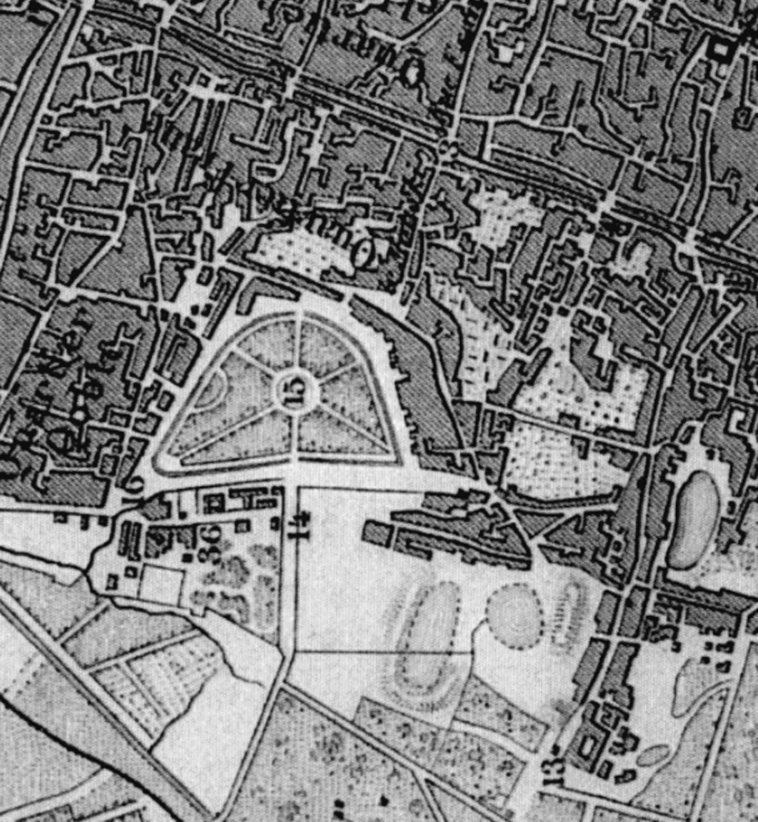
Among many other initiatives,Footnote 27 Azbakiyya's pond was drained, a School of Languages was built nearby, foreign consulates were established, the surrounding waqf land (religious endowment) was appropriated and its centre was turned into a public park by 1845 (Figure 1).Footnote 28 This park might have been ordered for reasons of public hygieneFootnote 29 but also coincided with Ibrahim Pasha (r. 1848), Mehmed Ali's heir, ordering the extensive planting of trees, levelling the ground and building palaces nearby.Footnote 30 Schools continued to be built in the 1850s, and Said Pasha (r. 1854–63) ordered the resupply of water to the new square.Footnote 31 Female prostitutes and dancers were banished from Cairo in 1834 (although not their male counterparts); later in the 1850s, they were permitted to return.Footnote 32 The new garden became a popular promenade,Footnote 33 and hotels catering to European tourists were established.Footnote 34 Some of the visitors already regarded this transformation, along with the other changes, as a symptom of Cairo losing its ‘Arab’ face.Footnote 35 As well as being a ‘port’ of entry (in addition to Bulaq's port the train station was built nearby in 1853) and a gateway for labour migration from rural Egypt, Azbakiyya and its environs (Muski especially) also functioned as a shopping district,Footnote 36 attracting prostitutes, singers, beggars and acrobats. Their presence did not stop the ruling dynasty from continuing to erect palacesFootnote 37 and from staging celebrations in the square. For instance, in 1849, Penbe, Abbas Pasha's mother, was welcomed there with three days of fireworks, just as Zeyneb, Said Pasha's sister, had been in 1854.Footnote 38 Azbakiyya, like other squares in Cairo, played an important role in representing political power via symbolic celebrations and simultaneously offered an open space for popular entertainments.
Azbakiyya in the 1850s. A. Joanne and É. Isambert, Itinéraire descriptif, historique et archéologique de l'Orient (Paris, 1861), detail. Collection Max Karkégi, with permission.

Music and death
The history of music reveals the everyday use of this space, since it is said that in nineteenth-century Egypt ‘all classes [had] their particular songs’;Footnote 39 or as E. Toledano underlined, coffeehouses with music ‘were really an institution of the lower strata of Egyptian society’.Footnote 40 Music in Cairo embodies a complex mixture of urban and tribal traditions, with songs in both the vernacular(s) and in classical Arabic, thus pointing to ‘the local’ or ‘the authentic’ as the outcome of migrating tastes. It is remarkable how during the 1850s music became an essential feature of this territory, in the Arab, Greek, Italian and Armenian cafés,Footnote 41 which were established nearby, on land rented by the government to cover the new garden's expenses.Footnote 42 Despite the complaint that it was losing its Arab identity, Azbakiyya/Izbikiyya continued to be an Egyptian location, with some Europeans remarking that Cairo had remained ‘oriental’ in contrast to Alexandria.Footnote 43 The Arab coffeehouses hosted a local clientele and served coffee, tobacco, hashish and music. E.W. Lane estimated that in the 1830s there were more than 1,000 coffeehouses in Cairo where, especially on evenings of religious festivals, musicians and storytellers performed.Footnote 44 By 1860, their number was estimated at more than 1,200.Footnote 45
Perhaps because of the increased foreign and domestic migration, a ‘master’ (usṭa), Mustafa, was given care of Azbakiyya in the 1850s.Footnote 46 It would be presumptuous to assert that earlier Egyptian traditions of entertainment at Azbakiyya were directly translated into the musical cafés of the mid-nineteenth century. However, the legendary Egyptian singer, ʿAbduh al-Hamuli (c. 1840–1901), who came from Tanta to Cairo, was said to have sung in the Arab cafés of Azbakiyya in his youth (1850s), especially in the café of ʿUthman Agha, where he became an established artist and accumulated some wealth. He sang muwashshaḥāt, songs of perhaps Andalusian origin, belonging to an Arab art-song tradition.Footnote 47 Arab musicians and singers in the early 1860s were so abundant in the Azbakiyya coffeehouses that the European tourists could pointedly look down on their music.Footnote 48 Egyptian singers similarly looked down on European music as inferior.Footnote 49
Azbakiyya also had its dark side. Here, Italians and Greeks fought and killed each other and ‘the music of the cafés was often mixed with the detonations of firearms’.Footnote 50 This aspect is reflected in a contemporary French poem: ‘L'Ezbékieh haite la contrainte / et l'homme est là dans son Eden. / Si Paris a son labyrinth / l'Ezbékieh est sans gardien.’Footnote 51 In addition to Egyptian songs, Italian music was also present. Continuing earlier amateur evenings,Footnote 52 the Teatro del Cairo in the Rosetti Garden hosted visiting Italian troupes in the 1840s.Footnote 53 At the end of the 1850s, there was a theatre close to Azbakiyya where visiting troupes performed Italian operas,Footnote 54 and in 1862 a theatre of uncertain location was advertised,Footnote 55 perhaps the same one that stood there in 1864.Footnote 56 Azbakiyya embodied immoral pleasure in the 1850s–1860s with its Arab and Italian music, both too vulgar for French taste.Footnote 57
Pre-colonial cosmopolitanism?
In its mixture of power and entertainment, this spot was unique in the mid-nineteenth-century Ottoman empire because Cairo was not a coastal city. Unlike Istanbul, Saloniki, Izmir/Smyrna, Beirut, Tunis, Tripoli(s) and most of all Alexandria, until the late 1860s the Egyptian capital had no dominant European or Europeanizing population. In these port cities, a Mediterranean coastal sociability resulted from incorporation into the world economy, economic and political migration, the fulfilment of maritime needs and colonial interests.Footnote 58 A crucial question, which cannot be tackled here, is the extent to which this coastal social hybridity, often labelled as cosmopolitan, affected the hinterlands. During Said Pasha's rule one may see in Cairo's Azbakiyya an inland development of a pre-colonial site of cosmopolitanism.
By the 1860s, Alexandria, with its new institutions (post offices, hotels, theatres, casino, etc.), had ‘relegated Cairo to second place among Egyptian cities’,Footnote 59 though perhaps, we must add, only in the eyes of the European visitors and the Ottoman Egyptian elite. The court spent the summer in Alexandria where Said Pasha hired European musicians for his private theatre.Footnote 60 In Alexandria, large groups of foreigners, not necessarily rich,Footnote 61 mingled with an even poorer Egyptian workforce. Symbolic, private buildings, such as the Zizinia or the Rossini Theatre, announced the presence of individuals who consumed Italian or French art. In 1864, for example, they hosted a series by the diva A. Ristori, who travelled to Cairo for a single performance.Footnote 62 Alexandria was more interwoven into international (especially Italian) social and economic life, but also embodied a more rigid model of cultural transfer.
Istanbul's modernization throughout the nineteenth century may have served the Ottoman-Egyptian elite as a model and a competitor equally loved and hated.Footnote 63 But again, unlike in Istanbul's Pera/Beyoğlu area, where European tourists, sailors and soldiers mingled with Ottoman Christians and Muslims in Italian and French theatres or Greek and Armenian coffeehouses listening to performances of French and Italian songs,Footnote 64 Azbakiyya in Cairo represented a leisure district where Egyptian traditions of entertainment were visible and audible side by side with Italian music. However, this mild inland version of coastal cosmopolitanism would soon change, through a process that was not unconnected to the rivalry with Istanbul.
Ottoman coastal urban culture functioned within an interregional entanglement with Greek (Athens), Italian (Milan and Livorno) and French (Marseille) cities. This entanglement was also manifest in the export of cultural goods and tastes, the best example here being the French–Italian musical competition in Istanbul in the 1860s. These developments were variously represented in inland Europe, especially in Paris: while the French Theatre in Istanbul was regarded as a victory over Italian opera,Footnote 65 the establishment of a theatre in Cairo (probably in Azbakiyya) in 1862 was ridiculed in the Parisian press. This last case is notable since Said Pasha engaged opera, ballet and vaudeville troupes and sought to invite, at his own cost, French journalists to attend the opening of the theatre, scheduled for early 1863.Footnote 66
The khedivial capital
Cairo changed significantly under Khedive Ismail, probably informed by the modernism of Istanbul, Alexandrian cosmopolitanism and his predecessor's development of Cairo as a dynastic garden. It is also hard to miss the continuity between Said's initiatives and Ismail's politics: the aforementioned theatrical subsidy was the blueprint for Ismail's legendary generosity with theatres, just as the first ceremony of the Suez Canal in 1862 (the waters of the Mediterranean entering Lake Timsah)Footnote 67 had prefigured the grand opening in 1869. Ismail financed French/Italian art institutions and Arab experiments (Arabic journals, music, theatre) hoping for international recognition and local loyalty. ‘An interstitial group, the cultural creoles’, a term here applied mostly to Ottoman citizens with French/Italian education, and coined by J. Clancy-Smith,Footnote 68 mediated many of the cultural transfers from France and Italy.
The representation of political independence from the Ottoman centre, the casting of his dynasty as a new imperial family and the process of urban transformation were closely connected in Ismail's politics. Since Egypt was legally an Ottoman province, there was no way to erect public institutions except by using khedivial money as a type of royal patronage, acquiring private property or ‘nationalizing’ religious land into new public (‘khedivial’) spaces, thus, like his grandfather Mehmed Ali Pasha, Ismail appropriated waqf land and established public institutions from private possessions.Footnote 69 Relying on the surplus of the ephemeral cotton-boom, in his first four years Ismail undertook large public works (some of which served his own wealth), including a transport system in the countryside, a new canal system in Cairo and the embankment of the city and its islands; he also ordered the widening of Muski street, introduced gasworks in 1865, started new works at Azbakiyya and issued new street regulations in 1866.Footnote 70 Perhaps the most significant symbolic building was the giant palace ʿAbdin, on which construction began in 1863. Finally, during Ismail's visit to Paris in 1867, his meetings with Baron Haussmann were decisive in persuading him to hire French experts in order to professionalize public works in Cairo.Footnote 71
The ministers of public works were often reluctant or unable to execute his plans, and thus they were changed all too frequently. Nubar (January 1865), Murad (January 1866), Mehmed Sherif (November 1866, after whom the ministry temporarily ceased), Mazhar (November 1867), ʿAli Mubarak (April 1868), Linant de Bellefonds (February 1869), ʿAli Mubarak (July 1869), Bahgat (September 1870), ʿAli Mubarak (June 1871) all successively headed the ministry.Footnote 72 As a sign of centralization, the office responsible for urban planning (Tanzim al-Mahrusa) joined the ministryFootnote 73 but probably with little effect.Footnote 74 Arnaud rightly criticized Mubarak and Linant for claiming too great a share in Cairo's urban planning,Footnote 75 because the khedive interfered with their work via his personal administration (in Turkish Daira-i Khassa), his privy council (al-Majlis al-Khususi) and the Cairo Governorate (Muhafazat Misr), and he also contracted directly with Jean-Antoine Cordier's private La Société des Eaux du Caire. This interplay of competency, business and power dominate Cairo's urban historiography, but the everyday work of Egyptian engineers has escaped attention.Footnote 76 The khedive exploited the Egyptian workforce.
The garden and the state
Ismail had already chosen Azbakiyya as a ground for investment in 1863, after his investiture,Footnote 77 and he acquired two palaces at the southern side of the garden,Footnote 78 in an act that was also a sign of wealth redistribution within the ruling family. In the beginning, businessmen were allowed to establish a society to construct houses for sale in one of Azbakiyya's corners.Footnote 79 However, this society failed around 1866 and was thus dissolved.Footnote 80 Nubar Pasha, who ‘loved his old Cairo’, probably obstructed their activity.Footnote 81 His reluctance to support these works, at least in Azbakiyya, can also be explained by the fact that he owned property nearbyFootnote 82 and that his foreign ministry occupied one of the surrounding palaces. Thus, by 1866, part of Azbakiyya had become an abandoned construction site.Footnote 83 It was perhaps at this point that the small European theatre was demolished.Footnote 84 The French, meanwhile, ridiculed the Egyptian public works:Footnote 85 Azbakiyya was deemed a ‘cloaque affreux’,Footnote 86 and was identified as an area to be dealt with urgently.Footnote 87
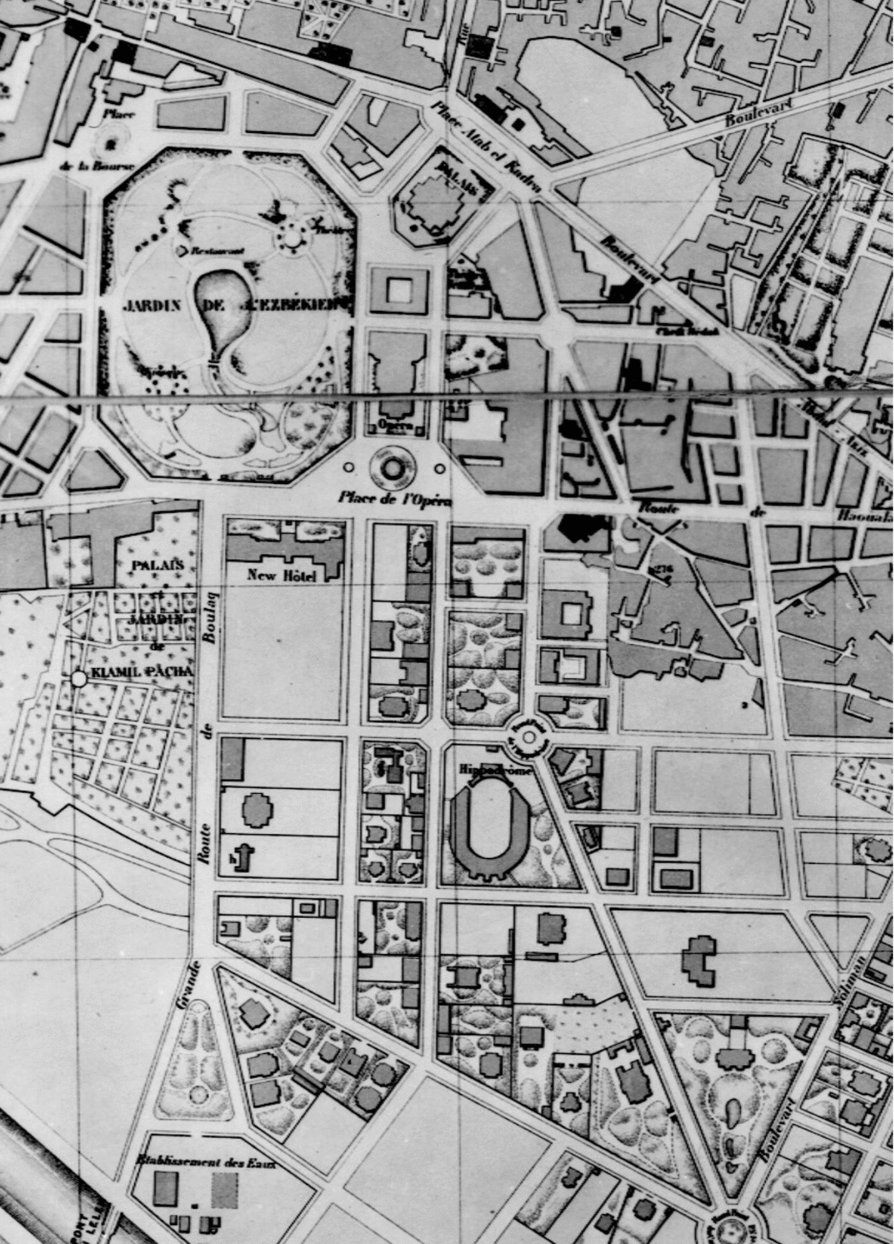
It is possible that it was the khedive alone who decided to turn Azbakiyya into a new type of public garden,Footnote 88 by buying/appropriating land, and even possible that this was the only public work he envisaged in the beginning (Figure 2).Footnote 89 He also ordered large private gardens to be attached to his new palaces.Footnote 90 (The khedive's love of gardens – one shared with all Egyptians – has been neglected in studies of urban change). Cordier's Société executed public works from early 1868, and destroyed many important smaller canals/wells (sāqiya) in the process, although the Egyptian engineers at Tanzim did their best to create new ones.Footnote 91 Urban legend holds that Ismail's men set fire to those houses at Azbakiyya whose owners were reluctant to sell.Footnote 92 By 1873, new roads and a new urban order – sometimes at the cost of aggressive demolition – had been implemented, along with the extension of the city.
Azbakiyya in the 1850s. Plan du Caire, F. Levernay, Guide-Annuaire d'Egypte (Alexandria, 1868), detail. Collection Max Karkégi, with permission.
It is important to recognize that the idea of a new public garden was closely bound to the idea of an independent state. Modern public gardens, connecting entertainment to public health, were a modern craze in the Ottoman, Habsburg, British and French empires as well as in the USA.Footnote 93 The public gardens of Paris and perhaps even the new public gardens in Istanbul (like Taksim Garden) were among the khedive's inspirations.Footnote 94 Conforming to the idea of the bourgeois state, instead of Azbakiyya ‘sans guardien’, the garden with fences and an entrance fee excluded those who could not pay or had no decent clothes or manners. In this way, the new garden embodied a new social hierarchy.
The visitor to ‘oriental’ Cairo in 1863 would not have recognized Azbakiyya in 1873: the smaller, European, fenced garden contained kiosks, a restaurant and a garden theatre (Figure 3). Below Azbakiyya, a new quarter filled up the triangle between Azbakiyya, Bulaq and the palace of Qasr al-Nil, labelled as ‘Ismailiyya’ (Wust al-Balad, ‘Downtown’ and Tahrir Square); it was for a time called in the Arabic press Ismāʿīliyya bi'l-Azbakiyya. Parcels of land, measured by Cordier's Société or by Muhafazat Misr,Footnote 95 were distributed free to the Ottoman-Egyptian elite and to Europeans on the condition that they build houses. Cordier's company executed most of the public works, damaging not only the old mansions but also the Misafirkhane Palace.Footnote 96 Although some work on the garden had already begun in 1868, it was ultimately the last public establishment to be completed (1872) in the territory.Footnote 97
Azbakiyya in the 1850s. Plan Général de la ville du Caire, by Grand Bey, 1874, detail. Collection Max Karkégi, with permission.
Music as civilization
Let us turn back to music at Azbakiyya, where a Comédie, a Circus, an Opera House and a Hippodrome were ordered by the khedive, while other urban works were executed in 1868–69. These ‘public’ buildings exemplify the khedive's personal interference in urban planning. In the nineteenth-century western European theory of music theatre relaxation was connected to a particular idea of cultured sociability. Draneht Bey, the superintendant of the new Opera, chatting with an Arab journalist in 1871, pointed out that music theatre is ‘the relaxing side of civilization’.Footnote 98 All such buildings were ‘khedivial’ not only in name, but as they were built on mīrī land, the khedive's Daira-i Khassa financing their yearly budgets, they were in his personal possession.Footnote 99 Thus, the exact responsibilities of the urban authorities were unclear in the beginning.Footnote 100
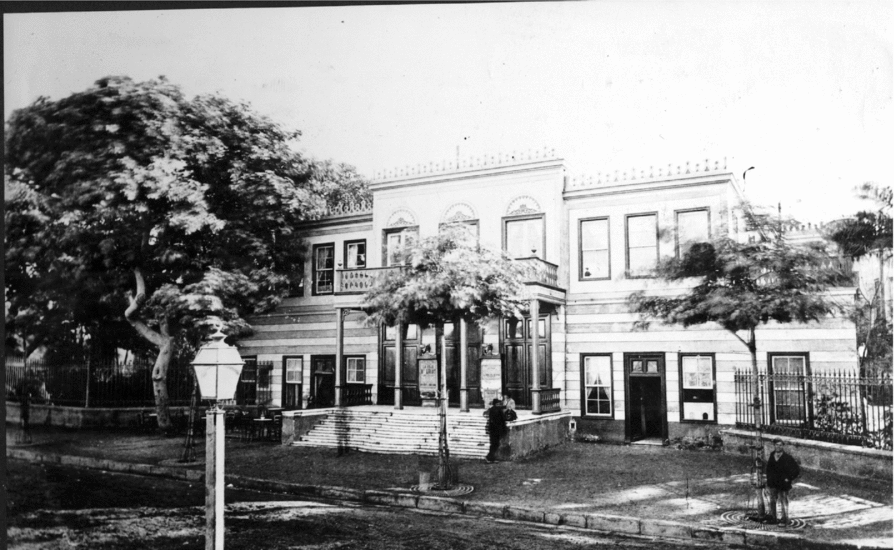
Given that these buildings did not respond to the needs of an existing audience, their creation is often interpreted as a west–east colonial transfer.Footnote 101 Yet the Ottoman context explains that their creation resulted from an interregional, yet autocratic, transfer. The first mention of a planned theatre in Cairo dates from September 1868 when the khedive was visiting Istanbul,Footnote 102 and an Ottoman Armenian impresario, the Francophile Seraphin Manasse, was invited to ‘migrate to Cairo’ from the Ottoman capital.Footnote 103 It is remarkable that Istanbul was perhaps not only a source of inspiration for building a French theatre but that the first impresario also came from this imperial capital. On the other hand, a German architect, Julius Franz (1831–1915), designed all the playhousesFootnote 104 with the exception of the Opera.Footnote 105 The music theatres were concentrated within a small territory on the south side of the Azbakiyya Garden. The first one, a Comédie, faced a police station (‘Zaptiyye’ (Ẓabṭiyya)), which might have been instrumental in the direct supervision of pleasure. It was built by demolishing the ruins of Ahmed Tahir Pasha's palace.Footnote 106 The building itself had a curious look because it indeed resembled a palace. It contained ‘116 stalls, 46 orchestra stalls, 18 pit boxes, 18 first class boxes and 18 second-class boxes’, with some screened boxes for the harem,Footnote 107 beautifully ornamented.Footnote 108 The inaugural performance by Manasse's French operetta troupe from Istanbul took place on 4 January 1869 (Figure 4).
Comédie (E. Béchard, 1874). Collection Max Karkégi, with permission.
Franz also designed the Circus in collaboration with a French engineer, Régis de Curel.Footnote 109 Although French colonialism did not export circuses,Footnote 110 it was built in the tradition of the circuses of imperial Paris that were copied all over Europe.Footnote 111 Its inauguration took place on 11 February 1869, by a French circus company (Theodore Rancy).Footnote 112 Again, special lodges for the harem with a thin wire screen in front were included, just as they had been in Istanbul's Gedikpaşa Circus-Theatre. Mattatias Nahman, a Greek Jewish merchant, bought the building in May 1872 and the ‘Mattatias-building’ was erected in its place in 1873.Footnote 113
If the Circus was a specific French fashion, the idea for an Italian Opera might have been a response to the imperial opera fever in Paris, Vienna, St Petersburg, Brazil and in Istanbul, where in February 1869 Sultan Abdülaziz planned to erect an Imperial Opera.Footnote 114 The khedive first ordered the recruitment of an opera company from Paris in February 1869,Footnote 115 and then the construction of an Opera House in around March. It is accepted that Pietro Avoscani, an Italian decorator, who designed the Zizinia Theatre in Alexandria, was the architect of the Opera,Footnote 116 although the architect Franz may have had a role in drawing the plans.Footnote 117 The worldwide competition between Italian and French music was thus extended to Egypt.
The khedive's wooden Opera House belonged to the theatre type dubbed ‘scène classique avec salle classique’,Footnote 118 an old-fashioned style of theatre construction.Footnote 119 (Wood was widely [re]used in Cairo and in general in Ottoman lands because it was cheap.) Scenery, furniture and props were imported from Paris,Footnote 120 whereas the interior was decorated by Italian painters.Footnote 121 The Opera opened on 1 November 1869 with a performance of Verdi's Rigoletto, preceded by a cantata in honour of Ismail,Footnote 122 as a prelude to the Suez Canal Opening Ceremonies. However, like the gunshots of the early 1860s, music and death were still fused in Azbakiyya: 10 workers died during the construction (Figure 5).Footnote 123
Khedivial Opera House and the Circus, around 1870, unknown photographer (perhaps E. Béchard?). Collection Max Karkégi, with permission.
If we consider that the Hippodrome opened in 1870 (designed by Franz, demolished in 1881),Footnote 124 and that the Garden with its garden theatre (presumably again designed by Franz)Footnote 125 opened in 1871, the cumulative impression is that the khedive replaced the mild cosmopolitanism of mid-nineteenth-century Azbakiyya with an imperial leisure district (see Figure 3). Azbakiyya kept its main function – the mixture of power and entertainment – but with a new visual, architectural and musical expression. The theatres and the garden embodied an imported imagination about imperial representation that announced hegemony to ordinary Egyptians and European visitors through visual and artistic means. The recently erected buildings offered new ceremonial spaces where Egypt's ruler could be celebrated both by his subjects and the international chorus, though previous Ottoman symbolism and the Egyptian popular ceremonies were markedly different.
The Opera: a school for the elite?
Clearly articulated traditions of entertainment succeeded each other; for example Arab art music gave way to French ballet. Yet, with dynamic urban change and the creation of symbolic western European imperial entertainments, Cairo also became the uncontested cultural capital, not only of Egypt, but of the whole Ottoman Arab world, joining the international market of the opera/theatre business. Its Opera especially served as a school for educating and disciplining a new urban elite, be they Egyptian Turks, Arabs, Jews, Armenians, Greeks or Italians.
During Draneht Bey's superintendancy (1869–78), the Opera House retained a strict Italian repertoire, hosting stars like Ferrucci, Valentine, De Gioza, Colonnese, Galletti, Zacchi, Colonnese Caryton, Augusti, la Pozzoni and Grossi; even employing Giovanni Bottesini as conductor for the 1871–72 season (for Aida's premier). Draneht Bey imported ballet troupes and famous dancers, such as Monplaisir, Cucchi and Pertholdi in 1870–71.Footnote 126 The khedive's Daira-i Khassa financed the enormous costs, including the writing and premier of Aida, intended as a ‘national’ Egyptian opera.Footnote 127 Due to both the financial crisis and the scarcity of audience, the Circus was sold, while the Hippodrome and the Comédie were often closed in the late 1870s.
During these years, the audience at the Opera House consisted mostly of the Ottoman Egyptian court of the khedive, Egyptian ministers, some Ottoman cultural creoles and the haute bourgeoisie of the rapidly increasing European migrant community. The khedive obliged the ministers to pay for the boxes, and he sent free tickets to schools. Some of the young Egyptian elite students employed tricks to get in.Footnote 128 Ismail was keen on inviting European journalists to the major symbolic events, including both the Suez Canal Opening Ceremonies in 1869 and the premier of Aida in 1871. He also invited visiting aristocrats to his Opera, thus creating an aura of prestige around it.Footnote 129 When his system could no longer pay the debts in 1876, the theatres were transferred to the state. Around 1879, after Ismail's fall and Draneht Bey's (now pasha) retirement, an inter-ministerial committee was formed (Comité des Théâtres) to supervise the Opera House until 1900. It became a contested public space during the first decade of the British occupation, the transitional years of the 1880s. The growing cosmopolitan and colonial audience, both the Europeans and the Europeanizing Ottoman Egyptian elite (especially the khedivial family), used the Opera House for their pleasure, served by Italian or French troupes and even by Ottoman Turkish-speaking Armenian performers from Istanbul.Footnote 130
Pleasure from below?
It is within this framework that new relations between class, taste and music/theatre were forged at the various levels of a society under khedivial and British rule. Ordinary Egyptians could now articulate their relation to imported urbanism only via an instrumentalized concept of pleasure as connected to discourses of progress and modernity. The dynamic transformation of Cairo and Khedive Ismail's propagandistic attempt to stage himself as a benevolent Arab ruler convinced many Egyptians and Syrians that Egypt had the potential to create a new type of modernity in Arabic, independent of the Ottoman Tanzimat.
The Egyptian ordinary public visited Rancy's circus in 1869 in large numbers, precisely because of its advertisements in Arabic. The Opera House's construction went more or less unnoticed in the Arabic press,Footnote 131 yet when soon after the opening the khedive began offering free seats to Arab journalists, especially to Muhammad Unsi and his father, Abu'l-Suʿud Effendi (editors of Wadi al-Nil journal), they in turn began to engage extensively with the theatre and opera.Footnote 132 In a similar way to that in which domestic culture shaped modernity in Beirut,Footnote 133 the public theatres in Cairo offered not only a musical taste but also an identification of this taste with a new, modernizing upper class. Yet the new ways of living did not necessarily give rise to imitation. Patriotic Egyptian individuals, in reaction to the khedivial urban pleasures and buildings, searching for an appropriate cultural expression, turned to the popular Egyptian traditions, be they street entertainments, folk songs or the Arab art music so characteristic of mid-nineteenth-century Azbakiyya.Footnote 134
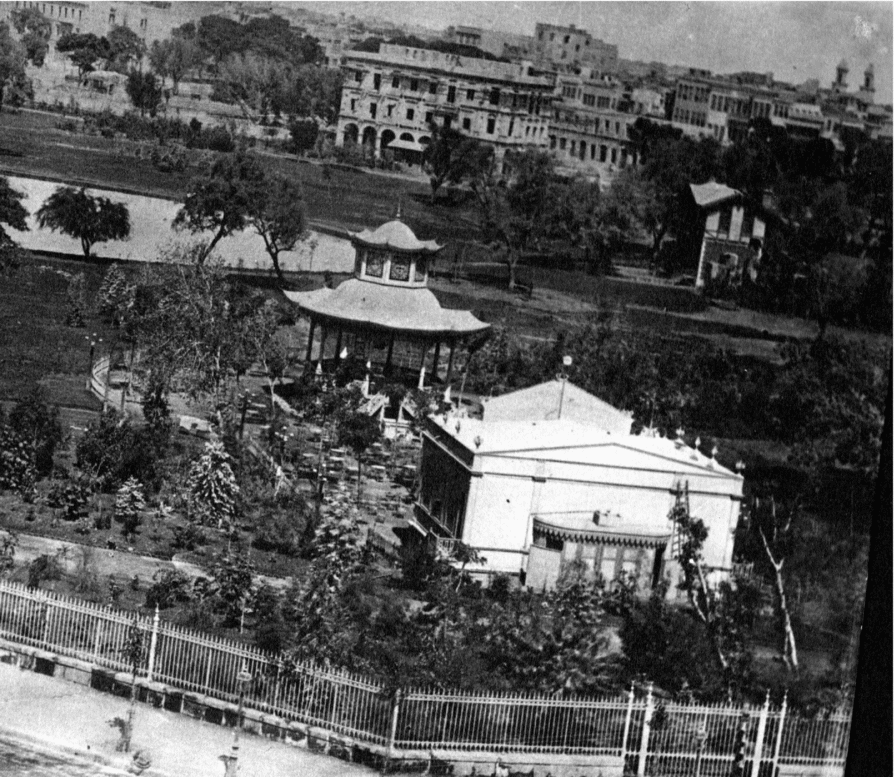
Such attempts to reclaim Azbakiyya via familiar entertainment for ordinary people can be traced back to the theatre of an Egyptian Jew, James Sanua, established in around spring 1871. During this year, his ‘operettas’, staged in colloquial Egyptian Arabic and using popular tunes, brought Egyptians to the Azbakiyya Garden Theatre (Figure 6) and conferred upon him the blessing of the khedive. By the spring of 1872, Sanua's theatre (which was a young Egyptians’ company) had been given a chance to be institutionalized through the staging of plays in the Comédie. But from this moment, due to its vulgar nature, Sanua's theatre did not receive more khedivial support, just as the classicist Muhammad Unsi of Wadi al-Nil was probably refused when he asked the khedive to support the establishment of an Arab state theatre in 1872.Footnote 135 For a time, only the guards represented ordinary Egyptians at the khedivial theatres.Footnote 136
Théâtre-Concert du Jardin de l'Esbekieh, around 1872, unknown photographer (perhaps E. Béchard?). Collection Max Karkégi, with permission.
The Opera House, as a new public space, despite its highly artificial sociability, still provided a link between earlier Egyptian traditions of entertainment, power and modernity in the 1880s. Ottoman Syrian theatre makers, many of them Christian, arrived in 1876 to offer a more suitable Arab culture to Khedive Ismail. Although he was already bankrupt, the version of Arab modernity offered by Syrians represented a potential khedivial Arab façade for his heir, Tevfik, in the colonial atmosphere of the 1880s. In order to mark themselves as ‘patriotic’, Syrians allied with Egyptian singers, thereby forging a particular type of interregional music theatre in Arabic. The most successful such alliance was the collaboration between the Syrian impresario Sulayman Qardahi and the Egyptian singer Salama Hijazi, first in the spring of 1882, performing at the Opera House for the patriotic ʿUrabi Pasha. After the British suppressed the ʿUrabi-revolt, in the second half of the 1880s, Qardahi and Hijazi achieved enormous success together with the support of Khedive Tevfik. During these years, symbolically embodying the continuity of old and new Azbakiyya, the singer ʿAbduh al-Hamuli also returned from private khedivial service to the public, with regular concerts at the Opera House. By attending these patriotic (waṭanī) occasions, ordinary Egyptians, Syrians and the self-nationalizing Ottoman Egyptian elite often expressed political opposition to the British occupation in the symbolic presence of the Ottoman imperial representative, Ahmed Muhtar Pasha.Footnote 137
However, banal coincidences, competition between theatre makers and the reassertion of British rule in the 1890s brought about a more rigid division between colonial policy and Arab patriotism: theatre in Arabic was excluded from the Opera House for many years. The new entertainment in Arabic, be it colloquial or classical, was confined to private/semi-private theatres or coffeehouses in Cairo, Alexandria, Tanta, Port Said, etc., where individuals who would today be considered middle class (writers, lawyers, doctors, bureaucrats, soldiers) and even the urban poor could participate. This mixing between Arab and Italian/French music resulted in hybrid musical art forms that became the basis for twentieth-century entertainment, such as al-Rihani's or Sayyid Darwish's song-theatres.Footnote 138
The proliferation of perceptions
There is a further connection between urbanism and sociability in Azbakiyya or ‘Izbikiyya’. Some of the new public spaces became associated with moral corruption. The café chantants in the neighbourhood offered roulette games where Egyptians spent, and too often lost, their money.Footnote 139 An Egyptian popular song, recorded in 1893, told an erotic tale about meeting a girl in Izbikiyya.Footnote 140 From ʿA. Mubarak's novel ʿAlam al-Din (1882) to Z. Fawwaz, T. al-Hakim or A. Amin, we may find numerous, often contradictory, perceptions of the theatres and the garden itself as beautiful but dangerous places of immorality, not so much against Muslim principles (that was a later development), but rather dangerous for the poor who lost money and face hunting for women. Musicians cursed Azbakiyya's early twentieth-century music halls as ‘caves of demons’ and the territory itself as a ‘square of debauchery and immorality’.Footnote 141 In this way, the garden and its neighbourhood also preserved their mid-nineteenth-century bad reputation.
On the other hand, the neighbouring Opera House symbolized a new conception of Egyptian sovereignty, closely connected to the staging of the dynasty as benevolent Arab rulers, as A. Shawqi's poems indicate.Footnote 142 Performing in Azbakiyya's music halls and the new mass music industry helped the rise of national stars, such as Umm Kulthum, repeating the pattern of al-Hamuli in a twentieth-century frame. In the 1930s, the pan-Muslim journal al-Fath alerted the public: ‘these halls are not for singing and dancing in fact, as they say, but these are special places that are shelters for prostitutes and trouble-making girls’.Footnote 143 Thus, the word ‘Azbakiyya’/‘Izbikiyya’ denoted several different locations (garden, theatres, music halls, casinos) and perceptions (foreigner, sublime national, morally corrupt). The Nasir-regime after 1952 would make extensive use of the Opera House as an elite Arab socialist locus, exactly in the way this spot had been used in previous centuries, until the Opera burned down in 1971.
Conclusion
This article has shown that elite ceremonials and popular entertainment were intertwined in Azbakiyya. From the Middle Ages to the early twentieth century, it was simultaneously the site of entertainments that were perceived as morally inferior and the site of symbolic celebrations of the elite. The ruling dynasty's continuous transformation of the city and specifically of Azbakiyya is central to my argument. In the modern era, this neighbourhood was first a pre-colonial cosmopolitan square, and later Khedive Ismail's experimental ground for a new state representation, comprising contested political spaces that were inhabited, lost, reclaimed, fought for and finally reused by Egyptians. During this process, taste became crucial in establishing a new class hierarchy and in articulating new moral conceptions in relation to urban spaces. Such a complex process involving various types of institutions for entertainment (Opera House, café chantants, casinos) within the same neighbourhood resulted in the proliferation of perceptions about Azbakiyya. This analysis sheds new light on the origins of modern Cairo, replacing bifurcated ruptures with more refined mechanisms of power. The intertwined history of sociability and urbanity as a method of studying the emergence of the modern metropolis to replace empty planning histories needs further research.