INTRODUCTION
Members of the family Barbouriidae are characterized as anchialine troglobitic decapod Crustaceans. This Caridean family includes four genera: Barbouria, Parhippolyte, Janicea and Calliasmata, totalling 11 species (De Grave & Fransen, Reference De Grave and Fransen2011; De Grave et al., Reference De Grave, Li, Tsang, Chu and Chan2014). Western Atlantic troglodytic shrimps may be relicts of ancient stocks and are believed to have evolved from deep-sea shrimp that invaded shallower anchialine caves and pools in the West Indies sometime during the Jurassic (Hobbs et al., Reference Hobbs, Hobbs and Daniel1977; Hart et al., Reference Hart, Manning and Iliffe1985; Hobbs, Reference Hobbs1994). Both Barbouria cubensis (Von Martens, Reference von Martens1872) and Parhippolyte sterreri (Hart & Manning, Reference Hart and Manning1981) exhibit wide-ranging yet disjunct distributions in the tropical western Atlantic and are thought to have originated from broadly distributed marine ancestors (Hobbs, Reference Hobbs1994).
Modern Barbouriidae are typically found in tropical waters, inhabiting marine caves and anchialine lakes, and it is not unusual to find different species of this family inhabiting the same site (Hart & Manning, Reference Hart and Manning1981). In the western Atlantic, P. sterreri has been previously reported from Bermuda, the islands of Andros, Exuma and Grand Bahama in the Bahamas, and Cozumel, Mexico (Hart & Manning, Reference Hart and Manning1981; Brooks, Reference Brooks1987; Kensley, Reference Kensley1988; Wicksten, Reference Wicksten1996). Barbouria cubensis has previously been reported from Bermuda, Cayman Brac, Cuba, Jamaica, the islands of Abaco, Exuma, San Salvador and Grand Bahama in the Bahamas, and Providenciales in the Turks and Caicos Islands (Hobbs et al., Reference Hobbs, Hobbs and Daniel1977; Manning & Hart, Reference Manning and Hart1984).
Prior to this study, only B. cubensis was reported from San Salvador Island and all anecdotal reports of shrimp observed in inland ponds and lakes were assumed to be this species. We report on the first occurrence of P. sterreri from San Salvador Island, which represents a minor range extension for this species in the Bahamas. We also describe the occurrence of B. cubensis based on widespread sampling in anchialine ponds across the island.
MATERIALS AND METHODS
Environmental setting
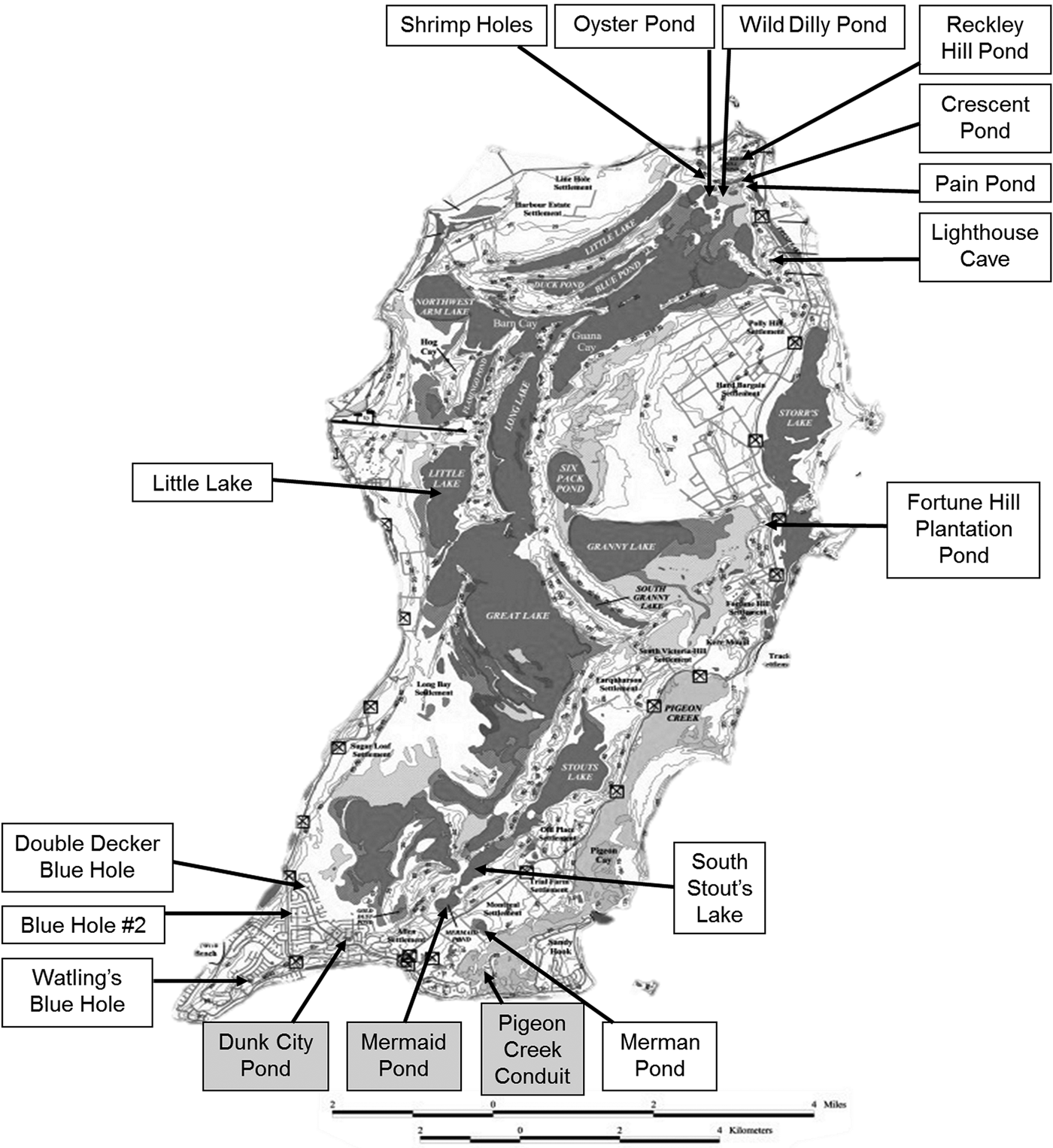
San Salvador is a small island in the Bahamian archipelago, measuring 9.66 km in width and 19.3 km in length. A prominent feature of the island is numerous inland ponds and lakes (Figure 1). Many are seep-fed, with high evaporation rates and exhibit hypersaline conditions, while others are conduit-fed and are marine in nature (Mylroie & Carew, Reference Mylroie, Carew, Budd, Saller and Harris1995). Most inland ponds and lakes on the island are nearly undisturbed ecosystems, which form ecological ‘islands’ within islands, each somewhat unique from the other ponds and lakes. These ‘islands’ typically contain faunal components of reduced ecological diversity and may be dominated by just a few groups of marine organisms (Edwards, Reference Edwards, Elliot, Edwards and Godfrey1996). It is believed that, with the exception of rare large storm events, these inland bodies of water have been isolated since the last sea-level high stand approximately 125,000 years ago (Carew & Mylroie, Reference Carew, Mylroie, Curran and White1995).
Map of San Salvador Island, Bahamas including the 17 sites where shrimp were collected. Parhippolyte sterreri collections sites are indicated by grey shaded boxes.

Methods
Samples were collected using SCUBA and baited minnow traps were deployed in 30 sites during 2011, 2012 and 2013. All specimens were fixed in 95–100% ethanol. Identification of Parhippolyte sterreri (Figure 2A) and Barbouria cubensis (Figure 2B) was based on Hobbs et al. (Reference Hobbs, Hobbs and Daniel1977), Hobbs (Reference Hobbs1978), Hart & Manning (Reference Hart and Manning1981), Manning & Hart (Reference Manning and Hart1984), Wicksten (Reference Wicksten1996) and Mejía et al. (Reference Mejía, Zarza and López2008). Representative specimens of P. sterreri were deposited in the US National Museum of Natural History (USNM 1234891-94) and the Oxford University Museum of Natural History (OU-MNH.ZC.2014-07-027, 028 and 034, 035). The remaining samples are currently retained at Florida International University.
Examples of Parhippolyte sterreri (A) and Barbouria cubensis (B) collected from San Salvador Island, Bahamas.
RESULTS AND DISCUSSION
A total of 1587 shrimp were captured from 17 of the 30 ponds sampled (Figure 1), of which 143 individuals were retained for further study. The incidence of Barbouria cubensis indicates a broad geographic distribution on San Salvador, while Parhippolyte sterreri was restricted to three sites (Mermaid Pond, Dunk City Pond and the Pigeon Creek Conduit) in the south-eastern portion of the island (Figure 3). Both B. cubensis and P. sterreri were readily visible in and around the conduit mouths of Mermaid Pond and Dunk City Pond, but observations could not be made in the Pigeon Creek Conduit mouth due to strong tidal flow. In all instances that P. sterreri was captured, B. cubensis was also present, but in far fewer numbers.
Map of sample sites where Parahippolyte sterrei was present (adapted from Google Earth).
The fact that P. sterreri was only found in the southern portion of the island is interesting, as this suggests a possible subterranean connection between Mermaid Pond, Dunk City Pond and the Pigeon Creek Conduit. Parhippolyte sterreri was not found in Merman Pond or Three Roses Cave within the pond. However, due to possible sampling errors (trap placement), strong tidal flow and the small number of B. cubensis captured in Merman Pond, the absence of P. sterreri in the pond on a single visit may not represent their true status. Previous investigations have attempted to trace the water flow through Three Roses Cave in Merman Pond, but have been unsuccessful (E. Cole, personal communication). Although this would suggest that Merman Pond is isolated from the neighbouring ponds and the Pigeon Creek tidal lagoon, its proximity and position on the landscape would suggest otherwise (Figure 3).
Neither species has been visible or present in and around the mouth of the conduits on each visit to samples sites (i.e. in 2011 only P. sterreri was present in Mermaid Pond vs in 2012 only B. cubensis was present). This might be due to the localized movement of individuals within conduits associated with tidal cycles and that a single sampling event may not accurately reflect the species composition in each pond.
The present study is the first record of P. sterreri from San Salvador Island, which represents a minor range extension for this species in the Bahamas. This study also represents the first record of P. sterreri and B. cubensis inhabiting a cave/conduit outside of landlocked anchialine pools (i.e. the Pigeon Creek Conduit). Future studies are required to confirm the species composition of previously sampled sites, to diagnose any remaining unsampled populations and to identify the source of P. sterreri on San Salvador Island. Additionally, further research is required to clarify the intermittent presence of shrimp in the conduit mouths and to examine the interactions between P. sterreri and B. cubensis, or other Barbouriidae, cohabitating the same anchialine pools.
ACKNOWLEDGEMENTS
We are grateful to Dr Ray Bauer for confirming species identifications and Dr Eric Cole for his advice on sampling Merman Pond and the Pigeon Creek Conduit. Special thanks go to Courtney Bennett, Gina Hendricks and Sean Goebel for their help in the field. Drs Greg Tolley, Mike Parsons, Randy Cross, John Winters, Eric Cole and Matt Palmtag provided valuable feedback and assistance. This research was funded in part by a student research award to RED from the Gerace Research Centre. Additional support was provided by the Whitaker Centre for STEM Education and the Office of Research and Sponsored Programs at Florida Gulf Coast University. Last but not least, we'd like to thank the citizens of San Salvador, the Ditter family and the Wayne family for their encouragement and support.