Introduction
Mexico is recognized as one of the Vavilov centres of origin, domestication and diversification of crops of global importance, such as maize, beans, pepper, tomato, pumpkin, etc., and there is a high diversity of their wild relatives (Vavilov, Reference Vavilov1926; Bellon et al., Reference Bellon, Barrientos-Priego, Colunga-García Marín, Perales, Reyes Agüero, Rosales Serna and Zizumbo-Villarreal2009; Vincent et al., Reference Vincent, Wiersema, Kell, Fielder, Dobbie, Castañeda-Álvarez, Guarino, Eastwood, León and Maxted2013). Crop wild relatives (CWR) are potential sources of adaptive traits for crop breeding due to their close genetic relationship to the crops and their wide genetic variation (Maxted et al., Reference Maxted, Hawkes, Guarino and Sawkins1997b, Reference Maxted, Ford-Lloyd, Jury, Kell and Scholten2006; Tanksley and McCouch, Reference Tanksley and McCouch1997). However, climate change and other factors are contributing to the genetic erosion and potential extinction of these important Mexican natural resources (Jarvis et al., Reference Jarvis, Lane and Hijmans2008; Lira et al., Reference Lira, Téllez and Dávila2009; Ureta et al., Reference Ureta, Martínez-Meyer, Perales and Álvarez-Buylla2012). Moreover, the conservation of CWR is relatively limited globally. Only an estimate 7.6% of ex situ accessions in the EURISCO network (European Search Catalogue for Plant Genetic Resources) belong to wild populations (EURISCO, 2018). Castañeda-Álvarez et al. (Reference Castañeda-Álvarez, Khoury, Achicanoy, Bernau, Dempewolf, Eastwood, Guarino, Harker, Jarvis, Maxted, Müller, Ramirez-Villegas, Sosa, Struik, Vincent and Toll2016) found that 70% of 1076 CWR taxa related to 81 globally important crops require improving of ex situ conservation. In Mexico, several national and international institutes host a wide range of Mexican crops and their wild relatives accessions, e.g. the National Plant Germplasm Bank (BANGEV) (http://www.chapingo.mx), the seedbank at Facultad de Estudios Superiores (FES) de Ixtacala (UNAM) (http://www.iztacala.unam.mx), the National Genetic Resources Center (CNRG) of the National Forestry, Crops and Livestock Research Institute (INIFAP) (http://www.inifap.gob.mx), and the International Maize and Wheat Improvement Center (CIMMYT) (http://www.cimmyt.org).
In situ conservation of CWR in protected areas (PA) is also generally deficient globally and only a handful of CWR genetic reserves have been established (Maxted and Kell, Reference Maxted and Kell2009), and none meet the in situ conservation standards established by Iriondo et al. (Reference Iriondo, Maxted, Kell, Ford-Lloyd, Lara-Romano, Labokas, Magos Brehm, Maxted, Dulloo, Ford-Lloyd, Frese, Iriondo and Pinheiro de Carvalho2012). However, in Mexico there are 182 PA, conserving 90.8 million hectares of natural habitats (http://www.gob.mx/conanp), so there is high potential for extending in situ conservation of CWR. As an example, the conservation of Zea diploperennis Iltis, Doebley & R. Guzmán and Z. mays subsp. parviglumis Iltis & Doebley in the Sierra de Manantlán Biosphere Reserve, Jalisco, is considered a good global example of active in situ conservation of CWR within Mexico (UNESCO, 2011).
Conservation of CWR genetic resources using complementary in situ and ex situ approaches will decrease the risk of losing valuable germplasm (Dulloo et al., Reference Dulloo, Ramanatha Rao, Engelmann, Engels, Batugal, Rao and Oliver2005; Maxted and Kell, Reference Maxted, Kell, Maxted, Ford-Lloyd, Kell, Iriondo, Dulloo and Turok2008; Zegeye, Reference Zegeye2017). Aiming to plan a systematic in situ and ex situ long-term conservation of priority CWR, a national CWR conservation strategy for Mexico is being developed (Contreras-Toledo et al., Reference Contreras-Toledo, Cortés-Cruz, Costich, Rico-Arce, Magos Brehm and Maxted2018) which will be integrated in the Mexican Strategy for Plant Conservation 2012–2030 (CONABIO, 2012). The national CWR conservation strategy will highlight necessary conservation actions identified through a gap analysis of in situ and ex situ conservation of priority CWR using the methodology proposed by Magos Brehm et al. (Reference Magos Brehm, Kell, Thormann, Gaisberger, Dulloo and Maxted2017). Here, we present the results of the in situ and ex situ conservation gap analyses of Mexican priority CWR, as a key step to developing a national CWR conservation strategy for Mexico.
Materials and methods
Priority CWR taxa
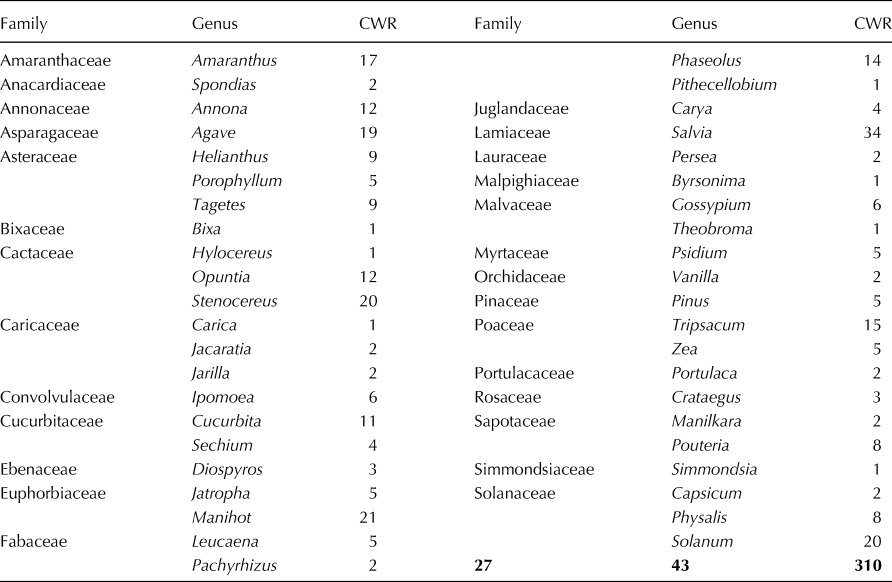
A set of 310 priority CWR taxa, comprising 27 families, 43 genera, 286 species and 24 sub-specific taxa related to 40 crop gene pools, containing fruits, vegetables, cereals and pseudo-cereals, legumes, tubers, nuts, forages, industrial/medicinal and spice crops, were previously identified as part of the national CWR inventory for Mexico (Contreras-Toledo et al., Reference Contreras-Toledo, Cortés-Cruz, Costich, Rico-Arce, Magos Brehm and Maxted2018 and Table 1). Occurrence records of all the taxa comprised in the national CWR inventory were obtained from national and international herbaria and gene banks (Supplementary Table S1). For those accessions without latitude and longitude data, but with location information, the coordinates were obtained using the Historic Archive of Geostatistical Localities of the National Institute of Geography and Statistics of Mexico (INEGI, 2017), the terrestrial infrastructure database of the Secretariat of Communications and Transportation of Mexico (SCT, 2017) and GoogleEarth©. These tools were used to ensure the maximum possible geographic precision of the records and therefore, of the performance of the species distribution models (SDM) and gap analyses.
Number of priority Mexican crop wild relatives (CWR) taxa per genus used in the in situ and ex situ gap analyses of this study (Contreras-Toledo et al., Reference Contreras-Toledo, Cortés-Cruz, Costich, Rico-Arce, Magos Brehm and Maxted2018)

Species distribution modelling
To build the SDM, the ecogeographic variables were selected for each taxon from an initial set of 84 variables for Mexico. These are grouped into three components: bioclimatic, edaphic and geophysical variables (Supplementary Table S2). The variables with a resolution of 30 arc-s (approximately. 1 × 1 km at the Equator) are included in the CAPFITOGEN 2.0 tools (Parra-Quijano et al., Reference Parra-Quijano, Torres, Iriondo, López and Molina2016, http://www.capfitogen.net/en). The most important variables that define the adaptive scenarios for each taxon were identified using the Random Forest method (RF) (Cutler et al., Reference Cutler, Edwards, Beard, Cutler, Hess, Gibson and Lowler2007) integrated in the ‘SelecVar’ tool of CAPFITOGEN 2.0 (Parra-Quijano et al., Reference Parra-Quijano, Torres, Iriondo, López and Molina2016). A final set of non-correlated variables was tested using correlation analysis and selected to produce the SDM for each CWR taxon using the maximum entropy modelling algorithm (MaxEnt) (Phillips et al., Reference Phillips, Anderson and Schapire2006), due to its wide utilization for conservation purposes (e.g. Ramírez-Villegas et al., Reference Ramírez-Villegas, Khoury, Jarvis, Debouck and Guarino2010; Khoury et al., Reference Khoury, Heider, Castañeda-Álvarez, Achicanoy, Sosa, Miller, Scotland, Wood, Rossel, Eserman, Jarret, Yencho, Bernau, Juarez, Sotelo, de Haan and Struik2015, Phillips et al., Reference Phillips, Asdal, Magos Brehm, Rasmussen and Maxted2016). The SDM for each taxon with 10−50 occurrences were produced using a fivefold cross-validate replication, while for taxa with >50 occurrences a 10-fold cross-validate replication was selected. In all cases, the maximum training sensitivity plus specificity threshold was applied (Liu et al., Reference Liu, Berry, Dawson and Pearson2005, Reference Liu, Cook, Melia-Hancock, Guill, Bottoms, Garcia, Ott, Nelson, Recker, Balint-Kurti, Larsson, Lepak, Buckler, Trimble, Tracy, McMullen and Flint-Garcia2016). The models were validated prior to being used for the gap analyses by assessing three conditions: (a) average area under the test receiver operating characteristic curve (AUC) >0.7 (ATAUC > 0.7), (b) standard deviation of the ATAUC < 0.15 (STAUC < 0.15), and (c) the proportion of potential distribution area (grids) with a STAUC > 0.15, being <10% (ASD15 < 10%) (Ramírez-Villegas et al., Reference Ramírez-Villegas, Khoury, Jarvis, Debouck and Guarino2010; Castañeda-Álvarez et al., Reference Castañeda-Álvarez, de Haan, Juárez, Koury, Achicanory, Sosa, Bernau, Salas, Heider, Simon, Maxted and Spooner2015). All three conditions had to be met for a model to be valid. For those taxa that failed the validation assessment and those with <10 observation points, the potential distribution areas were estimated using a circular area with a radius of 50 km (CA50) around each occurrence record, counting overlapping areas only once (Hijmans and Spooner, Reference Hijmans and Spooner2001; Castañeda-Álvarez et al., Reference Castañeda-Álvarez, de Haan, Juárez, Koury, Achicanory, Sosa, Bernau, Salas, Heider, Simon, Maxted and Spooner2015).
Ecogeographic land characterization maps
Ecogeographic land characterization (ELC) maps are tools that help describe different potential environmental conditions for plant taxon adaptation and were used to assess the representation of the ecogeographic variability and to identify potential sites for in situ conservation and ex situ collection (Parra-Quijano et al., Reference Parra-Quijano, Draper, Torres, Iriondo, Maxted, Ford-Lloyd, Kell, Iriondo, Dulloo and Turok2008, Reference Parra-Quijano, Iriondo and Torres2012a, Reference Parra-Quijano, Iriondo and Torresb; Castañeda-Álvarez et al., Reference Castañeda-Álvarez, Vincent, Kell, Eastwood, Maxted, Guarino, Ramanatha Rao and Goldberg2011). ELC maps were created for the priority CWR taxa with valid SDM using CAPFITOGEN 2.0 tools (Parra-Quijano et al., Reference Parra-Quijano, Torres, Iriondo, López and Molina2016). With the ‘ELCmapas’ tool, the previously selected variables (using the ‘SelecVar’ tool) were used to determine the number of environmental conditions (ELC categories or zones) per taxon. The parameters for the ‘ELCmapas’ tool were set to a maximum of three groups per variable component (bioclimatic, edaphic and geophysical) and using the method ‘elbow’. Layers with a grid cell size of 2.5 arc-min (approximately 5 × 5 km at the Equator) were used for this analysis.
Ex situ gap analysis
The diversity analyses were conducted according to Maxted et al. (Reference Maxted, Dulloo, Ford-Lloyd, Iriondo and Jarvis2008a), Scheldeman and Zonneveld (Reference Scheldeman and van Zonneveld2010) and Parra-Quijano et al. (Reference Parra-Quijano, Iriondo and Torres2012b) in which gaps of in situ and ex situ conservation were identified at taxon and ecogeographic levels. A map showing areas of predicted taxon richness was created based on the SDM. A second map showing areas of current ex situ collections was created and subtracted from the predicted taxon richness map to reveal the gaps in current germplasm collections and identify potential priority areas for future ex situ collection. The maps were created in DIVA-GIS 7.5 (Hijmans et al., Reference Hijmans, Guarino and Mathur2012, http://www.diva-gis.org/) and ArcMap 10.0 (ESRI, 2011) using a grid size of 0.125° (approximately 15 × 15 km). To assess the representativeness of the ecogeographic diversity in current ex situ conservation, the resulting ELC map and the presence points were used as the input for the ‘Representa’ tool to identify the level of representativeness of the ELC zones in the ex situ collections (Parra-Quijano et al., Reference Parra-Quijano, Torres, Iriondo, López and Molina2016). To assign the level of representativeness, the frequencies of the species in each zone of the ELC maps were grouped into quartiles: <0.25 (low), 0.25–0.5 (mid-low), 0.5–0.75 (mid-high) and >0.75 (high). Zones where species do not occur are assigned as ‘null’ (Parra-Quijano et al., Reference Parra-Quijano, Torres, Iriondo, López and Molina2016). The maps were processed in DIVA-GIS 7.5 and ArcMap 10.0 with a grid cell size of 2.5 arc-min (approximately 5 × 5 km at the Equator).
In situ gap analysis
A complementarity analysis was used to identify potential priority sites for in situ conservation of CWR. These sites are defined by Maxted et al., Reference Maxted, Hawkes, Guarino and Sawkins1997b as genetic reserves for management and monitoring of genetic diversity in natural wild populations within defined areas created for active, long-term conservation. They may be established within existing PA, as new conservation areas specific for CWR conservation, or as informal CWR management sites (Magos Brehm et al., Reference Magos Brehm, Kell, Thormann, Gaisberger, Dulloo and Maxted2017). Potential genetic reserve sites were designated according to their importance for the conservation of the CWR diversity, using the ‘Reserve selection’ tool in DIVA-GIS 7.5. The grid cell size was 0.125 degrees (approximately 15 × 15 km). The maps of PA of the country were obtained from CONABIO (2017) (http://www.conabio.gob.mx/informacion/gis/), then overlapped with the taxon richness map and the complementarity reserve sites map to identify the extent to which the CWR diversity is under at least current passive in situ conservation and to identify further in situ conservation actions. Passive in situ conservation means that the CWR are predicted to be present in existing PA but are not under any active management, such as monitoring of demographic and genetic structure, control of invasive species and disturbances, habitat restoration, assisted propagation, etc. (Maxted et al., Reference Maxted, Iriondo, Dulloo, Lane, Iriondo, Maxted and Dulloo2008b), contrary to those under active in situ conservation (Maxted et al., Reference Maxted, Ford-Lloyd and Hawkes1997a). Further analysis was conducted using ELC maps to determine the level of ecogeographic diversity that is at least passively conserved in situ, i.e. populations in different ecogeographic areas occurring within current PA network. The Mexican PA maps (CONABIO, 2017) were overlapped to the ELC maps previously created to compare the representativeness of the ELC zones in the PA networks. The frequencies of the PA in each zone of the ELC maps were estimated. They were grouped into quartiles to assign the level of representativeness: <0.25 (low), 0.25–0.5 (mid-low), 0.5–0.75 (mid-high) and >0.75 (high) and null (Parra-Quijano et al., Reference Parra-Quijano, Torres, Iriondo, López and Molina2016). The maps were processed in DIVA-GIS 7.5 and ArcMap 10.0 with a grid cell size of 2.5 arc-min (approximately 5 × 5 km).
Results
Ex situ gap analysis
A total of 44,448 unique presence points in Mexico for 308 priority CWR taxa were used for the analyses. Stenocereus thurberi (Engelm.) Buxb. subsp. littoralis (K. Brandegee) N. P. Taylor and S. thurberi (Engelm.) Buxb. subsp. thurberi, wild relatives of pitaya, were necessarily excluded from the analyses due to the lack of accurate occurrence records. A total of 224 SDM were used for those taxa where the validation conditions were met; for the remaining 84 taxa, the CA50 area was used. The number of environmental variables used for the analyses ranged from eight to 31 among the taxa. The ELC maps defined from 19 to 27 different ELC zones for each of the 224 priority taxa, based on the selected variables (Supplementary Table S3).
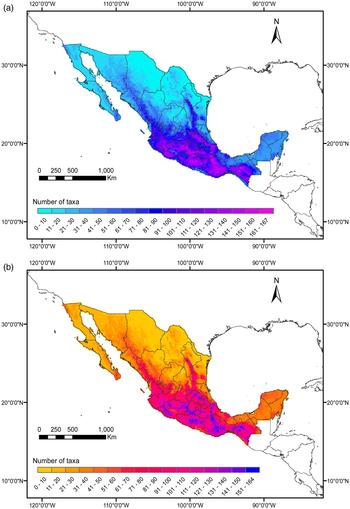
About 53% of Mexican CWR taxa (162) have at least one accession conserved ex situ. Of these about 7% (23) have accessions from at least 50 different populations. Wild Phaseolus vulgaris L. is the species with the highest number of accessions, a widely distributed taxon. About 93% of the taxa (285) are under-represented ex situ with accessions from <50 populations (Supplementary Table S5). The predicted taxon richness areas correspond to the hotspots for further collecting, located in central and southern Mexico (Fig. 1), mainly along the mountain ranges of the Trans-Mexican Volcanic Belt, Sierra Madre del Sur, Sierra Madre de Chiapas and the southern portion of the Sierra Madre Oriental. In these areas, up to 167 CWR taxa are predicted to be present and of those, up to 164 need further collection.
Predicted taxon richness (a) and hotspots (b) for further collecting of priority CWR in Mexico. Maps based on species distribution models (SDM). Grid square size is 0.125° (approximately 15 × 15 km). Geographic coordinate system is WCS 1984.

Most of the ELC zones are under-represented in ex situ collections for most taxa. On average, 54% of the taxa have no ELC zones represented ex situ, 15% are low represented, 9% are mid-low represented, 11% are mid-high represented and an additional 11% are highly represented ex situ (Supplementary Table S3). Agave fourcroydes Lem., Salvia columbariae Benth., Sechium hintonii (Paul G. Wilson) C. Jeffrey, Stenocereus fricii Sánchez-Mej., Tripsacum maizar Hern.-Xol. & Randolph and Zea diploperennis Iltis, Doebley & R. Guzman have accessions coming from fewer than five ELC zones (Supplementary Table S3).
In situ gap analysis
The potential distribution of the 308 priority CWR taxa showed that the highest diversity is potentially found in central and southern Mexico, along the main mountain ranges in the states of Jalisco, Michoacán, Guerrero, Oaxaca, Chiapas, Veracruz, Mexico State, Morelos, Hidalgo and Puebla (Fig. 1a), where up to 167 CWR taxa are present. By contrast, the area of north-central Mexico has the lowest number of taxa. There are 275 taxa (89%) predicted to occur in at least one PA, 175 (57%) of which are predicted in more than five PA. The remaining 133 taxa (43%) have less than five populations in different PA, the minimum suggested by Dulloo et al. (Reference Dulloo, Labokas, Iriondo, Maxted, Lane, Laguna, Jarvis, Kell, Iriondo, Maxted and Dulloo2008) for in situ conservation in PA. The PA with the highest predicted number of priority CWR taxa are the Cuenca Alimentadora del Distrito Nacional de Riego 043 (CADNR 043), in the states of Zacatecas, Durango, Jalisco, Nayarit and Aguascalientes, with 87 taxa; the Sierra Gorda Biosphere Reserve in the states of Querétaro, Guanajuato, San Luis Potosí and Hidalgo, with 71 taxa, and the Tehuacán-Cuicatlán Biosphere Reserve in the states of Puebla and Oaxaca, with 67 taxa (Supplementary Table S4). These PA cover a relatively large area, thus high numbers of CWR are predicted to be found within them. However, a relatively small proportion of CWR per hectare can potentially be found (0.0000374, 0.0001851 and 0.0001367, respectively) compared with other PA covering smaller areas, for example, in the ecological park Cerro Macuiltépetl in Veracruz (300 m2), where there is a relative richness of 97 CWR per hectare (Supplementary Table S4).
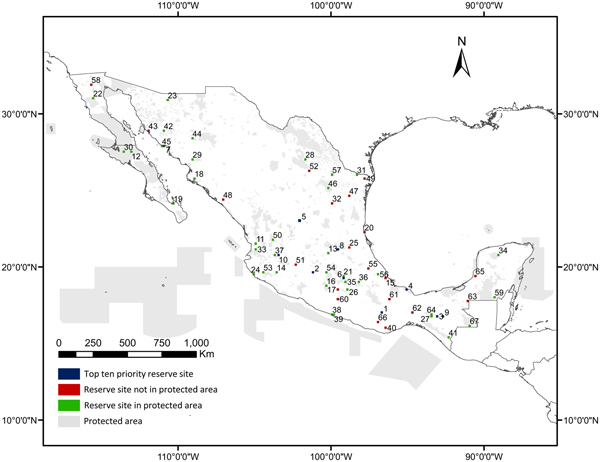
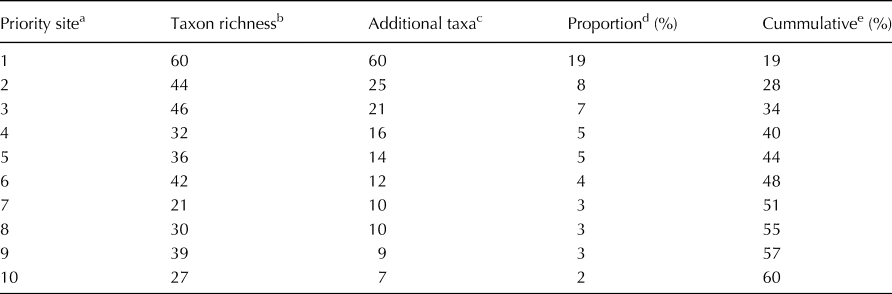
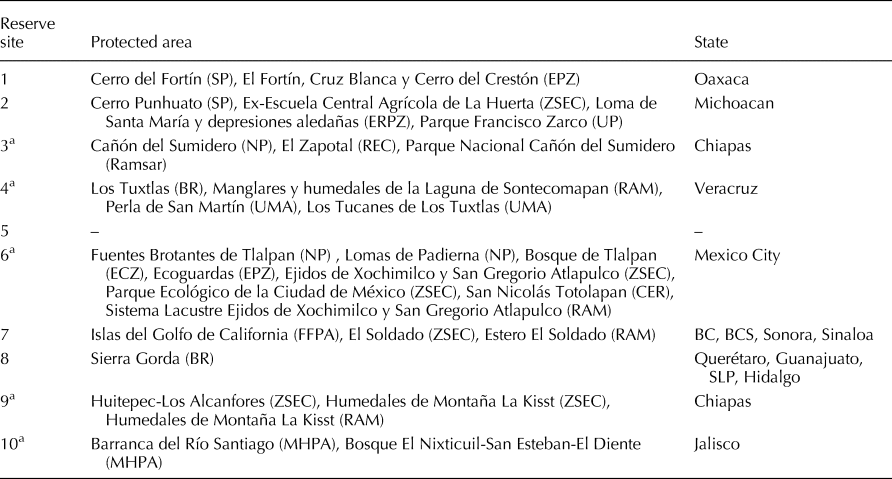
The complementarity analysis showed that 67 potential reserve sites with a grid square size of 15 × 15 km are potentially required to conserve all 308 priority taxa (Fig. 2). The grid squares are distributed all over the country, predominantly in the north-west, north-east, central and south. The top 10 grid squares conserve 60% of the diversity (184 taxa) (Table 2). The first grid square conserves 19% of the taxon richness (60 taxa), and is located in Oaxaca, south of Mexico. The second grid square is located in Michoacán, central Mexico, conserving 14% (44) of the taxa, 25 of which are taxa not conserved in the first grid square. The third grid square, located in Chiapas, south of the country, contains 15% (46) of the taxa, 21 of which are not contained in the second or first squares. Phaseolus vulgaris is the taxa that occur in the highest number of grid squares (34). Twenty-four per cent of the taxa (74) occur in five or more grid squares (Supplementary Table S5). Forty-six priority grid squares were located in at least one PA (Supplementary Table S6), including nine of the top 10 grid squares (Table 3).
Complementarity analysis showing the potential sites for the establishment of genetic reserves of priority CWR in Mexico. Numbers are the conservation priority order of the sites. Grid square size is 0.125° (approximately 15 × 15 km). Geographic coordinate system is WCS 1984.

Complementarity analysis of priority Mexican CWR taxa

Grid square size of each priority site is 0.125° (approximayely 15 × 15 km).
a Sequence of priority grids for conservation.
b Richness (taxon diversity).
c New taxa contained in each additional grid.
d Proportion of the diversity conserved by each grid.
e Cumulative proportion of the diversity conserved by each additional grid.
Top 10 priority reserve sites for the in situ conservation of priority CWR in Mexico and the protected areas within which they are located

BR, Biosphere Reserve; CER, Communitarian Ecological Reserve; ECZ, Ecological and Cultural Zone; EPZ, Ecological Conservation Area; ERPZ, Environmental Restauration and Protection Zone; FFPA, Flora and Fauna Protection Area; MHPA, Municipal Hydrological Protection Area; NP, Natural Park; REC, Recreational Ecologic Center; RAM, Ramsar site; SP, State Park; UMA, Wildlife Management Units; UP, Urban Park; ZSEC, Zone Subject to Ecological Conservation; BC, Baja California; BCS, Baja California Sur; SLP, San Luis Potosí.
a Overlaps with a Terrestrial Priority Site for Biodiversity Conservation (CONABIO, CONANP, TNC, and Pronatura, 2007).
In general, there is a low representativeness of the ELC zones within the national PA network (Supplementary Table S7). An average of 1% of the taxa have ELC zones not represented in any PA; 96% of the taxa are low represented in PA; for 3% of the taxa, the ELC zones are mid-low represented; and none of the taxa have ELC zones mid-high or high representation in PA (Supplementary Table S7).
Discussion
Ex situ gap analysis
Additional collections are required for those taxa under-represented ex situ. Hotspots for future collection have been identified and in many cases large number of taxa could be collected in a limited number of missions to central and southern Mexico (i.e. Trans-Mexican Volcanic Belt, Sierra Madre del Sur, Sierra Madre de Chiapas and the southern portion of the Sierra Madre Oriental). Those taxa with <50 accessions should also be considered as priority for collection to ensure that a representative sample of the genetic diversity range in the country is conserved. Several authors have discussed the optimal sample size for the conservation of plant diversity (including CWR). A minimum of five populations was suggested by Brown and Briggs (Reference Brown, Briggs, Falk and Holsinger1991) and it was further recommended by Fielder et al. (Reference Fielder, Brotherton, Hosking, Hopkins, Ford-Lloyd and Maxted2015) and Phillips et al. (Reference Phillips, Asdal, Magos Brehm, Rasmussen and Maxted2016) for the ex situ conservation of CWR in England and Norway, respectively. FAO (2017) advised to collect samples from as many sites as possible. However, Brown and Marshall (Reference Brown, Marshall, Guarino, Ramantha Rao and Reid1995) and Guerrant et al. (Reference Guerrant, Fiedler, Havens, Maunder, Guerrant, Havens and Maunder2004) suggested that 50 populations were required for a representative collection. Furthermore, fresh collections should also take into account the different ecogeographic conditions (ELC zones) in which they occur. Focusing on collecting ELC zones with null or low representation ex situ and by collecting populations from all different ELC zones, the conservation of the full range of environmental adaptation scenarios for the CWR taxa is likely to be guaranteed (Parra-Quijano et al., Reference Parra-Quijano, Draper, Torres, Iriondo, Maxted, Ford-Lloyd, Kell, Iriondo, Dulloo and Turok2008, Reference Parra-Quijano, Iriondo and Torres2012a, Reference Parra-Quijano, Iriondo and Torresb). Priority can be given to those zones that are less frequent (low, mid-low) in the ELC map (Supplementary Table S3) allowing the identification of populations in marginal environments, which may possess interesting traits related to abiotic stresses (Parra-Quijano et al., Reference Parra-Quijano, Torres, Iriondo, López and Molina2016; Garcia et al., Reference Garcia, Parra-Quijano and Iriondo2017). The effectiveness of this ecogeographic approach to estimate the representativeness of the ex situ collections has been previously evaluated by Parra-Quijano et al. (Reference Parra-Quijano, Draper, Torres, Iriondo, Maxted, Ford-Lloyd, Kell, Iriondo, Dulloo and Turok2008, Reference Parra-Quijano, Iriondo and Torres2012a, Reference Parra-Quijano, Iriondo and Torresb) and implemented by Rubio Teso et al. (Reference Rubio Teso, Iriondo, Parra and Torres2013). They suggested that by sampling populations from the full ecogeographic range, using ecogeographic range (ECL zones), a genetically diverse collection can be achieved.
In situ gap analysis
The geographical distribution of flowering plant richness in Mexico has been shown in various studies (Rzedowski, Reference Rzedowski1991; Villaseñor and Ortiz, Reference Villaseñor and Ortiz2014; Villaseñor, Reference Villaseñor2016). The states with the highest number of taxa identified by Villaseñor and Ortiz (Reference Villaseñor and Ortiz2014) and Villaseñor (Reference Villaseñor2016) are Jalisco, Michoacán, Guerrero, Oaxaca, Chiapas and Veracruz, which also contain the highest number of endemic species both to each state and to Mexico. These states are likewise among those with the highest predicted presence of priority CWR taxa identified in the present study.
The existing national PA network conserves a priori a substantial proportion of Mexican CWR taxa, although the presence of this CWR taxa should be confirmed through field surveys. Moreover, not all PA have effective mechanisms in conserving biodiversity (Sánchez-Cordero et al., Reference Sánchez-Cordero, Figueroa, Illoldi-Rangel, Linaje, Koleff and Urquiza-Haas2011) and appropriate revision and implementation of management plans may be necessary to ensure active in situ CWR conservation (Maxted et al., Reference Maxted, Iriondo, Dulloo, Lane, Iriondo, Maxted and Dulloo2008b). For the 133 taxa (43%) occurring in less than five PA, further surveying can be conducted to locate additional populations within the PA network and meet the minimum of five recommended by Dulloo et al. (Reference Dulloo, Labokas, Iriondo, Maxted, Lane, Laguna, Jarvis, Kell, Iriondo, Maxted and Dulloo2008) for in situ conservation of CWR. The active in situ conservation of the 33 CWR taxa (11%) not conserved in any PA (Supplementary Table S5) must be considered a priority either by extending the PA network or implementing extra-PA in situ conservation actions in collaboration with land managers (Maxted and Kell, Reference Maxted and Kell2009). The PA with the highest number of priority CWR taxa (such as the C.A.D.N.R. 043 Estado de Nayarit, Sierra Gorda Biosphere Reserve or Tehuacán-Cuicatlán Biosphere Reserve) are also amongst the largest in the national PA network (Supplementary Table S4). These large PA are generally designed to conserve a more diverse ecogeographic environments, species composition or populations; however, they contain a relatively small proportion of CWR per unit area. Several smaller genetic reserves located in different environments can be a more practical alternative to maximize the conservation of target species diversity (Dulloo et al., Reference Dulloo, Labokas, Iriondo, Maxted, Lane, Laguna, Jarvis, Kell, Iriondo, Maxted and Dulloo2008).
There is a relatively high number of complementarity reserve sites (67) identified in this study for the conservation of the full range of priority CWR diversity in Mexico. But as indicated by Fielder et al. (Reference Fielder, Brotherton, Hosking, Hopkins, Ford-Lloyd and Maxted2015) and Phillips et al. (Reference Phillips, Asdal, Magos Brehm, Rasmussen and Maxted2016), the additional diversity value of lower ranking sites decreases substantially, so initial in situ activity might be focused in the top 10 identified sites that contain 60% of the diversity (184 taxa), nine of which are located in at least one PA. A genetic reserve network for the in situ conservation of CWR can potentially be created for the 46 priority reserve sites that intersect with PA. The requirements for their establishment and management would be minimal within the current PA network to effectively conserve the CWR diversity and they can provide additional benefit to local people (Maxted et al., Reference Maxted, Iriondo, Dulloo, Lane, Iriondo, Maxted and Dulloo2008b; Maxted and Kell, Reference Maxted and Kell2009). The ELC zones are not reflected well within the existing PA network, therefore in situ complementary conservation measures outside PA will need to be implemented to ensure the full range of ecogeographic diversity is preserved (Maxted and Kell, Reference Maxted and Kell2009; Maxted et al., Reference Maxted, Avagyan, Frese, Iriondo, Magos Brehm, Singer and Kell2015).
When comparing the reserve sites identified in the present work with the Terrestrial Priority Sites for Conservation of Biodiversity network (TPSCB) (CONABIO, CONANP, TNC and Pronatura, 2007), certain degree of agreement can be observed. About 63% of the reserve sites (Supplementary Fig. S1) correspond with at least one TPSCB, and of these, 64% overlap with at least one PA and a reserve site (Table 3). Thus, the implementation of active in situ CWR conservation measures would also benefit the conservation of larger biodiversity communities in Mexico. Moreover, these results should also be integrated to other current conservation strategies that are being developed for specific crop genepools, such as the Global Project of Native Maize (CONABIO, 2011).
Recommendations for CWR conservation in Mexico
Derived from the results of the present study, the following recommendation for the in situ and ex situ conservation of priority CWR in Mexico are proposed:
(1) Link the top 10 reserve sites (Table 3) to establish an initial Mexican CWR genetic reserve network for active in situ conservation action, including management and monitoring of CWR populations, following the quality standards of genetic reserves for the conservation of CWR (see Iriondo et al., Reference Iriondo, Maxted and Dulloo2008, Reference Iriondo, Maxted, Kell, Ford-Lloyd, Lara-Romano, Labokas, Magos Brehm, Maxted, Dulloo, Ford-Lloyd, Frese, Iriondo and Pinheiro de Carvalho2012). Subsequently, whenever possible, other reserve sites can be incorporated to the network, for example, those overlapping PA (Supplementary Table S6).
(2) For those PA shown to be a priority for CWR in situ conservation (see Supplementary Tables S4 and S5), the management plans should be revised to ensure active conservation action to sustain and monitor CWR populations at an adequate frequency depending on the phenology, growth form or threat status of the species. For the taxa (133) with less than five populations in PA, further surveying is recommended to locate additional populations within the PA network.
(3) Conservation actions should be enhanced outside PA to ensure the protection of relevant CWR populations not associated with current PA, i.e. 21 priority in situ sites indicated in Fig. 2, to encourage sustainable utilization and management of natural resources as an economic activity for land owners. For example, through the creation of a few new PA for priority CWR populations (e.g. reserve site 5 in Fig. 2), incentive-based schemes, establishment of agreements and partnerships, protection of traditional agroecosystems, ecologically friendly practices in agriculture and industry, regeneration and reforestation, schemes for payments for ecosystem services, etc. (Ervin et al., Reference Ervin, Mulongoy, Lawrence, Game, Sheppard, Bridgewater, Bennett, Gidda and Bos2010; Hunter and Heywood, Reference Hunter and Heywood2011).
(4) The 198 taxa with <50 accessions conserved ex situ should be targeted for priority ex situ conservation, starting collection in the areas identified in Fig. 1b as containing highest collection priority.
(5) The ELC analyses presented in Supplementary Tables S3 and S7 can be used to ensure the genetic diversity already conserved represents at as many ELC zones as possible, particularly for taxa with low or non-represented ELC zones both ex situ and in situ.
(6) The results presented should be reviewed periodically and novel in situ and ex situ conservation actions updated accordingly. For instance, genetic analysis should be conducted for the priority CWR taxa to further assess and ensure their genetic diversity conservation is maximized.
Conclusions
In this study, priorities for complementary in situ and ex situ conservation of 308 CWR taxa were identified for Mexico. Of those, 285 were priorities for further field surveying and ex situ collection to ensure genetic diversity representation. The establishment of genetic reserves in at least the top 10 reserve sites will ensure the conservation of a high proportion of the priority CWR diversity. Incorporating the evaluation of ecogeographic information of the CWR contributes to improve the representativeness of the genetic diversity in both in situ and ex situ conservation efforts in Mexico. The proposed recommendations for the active long-term conservation of priority Mexican CWR will underpin maximum genetic diversity maintenance, its continuing availability for breeders and Mexican food security. These actions will help food security and management to feed the growing population of Mexico and minimize the deleterious impacts of climate change and other threats that the Mexican agro- and biodiversity is facing.
Supplementary material
The supplementary material for this article can be found at https://doi.org/10.1017/S1479262118000540
Acknowledgements
We appreciate the financial support of the Mexican National Council of Science and Technology (CONACYT) and the National Forestry, Crops and Livestock Research Institute (INIFAP).