Introduction
Zoonoses represent 58% of human diseases and 60% of emerging diseases (Woolhouse and Gowtagje-Sequeira, Reference Woolhouse and Gowtage-Sequeria2005; Jones et al., Reference Jones, Patel, Levy, Storeygard, Balk, Gittleman and Daszak2008). They represent a serious public health threat and they exert an enormous socio-economic impact. They affect millions of people every year by preventing efficient production of food of animal origin and interrupting trade in animals or animal products (Tomley and Shirley, Reference Tomley and Shirley2009).
A zoonosis is defined by the World Health Organisation (WHO) as a disease or infection that is naturally transmissible between vertebrate animals and humans. Over 200 zoonoses have been listed, including diseases that have been well documented over many years (such as rabies and anthrax) and new or emerging diseases that have appeared within the past one to two decades (such as Nipah Virus infection and severe acute respiratory syndrome (SARS)) (http://www.who.int/zoonoses/en/). In South-East Asia, socio-cultural practices combined with weak public and animal health infrastructures, favor the occurrence and spread of zoonoses (Bhatia and Narain, Reference Bhatia and Narain2010). Furthermore, because of the substantial changes in population growth and agricultural practices together with suitable climate conditions and a richness of wildlife, the region has been pin-pointed as a ‘hot spot’ for future emerging diseases events (Jones et al., Reference Jones, Patel, Levy, Storeygard, Balk, Gittleman and Daszak2008).
This review involves scanning for existing data on zoonotic diseases in continental South-East Asia to provide an overview of the data reported in both scientific literature and organizations’ reports at the national, regional and international levels. The study focuses on the specific features of the diseases at the human–animal–ecosystems interface in the region and on the data on the occurrence of the diseases in the human and animal populations, in order to identify trends in the evolution of zoonotic diseases in South-East Asia and knowledge gaps that compromise efficient surveillance and control strategies. This information could be of use in planning further surveillance and control programs.
Information gathering
This review was undertaken to provide an overview of qualitative epidemiological and ecological data in continental South-East Asia, as well as data on occurrence of the diseases in the region in both human and animal populations.
Case criteria
Zoonoses are caused by all types of agents: bacteria, parasites, protozoa, fungi, viruses and unconventional agents. They are sometimes transmitted directly, but indirect transmission through vector or food ingestion is most common (http://www.who.int/zoonoses/en/). In light of this broad definition and the expected high prevalence of zoonoses in South-East Asia, the scope of the study was restricted to:
— zoonotic diseases for which animals still represent the main reservoir and source of the pathogens (e.g. exclusion of HIV, which became effectively and essentially transmissible from human to human after a single species jump);
— zoonotic diseases for which species other than non-human primate species are commonly involved in disease transmission (e.g. exclusion of dengue and malaria);
— food-borne diseases for which transmission to human is due to primary contamination of raw animal products;
— zoonotic diseases that can be transmitted from animals to humans, excluding those transmitted exclusively from humans to animals (e.g. influenza H1N1).
The geographical area of interest was continental South-East Asia, consisting of Cambodia, two south-eastern Chinese provinces (Yunnan and Guangxi), Lao PDR, Myanmar, Thailand and Vietnam.
Search strategy
Searches of peer-reviewed literature were conducted using the PubMed database (http://www.ncbi.nlm.nih.gov/pubmed/advanced) from January 1990 to September 2011. A first scan involved searches for terms such as ‘zoonoses or zoonosis or zoonotic diseases South-East Asia’, ‘emerging diseases South-East Asia’, ‘bacteriosis South-East Asia’, ‘virosis South-East Asia’, ‘protozoosis South-East Asia’, ‘mycosis zoonotic South-East Asia’, ‘parasitosis South-East Asia’, ‘unconventional agents South-East Asia’, ‘food-borne South-East Asia’, ‘vector-borne South–East Asia’. Those searches led to a list of 23 diseases. Diseases caused by fungi were not included as the mycoses were poorly described. In addition, no cases due to unconventional agents, such as prions, have been reported in the area. Then, a new scan was undertaken, using either the name of each disease or its causal agent, each combined with the name of each country or province, and the region. Based on the title or the abstract of the articles found, only those describing or reviewing ecological and epidemiological studies were selected. Furthermore, a manual check was undertaken in the library of the Faculty of Veterinary Medicine of Kasetsart, Bangkok. For all publication searches, only articles or abstracts in English and French were retrieved.
Further information on the occurrence and official notification of the selected diseases was gathered by visiting official websites of international and national organizations involved in public and animal health: World Organisation for Animal Health (OIE) (OIE, 2010, http://web.oie.int/wahis/public.php?page=country&WAHIDPHPSESSID=e205cbafdbcecf5281a6f186903bf0bf), WHO (http://www.who.int/zoonoses/diseases/en/). Other data came from websites of professional organizations such as GIDEON, a medical decision support web application (http://www.gideononline.com/) and ProMed, a global reporting system for outbreaks of emerging infectious diseases open to all sources (http://beta.promedmail.org/mbds). In this last case, only official notifications from government or international organizations were considered. Thailand was the only country for which we accessed directly from national public health authorities (Bureau of Epidemiology) reports summarizing the health status of the country regarding notifiable diseases in humans (MOPH, 2010). The OIE databases (http://web.oie.int/wahis/public.php?page=country&WAHIDPHPSESSID=e205cbafdbcecf5281a6f186903bf0bf) were also considered to be national reports (for both human and animal populations), as the information is provided by the OIE delegate for each country.
Selection of the publications
The publications section of the search retrieved 262 relevant texts (251 in scientific journals, seven in congress proceedings and four textbooks). The frequency of texts dealing with different diseases and areas was very uneven, with some receiving more attention than others. A selection procedure was applied as follows: for all documents, duplicates were removed. Then, for all quantitative observational studies where more than two remained for a given disease, population and area, only the two most relevant were retained. Preference was given to those recently published, peer-reviewed and with the largest study population size.
Finally, 186 publications (177 in scientific journals, five in congress proceedings and four textbooks) were included in the review.
Data extraction
Information collected from the scientific literature, official websites of international organizations, and professional websites, was displayed in two tables for each category of causative agent: one showing the disease epidemiology and ecology data (notification status, evolution, risk group, animal reservoir, source, route of infection or agent characteristics), and the other showing data on occurrence (presence/absence, prevalence, seroprevalence, incidence, annual rate, latest cases or outbreak reports) of the diseases.
Quality of the publications and quantitative aggregation of the data
The quality of included data was not assessed, as the objective of the review was to obtain an overview of data available on zoonotic diseases, collected from different sources, and to identify discrepancies between data displayed by different communities (research, policy-makers and international organizations). The quantitative aggregation of occurrence data was not undertaken because of the large degree of heterogeneity of the data between study populations.
Following the information gathering, 23 zoonoses were identified as commonly studied and described in South-East Asia, and 186 articles and textbooks, as well as four databases, were used to compute crude data on those diseases.
Raw data on selected diseases
In order to get an overview of the data available in the area, information was displayed in two tables for each category of causative agents: one gathering the disease epidemiology and ecology data, and the other, data on occurrence of the diseases.
Ecological and epidemiological data
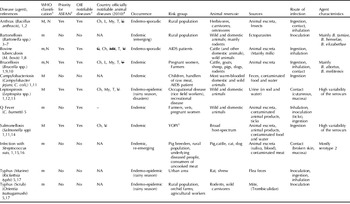
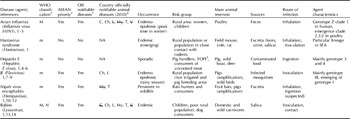
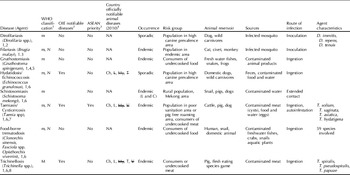
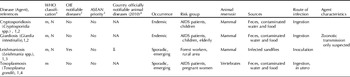
Epidemiological and ecological data on selected bacterial, viral, helminth and protozoan diseases in South-East Asia are summarized in Tables 1–5.
Epidemiological and ecological data on selected bacterial diseases in South-East Asia

Legend: m=minor; C=Cambodia; Ch=China; L=Laos; M=major; My=Myanmar; N=neglected; NA: not available; T=Thailand; V=Vietnam, : X: no official notification of the disease in the country (versus country not mentioned: no data available for the official notification of the disease at the country level); blank=no specific data for SEA.
Sources: 1http://www.who.int/zoonoses/diseases/en/ Accessed 11 September, 2012; 2Association of South East Asia Nations, 2009. Joint Recommendations of the ASEAN Plus Three Workshop on Animal and Human Health Collaboration for Emerging and Neglected Zoonotic Diseases, Bali, Indonesia, July 2009; 3http://www.oie.int/animal-health-in-the-world/oie-listed-diseases-2011/ Accessed 11 September, 2012; 4http://web.oie.int/wahis/public.php?page=country_status&year=2010 Access Sept 11; 5Young, old, pregnant, immunodeficient.
References
1. Acha and Szyfres (Reference Acha and Szyfres2005a), 2. Kunanusont and Limpakarnjanarat (Reference Kunanusont and Limpakarnjanarat1990), 3. Kosoy et al. (Reference Kosoy, Morway, Sheff, Bai, Colborn, Chalcraft, Dowell, Peruski, Maloney, Baggett, Sutthirattana, Maruyama, Kabeya, Chomel, Kasten, Popov, Robinson, Kruglov and Petersen2008), 4. Paitoonpong et al. (Reference Paitoonpong, Chitsomkasem, Chantrakooptungool, Kanjanahareutai, Tribuddharat and Srifuengfung2008), 5. Acha and Szyfres (Reference Acha and Szyfres2005b), 6. Bai ey al. (Reference Bai, Kosoy, Lerdthusnee, Peruski and Richardson2009), 7. Saisongkorh et al. (Reference Saisongkorh, Wootta, Sawanpanyalert, Raoult and Rolain2009), 8. Cosivi et al. (Reference Cosivi, Grange, Daborn, Raviglione, Fujikura, Cousins, Robinson, Huchzermeyer, de Kantor and Meslin1998), 9. Jittapalapong et al. (Reference Jittapalapong, Inpankaew, Sangwaranond, Phasuk, Pinyopanuwat and Arunwipat2008a, Reference Jittapalapong, Pinyopanuwat, Chimnoi, Kengradomkij, Arunvipas, Sarataphan, Maruyama and Desquesnesb), 10. Nga et al. (Reference Nga, de Vries, Abdoel and Smits2006), 11. Padungtod et al. (Reference Padungtod, Kadohira and Hill2008), 12. Victoriano et al. (Reference Victoriano, Smythe, Gloriani-Barzaga, Cavinta, Kasai, Limpakarnjanarat, Ong, Gongal, Hall, Coulombe, Yanagihara, Yoshida and Adler2009), 13. Laras et al. (Reference Laras, Cao, Bounlu, Nguyen, Olson, Thongchanh, Tran, Hoang, Punjabi, Ha, Ung, Insisiengmay, Watts, Beecham and Corwin2002), 14. Padungtod and Kaneene (Reference Padungtod and Kaneene2006), 15. Wertheim et al. (Reference Wertheim, Nghia, Taylor and Schultsz2009), 16. Nghia et al. (Reference Nghia, Ho, Tu, Le, Wolbers and Schultsz2011), 17. Suputtamongkol et al. (Reference Suputtamongkol, Suttinont, Niwatayakul, Hoontrakul, Limpaiboon, Chierakul, Losuwanaluk and Saisongkork2009) .
Epidemiological and ecological data on selected viral diseases in South-East Asia

Legend: m=minor; C=Cambodia; Ch=China; L=Laos; M=major; My=Myanmar; N=neglected; NA: not available; T=Thailand; V=Vietnam, X : no official notification of the disease in the country (versus country non mentioned: no data available for the official notification of the disease at the country level); blank=no specific data for SEA.
Sources: 1http://www.who.int/zoonoses/diseases/en/ Last accessed 11 September, 2012; 2Association of South East Asia Nations, 2009. Joint Recommendations of the ASEAN Plus Three Workshop on Animal and Human Health Collaboration for Emerging and Neglected Zoonotic Diseases, Bali, Indonesia, July 2009; 3http://www.oie.int/animal-health-in-the-world/oie-listed-diseases-2011/ Access Sept 11; 4http://web.oie.int/wahis/public.php?page=country_status&year=2010 Last accessed 11 September, 2012;5Young, old, pregnant, immunodeficient.
References
1. Acha and Szyfres (Reference Acha and Szyfres2005b), 2. Eagles et al. (Reference Eagles, Siregar, Dung, Weaver, Wong and Daniels2009), 3. Peiris et al. (Reference Peiris, de Jong and Guan2007), 4. Aggarwal and Naik (Reference Aggarwal and Naik2009), 5. Caron et al. (Reference Caron, Enouf, Than, Dellamonica, Buisson and Nicand2006), 6. Cooper et al. (Reference Cooper, Huang, Batista, Rayo, Bezanilla, Toth and Meng2005), 7. Erlanger et al. (Reference Erlanger, Weiss, Keiser, Utzinger and Wiedenmayer2009), 8. Nitatpattana et al. (Reference Nitatpattana, Dubot-Pérès, Gouilh, Souris, Barbazan, Yoksan, de Lamballerie and Gonzalez2008), 9. van den Hurk et al. (Reference van den Hurk, Ritchie and Mackenzie2009), 10. Wacharapluesadee et al. (Reference Wacharapluesadee, Lumlertdacha, Boongird, Wanghongsa, Chanhome, Rollin, Stockton, Rupprecht, Ksiazek and Hemachudha2005), 11. Wacharapluesadee et al. (Reference Wacharapluesadee, Boongird, Wanghongsa, Ratanasetyuth, Supavonwong, Saengsen, Gongal and Hemachudha2010), 12. Reynes et al. (Reference Reynes, Counor, Ong, Faure, Seng, Molia, Walston, Georges-Courbot, Deubel and Sarthou2005), 13. Wilde et al. (Reference Wilde, Khawplod, Khamoltham, Hemachudha, Tepsumethanon, Lumlerdacha, Mitmoonpitak and Sitprija2005), 14. Kasempimolporn et al. (Reference Kasempimolporn, Jitapunkul and Sitprija2008a).
Epidemiological and ecological data on selected helminthiases in South-East Asia

Legend: m=minor; C=Cambodia; Ch=China; L=Laos; M=major; My=Myanmar; N=neglected; NA: not available; T=Thailand; V=Vietnam, X: no official notification of the disease in the country (versus country non mentioned: no data available for the official notification of the disease at the country level); blank=no specific data for SEA.
Sources: 1http://www.who.int/zoonoses/diseases/en/ Last accessed 11 September, 2012; 2http://www.oie.int/animal-health-in-the-world/oie-listed-diseases-2011/. Last accessed 11 September, 2012.; 3Association of South East Asia Nations, 2009. Joint Recommendations of the ASEAN Plus Three Workshop on Animal and Human Health Collaboration for Emerging and Neglected Zoonotic Diseases, Bali, Indonesia, July 2009; 4http://web.oie.int/wahis/public.php?page=country_status&year=2010 Last accessed 11 September, 2012.
References
1. Acha and Szyfres (Reference Acha and Szyfres2005c), 2. Lee et al. (Reference Lee, Montgomery, Theis, Blagburn and Eberhard2010), 3. Nuchprayoon et al. (Reference Nuchprayoon, Junpee, Nithiuthai, Chungpivat, Suvannadabba and Poovorawan2006), 4. Chai et al. (Reference Chai, Han, Shin, Park, Chu, Hirota, Nakamura-Uchiyama and Nawa2003), 5. Rojekittikhun et al. (Reference Rojekittikhun, Waikagul and Chaiyasith2002), 6. Conlan et al. (Reference Conlan, Sripa, Attwood and Newton2011b), 7. Waikagul et al. (Reference Waikagul, Dekumyoy and Anantaphruti2006), 8. Kaewpitoon et al. (Reference Kaewpitoon, Kaewpitoon and Pengsaa2008).
Epidemiological and ecological data on selected protozoan diseases in South-East Asia

Legend: m=minor; C=Cambodia; Ch=China; L=Laos; M=major; My=Myanmar; N=neglected; NA: not available; T=Thailand; V=Vietnam, X: no official notification of the disease in the country (versus country non-mentioned: no data available for the official notification of the disease at the country level); blank=no specific data for SEA.
Sources: 1http://www.who.int/zoonoses/diseases/en/ Last accessed 17 December, 2012; 2http://www.oie.int/animal-health-in-the-world/oie-listed-diseases-2011/ Last accessed 17 December, 2012; 3Association of South East Asia Nations, 2009. Joint Recommendations of the ASEAN Plus Three Workshop on Animal and Human Health Collaboration for Emerging and Neglected Zoonotic Diseases, Bali, Indonesia, July 2009; 4http://web.oie.int/wahis/public.php?page=country_status&year=2010 Last accessed 17 December, 2012.
References
1. Acha and Szyfres (Reference Acha and Szyfres2005c), 2. Savioli et al. (Reference Savioli, Smith and Thompson2006), 3. Suankratay et al. (Reference Suankratay, Suwanpimolkul, Wilde and Siriyasatien2010), 4. Sukthana (Reference Sukthana2006).
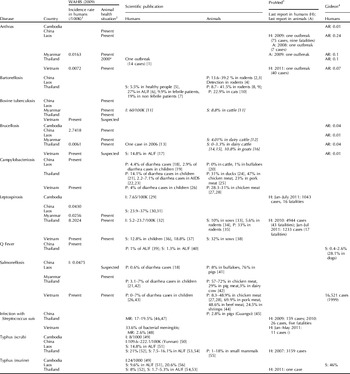
Data on occurrence of zoonoses caused by bacteria in South-East Asia

Legend: AUF=acute undifferentiated fever cases; AR=annual rate; I=incidence; P=prevalence; S=seroprevalence; blank=no data available; *=last occurrence; italic=in gray literature.
Sources: 1http://web.oie.int/wahis/public.php?page=country_zoonoses&year=2009 Last accessed 17 December, 2012; 2http://web.oie.int/wahis/public.php?page=country_status Last accessed 17 December, 2012; 3http://apex.oracle.com/pls/otn/f?p=2400:1040:674479108843189::NO::: Access Oct 2011; 4http://www.gideononline.com/ Last accessed 17 December, 2012
References
1. Kunanusont C and Limpakarnjanarat K (1990), 2. Bai et al. (Reference Bai, Yang, Yang and Zhang2005), 3. Li et al. (Reference Li, Yu, Liu and Gong2004), 4. Angelakis et al. (Reference Angelakis, Khamphoukeo, Grice, Newton, Roux, Aplin, Raoult and Rolain2009), 5. Maruyama et al. (Reference Maruyama, Boonmar, Morita, Sakai, Tanaka, Kabeya, Boonmar, Poapolapeth, Chalarmchaikit, Chang, Katsen, Chomel and Katsube2000), 6. Bhengsri et al. (Reference Bhengsri, Baggett, Peruski, Morway, Bai, Fisk, Sitdhirasdr, Maloney, Dowell and Kosoy2010), 7. Bhengsri et al. (Reference Bhengsri, Baggett, Peruski, Morway, Bai, Fisk, Sitdhirasdr, Maloney, Dowell and Kosoy2011), 8. Castle et al. (Reference Castle, Kosoy, Lerdthusnee, Phelan, Bai, Gage, Leepitakrat, Monkanna, Khlaimanee, Chandranoi, Jones and Coleman2004), 9. Bai et al. (Reference Bai, Kosoy, Lerdthusnee, Peruski and Richardson2009), 10. Maruyama et al. (Reference Maruyama, Sakai, Morita, Tanaka, Kabeya, Boonmar, Poapolathep, Chalarmchaikit, Chang, Kasten, Chomel and Katsube2001), 11. Thoen and Steele (Reference Thoen and Steele1995), 12. Tun et al. (Reference Tun, Tharavichitkul, Kreausukon and Tenhagen2008), 13. Paitoonpong et al. (Reference Paitoonpong, Ekgatat, Nunthapisud, Tantawichien and Suankratay2006), 14. Jittapalapong et al. (Reference Jittapalapong, Inpankaew, Sangwaranond, Phasuk, Pinyopanuwat and Arunwipat2008a), 15. Jittapalapong et al. (Reference Jittapalapong, Pinyopanuwat, Chimnoi, Kengradomkij, Arunvipas, Sarataphan, Maruyama and Desquesnes2008b), 16. Rukkwamsuk et al. (Reference Rukkwamsuk, Karnjanamala, Nuamjit, Supa, Phokrasung and Chakmongkhol2008), 17. Nga et al. (Reference Nga, de Vries, Abdoel and Smits2006), 18. Yamashiro et al. (Reference Yamashiro, Nakasone, Higa, Iwanaga, Insisiengmay, Phounane, Munnalath, Sithivong, Sisavath, Phanthauamath, Chomlasak and Vongsanith1998), 19. Phetsouvanh et al. (Reference Phetsouvanh, Midorikawa and Nakamura1999), 20. Boonmar et al. (Reference Boonmar, Chanda, Markvichitr, Chaunchom, Yingsakmongkon, Yamamot and Morito2007a), 21. Suwatano (Reference Suwatano1997), 22. Manatsathit et al. (Reference Manatsathit, Tansupasawasdikul, Wanachiwanawin, Setawarin, Suwanagool, Prakasvejakit, Leelakusolwong, Eampokalap and Kachintorn1996), 23. Waywa et al. (Reference Waywa, Kongkriengdaj, Chaidatch, Tiengrim, Kowadisaiburana, Chaiprasert, Curry, Bailey, Suputtamongkol and Beechin2001), 24. Boonmar et al. (Reference Boonmar, Yingsakmongkon, Songserm, Hanhaboon and Passadurak2007b), 25. Padungtod and Kaneene (Reference Padungtod and Kaneene2005). 26. Bodhidatta et al. (Reference Bodhidatta, Lan, Hien, Lai, Srijan, Serichantalergs, Fukuda, Can and Mason2007), 27. Ha and Pham (Reference Ha and Pham2006), 28. Luu et al. (Reference Luu, Tran, Phung and Nguyen2006), 29. Seng et al. (Reference Seng, Sok, Tangkanakul, Petkanchanapong, Kositanont, Sareth, Hor and Jiraphongsa2007), 30. Victoriano et al. (Reference Victoriano, Smythe, Gloriani-Barzaga, Cavinta, Kasai, Limpakarnjanarat, Ong, Gongal, Hall, Coulombe, Yanagihara, Yoshida and Adler2009), 31. Laras et al. (Reference Laras, Cao, Bounlu, Nguyen, Olson, Thongchanh, Tran, Hoang, Punjabi, Ha, Ung, Insisiengmay, Watts, Beecham and Corwin2002), 32.Tangkanakul et al. (Reference Tangkanakul, Smits, Jatanasen and Ashford2005), 33. Niwetpathomwat et al. (Reference Niwetpathomwat, Luengyosluechakul and Geawduanglek2006), 34. Kositanont et al. (Reference Kositanont, Naigowit, Imvithaya, Singchai and Puthavathana2003), 35. Doungchawee et al. (Reference Doungchawee, Phulsuksombat, Naigowit, Khoaprasert, Sangjun, Kongtim and Smythe2005), 36. Thai et al. (Reference Thai, Binh, Giao, Phuong, Hung, Van Nam, Nga, Goris and de Vries2006), 37. Van et al. (Reference Van, Thuy, San, Hien, Baranton and Perolat1998), 38. Boqvist et al. (Reference Boqvist, Thu, Vågsholm and Magnusson2002), 39. Suttinont et al. (Reference Suttinont, Losuwanaluk, Niwatayakul, Hoontrakul, Intaranongpai, Silpasakorn, Suwancharoen, Panlar, Saisonkgorh, Rolain, Raoult and Suputtamongkol2006), 40. Suputtamongkol et al. (Reference Suputtamongkol, Rolain, Losuwanaruk, Niwatayakul, Suttinont, Chierakul, Pimda and Raoult2003), 41. Boonmar et al. (Reference Boonmar, Markvichitr, Chaunchom, Chanda, Bangtrakulnonth, Pornrunangwong, Yamamoto, Suzuki, Kimura and Morita2008), 42. Padungtod and Kaneene (Reference Padungtod and Kaneene2006). 43. Vu et al. (2006), 44. Phan et al. (Reference Phan, Khai, Ogasawara, Tam, Okatani, Akiba and Hayashidani2005), 45. Xiong et al. (Reference Xiong, Liu, Qin, Bai, Zhu, Li Hm Guo, Qin, Pan, Long and Chen2007), 46. Wangsomboonsiri et al. (Reference Wangsomboonsiri, Luksananun, Saksornchai, Ketwong and Sungkanuparph2008), 47. Wangkaew et al. (Reference Wangkaew, Chaiwarith, Tharavichitkul and Supparatpinyo2006), 48. Mai et al. (Reference Mai, Hoa, Nga, Linh, Chau, Sinh, Phu, Chuong, Diep, Campbell, Nghia, Minh, Chau, de Jong, Chinh, Hien, Farrar and Schultsz2008). 49. Corwin et al. (Reference Corwin, Soeprapto, Widodo, Rahardjo, Kelly, Dasch, Olson, Sie, Larasati and Richards1997), 50. Zhang et al. (Reference Zhang, Li, Zhang, Zhang, Di, Luan and Fu2007), 51. Phongmany et al. (Reference Phongmany, Rolain, Phetsouvanh, Blacksell, Soukkhaseum, Frichithavong, Chu and Newton2006), 52. Strickman et al. (Reference Strickman, Tanskul, Eamsila and Kelly1994), 53. Leelarasamee et al. (Reference Leelarasamee, Chupaprawan, Chenchittikul and Udompanthurat2004), 54. Suputtamongkol et al. (Reference Suputtamongkol, Suttinont, Niwatayakul, Hoontrakul, Limpaiboon, Chierakul, Losuwanaluk and Saisongkork2009), 55. Coleman et al. (Reference Coleman, Monkanna, Linthicum, Strickman, Frances, Tanskul, Kollars, Inlao, Watcharapichat, Khaimanee, Phulsuksombati, Sangjun and Lerdthusnee2003), 56. Vallée et al. (Reference Vallée, Thaojaikong, Moore, Phetsouvanh, Richards, Soruis, Fournet, Salem, Gonzalez and Newton2010).
Data on occurrence of the diseases
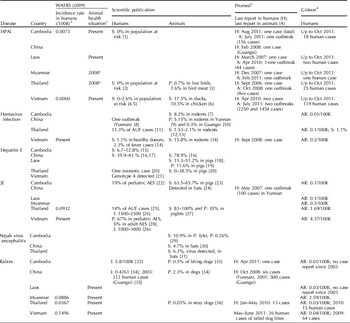
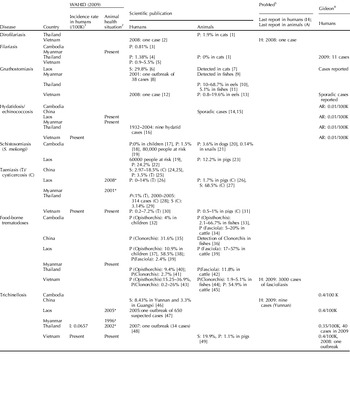
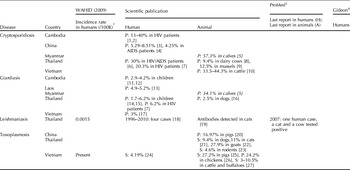
Data on occurrence of zoonoses caused by bacteria, viruses, helminthes and protozoa in South-East Asia are listed in Tables 6–8.
Data on occurrence of zoonoses caused by viruses in South-East Asia

Legend: AES=acute encephalitis syndrome; AR=annual rate; AUF=acute undifferentiated fever cases; HPAI=Highly Pathogenic Avian Influenza; I=incidence; P=prevalence; S=seroprevalene; blank=no data available; *=last occurrence.
Sources: 1http://web.oie.int/wahis/public.php?page=country_zoonoses&year=2009 Access Oct 2011; 2http://web.oie.int/wahis/public.php?page=country_status Access Oct 2011; 3http://apex.oracle.com/pls/otn/f?p=2400:1040:674479108843189::NO::: Access Oct 2011; 4http://www.gideononline.com/ Access Oct 2011
References
1. Vong et al. (Reference Vong, Coghlan, Mardy, Holl, Seng, Ly, Miller, Buchy, Froelich, Dufourcq, Uyeki, Lim and Sok2006), 2. Dejpichai et al. (Reference Dejpichai, Laosiritaworn, Phuthavathana, Uyeki, O'Reilly, Yampikulsakul, Phurahong, Poorak, Prasertsopon, Kularb, Nateerom, Sawananyalert and Jiraphongsa2009), 3. Amonsin et al. (Reference Amonsin, Choatrakol, Lapkuntod, Tantilertcharoen, Thanawongnuwech, Suradhat, Suwannakarn, Theamboonlers and Poovorawan2008), 4. Schultsz et al. (Reference Schultsz, Nguyen, Hai, Do, Peiris, Lim, Garcia, Nguyen, Nguen, Huynh, Phan, van Doorn, Nguyen, Farar and de Jong2009), 5. Cavailler et al. (Reference Cavailler, Chu, Ly, Garcia, Ha, Bergeri, Vong and Buchy2010), 6. Henning et al. (Reference Henning, Henning, Morton, Long, Ha, Vu, Vu, Hoa and Meers2011), 7. Reynes et al. (Reference Reynes, Soares, Hüe, Bouloy, Sun, Kruy, Flye Sainte Marie and Zeller2003), 8. Zhang et al. (Reference Zhang, Zhang, Dong, Yuan, Zhang, Yang, Zhou, Ge, Li, Wang and Shi2010a), 9. Zhou et al. (Reference Zhou, Zhang, Wang, Yang, Mi, Zhang, Zhang, Song, Hu, Dong, Pu, Hu, Gao, Yuan, Ya and Feng2009), 10. Tan et al. (Reference Tan, Bi and Wei2008), 11. Suputthamongkol et al. (Reference Suputthamongkol, Nitatpattana, Chayakulkeeree, Palabodeewat, Yoksan and Gonzalez2005), 12. Kantakamalakul et al. (Reference Kantakamalakul, Siritantikorn, Thongcharoen, Singchai and Puthavathana2003), 13. Nitatpattana et al. (Reference Nitatpattana, Henrich, Palabodeewat, Tangkanakul, Poonsuksombat, Chauvancy, Barbazan, Yoksan and Gonzalez2002), 14. Truong et al. (Reference Truong, Yoshimatsu, Araki, Lee, Nakamura, Endo, Schimizu, Yasuda, Koma, Taruishi, Okumura, Truong and Arikawa2009), 15. Caron et al. (Reference Caron, Enouf, Than, Dellamonica, Buisson and Nicand2006), 16. Li et al. (Reference Li, Shu, Pu, Bi, Yang and Yin2011), 17. Li et al. (Reference Li, Ge, Li, Zheng, Nong, Guo, Zhang, Ng and Xia2006), 18. Blacksell et al. (Reference Blacksell, Myint, Khounsy, Phruaravanh, Mammen, Day and Newton2007), 19. Conlan et al. (Reference Conlan, Jarman, Vongxay, Chinnawirotpisan, Melendrez, Fenwick, Thompson and Blacksell2011a), 20. Cooper et al. (Reference Cooper, Huang, Batista, Rayo, Bezanilla, Toth and Meng2005), 21. Hijikata et al. (Reference Hijikata, Hayashi, Trinh, Ha, Ohara, Shimizu, Keicho and Yoshikura2002), 22. Touch et al. (Reference Touch, Hills, Sokhal, Samnang, Sovann, Khieu, Soeung, Toda, Robinson and Grundy2009a), 23. Duong et al. (Reference Duong, Sorn, Holl, Rani, Deubel and Buchy2011), 24. Wang et al. (Reference Wang, Pan, Zhang, Fu, Wang, Tang, Wang and Liang2009), 25. Watt and Jongsakul (Reference Watt and Jongsakul2003), 26. Erlanger et al. (Reference Erlanger, Weiss, Keiser, Utzinger and Wiedenmayer2009), 27. Nitatpattana et al. (Reference Nitatpattana, Le Flohic, Thongchai, Nakgoi, Palaboodeewat, Khin, Barbazan, Yoksan and Gonzalez2011), 28. Lowry et al. (Reference Lowry, Truong, Hinh, Ladinsky, Karabatsos, Cropp, Martin and Gubler1998), 29. Reynes et al. (Reference Reynes, Counor, Ong, Faure, Seng, Molia, Walston, Georges-Courbot, Deubel and Sarthou2005), 30. Li et al. (Reference Li, Wang, Hickey, Zhang, Li, Wu, Zhang, Yuan, Han, McEachern, Broder, Wang and Shi2008), 31. Wacharapluesadee et al. (Reference Wacharapluesadee, Lumlertdacha, Boongird, Wanghongsa, Chanhome, Rollin, Stockton, Rupprecht, Ksiazek and Hemachudha2005), 32. Ly et al. (Reference Ly, Buchy, Heng, Ong, Chhor, Bourhy and Vong2009), 33. Reynes et al. (Reference Reynes, Soares, Keo, Ong, Heng and Vanhoye1999), 34. Song et al. (Reference Song, Tang, Wang, Mo, Guo, Li, Tao, Rupprecht, Feng and Liang2009), 35. Mo et al. (Reference Mo, Mo, Zhou, Shen, Huang, Hao, Tao, Yang and Tang2010), 36. Kasempimolporn et al. (Reference Kasempimolporn, Sichanasai, Saengseesom, Puempumpanich and Sitprija2008b).
Data on occurrence of zoonoses caused by helminths in South-East Asia

Legend: AR=annual rate; S=seroprevalence; P=prevalence; blank=no data available; *=last occurrence.
Sources: 1http://web.oie.int/wahis/public.php?page=country_zoonoses&year=2009 Last accessed 17 December, 2012; 2http://web.oie.int/wahis/public.php?page=country_status Access Oct 2011; 3http://apex.oracle.com/pls/otn/f?p=2400:1040:674479108843189::NO::: Last accessed 17 December, 2012; 4http://www.gideononline.com/ Last accessed 17 December, 2012.
References
1. Nuchprayoon et al. (Reference Nuchprayoon, Junpee, Nithiuthai, Chungpivat, Suvannadabba and Poovorawan2006), 2. Dang et al. (Reference Dang, Nguyen, Do, Uga, Morishima, Sugiyama and Yamasaki2010), 3. Leang et al. (Reference Leang, Socheat, Bin, Bunkea and Odermatt2004), 4. Triteeraprapab et al. (Reference Triteeraprapab, Karnjanopas, Porksakorn, Sai-Ngam, Yentakam and Loymak2001), 5. Meyrowitsch et al. (Reference Meyrowitsch, Nguyen, Hoang, Nguyen and Michael1998), 6. Vonghachack et al. (Reference Vonghachack, Dekumyoy, Yoonuan, Sa-nguankiat, Nuamtanong, Thaenkham, Phommasack, Kobayashi and Waikagul2010), 7. Scholz et al. (Reference Scholz, Uhlírová and Ditrich2003), 8. Chai et al. (Reference Chai, Han, Shin, Park, Chu, Hirota, Nakamura-Uchiyama and Nawa2003), 9. Jung et al. (Reference Jung, Lee, Pyo, Kim, Jeong, Yoon, Lee, Shin and Chai2008), 10. Nuamtanong et al. (Reference Nuamtanong, Waikagul and Anantaphruti1998), 11. Rojekittikhun et al. (Reference Rojekittikhun, Chaiyasith, Nuamtanong and Komalamisra2004), 12. Xuan et al. (Reference Xuan, Rojekittikhun, Punpoowong, Trang and Hien2002), 13. Sieu et al. (Reference Sieu, Dung, Nga, Hien, Dalsgaaard, Waikagul and Murrell2008), 14. Lu and Liu (Reference Lu and Liu2004), 15. Zhou et al. (Reference Zhou, Yang and Zhang2005), 16. Riengchan et al. (Reference Riengchan, Suankratay, Wilde and Thanakit2004), 17. Chhakda et al. (Reference Chhakda, Muth, Socheat and Odermatt2006), 18. Chai and Hongvanthong (Reference Chai and Hongvanthong1998). 19. Urbani et al. (Reference Urbani, Sinoun, Socheat, Pholsena, Strandgaard, Odermatt and Hatz2002), 20. Matsumoto et al. (Reference Matsumoto, Muth, Socheat and Matsuda2002), 21. Attwood et al. (Reference Attwood, Campbell, Upatham and Rollinson2004), 22. Sayasone et al. (Reference Sayasone, Mak, Vanmany, Rasphone, Vounatsou, Utzinger, Akkhavong and Odermatt2011), 23. Strandgaard et al. (Reference Strandgaard, Johansen, Pholsena, Teixayavong and Christensen2001), 24. Chung et al. (Reference Chung, Eom, Yang, Li, Feng, Rim, Cho and Kong2005), 25. Steinmann et al. (Reference Steinmann, Zhou, Li, Li, Chen, Yang, Fan, Jia, Li, Vounatsou and Utzinger2007), 26. Conlan et al. (Reference Conlan, Sripa, Attwood and Newton2011b), 27. Waikagul et al. (Reference Waikagul, Dekumyoy and Anantaphruti2006), 28. Anantaphruti et al. (Reference Anantaphruti, Okamoto, Yoonuan, Saguankiat, Kusolsuk, Sato, Sato, Sako, Waikagul and Ito2010), 29. Willingham et al. (Reference Willingham, De, Doanh, Cong, Dung, Dorny, Cam and Dalsgaard2003), 30. Montresor and Palmer (Reference Montresor and Palmer2006), 31. Lee et al. (Reference Lee, Bae, Kim, Deung, Ryang, Kim, Im and Yong2002), 32. Touch et al. (Reference Touch, Komalamisra, Radomyos and Waikagul2009b), 33. Dorny et al. (Reference Dorny, Stoliaroff, Charlier, Meas, Sorn, Chea, Holl, Van Aken and Vercruysse2011), 34. Yu et al. (Reference Yu, Kawanaka, Li, Xu, Lan and Rui2003), 35. Sohn et al. (Reference Sohn, Eom, Min, Rim, Hoang, Yang and Li2009), 36. Rim et al. (Reference Rim, Chai, Min, Cho, Eom, Hong, Sohn, Yong, Deodato, Standgaard, Phommasack, Yun and Hoang2003), 37. Sayasone et al. (Reference Sayasone, Odermatt, Phoumindr, Vongsaravane, Sensombath, Phetsouvanh, Choulamany and Strobel2007), 38. Quang et al. (Reference Quang, Duong, Richard-Lenoble, Odermatt and Khammanivong2008), 39. Jongsuksuntigul and Imsomboon (Reference Jongsuksuntigul and Imsomboon2003), 40. Traub et al. (Reference Traub, Macaranas, Mungthin, Leelayoova, Cribb, Murrel and Thompson2009), 41. Srihakim and Pholpark (Reference Srihakim and Pholpark1991), 42. De et al. (Reference De, Murrell, Cong, Cam, Chau, Toan and Dalsgaard2003), 43. Thu et al. (Reference Thu, Dalsgaard, Loan and Murrell2007), 44. Nguyen et al. (Reference Nguyen, Le, Dao, Tran, Praet, Speybroeck, Vercruysse and Dormy2011), 45. Cui et al. (Reference Cui, Wang and Xu2011), 46. Barennes et al. (Reference Barennes, Sayasone, Odermatt, De Bruyne, Hongsakhone, Newton, Vongprachanh, Martinez-Ausse, Strobel and Dupouy-Camet2008), 47. Kusolsuk et al. (Reference Kusolsuk, Kamonrattanakun, Wesanonthawech, Dekumyoy, Thaenkham, Yoonuan, Nuamtanong, Sa-Nguankiat, Pubampen, Maipanich, Panichakit, Marucci, Pozio and Waikagul2010), 48. Vu Thi et al. (Reference Vu Thi, Dorny, La Rosa, To Long, Nguyen Van and Pozio2010).
Data on occurrence of zoonoses caused by protozoa in South-East Asia

Legend: AR=annual rate; S=seroprevalence; P=prevalence; blank=no data available; *=last occurrence; italic=in gray literature.
Sources: 1http://web.oie.int/wahis/public.php?page=country_zoonoses&year=2009 Last accessed 17 December, 2012; 2http://web.oie.int/wahis/public.php?page=country_status Access Oct 2011; 3http://apex.oracle.com/pls/otn/f?p=2400:1040:674479108843189::NO::: Last accessed 17 December, 2012; 4http://www.gideononline.com/ Last accessed 17 December, 2012.
References
1. Chhin et al. (Reference Chhin, Harwell, Bell, Rozycki, Ellman, Barnett, Ward, Reinert and Pugatch2006), 2. Kong et al. (Reference Kong, Harwell, Suos, Lynen, Mohiuddin, Reinert and Pugatch2007), 3. Zhang et al. (Reference Zhang, Yu, Zhang, Tao, Li, Cao, Bai and He2002), 4. Le et al. (Reference Le, Wang, Gou, Chen, Yang, Yang, Li, Zhou, Li and Cai2008), 5. Lay et al. (Reference Lay, Hoerchner, Morakote and Kreausukon2008), 6. Saksirisampant et al. (Reference Saksirisampant, Prownebon, Saksirisampant, Mungthin, Siripatanapipong and Leelayoova2009), 7. Viriyavejakul et al. (Reference Viriyavejakul, Nintasen, Punsawad, Chaisri, Punpoowong and Riganti2009a, Reference Viriyavejakul, Nintasen, Punsawad, Chaisri, Punpoowong, Chaisiri, Punpoowong and Rigantib), 8. Jittapalapong et al. (Reference Jittapalapong, Pinyopanuwat, Chimnoi, Siripanth and Stich2006), 9. Srisuphanunt et al. (Reference Srisuphanunt, Wiwanitkit, Saksirisampant and Karanis2009), 10. Nguyen et al. (Reference Nguyen, Nguyen, Le, Le Hua, Van Nguyen, Honma and Nakai2007), 11. Park et al. (Reference Park, Kim, Deung, Kim, Yang, Lim, Ryang, Jin and Lee2004), 12. Chhakda et al. (Reference Chhakda, Muth, Socheat and Odermatt2006), 13. Sithithaworn et al. (Reference Sithithaworn, Sukavat, Vannachone, Sophonphong, Ben-Embarek, Petney and Andrews2006), 14. Warunee et al. (Reference Warunee, Choomanee, Sataporn, Rapeeporn, Nuttapong, Sompomg, Thongdee, Bang-on and Rachada2007), 15. Ratanapo et al. (Reference Ratanapo, Mungthin, Soontrapa, Faithed, Siripattanapipong, Rangsim, Naaglor, Piyaraj, Taamasri and Leelayoova2008), 16. Inpankaew et al. (Reference Inpankaew, Traub, Thompson and Sukthana2007), 17. Verle et al. (Reference Verle, Kongs, De, Thieu, Depraetere, Kim and Dormy2003), 18. Suankratay et al. (Reference Suankratay, Suwanpimolkul, Wilde and Siriyasatien2010), 19. Sukmee et al. (Reference Sukmee, Siripattanapipong, Mungthin, Worapong, Rangsin, SAmung, Kongkaew, Burumgsana, Chanachai, Apiwathanasorn, Rujirojindakul, Wattanasri, Ungchusak and Leelayoova2008), 20. Zou et al. (Reference Zou, Sun, Xie, Li, Zhao, Duan and Zhu2009), 21. Jittapalapong et al. (Reference Jittapalapong, Nimsupan, Pinyopanuwat, Chimnoi, Kabeya and Maruyama2007), 22. Jittapalapong et al. (Reference Jittapalapong, Sangvaranond, Pinyopanuwat, Chimnoi, Khachaeram, Koizumi and Maruyama2005), 23. Jittapalapong et al. (Reference Jittapalapong, Sarataphan, Maruyama, Hugot, Morand and Herbreteau2011), 24. Udonsom et al. (Reference Udonsom, Lekkla, Chung, Cam and Sukthana2008), 25. Huong and Dubey (Reference Huong and Dubey2007) . 26. Dubey et al. (Reference Dubey, Huong, Lawson, Subekti, Tassi, Cabaj, Sundar, Velmurugan, Kwok and Su2008), 27. Huong et al. (Reference Huong, Ljungström, Uggla and Björkman1998) .
Main trends of zoonoses in South-East Asia
South-East Asia: a hotbed for the endemization of zoonotic diseases
The epidemiology of zoonoses is complex and requires a good knowledge of the animal–human–ecosystems interfaces, as various socio-cultural, pathogen-related and environmental factors influence the epidemiological pattern of zoonotic diseases (Cascio et al., Reference Cascio, Bosilkovski, Rodriguez-Morales and Pappas2011). In South-East Asia, the geographical position, the current socio-economic situation and the socio-cultural practices, all facilitate the occurrence, spread and maintenance of such diseases. Indeed, the warm and humid climate, as well as a richness in wildlife host species, favor the spillover of zoonotic pathogens from wildlife to humans and domestic animals, and the transmission of vector-borne pathogens (Jones et al., Reference Jones, Patel, Levy, Storeygard, Balk, Gittleman and Daszak2008). Some prevailing socio-cultural practices, such as the close contact between human and livestock populations, especially in poor and marginalized populations, provide excellent conditions for the frequent exchange of pathogens between animal and human populations. Furthermore, the high human and animal density and the globalization of trade facilitate the spread of the diseases. Finally, weakness in medical and veterinary institutional capacity and a lack of food security and safety are aggravating factors for the endemization of zoonotic diseases (Bhatia and Narain, Reference Bhatia and Narain2010).
In South-East Asia, the importance of environmental factors on disease endemization is well illustrated by the example of Japanese encephalitis (JE) in the human population. JE virus is maintained and transmitted in an enzootic cycle, involving paddy-breeding mosquitoes as vectors, and pigs and water birds as reservoirs and amplifiers of the virus (Van den Hurk et al., Reference van den Hurk, Ritchie and Mackenzie2009). Increases in irrigated rice production and pig rearing are the two main environmental drivers that can explain the high prevalence of the disease in some countries of the region despite the implementation of efficient vaccination programs in humans (Erlanger et al., Reference Erlanger, Weiss, Keiser, Utzinger and Wiedenmayer2009). Indeed, pig rearing has grown exponentially and rice-production systems, particularly irrigated rice farming, have increased both in cropping area and cropping intensity. For example, the changes in paddy area and in pork production (from 1990 to 2005) are, respectively: +30 and +46% in Cambodia, +47 and +381% in Myanmar, +14 and +80% in Thailand and +21 and +147% in Vietnam. At the same time, JE-endemic countries have experienced a strong population growth in the last decades. The combination of agricultural and demographic determinants has resulted in an increase in the population potentially at risk of acquiring JE. In 2005, exposed persons were estimated to be 1,426,000 in Cambodia, 3,120,000 in Myanmar, 8,330,000 in Thailand and 18,648,000 in Vietnam.
Cultural issues are also of concern in the endemization of zoonotic diseases in South-East Asia, especially where they are barriers to setting up efficient prevention or eradication programs. Food habits and the extent to which raw or undercooked meat and fish are consumed are a key factor in the food-borne transmission of many parasites (Trichinella, Taenia, trematodes), bacteria (Salmonella, Steptococcus suis, Coxiella burnetti, Campylobacter) and viruses (hepatitis virus E) (Tables 1–4). Despite the fact that authorities are aware that the main preventive measure is proper cooking of food, the implementation of this measure is very difficult as there is still a strong tradition of eating uncooked or slightly cooked meat and fish.
South-East Asia: a hot spot for the emerging diseases
Most of the zoonoses commonly described in South-East Asia can be classified as emerging or re-emerging diseases, meaning that they have appeared in a population for the first time, or they may have existed previously but are rapidly increasing in incidence or geographic range (http://www.who.int/topics/emerging_diseases/en/). Furthermore, even if South-East Asia is not among the main hotspots of recent emerging infectious disease events, the region is considered at high risk for the future emergence of zoonotic pathogens from wildlife and vector-borne pathogens (Jones et al., Reference Jones, Patel, Levy, Storeygard, Balk, Gittleman and Daszak2008). Interestingly, the most recent emerging zoonoses are geographically limited to South-East Asia – Nipah virus (NiV), highly pathogenic avian influenza (HPAI) virus and severe respiratory acute syndrome (SRAS) virus (Cáceres and Otte, Reference Cáceres and Otte2009).
The emergence and spread of zoonoses in South-East Asia can be explained by the co-existence of various factors that facilitate the inter-species transmission, maintenance and dissemination of pathogens. One of the major factors is the increased contact between humans, domestic animals and wildlife, due to the exceptionally high growth rate of the human and livestock population, the expansion and intensification of agriculture and human encroachment on game reserves (Cáceres and Otte, Reference Cáceres and Otte2009). The changing lifestyles associated with the globalization of commerce and trade allow rapid propagation of pathogens. Additionally, in most of the countries in South-East Asia, neither the health nor veterinary services have sufficient capacity and resources to detect emerging pathogens early and to contain infections in animals (Bhatia and Narain, Reference Bhatia and Narain2010).
One of the emerging pathogens of concern in South-East Asia is S. suis. This bacterium, which has been recently recognized as a re-emerging pathogen for humans, is now endemic in the pig population of South-East Asia (Wertheim et al., Reference Wertheim, Nghia, Taylor and Schultsz2009). S. suis was first reported in 1954 by veterinarians, after outbreaks of meningitis, septicemia and purulent arthritis in piglets. Fourteen years later, the first human cases were diagnosed in Denmark and over the past few years, the number of human cases reported has increased significantly, with most cases originating from South-East Asia. S. suis is acquired through exposure to contaminated pigs or pig meat and is responsible for meningitis and sepsis with hearing loss as the most frequent complication. The increasing number of human cases in South-East Asia is driven by high density of the pig population, a lack of preventive measures during slaughter, and the widespread habit of consuming uncooked or lightly cooked pig product. In Thailand, the morbidity rate was 0.36/100,000 (with a fatality rate of 4.78%) in 2008 (MOPH, 2008) and the last reported outbreak, that involved 27 cases and five deaths, occurred in 2010 (http://beta.promedmail.org/mbds). In Vietnam, the two most recent outbreaks took place in 2007 and 2010 and involved, respectively, 42 cases (two fatal) and 28 cases (http://beta.promedmail.org/mbds). Serotype 2 was known to cause most cases of S. suis infection in humans, but recent studies have shown that serotype 14 is more commonly isolated from human cases, which indicates that the bacterium may be undergoing some genetic changes (Kerdsin et al., Reference Kerdsin, Oishi, Sripakdee, Boonkerd, Polwichai, Nakamura, Uchida, Sawanpanyalert and Dejsirilert2009).
Social factors are also important drivers for disease pattern changes in South-East Asia. For example, the dramatic increase in HIV/AIDS patients in the region has triggered the emergence or re-emergence of some zoonotic pathogens, especially among protozoan species: Cryptosporidium, Toxoplasma, Giardia (Table 4). In Thailand, where zoonotic species of Cryptosporidium are as prevalent as anthroponotic in HIV-infected patients (Gatei et al., Reference Gatei, Suputtamongkol, Waywa, Ashford, Bailey, Greensill, Beeching and Hart2002), Cryptospsoridium spp. was responsible for 34.4% of diarrhea cases among HIV/AIDS patients (Saksirisampant et al., Reference Saksirisampant, Prownebon, Saksirisampant, Mungthin, Siripatanapipong and Leelayoova2009) and the pathogen was isolated from 20.3% of HIV patients (Viriyavejakul et al., Reference Viriyavejakul, Nintasen, Punsawad, Chaisri, Punpoowong and Riganti2009a, Reference Viriyavejakul, Nintasen, Punsawad, Chaisri, Punpoowong, Chaisiri, Punpoowong and Rigantib). In the Yunnan province of China, the infection rate of Crysposporidium was estimated to be 4.25% in AIDS patients (Le et al., Reference Le, Wang, Gou, Chen, Yang, Yang, Li, Zhou, Li and Cai2008).
South-East Asia: propitious conditions for neglected tropical zoonoses
Another interesting trend is that most of the zoonoses defined as ‘neglected zoonotic diseases’ by the WHO are endemic in the area, including anthrax, rabies, filariasis, brucellosis, bovine tuberculosis, leptospirosis and cysticercosis. Neglected tropical diseases are infectious diseases that principally impact the world's poorest people, and unlike newly emerging zoonoses, they do not attract the attention of the developed world (Maudlin et al., Reference Maudlin, Eisler and Welburn2009). They also suffer from the intensity of focus on HIV, malaria and tuberculosis, known as the ‘big three’, to the detriment of other diseases. Neglected zoonoses are the victims of a vicious circle: as a consequence of the general disregard, they are usually under-reported and so underestimated in their global burden, which, in turn, downgrades their importance.
In the developing world, endemic zoonoses usually fall into the category of neglected diseases, and, as a result, some represent re-emerging health problems. For example, leptospirosis is considered an emerging health problem in Thailand with dramatic increases in reported incidence from 1996 to 2000 and a drop in subsequent years. The majority of the cases are reported in the Northeast region during the rainy season Tangkanakul et al., (2005). However, the incidence of leptospirosis in South-East Asia is not well documented. The efficiency of surveillance systems and data collection varies significantly among the countries of the region and the true burden of the disease remains unknown. In addition to underreporting, data are further compromised by the unavailability of laboratory diagnostic capacity and, when present, by lack of compliance with international quality standards (Victoriano et al., Reference Victoriano, Smythe, Gloriani-Barzaga, Cavinta, Kasai, Limpakarnjanarat, Ong, Gongal, Hall, Coulombe, Yanagihara, Yoshida and Adler2009).
Double penalty
As in the other parts of the developing world, in South-East Asia, zoonotic diseases appear as a double penalty for poor people. They are a hazard not only to their direct health but, also to their livelihood, by affecting the health of the livestock, on which they rely for food, transport and farm work, and income. As poorer people keep fewer animals, they suffer more from the illness or death of any livestock (Perry and Grace, Reference Perry and Grace2009). All these socio-economic components should be taken into account when calculating the global burden of a disease.
Because they are often forced to live in close contact with their animals, the poor are also more likely to become infected from the livestock reservoir and, once infected, they are less likely to have access to proper treatment. In the case of Japanese encephalitis, rural populations living in irrigated rice growing and pig-breeding areas are more exposed to the virus. Although a relatively safe and effective vaccine is now available, it is not delivered to most poor rural communities and this is part of the maintenance of the disease (Erlanger et al., Reference Erlanger, Weiss, Keiser, Utzinger and Wiedenmayer2009).
Different levels of priority among the stakeholders
By comparing the information gathered from the international and national report data and from the scientific bibliographic study, it seems that the scientific community, policy-makers and funders do not pay the same attention to the diseases.
In the case of brucellosis, anthrax and bovine tuberculosis, very few data are available in the scientific literature, whereas those diseases are among the few ones reported by the local government of the southeastern Asian countries (Table 5) and are listed as priority diseases by the ASEAN secretariat (Table 1). Bovine tuberculosis, which leads to lower herd productivity and is recognized as the main cause of zoonotic cases of tuberculosis in humans by the WHO (http://www.who.int/zoonoses/diseases/en/), is endemic in South-East Asia. China, Myanmar, Thailand and Vietnam and these countries have been officially declared to be infected through the OIE reporting system, WAHID, during recent years (http://web.oie.int/wahis/public.php?page=country&WAHIDPHPSESSID=e205cbafdbcecf5281a6f186903bf0bf). Thus, the disease is a concern for both public and animal health, but it is largely neglected by the scientific community (only one article referenced in PubMed) and the public authorities (no wide implementation of test-and-slaughter policy in cattle in ASEAN countries, no specific monitoring system at the slaughterhouse) (Cosivi et al., Reference Cosivi, Grange, Daborn, Raviglione, Fujikura, Cousins, Robinson, Huchzermeyer, de Kantor and Meslin1998). The production of scientific articles is not a reliable indicator of the importance of a disease in terms of its impact on animal and public health in South-East Asia. Transmission of Mycobacterium bovis is mainly due to the consumption of raw milk or raw milk products. In ASEAN countries, where the consumption of milk and the breeding of dairy cattle are increasing, the prevalence is expected to increase unless efforts are made to monitor the disease at herd and slaughterhouse levels.
In the case of infection due to S. suis, the gap between the impact of the disease at the regional level and the international commitment is very wide. Meningitis due to S. suis is an emergent disease of concern worldwide even if reported human cases are mainly limited to South-East Asia, and even if the disease is mainly asymptomatic in pigs. S. suis is not listed as a major zoonotic disease by the WHO and is not included in the priority list of the OIE, but is listed as a priority disease by the animal and human health sectors in many countries of the region and by the ASEAN secretariat (Table 1). Many epidemiological surveys and case reports are available in the scientific literature for Thailand, Vietnam and China. For example, in humans, S. suis is considered to be the main cause of adult bacterial meningitis in northern Vietnam, with 50 confirmed cases in 2007 (Wertheim et al., Reference Wertheim, Nghia, Taylor and Schultsz2009), and in northern Thailand, where a retrospective study, involving the years 2000–2002, described a series of 41 cases with a mortality rate of 19.5% (Wangkaew et al., Reference Wangkaew, Chaiwarith, Tharavichitkul and Supparatpinyo2006). A second study, involving the period 2005–2007 in Thailand, reported 66 cases with a mortality rate of 17% (Wangsomboonsiri et al., Reference Wangsomboonsiri, Luksananun, Saksornchai, Ketwong and Sungkanuparph2008). In the Chinese province of Guangxi, the seroprevalence in healthy pigs was determined to be 2.8% (Xiong et al., Reference Xiong, Liu, Qin, Bai, Zhu, Li Hm Guo, Qin, Pan, Long and Chen2007). Since May 2007, 13 reports on outbreaks due to S. suis were posted on the website of Promed Mekong Bassin (http://beta.promedmail.org/mbds). Nevertheless, as a result of the low commitment of international organizations to monitoring and controlling this agent, there is a lack of awareness and improper testing capacity in the countries of the area, which rely on international programs to implement laboratory surveillance network.
Gaps detected from data collected on zoonoses
Many gaps in the knowledge and in the control and surveillance network of zoonotic diseases have been pointed out by the authors of the articles dealing with zoonoses in South-East Asia. As a result of these gaps, data are often incomplete or biased.
Lack of knowledge
For many of the zoonotic diseases in the region, lack of scientific knowledge remains important. The first main gap in knowledge concerns the epidemiological patterns of the zoonotic diseases. Even in the case of diseases for which the epidemiology is well known, the route of transmission of the pathogens from animals to humans remains uncertain. For example, in the case of salmonellosis, this food-borne zoonotic disease is commonly described as transmitted through contaminated raw animal products, such as milk, chicken and pork and many studies highlighted the very high prevalence of Salmonella spp. in chicken, pork, beef, duck, shrimp and milk (Phan et al., Reference Phan, Khai, Ogasawara, Tam, Okatani, Akiba and Hayashidani2005; Ha and Pham, Reference Ha and Pham2006; Vindigni et al., Reference Vindigni, Srijan, Wongstitwilairoong, Marcus, Meek, Riley and Mason2007; Padungtod et al., Reference Padungtod, Kadohira and Hill2008). However, unexpectedly, there has been no significant association demonstrated between human cases and the consumption of chicken, pork or milk (Padungtod et al., Reference Padungtod, Kadohira and Hill2008). In the case of bartonellosis (Paitoonpong et al., Reference Paitoonpong, Chitsomkasem, Chantrakooptungool, Kanjanahareutai, Tribuddharat and Srifuengfung2008; Kosoy et al., Reference Kosoy, Morway, Sheff, Bai, Colborn, Chalcraft, Dowell, Peruski, Maloney, Baggett, Sutthirattana, Maruyama, Kabeya, Chomel, Kasten, Popov, Robinson, Kruglov and Petersen2008, Reference Kosoy, Bai, Sheff, Morway, Baggett, Maloney, Boonmar, Bhengsri, Dowell, Sitdhirasdr, Lerdthusnee, Richardson and Peruski2010), hantavirosis (Suputthamongkol et al., Reference Suputthamongkol, Nitatpattana, Chayakulkeeree, Palabodeewat, Yoksan and Gonzalez2005; Pattamadilok et al., Reference Pattamadilok, Lee, Kumperasart, Yoshimatsu, Okumura, Nakamura, Araki, Khoprasert, Dangsupa, Panlar, Jandrig, Krüger, Klempa, Jäkel, Schmidt, Ulirch, Kariwa and Arikawa2006; Truong et al., Reference Truong, Yoshimatsu, Araki, Lee, Nakamura, Endo, Schimizu, Yasuda, Koma, Taruishi, Okumura, Truong and Arikawa2009) and hepatitis E (Cooper et al., Reference Cooper, Huang, Batista, Rayo, Bezanilla, Toth and Meng2005; Aggarwal and Naik, Reference Aggarwal and Naik2009; Conlan et al., Reference Conlan, Jarman, Vongxay, Chinnawirotpisan, Melendrez, Fenwick, Thompson and Blacksell2011a), there is now scientific evidence of homologous, or genetically related, strains shared by animals and humans but there is poor understanding of the zoonotic relationship of the diseases and their transmission cycle (reservoirs, vectors). In Thailand, a study reported the infection of humans by Bartonella tamiae strains (Kosoy et al., Reference Kosoy, Morway, Sheff, Bai, Colborn, Chalcraft, Dowell, Peruski, Maloney, Baggett, Sutthirattana, Maruyama, Kabeya, Chomel, Kasten, Popov, Robinson, Kruglov and Petersen2008). Although all the patients of this study reported close contact with rodents within the 2 weeks prior to the onset of symptoms, further investigation is still needed to determine the animal reservoir and any possible vectors for B. tamiae. The findings of a study carried out in Thailand in 2010 suggested that rodents are likely reservoirs for a substantial portion of cases of human Bartonella infections (Kosoy et al., Reference Kosoy, Bai, Sheff, Morway, Baggett, Maloney, Boonmar, Bhengsri, Dowell, Sitdhirasdr, Lerdthusnee, Richardson and Peruski2010) but, to date, no homologous mammalian or flea Bartonella sequences phylogenetically similar to human strains (B. tamiae, Bartonella elizabethae) have been identified. The first case of bacillary angiomatis associated with the cat strain Bartonella henselae was reported in 2008 in Thailand (Paitoonpong et al., Reference Paitoonpong, Chitsomkasem, Chantrakooptungool, Kanjanahareutai, Tribuddharat and Srifuengfung2008). The prevalence of this strain in stray cats in Thailand was estimated to be 16.3% (Inoue et al., Reference Inoue, Maruyama, Kabeya, Kawanami, Yanai, Jitchum and Jittaparapong2009).
The second main gap highlighted by examination of the data is the lack of knowledge about the real status of zoonoses, due to a lack of technical knowledge and appropriate facilities for diagnosis. This is particularly true in the case of diseases which trigger a febrile syndrome without any specific onset of symptoms. Because of the difficulty of clinical differentiated diagnosis and the lack of specialized diagnostic capabilities, the aetiology of many cases of febrile illness is still unknown. Therefore, it is difficult to determine the relative burden of Leptospira, Bartonella, Rickettsia or Coxiella, in the aetiology of acute undifferentiated fever cases (Leelarasamee et al., Reference Leelarasamee, Chupaprawan, Chenchittikul and Udompanthurat2004; Suttinont et al., Reference Suttinont, Losuwanaluk, Niwatayakul, Hoontrakul, Intaranongpai, Silpasakorn, Suwancharoen, Panlar, Saisonkgorh, Rolain, Raoult and Suputtamongkol2006; Suputtamongkol et al., Reference Suputtamongkol, Suttinont, Niwatayakul, Hoontrakul, Limpaiboon, Chierakul, Losuwanaluk and Saisongkork2009). Additionally, in areas where malaria is endemic, fevers due to brucellosis may be misdiagnosed (Maudlin et al., Reference Maudlin, Eisler and Welburn2009). Furthermore, few hospitals in South-East Asia have the capacity to distinguish between tuberculosis strains of animal and human origins. This could explain why this study found no reports of human cases of animal-origin tuberculosis in the area (see Table 5), even though other studies have shown that 3.1% of human cases are due to M. bovis, and that these cases are mainly located in South-East Asia (Cosivi et al., Reference Cosivi, Grange, Daborn, Raviglione, Fujikura, Cousins, Robinson, Huchzermeyer, de Kantor and Meslin1998).
Because of the lack of standardized diagnostic tests, or the lack of laboratory confirmation of suspected cases, the assumption is usually made that diseases are under-reported. Conversely, however, leptospirosis cases appear to be over-reported. A study carried out in Thailand showed that of the 700 reported cases of clinical leptospirosis, only 20% were confirmed by reliable laboratory testing (isolation and/or microscopic agglutination test) and the accuracy of the clinical diagnosis varied from 0 to 50% between the different hospitals (Wuthiekanun et al., Reference Wuthiekanun, Sirisukkarn, Daengsupa, Sakaraserane, Sangkakam, Chierakul, Smythe, Symonds, Dohnt, Slack, Day and Peacock2007).
Lack of an efficient surveillance and control network
Gaps in control and surveillance programs have been widely reported in articles dealing with zoonoses in South-East Asia. Failure to control a disease can be due to efficient means being either unavailable or inadequate.
In some cases, control means are not available because they have not been developed yet, but in other cases, surveillance and control measures exist and have been successfully applied in other countries but they cannot be applied in the region due to a lack of financial support in both the animal and public health sectors or to the inability of individuals to support the cost of treatments. In the case of Japanese encephalitis, the lack of delivery of JE vaccines to the poor rural human population at risk, combined with the absence of vaccination programs in pigs, maintains the circulation of the virus between the animal and human populations (Erlanger et al., Reference Erlanger, Weiss, Keiser, Utzinger and Wiedenmayer2009). In the case of bovine tuberculosis, the basic strategies required for control and elimination of the pathogen within the animal source population are well known and well defined. However, because of financial constraints, scarcity of trained professionals, lack of political will and underestimation of the burden of the disease, control measures based on test-and-slaughter policy and disease notification are not applied in continental southeastern Asian countries (Cosivi et al., Reference Cosivi, Grange, Daborn, Raviglione, Fujikura, Cousins, Robinson, Huchzermeyer, de Kantor and Meslin1998). Concerning rabies, although knowledge and tools are available to eliminate canine rabies, it remains nevertheless a huge public health threat in South-East Asia because of a lack of motivation by governments, and the consequent inadequate funding. Most of the data and studies underline the real need to focus on controlling rabies in dog populations to eradicate the disease in humans. Nevertheless, funds dedicated to rabies control are mainly used to provide post-exposure treatment (Wilde et al., Reference Wilde, Khawplod, Khamoltham, Hemachudha, Tepsumethanon, Lumlerdacha, Mitmoonpitak and Sitprija2005).
Finally, the lack of efficiency of a control means can be also due to the development of resistance to treatment by a pathogen. This is the case for Campylobacter for which a high proportion of resistance to ciprofloxacin (77%) has been found in Thailand, as well as some resistance to azythromycin, although these antibiotics are drugs of choice for the treatment in humans (Padungtod et al., Reference Padungtod, Kadohira and Hill2008).
Lack of rational allocation of resources
As a result of the poor knowledge about endemic zoonotic diseases and their health and socio-economic impact, their burden is usually underestimated and this has serious consequences in terms of funding for research and control initiatives (Maudlin et al., Reference Maudlin, Eisler and Welburn2009). Furthermore, many emerging infectious diseases and zoonosis projects are driven by donors or international agencies and therefore reflect more the concerns of the developed world than the priorities at the local level in developing countries. As an example, avian influenza has had significant effects on the poultry industry but is mainly of concern because of the risk that it might mutate to a strain capable of causing a human pandemic. Yet avian influenza is not neglected in terms of funding: US$ 1.9 billion was pledged to control the disease for the year 2006 (Maudlin et al., Reference Maudlin, Eisler and Welburn2009). However, in terms of actual disease burden on humans, the impact of avian influenza is almost negligible and its morbidity and mortality are lower than those for rabies or leptospirosis, which are neglected by donors (Grace et al., Reference Grace, Gilbert, Lapar, Unger, Fèvre, Nguyen-Viet and Schelling2010). Another vivid example of the lack of rational allocation of resources is the case of parasitic zoonoses. Most of these occurring in South-East Asia (e.g. toxoplasmosis, trematodoses, echinococcosis, schistosomosis) are neglected despite their considerable burden on human health and on livestock economy. Collectively, they may have a similar burden to any one of the big three human infectious diseases – malaria, HIV or tuberculosis (Torgerson and Macpherson, Reference Torgerson and Macpherson2011).
Overall, prioritization for research funding and surveillance and control effort is found not to reflect accurately the respective disease burdens caused by various zoonoses in South-East Asia and there is a real demand from the stakeholders in the region to address prioritization of zoonoses, on the basis of their total impact on health, economy and society (Grace et al., Reference Grace, Gilbert, Lapar, Unger, Fèvre, Nguyen-Viet and Schelling2010).
Limitations of the study
Despite using a variety of sources for data collection, the results presented in this review are still incomplete and potentially biased.
Availability of sources
Information was mainly gathered from international organizations, such as OIE and WHO. Scientific information was collected using PubMed database which lacks contributions from some regional journals (especially those in native languages) and conference proceedings. Because of the difficulty in accessing gray literature, this source was only used for some of the data. However for some diseases, such as anthrax, brucellosis and toxoplasmosis, the gray literature appeared to be the main source of scientific data, in the absence of peer-reviewed international publications on those subjects. Furthermore, a recent study supports this finding, underlining the importance of scientific articles published in regional journals, including those not in English, when undertaking a bibliometric study (Takamashi-Omoe et al., 2009). This study was unable to collect data from national institutions, with the exception of Thailand, as most of the countries in the area do not provide free access to their reports, or only access to the non-English language versions. As a result, the data were mainly collected from international organizations.
In the case of China, data are abundant but it is very difficult to extract specific information for the two regions studied, Yunnan and Guangxi. Indeed, international organization reports provide health status data only at the country level. Moreover, for scientific articles, the location where the study was undertaken is rarely specified in the title of the article or in the key words, limiting the possibility of targeted searches in PubMed.
Finally, some sources for quantitative data, such as annual rate data from GIDEON database, have unclear origins.
Under-reporting and mis-diagnosis
The recurring issue of under-reporting and mis-diagnosis is underlined in the literature and this must be taken into account when interpreting the data. Indeed, the lack of well-structured government agencies for control and diagnosis does not allow the authorities to monitor diseases in human and animal populations or to investigate specific outbreaks. Despite reporting systems agreed on by international organizations (EMPRES-i for transboundary animal diseases of the FAO, WAHID for animal diseases of OIE, WHO reporting systems for human diseases), there is still a lack of network efficiency leading to under-reporting cases of notifiable diseases (Zhang et al., Reference Zhang, Chen, Chen, Liu, Wang, Zhao and Yao2010b). In developing countries, death certification and cause-of-death ascertainment may be also an important source of bias in human disease estimation.
Even in Thailand, a middle-income country with a reasonable data collection system, there is a considerable proportion of mis-classification of causes of human death in vital registers (Bundhamcharoen et al., Reference Bundhamcharoen, Odton, Phulkerd and Tangcharoensathien2011). About 65% of deaths occur outside hospitals and, in the absence of medical attention, the causes of these deaths are recorded based on data provided by relatives (Polprasert et al., Reference Polprasert, Rao, Adair, Pattaraarchachai, Porapakkham and Lopez2010). In this case, the reliability of causes of death at registration remains uncertain and data should be handled carefully for epidemiological surveys and health policy. For deaths occurring in hospitals, 15% are registered with non-specific diagnoses (Pattaraarchachai et al., Reference Pattaraarchachai, Rao, Polprasert, Porapakkham, Pao-In, Singwerathum and Lopez2010). This lack of data on cause-of-death raises the possibility, for some specific diseases, of unreported human cases where pathogens and their reservoirs and vectors, have been identified in the environment and animal population. For instance, in Thailand (Wacharapluesadee et al., Reference Wacharapluesadee, Lumlertdacha, Boongird, Wanghongsa, Chanhome, Rollin, Stockton, Rupprecht, Ksiazek and Hemachudha2005, Reference Wacharapluesadee, Boongird, Wanghongsa, Ratanasetyuth, Supavonwong, Saengsen, Gongal and Hemachudha2010), Cambodia (Reynes et al., Reference Reynes, Counor, Ong, Faure, Seng, Molia, Walston, Georges-Courbot, Deubel and Sarthou2005) and China (Li et al., Reference Li, Wang, Hickey, Zhang, Li, Wu, Zhang, Yuan, Han, McEachern, Broder, Wang and Shi2008), where there is scientific evidence of the persistence of the Nipah virus in bats, no clinical human cases of this disease have been reported. The same question arises with leishmaniasis, which is reported at very low levels in Thailand (three indigenous visceral cases), whereas the pathogen and its potential vector are present (Suankratay et al., Reference Suankratay, Suwanpimolkul, Wilde and Siriyasatien2010).
Reporting systems can also be made inefficient by farmers and country authorities withholding notification. At the country scale, when financial compensation is lacking or inadequate, farmers hesitate to report diseases for which the total or partial culling of the herd is required. At the international level, the notification of highly contagious diseases may have a severe impact on international trade. Finally, some diseases, such as S. suis infection, are not considered a priority disease by health authorities or international organizations and there are, therefore, no appropriate notifiable systems to report human and animal cases at national and international levels.
Data are even more scarce in Myanmar, which has a military regime that allocates little funding for animal and public health activities. Furthermore, a civil war is still present on the eastern border of the country, which precludes any implementation of efficient surveillance and control programs for infectious diseases in this area (Beyrer et al., Reference Beyrer, Villar, Suwanvanichkij, Singh, Baral and Mills2007). As a result, data from Myanmar are rare in the scientific journals because native stakeholders and scientists have no funds to investigate, report and publish the data about diseases. On the contrary, it is relevant to underline that data on animal status and incidence of zoonotic diseases in humans is well documented in the notification system of the OIE (WAHID), fed by the OIE delegates from each country.
Perspectives
The need to develop efficient surveillance systems
This review on zoonoses in South-East Asia emphasizes that there is still a lack of an efficient surveillance network. When looking at the different sources of data on zoonoses (Tables 5–8), for most of the diseases, there is some scientific evidence of the presence in the countries (prevalence and seroprevalence surveys in animal and human populations) although these are not officially reported at the national and international levels. From our study, three main causes can explain the discrepancy between the official health status of a country and scientific data provided by research studies: a lack of commitment by public authorities and international organizations to fighting the diseases (especially neglected diseases); a lack of awareness of veterinarians and medical doctors and the unavailability of proper testing methods; and the difficulty of building surveillance networks in hard-to-reach areas or those with restricted communication systems.
Efficient and permanent surveillance networks are a key issue in the management of diseases. There is an urgent need to properly evaluate the surveillance systems in South-East Asia to understand better the weaknesses of the systems, to identify gaps for improvement, and to adjust the allocation of resources among actors, budgets and structures. Furthermore, an appropriate balance needs to be found between active and passive surveillance. In terms of cost-effectiveness, passive surveillance is unanimously considered to be the most cost-effective system, but active surveillance ensures the presence of veterinary services in the field, which is key in maintaining the surveillance network at a global level (Peyre, Reference Peyre2010).
The One-Health concept
Dealing efficiently with zoonoses implies working at the interface between human, animal and ecosystems. There is now an international consensus around the ‘One-Health’ approach (Leboeuf, Reference Leboeuf2011), that supports and legitimizes the need for cooperation between animal, public and environmental health institutions to defeat diseases that threaten both animal and human health.
While the FAO, OIE and WHO have long-standing experience in direct collaboration, together they have realized that managing and responding to risks related to zoonoses is complex and requires a multi-sectoral and multi-institutional approach. In 2010, they drafted a document that set out a joint strategy and proposed a long-term basis for coordinating global activities to address health risks at the human–animal–ecosystems interface (FAO et al., 2010a).
In order to ensure a multi-disciplinary approach, both human and animal health sectors need to strengthen their own capacities and the mechanisms for coordination between them. At the regional level in South-East Asia, one of the first such efforts was the Regional Workshop on Collaboration Between Human and Animal Health Sectors on Zoonoses Prevention and Control convened in December 2010 in Sapporo, Japan, and co-organized by the FAO, OIE and WHO. The meeting produced several recommendations to strengthen this collaboration. Member countries were called on to establish a functional coordination mechanism between their animal and human health sectors by 2011. The recommendations also called on the FAO, OIE and WHO to continue their collaboration with each other, countries and regional organizations (i.e. ASEAN, SAARC) to strengthen the coordination mechanism (FAO et al., 2010b).
The example of rabies highlights both the necessity and the difficulties of implementing an efficient multi-sectorial collaboration to tackle a zoonotic disease at the animal source. Despite the availability of technology to control rabies in domestic animals, as well as in wildlife, and of technical and institutional know-how gained from successful control programs, rabies remains endemic in South-East Asia. Many governments neglect to seriously implement rabies control at the animal source for a number of reasons, including the fact that there is less economic incentive to control rabies in dogs than to fund other disease control programs in livestock. According to Dr. Bernard Vallat, OIE director general, success in eradicating rabies relies on the close collaboration between public health and veterinary services in designing the control programs. Good veterinary governance is crucial to applying successfully the technologies and tools available for rabies control but, most importantly, veterinary services have to establish collaboration between different sectors, beyond public health services.
Multidisciplinarity refers to the juxtaposition of disciplines. It is now necessary to go further to strengthen the efficacy and the acceptability of policies, by overlapping the different disciplines (interdisciplinary) and by going beyond the only academic aspects with the inclusion of the practical know-how (transdisciplinarity). Furthermore, the approach should be applied not only among health disciplines but also involving human and social sciences.
Prioritization for the allocation of resources
The management of public and animal health is based on a good understanding and knowledge of diseases, supported by efficient surveillance networks and relevant research programs. However, with more than 200 zoonoses currently listed by WHO and more still emerging, it is unavoidable to prioritize when setting surveillance and control programs, as well as defining key research questions, given the limited financial and human resources. In this context, decision-makers need efficient tools to help them allocate funds according to an objective prioritization of health issues. Several priority-setting procedures, using different approaches and models, have been developed and used by various organizations at the national, regional and international levels, but some limitations persist in the currently available tools. There is a need to adapt them to the special context of zoonoses in South-East Asia (Bordier et al., Reference Bordier, Wongnarkpet, Kasemsuwan and Roger2011). Accurate data on diseases are needed to support the prioritization exercise, and the choice of criteria should reflect the real burden of the diseases, on the basis of their overall impact on health, economy and society. Furthermore, when prioritizing health investments in developing countries, careful attention should be paid to the national and regional expectations and socio-cultural context. For instance, while developed countries are currently focusing mainly on exotic or emerging diseases, it may be more relevant for developing countries to concentrate on the surveillance and control of infectious diseases that impact the well-being of poor communities and small-hold farmers (FAO et al., 2008).
Conclusions
To our knowledge, this review of zoonoses in continental South-East Asia is the first study to provide an overview of the health status of the area regarding diseases that are transmissible from animals to humans. The environmental conditions and socio-economic context of South-East Asia are propitious for the persistence of zoonotic diseases and make it a hotspot for the emergence of new pathogens. Most of these diseases have a major impact on poor people, by impacting both their health and that of their livestock, on which they rely for their livelihood. Neglected by the international community, zoonotic diseases take root in the area, and local public and animal health infrastructures struggle to tackle the diseases.
The lack of attention is closely linked to a lack of data. This study has found that knowledge and understanding of these diseases are limited in terms of occurrence, epidemiology patterns and overall burden. On the one hand, there is a shortage of raw data regarding the zoonoses. However in addition, much of the field data in the region are not available in a useful format, especially on those classified as neglected zoonotic diseases. Some data are easily available from scientific articles, but these usually do not provide an overview of the health status at the country or regional level, and often overlook some diseases despite their real burden on health and the economy. Data on diseases that are neglected in scientific literature are often available in national organizations’ reports and gray literature. However, those data are very difficult to access because they are seldom referenced in free-access databases, or are only available in the native language.
This study underlines the need to improve surveillance networks in order to get a better understanding of the health status and the epidemiological patterns of the zoonotic diseases in South-East Asia. This information is also necessary to allocate resources according to the real burden of the various diseases and the socio-economic contexts of the countries. To be efficient, these approaches have to be undertaken within the framework of the One-Health concept, taking into account all the components of the diseases at the human–animal–ecosystems interface.
Acknowledgment
We thank Chris Dickson for his assistance in the preparation of the manuscript.