Introduction
Infertility, defined as the inability to conceive after 12 months of unprotected intercourse, is a common medical problem with a prevalence of 6.7% among married women aged 15–44 years. 1 Infertility can be treated using several modalities, including by controlled ovulation induction (OI) with or without intrauterine insemination, or by in vitro fertilization (IVF). Reference Zegers-Hochschild, Adamson and De Mouzon2 IVF alone or combined with additional manipulations of either the egg or the sperm is referred to as assisted reproduction technologies (ARTs). Pregnancies conceived using ART represent 2%–3% of all births in European countries and approximately 1% of all US births. Reference Jackson, Gibson, Wu and Croughan3 Since the 1990s, the number of IVF procedures has gradually increased worldwide. Reference Boivin, Bunting, Collins and Nygren4
Aside from the immediate complications of ovarian hyperstimulation syndrome and multiple pregnancies, ART has been associated with adverse perinatal outcomes such as preeclampsia, gestational diabetes mellitus (GDM), placenta previa, placental abruption, and an increased risk of cesarean delivery. Reference Silberstein, Levy, Harlev, Saphier and Sheiner5,Reference Gelbaya6 IVF has also been associated with offspring complications such as an increased risk for prematurity, low birth weight, congenital anomalies, and neonatal death. Reference Pinborg, Wennerholm and Romundstad7 Moreover, it has been noted as an independent risk factor for long-term complications to the offspring, including infectious, Reference Wainstock, Sheiner, Yoles, Sergienko, Landau and Harlev8 dermatological, Reference Krieger, Wainstock and Sheiner9 oncological, Reference Wainstock, Walfisch and Shoham-Vardi10 and gastrointestinal morbidities. Reference Shachor, Wainstock, Sheiner and Harlev11
Several studies have demonstrated an association between ART treatment and ophthalmic morbidities in mothers who underwent such treatments. For example, a cohort study with a 25-year follow-up showed that mothers following IVF treatments had a higher risk for retinal detachment. Reference Ratson, Sheiner, Davidson, Sergienko, Beharier and Kessous12 Another study showed that mothers with keratoconus who underwent IVF treatment were at higher risk for keratoconus progression. Reference Yuksel, Yalinbas, Aydin and Bilgihan13 There are studies correlating OI with clomiphene citrate with visual disturbances and other ophthalmic complications such as central retinal vein occlusion Reference Russom, Pradeep, Zeregabr, Fessehatzion and Araya14 and visual hallucinations. Reference Tunc15 There are rare cases who correlate the usage of clomiphene citrate with reversible and irreversible vision loss. Reference Russom, Pradeep, Zeregabr, Fessehatzion and Araya14,Reference Tunc15 However, larger studies have put this correlation to debate. It seems that such visual disturbances are mild and reversible. Reference Kedar Sade, Wainstock, Tsumi and Sheiner16,Reference Gur, Tsumi, Wainstock, Walter and Sheiner17 On the other hand, scarce data exist regarding the association between ART treatment and ophthalmic morbidity of the offspring. The current study aims to explore a possible association between ART treatment and long-term ophthalmic morbidity of the offspring. It should be noted that there is a wide range of ARTs, some are more invasive (such as IVF) than others (OI). It is reasonable to assume that different ARTs would have different effect on the offspring.
Materials and methods
We performed a population-based retrospective cohort study including all singleton deliveries in Soroka University Medical Center (SUMC) between the years 1991 and 2014. SUMC is the largest birth center in Israel. It is the sole tertiary medical center located in the Negev (southern Israel). The study was based on nonselective population data. Fetuses with congenital malformations or chromosomal abnormalities and perinatal mortality cases were excluded. Multiple pregnancies were also excluded. The study was approved by the institutional review board (SUMC IRB Committee) in accordance with the ethical standards of the Helsinki declaration.
In this study, we performed a comparison between children born after pregnancies conceived by fertility treatment and children who were conceived spontaneously. The outcome measure was hospitalization of offspring during which an ophthalmic morbidity was first documented. The analysis included only the first hospitalization for each child. Ophthalmic morbidities were defined by ICD-9 codes, such as visual disturbances (e.g. amblyopia), infections (e.g. orbital cellulitis), and inflammation (e.g. panuveitis). Visual disturbances leading to hospitalization were defined as any disease that compromises visual acuity and requires either medical treatment in hospitalization or surgical intervention. A detailed list of ICD-9 codes is included in the appendix. Follow-up time was defined as the time to a first ophthalmic-related hospitalization, or until the: end of the study period, death, or when the child reached 18 years of age.
Data were collected from two databases: one database was the computerized pediatric hospitalization database of SUMC (“Demog-ICD9”) – including demographic information and ICD-9 codes for all medical diagnoses made during hospitalizations in the SUMC pediatric departments. The second database was the computerized perinatal database of the SUMC obstetrics department that consists of information recorded immediately following delivery by an obstetrician. Experienced and professional medical secretaries routinely review the information prior to entering it into the database, assuring coding and diagnoses are complete and accurate. The two databases were cross-linked and merged based on the mother’s and children’s personal identification numbers.
Statistical analysis
All analyses were performed using the SPSS package 23rd ed. (IBM/SPSS, Chicago, IL, USA). Categorical data are shown in counts and rates. Differences between the study groups were evaluated using the χ 2 or t-test, based on variables characteristics. In order to demonstrate the cumulative hospitalization incidences over time among the study groups, a Kaplan–Meier survival curve was used, and the log-rank test was used to assess the differences between the curves.
In order to establish an independent association between mode of conception and the incidence of offspring ophthalmic-related hospitalizations, a Cox regression model was constructed. The model adjusted for confounding and clinically significant variables included maternal age, maternal hypertensive disorders of pregnancy (chronic hypertension, gestational hypertension or preeclampsia with or without severe features), diabetes mellitus (pregestational diabetes and gestational diabetes), preterm delivery (<37 weeks’ gestation), and mode of delivery. All analyses were two-sided, and a p-value ≤0.05 was considered as statistically significant.
Results
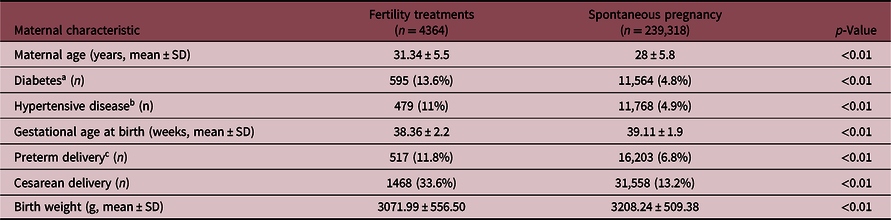
A total of 243,682 deliveries were included in the study: 4364 (1.8%) were of mothers who underwent fertility treatments and 239,318 (98.2%) were conceived spontaneously. Table 1 summarizes the maternal and perinatal characteristics by study group. Mothers in the infertility group were more likely to be older (31.34 ± 5.5 vs. 28 ± 5.8, p < 0.01) and obese (2.2% vs. 1%, p < 0.01). They were also more likely to be diagnosed with diabetes (13.6% vs. 4.8%, p < 0.01) and hypertension (11% vs. 4.9%, p < 0.01). The ART group exhibited significantly higher rates of preterm delivery (11.8% vs. 6.8%, p < 0.01) and cesarean sections (33.6% vs. 13.2%, p < 0.01) compared to the spontaneously conceived pregnancies group.
Maternal and perinatal characteristics by study group

a Including pregestational and gestational diabetes.
b Including pregestational, gestational hypertension, and preeclampsia.
c Preterm delivery <37 weeks of gestational age.
Table 2 presents the total ophthalmic-related hospitalizations. Ophthalmic-related hospitalizations were significantly higher in the fertility group compared to the spontaneously conceived group (1.2% vs. 1.0%, p = 0.04). Specifically, rates of retinopathy of prematurity (ROP), ocular infections, and visual disturbances were higher in the fertility group as compared to the spontaneously conceived group, although the differences were statistically insignificant.
Offspring long-term ophthalmological morbidities by study group

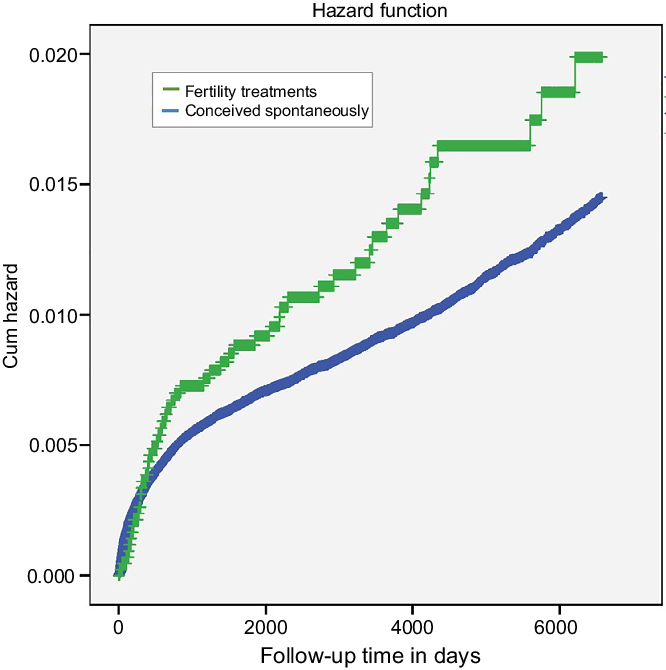
In the Kaplan–Meier survival curve (Fig. 1), offspring born to mothers who underwent fertility treatments had a significantly higher cumulative incidence of hospitalizations with ophthalmological morbidity, as compared to spontaneously conceived offspring (p < 0.001).
Kaplan–Meier survival curve demonstrating the cumulative incidence of ophthalmological-related hospitalizations in children of patients who underwent fertility treatments and those who conceived spontaneously (log rank = 0.02).

Table 3 presents the multivariable model for long-term risk of ophthalmic-related hospitalizations in children (age < 18 years). Fertility treatment was found to be a significant and independent risk factor for long-term risk for ophthalmic-related hospitalization of children (adjusted hazard ratio = 1.37, CI 1.04–1.80, p-value = 0.02). The model was adjusted for preterm delivery, maternal age, diabetes, and hypertensive disorders.
Cox regression analysis of the association between fertility treatment and ophthalmic-related hospitalization of children under 18 years

Discussion
In this large population-based study, fertility treatments were associated with offspring long-term ophthalmic morbidity. Singletons born as a result of ART treatments exhibited an increased risk of total ophthalmic-related hospitalizations. This association remained significant after adjusting for adverse pregnancy outcomes, known to be associated with fertility treatments such as GDM, hypertensive disorders, and preterm delivery. Importantly, these complications were also associated with long-term ophthalmic morbidity of the offspring in recent studies. Reference Kedar Sade, Wainstock, Tsumi and Sheiner16–Reference Walter, Tsumi, Wainstock, Spiegel and Sheiner18 We have also excluded multiple pregnancies since the physiological changes of the mother and fetus are distinct from those witnessed in singletons and may lead to biased results. Multiple pregnancies carry an increased risk for various morbidities. Reference Norwitz, Edusa and Park19,Reference Su, Zhu and Wei20
It is well established that ART pregnancies are at an increased risk for immediate adverse perinatal outcomes. Reference Sutcliffe and Ludwig21 A growing body of evidence indicates that fertility treatments may also be associated with long-term adverse offspring health. Specifically, studies have shown that fertility treatments carry an increased risk for neurologic morbidities, Reference Levin, Sheiner and Wainstock22 cardiovascular dysfunction, Reference Scherrer, Rexhaj, Allemann, Sartori and Rimoldi23 and cancer Reference Wainstock, Walfisch and Shoham-Vardi10 throughout life. Asthma Reference Carson, Sacker, Kelly, Redshaw, Kurinczuk and Quigley24 and gastrointestinal disorders Reference Shachor, Wainstock, Sheiner and Harlev11 have also been associated with fertility treatments.
Although the underlying pathophysiology associating fertility treatments and adverse long-term offspring health have not yet been fully established, some mechanisms have already been proposed. The Barker theory proposes that the fetal in utero period may determine the offspring’s risk for diseases throughout life. Epigenetic changes, such as DNA methylation that may occur during fertilization and early fetal period, are thought to comprise some of the molecular mechanisms that may be affected by the mode of conception. Reference Calkins and Devaskar25 A more specific epigenetic change is genomic imprinting. Genomic imprinting is the expression of only one allele of a specific gene (either maternal or paternal), and this occurs via the transmission of epigenetic information, using DNA methylation, from gametes to offspring. Genomic imprinting occurs in a relatively small number of human genes (about 100–200 genes, both protein-coding genes and noncoding RNA genes). Reference Ferguson-Smith and Bourc’his26 Recent studies have shown that such changes after ART may occur in phenotypically normal offspring. Reference Katari, Turan and Bibikova27,Reference Zechner, Pliushch and Schneider28 Importantly, changes in DNA methylation have been shown to occur after both OI and in vitro oocyte maturation. Reference Borghol, Lornage, Blachère, Sophie Garret and Lefèvre29,Reference Sato, Otsu, Negishi, Utsunomiya and Arima30
Subfertile women, who finally became pregnant spontaneously, had a higher frequency of poor pregnancy outcomes which is similar to infertile women who became pregnant by ART. Reference Raatikainen, Kuivasaari-Pirinen, Hippelainen and Heinonen31 Moreover, women undergoing IVF have been found to have higher methylation indices than non-IVF mothers, even before ovarian stimulation and exposure of the gametes/embryo to the techniques of ART. This suggests that maternal factors relating not only to the fertility treatments but also to the subfertility treatments are associated with epigenetic changes leading to adverse pregnancy outcomes. Reference Batcheller, Cardozo, Maguire, DeCherney and Segars32 Other possible factors associated with the different perinatal and long-term outcomes, such as procedure-related factors (manipulation of the embryo and culture media conditions) and patient-related factors (as psychological stress and infertility), are yet to be determined.
Only few studies have investigated the association between conception mode and ophthalmic morbidity of the offspring: Gao et al. recently published a meta-analysis that found a higher risk of ROP in infants born following ART and concluded that IVF treatments were significantly associated with ROP in singletons and stage 3 ROP. Reference Gao, Shao and Li33 They concluded that the underlying mechanism for ROP in IVF is probably premature birth. Jafarzadehpur et al. reported that poor fixation, refractive errors, and strabismus were higher among infants born following ART. Reference Jafarzadehpur, Kermani, Mohhamadi, Nateghi, Fazeli and Kashi34 Anteby et al. Reference Anteby, Cohen, Anteby and BenEzra35 described a case series of 47 children born following IVF with major ocular malformations including Coats disease, congenital cataract, congenital glaucoma, hypoplastic optic nerve head, idiopathic optic atrophy, coloboma with microphthalmos, and retinoblastoma. On the other hand, one study has concluded that there is no association between ART and ocular morbidity in the offspring. Reference Wikstrand, Strömland, Flodin, Bergh, Wennerholm and Hellström36 In this study, 296 children were stratified to children born after Intracytoplasmic sperm injection (ICSI) versus children conceived spontaneously. The children went through a complete ophthalmological and orthoptic evaluation at the age of 5 years with no significant differences between the two groups. It should be noted, however, that this study had a small sample size. In addition, one child with Goldenhar syndrome and one with Marcus Gunn syndrome were observed in the ICSI group. One child in the ICSI group was treated for ROP.
Early diagnosis of ocular morbidity in children, particularly vision disturbances, is very important for preventing amblyopia and irreversible poor vision later in life. To the best of our knowledge, no research has been conducted to clarify whether there is an association between fertility treatments and long-term offspring ophthalmic morbidity. In this nonselective population-based study, databases of the entire hospital records were combined for the purpose of the study, enabling a long follow-up on offspring conceived following ART. Some of the limitations of the study may include its retrospective design so that it can only point out associations rather than causation between fertility treatments and long-term ophthalmic morbidity. Another limitation is the limited geographical area and the lack of possibility for external validity of the findings. Additionally, ophthalmic morbidities were based on in-patient registries, and less acute cases of ophthalmic morbidities that are unrepresented in this setting may have led to an underestimation of the ophthalmic morbidity. The strength of this study is that SUMC is the only tertiary hospital in the southern region of Israel, the only one in the region that provides fertility treatments, and the main delivery center. This unique setting enables the formation of a reliable and comprehensive database of both maternal and pediatric medical information.
In conclusion, our current findings support the adverse long-term health effects of fertility treatments on the offspring. Future studies should clarify the mechanisms by which the fertility treatment affects offspring health. Also, it is possible that specific parameters such as patients’ characteristics or various fertility treatment modalities pose a different risk correlating with different ophthalmological morbidities. This knowledge may aid in the future to understand how morbidity related to these treatments might be avoided.
Acknowledgments
None.
Financial support
This research received no specific grant from any funding agency, commercial or not-for-profit sectors.
Conflicts of interest
None.
Ethical standards
The authors assert that all procedures contributing to this work comply with the ethical standards of Israel on human experimentation and with the Helsinki Declaration of 1975, as revised in 2008, and have been approved by the institutional committees of the Soroka university medical Center.