Introduction
Over a billion people worldwide are affected by the obesity epidemic (WHO, 2022). In Europe, 23% of the population lives with obesity (WHO-ROE, 2022). In France, the prevalence of obesity rose from 8.5% to 17% between 1997 and 2020 (Fontbonne et al., Reference Fontbonne, Currie, Tounian, Picot, Foulatier, Nedelcu and Nocca2023), and appears to vary in accordance with gender and age. Although French women continue to be more affected than men (Fontbonne et al., Reference Fontbonne, Currie, Tounian, Picot, Foulatier, Nedelcu and Nocca2023), the increase has been more significant among men, especially regarding severe obesity, which has tripled in 8 years (from 0.6% to 1.8%).
Obesity is associated with several emotional and psychological challenges. Lower self-esteem (defined as an individual’s perception of self-worth) is consistently linked to obesity (Niveau et al., Reference Niveau, New and Beaudoin2021). This is particularly pronounced among women, who often experience self-deprecating thoughts tied to societal blame for their appearance (Adam & Wani, Reference Adam and Wani2022). Obesity also significantly reduces quality of life (hereafter QoL), affecting both physical and psychological functioning (Le Foll et al., Reference Le Foll, Lechaux, Rascle and Cabagno2020). Research consistently shows a negative correlation between increasing body mass and perceived QoL (Kolotkin et al., Reference Kolotkin, Williams, Ervin, Williams, Meincke, Qin, Huth Smith and Fehnel2019; Stephenson et al., Reference Stephenson, Smith, Kearns, Haywood and Bissell2021).
The causes of obesity are multifactorial. Dietary patterns characterized by quality, value, and convenience (QVC), physical inactivity, and polygenic traits all play a role. Certain genes may amplify susceptibility in specific environmental contexts (Mas et al., Reference Mas, Brindisi and Chambaron2021). While genetic predisposition is relevant, social factors are equally influential. Health behaviors are often shaped by socioeconomic status (SES), and a comprehensive review of 144 studies found a strong inverse relationship between SES and obesity, especially among women in developed nations (Sobal & Stunkard, Reference Sobal and Stunkard1989).
Despite decades of research confirming the dominant influence of genetic and environmental factors in the development of obesity, public opinion continues to view obesity as the result of individual decision-making. Nearly one in two French people (45%) still believe that obesity is due to a lack of willpower (Branche et al., Reference Branche, Buscail, Péneau, Baudry, Poitou, Oppert, Czernichow, Kesse-Guyot, Touvier, Julia and Bellicha2023). This idea is one of the adverse prejudices frequently encountered in the stigmatization of people suffering from obesity. This misperception is associated with harmful assumptions about the lifestyles and characters of people with obesity (hereafter PwO) (Nutter et al., Reference Nutter, Eggerichs, Nagpal, Ramos Salas, Chin Chea, Saiful, Ralston, Barata‐Cavalcanti, Batz, Baur, Birney, Bryant, Buse, Cardel, Chugh, Cuevas, Farmer, Ibrahim, Kataria and Yusop2024).
Stigmatization, as first conceptualized by Goffman (Reference Goffman and Anderson1963), refers to societal reactions toward individuals or groups considered deviant, resulting in identity being reduced to a singular, often negative attribute (Goffman & Kihm, Reference Goffman and Kihm1975). In the context of obesity, this manifests as pervasive stigma across nearly all domains of daily life (Puhl & King, Reference Puhl and King2013). Weight-related stigma includes negative attitudes, discriminatory behaviors, and systemic biases toward individuals based on their body size (Puhl, Reference Puhl2023). In Western societies, PwO (Body Mass Index, hereafter BMI ≥ 30 kg/m2) or overweight (BMI ≥ 25 kg/m2) are often stereotyped as lazy, lacking willpower, unintelligent, or excessively indulgent (Puhl & Brownell, Reference Puhl and Brownell2006). Among adults, weight stigma ranks as the fourth most common form of discrimination (following age, gender, and race) and disproportionately affects women (Fikkan & Rothblum, Reference Fikkan and Rothblum2012). Moreover, a higher BMI correlates with increased experiences of stigma and a reduced perception of protection against discrimination (Levinson et al., Reference Levinson, Kinkel-Ram, Myers and Hunger2024).
Although weight stigma is a significant public health concern, methods for assessing the lived experiences of PwO remain inconsistent and underrepresented in the literature (DePierre & Puhl, Reference DePierre and Puhl2012). Most studies have centered on the stigmatizer’s perspective, such as employer bias (Rubino et al., Reference Rubino, Puhl, Cummings, Eckel, Ryan, Mechanick, Nadglowski, Ramos Salas, Schauer, Twenefour, Apovian, Aronne, Batterham, Berthoud, Boza, Busetto, Dicker, De Groot, Eisenberg and Dixon2020), healthcare provider attitudes (Puhl, Reference Puhl2023), and negative stereotypes from peers and family (Lawrence et al., Reference Lawrence, Puhl, Watson, Schwartz, Lessard and Foster2023), rather than on the experiences of those targeted. This focus is partly methodological: it is often easier to assess attitudes toward PwO than to investigate their personal accounts (Ruggs et al., Reference Ruggs, King, Hebl and Fitzsimmons2010). While such research has improved understanding of the scope of weight stigma, it leaves critical gaps. For example, little is known about the frequency, context, and emotional impact of verbal, physical, or relational stigma experienced by PwO. Many measures rely on BMI correlations with general mockery, rather than explicitly documenting weight-specific discrimination. A more comprehensive understanding requires tools that capture the frequency, intensity, and context of weight-based stigma across multiple environments.
Efforts to address this gap include work by Myers and Rosen (Reference Myers and Rosen1999), who developed an inventory with an American population to measure perceived weight-based stigmatization. The authors asked patients with obesity (n = 63 patients enrolled in a bariatric surgery program) and professionals working with them (n = 139) to list the stigmatizing situations they encountered or reported. For stigmatizing situations, the instructions given to the respondent were as follows: “Here is a list of situations that some people encounter because of their weight. Indicate whether any of these situations happens to you, and how often.” This study identified 50 stigmatizing experiences classified by frequency of occurrence. These categories are in order of appearance: comments from children, others who make negative assumptions about you, physical barriers, being stared at, inappropriate comments from doctors, unpleasant comments from family, unpleasant comments from others, being avoided, excluded, ignored, people you care about being embarrassed by your size, discrimination at work, and physical aggression.
More recently, Vartanian et al. (Reference Vartanian, Pinkus and Smyth2014) examined the temporal frequency of weight stigma in daily life. Their study tracked not only the type of stigma (verbal or non-verbal) but also its source (e.g., friends, parents, and partners), context (e.g., home settings), and whether others were present. The findings revealed that many individuals experience weight-based stigma on a near-daily basis, typically involving verbal or behavioral cues, and often occurring in social environments. Notably, the emotional impact of stigma varied according to its source, reinforcing the importance of context in understanding its effects.
In coping with repeated stigmatization, individuals often adopt a range of strategies (cognitive, emotional, and behavioral) to manage stress and restore psychological balance (Lazarus, Reference Lazarus1993). Evidence suggests that PwO may use different coping mechanisms than those with normative BMI (Aynehchi et al., Reference Aynehchi, Saleh-Ghadimi and Dehghan2023). One such mechanism is belief in a just world (hereafter BJW), a psychosocial theory which postulates that individuals generally reap the rewards of their actions (Bègue & Bastounis, Reference Bègue and Bastounis2003). Greater or lesser adherence to BJW reflects the way in which individuals perceive and understand their physical and social environment (Lerner & Miller, Reference Lerner and Miller1978). This theory suggests that deserving individuals are likely to be rewarded, while others are more likely to suffer negative consequences (Lerner, Reference Lerner1980). Believing in a just world enables individuals to perceive their environment as orderly and predictable.
However, studies suggest that a weaker personal BJW is linked to poorer psychological outcomes among individuals facing weight-related prejudice (Pearl & Dovidio, Reference Pearl and Dovidio2015), while a stronger belief is associated with higher self-esteem and subjective well-being (Jiang et al., Reference Jiang, Chen and Wang2017; Yasien, Reference Yasien2015).
Issues and Hypotheses
People suffering from obesity are particularly stigmatized in France (Fontbonne et al., Reference Fontbonne, Currie, Tounian, Picot, Foulatier, Nedelcu and Nocca2023). Despite the recognition of obesity-related stigma in other countries, research specific to France remains limited, and to our knowledge, there are no studies aimed at identifying stigmatizing situations among persons with obesity.
This article had two objectives. First, to generate a systematic inventory of weight-related stigmatizing situations in order to obtain a description for France (description of negative situations, person at the origin of the stigmatization, mode and place of expression of the stigmatization, other people present during the stigmatization, and feelings), which was done in the first part of the experimental procedure. Second, to show how characteristics such as QoL (physical impact, psychosocial impact, sexual life, dietary well-being, and experiences of dieting and dietetics), self-esteem, and the internalization of responsibility by stigmatized people (BJW) evolve as a function of BMI and other sociodemographic factors (age, degree, and whether or not bariatric surgery has been performed).
This second objective allowed us to test specific hypotheses. More specifically, we expected QoL (see, for instance, Rubino et al., Reference Rubino, Puhl, Cummings, Eckel, Ryan, Mechanick, Nadglowski, Ramos Salas, Schauer, Twenefour, Apovian, Aronne, Batterham, Berthoud, Boza, Busetto, Dicker, De Groot, Eisenberg and Dixon2020; Table 2), internalization of responsibility (BJW-self and BJW-other; see, for instance, Ebneter et al., Reference Ebneter, Latner and O’Brien2011 ), and self-esteem (see, for instance, Myers & Rosen, Reference Myers and Rosen1999) to be lower in people who had experienced stigmatizing situations (yes/no) than in those who had not (hypotheses 1a, 1b, 1c, and 1d, respectively). Next, self-esteem was expected to increase in conjunction with QoL, internalization of responsibility for oneself (BJW-self), and for others (BJW-other), corresponding to hypotheses 1e, 1f, and 1 g, respectively (see, for instance, MacLean & Kermode, Reference Maclean and Kermode2001; Bartholomaeus et al., Reference Bartholomaeus, Burns and Strelan2023; Lipkusa et al., Reference Lipkusa, Dalbert and Siegler1996). Additionally, consistent with the literature, BMI was expected to decrease QoL (see, for instance, Stephenson et al., Reference Stephenson, Smith, Kearns, Haywood and Bissell2021; hypothesis 2a) and self-esteem (see, for instance, Adam & Wani, Reference Adam and Wani2022; hypothesis 2b). Finally, we expected to find links between sociodemographic characteristics (gender, age, and degree) and self-esteem. Specifically, self-esteem was expected to be higher in men (Kling et al., Reference Kling, Hyde, Showers and Buswell1999; hypothesis 3a) and to increase with age (Orth et al., Reference Orth, Erol and Luciano2018) and degree (De Araujo & Lagos, Reference De Araujo and Lagos2013; Waddell, Reference Waddell2006, hypotheses 3b and 3c, respectively).
Method
Ethical Compliance
All procedures in this study involving human participants were performed in accordance with the ethical standards of our institutional research committee (#2023–06) and with the 1964 Helsinki Declaration and its later amendments or comparable ethical standards (APA 2019). Prior to participation, all individuals were fully informed about the nature, purpose, and procedures of the study. Written informed consent was obtained from all participants. Participation was voluntary, and participants were assured of the confidentiality and anonymity of their responses. They were also informed of their right to withdraw from the study at any time without any negative consequences.
Participants
The study sample included 497 adults aged 18 or over, regardless of their BMI: 418 females aged 18–74 (M = 42.4, SD = 13.7) and 72 males aged 18–73 (M = 43.8, SD = 14.3). Forty-seven participants were removed from the analyses due to partial or missing sociodemographic data (e.g., gender, height, weight, etc.), attitudinal data (questionnaires), or country of birth other than France. The final sample included 450 participants, 387 French women aged 18–74 (M = 42.4, SD = 13.8) and 63 French men aged 18–73 (M = 44.8, SD = 14.5). The qualitative analyses regarding the creation of a systematic inventory of weight-related stigmatizing situations were conducted on 252 obese women. The quantitative analyses performed to examine how QoL, self-esteem, and internalization of responsibility vary with BMI and sociodemographic factors (age, degree, and bariatric surgery) were conducted on the total sample of 450 participants. See Table 1 in the Supplemental Material for more statistics about the final sample of 450 participants.
Material
Stigmatizing Situations Inventory
The questionnaire from the Myers and Rosen (Reference Myers and Rosen1999) study was used to generate an inventory of stigmatizing situations. The authors asked participants of all weights to answer the following open-ended question: “Please describe a negative weight-related experience you have had with another person. Please rate only the negative weight-related experience you had. For each situation, please rate your feelings on a scale from 1 (not at all affected) to 4 (enormously affected).” As in other studies, the four additional questions proposed by Vartanian et al. (Reference Vartanian, Pinkus and Smyth2014) to complement the initial question by Myers and Rosen (Reference Myers and Rosen1999) were added. For Vartanian et al. (Reference Vartanian, Pinkus and Smyth2014), these new questions identify the contexts in which stigmatizing situations appear most frequently: “Who or what made you feel stigmatized or discriminated against?” with the following response options (from which participants select only one): spouse/partner, parent, son/daughter, other relative, acquaintance, stranger, customer, customer service representative, doctor/health professional, boss/supervisor, colleague, physical environment, media/advertising, and other. “How was the stigma expressed?” “Where did the stigmatization episode occur?” and “Who was present during the stigmatization episode?”
Self-Esteem Scale
Rosenberg’s Self-Esteem Scale (Rosenberg, Reference Rosenberg1965), validated in French by Vallieres and Vallerand (Reference Vallieres and Vallerand1990), consists of 10 items assessing global self-esteem on a 4-point Likert scale (1 = strongly disagree to 4 = strongly agree). Higher scores indicate higher self-esteem. The scale showed good internal consistency (α = .89).
Quality of Life Scale
This 36-item French-validated scale (Ziegler et al., Reference Ziegler, Filipecki, Girod and Guillemin2005) measures obesity-specific QoL across domains such as physical impact, psychosocial impact, impact on sex life, comfort with foods, and diet experiences. Each item is rated on a 5-point Likert scale (1 = all the time to 5 = never), and scores are converted into a 100-point scale. Higher scores reflect better perceived QoL. The scale has high internal consistency (α = .93).
Beliefs in a Just World
Adapted into French by Bègue and Bastounis (Reference Bègue and Bastounis2003) from Lipkus (Reference Lipkus1991), this two-dimensional scale measures beliefs that the world is fair. It distinguishes between beliefs about justice for oneself (α = .66; e.g., “I’m treated fairly most of the time”) and for others (α = .80; e.g., “People are treated fairly most of the time”). Responses are given on a 5-point Likert scale (1 = strongly disagree to 5 = strongly agree).
Sociodemographic Variables
Socio-demographic data (gender, age, degree, and whether or not bariatric surgery has been performed) were collected online after completion of the stigma inventory and scales.
Procedure
Participants were recruited through social media and a hospital where they had undergone bariatric surgery. After consent, they completed a 15–20-minute online questionnaire via a GDPR-compliant platform (www.soscisurvey.de). The sole exclusion criterion was age (participants had to be over 18). In the first section, participants indicated whether they had experienced weight-related stigma. Those who had were asked to describe up to four negative experiences, to rate their emotional impact (from “not affected at all” to “extremely affected”), and to report the perpetrator, the form and setting of the experience, and the presence of others. The second section, divided into three parts, included measures of self-esteem, BJW, and QoL. Demographic information was also collected, including gender, age, height, weight, degree, and bariatric surgery history (yes/no).
Results
First, we present the results of the systematic inventory of weight-related stigmatization situations. Second, we present analyses showing how characteristics such as QoL (physical impact, psychosocial impact, sexual life, dietary well-being, and experiences of dieting and dietetics), self-esteem, the internalization of responsibility by stigmatized individuals (BJW) evolve as a function of BMI and other sociodemographic factors (age, degree, and whether or not bariatric surgery has been performed).
Describing the Stigmatizing Experiences Reported by French Female Participants
Among the 387 female participants, 283 reported having experienced a stigmatizing situation (measured as yes or no), but only 252 of them verbally described at least one weight-related stigmatizing situation. This included five individuals with anorexia (BMI < 18.5) who were therefore not included in the inventory of obesity-related stigmatizing situations (see Table 2 in Supplemental Material for demographic statistics).
All reported stigmatizing experiences were merged to create a corpus constituting one entity, as they all referred to the themes or variables. The analysis applied a reliability thematic analysis (RTA, Braun & Clarke, Reference Braun and Clarke2022 ) to describe how the participants made sense of their experiences of care provision for inpatients with obesity. The themes were developed early in the analytic process, following some data familiarization and reflection, and completing Myers and Rosen’s (Reference Myers and Rosen1999) inventory. A codebook was applied to a portion of the data by multiple coders. The codes were then organized into themes, represented by categories of experience that reached consensus between all authors, and unified into a comprehensive description of the phenomenon. Two authors (I. U. and A. L) reconciled their ratings to arrive at a first coding tree that reached consensus. Then, on this basis, one of the authors coded the rest of the interviews while refining the coding tree. Regular updates on these ratings were made by all the authors. Detailed discussions were held until consensus was reached, and the reliability of the data was enhanced by the transparent process of analysis. Credibility of the analysis was established by asking authors with expertise in qualitative methodology to validate themes and coding. The themes were illustrated by references (by reference, we mean quotation of text associated with a theme). NVivo software (QSR International Pty Ltd, 2023) was used to analyze and manage these data.
The results of the analysis are presented in several parts: (1) identification of the types of stigmatizing experiences mentioned by the participants; (2) identification of the people who were the sources of stigmatizing experiences (who); (3) mode of expression of stigmatization (how); (4) place where the stigmatizing episode occurred (where); (5) people present during the stigmatization episode (witness); and (6) feelings about the situation (feelings). The six questions we set out to answer were as follows: What stigmatizing situations did participants encounter? Who were the people behind them? How were stigmatizing situations expressed? Where did they occur? Who was present when stigmatization occurred? How did the victims feel?
We were also interested in the type of stigmatizing experiences produced depending on the person responsible for the stigmatizing experience (who), the mode of discrimination (how), and the place where the discrimination occurred. We created cross-tabulations to answer these questions. For each cross-tabulation addressing one of the previous questions (e.g., stigmatizing experiences × who), we identified the most representative categories (e.g., doctor/healthcare professional) of stigmatizing behaviors by determining which were more than 2 standard deviations above the mean of the categories forming the studied variable (for instance, for the who variable, the average number of negative weight-related inferences stigmatizing behavior was M = 1.93, SD = 2.15. Thus, the threshold beyond which a category of person responsible for stigmatizing behavior was overrepresented was 1.93 + 2 × 2.15 = 6.24. For this type of stigmatization, only doctors/healthcare professionals exhibited this behavior more frequently than the established threshold.)
All participants who reported experiencing at least one stigmatizing situation provided at least one description (252 participants). A total of 484 stigmatizing situations were described (some verbal comments included more than one stigmatizing situation). To analyze the content of the stigmatizing situations, a codebook was produced to classify each stigmatizing situation into one or more categories (and subcategories; see Table 3 in the Supplemental Material for the Codebook).
Identification of the Type of Stigmatization Mentioned by the Participants
We performed a content analysis of participants’ reported stigmatizing experiences. This process yielded eight distinct categories, each with corresponding subcategories, which were reliably identified (see Table 3 in the Supplemental Material). Unpleasant comments accounted for approximately half of all reported stigmatization experiences. These comments primarily concerned remarks related to physical appearance and weight, encompassing all hurtful, demeaning, or contemptuous statements directed at a person due to their weight, appearance, or behaviors perceived as non-conforming to social norms. This category also included injunctions to change or conform, as well as guilt-tripping statements (e.g., phrases such as “you should…” or “you must…”). Remarks related to diet or more general comments were less frequent. Derision and ridicule represented the second category, accounting for approximately 15% of reported stigmatization experiences. This category included malicious remarks and sarcasm intended to make fun of a person’s weight or appearance, as well as the use of humiliating or pejorative nicknames related to weight, aimed at demeaning an individual. Other forms of stigmatization, such as physical barriers (obstacles related to infrastructure, objects, or clothing), attacks (physical, sexual, and verbal), being stared at by others, negative weight-related inferences, and discrimination (at work or at school, in love and friendship contexts), represented between 5% and 10% of all reported stigmatization experiences. Finally, embarrassment expressed by relatives constituted the last category, accounting for approximately 2% of reported stigmatization experiences.
Identification of the People who were the Sources of the Stigmatizing Experiences Mentioned by the Participants (Who)
Doctors and healthcare professionals were the primary source of stigmatizing experiences (19%), followed closely by strangers (> 16%) and acquaintances (> 13%) (Table 4 in the Supplemental Material). Parents, spouses and partners, friends, and other family members contributed to a lesser extent to the stigmatization (< 10%).
Identifying the Mode of Expression of Stigmatization Mentioned by the Participants (How)
The primary modes of expressing stigmatization included verbal comments (> 78%) (Table 5 in the Supplemental Material). All other modes of expression were far less frequent (between < 7% and 0.5%).
Identifying the Place where the Stigmatizing Episode Occurred Mentioned by the Participants (Where)
The majority of episodes occurred in the private sphere (home or other domestic settings (> 20%), followed by medical settings (about 18%). The school and educational environment, the workplace and the street, and public transportation were also problematic places for stigmatized people (> 11%). In-store locations accounted for just under 10% of stigmatizing situations. Remaining situations (transportation, restaurant, etc.) appeared to be infrequent (< 3%) (Table 6 in the Supplemental Material).
Identifying the People Present during the Stigmatizing Episode Mentioned by the Participants (Witnesses)
Stigmatizing episodes were mainly produced when the person in a situation of obesity was alone with another person (about 40%). When one or two additional people were present, a decrease in stigmatizing behavior frequency was observed. The more people were present, the less frequently these negative situations occurred (Table 7 in Supplemental Material).
Identification of the Feelings of Overweight Individuals when Faced with Stigmatizing Situations (Feelings)
In terms of the perception of stigmatizing experiences (N = 478), participants reported being very significantly affected (n = 261, 54.6%) or affected by the stigmatizing situation (n = 186, 38.9%). Those reporting being moderately or not at all affected were much less frequent (n = 29, 6.1%, and n = 2, 0.4%, respectively).
Type of Stigmatization According to Who, How, Where, Witness, and Degree
As far as the perpetrators of stigmatization were concerned (who), doctors and medical settings were the ones who produced the most weight-related inferences, discrimination, and unpleasant comments, while aggression was predominantly perpetrated by unknown or unidentified people. Parents were the ones who made the most remarks about diet, while degrading nicknames were produced by friends.
In terms of how stigma was produced (how), this overwhelmingly took the form of verbal comments, and mostly unpleasant comments related to physical appearance or weight. It also took the form of mockery, weight-related inferences, and, more seriously but to a lesser extent, verbal aggression and insults. As for the places where stigmatizing situations occurred (where), the stigmatizations over-represented were mockery at school, at work, or in the school environment. Degrading nicknames were mostly heard in the street, and weight-related inferences in the medical world. As far as witnesses and feelings were concerned, there was no over-representation of different types of stigmatization.
Quality of Life, Self-Esteem, and Sociodemographic Factors Related to Stigmatizing Situations
The characteristics of the participants in this second part of the results are presented in Supplemental Material Table 1 (N = 450; 387 French women aged 18–74, M = 42.4, SD = 13.8; 63 French men aged 18–73, M = 44.8, SD = 14.5). The sample of participants included underweight individuals, individuals with normal weight, and those with varying degrees of obesity. As a result, the mean BMI was 29.43 (SD = 8.30).
All analyses were conducted with JAMOVI 2.3.26.0 (The Jamovi Project, 2024), except for MANOVA analyses that were conducted with SPSS 29.0.2.0 (20) (IBM Corp, 2023). Data, analyses, and supplemental material are available in the following OSF folder https://osf.io/6zejk/.
Internal consistency scores for self-esteem, just world believer, and QoL showed good-to-high consistency levels, with, respectively, α = .88, .81, and .93; ω = .88, .82, and .93. Criteria from confirmatory factorial analysis were closed in accordance with the recommendations of Hu and Bentler (Reference Hu and Bentler1999), pp. 27–28), with, respectively, TLI = .73, .75, and .78; SRMR = .08, .06, and .08; RMSEA = .17, .19, and .08; 95% CI [.16, .18], [.16, .22], and [.08, .08]. No deviation from normality conditions (skewness and kurtosis) was observed according to Kim’s (Reference Kim2013) criteria for all the continuous variables included in the following analyses.
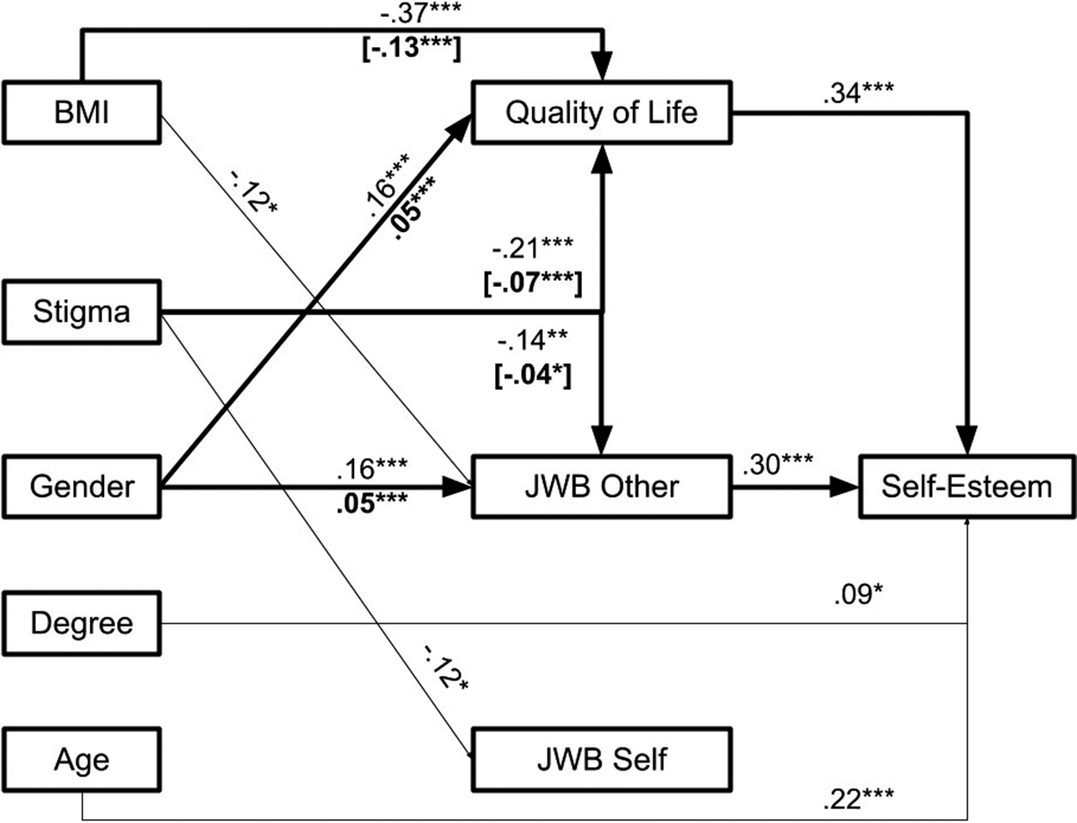
As can be seen in Figure 1, demographic variables (gender, degree, and age) correlated with most of the relevant dimensions measured in this study (BJW-self, BJW-other, QoL, and self-esteem). The variances of BJW-self, BJW-other, and QoL were significantly explained by the models, with, respectively, R 2 = .03, F(6, 443) = 2.18, p = .044; R 2 = .09, F(6, 443) = 7.45, p < .001; and R 2 = .27, F(6, 443) = 27.49, p < .001. Both antecedents (sociodemographic characteristics, BMI, and stigma) and mediator (BJW-self, BJW-other, and QoL) explained 37% of the self-esteem variance, with R 2 = .30, F(9, 440) = 20.58, p < .001.
The effects (β) on the continuous variables on the self-esteem.
Note. Gender (1 = male, 2 = female); BMI = Body Mass Index; Stigma = Weight-stigma; BJW-Other = Belief in a Just World for Other; BJW-Self = Belief in a Just World for Self. Thin arrows: components or direct effects; thin statistics: components statistics; bold arrows: mediation; [bold statistics]: mediation statistics.
*p < .05. **p < .01. ***p < .001.

Three sets of hypotheses were formulated to model the variation in self-esteem. The first set of hypotheses concerned the impact on self-esteem of experiencing stigmatizing situations (effects of antecedents on mediators, effects of mediators on self-esteem, then mediation and direct effects), the second set focused on the impact of BMI on QoL and self-esteem, and the last set examined the link between sociodemographic characteristics and self-esteem: gender (male, female or other), age (in year), degree (1: no diploma, 2: vocational training certificate, 3: high school diploma, 4: two-year university degree, 5: Bachelor’s degree/Professional Bachelor’s/University Technology Degree, 6: first year of Master’s, 7: Master’s degree, 8: Doctorate/Engineering degree/Advanced Graduate Diploma/Specialized Graduate Diploma/equivalent to 8 years post-baccalaureate, and 9: Post-Doctoral or equivalent), and bariatric surgery (yes or no) (see Table 8 in the Supplemental Material for correlations between all the variables included in the analysis for the full sample of N = 450; see Table 9 in the Supplemental Material for means and standard deviations of the measures used segmented by BMI categories).
First, consistent with hypothesis 1a, individuals who experienced stigmatizing situations reported a lower average QoL than those who had never faced such situations, with b = −0.28, SE = 0.06, 95% CI [−0.39, −0.15], z = −4.41, p < .001. Next, in line with hypotheses 1b and 1c, experiencing stigmatizing situations decreased both components of internalization of responsibility, with b = −0.19, SE = 0.09, 95% CI [−0.35, −0.02], z = −2.22, p = .027 for BJW-Self; and b = −0.24, SE = 0.09, 95% CI [−0.40, −0.06], z = −2.68, p = .007 for BJW-other. Moreover, consistent with hypotheses 1e and 1 g, self-esteem increased in conjunction with QoL and BJW-other, with b = 0.28, SE = 0.05, 95% CI [0.18, 0.37], z = 5.72, p < .001; and b = 0.19, SE = 0.03, 95% CI [0.12, 0.26], z = 5.75, p < .001, respectively. However, no link was found between self-esteem and BJW-self, contrary to hypothesis 1f, with b = 0.00, SE = 0.04, 95% CI [−0.07, 0.08], z = 0.01, p = .99. Finally, consistent with hypothesis 1d, self-esteem depended on whether or not stigmatizing situations were experienced, with b = −0.13, SE = 0.06, 95% CI [−0.24, −0.01], β = −0.11, z = −2.20, p = .028. Specifically, it appeared that this relationship was mediated by QoL and BJW-other, but not by BJW-self, with b = −0.08, SE = 0.02, 95% CI [−0.12, −0.04], z = −3.51, p < .001, b = −0.05, SE = 0.02, 95% CI [−0.09, −0.01], z = −2.36, p = .018, and b = −0.00, SE = 0.01, 95% CI [−0.02, −0.00], z = −0.01, p = .99, respectively. No direct effect was found, indicating a total mediation effect between experiencing stigmatizing situations and self-esteem, with b = −0.00, SE = 0.05, 95% CI [−0.10, 0.09], z = −0.09, p = .93.
Regarding the impact of BMI on self-esteem, the analyses showed that an increase in BMI decreased perceived QoL (hypothesis 2a), with b = −0.03, SE = 0.00, 95% CI [−0.04, −0.02], z = −6.75, p < .001. Additionally, as expected, an increase in BMI decreased self-esteem (hypothesis 2b), with b = −0.01, SE = 0.00, 95% CI [−0.02, −0.00], z = −2.06, p = .039. Specifically, this effect was mediated by QoL, and no direct effect was found, with b = −0.01, SE = 0.00, 95% CI [−0.01, −0.00], z = −4.29, p < .001, and b = 0.00, SE = 0.00, 95% CI [−0.01, 0.01], z = 0.45, p = .66, respectively. Exploratory analyses also revealed that an increase in BMI decreased the internalization of responsibility directed toward others but did not impact the dimension directed toward oneselfFootnote 1, with b = −0.01, SE = 0.01, 95% CI [−0.02, 0.00], z = −2.01, p = .044, and b = 0.00, SE = 0.01, 95% CI [−0.01, 0.01], z = 0.24, p = .81, respectively.
Regarding sociodemographic variables, we observed that degree and age did not impact the three mediatorsFootnote 2 (Quality of Life, BJW-Self, and BJW-other). However, the results showed that self-esteem increased with degree and age, with b = 0.03, SE = 0.01, 95% CI [0.01, 0.05], z = 2.44, p = .015, and b = 0.01, SE = 0.00, 95% CI [0.00, 0.01], z = 3.74, p < .001, respectively. However, neither gender nor having undergone bariatric surgery affected self-esteem, with b = 0.06, SE = 0.07, 95% CI [−0.07, 0.19], z = 0.89, p = .37, and b = −0.01, SE = 0.05, 95% CI [−0.11, 0.10], z = −0.14, p = .89, respectively. Specifically, the relationships between self-esteem and degree on the one hand, and self-esteem and age on the other hand, are direct and not mediated, with b = 0.02, SE = 0.01, 95% CI [0.00, 0.05], z = 2.00, p = .046, and b = 0.01, SE = 0.00, 95% CI [0.00, 0.01], z = 4.83, p < .001, respectively.
Regarding the effect of gender on self-esteem, we encounter a contradiction. Indeed, we do not observe a total effect or a direct effect of gender on self-esteem, with b = 0.06, SE = 0.07, 95% CI [0.07, 0.19], z = 0.89, p = .37, and b = −0.10, SE = 0.06, 95% CI [0.02, −0.06], z = −1.58, p = .115, respectively. However, the results indicate a mediated effect of gender on self-esteem through BJW-other and QoL, with b = 0.07, SE = 0.02, 95% CI [0.03, 0.12], z = 3.22, p < .001, and b = 0.08, SE = 0.02, 95% CI [0.04, 0.14], z = 3.33, p < .001, respectively, but not through BJW-Self, with b = 0.00, SE = 0.01, 95% CI [−0.01, 0.02], z = 0.01, p = .99. Regarding the components, we also observed effects of gender on self-esteem and QoL, with b = 0.39, SE = 0.10, 95% CI [0.19, 0.60], z = 3.89, p < .001, and b = 0.39, SE = 0.08, 95% CI [0.15, 0.16], z = 3.97, p < .001, respectively. However, BJW-Self did not impact self-esteem in its components, with b = 0.18, SE = 0.10, 95% CI [−0.02, 0.40], z = 1.69, p = .09.
Discussion
This study aimed in the first phase to generate a systematic inventory of weight-related stigmatizing situations, and, second, to examine how QoL, self-esteem, and internalization of responsibility vary with BMI and sociodemographic factors (age, degree, and bariatric surgery). To achieve our first objective, a modified version of Myers and Rosen’s (Reference Myers and Rosen1999) questionnaire was used. Participants reported one to four weight-related stigmatizing experiences, evaluated the emotional impact of each, and provided contextual details (e.g., identity of the perpetrator, social context, and setting), based on items adapted from Vartanian et al. (Reference Vartanian, Pinkus and Smyth2014). Among 387 participants, 252 reported verbal weight-related stigmatization, accounting for 484 individual incidents. These were classified into eight major types and subtypes, with verbal comments (particularly those targeting appearance, weight, normative behaviors, and guilt induction) being the most prevalent. In contrast, less overt forms of stigma, such as environmental barriers or public staring, were reported in fewer than 10% of cases.
These findings differ substantially from those of Myers and Rosen (Reference Myers and Rosen1999), who identified children as the most frequent sources of verbal stigma. In the current study, by contrast, doctors and healthcare professionals emerged as the principal perpetrators, followed by strangers and acquaintances. Within the private sphere, family members (especially parents) were often sources of dietary criticism, while friends were more likely to use derogatory nicknames. The discrepancies between this study and that of Myers and Rosen (Reference Myers and Rosen1999) may be attributed more to methodological differences than cultural variation. Whereas Myers and Rosen included both men and women (no men participated in our study), individuals without obesity, and professionals or journalists, the present study focused exclusively on women with lived experiences of obesity, including bariatric surgery patients. Furthermore, unlike Myers and Rosen, who excluded responses lacking coder consensus, this study included all self-reported experiences, offering a potentially more representative account of weight-related stigmatization.
A key observation concerns the spatial context of these experiences. Most stigmatization episodes occurred in private or semi-private environments, such as homes and healthcare settings. This is particularly concerning, as these are spaces where individuals typically expect support and empathy. The presence of stigma in medical contexts highlights a systemic problem, raising both ethical and practical concerns about the delivery of healthcare to individuals with obesity. This study identifies specific contexts in which women with obesity are most likely to experience stigmatization. The highest probability of encountering a stigmatizing situation occurs when alone, with medical professionals, or with family members. The environments most conducive to such experiences are medical settings and domestic spaces. However, these findings also provide insights into the characteristics of protective contexts: the presence of multiple individuals appeared to reduce the risk of stigmatization, and the presence of relatives did not guarantee protection.
In its second phase, the study examined how characteristics such as QoL (physical impact, psychosocial impact, sexual life, dietary well-being, and experiences of dieting and dietetics), self-esteem, and the internalization of responsibility by stigmatized individuals (BJW) vary according to BMI and other sociodemographic factors (age, degree, and whether or not bariatric surgery has been performed).
As expected, participants who reported experiencing stigma demonstrated significantly lower QoL, confirming hypothesis 1a. This result aligns with previous studies indicating that stigma, particularly weight-related stigma, is a consistent predictor of diminished psychological and physical well-being (Abiri et al., Reference Abiri, Hosseinpanah, Banihashem, Madinehzad and Valizadeh2022; Latner et al., Reference Latner, Durso and Mond2013; Wu & Berry, Reference Wu and Berry2018). For instance, Papadopoulos and Brennan (Reference Papadopoulos and Brennan2015) found in a systematic review that weight stigma was strongly associated with poorer mental health outcomes and reduced psychological well-being. Similarly, Puhl and Heuer (Reference Puhl and Heuer2009) observed that individuals exposed to stigmatizing experiences reported lower overall QoL.
In line with hypotheses 1b and 1c, stigmatized individuals also reported lower scores on both components of internalized justice beliefs (BJW-self and BJW-other). Notably, those who experienced stigmatization not only internalized the injustice but also perceived more injustice directed at others, thereby reinforcing their belief that the world is fundamentally unfair. This reduction in the internalization of responsibility, in particular the BJW-other dimension, could indicate that stigmatized individuals are less inclined to believe that their situation is due to external factors, such as injustice or social prejudice. This erosion in their belief that the world is fair contributed to a decline in self-esteem (hypothesis 1d).
The core hypothesis (hypothesis 1d) posited that the relationship between stigma and self-esteem is mediated by QoL and BJW-other. Results confirmed that although stigma exerts a total effect on self-esteem (Smith et al., Reference Smith, Becnel and Williams2019), this effect is fully mediated by declines in QoL and BJW-other. These mediating effects are consistent with Uzdil et al. (Reference Uzdil, Macit Çelebi and Coşkun Us2024), who found that reduced QoL correlates with lower self-esteem and greater psychological distress in individuals subjected to weight-related discrimination. Notably, the severity of this impact appears to be context-dependent. These findings suggest that weight stigma erodes well-being and disrupts fundamental cognitive schemas concerning justice and fairness, thereby diminishing self-esteem. This aligns with existing literature showing that BJW serves as a cognitive buffer, helping individuals to emotionally regulate and cognitively reframe negative experiences (Benson & Ritter, Reference Benson and Ritter1990; Jiang et al., Reference Jiang, Chen and Wang2017; Lipkusa et al., Reference Lipkusa, Dalbert and Siegler1996). These effects are likely mediated by complex emotional and psychological processes such as shame, anxiety, and depression (Tibere et al., Reference Tibere, Poulain, Pacheco Da Costa Proenca and Jeannot2007), which may involve decreased self-esteem and psychosocial functioning, particularly among individuals affected by obesity-related stigma (Puhl & Latner, Reference Puhl and Latner2007).
Hypotheses H1e and H1g were further supported by the results, indicating that self-esteem is positively associated with both QoL and BJW-other. These findings align with a well-established body of literature highlighting self-esteem as a crucial predictor of adaptive functioning across various life domains, including physical health, social relationships, and coping with stressful experiences (Judge & Bono, Reference Judge and Bono2001; Mikula et al., Reference Mikula, Nagyova, Krokavcova, Vitkova, Rosenberger, Szilasiova, Gdovinova, Stewart, Groothoff and Van Dijk2017, Reference Mikula, Nagyova, Vitkova and Szilasiova2018). In particular, self-esteem has been linked to improved health outcomes and greater emotional well-being among individuals living with obesity (Griffiths et al., Reference Griffiths, Parsons and Hill2010; Sarwer et al., Reference Sarwer, Allison, Wadden, Ashare, Spitzer, McCuen-Wurst, LaGrotte, Williams, Edwards, Tewksbury and Wu2019; Ul-Haq et al., Reference Ul-Haq, Mackay, Fenwick and Pell2012). The observed positive association between self-esteem and perceived QoL underscores the close interconnection between psychological and physical well-being, a relationship also emphasized in previous studies (Dunkley et al., Reference Dunkley, Zuroff and Blankstein2003). For example, Ul‐Haq et al. (Reference Ul-Haq, Mackay, Fenwick and Pell2013) showed that among a sample of 500 overweight or obese adults, lower self-esteem was significantly associated with diminished QoL, particularly in physical, psychological, and social domains. Similarly, a review by Ul-Haq et al. (Reference Ul-Haq, Mackay, Fenwick and Pell2012) identified self-esteem as a key predictor of health-related QoL in individuals with obesity. Furthermore, a meta-analysis by Griffiths et al. (Reference Griffiths, Parsons and Hill2010) confirmed that interventions aimed at enhancing self-esteem produced substantial improvements in QoL among this population. However, contrary to Hypothesis H1f, no significant association was found between self-esteem and BJW-Self. This result could suggest that, in the context of stigmatization, the individual does not necessarily perceive his or her own actions as responsible for his or her stigmatized situation, but is more influenced by social beliefs about injustice and societal norms (Jost & Banaji, Reference Jost and Banaji1994).
The study also found that BMI negatively affected QoL (hypothesis 2a), which in turn mediated its effect on self-esteem (hypothesis 2b). This reinforces previous findings that QoL serves as a key intermediary variable linking physical attributes such as body weight to psychological constructs such as self-worth (Abiri et al., Reference Abiri, Hosseinpanah, Banihashem, Madinehzad and Valizadeh2022; İmre & Toprak, Reference İmre and Toprak2023).
Unexpectedly, gender (hypothesis 3a) did not exert a direct or total effect on self-esteem, although previous literature often reports higher self-esteem among men (e.g., Kling et al., Reference Kling, Hyde, Showers and Buswell1999). While men reported higher QoL and BJW scores, which indirectly enhanced their self-esteem, the lack of a total effect complicates interpretations and suggests that the gender–self-esteem relationship may operate through complex or unmeasured pathways.
In contrast, age and degree both positively and directly lead to self-esteem, confirming hypotheses H3b and H3c. These findings align with prior research indicating that self-esteem generally increases with age (Orth et al., Reference Orth, Trzesniewski and Robins2010) and degree (von Soest et al., Reference Von Soest, Wichstrøm and Kvalem2016). However, neither QoL nor BJW mediated the relationship between self-esteem and these variables, suggesting that the effects of age and degree on self-worth are likely shaped by alternative mechanisms not explored in the present study.
Conclusion
The study offers a comprehensive and nuanced examination of how weight-related stigmatization affects women with obesity in France. The findings underscore the prevalence of verbal stigma, especially within the medical domain, but also in family and domestic environments, environments that are supposed to be sources of support, and highlight the significant emotional toll it takes.
Besides identifying the sources and settings of stigma, the study reveals a complex network of mediating factors—most notably QoL and BJW—that explain the erosion of self-esteem in stigmatized individuals. These insights call for policy interventions and public health efforts to address not only the visible discrimination faced by individuals with obesity, but also the less overt, systemic biases perpetuated in healthcare and intimate environments.
This study presents several limitations. First, the sample was composed almost exclusively of French women, revealing a substantial gender imbalance: only 63 men completed the stigma inventory, compared to 387 women. The small number of male respondents—insufficient for statistical analysis—limited their inclusion in the assessment of stigmatizing experiences. While it is well established that women, regardless of cultural context, are generally more frequently subjected to discrimination than men (Anastasiadou et al., Reference Anastasiadou, Tárrega, Fornieles-Deu, Moncada-Ribera, Bach-Faig and Sánchez-Carracedo2024; Ligue contre l’Obésité, 2024; Prunty et al., Reference Prunty, Clark, Hahn, Edmonds and O’Shea2020; Sohier et al., Reference Sohier, Brearty, LeBlanc, Chartrand, St-Laurent, Spahis, Philibert, Mangliar, Gagnon-Girouard, Lakritz and Iceta2025), the exclusion of male participants and individuals of other gender identities restricts the generalizability of the findings. Further research is therefore needed to explore the stigmatization experiences of men and gender-diverse individuals. Second, the study relied exclusively on self-reported data, which may be subject to various biases, including social desirability and recall inaccuracies. Future research should consider incorporating objective or multi-method approaches and expanding the scope to include non-Western cultural contexts, where perceptions and experiences of stigma may differ significantly.
Future research should continue exploring these mediating pathways and seek to identify protective factors that can buffer against the harmful effects of weight stigma. Equally important is the development of training and awareness programs targeting healthcare professionals, who were identified as the main perpetrators of stigmatization in this study. Lastly, empowering individuals with obesity through education, social support, and esteem-enhancing interventions may provide meaningful avenues for mitigating the detrimental effects of stigma and improving their overall QoL and well-being.
Supplementary material
To view supplementary material for this article, please visit http://doi.org/10.1017/SJP.2025.10014.
Data availability statement
Data and supplemental material are available at https://osf.io/6zejk/.
Author contribution
Contributed equally to this work with conceptualization, formal analysis, methodology, validation, writing – original draft, writing – review & editing: Isabel Urdapilleta, Samuel Demarchi, and Annick Lemoine. Investigation: Annick Lemoine and Jean-Marc Catheline. Resources: Jean-Marc Catheline. Project administration and supervision: Isabel Urdapilleta and Samuel Demarchi.
Funding statement
The authors declare that no financial support was received for the research, authorship, and/or publication of this article.
Competing interests
The authors declare none.