Working memory is a cognitive structure or capacity, which remembers, maintains, manages, processes, and stores information, with its role specific to the short term (Alloway, Reference Alloway2011; Baddeley, Reference Baddeley2003). Working memory capacity increases throughout childhood and with time spent at school, independently of age (Roberts et al., Reference Roberts, Quach, Mensah, Gathercole, Gold, Anderson and Wake2015). Working memory is typically described as a cognitive capacity (Klingberg, Reference Klingberg2010); however, it can also be conceptualised as a set of skills or strategies that can be learned, enabling better use of capacity and potentially better functioning in classroom contexts (Gathercole, Reference Gathercole2008; Tidwell, Dougherty, Chrabaszcz, Thomas, & Mendoza, Reference Tidwell, Dougherty, Chrabaszcz, Thomas and Mendoza2014).
The role of attention, as part of working memory, and as a feature of all aspects of cognitive functioning, is important in classroom contexts, particularly as its presence or absence may be more readily observed compared with working memory itself (Gathercole, Lamont, & Alloway, Reference Gathercole, Lamont, Alloway and Pickering2006; Gathercole et al., Reference Gathercole, Alloway, Kirkwood, Elliott, Holmes and Hilton2008). Within a working memory model, attention includes the strategic prioritising of information for working memory and the ability to maintain information when distractions occur (Alloway & Alloway, Reference Alloway and Alloway2013).
Working memory predicts academic achievement, such that higher measured working memory is associated with better academic outcomes (Aronen, Vuontela, Steenari, Salmi, & Carlson, Reference Aronen, Vuontela, Steenari, Salmi and Carlson2005), with some variation in this relationship as a function of grade and academic domain (Gathercole, Pickering, Knight, & Stegmann, Reference Gathercole, Pickering, Knight and Stegmann2004). Conversely, attention and working memory difficulties negatively impact on academic learning and progress (Gathercole & Alloway, Reference Gathercole and Alloway2008).
There are three main ways to increase working memory capacity and skills, and/or reduce working memory overload. These are to:
1. train working memory capacity directly;
2. manage the way information and learning is presented in the learning environment (classroom), primarily through the agency of the teacher; and
3. provide students with strategies they can use to self-manage their working memory skills, and potentially increase their working memory capacity, within the classroom context.
A number of working memory programs, many of which are computerised, have been developed, with the aim of improving individual working memory capacity outside the classroom, and with an assumption that generalisation or transfer should occur within the classroom setting — for example, Cog Med (Klingberg et al., Reference Klingberg, Fernell, Olesen, Johnson, Gustafsson, Dahlstrom and Westerberg2005) and Jungle Memory (Alloway, Reference Alloway2012; Alloway & Alloway, Reference Alloway and Alloway2013).
Several authors have extrapolated from theory and research, suggesting ways in which teachers can both observe and support students with difficulties in working memory (e.g., Alloway, Reference Alloway2011; Dehn, Reference Dehn2008; Elliott, Gathercole, Alloway, Holmes, & Kirkwood, Reference Elliott, Gathercole, Alloway, Holmes and Kirkwood2010; Gathercole & Alloway, Reference Gathercole and Alloway2007, 2008). However, only one experimental study to date has introduced a working memory intervention within a classroom context (Elliott et al., Reference Elliott, Gathercole, Alloway, Holmes and Kirkwood2010). The working memory intervention, which extended over 8 months, was not fully described, but the focus was on giving information to the teacher about providing an appropriate environment to support students with working memory difficulties. No differences were found between the intervention, control, and an academic direct instruction group; therefore, the intervention did not lead to any significant measurable improvements in outcomes, although anecdotal reports were positive.
The third approach is to enhance students’ own use of attention and working memory-related strategies within the classroom context (Davis, Sheldon, & Colmar, Reference Davis, Sheldon and Colmar2014), by providing them with student-oriented strategies. Children appear to learn strategies for utilising their attention and working memory more effectively as they get older and as they adapt to teaching and learning contexts with increasing academic demands (Gathercole, Reference Gathercole2008). Students may also be able to make greater gains following a specific, classroom-based intervention program; this was researched in the present study. Memory Mates was developed from the behaviourally observable elements that constitute attention and working memory (Davis & Sheldon, 2013; as cited in Davis et al., Reference Davis, Sheldon and Colmar2014), as presented in key literature (Gathercole, Reference Gathercole2015; Gathercole & Alloway, Reference Gathercole and Alloway2007; Holmes, Gathercole, & Dunning, Reference Holmes, Gathercole, Dunning and Holmes2010). The focus was on enhancing students’ learning within a classroom context by preparing accessible strategies, presented in the form of 10 icons with short explanations, which would be understandable and appealing to primary-aged students. Memory Mates are designed for students’ personal use, aiming to encourage independent learning and functioning within a classroom by focusing on students’ self-regulated use of attention and working memory strategies.
The aim of the present experimental pilot study was to provide working memory strategies directly to students, with the teacher supporting their use. It was predicted that the intervention would lead to improvements in academic achievement compared to a control group of students. To date, no study has implemented a working memory program within a regular classroom setting provided directly to all students, rather than specifically targeted students with difficulties in working memory, as in Davis et al. (Reference Davis, Sheldon and Colmar2014) and Elliot et al. (Reference Elliott, Gathercole, Alloway, Holmes and Kirkwood2010). Thus, this small-scale experimental study is of critical importance in being the first to introduce a classroom-wide program for students; specifically, Memory Mates. However, it was presumed that approximately 10–15% of the students would present with working memory problems, in line with the commonly cited numbers, and additional post-data were collected for these students. Post-data were also collected from students, teacher and parents about their use of and attitudes towards Memory Mates.
Therefore, the study focused on teaching attention and working memory strategies to enhance the learning process, that is, ‘how’ to learn; however, it was predicted that this would lead to measureable benefits in students’ academic progress and achievements, which is the ‘what’ of learning.
Research Questions
What is the impact of implementing a working memory intervention; specifically, Memory Mates, in a classroom? The hypothesis is that the students in the experimental classroom will make significantly higher gains in academic achievement outcomes — specifically, reading comprehension, spelling, and mathematics — compared with students in the control classroom.
A secondary question about the impact of the program relates to the qualitative data collected from the teacher, students and parents in the experimental classroom, which was evaluated primarily to facilitate the program's development. It was predicted that the response of students, teacher and parents would be positive, such that they used and liked Memory Mates.
Method
Participants
The participants were 57 Year 3 students and their teachers from a single public primary school in a large metropolitan city in Australia. Over 96% of those available in the two classes took part in the study (all those whose parents gave permission), with no data collected on the two students not participating. One teacher and class was randomly chosen as the experimental classroom, while the other class became the control classroom. Nine children (18% of the final sample of 50) across both classes were identified as having either low or medium working memory.
Materials
Instruments
The Working Memory Rating Scale (WMRS; Alloway, Gathercole, & Kirkwood, Reference Alloway, Gathercole and Kirkwood2008) was used to classify working memory in students as high, medium and low, with children scoring medium and low most likely to have working memory problems. This is a psychometrically robust teacher rating scale where students are rated on 20 items across a 4-point Likert scale, ranging from not typical at all to very typical on behaviours characteristic of working memory difficulties such as ‘Frequently asks for help’ and ‘Requires regular repetition of instructions’. A higher total score on this measure is indicative of lower working memory.
Academic achievement was examined in the areas of reading comprehension, spelling, and mathematics. Reading comprehension was measured using the Progressive Achievement Tests in Reading Comprehension (PAT-Reading, Australian Council for Educational Research [ACER], 2008); spelling, using the Dalwood Spelling Test (DST; Dalwood Assessment Centre, 2008); and for mathematics, the Progressive Achievement Tests in Mathematics (PAT-Maths, ACER, 2013) was used.
Reliabilities for the instruments
Reliability was computed for the WMRS, and the Cronbach alpha was .98. For the PAT Reading Comprehension, the reliability was reported as .88; Dalwood Spelling was reported as .97; and PAT Maths was reported as .87.
Memory Mates materials
Two A4-sized visual cards with attention and working memory strategies depicted by an appropriate pictorial symbol, with short explanations, were provided (see Figure 1) to all student participants in the experimental classroom, one to use in class, with one for use at home.
Memory Mates’ icons with explanations.

Procedure
Teacher training
The teacher in the experimental classroom was trained by the second author using both demonstration and co-teaching sessions. Reading classes were initially targeted during training, with encouragement to extend across all appropriate curricula as opportunities arose. Following discussion with the teacher after two sessions, she stated that she was confident to proceed with the program. The teacher displayed the Memory Mates A4 card as a poster in the classroom. An A4-sized card with the ‘Forgotten?’ card was placed on the students’ desks, shared between two.
Data collection
Following ethics clearance from The University of Sydney Human Research Committee, The State Education Research Applications Process NSW, and Bath University's Ethics Committee, approval was obtained from the participating school's two Year 3 teachers. Consent forms and information letters about the study were sent to parents. Teachers completed a WMRS for each child in the study for their own class: experimental or control, respectively. Working memory was used to rank all students initially and as a post-intervention measure for children with low or medium working memory.
All children were pre- and post-tested on all instruments (see earlier for a list) across two separate testing sessions on two different days, such that mathematics and spelling were assessed in separate sessions from reading comprehension. To maintain confidentiality, each student was given a sticky label with a number that acted as their identification during testing, with each child transferring their own number to all testing materials. These numbers were used in all subsequent data analyses.
In addition, students in the experimental classroom completed a post-intervention questionnaire asking them about their use of in terms of frequency and type of Memory Mate, and their overall enjoyment of Memory Mates. Separate semi-structured interviews were completed with their teacher and available parents, who provided feedback about their views on Memory Mates. The students in the experimental classroom also recorded examples of their spontaneous use of Memory Mates.
Planned data analyses
A quantitative mixed-model ANCOVA was planned to investigate if significantly different improvements on the three academic achievement measures of mathematics, reading comprehension, and spelling occurred between the students in the experimental and control group classrooms.
Design
The research design was experimental, with two Year 3 classes from a single school participating. The teacher in the experimental classroom implemented the Memory Mates program with her students for 5 weeks, while the teacher in the control classroom taught the students in her usual fashion. The study was exploratory and small scale; nevertheless, appropriate experimental control was exercised across the two class teachers and the students. In addition, qualitative data were collected and largely used by the Memory Mates’ team to further develop the program.
Results
The Student Sample
Screening student participants
The data were screened in order to remove participants with incomplete post-data and seven participants were removed. The final sample was 50, with 27 participants in the experimental classroom and 23 in the control classroom.
Randomisation check
In order to evaluate the effectiveness of the randomisation procedure, a series of ANOVAs were performed to determine if there were any differences between the groups in terms of age or pre-intervention working memory. In addition, chi square tests of independence were used to test for group differences in gender and language.
The control group was significantly older than the experimental group (M = 8.61 vs. 8.19); F(1,48) = 11.19, p =. 002. In order to control for the differences in age, subsequent analyses included age as a covariate. The groups did not differ in terms of pre-intervention working memory F(1,48) =. 046, p =. 831. Chi square tests indicated that the groups did not differ in terms of gender, χ2(2, N = 50) = 1.24, p = .266, Cramer's V = .157, or language spoken at home, χ2(2, N = 50) = .311, p = .577, Cramer's V = .079.
Quantitative Analyses of the Intervention Program
Descriptive statistics for academic achievement variables
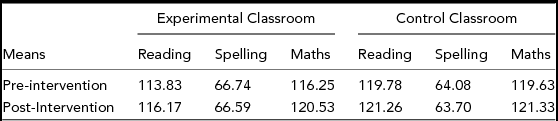
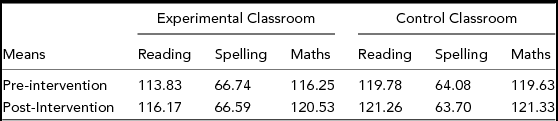
The pre-test and post-test academic score means are presented in Table 1.
Mean Scaled Test Scores for Spelling, Reading and Maths at Pre- and Post-Intervention as a Function of Experimental Group
Effects of the intervention on academic achievement
Mixed between-subjects ANOVAs (with age as a covariate) showed no significant interaction between time and experimental group, indicating no significant difference between the groups in improvement on the dependent academic variables: PAT Reading F(1,47) = .001, p = .991, ηp 2 < .001; Dalwood Spelling Test F(1,47) = .002, p = .968, ηp 2 < .001; PAT Maths F(1,47) = 2.357, p = .131, ηp 2 = .048.
Students with working memory difficulties
Nine children across both classes were identified as having either low or medium working memory, with four in the experimental classroom and five in the control classroom. Eight were available at post-testing. In the experimental classroom, three of the four moved from either medium to high working memory, or from low to medium, while one remained in the medium group. In contrast, in the control classroom, no students improved their working memory group placement, and one moved down from medium to low.
Qualitative Analyses of the Intervention Program
Qualitative data collected from the teacher, students and parents in the experimental classroom were examined, with some verbatim examples chosen to exemplify the data.
Teacher data
The teacher of the experimental classroom where the Memory Mates program was implemented was interviewed using a semi-structured, specifically designed interview schedule. She described Memory Mates as ‘wonderful, useful strategies that the children relate to and use daily’. Further, the teacher and students spontaneously generalised their use of the strategies, noting that: ‘Memory Mates strategies are used in every lesson in our classroom. The children don't need to be reminded about the flow of strategies and can verbalise which strategy they are using and why.’
The teacher also noted ‘the value of talking about what is happening inside your head and sharing that with others; also about how important that is for students to understand the process they go through’. In summary, the teacher stated that Memory Mates ‘has been a huge success. I've even had parents come to me and say they use the Memory Mates card that was sent home when their child is doing homework to assist’; ‘The students are able to verbalise proficiently exactly what each strategy is and how they use it, which is astounding to me!’
Student data
Students provided feedback in two key ways: by filling in a provided form on some occasions when they spontaneously used a Memory Mates strategy, and by completing a final questionnaire, including recording which strategies they used most often. Some comments, in the students’ own written words, are presented; related here largely to Picture It as an example: ‘I enjoyed doing “Picture It” because I like stuff with pictures and I like to imagine’; ‘“Self Talk” was helpful with maths and “Picture It” was helpful with drawing Matilda, by closing my eyes and seeing the picture’, and ‘“Picture It” is the best for me because it puts a picture in my head.’
Memory Coach was also popular, such that a form of peer tutoring occurred, often bi-directionally: ‘She is fun and she likes to help me a lot and I always know how to do it when she explains it to me’ and ‘I enjoyed using Memory Mates because I like how you just go to the person that is your “Memory Coach” and they help very much to learn.’
Comments that were offered more generically included: ‘I have enjoyed using Memory Mates a lot because they make me understand a bit more on my subjects, and gives me a clear vision for my understanding’; ‘I enjoyed when I use them (all MMs), because they help me learn and know stuff I already know’; ‘I have enjoyed using Memory Mates because they make everything easier and uncomplicated’, and ‘They help you if you need help, and remind you. They can teach you a few things so you can do it yourself.’ One student's spontaneous within-classroom feedback sheet nicely summarised her use of all the strategies: ‘It helped me if I was stuck or if I'm going too fast. When I needed help, I used these things. It can help me learn.’ A number of students spontaneously generalised the Memory Mates strategies to out-of-classroom contexts, such as sport activities, dancing and homework.
Parent data
Available parents were interviewed and some reported positively on the use of Memory Mates at home: ‘Every time he remembers something he talks about the strategies. I think he has been trying to teach us the strategies. He said “think about a story or a picture mum to help you remember where you left your keys; you can use the memory strategies”’; ‘Visualising more, when she finds a word difficult, she will try and break it down or use the strategies to try and remember the word, because she has found spelling difficult’; ‘Before needed a lot of help to do his homework. Now doing it by himself for the last 3 weeks. Says “I want to do it by myself, I want to do it all perfect”’, and ‘More concerned about homework now. She was really excited from the start.’ Other parents did not report their child talking about or using Memory Mates at all.
Discussion
This small-scale experimental research study is important in being the first to provide working memory strategies, embedded within a classroom context, directly to students. To date, the studies by Davis et al. (Reference Davis, Sheldon and Colmar2014) and Elliott et al. (Reference Elliott, Gathercole, Alloway, Holmes and Kirkwood2010) are the only published classroom studies. In addition, the present research was completed with normally developing students, whereas in the previous two articles, all students had working memory difficulties. The approach employed was twofold. Initially, we provided students with Memory Mates, strategies to help students self-regulate their attention and working memory. The second key component of the intervention was to train the teacher to display and implement these strategies during the regular classroom program, as well as encouraging the teacher to identify working memory overload in students and to adjust the lesson's content and delivery accordingly.
The key research question focused on the quantitative impact of the Memory Mates program on academic achievement outcomes; specifically, reading comprehension, spelling, and mathematics. Although the results of the program for outcome data were not significant, other data demonstrated some success. The students with working memory difficulties in the experimental classroom either improved or maintained their working memory level, whereas in the control classroom, students did not improve their level or got worse. Previous research confirmed good psychometric properties for the Working Memory Rating Scale (Alloway, Gathercole, Kirkwood, & Elliott, Reference Alloway, Gathercole, Kirkwood and Elliott2009) and in the present study the reliability was .98; therefore, we can have confidence in these findings.
The teacher's feedback was very positive, including acknowledging the significance of students being aware of cognitive processes and how to learn and engage better in the classroom context by using attention and working memory strategies. In addition, most students used and enjoyed using the strategies, extending their use to home and community activities and showing some interesting insights.
Overall, the findings of no quantitative change are most likely attributable to the 5-week intervention period. Realistically, this was unlikely to provide sufficient time for significant changes in academic achievement, although it appears to have enabled a successful implementation of the Memory Mates program. Elliott et al. (Reference Elliott, Gathercole, Alloway, Holmes and Kirkwood2010), in a similar, much longer experimental study, also obtained no change in students’ academic outcomes; however, they trained teachers and did not directly provide students with strategies.
Another plausible explanation for the lack of objectively measured quantifiable change parallels was put forward by Elliott et al. (Reference Elliott, Gathercole, Alloway, Holmes and Kirkwood2010), which is that an effective teacher may well be incorporating good supportive adjustments for children with difficulties in working memory, without explicit training and without specific strategies being provided to the students. In addition, although the findings were for Australian students in Year 1 rather than Year 3, Roberts et al. (Reference Roberts, Quach, Mensah, Gathercole, Gold, Anderson and Wake2015) confirmed that positive working memory changes were observed as an effect of exposure to schooling, independent of age, suggesting that quality teaching per se can lead to working memory gains. However, the teacher of the experimental classroom did observe important additional changes in how students managed their classroom learning following the implementation of Memory Mates.
Importantly, the work focused on a school psychologist training a teacher across two sessions and with discussion, to support primary aged students’ use of attention and working memory strategies in their classroom context. Further, the teacher directly introduced 10 working memory strategies as icons with explanations to the students, provided them with copies, and supported, mentored and reinforced their use within the classroom. In contrast, most studies in this area to date have evaluated ‘external to classroom’ working memory training programs, which are often computer-based and expensive, and with poor generalisation (Tidwell et al., Reference Tidwell, Dougherty, Chrabaszcz, Thomas and Mendoza2014). Further, the questions of whether programs are aiming to achieve academic improvements, or to enhance children's working memory capacity, or to ensure better use of existing working memory strategies, and/or support an increase in the range of strategies used, remain open (Gathercole, Reference Gathercole2008). The students’ and teacher‘s comments suggest that some awareness of your own working memory processes, both as skills and in a ‘within the brain or head’ sense, were helpful in enhancing attention and learning. An important outcome of the present study, and a subsequent larger scale one, was the development of two key resources: a booklet for teachers about the program (Sheldon, Davis, & Colmar, 2015) and the setting up of a website with all the resources available for school psychologists and teachers, and with further detail about implementing Memory Mates (in progress).
There were important limitations in the present study. The period of intervention for the experimental classroom was short. A variety of constraints related to the school year, the school's commitments, and the availability of research team members contributed to this truncated time. Originally a 3-month intervention period was planned for, and realistically, 5 weeks was insufficient time for changes in standardised academic achievement measures to occur. On reflection, two terms with data collected at the end of each term might be more appropriate. Therefore, the interview and questionnaire data were important as a relevant means of assessing the impact of the intervention and obtaining some evaluative material to assist the team to develop Memory Mates further. A potential limitation was the confounding factor of the teacher, as functioning intact classes participated. However, in real-world, classroom-based research, both the random allocation of students, and choice over teacher characteristics are not controllable. Anecdotally, it was evident that both teachers were competent and that possibly, as discussed by Elliott et al. (Reference Elliott, Gathercole, Alloway, Holmes and Kirkwood2010), there was limited scope for the experimental classroom students to make additional gains.
In administering the WMRS to a normally developing cohort of students, we anticipated there might be a range of working memory levels in the students to allow us to explore the differential effect of the intervention on students; however, 82% of the students scored in the high working memory range, 14% medium, and 4% low. While data were presented demonstrating changes in the hypothesised direction for the students in the experimental classroom with some working memory difficulties, compared with no change in the control classroom, a larger sample of students, which we hope to work with in future research, may have enabled the exploration of a range of impacts of the Memory Mates program on working memory and achievement.
In summary, in the present study, students were taught and supported in using the Memory Mates strategies, which are focused on how they attend, learn and engage in classroom activities. Children were also encouraged to be self-reflective and to define some elements of meta-cognitive awareness of their own attention and working memory processes, with data confirming that, for some students, this did take place. Although the study focused on teaching attention and working memory strategies to enhance the learning process — that is, the ‘how’ to learn — it was predicted that students’ academic progress and achievements would improve, which is the ‘what’ of learning. The short period of intervention made it unlikely that significant academic change would occur; however, over a longer period, given the strong links between working memory and academic achievement, it is predicted that positive changes would be observed.