1. Introduction
The Middle Jurassic was a critical time in the evolution of predatory dinosaurs (theropods), as it witnessed the radiation of derived theropod clades of larger body size and more diverse morphology than the previously dominant coelophysoids (Sereno, Reference Sereno1999; Rauhut, Reference Rauhut2003; Allain et al. Reference Allain, Tykoski, Aquesbi, Jalil, Monbaron, Russell and Taquet2007; Smith et al. Reference Smith, Makovicky, Hammer and Currie2007; Carrano & Sampson, Reference Carrano and Sampson2008). One such clade, Tetanurae, included the largest carnivorous dinosaurs in most post-Early Jurassic ecosystems and gave rise to birds.
The early evolution of Tetanurae is poorly understood, thanks to the meagre Early–Middle Jurassic theropod record (Rauhut, Reference Rauhut2003). The majority of recent phylogenetic hypotheses posit the origination of Tetanurae in the latest Early Jurassic (e.g. Rauhut, Reference Rauhut2003; Smith et al. Reference Smith, Makovicky, Hammer and Currie2007; Carrano & Sampson, Reference Carrano and Sampson2008), and the oldest known unequivocal tetanurans are Magnosaurus and Duriavenator from the Bajocian (early Middle Jurassic) of England (Waldman, Reference Waldman1974; Benson, Reference Benson2008a). However, these specimens are fragmentary and are currently the subject of an ongoing review of the British Jurassic theropod fauna (Day & Barrett, Reference Day and Barrett2004; Sadleir, Barrett & Powell, Reference Sadleir, Barrett and Powell2008; Benson et al. Reference Benson, Barrett, Powell and Norman2008). More complete are several Middle Jurassic theropods from China, including Gasosaurus (Dong & Tang, Reference Dong and Tang1985), Monolophosaurus (Zhao & Currie, Reference Zhao and Currie1993), ‘Szechuanosaurus’ zigongensis (Gao, Reference Gao1993) and Xuanhanosaurus (Dong, Reference Dong1984). The Chinese Middle Jurassic record is therefore critical to our understanding of theropod evolution. Unfortunately, these taxa have only been briefly described, which hampers more complete study of their phylogenetic and evolutionary importance.
Here we describe the postcranial skeleton of Monolophosaurus jiangi, from the Middle Jurassic Shishugou Formation of the Junggar Basin. The bizarre, crested skull of this taxon, which is one of the most complete skulls of any Jurassic theropod, will be described elsewhere. Monolophosaurus was originally reported as a ‘megalosaur-grade’ theropod closely related to Allosaurus (Zhao & Currie, Reference Zhao and Currie1993). The accompanying description, particularly that of the postcranial skeleton, was brief, and important anatomical details were not noted. Subsequent studies regarded Monolophosaurus as an allosauroid, a member of a clade of basal tetanurans including Allosaurus, Sinraptor, and other Late Jurassic–Early Cretaceous theropods (e.g. Sereno et al. Reference Sereno, Wilson, Larsson, Dutheil and Sues1994, Reference Sereno, Dutheil, Iarochene, Larsson, Lyon, Magwene, Sidor, Varricchio and Wilson1996; Holtz, Reference Holtz2000; Currie & Carpenter, Reference Currie and Carpenter2000; Rauhut, Reference Rauhut2003; Holtz, Molnar & Currie, Reference Holtz, Molnar, Currie, Weishampel, Dodson and Osmólska2004). However, recent work has suggested that the affinities of this taxon may lie elsewhere, perhaps closer to the base of Tetanurae (Smith et al. Reference Smith, Makovicky, Hammer and Currie2007; Brusatte & Sereno, Reference Brusatte and Sereno2008). The evaluation of these alternatives hinges on a better understanding of Monolophosaurus anatomy.
2. Institutional abbreviations
Repositories for specimens and abbreviations used in the text are indicated by the following acronyms: BYU – Brigham Young University Museum of Geology, Provo, Utah, USA; CCG – Chengdu University of Geology, Chengdu, China; IVPP – Institute of Vertebrate Paleontology and Paleoanthropology, Beijing, China; MACN – Museo Argentino de Ciencas Naturales, Buenos Aires, Argentina; MCF – Museo Carmen Funes, Plaza Huincul, Argentina; MIWG – Dinosaur Isle, Isle of Wight Museum Services, Sandown, United Kingdom; ML – Museu da Lourinhã, Lourinhã, Portugal; MPEF – Museo Paleontológico ‘Egidio Feruglio’, Trelew, Argentina; MUCPv – Museo de la Universidad Nacional del Comahue, Neuquen Province, Argentina; PVL – Instituto de Miguel Lillo, Tucuman, Argentina; UC OBA – University of Chicago, Department of Organismal Biology and Anatomy, Chicago, USA; UCMP – University of California Museum of Paleontology, Berkeley, USA; UMNH – University of Utah Museum of Natural History, Salt Lake City, USA; ZDM – Zigong Dinosaur Museum, Zigong, China.
3. Systematic palaeontology
DINOSAURIA Owen, Reference Owen1842
THEROPODA Marsh, Reference Marsh1881
TETANURAE Gauthier, Reference Gauthier1986
Monolophosaurus jiangi Zhao & Currie, Reference Zhao and Currie1993
Figures 1–8
Zhao & Currie (Reference Zhao and Currie1993, figs 1–5); Rauhut (Reference Rauhut2003, fig. 5d); Holtz, Molnar & Currie (Reference Holtz, Molnar, Currie, Weishampel, Dodson and Osmólska2004, fig. 4.9)
The mounted skeleton of Monolophosaurus jiangi (IVPP 84019) in right anterolateral view: (a) photograph; (b) line drawing indicating mounted bones. Abbreviations: ce2 – axis (second cervical vertebra); ce7 – seventh cervical vertebra; ce8 – eighth cervical vertebra; d4 – fourth dorsal vertebra; d5 – fifth dorsal vertebra; d14 – fourteenth dorsal vertebra; ca1 – first caudal vertebra; ca6 – sixth caudal vertebra. Scale bar (in a) = 300 mm (but image is attenuated to the left).

Holotype. IVPP 84019, complete skull and partial postcranial skeleton comprising the pelvis and axial column from the atlas to the sixth caudal vertebra.
Locality and horizon. Middle Jurassic Shishugou Formation (Eberth et al. Reference Eberth, Brinkman, Chen, Yuan, Wu, Li and Cheng2001), 34 km northeast of Jiangjunmiao in the Jiangjunmiao Depression within the Junggar Basin, Xinjiang, People's Republic of China.
Diagnosis. ‘Skull with midline crest (formed by the paired premaxillary, nasal, lacrimal, and frontal bones) extending above external naris to a point between orbits. Long, low external naris, and anteroposteriorly elongate premaxilla. Antorbital sinuses in nasals confluent through openings in base of crest’ (Zhao & Currie, Reference Zhao and Currie1993, p. 2028).
4. Description
The specimen is currently mounted for touring exhibition (Fig. 1). It is embedded in foam that obscures the bones so that they are only visible in right lateral view, and only rarely are portions of the ventral surfaces of the vertebrae exposed. However, two sources of additional data were consulted during the course of this study: unpublished notes and photographs taken by PJC during his original study of the specimen, and the figures and description of the left side of the specimen published by Zhao & Currie (Reference Zhao and Currie1993). The right ilium is currently mounted lateral to the sacrum and only the sacral neural spines, which consist of plaster used to reconstruct the original bone, are visible. The pubes and ischia are mounted on a tall mound of foam that approaches the ilium and obscures the posteroventral surfaces of the pubes, lateral surface of the left pubis, anteroventral surfaces of the ischia, and lateral surface of the left ischium.
The axial complex, all postaxial cervical vertebrae, all dorsal vertebrae, the sacrum, and the first six caudal vertebrae are preserved (Fig. 1). Zhao & Currie (Reference Zhao and Currie1993, fig. 3a) also mentioned and figured the atlantal neurapophyses but these were not located during the course of the present study. The neural arch is fused to the centrum in all known vertebrae and the neurocentral suture is not visible, indicating that the specimen represents an adult or subadult individual approaching maximum size.
4.a. Odontoid
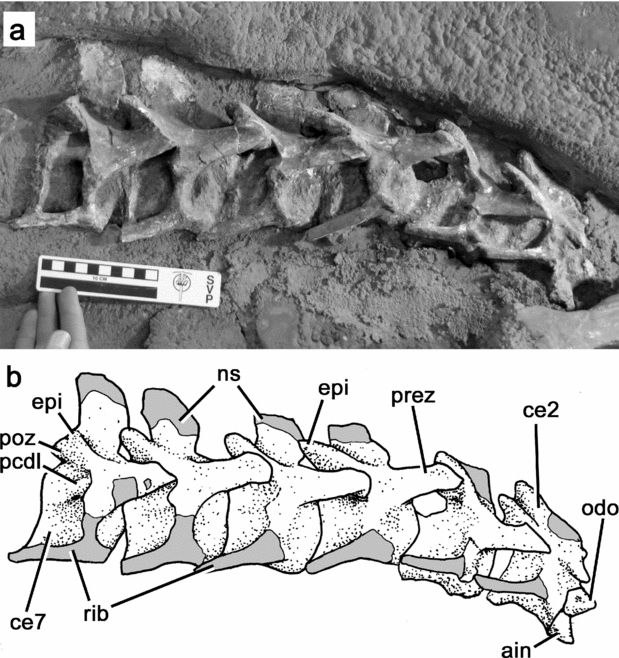
The odontoid is a blunt wedge of bone fused to the dorsal part of the anterior articular surface of the axis. It has a semicircular outline in anterior view with a truncated and slightly concave dorsal surface. A small, suboval depression that is probably not pneumatic in origin is present on the lateral surface of the odontoid (Fig. 2), as in most basal theropods (e.g. Ceratosaurus, UMNH VP 5278; Dilophosaurus, UCMP 37302; Piatnitzkysaurus, PVL 4078; Giganotosaurus, MUCPv-Ch 1).
Mounted articulated vertebral series of comprising the axis–seventh cervical vertebra of Monolophosaurus jiangi (IVPP 84019) in right lateral view: (a) photograph; (b) interpretive line drawing. Abbreviations: ain – axial intercentrum; ce2 – axis (second cervical vertebra); ce7 – seventh cervical vertebra; epi – epipophysis; ns – neural spine; odo – odontoid; pcdl – posterior centrodiapophyseal lamina; prez – prezygapophysis; poz – postzygapophysis. Scale bar (in a) = 100 mm.

4.b. Axial intercentrum
The axial intercentrum is a wedge-shaped bone fused to the anterior articular surface of the axis ventral to the odontoid (Fig. 2). The intercentrum and odontoid seem to occupy approximately half of the height of the anterior surface each, although the exact proportion cannot be determined due to encasing foam. The ventral and lateral surfaces of the axial intercentrum are evenly rounded. In the figures of Zhao & Currie (Reference Zhao and Currie1993, fig. 3b), the ventral surface of the intercentrum is inclined anterodorsally relative to the ventral surface of the axis, such that the two form an oblique angle. A gentle inflection, similar to that in Monolophosaurus, is also present in some allosauroids (e.g. Acrocanthosaurus: Harris, Reference Harris1998; Giganotosaurus, MUCPv-Ch-1). Contrastingly, in more primitive theropods such as Ceratosaurus (UMNH VP 5278), Dilophosaurus (UCMP 37302) and Piatnitzkysaurus (PVL 4078), the ventral surface of the axial intercentrum is horizontal.
4.c. Axis
The axial centrum has a narrow and evenly rounded ventral surface that lacks a ventral keel. The axes of many theropods bear a ventral keel (Harris, Reference Harris1998), but those of some basal tetanurans such as Allosaurus (Madsen, Reference Madsen1976), Neovenator (MIWG 6348: Brusatte, Benson & Hutt, Reference Brusatte, Benson and Hutt2008), and Sinraptor (Currie & Zhao, Reference Currie and Zhao1993) lack keels or bear only a weak ventral ridge. A cervical rib, predominantly composed of plaster, obscures details of the lateral surface of the axial centrum, and the presence of structures such as the parapophysis, diapophysis, and pleurocoel cannot be assessed (Fig. 2). This rib is absent on the left side in the figures of Zhao & Currie (Reference Zhao and Currie1993, fig. 3b), which indicate that a well-developed axial parapophysis and pleurocoel are present.
The axial prezygapophysis is reduced to a small flange emerging anteriorly from the lateral side of the neural arch. The prezygapophyseal facet faces anterodorsolaterally. The axial neural spine differs from the figures of Zhao & Currie (Reference Zhao and Currie1993, fig. 3b) in being lower and inclined more strongly posterodorsally, although much of the spine is encased in foam, causing it to appear more strongly inclined still (Fig. 2). It has a triangular outline in lateral view. The spinopostzygapophyseal laminae are reduced as in most basal tetanurans, and not strongly developed as in Sinraptor (Currie & Zhao, Reference Currie and Zhao1993) and non-tetanuran theropods such as Ceratosaurus (UMNH VP 5278) and Dilophosaurus (UCMP 37302). A small, nub-like process projects anteriorly from the anteroventral portion of the spine dorsomedial to the prezygapophyses as is usual for theropods.
The axial postzygapophyses are large with well-developed facets, similar to those of more posterior presacral vertebrae. The facets face posteroventrally with a slight lateral inclination. Prominent, broad, but dorsoventrally low epipophyses overhang the postzygapophyseal facets and have long axes that are oriented slightly more medially than those of the postzygapophyses.
4.d. Postaxial cervical vertebrae
All of the postaxial cervical vertebrae are preserved. The axis (second cervical vertebra) up until the seventh cervical vertebra form a continuous, articulated series, as they have not been separated by preparation (Fig. 2); the eighth and ninth cervical vertebrae have been mounted in a continuous series with the anterior portion of the dorsal vertebral series (Fig. 3). Many of the details of the cervical vertebrae, such as the left lateral, ventral, anterior and posterior surfaces, are obscured by encasement in foam.
Mounted articulated vertebral series comprising the eighth cervical vertebra–fourth dorsal vertebra of Monolophosaurus jiangi (IVPP 84019) in right lateral view: (a) photograph; (b) interpretive line drawing. Metal armatures are visible in the foreground. Light grey tone indicates restored bone surface; dark grey tone indicated broken bone, and crossed hatching indicates matrix. Abbreviations: acdl – anterior centrodiapopohyseal lamina; epi – epipophysis; ce8 – eighth cervical vertebra; d4 – fourth dorsal vertebra; ns – neural spine; pap – parapophysis; pcdl – posterior centrodiapophyseal lamina; pl – pleurocoel; poz – postzygapophysis; prz – prezygapophysis. Scale bar (in a) shows 10 mm gradations.

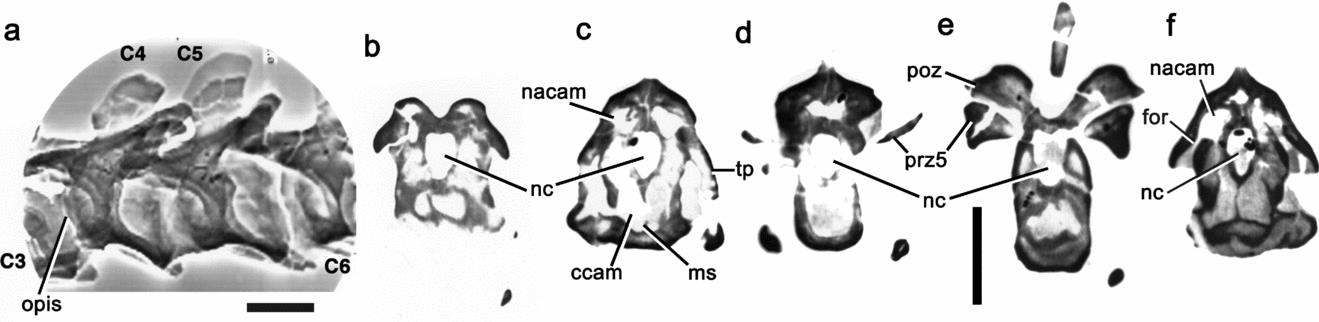
Zhao & Currie (Reference Zhao and Currie1993) stated that the cervical vertebrae were opisthocoelous and similar to those of tetanuran theropods. In some tetanurans the anterior articular surface is highly convex and therefore distinctly opisthocoelous (Holtz, Molnar & Currie, Reference Holtz, Molnar, Currie, Weishampel, Dodson and Osmólska2004). However, in others such as Piatnitzkysaurus (PVL 4078), the anterior surface is almost flat, similar to those of Ceratosaurus (UMNH VP 5278) and Dilophosaurus (UCMP 37302), but unlike those of more basal theropods such as Coelophysis (Colbert, Reference Colbert1989), in which the anterior surface is concave. Although the published figures of Monolophosaurus (Zhao & Currie, Reference Zhao and Currie1993, fig. 3b) indicate slightly convex anterior articular surfaces for some of the cervical centra and almost flat surfaces for others, the vertebrae are in an articulated series and it is difficult to see the degree of convexity on most specimens. Fortunately, a CT-scan was done of part of the articulated series of vertebrae before it was mounted. The pilot scan is an X-ray of the fourth and fifth cervical vertebrae, and includes the back of the third and front of the sixth cervical vertebra. Although CT-scans were not as detailed in 1992 as they are today, the scans do clearly show that the anterior surfaces of the fourth and fifth cervical centra are smoothly convex (Fig. 4a). The convexity is not as strong as that found in Allosaurus, Sinraptor and some other basal tetanurans, nor is it flattened as in Piatnitzkysaurus.
CT-scan images of the fourth and fifth cervical vertebrate of IVPP 84019: (a) left lateral X-ray view; (b–e) successively posterior CT slice images of the fourth cervical vertebra; (f) CT slice image of fifth cervical vertebra equivalent to (c). Abbreviations: ccam – camera in centrum; for – foramen; nacam – camera in neural arch; ms – median septum; nc – neural canal; opis – convex anterior surface of centrum; poz – postzygapophysis; prz5 – prezygapophysis of fifth cervical vertebra; tp – transverse process. Scale bars = 50 mm.

The ventral surfaces of the third and fourth cervical vertebrae are partially visible and seem to be almost flat. The almost flat ventral surface is also evident in the CT-scan of the fourth and fifth cervical vertebrae (Fig. 4d, e). More posterior cervical centra have almost vertical lateral surfaces that only begin to curve medially at their ventralmost limit, indicating that they were either transversely narrow or also had flat ventral surfaces.
It is difficult to assess the relative positions and inclinations of the articular surfaces of individual centra, but it is clear that the anterior surface of most of these elements is offset dorsally relative to the posterior surface and is inclined to face anteroventrally in several elements. There is no offset between the articular surfaces of the eighth and ninth cervical centra.
The parapophyses of all of the postaxial cervical vertebrae are situated in the anteroventral corners of the lateral surfaces of the centra. As in the axis, heavily reconstructed ribs obscure the lateral surfaces of most of the cervical vertebrae and small, subcircular, single pleurocoels are only visible in the eighth and ninth cervical centra (Figs 2, 3). Hollow centra indicate that at least one pleurocoel was also present on each side of the fourth and fifth cervical vertebrae. These open into a pair of large internal sinuses separated by a median septum (Fig. 4c). This is the camerate type of vertebral pneumaticity that is generally found in sauropods and is primitive for theropods (Britt, Reference Britt, Currie and Padian1997).
Pneumatic foramina entering the neural arches are obscured by matrix or foam in all cervical vertebrae. However, a complex system of pneumatic sinuses invades the bases of the diapophyses, zygapophyseal peduncles and neural spine (Fig. 4c). Sections clearly show the presence of pneumatic foramina passing dorsomedially from the infradiapophyseal fossa into pneumatic chambers within the arch (Fig. 4f). There is also a pair of anterior peduncular pneumatic foramina beneath the prezygapophyses in the fourth cervical neural arch (Fig. 4b).
The cervical prezygapophyses are widely separated on elongate, anterolaterally oriented processes that emerge from the transverse processes. The prezygapophyseal facets face dorsomedially (32 degrees from horizontal in the fourth and fifth cervical vertebrae) with a slight anterior inclination. The postzygapophyses are similar in morphology to those of the axis. The epipophyses are slightly higher dorsoventrally than in the axis but become reduced posteriorly in the cervical series; they are still prominent in the sixth cervical vertebra but do not extend posteriorly past the postzygapophyseal facets in the eighth and ninth cervical vertebrae (Figs 2, 3).
The transverse processes of the third cervical vertebra are mediolaterally thin, ventrolaterally oriented sheets that are proximodistally short, terminating in small suboval facets for the tubercula of the ribs. More posteriorly in the cervical series, the transverse processes become larger and more proximodistally elongate. These elongate posterior cervical transverse processes have anteroposteriorly short bases, and thus approach the rod-like morphology of the dorsal transverse processes (Figs 3, 4). Weak epipophyseal–prezygapophyseal laminae connect the posterolateral margins of the prezygapophyseal facets to the epipophyses, marking a slight inflection between the dorsolateral surface of the neural arch adjacent to the neural spine and the slightly depressed lateral surface of the transverse process.
The posterior centrodiapophyseal lamina is a low bar extending posteriorly from the transverse process to the posteroventral corner of the lateral surface of the neural arch in the third cervical vertebra. It becomes slightly more prominent posteriorly in the cervical series and is well-developed in the seventh and more posterior elements (Figs 2, 3). The anterior centrodiapophyseal lamina, if present, is obscured by the transverse process in the third to the seventh cervical vertebrae. The centroprezygapophyseal laminae of the third and fourth cervical vertebrae are thin laminae connecting the anteroventral corners of the neural arches to points just past midlength on the ventromedial surface of each prezygapophyseal process, enclosing an elongate recess between the lamina and the prezygapophyseal process. The centroprezygapophyseal lamina extends only just proximal to midlength of the prezygapophyseal process of the fifth cervical vertebra and is not evident in subsequent elements of the cervical series.
Large portions of the cervical neural spines have been reconstructed in white plaster. The neural spines of the anterior and middle cervical vertebrae are transversely thin sheets that are taller than they are anteroposteriorly long. They become anteroposteriorly shorter more posteriorly in the cervical series and those of the eighth and ninth cervical vertebrae are rod-like, although only their bases are preserved (Fig. 3). This style of regional differentiation of neural spine morphology is common among basal tetanurans (e.g. Madsen, Reference Madsen1976; Charig & Milner, Reference Charig and Milner1997). The anterior and middle cervical neural spines appear to have a distinctive outline in lateral view; the anterior margin of the outline is vertical at its base but is inflected posterodorsally just ventral to midheight (Zhao & Currie, Reference Zhao and Currie1993, fig. 3b). However, this region in all cervical neural spines has been broken and reconstructed (Fig. 3). The neural spines of the fourth and fifth cervical vertebrae are the most completely preserved in the anterior and mid-cervical regions. Their neural spines are each less than half the anteroposterior length of the corresponding centrum, but expand distally (both anterodorsally and posterodorsally). A rectangular, dorsoventrally oriented, rugose ridge is present on the anterior surface of the eighth and posterior surface of the fourth neural spines. Similar ridges may have been present anteriorly and posteriorly on the majority of cervical neural spines, but this region is encased in foam in the other cervical vertebrae.
4.e. Dorsal vertebrae
All fourteen dorsal vertebrae are preserved (Fig. 1; Zhao & Currie, Reference Zhao and Currie1993, figs 3b, 4a). The most anterior four are still in articulation with the eighth and ninth cervical vertebrae (Fig. 3), whereas the posterior three are still attached to the sacrum. Those in between are preserved as two articulated series (Fig. 5). The second dorsal vertebra is the shortest (anteroposteriorly) of the presacral vertebrae (Currie & Zhao, Reference Currie and Zhao1993, table 1); more posterior elements of the dorsal series are progressively longer, with the exception of the fourteenth, which is slightly shorter than the thirteenth.
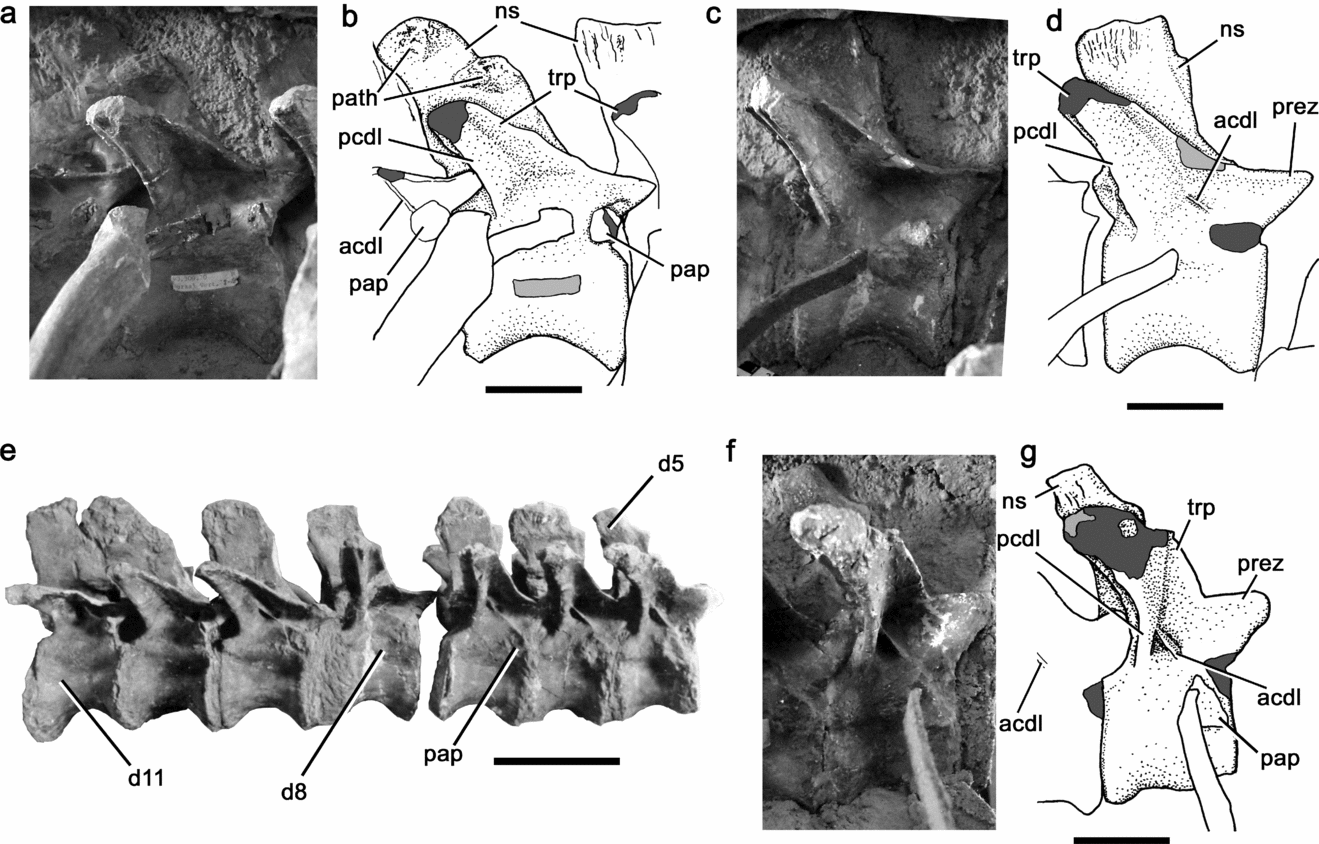
Dorsal vertebrae of Monolophosaurus jiangi (IVPP 84019) in right lateral view: (a, b) mounted tenth dorsal vertebra and parts of the ninth and eleventh dorsal vertebrae; (c, d) mounted eighth dorsal vertebra and parts of the seventh and ninth dorsal vertebrae; (e) PJC's original photograph showing an articulated series comprising the fifth to eleventh dorsal vertebrae; (f, g) mounted fifth dorsal vertebra and parts of the fourth and sixth dorsal vertebrae. In line drawings (b, d, g) light grey tone indicates reconstructed bone surface and dark grey tone indicates broken bone. Metal armatures, some bearing ribs, are visible in the foreground (a–d, f, g). Abbreviations: acdl – anterior centrodiapophyseal lamina; d5 – fifth dorsal vertebra; d8 – eighth dorsal vertebra; d11 – eleventh dorsal vertebra; ns – neural spine; pap – parapophysis; path – pathological swelling; pcdl – posterior centrodiapophyseal lamina; prez – prezygapophysis; trp – transverse process. Scale bars = 50 mm (a–d, f, g) and 100 mm (e).

The first dorsal vertebra is more similar in morphology to the ninth cervical vertebra than it is to the second and more posterior dorsal vertebrae: it has an anteroventrally positioned parapophysis and lacks a ventral keel. Zhao & Currie (Reference Zhao and Currie1993) identified this element as the first dorsal vertebra on the basis of rib morphology: the rib associated with this vertebra lacks an anterodorsal process. The right transverse process of the first dorsal vertebra has been broken and the distal end is reconstructed. It is rod-like, similar to those of posterior cervical and anterior dorsal vertebrae, and is oriented almost horizontally, in contrast to the ventrolaterally oriented transverse processes of more anterior presacral vertebrae (Fig. 3).
Most of the horizontally oriented transverse process of the second dorsal vertebra is broken off. The parapophysis of this vertebra is dorsoventrally elongate and located more dorsally than those of the preceding vertebrae, around midheight on the lateral surface of the centrum (Fig. 3).
Although Zhao & Currie (Reference Zhao and Currie1993, fig. 3b) described and figured prominent ventral keels, inset from the lateral surfaces of the centrum in the second to fourth dorsal vertebrae, these seem in fact to be present in the more posterior cervical and first two dorsal vertebrae. The original misconception may have stemmed from the fact that PJC (unpub. data) originally numbered the vertebral sequence two numbers in advance of its actual sequence, such that the second dorsal vertebra would be labelled as the fourth. Prominent ventral keels are also present in ‘pectoral’ vertebrae (sensu Welles, Reference Welles1984) in a range of basal tetanuans, such as Afrovenator (UC OBA 1), Baryonyx (Charig & Milner, Reference Charig and Milner1997), Carcharodontosaurus (Sereno et al. Reference Sereno, Dutheil, Iarochene, Larsson, Lyon, Magwene, Sidor, Varricchio and Wilson1996; Brusatte & Sereno, Reference Brusatte and Sereno2007) and Condorraptor (Rauhut, Reference Rauhut2005a), but are weak or absent in others such as Allosaurus (Madsen, Reference Madsen1976), Eustreptospondylus (Sadleir, Barrett & Powell, Reference Sadleir, Barrett and Powell2008), Lourinhanosaurus (ML 370) and Neovenator (Brusatte, Benson & Hutt, Reference Brusatte, Benson and Hutt2008).
The twelfth and thirteenth dorsal vertebrae have evenly rounded ventral surfaces. The condition in other elements is obscured by foam. However, some of the more anterior dorsal vertebrae may have borne residual low ventral ridges or have been slightly angular.
Pleurocoels are absent from the fourth and more posterior dorsal vertebrae (Fig. 5), and although they appear to be present in the figures of Zhao & Currie (Reference Zhao and Currie1993), this may be an attempt to represent small, shallow depressions posteroventral to the parapophyses of the fourth and fifth dorsal vertebrae. The pleurocoels are restricted to anterior dorsal vertebrae in most basal theropods, but are present in all of the dorsal vertebrae of abelisaurids (Carnotaurus: Bonaparte, Novas & Coria, Reference Bonaparte, Novas and Coria1990), Torvosaurus (Britt, Reference Britt1991), and carcharodontosaurids (Acrocanthosaurus: Harris, Reference Harris1998; Giganotosaurus, MUCPv-Ch-1; Mapusaurus: Coria & Currie, Reference Coria and Currie2006; Neovenator: Brusatte, Benson & Hutt, Reference Brusatte, Benson and Hutt2008). In Monolophosaurus the lateral surfaces of the fourth and all more posterior dorsal centra have shallow, oval depressions immediately ventral to the neurocentral sutures (Fig. 5).
The parapophysis of the fourth dorsal vertebra is a large, slightly rugose surface situated anterodorsally on the lateral surface of the centrum, lapping slightly onto the neural arch (Fig. 5e–g). The parapophysis of the fifth dorsal vertebra is slightly smaller and is subdivided equally between the centrum and neural arch. The parapophyses of sequentially more posterior dorsal vertebrae have progressively smaller facets situated entirely on the neural arch. They are located more dorsally in more posterior elements of the dorsal series, such that the parapophysis is just below midheight of the neural arch on the thirteenth dorsal vertebra. The parapophysis projects laterally in more posterior dorsal vertebrae. That of the seventh forms a low mound, and those of the ninth and more posterior elements form distinct, low pedicles as in Cryolophosaurus, Dilophosaurus, Piatnitzkysaurus (Fig. 5a, b; Smith et al. Reference Smith, Makovicky, Hammer and Currie2007). In neoceratosaurs the pedicle is almost as long as the transverse process (e.g. Bonaparte, Novas & Coria, Reference Bonaparte, Novas and Coria1990).
The transverse processes of the third and more posterior dorsal vertebrae are directed dorsolaterally (Fig. 5). The transverse process of the seventh dorsal vertebra is the most strongly inclined dorsally in the series. Those of more posterior presacral vertebrae become progressively more lateral in orientation, and that of the twelfth is close to horizontal (the thirteenth is obscured by adhesive used to attach it to the ilium). All of the dorsal transverse processes have a slight posterolateral inclination, although this is stronger in the eighth and ninth dorsal vertebrae. The bases of the transverse processes become anteroposteriorly broader more posteriorly in the dorsal series. The seventh and more posterior dorsals have elongate, slender, and distally tapering transverse processes, similar to those of basal tetanurans in general.
The transverse processes are supported ventrally by prominent centroprezygapophyseal and anterior and posterior centrodiapophyseal laminae that become more prominent posteriorly in the series. The anterior centrodiapophyseal lamina is very thin. It extends anteroventrally to the parapophysis as a weak ridge. It is less prominent than the posterior centrodiapophyseal lamina, which is thicker and more strongly developed in all dorsal vertebrae (Fig. 5). The centroprezygapophyseal laminae are robust buttresses, supporting the prezygapophyses ventrally. As the infraprezygapophyseal fossa is not excavated past the level of the lateral wall of the neural arch in any of the dorsal vertebrae, the centroprezygapophyseal laminae have a rather indistinct appearance. The infradiapophyseal and infrapostzygapophyseal fossae are also shallow, although the infradiapophyseal fossae of the ninth and eleventh dorsal vertebrae contain small, suboval depressions.
The prezygapophyseal facets of the dorsal vertebrae are large, comparable in size to those of the anterior cervical vertebrae, and face dorsomedially. The prezygapophyses of the anterior dorsal vertebrae are widely separated and rise dorsolaterally and only slightly anteriorly relative to those of the anterior cervical vertebrae. The prezygapophyses become closer to each other in more posterior dorsal vertebrae and project almost directly anteriorly in the fifth and more posterior dorsal vertebrae.
The postzygapophyses are also large, with ventrolaterally facing facets. Reduced epipophyses that do not overhang the postzygapophyseal facets are present in the first dorsal vertebra. The ventromedial corners of the postzygapophyses extend ventrolaterally to form a prominent triangular hyposphene (Zhao & Currie, Reference Zhao and Currie1993, fig. 3d) as in most basal tetanurans, including Allosaurus (Madsen, Reference Madsen1976) and Piatnitzkysaurus (PVL 4078). In carcharodontosaurids the hyposphene is a transversely narrow sheet forming a dorsoventrally tall rectangle in posterior view (Coria & Currie, Reference Coria and Currie2006; Brusatte, Benson & Hutt, Reference Brusatte, Benson and Hutt2008).
The neural spines of the first two dorsal vertebrae are similar to those of the posterior cervical vertebrae: anteroposteriorly short and rod-like. Large portions of both spines are broken and have been reconstructed in plaster. The neural spines of the third and fourth dorsal vertebrae are slightly longer anteroposteriorly at their bases and gently taper towards a rounded-off dorsal termination. However, this morphology may be the result of abrasion of an originally more rectangular spine. There is a distinct transition in neural spine morphology between the fifth and sixth dorsal vertebrae; the sixth and more posterior neural spines are anteroposteriorly long, sheet-like, and posterodorsally inclined (Fig. 5a–e). The lateral surfaces of the neural spines bear coarse dorsoventrally oriented striations dorsally. Small, suboval depressions are present on the lateral surfaces at the bases of the neural spines in the second to ninth dorsal vertebrae and lap onto the dorsal surfaces of the transverse processes. The neural spine of the tenth dorsal vertebra is pathological: the distal portion has been broken away from the base and reoriented posterodorsally. There is evidence of exostotic bone regrowth to form thick, rugose patches around the break (Fig. 5a, b).
Zhao & Currie (Reference Zhao and Currie1993, p. 2032) noted that the neural spines of Monolophosaurus were ‘more gracile than those of Allosaurus’ and suggested that this was a size-related feature. However, many larger theropods, including Sinraptor (IVPP 10600) and Torvosaurus (Britt, Reference Britt1991), have transversely narrow neural spines, and the transversely thickened neural spines of Allosaurus (Madsen, Reference Madsen1976) are only otherwise present in Neovenator (Brusatte, Benson & Hutt, Reference Brusatte, Benson and Hutt2008) among non-coelurosaurian theropods. Zhao & Currie (Reference Zhao and Currie1993) also stated that the neural spines of the dorsal vertebrae of Monolophosaurus were unlike the tall, thin, blade-like neural spines of Ceratosaurus, Piatnitzkysaurus, Sinraptor, Torvosaurus and other large Jurassic theropods. However, they are similar in relative height to those of Piatnitzkysaurus (PVL 4078) and Torvosaurus (Britt, Reference Britt1991), and only those of those of Ceratosaurus (Madsen & Welles, Reference Madsen and Welles2000) and Sinraptor (Currie & Zhao, Reference Currie and Zhao1993) are substantially taller (Table 1).
Selected measurements (in millimetres) of the dorsal vertebrae of a range of basal theropods

4.f. Sacral vertebrae
The sacral vertebrae are covered up by the ilia. The situation has been exacerbated by foam in the existing mount, although this could easily be removed if the specimen was no longer being sent out for touring exhibitions. Zhao & Currie (Reference Zhao and Currie1993) noted that there were five sacral vertebrae, and figured the sacrum in ventral view (Zhao & Currie, Reference Zhao and Currie1993, fig. 4a). In PJC's original photograph of the iliosacral block in left lateral view it appears that the sacrum is displaced posteriorly relative to the ilium, such that the posterior sacral transverse processes are visible (Fig. 7e, f). As such, it seems that the sacral ribs were not fused to the medial surfaces of the ilium as they are in some non-tetanuran theropods (Tykoski & Rowe, Reference Tykoski, Rowe, Weishampel, Dodson and Osmólska2004). Each sacral neural spine is in close contact with the preceding and succeeding neural spine along its anterior and posterior margins as in Allosaurus (Madsen, Reference Madsen1976).
4.g. Caudal vertebrae
The first to the fifth caudal vertebrae and the centrum of the sixth are preserved. Zhao & Currie (Reference Zhao and Currie1993) noted that the distal ends of the neural spines and transverse processes were broken off during collection and preparation of the specimen. These missing portions have been reconstructed in plaster (Fig. 6).
Mounted caudal vertebrae of Monolophosaurus jiangi (IVPP 84019): (a, b) third caudal vertebra in right lateral view; (c, d) fourth, fifth and sixth caudal vertebrae in right ventrolateral view. In line drawings (b, d) light grey tone indicates reconstructed bone surface and dark grey tone indicates broken bone. Abbreviations: acdl – anterior centrodiapophyseal lamina; ns – neural spine; pcdl – posterior centrodiapophyseal lamina; prez – prezygapophysis; trp – transverse process. Scale bars = 50 mm.

The caudal centra are higher than they are wide (Zhao & Currie, Reference Zhao and Currie1993). The anterior articular surface is offset dorsally relative to the posterior surface in all preserved elements. Part of the ventral surface of the fifth caudal vertebra is visible and bears a narrow but distinct longitudinal groove (Fig. 6c, d). A similar groove is present on the ventral surface of the fourth centrum (Zhao & Currie, Reference Zhao and Currie1993). Longitudinal grooves are present on the ventral surfaces of the caudal vertebrae in a range of basal tetanurans, but these are normally broad and shallow compared to those of Monolophosaurus. Deep ventral grooves, broader than those of Monolophosaurus, with well-defined edges, are present in Ceratosaurus (UMNH VP 5278), Condorraptor (MPEF-PV 1682) and Piatnitzkysaurus (PVL 4078), however, the detailed morphology of this groove may be dictated by non-phylogenetic factors such as ontogenetic stage or degree of ossification.
The caudal transverse processes are dorsoventrally thin sheets that are oriented posterodorsolaterally. They are supported ventrally by low anterior and posterior centrodiapophyseal laminae (Fig. 6a, b). Weak centrodiapophyseal laminae are frequently present on the anterior caudal vertebrae of basal theropods (e.g. Allosaurus: Madsen, Reference Madsen1976; Dilophosaurus, UCMP 37302; Ceratosaurus, UMNH VP 5278; Piatnitzkysaurus, PVL 4078) but are generally weaker even than those of Monolophosaurus.
The prezygapophyses extend anterodorsally from the anterior surface of the neural arch on short pedicles that diverge anterolaterally from the midline. The neural spines are transversely narrow, anteroposteriorly long, and posterodorsally inclined. As all of the spines have been broken distally, their original heights are unknown, but they were certainly taller dorsoventrally than they are long anteroposteriorly. Shallow, suboval depressions that extend onto the dorsal surfaces of the transverse processes, similar to those of the dorsal vertebrae, are present on the lateral surfaces at the bases of the caudal neural spines; they are situated slightly anterior to midlength.
Zhao & Currie (Reference Zhao and Currie1993) noted that, unlike in Allosaurus, hyposphenes were present in the anterior caudal vertebrae of Monolophosaurus. This is common among basal tetanurans (e.g. Neovenator: Brusatte, Benson & Hutt, Reference Brusatte, Benson and Hutt2008). In abelisaurids such as Aucasaurus (MCF-PVPH 236) and Majungasaurus (O'Connor, Reference O'Connor, Sampson and Krause2007), hyposphenes are present in a greater number of caudal vertebrae and the anterior caudal hyposphenes are pronounced, comparable in height to those of the dorsal vertebrae.
4.h. Ribs
Zhao & Currie (Reference Zhao and Currie1993) stated that most of the cervical and dorsal ribs were recovered with the specimen. They conceded that none of the cervical ribs were complete, and thus they were probably preserved in similar condition to their present state. The dorsal ribs of the right side are also present in the mount (Fig. 1). Many of these have been damaged: their proximal ends have been broken off and several can be found lying at the base of the mount. The distal ends of all are incomplete and the length estimated from Zhao & Currie (Reference Zhao and Currie1993, fig. 5) of the longest rib at 585 mm agrees with the maximum length of the longest rib on the mount as currently preserved. Consequently, it is probable that the distal ends of the ribs were damaged during recovery or preparation of the specimen. Unpublished photographs (PJC, 1992) that formed the basis of figures in Zhao & Currie (Reference Zhao and Currie1993, fig. 5) show that IVPP 84019 included all of the left thoracic ribs except for the first, second and twelfth. The present whereabouts of the left ribs are unknown.
The dorsal ribs are long and have a weak distomedial curvature, indicating that the trunk of Monolophosaurus had a dorsoventrally tall, suboval cross-section. Anterior dorsal ribs have two prominent articular processes, the capitulum and tuberculum, connected by a thin, apneumatic web of bone. The tuberculum is reduced in prominence in more posterior ribs and in the sixth and more posterior ribs it is reduced to a low mound.
4.i. Ilium
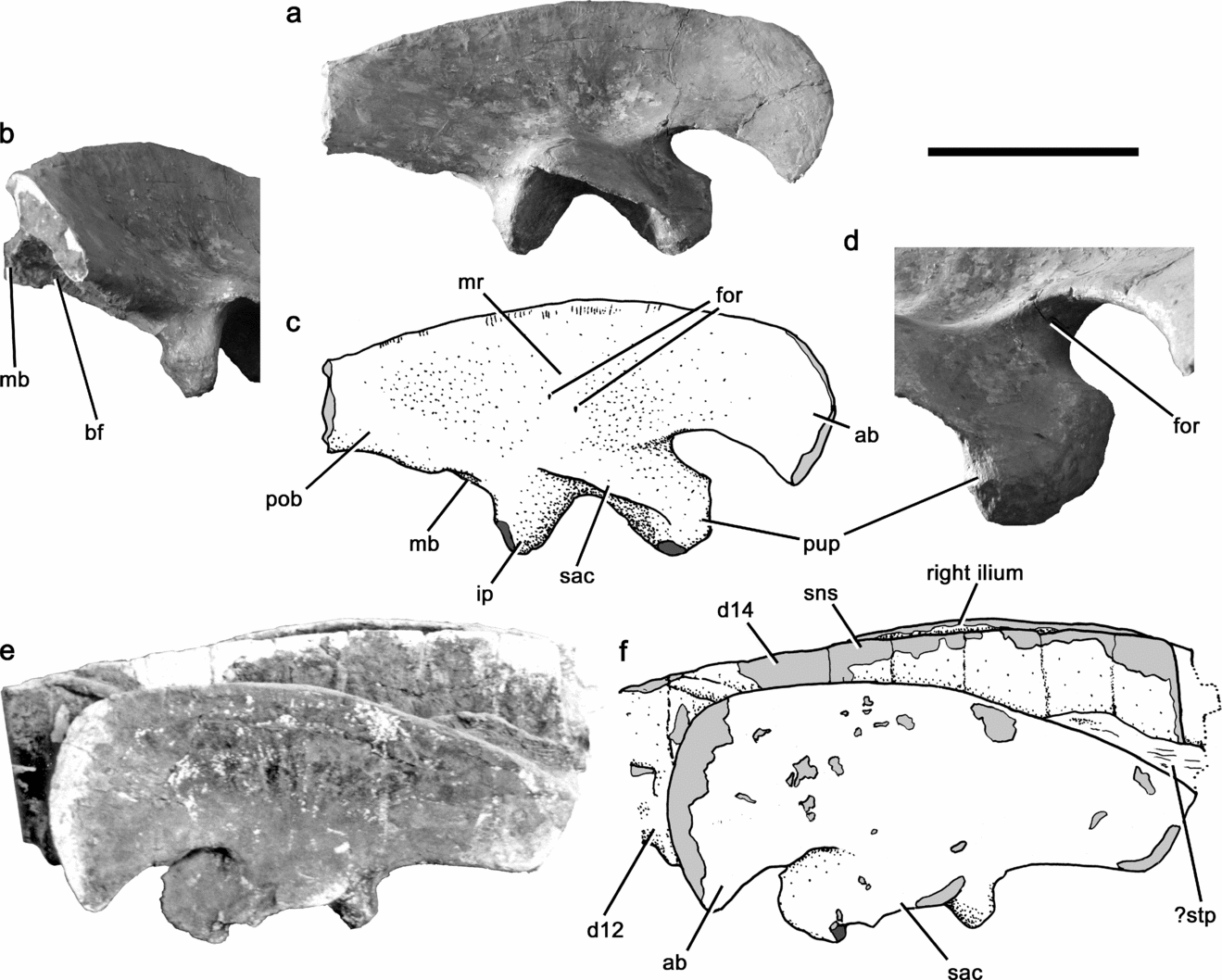
Only the right ilium was observed during the course of the present study. The left ilium was not observed but was studied and photographed by PJC during the original description of Monolophosaurus (Fig. 7e). Although Zhao & Currie (Reference Zhao and Currie1993) only described breakage to the anterior margin in the right ilium, this margin is broken in both ilia and has been restored using white plaster. Parts of the posterior blade have also been broken on both sides (Fig. 7c, f).
Iliosacral elements of Monolophosaurus jiangi (IVPP 84019): (a–d) right ilium in lateral (a, c) and posterolateral (b) views with magnification (×2) of the pubic peduncle and preacetabular notch (d); (e, f) right ilium, sacrum, and posterior dorsal vertebrae in left lateral view. In line drawings (c, f) light grey tone indicates reconstructed bone surface and dark grey tone indicates broken bone. Abbreviations: ab – anterior blade; bf – brevis fossa; d12 – twelfth dorsal vertebra; d14 – fourteenth dorsal vertebra; ip – ischial peduncle; for – foramen; mb – medial blade; mr – median ridge; pob – posterior blade; pup – pubic peduncle; sac – supracetabular crest; sns – sacral neural spines; stp – sacral transverse processes. Scale bar = 300 mm.

The outline of the ilium in lateral view is low, with a gently convex dorsal margin. There is a prominent, hook-shaped anteroventral process on the anterior margin as in Ceratosaurus and basal tetanurans (Holtz, Molnar & Currie, Reference Holtz, Molnar, Currie, Weishampel, Dodson and Osmólska2004; Tykoski & Rowe, Reference Tykoski, Rowe, Weishampel, Dodson and Osmólska2004). This process is absent in more basal theropods such as Coelophysis (Colbert, Reference Colbert1989) and Dilophosaurus (Welles, Reference Welles1984). The iliac body is transversely thin and plate-like, with a gently concave lateral surface. This concavity is interrupted by a low swollen ridge extending dorsally from the supracetabular crest along the lateral surface of the ilium, similar to that figured by Bonaparte (Reference Bonaparte1986) in Piatnitzkysaurus. Two small foramina approximately 2 mm in diameter are associated with this swelling, one immediately anterior to the swelling and one immediately posterior to it (Fig. 3a, c). Both are positioned a short distance dorsal to the supracetabular crest. A third small foramen is present on the bone surface bounding the preacetabular notch, as is often present in basal tetanurans (Fig. 7d; Madsen, Reference Madsen1976).
The pubic peduncle is oriented anteroventrally at an acute angle relative to horizontal. The pubic articular surface is only slightly broader anteroposteriorly (87 mm) than it is transversely (64 mm). It is subdivided into a pair of facets, the more anterior of which faces almost anteriorly and the more posterior of which faces almost ventrally (Fig. 7a, c, d). These facets have smooth surface textures ornamented by gentle depressions, which suggests that the original bone surface is preserved undamaged. This is an unusual morphology, as in all other tetanurans the pubic articular surface forms only a single facet that faces primarily ventrally. Only in more basal theropods such as Coelophysis (Colbert, Reference Colbert1989) and Dilophosaurus (UCMP 37302) is it divided into two facets (Sereno, Reference Sereno1999).
The ischial peduncle is markedly smaller than the pubic peduncle, as in tetanurans (Sereno et al. Reference Sereno, Wilson, Larsson, Dutheil and Sues1994). However, relative to other tetanurans in which the ischial peduncle is around half the length of the pubic peduncle, the ischial peduncle is large in Monolophosaurus. Regardless, it is not as large as those of neoceratosaurs, in which the ischial peduncle is only slightly smaller than the pubic peduncle (Carrano, Reference Carrano, Sampson and Krause2007), or those of more basal theropods, in which it is subequal in size (e.g. Coelophysis: Colbert, Reference Colbert1989; Dilophosaurus, UCMP 37302). Although the distal end of the peduncle seems to taper, this is not necessarily reflective of the original condition, as the posterodistal portion of the peduncle is abraded (Fig. 7c). Based on PJC's photographs, the ischial peduncle of the left ilium may have a flattened distal articular surface as in some basal tetanurans such as Piatntizkysaurus (MACN CH 895). However, it is difficult to determine whether this appearance is also an artefact of preservation or preparation (Fig. 7e, f).
The ventral margin of the anterior blade continues onto the lateral surface of the base of the pubic peduncle as a low ridge. The anterior surface bounding the preacetabular notch ventromedial to this ridge is thick and slightly depressed, forming a slight fossa as in basal theropods such as Sarcosaurus (Carrano & Sampson, Reference Carrano and Sampson2004), possibly for attachment of the cuppedicus muscles (Fig. 7d; Hutchinson, Reference Hutchinson2001). A true preacetabular fossa is present in neotetanuran theropods. However, in these taxa it is formed by the development of a pronounced shelf medial to the preacetabular notch.
The supracetabular crest forms a prominent ventrolaterally projecting shelf, obscuring the anterodorsal region of the acetabulum in lateral view. This shelf is hypertrophied relative to those of other tetanurans, and also unlike other tetanurans it has a strongly asymmetrical outline in dorsal view. The overall morphology is identical to that seen in non-tetanuran theropods such as Ceratosaurus (BYU 17550) and Dilophosaurus (UCMP 37302).
On the postacetabular process, the medial blade of the ilium is neither as thick transversely nor as prominent as those of other tetanurans such as Allosaurus (Madsen, Reference Madsen1976) and Torvosaurus (Britt, Reference Britt1991), or neoceratosaurs (Ceratosaurus, BYU 13024). It does not extend so far ventrally at its base as in those taxa and is therefore almost entirely concealed by the prominent lateral blade in lateral view (Fig. 7a–c). As a result, the brevis fossa is also concealed in lateral view as in basal theropods such as Dilophosaurus (UCMP 37302), and in some coelurosaurs such as Stokesosaurus (Benson, Reference Benson2008b).
4.j. Pubis
The pubes are preserved in articulation. The distal ends are incomplete so that the morphology of the distal expansion cannot be determined. The proximal end of the right pubis is broken. The left pubis is broken at midlength and has been twisted posteroventrally (Fig. 8a–d), as stated by Zhao & Currie (Reference Zhao and Currie1993). Distortion of this bone led Zhao & Currie (Reference Zhao and Currie1993, fig. 4b) to figure the pubic shafts as curving posteroventrally along their length as in some coelophysoids and Ceratosaurus (Tykoski & Rowe, Reference Tykoski, Rowe, Weishampel, Dodson and Osmólska2004). However, it seems that the pubic shafts of Monolophosaurus were straight prior to breakage (Fig. 8a, b), as in other basal tetanurans (e.g. Bonaparte, Reference Bonaparte1986; Britt, Reference Britt1991).
Pubes and ischia of Monolophosaurus jiangi (IVPP 84019): (a–d) conjoined pubes in left lateral (a, b) and posterior (c, d) views; (e, f) right ischium in lateral view; (g, h) left ischium in lateral view. In line drawings (b, d, f, h) light grey tone indicates reconstructed bone surface and dark grey tone indicates broken bone. Photographic images (a, c, e, g) are taken from original notes taken by PJC. Abbreviations: of – obturator foramen; ofl – obturator flange; pim – ossified puboischiadic membrane; pub – pubic boot. Scale bar = 200 mm.

The distal portions of the opposing pubes are approximately parallel, and produce thin medial flanges that meet across the midline to form the pubic apron. A proximodistally elongate fenestra interrupts the apron distally. The proximal portions of the pubes diverge, making the conjoined pubes ‘Y’-shaped in anterior view (Fig. 8c, d). The proximal end is expanded anteroposteriorly to accommodate the iliac and ischial processes, which are transversely thickened regions of the proximal plate that have articular facets for the adjacent bones of the pelvis. The proximal plate is medially concave. It is perforated by a large, suboval obturator foramen similar to those of basal tetanurans such as Piatnitzkysaurus (Bonaparte, Reference Bonaparte1986), neoceratosaurs such as Ceratosaurus, and more basal theropods (Tykoski & Rowe, Reference Tykoski, Rowe, Weishampel, Dodson and Osmólska2004).
4.k. Ischium
Both ischia are preserved, although portions of the distal ends have been reconstructed in plaster and the original morphology of these structures cannot be determined (Fig. 8e–h). The proximal end of the right ischium has been broken off and is missing.
The ischial shafts are straight in lateral view. Their medial surfaces are flat and closely appressed as is in non-tetanuran theropods such as Ceratosaurus (BYU 13024), Cryolophosaurus (Smith et al. Reference Smith, Makovicky, Hammer and Currie2007), Dilophosaurus (UCMP 37302), and some basal tetanurans (Gasosaurus, ZDM 9008; Piatnitzkysaurus, MACN CH 895; Sinraptor, IVPP 10600). The obturator flange of the ischium continues onto the ventral surface of this pubic process and is perforated by a large, suboval obturator foramen. In most tetanurans the ischial apron does not continue onto the ventral surface of the pubic process and this foramen is absent (Holtz, Molnar & Currie, Reference Holtz, Molnar, Currie, Weishampel, Dodson and Osmólska2004). However, a similar condition to that in Monolophosaurus is also seen in some megalosauroids (Torvosaurus: Britt, Reference Britt1991; Baryonyx: Charig & Milner, Reference Charig and Milner1997) and non-tetanuran theropods (Tykoski & Rowe, Reference Tykoski, Rowe, Weishampel, Dodson and Osmólska2004). In most non-coelurosaurian theropods, the obturator flange is also separated from the ischial shaft distally by a notch (Rauhut, Reference Rauhut1995), although in Torvosaurus (Britt, Reference Britt1991), as in Monolophosaurus and coelurosaurs, there is no such notch. The overall similarity between the obturator flanges of Monolophosaurus and Torvosaurus is probably related to a high degree of ossification of the puboischial membrane in both taxa (Hutchinson, Reference Hutchinson2001).
5. Discussion
5.a. Comparison of Monolophosaurus with other Middle Jurassic theropods
Relatively complete Middle Jurassic theropod skeletons are known from Argentina (Bonaparte, Reference Bonaparte1986; Rauhut, Reference Rauhut2005a) and Europe (Buckland, Reference Buckland1824; Eudes-Deslongchamps, Reference Eudes-Deslongchamps1838; Waldman, Reference Waldman1974; Allain, Reference Allain2002, Reference Allain2005). All of these remains have been assigned to tetanurans (Allain & Chure, Reference Allain and Chure2002; Holtz, Molnar & Currie, Reference Holtz, Molnar, Currie, Weishampel, Dodson and Osmólska2004), and confirmed non-tetanuran theropods from the Middle Jurassic are unknown (Tykoski & Rowe, Reference Tykoski, Rowe, Weishampel, Dodson and Osmólska2004; Carrano & Sampson, Reference Carrano and Sampson2008; but see Rauhut, Reference Rauhut2005b). All of the taxa represented by this material have been recovered as members of Tetanurae by numerous phylogenetic analyses (Allain, Reference Allain2002; Rauhut, Reference Rauhut2003; Holtz, Molnar & Currie, Reference Holtz, Molnar, Currie, Weishampel, Dodson and Osmólska2004).
The Chinese Middle Jurassic theropod record is no less abundant than those of Argentina and Europe, and may be the best such record in the world. It includes the following taxa: Chuandongocoelurus (He, Reference He1984), Gasosaurus (Dong & Tang, Reference Dong and Tang1985), Kaijiangosaurus (He, Reference He1984), ‘Szechuanosaurus’ zigongensis (Gao, Reference Gao1993) and Xuanhanosaurus (Dong, Reference Dong1984), all of which are also generally considered to be tetanurans (Holtz, Molnar & Currie, Reference Holtz, Molnar, Currie, Weishampel, Dodson and Osmólska2004). However, these taxa have been the focus of far less descriptive and systematic work.
All of the Middle Jurassic theropod taxa, including Monolophosaurus and Argentinian and European taxa, for which the appropriate elements are known, possess an anteroventral process on the ilium, a completely enclosed obturator foramen of the pubis, a straight pubic shaft and single pleurocoels. These features are common among basal tetanurans (Holtz, Molnar & Currie, Reference Holtz, Molnar, Currie, Weishampel, Dodson and Osmólska2004).
Material from two individuals has been referred to Chuandongocoelurus (He, Reference He1984). A small individual is represented by hindlimb and pelvic bones (CCG 20010) and a larger individual is represented by axial material. Since the two cannot be easily compared, only information from the holotype (CCG 20010) is discussed here. The ilium is similar to that of Monolophosaurus and unlike those of other tetanurans, as the articular surface of the pubic peduncle is composed of two facets and the supracetabular shelf is hood-like and hypertrophied. In other tetanurans the pubic peduncle bears only a single facet; this includes all other Middle Jurassic theropods for which the ilium is known, such as Eustreptospondylus (OUMNH J.13558: Sadleir, Barrett & Powell, Reference Sadleir, Barrett and Powell2008), Piatnitzkysaurus (PVL 4073) and the Chinese theropods discussed below. Furthermore, Monolophosaurus and Chuandongocoelurus are the only theropods in which these traditionally non-tetanuran characters (Sereno, Reference Sereno1999; Tykoski & Rowe, Reference Tykoski, Rowe, Weishampel, Dodson and Osmólska2004) are present in combination with an ischial peduncle that is substantially reduced in size relative to the pubic peduncle, a tetanuran synapomorphy (Sereno et al. Reference Sereno, Wilson, Larsson, Dutheil and Sues1994). Unlike that of Monolophosaurus, the hindlimb of Chuandongocoelurus is almost completely known and shares a number of features with non-tetanuran theropods, such as a ventrally inclined femoral head, a lesser trochanter that does not rise past the ventral surface of the femoral head (Tykoski & Rowe, Reference Tykoski, Rowe, Weishampel, Dodson and Osmólska2004), and an anterolateral tubercle of the fibula that is developed as an anterolaterally curving flange as in Dilophosaurus (UCMP 37302). Unfortunately, only the proximal ends of the pubes (preserving an enclosed obturator foramen as in Monolophosaurus and a range of other basal tetanurans: e.g. Britt, Reference Britt1991; Gao, Reference Gao1993) are preserved in CCG 20010, and the ischia are not preserved. This limits the degree to which Chuandongocoelurus can be compared with Monolophosaurus. However, the unique character suite shared by the ilia of these two taxa raises the possibility that they represent a clade or grade of basal tetanuran theropods currently only known from the Middle Jurassic of China. This possibility is confirmed in a new phylogenetic analysis focusing on basal tetanuran relationships (Benson, Reference Benson and Krempaská2008c,Reference Bensond, and in press) in which Chuandongocoelurus and Monolophosaurus form a clade within Megalosauroidea (Spinosauroidea of some authors) outside Megalosauridae and Spinosauridae. Bootstrap and Bremer support values for this clade are low (Bremer support = 1; bootstrap < 50) and this is thought to be due to limited overlap between material of Chuandongocoelurus and Monolophosaurus. The position of this new clade among basal tetanurans is also poorly supported and it is possible that more complete taxon sampling, particularly in the outgroups to Tetanurae, could result in rearrangement of basal tetanuran clades.
Overall, the comparable material of small holotypic individual of Chuandongocoelurus is much more similar to Monolophosaurus than that of the larger individual. As there is no compelling reason to believe that the two specimens belong to the same taxon it is possible that they represent two different taxa. The material is currently being reviewed by N. Smith, L. Kui and J. Lui (N. Smith, pers. comm. 2008) and will not be discussed further here.
Fragmentary cranial (a jugal) and postcranial material, including anterior cervical vertebrae and elements of the pectoral girdle and both limbs, have been described for Kaijiangosaurus (He, Reference He1984). The anterior and posterior end of the jugal are damaged and it is not possible to tell if the bone is pneumatized, as is the jugal of Monolophosaurus. The preserved morphology is similar to that in Monolophosaurus but this does not represent derived similarity (He, Reference He1984, plate 9, fig. 2). An anterior cervical vertebra differs from those of Monolophosaurus in possessing a flat anterior articular surface (He, Reference He1984, fig. 6.20) similar to those of Piatnitzkysaurus (PVL 4073) and some non-tetanuran theropods such as ceratosaurs (e.g. Madsen & Welles, Reference Madsen and Welles2000) and Dilophosaurus (UCMP 37302; Welles, Reference Welles1984). The morphology of presacral vertebrae of Kaijiangosaurus otherwise resembles that in Monolophosaurus and other basal tetanurans such as Piatnitzkysaurus (Bonaparte, Reference Bonaparte1986). Unfortunately, this material is not well figured and is only described briefly in Chinese, so more informative comparisons await further study. Holtz, Molnar & Currie (Reference Holtz, Molnar, Currie, Weishampel, Dodson and Osmólska2004) mentioned additional material from several individuals representing much of the postcranial skeleton, but this material has never been described. Holtz, Molnar & Currie (Reference Holtz, Molnar, Currie, Weishampel, Dodson and Osmólska2004) stated that the scapular blade of Kaijiangosaurus is long and narrow and that this may support a tetanuran affinity. However, the distal end is broken and its total length is not known (He, Reference He1984, fig. 6.21). As preserved, the blade is seven and a half times as long as broad. This ratio is comparable to that in non-tetanurans such as Ceratosaurus (7.9: Madsen & Welles, Reference Madsen and Welles2000) and Aucasaurus (8.6: MCF-PVPH 236) and some basal tetanurans such as Piatnitzkysaurus (8.6: PVL 4073), but unlike the short, broad scapula of more basal theropods such as Dilophosaurus (6.5: Welles, Reference Welles1984) and some other basal tetanurans such as Megalosaurus (6.7: OUMNH J.13574). However, a higher ratio is possible as the bone is incomplete. Kaijiangosaurus would benefit from redescription and inclusion in a phylogenetic analysis.
The holotype of Gasosaurus includes sacral, pelvic and hindlimb material, and cervical, dorsal and caudal vertebrae (Dong & Tang, Reference Dong and Tang1985). The vertebrae have only been briefly described and are poorly figured and thus difficult to compare with Monolophosaurus. They have the same general proportions of the centrum and neural spine, but this is common among basal tetanurans (e.g. Bonaparte, Reference Bonaparte1986; Sadleir, Barrett & Powell, Reference Sadleir, Barrett and Powell2008). Gasosaurus seems to possess a hypertrophied supracetabular buttress of the ilium, similar to those of ?Chuandongocoelurus, Monolophosaurus, and non-tetanuran theropods (Dong & Tang, Reference Dong and Tang1985, fig. 4). However, this region of the ilium is damaged and the presence of this feature cannot be determined with certainty until the taxon is re-examined. The poorly preserved ilium of Gasosaurus differs from that of Monolophosaurus as the pubic peduncle forms a single facet as in most tetanurans (Sereno et al. Reference Sereno, Wilson, Larsson, Dutheil and Sues1994). Also unlike in Monolophosaurus, the pubis of Gasosaurus is straight, and the obturator flange is separated from the pubic process of the ischium by a notch. More detailed comparisons with Gasosaurus will be possible, given further study of the holotype (IVPP V7263–5) and new specimens mentioned by Holtz, Molnar & Currie (Reference Holtz, Molnar, Currie, Weishampel, Dodson and Osmólska2004) that have yet to be described.
‘Szechuanosaurus’ zigongensis is known from an almost complete axial column, pectoral and pelvic girdles, and forelimb elements (Gao, Reference Gao1993; ZDM 9011). The ilium lacks the unique suite of characters seen in Chuandongocoelurus and Monolophosaurus, as the pubic peduncle bears an undivided articular facet and the supracetabular buttress is not hypertrophied (Gao, Reference Gao1993, fig. 6). Also unlike in Monolophosaurus the ischial obturator flange is separated from the pubic process and ischial shaft by proximal and distal notches, and the pubic shaft is straight rather than curved. In common with Monolophosaurus and a range of other theropods such as Cryolophosaurus (Smith et al. Reference Smith, Makovicky, Hammer and Currie2007), Dilophosaurus (UCMP 37302) and Piatnitzkysaurus (PVL 4073), the parapophyses of posterior dorsal vertebrae are situated on short pedicles. Gao (Reference Gao1993) described opisthocoelous cervical vertebrae and ventral keels as present in the ninth to the thirteenth presacral vertebrae, which could be comparable to Monolophosaurus. However, the level of development of these features is uncertain, as only posterior cervical vertebrae are figured (Gao, Reference Gao1993, fig. 1). These do not show ventral keels and seem to have flat anterior articular surfaces consistent with their posterior position in the cervical series. Further useful comparisons with the axial column of Monolophosaurus are difficult, due to the brief description and incomplete figuring of the specimen, but the centra and neural spines of the presacral vertebrae have the same general proportions as in the other Chinese taxa discussed here and other Middle Jurassic basal tetanurans such as Piatnitzkysaurus (Bonaparte, Reference Bonaparte1986). Peng et al. (Reference Peng, Ye, Gao, Shu and Jiang2005) figured a maxilla of ‘Szechuanosaurus’ zigongensis (IVPP 9015: Peng et al. Reference Peng, Ye, Gao, Shu and Jiang2005, fig. 43). It is not certain whether this maxilla belongs to the holotype individual or was referred to the taxon separately. However, it differs from that of Monolophosaurus in lacking a maxillary anterior process and possessing a ventrally extensive antorbital fossa.
Xuanhanosaurus (IVPP V.6729) is represented primarily by forelimb material, and only a few fragmentary vertebrae are known that can be compared with Monolophosaurus (Dong, Reference Dong1984). The ‘pectoral’ vertebrae share the presence of a single pleurocoel, a prominent ventral keel, and weakly convex anterior articular surface with Monolophosaurus. However, these features are present in a range of other basal tetanurans and do not indicate any particularly close relationship. The vertebrae have the same general proportions of the centrum but the dorsal neural spines are more than twice as tall as they are long anteroposteriorly (IVPP V.6729) and are thus significantly taller than those of Monolophosaurus.
In general, the brief published descriptions and incomplete figuring of Chinese Middle Jurassic theropods means that there is a lot less certainty about the distribution of systematically important features in these taxa than in their European and Argentine contemporaries. At least one specimen, the holotypic indivdual of Chuandongocoelurus (CCG 20010), shares a unique combination of primitive and derived characters of the ilium with Monolophosaurus (the articular surface of the pubic peduncle is composed of two facets; the supracetabular shelf is hood-like and hypertrophied; the ischial peduncle reduced relative to pubic peduncle). The two may therefore be sister taxa and represent an endemic Middle Jurassic Chinese clade (Benson, Reference Benson and Krempaská2008c,Reference Bensond). The relationships of other Chinese Middle Jurassic theropods remain uncertain, pending a thorough review of these taxa.
5.b. Characters supporting a basal position of Monolophosaurus within Tetanurae
Monolophosaurus was originally described as a ‘megalosaur grade’ theropod (Zhao & Currie, Reference Zhao and Currie1993) but has been recovered as an allosauroid in most cladistic analyses (e.g. Sereno et al. Reference Sereno, Dutheil, Iarochene, Larsson, Lyon, Magwene, Sidor, Varricchio and Wilson1996; Currie & Carpenter, Reference Currie and Carpenter2000; Holtz, Reference Holtz2000; Novas et al. Reference Novas, Valais, Vickers-Rich and Rich2005). However, Smith et al. (Reference Smith, Makovicky, Hammer and Currie2007) pointed out that a number of the cranial characters previously used to place Monolophosaurus within Allosauroidea have a wider distribution and are found outside of Allosauroidea, and even Tetanurae. These include: a pneumatic foramen in the nasal; extension of the antorbital fossa onto the lateral surface of the nasal; broad contact between the squamosal and quadratojugal; pneumatism associated with the internal carotid canal in the braincase; and the presence of a pendant medial process of the articular. They also pointed out several features that may unite Monolophosaurus with clades more primitive than Allosauroidea and suggested that the phylogenetic position of Monolophosaurus remained uncertain.
A number of postcranial features of Monolophosaurus are shared with non-tetanuran theropods but absent in all other tetanurans: a pubic articular surface of the ilium composed of two facets, one of which faces anteriorly (Smith et al. Reference Smith, Makovicky, Hammer and Currie2007) and a hypertrophied, hood-like supracetabular crest. If Chuandongocoelurus is the sister taxon of Monolophosaurus (as recovered by Benson, Reference Benson and Krempaská2008c,Reference Bensond, and in press) and can be used as a proxy for the hindlimb anatomy of Monolophosaurus, then other features of non-tetanurans are found in these tetanurans: a ventrally inclined femoral head; a lesser trochanter that does not rise past the ventral level of the femoral head; and an anterolateral tubercle of the fibula shaped as an anterolaterally curving flange. These features may either be secondarily derived from the tetanuran condition (as optimized onto the phylogeny of Benson, Reference Benson and Krempaská2008c,Reference Bensond, and in press) or retained from the primitive condition, indicating a ‘transitional’ morphology. Future tests of theropod phylogeny will help to consolidate the phylogenetic position of Chuandongosaurus and Monolophosaurus.
5.c. Importance of the Middle Jurassic theropod fauna
Tetanurae is an important clade of theropod dinosaurs, as it comprises the most diverse taxonomic assemblage, both in terms of species richness and body forms, and also gave rise to the birds, which constitute one of the most dominant and conspicuous groups of terrestrial vertebrates alive today. As the earliest-known tetanuran taxa are Middle Jurassic in age, study and redescription of these taxa is crucial to understanding the early radiation of the clade.
If, as we suggest, Monolophosaurus proves to be a very basal tetanuran, then it may have high value in establishing the primitive condition of anatomical features at the base of Tetanurae. Presently, most major phylogenetic analyses disagree on the basal relationships of Tetanurae, and all analyses are characterized by poor support in this part of the tree (cf. Rauhut, Reference Rauhut2003; Holtz, Molnar & Currie, Reference Holtz, Molnar, Currie, Weishampel, Dodson and Osmólska2004; Smith et al. Reference Smith, Makovicky, Hammer and Currie2007). Consequently, the distribution of phylogenetically significant characters and the evolutionary sequence of character transitions in this area of theropod phylogeny remain uncertain.
There is evidence that Asia was separated from Pangaea between Early or Middle Jurassic and Early Cretaceous times, during which period an Asian endemic dinosaur fauna developed (Upchurch, Hunn & Norman, Reference Upchurch, Hunn and Norman2002). If this was the case, then it is possible that other relatively complete members of the Middle Jurassic Chinese theropod fauna, such as Gasosaurus (Dong & Tang, Reference Dong and Tang1985) and ‘Szechuanosaurus’ zigongensis (Gao, Reference Gao1993), could also provide important data on the transition between basal theropods and tetanurans, as well as other morphological transitions not well sampled in the theropod record from mainland Pangaea. Neither taxon has been included in a cladistic analysis with much success. This seems to be due to the brevity of published descriptions.
For the reasons outlined, it seems likely that continued anatomical work on Middle Jurassic theropods, not just in China, but globally, combined with formulation of additional characters relevant to basal tetanuran systematics, will lead to improved understanding of this unstable, yet critical, area of theropod phylogeny.
Acknowledgements
RBJB and SLB first and foremost thank ZX-J for the opportunity to study the specimen and the Zhao family for logistical assistance and hospitality in Beijing. We thank numerous curators and researchers (J. Calvo, S. Chapman, R. Coria, M. Getty, P. Holdroyd, A. Kramarz, L. Kui, R. Masek, M. Munt, G.-Z. Peng, D. Pol, J. Powell, R. Scheetz) for access to theropod material in their care, and P. Barrett, P. Sereno, and X. Xu for assistance and advice. CT scanning in 1992 was done at Foothills Hospital (Calgary) with the assistance of Richelle Humphries. This project was supported by grants from the Jurassic Foundation (to SLB and RBJB) and Cambridge Philosophical Society (to RBJB). RBJB is supported by NERC studentship: NER/S/A/2005/13488. SLB is supported by the Marshall Scholarship for study in the UK.